Showing posts with label Satire. Show all posts

Friday, October 20, 2023

El Conde

Any Resemblance to Persons Alive or Dead or Undead is Purely Dictatorial
or
"It's Said That When One Samples the Succulent Muscle of a Still Palpitating Heart, It's Hard To Go Back To Being a Normal Person."

Political satire can be very heavy-handed. 
 
But, then, so can vampire movies.
 
Chilean director Pablo Larrain—he made the bio-pics Spencer and Jackie—now has a new film which combines the two and brings him a little closer to home. El Conde—which translates to "The Count"—imagines Chilean dictator Augusto Pinochet as a vampire, secreted away after faking his own death, and preparing for succession. 
 
Obviously, we're not talking about a film with a strict adherence to the truth, or even to vampire lore—vampires in El Conde have no problems with sunlight (not even a sunburn, although one can't tell anything about pigment as the film is in black and white)—but, instead, is a horror-fantasy using historical figures for dramatic purposes. After all, Bram Stoker used Vlad Tepes as his model for his "Dracula", which might have inspired Larrain in the first place. Of course, liberties were taken because when have facts ever gotten in the way of a good story. Not on film, anyway.
Larrain starts his film far in the past in 18th Century France, creating a fictitious origin story for Pinochet, starting with him as a vampiric French soldier named Claude Pinoche, who, at the time of the French Revolution, deserts—and after witnessing the beheading of Marie Antoinette (he can't resist licking the guillotine blade as royal blood is so tasty). He fakes his own death—using the means at his disposal—and then travels across Europe, joining respective militaries and suppressing any revolutions by the common people, until he makes his way to Chile, where he rises in the ranks to dictator after helping overthrow the communist government of Allende in 1973. As per history, Pinochet stepped down in 1990, remained Commander-in-Chief of the Army until 1998, but was arrested in London for human rights violations. He was returned to Chile in 2004 citing his ill health, where he still faced trial for atrocities, tax evasion and embezzlement and died in 2006.
Or did he?
 
Larrain maintains that Pinochet stopped privately drinking blood in order to weaken himself and "die" before a watching populace, whereupon after a state funeral, free from prosecution, he "retired" to a remote farmhouse compound (complete with guillotine for nostalgia's sake) for the occasional "fly" into town where he would swoop in and carve the heart out of someone's chest, put it in a blender (chop or puree, I wonder? Then a couple of quick pulses) and help himself to a "cardiac smoothie".
But now, Pinochet (played by 
Jaime Vadell) has lost the will to live and makes plans to actually die, leaving the estate to his wife, Lucia (Gloria Münchmeyer). His children, Luciana (Catalina Guerra), Mercedes (Amparo Noguera), Jacinta (Antonia Zegers), Anibal (Marcial Tagle) and Manuel (Diego Muñoz) all worry that their inheritance will be at risk, so they arrange a visit to Mom and Dad. But, before they do, they contact the Roman Catholic Church and arrange that a saintly nun, Carmen (Paula Luchsinger), visit the compound under the guise and conducting an audit, but with the real intention of performing an exorcism on their father and dispatch him with a stake.
That's the plan, anyway. But, one doesn't live 250 years and become an international despot without learning a few tricks of survival, and things don't go exactly as the kids plan. For someone else is playing a longer game than Pinochet—the iron-willed person (Stella Gonet) who is narrating the story, and makes a grande entrance about half-way through.
Oh, it's weird...and it's grisly (I mean, he's a vampire AND a South American dictator)...and (as I said) a bit heavy-handed. And it's rather gorgeously photographed (by 
Edward Lachman). For all the shivery aspects of it—there's a particularly nasty part where young Claude Pinoche pummels the face of a prostitute plotting to kill him with a mallet—there are the odd beauties as well, including one rapturous sequence where a newly fanged vampire takes flight and it feels like a free-form ballet that is just lovely. But, it also, at times, veers dangerously close to camp, which will kill a vampire flick faster than a stake through the heart.
One blanks when thinking about how one could improve it—maybe excising the second half complication that seems like its gilding one too many lillies (except that it's so deliciously perverse)—but then, Larrain was marching down a dangerous road to begin with, and probably should be glad that the individuals portrayed are too dead to take him to court for slander.
 
At least, one hopes they are...

Thursday, April 6, 2023

Cold Turkey (1971)

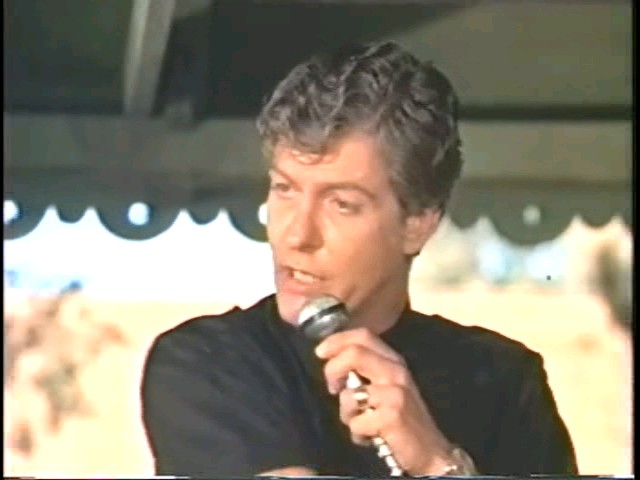
Cold Turkey (Norman Lear, 1971) One of the first movies I saw under my own power and financial resources* at the late, lamented John Danz Theatre (Rest in the "116church," for God's sake!—I wonder what they did with the dolphin sculpture in the lobby?). It's one of the clutch of semi-satirical social comedies that wasn't radical enough to offend the oldsters or attract the kids, and took on its subject in a style reminiscent of a soft-core It's a Mad, Mad, Mad, Mad World.** It also gave TV-sit-com writers a chance to stretch their writing arms with less restrictive material and work during the summer hiatus.
 
In a PR move, an exec (Bob Newhart) at the Valiant Tobacco Company pushes through a 25 million (!!) dollar incentive to any American city that can quit smoking for a month, in a deal reminiscent of the Nobel Peace Prize. For the depressed community of Eagle Rock, Iowa, that's just lost a military base and is struggling through tough economic times, it's a chance to pull itself up by its filter-tips. And so with the activism of Reverend Clayton Brooks (Dick Van Dyke), the entire town pledges to give up smoking...or die trying.
Low-brow Hi-jinks ensue. The national press (all in the dry forms of Bob and Ray) begin focusing on Eagle Rock, as the nervous population goes through withdrawal and panic attacks and the Valiant executive, fearing that they actually may have to pay up, travels to Iowa to try to sabotage their efforts.
There's a lot of soft-ball satire going on from director
Norman Lear (who'd go on to create "All in the Family" and a long string of shows that would require a large book-case to collect all the box-sets), and some low comedy as the Eagle Rockians begin to crack: the mayor's wife (Jean Stapleton) eats pickles (although she calls them "gherkins" ...because it's funnier) to fight the cravings, the town-surgeon (Barnard Hughes) who depended on a relaxing smoke to calm his nerves before surgery is losing his patients, the Reverend turns to the evils of intercourse, of course, (should we call that "taking communion?") and, in the most common sight-gag in the film, any stray animal is kicked and sent flying through the air. It's a sure laugh, but some of the kicks are just brutal.
***
It's a nail-biter for audiences and towns-people alike as the month-clock counts down, but rest assured it ends quite ironically, with some nice cutting jabs at then-President Richard Nixon.
 
It also boasted the first music score by Randy Newman (years and years before The Natural and Pixar) who wrote a pleasant soundtrack and a positively mordant theme song "He gives us all His love," that left audiences walking out of the theater, perplexed.

* Come to think of it, the first movie I saw without parent, guardian or hand-out was probably On Her Majesty's Secret Service, the not-so-lucky double-o-seventh in the "official" James Bond series and the first not to star Sean Connery. The vacancy was temporarily filled—like wood-glue—with the unfortunate George Lazenby. They say that the first "007" actor you see becomes your favorite. I was fortunate enough to start with Lazenby and remain objective!
 
** Cold Turkey was on a double bill with a 1969 comedy called Viva Max directed by Dick Van Dyke Show director Jerry Paris (he also played the Petries' next-door neighbor...Jerry). It starred Peter Ustinov as a Mexican General determined to re-take the Alamo, despite U.S. resistance. Hilarity ensues. It was based on a novel by Jim Lehrer—yes, the anchorman of PBS's "The NewsHour," and frequent presidential debate moderator.
 
***To this day, I find the fast yelp of a dog or a spitting squeal from a cat a sure laugh-getter whenever I do sound design work—PETA be damned. 
 
2023 Update: Yeah, I don't do that anymore. That was a past life. Things are a lot quieter now.

Thursday, May 5, 2022

The Unbearable Weight of Massive Talent

The Insufferable Height of Perpetual Narcissism
or 
Putting the "Meh" Back in "Meta"
 
I like "meta" in movies, when the Hollywood fantasy machine suddenly turns transparent, and something walks into frame that reminds you that "it's just a movie." The painted back-drop rolls out of frame to show the less-than-inspiring back-lot and makes the point that everything is calculated to make you believe in the situation portrayed and not that everything is "designed" to reinforce the falsehood. "Pay no attention to the man behind the curtain" shouts Oz. Or the gaffer. Or the boom-operator. Or the perpetual green-screen. We want you to see what we want you to see. 
 
As Johnny Carson once joked "I can't believe 'Survivor' because I know that just off-camera there's a camera-grip eating a cruller."
 
But, it's a nice little joke to sometimes see the cruller. To see reality sneak in and wink. Like all the celebrity cameos in The Player. Like Julia Roberts (playing Tess Ocean in Oceans Twelve) trying to pretend to be movie-star Julia Roberts to pull off a scam (until Bruce Willis shows up and wonders why she can't remember their kids' play-dates).* Or when John Malkovich plays himself—or an actor named John Malkovich—in Being John Malkovich. Or, as in another Charlie Kaufman-penned screenplay, Adaptation., which is about the struggles of a screenplay-writer trying to write an "unfilmable" movie. Which starred Nicolas Cage.
Tom Gormicon's film The Unbearable Weight of Massive Talent is one shallow dive into the madness of the "meta"-verse while being a love-letter to the star appeal of Nicolas Cage, its star. The film is plastered and puttied with references and clips of past Cage films and roles as it builds up the character of Nick Cage—not Nicolas, notice—an actor of many iconic roles, beloved by a fan-base, but struggling with finding parts to pay off his massive debts, stemming from a recent (fictional, mind you) divorce.**
The problem is that "Nick"—fictional Nick—is an actor of intense sensibilities who has a tendency to go "all in" in his roles and that can be discouraging to directors who are looking for stable and not mercurial. Nick is a star ("of course, I don't have to do a 'read'") but hovering below the A-list ("Of COURSE, I'll do a 'read'!"), who has had a good run but now is in the doldrums of his career, discouraged by all the film-makers wanting "to go another direction." For a self-involved narcissist like Nick, this is a situation he cannot process and he endlessly obsesses over the unfathomable consideration that he might not be in demand. In another Cage-career reference, he debates with an Adaption.-like twin of his former self, Nicky (
Nicolas Kim Coppola, Cage's birth name), who has all the insufferable grand-standing of...young Nicolas Cage. Nicky wants Nick to remember that he's not an actor, he's a *STAR* and the id/ego clashes between the two are the best parts of the movie (and though my view of the film is marginal, kudo's to real-life actor Nicolas Cage for being so brutally satiric in doing a brilliant imitation of himself!)
With a sizable hotel bill mounting up and no prospects, he decides to take an offer from his agent, Richard Fink (
Neil Patrick Harris) to appear at a millionaire's birthday party for a sizable fee, despite his artistic ambivalence to the idea ("I'm not a trained seal!"). The millionaire is Javi Gutierrez (Pedro Pascal, at his puppy-dog best), who has made his fortune in olive oil (sounds familiar...), but under surveillance by the CIA in the form of agents Tiffany Haddish and Ike Barinholtz who suspect Javi of being a drug kingpin and the mastermind behind the kidnapping of a local politician's daughter.
Javi is, in fact, a massive fan of Cage's—maybe more so than Cage, himself) and, after some initial truculence on the actor's part, they bond over movies ("Paddington 2—it made me want to be a better man"), their mutual love for Nick Cage, and the possibility to collaborate on a screenplay. But, soon, Nick is in conflict as he's approached by the CIA agents to help their kidnapping investigation by being their inside man at Javi's compound, a task that he's thoroughly incapable of handling. No amount of "nouveau shamanic" acting can prepare him for "spy-craft, subterfuge, what-have-you."
The first blush of the movie and its premise is enjoyable, sometimes even brave, but pretty soon the movie is too meta for it's own good—especially when it starts to follow the two main characters' screenplay breakdown of "character driven opening—typical Hollywood blockbuster—we need to clear our heads and work on the third act." Boy-Howdy! That third act consists of a deliberately (but not amusingly) clumsy action chase that culminates in Cage suddenly proving competent—at gun-point—even while suffering from a vicious knife wound in his leg. What starts out as a mildly interesting little satire of narcissism and fan adulation finally succumbs to a by-the-numbers plot that would only energize a rom-com...or the vehicle for a flavor of the month comedic actor graduating from television.
Oh, the potential was there. And every once in a while there's a glimmer that either the writers or the director were waking up to the idea that this could lead up to something interesting...but the movie finally succumbs to formula and wasted potential, like an actor "settling" for a project, finally showing that it doesn't even have the courage to have anything less than an "everybody's happy" ending. Paddington 2 took more chances. You think massive talent has unbearable weight, consider that there's no heavier burden than a great potential.
One has to review the movie that's there, though, not its possibilities or its potential, so leave any worthless suggestions in the "might've been" section of the blog (there isn't one). But, one story intrigues me—that Nicolas Cage (the real one) liked the script but kept turning it down, and once he agreed, really wanted to play the "Javi" part.
 
Another reason that Nicolas Cage should keep working.

* On television, two of the best "meta" shows were "It's Gary Shandling Show" where Gary Shandling played himself in a sit-com or the blisteringly satirical high-wire act of "The Colbert Report" where Stephen Colbert played a windy blow-hard news reporter named Stephen Colbert.
 
 ** Cage in real life is in his fifth marriage. The ex-wife he's talking about in the movie is a fictional make-up artist he met while making Captain Corelli's Madolin, which is a real movie Cage made in 2001. Yeah, I know, it's confusing, but just keep in mind that the real-life Nicolas Cage is playing a fictional actor named Nick Cage, who looks, sounds and acts like Nicolas Cage and starred in all of Nicolas Cage's films. Got it?

Saturday, December 25, 2021

Don't Look Up (2021)

Deep Impact on a Shallow Planet
or
The Dinosaurs Couldn't Say 'Told Ya So..."
 
A recent article in The Atlantic says that there are 21 million Americans who have no relationship to reality, wanting to re-instate Donald Trump as President of the United States, citing sheisters, Alzheimic Air Force Generals, and bad math to support their contentions. There's a bunch of Gen Z's who think birds are fake (they should get together with the folks who worry about chem-trails—there must be a connection because they're both in the AIR!) And we've always had Flat-Earthers because they've never been in a plane and figured out why the shortest distance to get to anywhere is not over the pole.
 
But, ask a farmer about global warming and they get serious.  Or a gardener. They've seen the time-shifts. They've seen annuals sprout too early. Crops lose their "window" and you compensate by shifting the planting earlier, risking the prospect of freezing. They know. You can't count on the Earth anymore. You can't count on anything...except maybe on one hand the number of friends you have that actually might be sane.
 
It used to be "If You Don't Stand For Something, You'll Fall for Anything." Now, with the internet the harder you stand, you'll fall even harder.
So, with that little sanctimony out of the way...what's the scoop on Don't Look Up, Adam McKay's look at "problem-solving" in a modern "connected" world?
 
McKay's conceit is to look at the "climate change" debate in a metaphorical way—what if we knew an "extinction-level" sized body was going to hit the Earth and we couldn't depend on our leaders, political or business, to save us for any reason?
Michigan State doctoral candidate Kate Dibiasky (Jennifer Lawrence) is spending a quiet night at an observatory studying trace gasses in dead galaxies for Astronomy Professor Dr. Randall Mindy (Leonardo DiCaprio) when she sees something weird on the screen. It's a comet...and it's moving. Mindy is called and he and his grad students celebrate what will be the Dibiasky Comet, and start working the orbital path...when Mindy starts to get nervous and tells all the other students to go home. Except for Kate. She sees what he saw: that the comet is heading for Earth. It's 5-6 km long and it will hit Earth in 6 months and 14 days. Call it 26 weeks.
They call NASA, who conference calls them in with Dr. Teddy Oglethorpe (
Rob Morgan) of the Planetary Defense Coordination Office. The link says it's real. And shit just got real; Oglethorpe mutters "that's a big boy" and then goes quiet when he realizes it signals "an extinction-level event." And while NASA advises caution, Oglethorpe orders a plane to bring Mindy and Dibiasky to the White House to tell the President. Dibiasky sees the Oval Office through an open door and grabs Mindy: "Are we really about to tell the President of the United States that we have just over six months until humankind—basically every species—is completely extinct?" Getting a shaky affirmative, she promptly throws up in an executive waste-basket. 
They're kept waiting for seven hours because the Executive Branch is in crisis mode: their nominee for Supreme Court justice has been revealed to be a pervert. Coming back the next day, they're given 20 minutes to explain what's going on and it doesn't go well: Mindy is nervously hyperventilating and that's off-putting to the coke-head Chief of Staff (
Jonah Hill), who got the job because he's the President's son. The President (Meryl Streep) is a hot mess, unable to focus on the potential disaster for need of a smoke, and saying that the timing of this "is atrocious" (mid-terms). She cuts to the chase: "What's the 'ask' here?" "Save us" is the reply. The decision is made to have "her people" look into it and "Sit tight and assess."
The three scientists can't believe it—they only have six months—so, they decide to take it to the press, the Washington Herald, who sets up a segment on it at the end of "The Daily Rip" (hosted by shiny anchors played by
Tyler Perry and Cate Blanchett) after a segment on the disasterous Supreme Court pick and then on the break-up of two "important" pop stars (Ariana Grande and Scott Mescudi). Warned that they don't have "media training" Dibiasky and Mindy have trouble negotiating the happy banter of the hosts until Dibiasky cracks and melts down on-camera: "Are we not being clear? Maybe the destruction of the entire planet isn't supposed to be FUN! Maybe it's supposed to be terrifying." The hosts are affronted. That's just bad form. And bad television. Dibiasky becomes a snarky meme, and interest in the Herald's story on the internet drops like a comet from the sky. So, they stop covering it.
But, because they've gone on national TV with national secrets Dibiasky and Mindy are arrested by the FBI, and the White House has to scramble. President Orlean goes on television in an elaborately staged event on a naval vessel to announce an emergency spending bill to launch a space mission to try and blow up the comet—a space mission that is manned by a single astronaut (
Ron Perlman) because "Washington needs a hero." All well and good until a cell-phone/tech pioneer, Peter Isherwell (Mark Rylance), is told by his team that the comet is a source of Earth-depleted minerals that are critical for making cell-phones. The mission is scrubbed—he's a big donor to the President's campaign—and another mission is planned to break up the comet and have it's pieces fall into the Pacific so they can be recovered and resourced.
One sees the point: nobody is going to do anything about it while there's time enough for people to figure out a way to make money from it, because that's the only "killing" they're concerned about. If there was a way to take carbon out of the atmosphere that wasn't deemed fiscally expensive and would make a fortune, we'd be worrying, instead, that there was too much ice at the poles, rather than selling our waterfront property. Don't Look Up merely converts that to the disaster scenario of Armageddon—at times the movie looks like Michael Bay's "this would look great in a car commercial" style of film-making—or Deep Impact.
The satire veers all over the place, sometimes sharp (of course people wouldn't believe it until they saw it with their own eyes, and, of course, a television chat show would cock up such news and, of course, a screaming fit on-air is going to be dismissed and the stuff of internet jokes) and heavy-handed (the political stuff is baldly aimed at the last administration, with the difference being that the Orlean team look a bit more competent and decisive). It falls somewhere between Hitchhiker's Guide to the Galaxy smart and Tropic Thunder dumb without ever achieving Dr. Strangelove brilliance. One grimly concedes McKay's aiming for the fences but he sometimes gets distracted by his own gee-wizardry and sarcastic weltschmerz to score a home-run.
Some of it is performance issues: Perry and Blanchett are rather one-note, but that seems appropriate for chat hosts. Hill's performance is as obnoxious as it's supposed to be, but Streep wears her tweet-hurt a bit too far, although it is reminiscent of Sarah Palin-subtlety. DiCaprio tries to achieve his Wolf of Wall Street comedic heights at times and falls short, but impresses in his dramatic scenes. Lawrence is terrific as the audience stand-in for expressing incomprehension and Rob Morgan stays out of comedy territory completely and frequently becomes a life-raft of reason. Best of all is Mark Rylance, who makes his tech entrepreneur suggestive but not an imitation, with just the right touch of Asperger's, child-like wonder, and child-like malice.
The reviews for Don't Look Up have been horrible, accusing McKay of condescension and being supercilious—social critics usually are—and there's a whiff of that here. But, there's also an earnestness that his heart is in the right place, if slightly broken, railing like a mad prophet to an ignoring, apathetic crowd. Despite the brickbats, I found myself enjoying it much more than I suspected I would, recognizing its weaknesses but appreciating the strengths.  
Now, about the message. Maybe by clothing "climate change" in a more direct disaster scenario is too subtle. There is a scene in the last season of "The Newsroom" ("Main Justice" Season 3 Episode 3) where there's an interview with a scientist from the EPA who has been prevented from issuing an alarming report about the environment (involving CO2 levels measured in Hawaii), and when asked to sum up the findings replies "a person has already been born who will die due to catastrophic failure of the planet" The anchor is taken aback and tries to walk it back to a less alarming conclusion, "Let's see if we can find a better spin...people are starting their weekends."
 
There isn't one. The only counter-argument is denial and that's just deflection and a stall to action. And we're doomed anyway. It's funny and it's a gut-punch. A sick joke that punches right in the nose.
 
On the much grander scale of things—pale blue dot-wise—cosmic catastrophes happen all the time—we just haven't heard about it since we haven't gotten television from there (yet)...because it's a messy Universe, despite all the space. We postulate the supernovas, the gravity collisions, but cannot grasp the implications, like imagining what happens to an ant colony when developing condo's. But, think of it in the "if Helen Keller fell down in a forest, would she make a sound" kind of way: "What if there was a cataclysmic event, and nobody did anything about it?"
 
The cosmic punch-line is "They deserved their fate."


Tuesday, January 19, 2021

To Die For (1995)

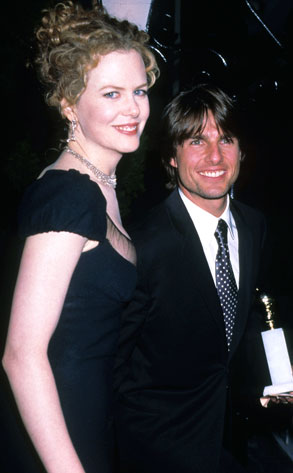
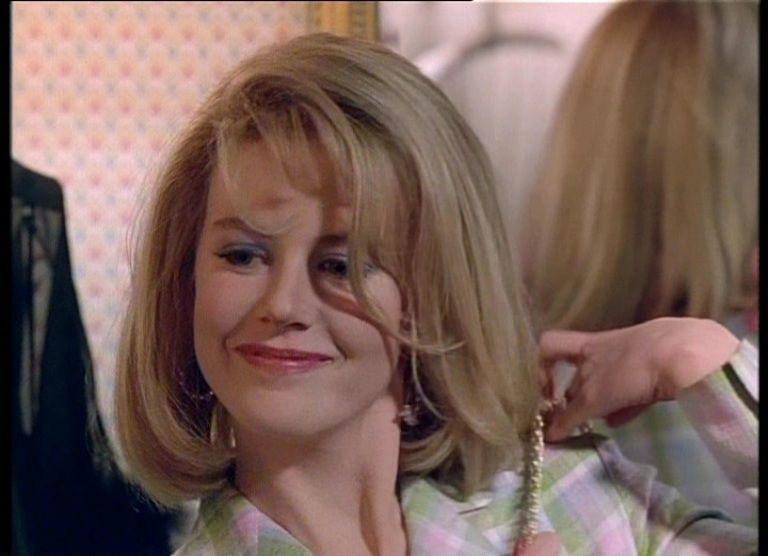
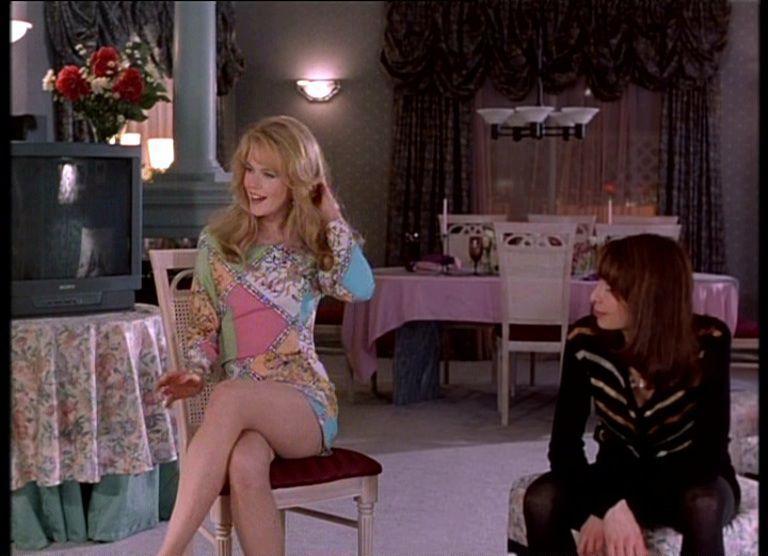
To Die For (Gus Van Sant, 1995) Nicole Kidman plays Suzanne Stone, a local tv weather-girl with a particularly aggressive addiction to celebrity. Her new-found fame conflicts with her ordinary home-life and her marriage to a mechanic, despite the financial stability it gives her. So she plots to murder her husband (Matt Dillon), as his lack of status might hold back her fortunes. She recruits three teenage misfits (Joaquin Phoenix, Casey Affleck, Alison Folland), whom she's met while doing a documentary called "Teens Speak Out", to carry out the homicide. But, when her in-law's attempt to pin the murder on her, she turns on the kids with blackmail and the local police with entrapment. Despite being found not guilty, she's only too eager to keep building her career. After all, there's no such thing as bad publicity. To Die For is a black comedy mixed with film-noir (that pairing almost never works as it tends to pile on the ironies) on the sociopathy of celebrity. It was written by Buck Henry (based on a novel by Joyce Maynard, which in turn was inspired by the Pamela Smart case) and directed by Gus Van Sant

"You're not anybody in America unless you're on TV."

Those who had seen her in BMX Bandits, "Bangkok Hilton," and Dead Calm knew that Kidman was more than "Mrs. Tom Cruise," but it wasn't until To Die For that she emerged from her superstar husband's shadow and began creating a separate career. An arch performance just shy of camp, it was the first of the actress' many forays into aberrant personalities that have subsequently dominated her career, and, for some, has proved troubling to her audience base. On the other hand, she's become one of those actors who have defied "typing"—one never knows what Kidman one is going to get.  And, as time has moved on and the bar for celebrity has sunk as low as a snake's belly, the film looks positively prescient.
It certainly was indicative of the careers of Phoenix (who had previously been billed as "Leaf" Phoenix) and Affleck, both of whom have gone to Oscar-winning careers. And Kidman—who would win her Oscar seven years after this movie—etches an indelible portrait of a femme fatale, hot-blooded in her manipulation and cold-blooded in her abandonment. Making an audition tape, Kidman's Stone looks directly into the camera with knowing seductiveness and invites the watcher in on her little dark secrets and fervent desires for TV work.
The wiliness of the actress playing the character is matched by the character's own wickedness and the two seem to fuse. Reason enough to watch the film, but
Kidman is nearly matched in ferocity by the fine Illeana Douglas, as the Dillon character's sister, who is equally capable of killing for love. It's a movie that will keep you unnerved until the final black comic cold-hearted image.

Friday, December 13, 2019

Jojo Rabbit

Dann Sind Wir Helden
or
"Gesundheit" (Definitely Not a Good Time to Be a Nazi...)

Ah, satire.

You can't win with it. There are going to be people who say it goes too far and there are going to be people who say it trivializes horror and injustice and there are going to be people who say it doesn't go far enough.

Which means that it's pissing people off and that's just right. It's doing its job. Autocrats of all stripes do not like satire. And they won't like New Zealand director Taika Waititi's Jojo Rabbit, either. 

That's alright. Autocrats don't deserve to have a good time.

Waititi might be new to some, his most popular movie being Thor: Ragnarok, which brought a breath of fresh jovial air to the most atrophied of the Marvel Universe series, but his earlier works, Boy, What We Do in the Shadows, and Hunt for the Wilderpeople showed an anarchic sense of comedy and film-making that was fun, heart-warming, and refreshing. He makes darn fine films, even if the silliness in them might discourage one from thinking so.

But, Waititi's free-form adaptation of the first half of New Zealand author Christine Leunens' "Caging Skies" is one of those approaches where to go all out silly might be the antidote to a story that is, on the face of it, about cruelty, inhumanity, and the depths of evil that human beings and a complacent society can sink into.
"I am Jojo Betzler. I am 10 years old...today, I will become a man." That traditional line of a Bar Mitzvah is turned on its head, as Johannes (Roman Griffin Davis) is dressing for his first day on his way to becoming a man, thanks to a camp to train Hitler Youth, run by Captain Klenzendorf (Sam Rockwell). It is a dream of the scrawny young Jojo to do well at the camp for his ultimate dream is to be made part of the honorary guard to his hero, Adolph Hitler (Taika Waititi) himself. It should be a shoe-in, as the Fuehrer is already an imaginary friend of Jojo ("Heil me, man!") appearing in times of confusion and distress to provide simple advice that a 10 year old boy might understand ("People used to say a lot of nasty things about me: 'Oh, this guy's a lunatic' 'Oh, look at that psycho, he's going to get us all killed!'").
Johannes lives with his mother, Rosie (Scarlett Johansson) who is skeptical of his devotion to Nazism while maintaining a sunny disposition, despite her husband being missing from the household. Johannes thinks he's fighting for the Nazis in Africa, but his Mom remains mum.
The Hitlerjugend Camp is run—if that is the term—by Klenzendorf, a hard-drinking, not very competent soldier who has clearly been given an assignment he can't screw up, let alone harm the floundering war effort. He barks the rhetoric with a slightly cynical weariness, wears the uniform not too nattily (while secretly designing something a little flashier if highly unregulation), knows he's been benched from anything important, but is a good little soldier who does his duty ("Even though we're losing the war, everything seems to be going fine...").
Jojo does not have an easy time with the prospective Hitlerjugend. He can salute precisely, has a force-fed hatred of the Jews (of whom he knows nothing about and who take on mythic properties), but even the worst of best intentions does not necessarily translate to actions. When he is picked out to kill a rabbit by strangulation, he can't do it, and is mocked mercilessly by the trainers and his fellow acolytes, with a new name pointing out his weakness—"Jojo Rabbit".
Jojo runs away to the woods is consoled by his pal, Adolph. So much so, that, his brio renewed, he charges back to the camp in the middle of a grenade training class...

...and manages to blow himself up.
Needless to say, grenade training is suspended for the day and Klenzendorf is reprimanded and given a dressing-down by Jojo's mother, who puts Jojo's further training in Klenzendorf's hands, but, this time, but now restricted to the Hitler Youth headquarters.
Jojo spends some time in hospital and is distressed that his face is scarred up, making him look less Aryan and therefore "monstrous," making him feel further ostracized from his Nazi countrymen.
Jojo learns, though, to be independent because his mother is spending less time at home (she is secretly working for the resistance). But, he's also home alone more than usual. He begins to hear odd noises in the house, coming from within the house. A furtive investigation finds that, hidden in a storage section of his late sister's room, is a teen-aged girl named Elsa (Thomasin McKenzie). Jojo takes an immediate dislike to her because 1) he's scared of her, 2) she's a girl, and 3) she's in his house and 4) she's Jewish.
Elsa takes advantage of his confused terror, keeping him quiet about her presence—he and his Mom will be arrested, too, of course, for hiding her. So, an uneasy pact must be made between Jojo, Nazi-in-training, and "a Jew"—who has a name, a personality, and a vague resemblance to his sister. In the waning days of the war, with everything "going fine," Jojo must deal with his own "otherness" and be in close proximity to the most wanted "other" in his blighted country.
Heavy stuff. And the monstrousness and tragedy that is the yin and yang of the Nazi machinery and those who are caught up in it is not given short shrift in Jojo Rabbit. Terrible things happen and the pain and ache and villainy of it is made apparent and communicated appropriately.

But, despite this, the movie, generally, is funny as Hell.
Partially, it's because Jojo is a kid and a mass of misinformation, schadenfreude, and the inability to live up to the rhetoric. Combine that with the lampooning of Nazi doctrine where there is no room for doubt despite ample evidence to the contrary surrounding you and you have, not so much a comedy of errors as a comedy of dogma.
And therein the front of satire lies. Everything you know is wrong, yet you march on in the same goose-step anyway even if it's through a mine-field of your own making. Fortunately, the movie spends a great deal of time mocking the tenets of Nazism leading to such observations as Jojo's friend telling him: "It's not a good time to be a Nazi. Our only friends are the Japanese—and just between you and me, they don't look very Aryan." It may be a little UN-PC, but it's to the point. If it had been merely this, it would not be very successful. But, as it involves a change of heart and a valuable learning experience on the part of the protagonist, it's actually valuable and sweet.

And Hitler has never been funnier.