Showing posts with label Adam McKay. Show all posts

Saturday, January 1, 2022

The Other Guys

Written at the time of the film's release...

Saturday is traditionally "Take Out the Trash" Day. (Remember when Adam McKay made comedies?)

"Did That Go the Way You Thought It Was Gonna Go?""Nope."
or 
"Anything You Say Can and Will Be Used...(what's the rest?)" "As a Flotation Device..."

More comedy, and this one's even very funny for its first half, but then, once one scene goes sideways and doesn't work, the whole thing falls apart like a hostage situation gone wrong.  And the audience is the hostage, waiting for it to kick back in...but it never does.

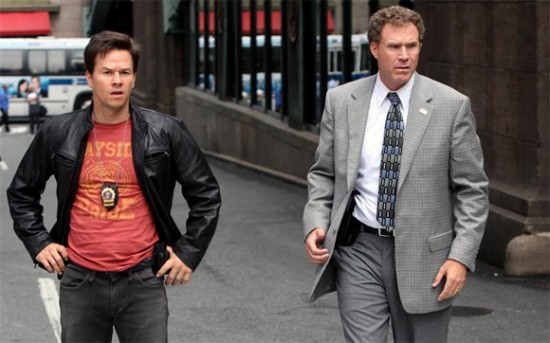
Allen Gamble (Will Ferrell) and Terry Hoitz (Mark Wahlberg) are two New York City detectives working in the considerable shadow of detectives Danson and Highsmith (Dwayne Johnson and Samuel L. Jackson in nice parodies of their "serious" screen-work), a team of glory-hounds for whom property damage is all in a day's conflagration, but who refuse to do the paperwork.  Gamble is self-described as "an accountant for law-and-order," and Hoitz is riding a desk-job after a shooting that goes wrong.* Gamble loves the mundane filing, but his partner Hoitz, itches to be "in the field." "I'm a peacock!" he is fond of remonstrating. "You've got to let me fly!" At which point, he is reminded that peacocks do not fly.** 
Unperturbed, and when advancement in the ranks becomes possible, the two glom onto a white-collar crime that Gamble has discovered that has connections to a series of high-profile robberies. 
The mis-matched pair
(Hoitz is volatile, Gamble is eerily up-beat) are completely street-dumb and their investigation is constantly being dis-railed (sometimes literally) by distractions and their lack of ability to resist the charms of their high-rolling suspect's lifestyle. Their increasing frustration with the case and each other (as well as Hoitz's relationship problems, in contrast with the milquetoast Gamble's inexplicable attractiveness to women) is fertile ground for situations that explode in conflict.
It works and works gang-busters for the first hour. The combination of loose script and improvisation is beefed up by all the actors (especially Ferrell and
Michael Keaton
, who does quick-silver wonders with the cliche "harried Captain" role), especially when the story is building and we're getting to know the characters. The "left-field" surprises come fast and loose, and the timing by the actors (and the editing) is crack. One senses trouble early on when Anne Heche (uncredited, by the way) is given a thankless role in which she's really not allowed to do anything funny...or much of anything. But Ferrell, for the most part, is at the top of his game playing the contrary stiff in a room full of crazies, and Wahlberg who, depending on the material, can be brilliant, plays pathetic frustration hilariously.  Even Eva Mendes acquits herself well in the mix, milking laughs out of the role of Gamble's absurdly perfect wife—Gamble's sexual magnetism makes for a great series of running gags throughout the movie.
But, right at the point where Bob, the union rep, gets dissed and leaves the room, the entire movie goes flat.*** Maybe the improv was getting too expensive and they decided to "coast." Maybe the assurance of an "action-filled" finale made them scrimp on the script.  Maybe the irrelevant story-line getting in the way changed the tone. Maybe everyone got tired. But, for whatever reason, The Other Guys is two movies..."Good Cop" comedy and "Bad Cop" comedy.
Interestingly, the most useful part of the movie is the end credits where the increasing disparity between the incomes of the top 1% earners and the rest of us is presented in chilling graphic detail.
"Wilhelm" Alert @ 1:30
 
* Hint:  He's called "The Yankee Clipper" around the squad-room.

** What can I say?  It's New York, and the Bronx Zoo is the closest they come to a peacock.  Peacocks do indeed fly, but it's a brief, clumsy, scary thing to watch—which I think was the point of bringing it up in the movie.

*** It's funny I can pinpoint it, because that's where the movie became NOT funny, and I thought to myself..."Well, THAT didn't work..." and watched to my amazement as very little worked after.

Saturday, December 25, 2021

Don't Look Up (2021)

Deep Impact on a Shallow Planet
or
The Dinosaurs Couldn't Say 'Told Ya So..."
 
A recent article in The Atlantic says that there are 21 million Americans who have no relationship to reality, wanting to re-instate Donald Trump as President of the United States, citing sheisters, Alzheimic Air Force Generals, and bad math to support their contentions. There's a bunch of Gen Z's who think birds are fake (they should get together with the folks who worry about chem-trails—there must be a connection because they're both in the AIR!) And we've always had Flat-Earthers because they've never been in a plane and figured out why the shortest distance to get to anywhere is not over the pole.
 
But, ask a farmer about global warming and they get serious.  Or a gardener. They've seen the time-shifts. They've seen annuals sprout too early. Crops lose their "window" and you compensate by shifting the planting earlier, risking the prospect of freezing. They know. You can't count on the Earth anymore. You can't count on anything...except maybe on one hand the number of friends you have that actually might be sane.
 
It used to be "If You Don't Stand For Something, You'll Fall for Anything." Now, with the internet the harder you stand, you'll fall even harder.
So, with that little sanctimony out of the way...what's the scoop on Don't Look Up, Adam McKay's look at "problem-solving" in a modern "connected" world?
 
McKay's conceit is to look at the "climate change" debate in a metaphorical way—what if we knew an "extinction-level" sized body was going to hit the Earth and we couldn't depend on our leaders, political or business, to save us for any reason?
Michigan State doctoral candidate Kate Dibiasky (Jennifer Lawrence) is spending a quiet night at an observatory studying trace gasses in dead galaxies for Astronomy Professor Dr. Randall Mindy (Leonardo DiCaprio) when she sees something weird on the screen. It's a comet...and it's moving. Mindy is called and he and his grad students celebrate what will be the Dibiasky Comet, and start working the orbital path...when Mindy starts to get nervous and tells all the other students to go home. Except for Kate. She sees what he saw: that the comet is heading for Earth. It's 5-6 km long and it will hit Earth in 6 months and 14 days. Call it 26 weeks.
They call NASA, who conference calls them in with Dr. Teddy Oglethorpe (
Rob Morgan) of the Planetary Defense Coordination Office. The link says it's real. And shit just got real; Oglethorpe mutters "that's a big boy" and then goes quiet when he realizes it signals "an extinction-level event." And while NASA advises caution, Oglethorpe orders a plane to bring Mindy and Dibiasky to the White House to tell the President. Dibiasky sees the Oval Office through an open door and grabs Mindy: "Are we really about to tell the President of the United States that we have just over six months until humankind—basically every species—is completely extinct?" Getting a shaky affirmative, she promptly throws up in an executive waste-basket. 
They're kept waiting for seven hours because the Executive Branch is in crisis mode: their nominee for Supreme Court justice has been revealed to be a pervert. Coming back the next day, they're given 20 minutes to explain what's going on and it doesn't go well: Mindy is nervously hyperventilating and that's off-putting to the coke-head Chief of Staff (
Jonah Hill), who got the job because he's the President's son. The President (Meryl Streep) is a hot mess, unable to focus on the potential disaster for need of a smoke, and saying that the timing of this "is atrocious" (mid-terms). She cuts to the chase: "What's the 'ask' here?" "Save us" is the reply. The decision is made to have "her people" look into it and "Sit tight and assess."
The three scientists can't believe it—they only have six months—so, they decide to take it to the press, the Washington Herald, who sets up a segment on it at the end of "The Daily Rip" (hosted by shiny anchors played by
Tyler Perry and Cate Blanchett) after a segment on the disasterous Supreme Court pick and then on the break-up of two "important" pop stars (Ariana Grande and Scott Mescudi). Warned that they don't have "media training" Dibiasky and Mindy have trouble negotiating the happy banter of the hosts until Dibiasky cracks and melts down on-camera: "Are we not being clear? Maybe the destruction of the entire planet isn't supposed to be FUN! Maybe it's supposed to be terrifying." The hosts are affronted. That's just bad form. And bad television. Dibiasky becomes a snarky meme, and interest in the Herald's story on the internet drops like a comet from the sky. So, they stop covering it.
But, because they've gone on national TV with national secrets Dibiasky and Mindy are arrested by the FBI, and the White House has to scramble. President Orlean goes on television in an elaborately staged event on a naval vessel to announce an emergency spending bill to launch a space mission to try and blow up the comet—a space mission that is manned by a single astronaut (
Ron Perlman) because "Washington needs a hero." All well and good until a cell-phone/tech pioneer, Peter Isherwell (Mark Rylance), is told by his team that the comet is a source of Earth-depleted minerals that are critical for making cell-phones. The mission is scrubbed—he's a big donor to the President's campaign—and another mission is planned to break up the comet and have it's pieces fall into the Pacific so they can be recovered and resourced.
One sees the point: nobody is going to do anything about it while there's time enough for people to figure out a way to make money from it, because that's the only "killing" they're concerned about. If there was a way to take carbon out of the atmosphere that wasn't deemed fiscally expensive and would make a fortune, we'd be worrying, instead, that there was too much ice at the poles, rather than selling our waterfront property. Don't Look Up merely converts that to the disaster scenario of Armageddon—at times the movie looks like Michael Bay's "this would look great in a car commercial" style of film-making—or Deep Impact.
The satire veers all over the place, sometimes sharp (of course people wouldn't believe it until they saw it with their own eyes, and, of course, a television chat show would cock up such news and, of course, a screaming fit on-air is going to be dismissed and the stuff of internet jokes) and heavy-handed (the political stuff is baldly aimed at the last administration, with the difference being that the Orlean team look a bit more competent and decisive). It falls somewhere between Hitchhiker's Guide to the Galaxy smart and Tropic Thunder dumb without ever achieving Dr. Strangelove brilliance. One grimly concedes McKay's aiming for the fences but he sometimes gets distracted by his own gee-wizardry and sarcastic weltschmerz to score a home-run.
Some of it is performance issues: Perry and Blanchett are rather one-note, but that seems appropriate for chat hosts. Hill's performance is as obnoxious as it's supposed to be, but Streep wears her tweet-hurt a bit too far, although it is reminiscent of Sarah Palin-subtlety. DiCaprio tries to achieve his Wolf of Wall Street comedic heights at times and falls short, but impresses in his dramatic scenes. Lawrence is terrific as the audience stand-in for expressing incomprehension and Rob Morgan stays out of comedy territory completely and frequently becomes a life-raft of reason. Best of all is Mark Rylance, who makes his tech entrepreneur suggestive but not an imitation, with just the right touch of Asperger's, child-like wonder, and child-like malice.
The reviews for Don't Look Up have been horrible, accusing McKay of condescension and being supercilious—social critics usually are—and there's a whiff of that here. But, there's also an earnestness that his heart is in the right place, if slightly broken, railing like a mad prophet to an ignoring, apathetic crowd. Despite the brickbats, I found myself enjoying it much more than I suspected I would, recognizing its weaknesses but appreciating the strengths.  
Now, about the message. Maybe by clothing "climate change" in a more direct disaster scenario is too subtle. There is a scene in the last season of "The Newsroom" ("Main Justice" Season 3 Episode 3) where there's an interview with a scientist from the EPA who has been prevented from issuing an alarming report about the environment (involving CO2 levels measured in Hawaii), and when asked to sum up the findings replies "a person has already been born who will die due to catastrophic failure of the planet" The anchor is taken aback and tries to walk it back to a less alarming conclusion, "Let's see if we can find a better spin...people are starting their weekends."
 
There isn't one. The only counter-argument is denial and that's just deflection and a stall to action. And we're doomed anyway. It's funny and it's a gut-punch. A sick joke that punches right in the nose.
 
On the much grander scale of things—pale blue dot-wise—cosmic catastrophes happen all the time—we just haven't heard about it since we haven't gotten television from there (yet)...because it's a messy Universe, despite all the space. We postulate the supernovas, the gravity collisions, but cannot grasp the implications, like imagining what happens to an ant colony when developing condo's. But, think of it in the "if Helen Keller fell down in a forest, would she make a sound" kind of way: "What if there was a cataclysmic event, and nobody did anything about it?"
 
The cosmic punch-line is "They deserved their fate."


Friday, January 11, 2019

Vice (2018)

Hook, Line, and Sinker
or
What Becomes of the Broken Hearted...

"A year ago, my approval rating was in the 30's, my nominee for the Supreme Court had just withdrawn, and my Vice-President had just shot someone. Ah, those were the good old days..."
President George W. Bush at the 2007 Broadcasters Annual Dinner

"Never apologize. It's a sign of weakness."
Capt. Nathan Brittle She Wore a Yellow Ribbon

"Demand me nothing. What you know, you know. From this time forth, I will never speak word."
The Tragedy of Othello Act 5, Scene 2

"There comes a time when deceit and defiance must be seen for what they are. At that point, a gathering danger must be directly confronted. At that point, we must show that beyond our resolutions are actual resolve."
Richard Bruce Cheney

Once at work there was this guy that I just loathed. He didn't work much or very hard and would rather talk and boast than actually do anything resembling what he was being paid to do. His output wasn't that good, of course. So, to beef up his paycheck he started doing overtime, which meant that he was at work more and our schedules would overlap more. I didn't like that. I liked it when he wasn't there, causing issues.

The one day I could count on was Saturday. He didn't want to work Saturdays and would whine if anybody suggested it. That gave me one blissful day of work when I didn't have to deal with his shit. Then, one Friday he announced that he was going to work overtime on Saturday. I looked enthused. "Oh, you're going to love it! It's work-work-work, nose to the grindstone, and the supervisors really push us hard." He curled his lip as if I suggested he not take my last onion-ring. "That doesn't sound like any fun," he grumbled. And true to his goals, he didn't show up that Saturday.

The reactions I got from co-workers (of a similar opinion about this guy) was raised eyebrows, wide eyes, and a conspiratorial silence. They couldn't believe that I would turn his deficiencies and tendencies to my advantage and manipulate them into his deciding to not show up. Once he left the room, I took great pleasure in saying "I...am an evil son-of-a-bitch."
It's in moments like these that I know what it must be like to be former Vice-President Richard ("Dick" to his friends and "dick" to his enemies) Cheney, the very definition of "shadow government" during the George W. Bush Administration. Cheney would disappear for days, incognito, while W. stayed out in the forefront acting presidential, while Cheney would be in one of several offices he had squirreled around Washington doing God Knows What out of the scrutiny of the public eye...or the President's.

One of the weird by-products of the current Trump Administration is that, in comparison, the George W. Bush tenure looks pretty good—just as George H.W. Bush's Administration looked better in comparison to his son's. The things is, they weren't good by any stretch of the imagination. They're just better than the shit-storm we're going through now. 
So, it's probably good that Adam McKay made Vice at this time, just to slap us around a bit in case we get too sentimental about water-boarding and freelance merc's as a business model. And slap around he does, sparing nobody, not even the shallowness of the American voter, in his study of Richard Cheney, a political operative who maneuvered himself into power whenever the Republicans were in the White House and served as a consultant to oil executives when they were not. 
After an anonymous quote ("Beware the quiet man..."), McKay starts his bio-pic/screed with the 9-11 attacks, when Cheney (say what you will, but this is astonishing work by Christian Bale) is whisked away by Secret Service agents to a secure command bunker, along with other key White House advisers—like Condoleeza Rice (played by LisaGay Hamilton) and wife Lynne (Amy Adams) who has demanded of the Secret Service that she be taken there from a beauty salon—cloistered in the key moments of the planes hitting the Twin Towers and the Pentagon. POTUS Bush (Sam Rockwell—great work here) is in the air and (I know this from another source) frustrated by the spotty communications achievable on Air Force One in the midst of the crisis. At the Pentagon, Donald Rumsfeld (Steve Carell) takes an order from Cheney that fighter jets are to be scrambled to shoot down any civilian aircraft still in the air. Rumsfeld questions whether it's approved by the President and Cheney, not having checked, says "Yes," puts down the phone and contemplates the question—as Michael Moore put it in Fahrenheit 9-11—"which of our friends screwed us."
There's a telling moment early one when a young Dick Cheney is working as a lineman in Wyoming, when a fellow worker falls and breaks his leg, badly. The guy is in obvious pain, going into shock, and a bunch of the workers gather around to observe. A foreman comes by and tells everybody to get back to work. Cheney hesitates and has to be told again to get back to work. No "we'll call an ambulance" or "the situation is handled" just "get back to work" and Cheney turns and does what he's told.
As a young man in Wyoming, wife Lynne is getting tough. She's had to bail Dick out of jail twice for DUI's and she's had enough. She's seen enough domestic abuse in her childhood that she's not going to go down that path in her own family. "This is not the man I intended to marry" she yells and a cowed Cheney vows he'll do better and change, but, as he makes his way to a government internship program, he develops another addiction to replace the alcohol, one that Lynne heartily approves of—power.
At a meet and greet, he sees a cocky, youngish up-and-coming functionary named Donald Rumsfeld, quite apart from the old men making up the majority of the speakers, and Rumsfeld spells out what it will take to succeed in three simple rules: 1) You don't go blabbing—keep your mouth shut; 2) do as you're told; 3) be loyal. Oh, and "if the wife calls, they're in a meeting." With those edicts, the interns become indoctrinated into the Old Boys' School of self-perpetuating power. Before he's done, Cheney will violate all of those rules.
McKay's film then outlines Cheney's career—first as Rumsfeld's assistant during the Nixon Administration, then gaining more access with Ford by circumventing the influence of Henry Kissinger and becoming Chief of Staff. When carter gained the White House over Ford, Cheney ran for Wyoming House seat, which he won, giving it up to be George H.W. Bush Secretary of Defense, then during the Clinton years, serving as CEO for Halliburton.  When Bush's son, George W. ran for President, he wanted Cheney to be his Vice-President, but Cheney played shy until he could leverage more power concessions from the Veep job from the less experienced Bush by couching them as "mundane." Dull they may be, but they gained him access to in-roads of government to conduct his own form of cronyism and punishment.
McKay, who started as a writer—for awhile on Saturday Night Live—and as director of the Anchorman films and Talledega Nights, then upped his game on the impressive distillation of Michael Short's book The Big Short. That film was such a success, McKay tries to pull the same tricks, with black-out sketches—Dick and Lynne suggest Lord and Lady MacBeth with a brief Shakespearean sequence (that does not work), or a sequence where waiter Alfred Molina discusses what choices the Bush party have in violating civilian rights after 9-11 (rather clever way to look at it), and a lovely fake-out half-way through the movie (that's hilarious).
But, the through-line with the mystery narrator named Kurt (Jesse Plemons) is distracting throughout the movie and its pay-off is a bit precious when it wants to be hard-hitting. It's emblematic of an intention to be tough and cynical with a "just kidding" approach that doesn't do any help to the cause than be momentarily entertaining, which, along with the thrumming of a vague "fisherman" metaphor that McKay keeps pushing, keeps the film from ever seeming like more than a trifle with a sterling performance at its center.
One should stay until the end, though, because the film turns much braver in its final minutes, with a defiant Cheney breaking the fourth wall of an interview to admonish us all in the audience from being too self-satisfied and smug in our criticism, and a mid-credits sequence in which an opinion focus group ("What DO we believe?") falls apart into fractious chaos about...the movie itself, then throws out a last damning line about audience's tastes and priorities...that may be the core point of the movie all along. And its most damning one.

If it's not there to just "go out' on a laugh.

Would you buy a Used Unitary Executive Theory from this man?

Saturday, January 30, 2016

The Big Short

Betting Against the House
or
Whose Default Is It, Anyway?

Michael Lewis is the darling of the non-fiction set, as Dan Brown is for fiction. His books have a great in-depth take on interesting subjects and change perspectives in fields that have already been well-tilled. Best-sellers get noticed by the movies and his books of "Moneyball: The Art of Winning an Unfair Game" and "The Blind Side: Evolution of a Game" attracted Hollywood. The one book Lewis thought would never be turned into a movie was his "The Big Short: Inside the Doomsday Machine," because it was about economics and, more specifically, the bursting of the housing bubble and the resulting nuclear conflagration of the mortgage industry.

Now, the situation has been mined for movies before—Oliver Stone's Wall Street: Money Never Sleeps, and (more successfully) Margin Call—but, Lewis' take was a little different. It focused on the money-men who bet against the prevailing wisdom and saw the vast mortgage industry of buying mortgage after mortgage propping up the housing industry as a house of cards—there was no real money in it, merely paper, except at the tip of the iceberg. If things started to change, and if the industry didn't keep propping up its fantasy of the emperor having a nice outfit, the whole thing would collapse. All those houses had foundations of sand.
What an exciting movie that would make! Geeks looking at their computer-screens spotting trends. But, as unlikely as making a movie from Lewis' least cinematic book might be, it's even less likely that it could be made into a decent film by Adam McKay. McKay is most associated with movies starring Will Ferrell (Anchorman I and II, Step-Brothers, Talledega Nights: The Ballad of Ricky Bobby) and he created the comedy web-channel "Funny or Die!" with the comedian. Not the best record for doing a movie with this subject matter (and the distributor, Paramount, insisted that he do Anchorman II in order to off-set the predicted losses on The Big Short—it's own movie hedge-fund, a bit like life imitating art imitating life). But, sonuvagun, if McKay didn't pull the thing off, with a complex strategy that made the movie seem a lot less complex and entertaining to those wandering in off the streets looking for movie-fodder to kill a couple hours (and convince nervous movie execs that the movie, if done right, had precedent for attracting audiences).
McKay and his co-screenwriter Charles Randolph (who did something similar with the pharma-rom-com Love and Other Drugs) staged the whole thing as if it was a disconnected version of Ocean's 11 (one of the financiers of The Big Short is Plan B, Brad Pitt's production company), then top-loaded it with versatile performers who could do both drama and comedy—Steve Carell, Christian Bale, Pitt, Ryan Gosling—as point-men in the parallel stories of the only semi-affiliated co-conspirators.
Bale's Burry feigns indifference when launching his credit default scheme
before an unbelieving Goldman Sachs securities team.
Bale plays Michael Burry, an idiosyncratic investor who could never fit in to the corporate environment, but whose success has attracted a lot of big time money-men (Burry is the only real name in the screenplay and the real Burry isn't nearly as odd-ball as Bale's wonderful portrayal). After some careful analysis of the top-selling mortgage bonds, he sees that they are mostly financed by sub-prime loans that run the risk of defaulting if not backed up by actual cash. And it is here that McKay does something a little brilliant. He has his narrator Jared Vennett (Gosling) introduce the subject of sub-prime loans and what they are by saying "to explain them, here is Margot Robbie in a bubble-bath."
Cut to a soaking Robbie. Sipping champagne, she raunchily describes sub-prime loans, their origins and usefulness to growing a market, and just how volatile they are by saying "when you hear 'sub-prime loans,' think 'shit'" then blithely dismisses us with an "f-bomb" and we're back to the movie.

This is a little brilliant. McKay doesn't use this too much—chef-writer Anthony Bourdain goes over collateralized debt obligations and Selena Gomez expands on it by talking about synthetic CDO's—too much of it would ruin the surprise and, frankly, you've got to be careful about who you have do this stuff. McKay also bridges sequences with very artfully done montage sequences that give context and a smattering of fore-shadowing which up's the tension.
Ryan Gosling's Jared Vennett gets wind of the plan and becomes
its chief salesman and our narrator.
Part of the tension is provided by Carell, playing a fictional investor (although based on Steve Eisman), who is so dyspeptic and without filters that he can single-handedly ruin a group-therapy session. Bale's Burry comes up with the brilliant scheme (which amuses Goldman Sachs, confident in their pyramid housing scheme), but word gets to Venett who then sells the idea to Baum's company—although he's turned off by Venett's sales tactics and his own queasiness about the state of the business and the ethics of of profiting hugely on other people's miseries. Then there are the upstarts Jamie Shipley (Finn Wittrock) and Charlie Geller (John Magaro) who stumble onto the tactic and seek out financial guru Ben Rickert (Pitt) to be the financial Gandalf to their Hobbits and oversee the journey of valleys and hills to the pot of gold.
It is, of course, a risk. One that not everyone understands and is laughed at and mocked in the financial community high on its own profits and affluenza. Meanwhile, those invested in the hedge funds see the trends not abating and their risks increasing. Burry loses investors who think he's "gone rogue" and taking unnecessary risks with their money. All of the players see their investments in the hedge-fund not paying off and, in fact, losing money they could be spending on other things. They have bet large against the house and the house continues to win.
It all comes together in one of those "nobody-would-believe-this-if-you-wrote-it" moments where the protagonists get a front-row seat to seeing their dreams come true amidst the nightmares of others—one of the most telling is Shipley and Geller taking a tour of the abandoned offices and trading floors of multi-billion dollar companies they were barred from entering before. Along the way, factoids are dropped, hands wrung, and Rome burns...only to be bailed out by taxpayer money, the one seemingly inexhaustible resource. 

And the band plays on.

The Big Short might be called a black comedy...if anybody were laughing. For the characters, success only leads to contempt. There is no sense of triumph, only tragedy, and one is left as empty as a retirement account at the end of it. Still, for making a good film out of a sore subject, The Big Short is worth the investment.