Showing posts with label Marisa Tomei. Show all posts

Friday, December 17, 2021

Spider-Man: No Way Home

If You Break the Universe, You Have to Buy It
or
"It Looks Like We Have Some Competition" (Pete, Re-Pete and Amazing Re-Pete)

I've seen every Spider-Man movie—the 3 Tobey Maguires and the 2 Andrew Garfields and the 2 Tom Hollands (and that helps if you're going to enjoy Spider-Man: No Way Home and appreciate its cleverness). A couple of them have been good. My personal favorites were 2004's Spider-Man 2—the one with Dr. Octopus (Alfred Molina) and the best of them, the animated Spider-Man: Into the Spider-verse.
 
So, even though I thought the first Spider-Man movie was only sub-par, the third a mess, and the Andrew Garfield ones slight improvements, and the Tom Holland ones enjoyable, No Way Home is aimed right at my tingling spider-sense. It plays deep into my nostalgia for what was good about the various series and manages to improve on what I thought were their deficiencies. It's enough to make me think that No Way Home is a fun, great movie.
 
I'm not so sure that anyone without my slavish history (despite reservations) will come away with so unequivocal an evaluation. Without the back-story (or stories) a lot of things are going to fall a little flat—will anyone but a Marvel reader "get" what's going on with Peter's lawyer (for instance)?**
Fortunately, there's not a lot of catching up to do since Spider-Man: Far From Home: The Daily Bugle vlogger J. Jonah Jameson (J.K. Simmons...again) had just revealed the taped message left by Mysterio exposing Peter Parker (Tom Holland) as Spider-Man and labeling him as "Public Enemy #1". This makes things uncomfortable in Parker's life, including girlfriend Michelle "MJ" Jones-Watson (Zendaya), pal Ned (Jacob Batalon), and his Aunt May (Marisa Tomei). Soon, news helicopters are hovering outside their windows and the Department of Damage Control has everybody hauled in for questioning. Stark Industries' Happy Hogan (Jon Favreau) moves then to an ultra-secure Stark property to escape the scrutiny. Things finally become intolerable when Peter, MJ, and Ned all are not accepted to MIT because of the "recent controversy."
Peter seeks the help of fellow Avenger Dr. Strange (Benedict Cumberbatch) to cast some spell that will make people forget that Peter Parker is Spider-Man. "Can do," says the magician and starts casting—except Peter has some hedges because Aunt May needs to know, and MJ and Ned...and ultimately it gets changed six times, which makes for a messy spell, which isn't very stable and might have some consequences. "The problem isn't Mysterio," says a piqued Strange. "It's you living two lives." Off into the messy Universe, Peter goes to try to convince an MIT official to reconsider, but he's stopped by Dr. Otto Octavius (Alfred Molina, again) who stops Peter only to discover...it's not a Peter Parker he recognizes. Spidey is able to defeat Doc Ock using nano-technology in his suit, when suddenly they're transported back to Strange's Sanctum Santorum. The mage tells him that the forget-me spell has caused a rift in the multi-verse and is letting in anybody who might know that Peter is Spider-Man. Octavius and the Lizard (Rhys Ifans from Amazing Spider-Man 1) are imprisoned, but there are others out there, including Electro (Jamie Foxx from Amazing Spiderman 2), The Sandman (Thomas Haden Church from Spider-Man 3) and Norman Osborn (Willem Dafoe from Spider-Man 1 and 3). They set about capturing the villains from other worlds and finding a way to send them back. The moral quandary is that all these villains died fighting Spider-Man (in their movies); if they send them back, they'll be sending them back to their doom.
Okay. Enough with the story-line. Just the number of links in that much description tells you that things are getting complicated—they'll get even more complicated. It also tells you that all these villains were in past Spider-Man movies and they're being played by the original actors (Makes you think). The surprise is they're all doing a better job of it,
especially Dafoe...or they're being written better. Whichever solution, it works. As over-stuffing the movies with villains was a problem with the past series, that's rather interesting, plus they're squeezing Dr. Strange into the scenario, so it's even more crowded. It's no wonder the movie is 2 hours 28 minutes.
But, it never feels like it. Director Jon Watts (and the series writers Chris McKenna and Erik Sommars) keep the film fast and loose, constantly moving and the characters perpetually speaking in Marvel-snark. There are 3½ action set-pieces (the ½ being that fight on the bridge). There's another trippy one with Strange and Spidey fighting over a doo-hickey in Strange's "Mirror Universe," a fight between Spidey and the villains in that security building—it doesn't stay secure for long—and the big final brouhaha with the kids fighting the villains with an assist by Strange and a couple of guest heroes. I'll say nothing else except that it's the best part of the movie. 
There are two guys missing in this shot...*
 
It's just plain fun. And satisfying. And as "gee-whizzy" as reading a good comic book as a teen-ager. The title of the movie is No Way Home and, as they say, you can't go home again. But, this feels close to it, and, against all sense, it might just leave your spidey-sense tingling.

* Okay, I'll tell ya: Peter's lawyer is "Mr. Murdock" who happens to be blind...and also happens to be the superhero Daredevil, who has enhanced senses and reflexes...which is why he catches the brick thrown through the window. Matt Murdock is played by Charlie Cox, who starred on the Netflix series of Daredevil. All these series tie together like...they're a shared Universe or something.
 
** Sh'yup...here they are: 

Wednesday, April 14, 2021

The Wrestler

Written at the time of the film's release...

"Career Suicide"
 
or 
"Falling at the Meat Market" 

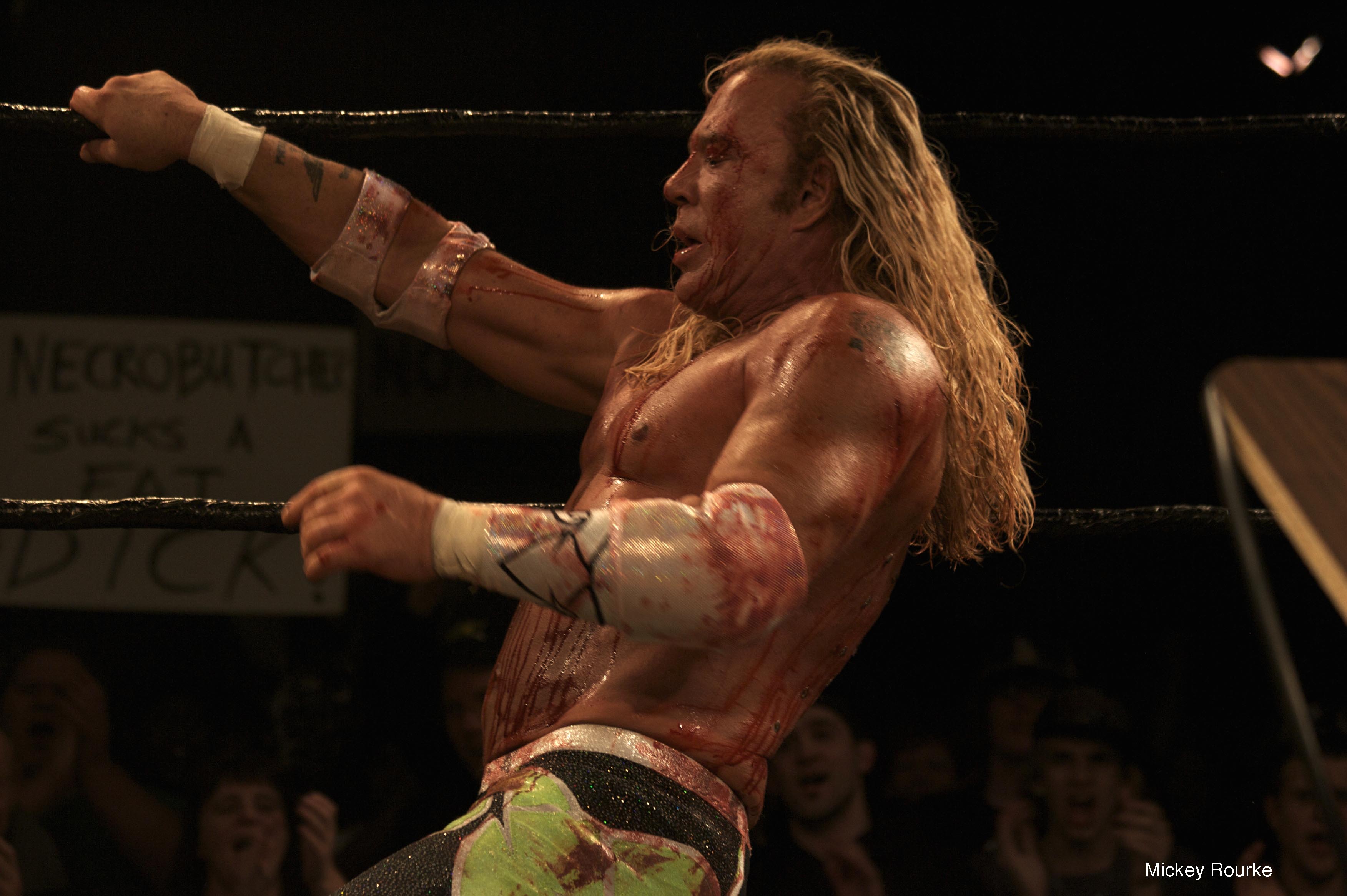
The body is bulked up like a Macy's balloon. The face is lumpy and puffed from bad plastic surgeries to enhance his cheek-bones. The voice is full of razor blades, punctuated by phlegm-caked gasps. 

For awhile now, Mickey Rourke has only taken roles that hide his mangled features. But he's been never less than interesting in those roles (even when he's been less than intelligible). Whether with sunglasses or the elaborate make-up that turned him into Frank Miller's "Marv'" in Sin City,* Mickey Rourke has hidden himself as he does his sporadic film work. Whatever demons drive the actor have made securing financing for films featuring him difficult at best.** There have been a lot of missed opportunities: can you imagine Mickey Rourke in a Quentin Tarantino film? There's a sleaze-match made in back-water heaven. 
So, here he is, Main-Eventing The Wrestler, freak-showed out, his face obscured for the first few minutes of the film, as if delaying the inevitable and pretty soon, you ignore the puffery and start to see the performance, as restrained and gentle as anything he's done in years. 
He's getting all the acclaim for
the film's "broken-down piece of meat" scene in the trailers, but there are moments of brilliance here—the animal-eye-of-panic that occasionally creeps out of Robin ("Call me 'Randy'") Ramzinski, aka Randy "The Ram" Robinson during a match, and an extended scene that begins as "The Ram," a heart attack forcing his retirement, steels himself for a shift working the deli counter at his day-job super-market. He spends a sullen couple of hours learning the ropes, and then—Ram-Jam!—his natural entertainer's instincts kick in as he starts dealing with customers. It's a scene that brings out a smile because Rourke is ad-libbing his way through it, glorying in the eccentricity of it all.
It's as good as it gets for Rourke and his anti-Rocky character. It is not fair to say that Rourke is the only reason to see The WrestlerMarisa Tomei does good tough work here as a working-class stripper, and Evan Rachel Wood makes a lot of the under-written role of Randy's estranged daughter
And while
Darren Aronofsky became overly-stagey in his last film The Fountain, here he's dogging Rourke's path with tight point-of-view compositions that breaks the kayfabe
and paints the world of the small-time pro wrestler—at least from the point-of-view of a face at House shows. The petty rivalries and the macho camaraderie, the brief pre-show negotiated calls, and the sweaty stage-craft of brutality are all on hand-held de-glammed display. It's a world of soiled bandages and card-tables and getting back into the ring. It's as sordid a picture as Aronofsky can make it, but it doesn't hide the moments of personal grace between screw-ups and free-falls. It also shows that the biggest falls these post-modern gladiators take are the self-inflicted ones. It's final shot is one I've been thinking about for days.
The View from 2021: Every few days I still think of that shot.

Portrait of the Artist as a Young Man: Mickey Rourke as he appeared in Diner

* The man even did his press interviews for the film in the camouflaging "Marv" make-up. How twisted is that? 

** He was nearly fired from The Wrestler even after Aronofsky had secured a deal for making it for less money than intended. The actor in the wings? Rourke's Rumble Fish co-star Nicolas Cage.

Thursday, July 11, 2019

Spider-Man: Far From Home

Spider-Man's European Vacation
or
Spider-Man, Spider-Man
Visiting Europe (Not Amsterdam)
London, Prague and "The Boot"
Too Much Gadgetry in His Suit
Mon Dieu!
Qu'Est-ce Que C'est, Spider-Homme.
(Wherever There's a Baguette/
Aunt May's Too Young to Nag Yet)
Stay Sticky, Spider-Maaaaaaan!)*

Upfront: I liked Spider-Man: Far From Home more than I liked Spider-Man: Homecoming, but I'm not sure that will be the way of the mob. The central premise is "people will believe anything" and it spends more time than a White House spokesman proving that very point. I think folks will believe that less than the ability to wipe out half a Universe with a snap of your fingers. ("Yeah, man, but...ya know..."Stones.")

Spider-Man: Far From Home acknowledges the events of The Avengers movies (Infinity War and Endgame) right off the bat—even before the Marvel Studios Logo—everyone is calling it "The Blip" and it has caused all sorts of embarrassing havoc in the world. For example, Peter Parker's Aunt May (Marisa Tomei) re-appeared in her apartment after it rented out to someone else—embarrassing—the courts, insurance companies, and homeowners associations must be swamped. Reappearing students at Peter's high school have found that five years have elapsed (but not their three-picture deals) and a lot of their friends have graduated and moved on—and the absent students had to take their mid-terms again (I'm surprised the admins remembered, but at least the kids who returned didn't need a note to explain their absenteeism).
Anyway, they acknowledge it (but avoid the complexities), as well as the deaths of The Vision, Black Widow, Captain America (heh) and, of course, Iron Man Tony Stark. Especially Tony Stark. And Peter Parker (Tom Holland), only recently pulled back together, is feeling that death, and it's tearing him apart. It was Stark who recruited him for the Avengers, it was Stark who built his suits, and it is Stark that the public wants Spider-Man to live up to—they're looking for another Iron Man and they assume it will be Spider-Man.** But, as Peter tells Stark majordomo "Happy" Hogan (Jon Favreau, in between Disney jungle movies) he doesn't think he can live up to the Legacy. "Nobody expects you to live up to Tony Stark," Hogan counsels. "Even he couldn't live up to it." As a parting gift, Happy bequeaths some last Stark tech—a pair of glasses with interactive gizmo's, access to all sorts of Stark Industries technology, and its AI interface, EDITH. "Tony loved acronyms," says Hogan. "It stands for "Even Dead, I'm The Hero." 

Best line of the movie.
Samuel L. Jackson's reprise of "Bitch, please....." from Kong: Skull Island is the second.
So, while Peter feels the great power/great responsibility weight of the Legacy, his class is preparing for a science field-trip in Europe. Why Europe? Because 77% of Americans believe in angels, that's why. For Peter, this is of high importance, not so much for the science stuff, but for...yaknow...personal stuff. No longer enamored of Liz Toomes (Laura Harrier from Homecoming and, one should mention, BlackKklansman), he's more interested in Michelle "M.J." Jones (Zendaya), pretty, blunt ("You look pretty." "And therefore, I have value?"), and oddly dark—he wants to let her know that he likes her and he plans to make La Grande Gesture by telling her on top of the Eiffel Tower. But, he has a rival for MJ's affections in Brad (Remi Hii) who, after the blip, has aged five years and turned into something of a hunk. So, Spidey's attentions are focused on that.
Un-focusing are the constant calls from Nick Fury (Samuel L. Jackson) of S.H.I.E.L.D., who, with Agent Hill (Cobie Smulders) is trying to web-sling Peter into helping out with what seem to be a global crisis of elemental monsters—earth, air, water, and fire—which are popping up all over the world causing considerable damage. But, where these things are coming from, and why, are a mystery. But, they have a good idea. And it comes from an unlikely source—a previous victim, whose own Earth has been destroyed by the elementals.
His name is Quentin Beck (Jake Gyllenhaal, more on him later) who has traveled to this Earth (616, in case you want to update your Facebook profile) from his own (Earth-833)—if it existed. His Earth was destroyed by the Fire elemental that was allowed to get out of control and consume his world. How, Beck, whom Parker dubs "Mysterio," got here, no one knows—presumably the same way the "things" got here, by subtracting 217, turn right at Mars. Fury wants Spider-Man to team up with Mysterio, who seems to have a knack with his magical Dr. Strange-ish powers, to try to stop the threat, but Parker is reluctant—he's not Iron Man and not sure he could do anything to stop something so huge. But, Fury is insistent, and he has a contingency plan.
He uses the considerable resources of S.H.I.E.L.D to re-route the school science trip to wherever they think the elementals will appear, which although it may be a bit abrupt to the group, but it comes with upgrades, so nobody's complaining. Well, except for Parker who bleats to best-friend Ned, "Nick Fury has hijacked our summer vacation!!" Yes, he has. But, he hasn't done it alone.
That's the plot and the main gist of the important elements (no pun intended). The film-makers flesh it out with the side-characters, and a hint of intrigue that doesn't feel too threatening in its implications. It's wise that they come down to Earth after the cosmic implications of The Avengers movies—although they flirt with the Marvel version of the Multi-verse, only to let it go...leave that to Into the Spider-verse. Also, the threat, though having elements of the supernatural, boils down to that most Earth-bound of villains, the Disgruntled Employee. But, the threat part is mere window-dressing. It's a bit dull—what we've come to expect.
The best part of Spider-Man: Far From Home is not the super-heroics (aside from a very creative "dream" sequence); it's the kids. The messy, fussy, hormonal, and slightly desperate mood-yanks of teen-ager-dom are neatly, comically, played out, especially of kids in unfamiliar surroundings and disorienting circumstances. The throwing of semi-confident kids into non-comfort zones and their ability to cope—or not—is well thought out and played. And the tentative, nervous romantic pairing of Zendaya and Holland makes for the most enjoyable Spider-couple in any of the versions of Spider-Man brought to the screen.
There are elements that bothered me—the CGI of the Mysterio fights with the Elementals are some of the dodgier special effects I've seen in the Marvel movies...and the characterization of Nick Fury seemed...off to me. Now, maybe I'm being too much of a Marvel-zombie saying this, but...could this have been done deliberately? It's not a good strategy because I found it a bit disorienting, but given the way the film plays out, one could make the case that they was intentional. Still, it makes my Spider-sense tingle.
And Jake Gyllenhaal? I've seen Gyllenhaal do great things, even in "iffy" movies. But, here, he's terrible and it might be the biggest character mis-fire since Ben Kingsley's The Mandarin in Iron Man Three (or Paul Giamatti's Rhino in The Amazing Spider-Man 2). One could imagine someone doing some great things with the role, but Gyllenhaal's portrayal has no depth, and little consistency from scene to scene. It might have been the script, but I suspect the actor was thinking how he'd ever live down the costume, rather than looking at the character with a solid through-line.
Anyway, good times most of the time. Definitely stay for the End-Credits scenes, one of which brings back a beloved Spider-Man character, and the other which made me even more suspicious those things that bothered me were deliberate.
Made me go "Hmmmm."
"Stay sticky...except with Aunt May"

* Alternate Lyrics:
Takes His Class on a Trip/
Awfully Vague about "The Blip"/
Oh, Snap! There Went the Spider-Man
** Uh, why? It's not like Hawkeye can become Thor, or The Hulk become Black Widow...I mean, these heroes do what they can based on their skill-sets, people. 
a) I still find it funny that so much emphasis is put on Iron Man—he was a Tier 2 super-hero at Marvel, the movie series wasn't great, but it's only Robert Downey Jr.'s portrayal that kick-started the Marvel Studios success story. Downey was the corner-stone and BVP utility actor for the studio, which is why he's being lionized.
b) Why Spider-Man? Does everybody know the link between the two heroes? The public didn't know. We know, because we've seen the movies...Oh, it's okay, Marvel. Keep collecting your zillions.

Wednesday, October 17, 2018

Chaplin

Chaplin (Richard Attenborough, 1983) Elephantine, lugubrious bio-pic of the man underneath "The Little Tramp," Charles Spencer Chaplin. If more bio-pics were this ill-serving, it would be good reason to avoid the limelight altogether. Years after sweeping the Oscar-race with his ever-so-respectful biography of Gandhi* (starring Ben Kingsley), director Attenborough took on his famous countryman's auto-biography and varnished it with the same extra coats of shellac (with broad strokes) that made a still-life out of his film of A Chorus Line.

Charles Chaplin is a more-than-worthy subject for a sweeping biography that covers a huge amount of history in both the times of the U.S. and England, but also of the film industry. Chaplin was one of the rare few film-makers to make it out of the silent era alive and functioning, amassing a great fortune, becoming beloved world-wide—his Tramp character was recognized world-wide, with even more reach than Mickey Mouse—and treading the then-virgin territory of film star-dom with all its glamor, responsibilities...and pit-falls. Only thing, part of the problem was too many virgins. A clown-comedian who made his living, first by exposing the pomposity of authority, and then—as the Tramp—actively fighting it, he ran afoul of the authorities who didn't take too kindly to his irreverent side, little noting that the Tramp's triumphs were a balm for a restless public, sublimating dissatisfaction in a permanent trap on-screen, keeping it from spilling into reality. They should have thanked him. But instead, the authoritarians, be they Nazi's or J. Edgar Hoover, fought him. And Chaplin had enough hubris and pomposity himself, to think that the public would always rally to his side.

Now, that's a story. One that Chaplin would appreciate, if he wasn't living it. But, instead, Chaplin saw himself as he always saw himself—the hero. You could say of Chaplin what Alice Roosevelt Longworth said of her President-father Theodore: "He wanted to be the bride at every wedding, and the corpse at every funeral." Chaplin loved being the Clown and the center of attention, but he also wanted to be taken very seriously, as he saw himself. Quite the dichotomy. That Chaplin couldn't embrace his own pretentiousness as part of the act was what turned his reel-comedy into real-tragedy.
But don't drop any tears for Chaplin. He lived an extraordinary life...of his own creation. Well, feel bad for him for this movie, perhaps.
The problems start with the screenplay. The timeline uses his films as the spine of it, set up by little incidents that inspired them. A more fitting strategy for a film-symposium than a movie, especially a movie about a comedian: Nothing kills a joke faster than having to explain it. The films are the high-lights; they are punctuated by explorations of Chaplin's relationships with the women in his life, starting with his Mother (eerily played by Geraldine Chaplin, the person's real grand-daughter!), then his lost loves, whether by his own design or by his inability to maintain a love greater than his own. This is interrupted by the lamest of devices—going over the autobiography with his ghost-writer (Anthony Hopkins), in a kind of literary psychiatric session. They amount to repeated episodes of the aging Chaplin clinging to his fantasies and the writer calling "Bull-shit," once literally.
This may be a convenient way to film in the blanks, but it also splinters the narrative force. Are we to believe Charlie, the biographer, or what we see with our own eyes being represented? And as the subject is a film-maker, it's a bit like falling down a rabbit-hole of fun-house mirrors. Who do you trust? The end-result is taking none of it very seriously, as Attenborough can't resist speeding up some episodes in a representation of silent film techniques. Nothing is real. A little contrary for a biography.
Then, the tone is so heavy. Starting with a title sequence of Chaplin taking off his "Tramp" make-up (exposing the real man, get it?) to a melancholy score by John Barry, that would be more suited for a funeral, the film never gives up the tone of self-important tragedy that ultimately swamps the movie and any good feelings that one might have for Chaplin, the man, his work or the movie.
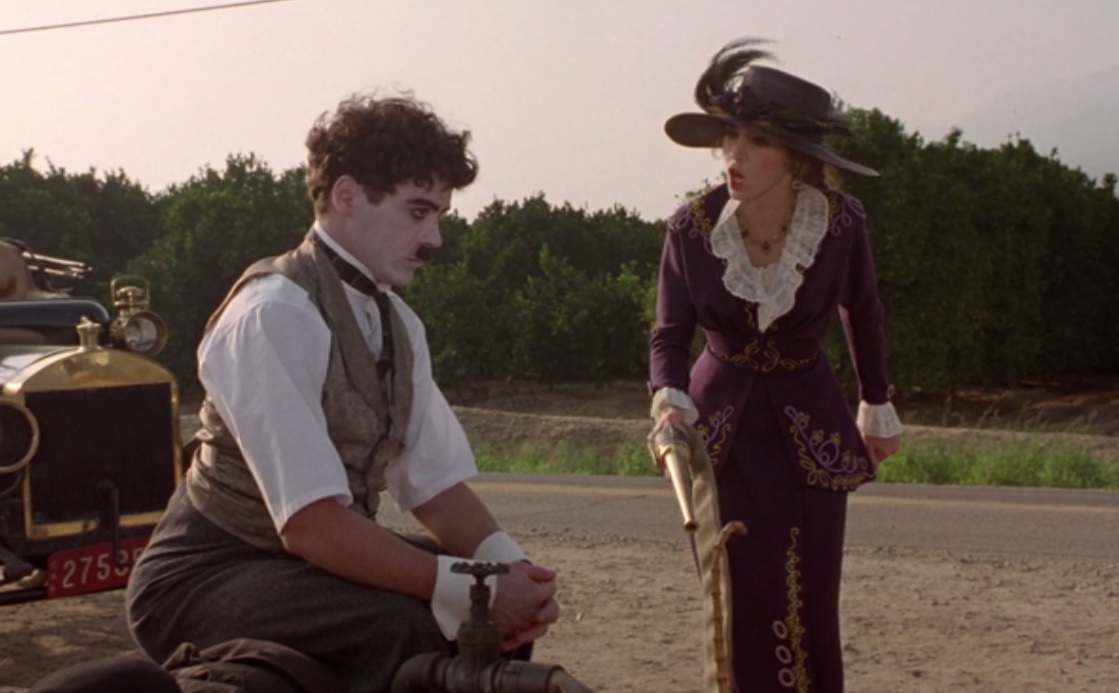
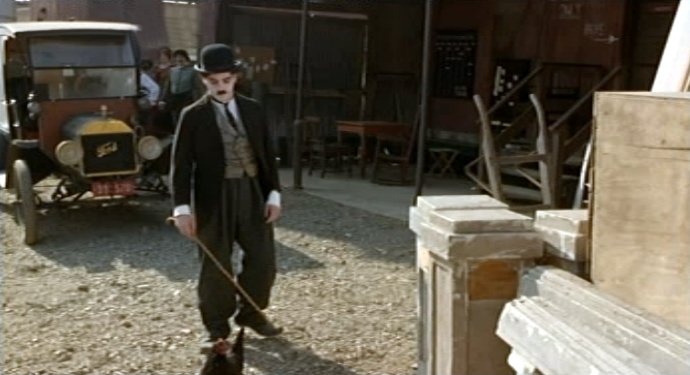
But, every dark cloud has a silver lining. In the case of Chaplin, it is its star, Robert Downey, Jr. Downey was a once-removed member of "The Brat Pack," the coterie of young actors who buzzed through Hollywood in the late 70's and 80's, appearing in ensemble pieces by John Hughes and other directors. Appearances in his father's films, a couple of featured roles and a disastrous stint on "Saturday Night Live" offer no hint of the disciplined, exemplary work he brings to the title role, eerily evoking the lookespecially the smile of Chaplinand, most amazingly, pulling off the physical comedyChaplin's particularly physical comedythe role required. He was honored with his first Oscar nomination (losing to Al Pacino's first Oscar win for Scent of a Woman.), but, after Chaplin, Downey's performances would turn more physical, quick-silvered and nuanced, paving the way for a universal respect for his craft that even an errant personal life couldn't derail. Downey's evocation is the one reason to watch Chaplin, rather than, say, reading about him...or better yet, watching the man's films.
The immigrant looks upon the Promised Land: Robert Downey Jr. as Charlie Chaplin 
looks at a strip of this new medium, film, left on the cutting room floor. 
Of course, the footage is of him.


* Gandhi beat out E.T., the Extra-Terrestrial for Best Picture that year. I understand the Academy's hesitancy to give the statue for an alien combination of Shane and Lassie, but no amount of prestige attached to a project can replace a film's status years after the fact. This one was a mistake. And short-sighted, replacing typical Awards reverence for "prestige," rather than popularity or endurance.

Thursday, May 24, 2018

Crazy Stupid Love

Written at the time of the film's release...which is why there is absolutely no mention of La La Land.

"Love Sucks (A Cautionary Tale)"
or
"It Takes a Village (To Make a Divorce)"

The sad thing about romantic-comedies, circa the 21st Century, is their dependence on formula: Boy Meets Girl/Boy Loses Girl/Complications Ensue/Boy Wises Up/Happy Ending; or Girl Meets Boy/Girl Loses Boy/Girl's Self-Worth Depends on Boy/Romantic Rival Meets Terrible Demise/Happy Ending (of a sorts). The last few I've seen of the genre have depended on hitting these plot-points, no matter what city, what occupation, or what sex the film centers around. Even Bridesmaids, for all its wit and wildness, still ended with the assumption that everything will be alright if "the girl" gets "a man." The "by-the numbers" dance steps that most rom-coms boogie to have the ability to regress me back to the five-year old boy I was who hated "kissing scenes;" the final rosy fade-out inevitably spoils the most romantic of comedies for me, failing to warm the cockles of my heart or make me feel all-gooey-fuzzy. Instead, I walk away cheerlessly cynical. Been there. Done that. A fish needs a bicycle.


So, it's a nice surprise, bordering on the revolutionary, when a romantic-comedy turns the formula on its ear enough that I enjoy it. Don't get me wrong, Crazy, Stupid, Love* has a "happy ending," but there is also a nice glowing lack of resolution. This is a movie that dares to say that Love is hard work, and, yeah, it sucks, but it could be worth it, because, like Life, it beats the alternative.
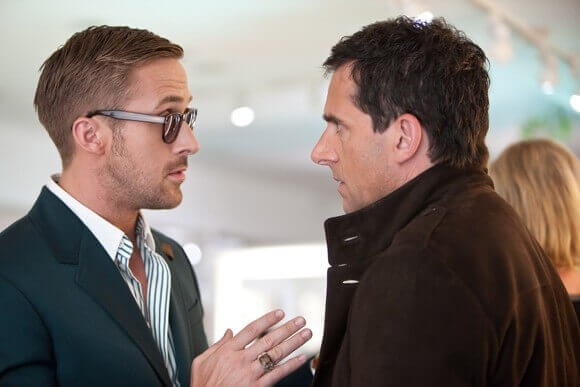
This is not where it starts, but where it starts to get interesting: Chick-magnet Jacob (Ryan Gosling,** he has a nicely subtle double-take for comedy) is in a bar in mid-closer with his latest fling when he takes the time to call over a half-stewed Cal Weaver (Steve Carell, showing exactly why he deserves to be out of TV and in films, something that doesn't happen nearly enough). The reason?  Cal's moaning is throwing off Jacob's technique. Cal's been doing that a lot lately (at the office he's told: "Amy heard you crying in the bathroom - we all thought it was cancer.") No, it's not cancer. After 25 years of marriage, Cal's wife (Julianne Mooreshe's great) has revealed she wants a divorce AND she's slept with another man (Kevin Bacon, he's also great). This offends Jacob's self-absorbed sensibilities: "Seriously, I don't know whether to help you or euthanize you."
So, Jacob helps Cal to "man up"a younger "Obi-Wan" to the elder's bowl-cut Luke with credit cards as lightsabers—and this, if not turning Cal's life around, at least makes it busierAnd complicated.
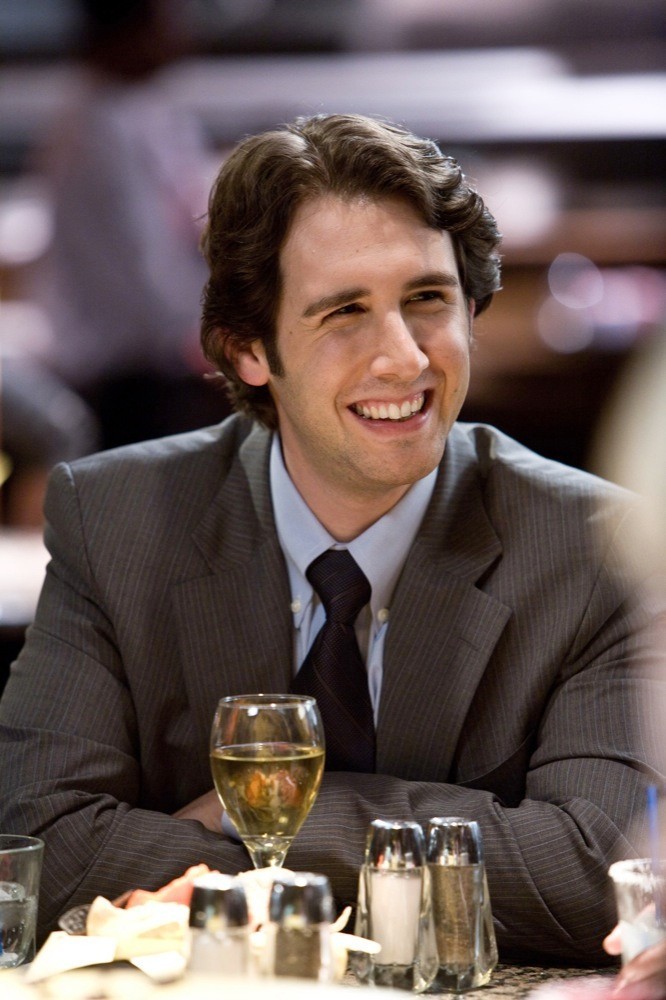
Running parallel to the story is Hannah's (Emma Stone, big-eyed waif) relationship problems ("You're life is so PG-13!" says her token-Asian friend, Liz). That's because she wants to be engaged to office co-worker Richard (Josh Grobanrather risky of him to look so bad in this movie) and is focused on that, so much so that she plays ignorant to Jacob's innuendos when he approaches her while trolling in a bar.
And, at this point, to say anything more would be saying too much, spoiling the fun and sending the whole Jenga-construction of the film crashing to the rec-room floor (In fact, I've probably said too much already). Just when you think everything is going as smooth as satin sheets, the film-makers throw you an extra wrinkle, and it's been a long, long while since a rom-com has done that.  The dialogue is fresh though the situations seem familiar—everyone's conceptions of Love and Romance seem to be based on The Movies and directors Glenn Ficarra and John Requa *** and writer Dan Fogelman **** are only too happy to skewer them, while paying some respect—the complications teetering on the sit-comish, then resolving with the most graceless of dismounts. Applaud anyway because if they're not the best of executions (the performances help here), there are extra points for "artistic" and "difficulty."
Adding to the fray are the effects all this confusion have on "the kids" (Jonah Bobo, Joey King) and the friends (John Carroll Lynchhe's becoming one of my favorite character actors—and Analeigh Tipton). It, after all, takes a village to make a divorce...very uncomfortable. And special mention should be made to the movies' best utility player, Marisa Tomei, who surprises with just about every performance these days (Okay, okay, Marisa, you DESERVED that Oscar, okay?).
Highly enjoyable.  Bravo.

* Yes, it has the superfluous comma, you English Majors, but if you see the title as a list rather than "adverb, adjective, subject," it makes a bit of sense, and the film actually earns the charity for considering the possibility. 

** Gosling is an odd bird.  It's taken awhile for me to warm to him (I'm one of the few people to have seen his awful work in Fracture, but he has a nice laid-back dead-pan style of comedy—as displayed in Lars and the Real Girl—that hews closely to his dramatic work.  Just a nudge, either way determines comedy or tragedy.  He's dangerously good.

*** Okay, this is scary, but hear me out: Ficarra and Requa have written such films as the remake of Bad News Bears, Cats & Dogs, Bad Santa (a bit raw, but actually rather sweet) and...wrote and directed the little seen gay romance, I Love You Phillip Morris—as subversive and weirdly sweet a movie to be seen in a long time.  Forgive the early credits—these guys are good.

**** Okay, now REALLY hear me out: Fogelman wrote the screenplay for Cars and the screen-story for Cars 2, wrote Fred Claus...but did fine work on both Bolt and Tangled for Disney.  Seems he can write for real people, too, and not just 'toons.

Thursday, July 20, 2017

Spider-Man: Homecoming

With Great Power Comes Greeeeeat Flakiness
or
"You Say that a Lot. What Are You Sorry For THIS Time? ("...Previously on 'Peter Screws the Pooch'")

At one point in Spider-Man: Homecoming, Peter—Spider-Man—Parker (Tom Holland) says to Tony—Iron Man—Stark (Robert Downey, Jr.) "I wanted to be just like you!" and Stark counters "...and I wanted you to be BETTER."

Precisely my feelings towards the Spider-Man 3.0 reboot, which I found a generally disappointing mess, with some very good things about it that did things differently...and refreshingly.

I like the fact that it doesn't take itself too seriously—the Tobey McGuire and Andrew Garfield versions had their moments of mirth, but got mired down in the soap opera aspects of the character and the weight of the "With Great Power Comes Great Responsibility" philosophy. This Spider-Man entry feels like a hyper-After-School Special that dispenses with the "Life with Archie" aspects of the traditional mythos ("Hmmm: Gwen or Mary Jane?") and features a cast far more diverse than merely blond and brunette. That's good. It plays around with the teen-hero aspect of Spidey—he's supposed to be 15 in the movie and Holland is 21 (McGuire started at age 27 and Garfield at age 29, the latter two abandoning High School for college) and sticks him in the very awkward high-school years of the character's origins in the early days of Spider-Man's history.
I like the fact that we don't have to go through the motions of seeing his origin story—bitten by a radio-active spider and suddenly finding himself with out-sized strength, sticky appendages, and the acrobatic skills and balanced of a headlining Cirque du Soleil performer. Here, Spider-man simply is. Doesn't matter how, and that he's young, eager, and learning is part and parcel of the origin, anyway. So, I'm glad we don't have to watch Krypton explode again...or his parent get shot in an alley...again. Let him be...in media res.
I like the fact that—like the recent Wonder Woman—there is no revenge plot. He's not trying to avenge the murder of his Uncle Ben (portrayed earlier by Cliff Robertson and Martin Sheen) or even girl-friend Gwen Stacy. He wants to be Spider-Man because being Spider-Man is cool! He also wants to be just like his hero Tony Stark—who has provided him with a too-gadgety Spider-Man suit (which gets very tiresome after awhile, more on that later).
But, the best part about it has little to do with Spider-Man or the new guy who's portraying him—it's the "villain." The best part of Spider-Man: Homecoming is Michael Keaton (former Bat-man, former "Bird-Man"). His Adrian Toomes aka "The Vulture" starts out as a blue-collar guy (actually he remains a blue-collar guy although he starts sporting a full collar later on—a neat touch) who's salvage company is in charge of cleaning up Stark Tower after the big dust-up The Avengers had with the Chitauri in downtown New York. "The world had changed," he opines to one of his grunts as they pick through the rubble, finding all sorts of neat other-worldly tech.
While he's ruminating on that and instructing his crew how they should use the alien gadgets to take other alien gadgets apart, they are interrupted by a police-escorted group from Stark Industries (including Tyne Daly!) telling them to cease and desist. Stark Industries has used their political clout to take over the salvage operation—Toomes and his crew are out of a job. "Times are changing," says Toomes as he pockets a couple items in secret. "We need to change, too."
It's curious. The focus of the Spider-Man movies should be Peter Parker, but here, with the puerile adventures of kid Parker and his High School buddies not providing anything of depth and his general dorkiness, you gravitate to Toomes, whose character is at least competent. He's not unbalanced, he's opportunistic, entrepreneurial, and he's got a well thought-out defense for doing everything he's doing. Yes, his "crew" is selling alien and extra-dimensional tech to criminals, but to hear Toomes tell it (to Parker), he's no different than Parker's hero, Tony Stark, who started out—and, for all intents and purposes, still is—an arms-dealer. But, Toomes sees a difference: "People like Stark—they're not like us—you and me. We build their roads, fight their wars, eat their table-scraps..." He thinks he's doing what he has to do to survive and to keep his family afloat and solvent. He's seen people go off the path and do well, and, for his family...why not?
Keaton is at the top of his game here. Laconic, thoughtful, dangerous, he has a lot of every-man bonhomie and you're drawn to him. But, the best scene in the film (which would be a crime if I spoiled by revealing it in any way) is his. And, it is played mostly silently with looks and deflecting casual dialog. Then, he delivers terms of engagement and he threatens our hero, his eyebrows arched, a smile on his face. What Keaton is doing is a bit reminiscent of what his co-star Jack Nicholson did playing The Joker opposite his Batman—there is a theatricality to it, but tamped down, malevolent but smoldering, and stated not as threat, but as fact. It's no wonder Tom Holland looks scared shit-less during the scene—Keaton is the villain and has stolen his movie.
So, that's the good parts: some good casting, some clever dialog here and there. Peter has an interesting story-arc—he begins wanting to be an Avenger like he was in Captain America: Civil War (Peter has done a selfie-video of his adventure in the other movie—from another studio) and realizes, eventually through the course of the movie, that he shouldn't be an Avenger, but can do the most good just by being "your friendly, neighborhood Spider-Man" (as the saying goes). And to have that arc, Spidey 3.0 has inserted itself into the tangled web of the Marvel Cinematic Universe, so, yes, there's a lot of the MCU poster-boy, Tony Stark—some of which is necessary (Toomes' motivation is squarely on the shoulders of Stark), but a lot of which is Robert Downey, Jr. collecting a pay-check. Chris Evans shows up in a running gag as Captain America keeps turning up in Public Service Announcements "for the kids"*
Here's the issue—it's all for a gag—it's tied to the Marvel movies, sure, but it also undercuts one of its major characters, doesn't respect him. I'm not sure what the internal logic of having Captain America be a role-model/spokes-hero "for the kids," since, after Civil War he's now considered an "outlaw" in the Marvel movies. But, hey, it's for a gag and another tie-in to the popular movies, right, so what's the harm? That it makes no sense probably shouldn't matter, as it's a "Spider-Man" movie, which should be it's own "thing," a Universe in a bottle...but for marketing purposes—to make sure there aren't any entries like the third Tobey McGuire and the second Andrew Garfield movies that have a slight down-tick in revenues to make studio executives nervous—they bring in popular characters from other Marvel movies...and...diminish them. Curious strategy, that.
Also, the presence of Stark contributes to something I find just annoying, but it's annoying for a significant amount of running time in the film: Spidey's suit. Looks good, okay. But, over the course of the movie, you find that there are so many goo-gah's and other gizmo's in it that you could imagine that given a good remote control, you don't even need a person in it.** The eye-holes respond to emotions (a trait picked up from Deadpool) and the mask has a "heads-up display" like Iron Man, they can control the types of webs he shoots, and, most egregiously, he has a "Siri" voice in his suit (voiced by Jennifer Connelly), who gives him so much information that there is no need for him to think. But, it does give him plenty of time to talk, which he does incessantly while he's trapped overnight in a weapons warehouse. Guess it beats trying to find an exit somewhere.
Need a lot less of this.
The thing is, it's not the suit that people like—it's the character inside it—although Marvel Studios tried to make him as much like Iron Man as possible, it will all be for naught if audiences don't respond to Holland and the character they've written. The movie makes the point, itself; after a botched confrontation with "The Vulture" on a Staten Island ferry, Stark's Iron Man comes to save the day and dresses Spider-Man down...by taking away his tech-suit. "I'm nothing without the suit," bleats Peter. "If you're nothing without the suit, then you shouldn't have it!" Stark replies. Hopefully, when he gets it back, they'll have dialed down the tech. The character is fun enough when he has to improvise a get-up in the third act. And more competent.
But, the thing that really disappointed me is a problem that past Spider-Man films have had—a needlessly frenetic pace and editing by a cuisinart. It's happened in Spider-Man 3 and The Amazing Spider-Man 2 (the ones fewer people saw and caused the respective re-boots). The timing is off on a few things because there seems to be an attempt to shoe-horn as many bits of business and details as possible, but not to dwell on them (one isn't given enough time to notice them!). Look at that fight gif above. See how things don't seem very smooth and jerk around a bit. That's because the director—or it could be 2nd, even 3rd unit-director—didn't have a basic design strategy that would make the fight work as a whole, followable sequence. They basically took bits and pieces, added some inserts and just thought it would come out looking good in the editing room. It didn't, and it doesn't. 
"See? Superman isn't the only hero who's a Christ-allegory!"
And once we get into the big battle set-pieces, the action (which is now more CGI than practical stage work) just becomes nearly incomprehensible and hard to follow—you can't see who's where and what spatial relationship they have with each other to determine the sequence of danger. It's just individual shots that are supposed to give you a sense of action highlights, but not how they relate to each other. Combine that with the tendency to have the Spider-Man fight sequences run a little too fast, especially in the swooping-and-dodging departments (which I suspect has more to do with trying to make the CGI pass scrutiny than anything else—come to think of it, the worst fight sequences of the previous "Spider-Man" films also occurred at night as this one does), and it makes you wonder if all the various FX houses go into a room to actually coordinate what the sequences will look like, as opposed to individual shots. They might be technically brilliant, but do they share the same framework to make the collection of shots legible? Not very. In fact, the last time, they had really good action sequences was way back in Spider-Man 2 (Series 1.0).
So, there's less doom-and-gloom and Spider-moping in this Spider-Man movie. But, I can't say things have noticeably improved. In fact, the character seems even less important in his own series than when he started to be crowded out by villains. Maybe someday there will be another good one along the lines of Spider-Man 2—still one of the best movies in the super-hero genre—but this one isn't it. This third time has some charm, but it's not enough to keep it off the bargain racks at your friendly neighborhood supermarket.

* The punch-line of which is Cap showing up in the completely superfluous Final Credits Teaser that completely nerd-bashes the idea of sitting through the Credits to watch to the teaser: "Hi, I'm Captain America. Here to talk to you about one of the most valuable traits a student or soldier can have. Patience. Sometimes, patience is the key to victory. Sometimes, it leads to very little, and it seems like it's not worth it, and you wonder why you waited so long for something so disappointing... How many more of these?"

** There's an antecedent in the comics for this: Spider-man has an enemy named "Venom"—he was briefly in Spider-Man 3 (the only #3 there has been), which is essentially a Spider-Man costume that possesses people (yeah, don't even ask, True Believer...)