Showing posts with label Jon Favreau. Show all posts

Thursday, July 23, 2020

Cowboys & Aliens

Written at the time o' the film's release...

"This Galaxy Ain't Big Enough for the Both of Us"
or
"Just My Ray-Gun, Pony and Me..."

Good idea, this. Two genres that have been around as long as there've been movies* and have served the same purpose—taking a theme that might be controversial if played in modern street-clothes, but dress it in rawhide or spandex and it takes some of the "edge" off. You'd think the two would go together as well as Zero-G and sawdust, but there have been already some tentative steps in anti-gravity cowboy boots: There have been westerns with a touch of fantasy—The Valley of Gwangi—and Sci-Fi with a western foundation (Outland was High Noon in space suits) but the two haven't really been combined as equal parts as in Cowboys & Aliens (the ampersand is required).
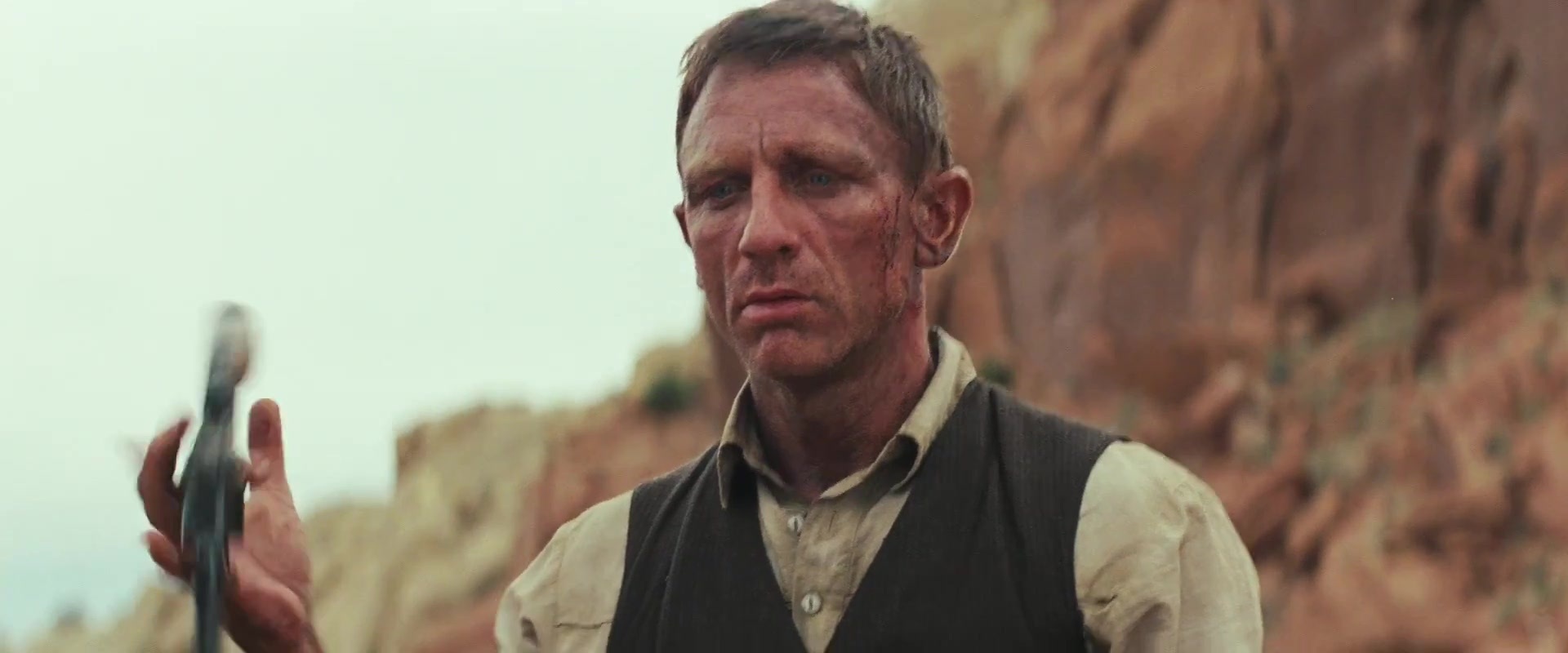
Loosely based on its comic source, it starts in familiar territory—a desert landscape, ancient river-beds long-since dried up and now sun-blasted bluffs and scrub.  Suddenly, a Man With No Name (Daniel Craig) lurches up into frame, sun-burned, bootless, bloodied with a wound in his side.**  He has no memory of who he is, where he is or why he's there (at one point a townie asks him "What DO you know?" "English" is the laconic reply). One odd thing—a thick manacle from wrist to forearm on his left armSmashing it with a rock would work with hand-cuffs, but this thing won't budge. He's set upon by riff-raff that he dispatches in a whirlwind of flying fists and gun-fire. So much for outfitting.  With newly acquired boots, shirt, vest and hat, he climbs on top of a pilfered horse and rides to a nearby town...with a loyal dog in tow. All the elements are in place.
A stranger in town (and everywhere, one assumes), he gets noticed and in trouble—mussing up the son (Paul Dano, really good) of the requisite town rich-guy-fascist (Harrison Ford, low and husky), and getting landed in the hoosegow by Sheriff John Taggart (Keith Carradine, whose Daddy appeared as a gambler in the granddaddy of Westerns, John Ford's Stagecoach). That's sounding like Howard Hawks' Rio Bravo, but about the time Ford's Colonel Dolarhyde (nice name for a rancher) arrives with some hired rough-necks to spring his boy, new arrivals appear in town—blue lights in the sky, which turn into flying ships—they recall fighter-jets in the daylightthat start blowing things up and (in a neat touch) lasso people and yanking them into the skyThe attack sets off The Stranger's fancy bracelet, which starts to "queep," pops up a sight, and knocks one of the ships out of the sky.

Suddenly, The Stranger gets a lot more interesting.
Because the invaders have been nicely particular about who they took—Dolarhyde's son, the Sheriff, the wife of the town's doc/bar-keep (Sam Rockwell, not used well enough, sadly), a posse is formed to find the kidnapees and at this point the movie turns decidedly conventional. It should. It's The Searchers, which begat Close Encounters of the Third Kind. And along the way, the posse manages to accumulate allies in a criminal gang, a tribe of Apaches (who are polite enough not to mention that "an invasion by strange aliens with weapons to take our resources" sounds vaguely familiar), and, for all I know, The Outlaw Josey Wales—who also accumulated an unlikely army that turned into family.  This is useful, because for the big battles with the Invaders, there needs to be a large number of red-shirts and red-bandanas to eliminate, so we don't lose the strays that make up the posse, which include a dog, the Sheriff's grand-son (Noah Ringer), and as Clancy Brown's Preacher (gotta have one of those, too) grouses, "We gotta dog and a kid, we might as well have a woman, too"   
That woman is Olivia Wilde, who spends most of the movie looking enigmatically sultry, while doing things that make you go "eh?" throughout the movie, beyond just the fact that as Craig gets more and more beat-up, her make-up never gets smudged. As welcome as Wilde's presence is in all this testosterone, her character is the most problematic, running inconsistently throughout the film—she's either "capable" or she isn't, and ultimately you realize that she's just a "device" that gets the screenwriters (a squad of them including the two that wrote Star Trek and the "Transformers" films—as opposed to the two who wrote the "Pirates of the Caribbean" movies) out of trouble. Mention should also be made of Adam Beach, who keeps getting better every movie, and Craig who does "the Eastwood thang" real good. Director Favreau (he of Iron Man fame, his chief skill seems to be impeccable casting), manages to direct it absolutely straight, with just enough of a hitch in the standard cliches to make things interesting, rather than well-trod.
Nothing is made of the irony of these new aliens making life difficult for "the natives," save for some terse nods of collaboration between members of the extended posse. That doesn't sadden me too much as most movies these days seem to want to beat you over the head with their "message," in case you don't get it. But, in so doing, Cowboys & Aliens manages to fulfill both the Western and Sci-Fi genre's abilities to put things in unique perspectives to throw a light onto our world. 

As I said, good idea.  A bit fun, too.

But, only a bit.


* As in The Great Train Robbery (1903) and A Trip to the Moon (1902). 

** It's not too unlike the beginning of Silverado where Paden (Kevin Kline) is found by Emmett (Scott Glenn), alone in the desert, robbed of everything but his skivvies.

Saturday, July 27, 2019

The Lion King 2019

Cheetahs Never Prosper (in the Uncanny Valley)
or
A Corporation's Belly is Never Full (Mustafa Your Face)

Disney, the corporation, has been systematically making live-action versions of their beloved cartoons. Starting with 101 Dalmations in 1996. they've been doing it for awhile, but it has, in very recent years, increased in frequency to the point where it is now a veritable flood. There have been two versions of The Jungle Book (1994 and 2016, without and with songs, respectively), Tim Burton re-thinkings of Alice in Wonderland and Dumbo, Cinderella, Beauty and the Beast and Aladdin and "Wicked" re-imaginings of Sleeping Beauty, with many more on the way including Mulan, Pinocchio, The Little Mermaid, The Hunchback of Notre Dame, even Lilo & Stitch. It's a way to increase the Scrooge McDuck-like coffers, while not really hurting the history—the animated versions are still there, after all, just as are the original stories (where there are)...for those who think they were cheapened by being "Disney-fied." It's not like anything's being replaced and the first versions aren't available.
Now, comes a version of their jewel in the monetary crown—The Lion King, which became a smash in its animated version (Disney's most successful cartoon) as well as in its Tony Award winning Broadway version directed by Julie Taymor. Who would have suspected that such a late bloomer would be its most precious commodity? Certainly not me. I was never a fan of the animated film, thinking it a step down from the Ashman-Menken days of Disney's resurgence. Audiences did not agree, as it produced a lot of revenue for Disney, despite being derivative (being based on Shakespeare's "Hamlet") and having an inferior array of songs (by Tim Rice and Elton John). I was also unnerved that the most interesting character was the villain, and that the film created a fantasy world of animals, especially in the lion kingdom where the females do all the hunting and the males...well, the males just have bragging rights.
I was also found it (oh, I hate using this word) "un-American." Hear me out. The Lion King champions the idea that power is earned the old-fashioned way—you inherit it. No room for democracy in the Pride-lands; young Simba is presented to the world as the Future King and not only do all the animals have to show up for the presentation, they have to accept it—"Here's the next King; Show some respect." Okay, who can resist a baby lion-cub, but the whole idea of the Right of Succession is what the words of the Declaration of Independence—"We hold these truths to be self-evident, that all men are created equal..."—was arguing in the most basic words possible; the signers were declaring that you did not have to be born in the house of Windsor or Stuart or Plantagenet in order to hold positions of power over others—better that they be decided by a majority of those to be governed. But, here we are, celebrating "kingly" DNA. Fie on it!
The film opens with a nearly shot-by-shot recreation of the "Circle of Life" sequence (I'm still expecting that to be a slogan for a fast-food restaurant or the tag-line for a Soylent Green remake) as young Simba, the son of King Mustafa (James Earl Jones, the once and future...) and Queen Sarabi (Alfre Woodard), is presented to the animal kingdome as the next line of succession. This throws a bone into the craw of the King's brother, Scar (the wonderful Chiwetel Ejiofor, in a performance much more dynamic than his on-screen performances, taking much more of a Shakespearean tone—in fact, Timothy Dalton's Shakespearean tone). Simba's birth has kicked Scar down a rung from becoming King and, having previously lost in a battle for supremacy with Mustafa, sets his mind to roiling how he can supplant his decreasing fortunes—by either eliminating Simba or Mustafa.
You know how this goes—Scar uses Simba as a lure to do away with the King, sending the young Simba into exile and leaving a vacuum in leadership that Scar is only too happy to fill. 
Simba is found by two jesters Timon and Pumbaa (Billy Eichorn and Seth Rogen and both better than you'd expect) who serve as the "Falstaff" to Simba's Prince Hal/Hamlet teaching him to let go of the past and live for the moment. The odd thing about having Rogen and Eichorn as the characters is that it turns the characters into unambitious loafs rather than mere free spirits—and their directives to eat grubs comes off as very convenient as the juicy worms can't talk—or sing—in protest. Simba grows up through his awkward phase and it is only due to him being found in exile that he returns to fight what is rotten in Scar-land.
It's all very similar and familiar—although the new one's PG rating allows the word "farting" in "Hakuna Matata" (rather than "Please, not in front of the kids!") and there is some suspicious cross-promotion between Disney products.
BIG difference, though, is how the CGI-photo-realistic animals compare to the stylization of animation. In animation, you can get away with anything, like smiling prideful lions or gravity-defying suspensions in the laws of physics (or, as above, "sashaying" animals) that the CGI modelling just won't allow.* The Lion King does NOT take place in The Uncanny Valley, and so anything that smacks of fantasy will get picked apart like digital carrion. And so, director Jon Favreau, cinematographer Caleb Deschanel, and the digital zoo-keepers work overtime to make the thing look like an episode of PBS' "Nature" (I kept wondering when David Attenborough was going to chime in: "The wart-hog, although not burdened by gastric issues, will most typ-ically..."belch"—and with alarming frequency." But, as the animals are doing all the monologing, he isn't needed). It's absolutely beautiful to look at, and often breath-taking in what it presents pictorially, even bringing about a real sense of majesty in realistic settings. It's just, in very subtle ways, off-putting.
The dialog is done subtly, so as to not make it too jarring. But, it also limits the movie in its theatricality. It's a bit less eccentric and a bit less entertaining as a result, a chronic problem with the Disney remakes. The studio is going to have to find a way—a brilliant solution ala Pixar—to cross the wide expanse between imaginative line-drawing and recreating reality in their fantasies.
It's not embarrassing—like, say, what they're trying to do with "Cats." But, it's a good attempt, even if this The Lion King keeps it down to a dull roar.

* There are no plans, as yet, to do a CGI version of Fantasia. Not yet, anyway. But, before they do it, I hope they solve the issue before attempting the sequence with the dancing hippos in tutus. That's something I'd like to see.

Thursday, July 11, 2019

Spider-Man: Far From Home

Spider-Man's European Vacation
or
Spider-Man, Spider-Man
Visiting Europe (Not Amsterdam)
London, Prague and "The Boot"
Too Much Gadgetry in His Suit
Mon Dieu!
Qu'Est-ce Que C'est, Spider-Homme.
(Wherever There's a Baguette/
Aunt May's Too Young to Nag Yet)
Stay Sticky, Spider-Maaaaaaan!)*

Upfront: I liked Spider-Man: Far From Home more than I liked Spider-Man: Homecoming, but I'm not sure that will be the way of the mob. The central premise is "people will believe anything" and it spends more time than a White House spokesman proving that very point. I think folks will believe that less than the ability to wipe out half a Universe with a snap of your fingers. ("Yeah, man, but...ya know..."Stones.")

Spider-Man: Far From Home acknowledges the events of The Avengers movies (Infinity War and Endgame) right off the bat—even before the Marvel Studios Logo—everyone is calling it "The Blip" and it has caused all sorts of embarrassing havoc in the world. For example, Peter Parker's Aunt May (Marisa Tomei) re-appeared in her apartment after it rented out to someone else—embarrassing—the courts, insurance companies, and homeowners associations must be swamped. Reappearing students at Peter's high school have found that five years have elapsed (but not their three-picture deals) and a lot of their friends have graduated and moved on—and the absent students had to take their mid-terms again (I'm surprised the admins remembered, but at least the kids who returned didn't need a note to explain their absenteeism).
Anyway, they acknowledge it (but avoid the complexities), as well as the deaths of The Vision, Black Widow, Captain America (heh) and, of course, Iron Man Tony Stark. Especially Tony Stark. And Peter Parker (Tom Holland), only recently pulled back together, is feeling that death, and it's tearing him apart. It was Stark who recruited him for the Avengers, it was Stark who built his suits, and it is Stark that the public wants Spider-Man to live up to—they're looking for another Iron Man and they assume it will be Spider-Man.** But, as Peter tells Stark majordomo "Happy" Hogan (Jon Favreau, in between Disney jungle movies) he doesn't think he can live up to the Legacy. "Nobody expects you to live up to Tony Stark," Hogan counsels. "Even he couldn't live up to it." As a parting gift, Happy bequeaths some last Stark tech—a pair of glasses with interactive gizmo's, access to all sorts of Stark Industries technology, and its AI interface, EDITH. "Tony loved acronyms," says Hogan. "It stands for "Even Dead, I'm The Hero." 

Best line of the movie.
Samuel L. Jackson's reprise of "Bitch, please....." from Kong: Skull Island is the second.
So, while Peter feels the great power/great responsibility weight of the Legacy, his class is preparing for a science field-trip in Europe. Why Europe? Because 77% of Americans believe in angels, that's why. For Peter, this is of high importance, not so much for the science stuff, but for...yaknow...personal stuff. No longer enamored of Liz Toomes (Laura Harrier from Homecoming and, one should mention, BlackKklansman), he's more interested in Michelle "M.J." Jones (Zendaya), pretty, blunt ("You look pretty." "And therefore, I have value?"), and oddly dark—he wants to let her know that he likes her and he plans to make La Grande Gesture by telling her on top of the Eiffel Tower. But, he has a rival for MJ's affections in Brad (Remi Hii) who, after the blip, has aged five years and turned into something of a hunk. So, Spidey's attentions are focused on that.
Un-focusing are the constant calls from Nick Fury (Samuel L. Jackson) of S.H.I.E.L.D., who, with Agent Hill (Cobie Smulders) is trying to web-sling Peter into helping out with what seem to be a global crisis of elemental monsters—earth, air, water, and fire—which are popping up all over the world causing considerable damage. But, where these things are coming from, and why, are a mystery. But, they have a good idea. And it comes from an unlikely source—a previous victim, whose own Earth has been destroyed by the elementals.
His name is Quentin Beck (Jake Gyllenhaal, more on him later) who has traveled to this Earth (616, in case you want to update your Facebook profile) from his own (Earth-833)—if it existed. His Earth was destroyed by the Fire elemental that was allowed to get out of control and consume his world. How, Beck, whom Parker dubs "Mysterio," got here, no one knows—presumably the same way the "things" got here, by subtracting 217, turn right at Mars. Fury wants Spider-Man to team up with Mysterio, who seems to have a knack with his magical Dr. Strange-ish powers, to try to stop the threat, but Parker is reluctant—he's not Iron Man and not sure he could do anything to stop something so huge. But, Fury is insistent, and he has a contingency plan.
He uses the considerable resources of S.H.I.E.L.D to re-route the school science trip to wherever they think the elementals will appear, which although it may be a bit abrupt to the group, but it comes with upgrades, so nobody's complaining. Well, except for Parker who bleats to best-friend Ned, "Nick Fury has hijacked our summer vacation!!" Yes, he has. But, he hasn't done it alone.
That's the plot and the main gist of the important elements (no pun intended). The film-makers flesh it out with the side-characters, and a hint of intrigue that doesn't feel too threatening in its implications. It's wise that they come down to Earth after the cosmic implications of The Avengers movies—although they flirt with the Marvel version of the Multi-verse, only to let it go...leave that to Into the Spider-verse. Also, the threat, though having elements of the supernatural, boils down to that most Earth-bound of villains, the Disgruntled Employee. But, the threat part is mere window-dressing. It's a bit dull—what we've come to expect.
The best part of Spider-Man: Far From Home is not the super-heroics (aside from a very creative "dream" sequence); it's the kids. The messy, fussy, hormonal, and slightly desperate mood-yanks of teen-ager-dom are neatly, comically, played out, especially of kids in unfamiliar surroundings and disorienting circumstances. The throwing of semi-confident kids into non-comfort zones and their ability to cope—or not—is well thought out and played. And the tentative, nervous romantic pairing of Zendaya and Holland makes for the most enjoyable Spider-couple in any of the versions of Spider-Man brought to the screen.
There are elements that bothered me—the CGI of the Mysterio fights with the Elementals are some of the dodgier special effects I've seen in the Marvel movies...and the characterization of Nick Fury seemed...off to me. Now, maybe I'm being too much of a Marvel-zombie saying this, but...could this have been done deliberately? It's not a good strategy because I found it a bit disorienting, but given the way the film plays out, one could make the case that they was intentional. Still, it makes my Spider-sense tingle.
And Jake Gyllenhaal? I've seen Gyllenhaal do great things, even in "iffy" movies. But, here, he's terrible and it might be the biggest character mis-fire since Ben Kingsley's The Mandarin in Iron Man Three (or Paul Giamatti's Rhino in The Amazing Spider-Man 2). One could imagine someone doing some great things with the role, but Gyllenhaal's portrayal has no depth, and little consistency from scene to scene. It might have been the script, but I suspect the actor was thinking how he'd ever live down the costume, rather than looking at the character with a solid through-line.
Anyway, good times most of the time. Definitely stay for the End-Credits scenes, one of which brings back a beloved Spider-Man character, and the other which made me even more suspicious those things that bothered me were deliberate.
Made me go "Hmmmm."
"Stay sticky...except with Aunt May"

* Alternate Lyrics:
Takes His Class on a Trip/
Awfully Vague about "The Blip"/
Oh, Snap! There Went the Spider-Man
** Uh, why? It's not like Hawkeye can become Thor, or The Hulk become Black Widow...I mean, these heroes do what they can based on their skill-sets, people. 
a) I still find it funny that so much emphasis is put on Iron Man—he was a Tier 2 super-hero at Marvel, the movie series wasn't great, but it's only Robert Downey Jr.'s portrayal that kick-started the Marvel Studios success story. Downey was the corner-stone and BVP utility actor for the studio, which is why he's being lionized.
b) Why Spider-Man? Does everybody know the link between the two heroes? The public didn't know. We know, because we've seen the movies...Oh, it's okay, Marvel. Keep collecting your zillions.

Thursday, July 20, 2017

Spider-Man: Homecoming

With Great Power Comes Greeeeeat Flakiness
or
"You Say that a Lot. What Are You Sorry For THIS Time? ("...Previously on 'Peter Screws the Pooch'")

At one point in Spider-Man: Homecoming, Peter—Spider-Man—Parker (Tom Holland) says to Tony—Iron Man—Stark (Robert Downey, Jr.) "I wanted to be just like you!" and Stark counters "...and I wanted you to be BETTER."

Precisely my feelings towards the Spider-Man 3.0 reboot, which I found a generally disappointing mess, with some very good things about it that did things differently...and refreshingly.

I like the fact that it doesn't take itself too seriously—the Tobey McGuire and Andrew Garfield versions had their moments of mirth, but got mired down in the soap opera aspects of the character and the weight of the "With Great Power Comes Great Responsibility" philosophy. This Spider-Man entry feels like a hyper-After-School Special that dispenses with the "Life with Archie" aspects of the traditional mythos ("Hmmm: Gwen or Mary Jane?") and features a cast far more diverse than merely blond and brunette. That's good. It plays around with the teen-hero aspect of Spidey—he's supposed to be 15 in the movie and Holland is 21 (McGuire started at age 27 and Garfield at age 29, the latter two abandoning High School for college) and sticks him in the very awkward high-school years of the character's origins in the early days of Spider-Man's history.
I like the fact that we don't have to go through the motions of seeing his origin story—bitten by a radio-active spider and suddenly finding himself with out-sized strength, sticky appendages, and the acrobatic skills and balanced of a headlining Cirque du Soleil performer. Here, Spider-man simply is. Doesn't matter how, and that he's young, eager, and learning is part and parcel of the origin, anyway. So, I'm glad we don't have to watch Krypton explode again...or his parent get shot in an alley...again. Let him be...in media res.
I like the fact that—like the recent Wonder Woman—there is no revenge plot. He's not trying to avenge the murder of his Uncle Ben (portrayed earlier by Cliff Robertson and Martin Sheen) or even girl-friend Gwen Stacy. He wants to be Spider-Man because being Spider-Man is cool! He also wants to be just like his hero Tony Stark—who has provided him with a too-gadgety Spider-Man suit (which gets very tiresome after awhile, more on that later).
But, the best part about it has little to do with Spider-Man or the new guy who's portraying him—it's the "villain." The best part of Spider-Man: Homecoming is Michael Keaton (former Bat-man, former "Bird-Man"). His Adrian Toomes aka "The Vulture" starts out as a blue-collar guy (actually he remains a blue-collar guy although he starts sporting a full collar later on—a neat touch) who's salvage company is in charge of cleaning up Stark Tower after the big dust-up The Avengers had with the Chitauri in downtown New York. "The world had changed," he opines to one of his grunts as they pick through the rubble, finding all sorts of neat other-worldly tech.
While he's ruminating on that and instructing his crew how they should use the alien gadgets to take other alien gadgets apart, they are interrupted by a police-escorted group from Stark Industries (including Tyne Daly!) telling them to cease and desist. Stark Industries has used their political clout to take over the salvage operation—Toomes and his crew are out of a job. "Times are changing," says Toomes as he pockets a couple items in secret. "We need to change, too."
It's curious. The focus of the Spider-Man movies should be Peter Parker, but here, with the puerile adventures of kid Parker and his High School buddies not providing anything of depth and his general dorkiness, you gravitate to Toomes, whose character is at least competent. He's not unbalanced, he's opportunistic, entrepreneurial, and he's got a well thought-out defense for doing everything he's doing. Yes, his "crew" is selling alien and extra-dimensional tech to criminals, but to hear Toomes tell it (to Parker), he's no different than Parker's hero, Tony Stark, who started out—and, for all intents and purposes, still is—an arms-dealer. But, Toomes sees a difference: "People like Stark—they're not like us—you and me. We build their roads, fight their wars, eat their table-scraps..." He thinks he's doing what he has to do to survive and to keep his family afloat and solvent. He's seen people go off the path and do well, and, for his family...why not?
Keaton is at the top of his game here. Laconic, thoughtful, dangerous, he has a lot of every-man bonhomie and you're drawn to him. But, the best scene in the film (which would be a crime if I spoiled by revealing it in any way) is his. And, it is played mostly silently with looks and deflecting casual dialog. Then, he delivers terms of engagement and he threatens our hero, his eyebrows arched, a smile on his face. What Keaton is doing is a bit reminiscent of what his co-star Jack Nicholson did playing The Joker opposite his Batman—there is a theatricality to it, but tamped down, malevolent but smoldering, and stated not as threat, but as fact. It's no wonder Tom Holland looks scared shit-less during the scene—Keaton is the villain and has stolen his movie.
So, that's the good parts: some good casting, some clever dialog here and there. Peter has an interesting story-arc—he begins wanting to be an Avenger like he was in Captain America: Civil War (Peter has done a selfie-video of his adventure in the other movie—from another studio) and realizes, eventually through the course of the movie, that he shouldn't be an Avenger, but can do the most good just by being "your friendly, neighborhood Spider-Man" (as the saying goes). And to have that arc, Spidey 3.0 has inserted itself into the tangled web of the Marvel Cinematic Universe, so, yes, there's a lot of the MCU poster-boy, Tony Stark—some of which is necessary (Toomes' motivation is squarely on the shoulders of Stark), but a lot of which is Robert Downey, Jr. collecting a pay-check. Chris Evans shows up in a running gag as Captain America keeps turning up in Public Service Announcements "for the kids"*
Here's the issue—it's all for a gag—it's tied to the Marvel movies, sure, but it also undercuts one of its major characters, doesn't respect him. I'm not sure what the internal logic of having Captain America be a role-model/spokes-hero "for the kids," since, after Civil War he's now considered an "outlaw" in the Marvel movies. But, hey, it's for a gag and another tie-in to the popular movies, right, so what's the harm? That it makes no sense probably shouldn't matter, as it's a "Spider-Man" movie, which should be it's own "thing," a Universe in a bottle...but for marketing purposes—to make sure there aren't any entries like the third Tobey McGuire and the second Andrew Garfield movies that have a slight down-tick in revenues to make studio executives nervous—they bring in popular characters from other Marvel movies...and...diminish them. Curious strategy, that.
Also, the presence of Stark contributes to something I find just annoying, but it's annoying for a significant amount of running time in the film: Spidey's suit. Looks good, okay. But, over the course of the movie, you find that there are so many goo-gah's and other gizmo's in it that you could imagine that given a good remote control, you don't even need a person in it.** The eye-holes respond to emotions (a trait picked up from Deadpool) and the mask has a "heads-up display" like Iron Man, they can control the types of webs he shoots, and, most egregiously, he has a "Siri" voice in his suit (voiced by Jennifer Connelly), who gives him so much information that there is no need for him to think. But, it does give him plenty of time to talk, which he does incessantly while he's trapped overnight in a weapons warehouse. Guess it beats trying to find an exit somewhere.
Need a lot less of this.
The thing is, it's not the suit that people like—it's the character inside it—although Marvel Studios tried to make him as much like Iron Man as possible, it will all be for naught if audiences don't respond to Holland and the character they've written. The movie makes the point, itself; after a botched confrontation with "The Vulture" on a Staten Island ferry, Stark's Iron Man comes to save the day and dresses Spider-Man down...by taking away his tech-suit. "I'm nothing without the suit," bleats Peter. "If you're nothing without the suit, then you shouldn't have it!" Stark replies. Hopefully, when he gets it back, they'll have dialed down the tech. The character is fun enough when he has to improvise a get-up in the third act. And more competent.
But, the thing that really disappointed me is a problem that past Spider-Man films have had—a needlessly frenetic pace and editing by a cuisinart. It's happened in Spider-Man 3 and The Amazing Spider-Man 2 (the ones fewer people saw and caused the respective re-boots). The timing is off on a few things because there seems to be an attempt to shoe-horn as many bits of business and details as possible, but not to dwell on them (one isn't given enough time to notice them!). Look at that fight gif above. See how things don't seem very smooth and jerk around a bit. That's because the director—or it could be 2nd, even 3rd unit-director—didn't have a basic design strategy that would make the fight work as a whole, followable sequence. They basically took bits and pieces, added some inserts and just thought it would come out looking good in the editing room. It didn't, and it doesn't. 
"See? Superman isn't the only hero who's a Christ-allegory!"
And once we get into the big battle set-pieces, the action (which is now more CGI than practical stage work) just becomes nearly incomprehensible and hard to follow—you can't see who's where and what spatial relationship they have with each other to determine the sequence of danger. It's just individual shots that are supposed to give you a sense of action highlights, but not how they relate to each other. Combine that with the tendency to have the Spider-Man fight sequences run a little too fast, especially in the swooping-and-dodging departments (which I suspect has more to do with trying to make the CGI pass scrutiny than anything else—come to think of it, the worst fight sequences of the previous "Spider-Man" films also occurred at night as this one does), and it makes you wonder if all the various FX houses go into a room to actually coordinate what the sequences will look like, as opposed to individual shots. They might be technically brilliant, but do they share the same framework to make the collection of shots legible? Not very. In fact, the last time, they had really good action sequences was way back in Spider-Man 2 (Series 1.0).
So, there's less doom-and-gloom and Spider-moping in this Spider-Man movie. But, I can't say things have noticeably improved. In fact, the character seems even less important in his own series than when he started to be crowded out by villains. Maybe someday there will be another good one along the lines of Spider-Man 2—still one of the best movies in the super-hero genre—but this one isn't it. This third time has some charm, but it's not enough to keep it off the bargain racks at your friendly neighborhood supermarket.

* The punch-line of which is Cap showing up in the completely superfluous Final Credits Teaser that completely nerd-bashes the idea of sitting through the Credits to watch to the teaser: "Hi, I'm Captain America. Here to talk to you about one of the most valuable traits a student or soldier can have. Patience. Sometimes, patience is the key to victory. Sometimes, it leads to very little, and it seems like it's not worth it, and you wonder why you waited so long for something so disappointing... How many more of these?"

** There's an antecedent in the comics for this: Spider-man has an enemy named "Venom"—he was briefly in Spider-Man 3 (the only #3 there has been), which is essentially a Spider-Man costume that possesses people (yeah, don't even ask, True Believer...)