Showing posts with label Adam Beach. Show all posts

Friday, December 31, 2021

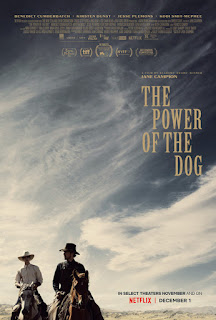
The Power of the Dog

Gloves Off
or
"Well, Well...I Wonder What Little Lady Made This?"
 
Jane Campion knows her Westerns. You can tell that with an opening shot of The Power of the Dog, tracking along the windows inside a house, the interior black, but the outside bright with sunlight, focusing on the outsider walking along parallel to the side of the house, but not a part of it, echoing John Ford and echoing The Searchers, but in her own way.
 
Like Ford, she will play with light and shadow in her western, even depending on it for a visual motif that will form a sub-text in the film, and she will pay particular attention to landscapes that separate people and must be conquered if anything resembling civilization is to take root in that wilderness. Ford's westerns were all about that and the land he photographed was itself a character in that/those stories, not merely a back-drop, not location-for-location's sake. 
 
But, that's what she takes from Ford and goes her own, entirely different way, leaving him and the dream of civilization in the dust. For Campion, the world-building of westerns is as much a myth as the westerns themselves. Civilization is about what people decide to agree on, and if the point of rugged individualists is to play by their rules, there won't be much agreement. Or very little civil.
The man in the window is Phil Burbank (
Benedict Cumberbatch), who, with his brother George (Jesse Plemons) is part of a well-to-do family with a cattle ranch in 1925 Montana. Both brothers—"Romulus and Remus" Phil calls them—are college educated with George knowing the law and Phil the classics of English literature. But, the two couldn't be more different, from each other and their educations. Phil is rough in speech and manner and does most of the work around the ranch, while George is sensitive and does the paper-work. Where Phil is coarse and brutal, George is quiet and empathetic.
They've been working the ranch for a long time, with George leavening the coarseness and conflicts the acerbic Phil causes in whatever he does. At the end of their cattle drive, the crew stops into an inn run by Rose Gordon (
Kirsten Dunst) for drinks and chow. They're served by Rose's son Peter (Kodi Smit-McPhee), who is slight, effeminate, and shy. Peter becomes an easy target for Phil's malice, making fun of everything the boy does, including using the artistic center-pieces that Peter has meticulously created to light his cigarette. Rose breaks down over this and George tries to apologize, since Phil wouldn't think of it, nor would he were it suggested to him.
But, this starts a series of events that drives a wedge between Phil and George, starting with the gentler brother marrying the Gordon woman—Phil considers her (as he says to her face) "a cheap schemer" only after the family money, and once she sells the inn and moves to the Burbank ranch-house, he begins a campaign of intimidation and hostility towards her that drives her to drink—a habit that she had previously disdained. George has paid for Peter to go away to college, but when he comes back, he finds his mother a wreck, and an open hostility against him from the cowboys working the ranch.
Campion breaks with Ford in the portrayal of women as revered stabilizers in the wilds of the West—Rose doesn't have the strength to take command and be the influence that Ford's women are in the isolation of the prairie—and Phil's cunning brute is too entrenched in his "man's world" view to allow any sort of control out of his grasp. The presence of a woman is just too intrusive to his staked-out territory.
But it's more complicated than that. And to say anything more would be to take away some complexities and motivations that might spoil the bumps and shocks that the movie has in store and could ruin its journey for audiences. Let's just say this: Campion has made a Western in locale (and borrowed some tropes from the genre), but she has other influences as well, taken from psychological thrillers and even thrown a shade of Hitchcock, making The Power of the Dog a definite hyphenate. It starts out as one thing—which may make some reconsider if they want to watch something that dark—and eventually changes into something else—something much darker.
But, one cannot parse just how beautiful The Power of the Dog is. Campion, working with cinematographer
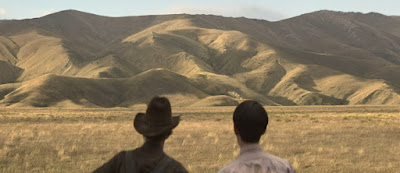
Ari Wegner, has created images of vistas and landscapes that at times take the breath away, sometimes mimicking iconic shots from previous Westerns, at times taking their cue (as in the shot above) from the paintings of Frederic Remington—as previous directors had done. Sometimes you just want to hold on an image before it inevitably movies on, wondering at how it managed to be lit by a single match, or how it captures the troubling disquiet of twilight.
It's a good watch, that will inspire questions and cast a refraction on past examples of the Western—whether the winning of the West wasn't as much a loss, and whether in bringing European culture to the frontier, we didn't drag along something horrible in the process, something that only seemed tame, in our taming of the frontier.


Thursday, July 23, 2020

Cowboys & Aliens

Written at the time o' the film's release...

"This Galaxy Ain't Big Enough for the Both of Us"
or
"Just My Ray-Gun, Pony and Me..."

Good idea, this. Two genres that have been around as long as there've been movies* and have served the same purpose—taking a theme that might be controversial if played in modern street-clothes, but dress it in rawhide or spandex and it takes some of the "edge" off. You'd think the two would go together as well as Zero-G and sawdust, but there have been already some tentative steps in anti-gravity cowboy boots: There have been westerns with a touch of fantasy—The Valley of Gwangi—and Sci-Fi with a western foundation (Outland was High Noon in space suits) but the two haven't really been combined as equal parts as in Cowboys & Aliens (the ampersand is required).
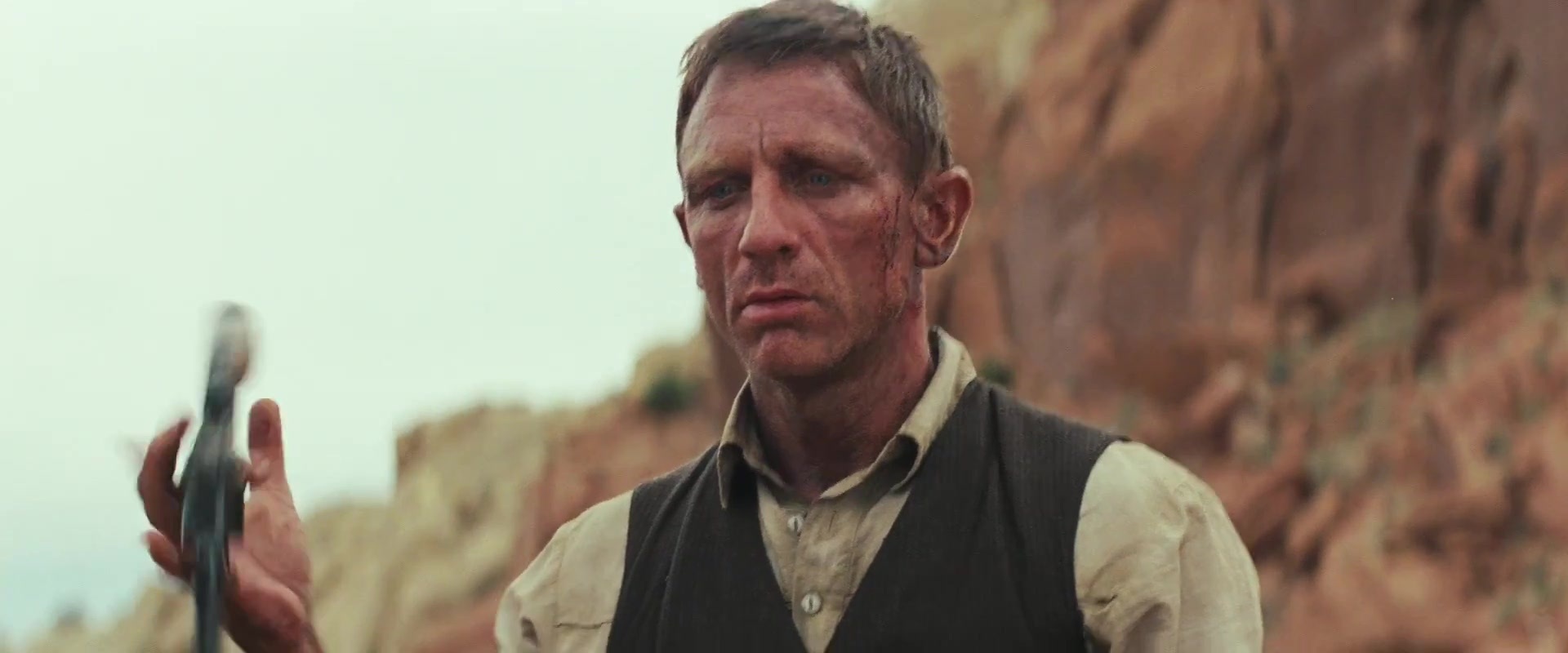
Loosely based on its comic source, it starts in familiar territory—a desert landscape, ancient river-beds long-since dried up and now sun-blasted bluffs and scrub.  Suddenly, a Man With No Name (Daniel Craig) lurches up into frame, sun-burned, bootless, bloodied with a wound in his side.**  He has no memory of who he is, where he is or why he's there (at one point a townie asks him "What DO you know?" "English" is the laconic reply). One odd thing—a thick manacle from wrist to forearm on his left armSmashing it with a rock would work with hand-cuffs, but this thing won't budge. He's set upon by riff-raff that he dispatches in a whirlwind of flying fists and gun-fire. So much for outfitting.  With newly acquired boots, shirt, vest and hat, he climbs on top of a pilfered horse and rides to a nearby town...with a loyal dog in tow. All the elements are in place.
A stranger in town (and everywhere, one assumes), he gets noticed and in trouble—mussing up the son (Paul Dano, really good) of the requisite town rich-guy-fascist (Harrison Ford, low and husky), and getting landed in the hoosegow by Sheriff John Taggart (Keith Carradine, whose Daddy appeared as a gambler in the granddaddy of Westerns, John Ford's Stagecoach). That's sounding like Howard Hawks' Rio Bravo, but about the time Ford's Colonel Dolarhyde (nice name for a rancher) arrives with some hired rough-necks to spring his boy, new arrivals appear in town—blue lights in the sky, which turn into flying ships—they recall fighter-jets in the daylightthat start blowing things up and (in a neat touch) lasso people and yanking them into the skyThe attack sets off The Stranger's fancy bracelet, which starts to "queep," pops up a sight, and knocks one of the ships out of the sky.

Suddenly, The Stranger gets a lot more interesting.
Because the invaders have been nicely particular about who they took—Dolarhyde's son, the Sheriff, the wife of the town's doc/bar-keep (Sam Rockwell, not used well enough, sadly), a posse is formed to find the kidnapees and at this point the movie turns decidedly conventional. It should. It's The Searchers, which begat Close Encounters of the Third Kind. And along the way, the posse manages to accumulate allies in a criminal gang, a tribe of Apaches (who are polite enough not to mention that "an invasion by strange aliens with weapons to take our resources" sounds vaguely familiar), and, for all I know, The Outlaw Josey Wales—who also accumulated an unlikely army that turned into family.  This is useful, because for the big battles with the Invaders, there needs to be a large number of red-shirts and red-bandanas to eliminate, so we don't lose the strays that make up the posse, which include a dog, the Sheriff's grand-son (Noah Ringer), and as Clancy Brown's Preacher (gotta have one of those, too) grouses, "We gotta dog and a kid, we might as well have a woman, too"   
That woman is Olivia Wilde, who spends most of the movie looking enigmatically sultry, while doing things that make you go "eh?" throughout the movie, beyond just the fact that as Craig gets more and more beat-up, her make-up never gets smudged. As welcome as Wilde's presence is in all this testosterone, her character is the most problematic, running inconsistently throughout the film—she's either "capable" or she isn't, and ultimately you realize that she's just a "device" that gets the screenwriters (a squad of them including the two that wrote Star Trek and the "Transformers" films—as opposed to the two who wrote the "Pirates of the Caribbean" movies) out of trouble. Mention should also be made of Adam Beach, who keeps getting better every movie, and Craig who does "the Eastwood thang" real good. Director Favreau (he of Iron Man fame, his chief skill seems to be impeccable casting), manages to direct it absolutely straight, with just enough of a hitch in the standard cliches to make things interesting, rather than well-trod.
Nothing is made of the irony of these new aliens making life difficult for "the natives," save for some terse nods of collaboration between members of the extended posse. That doesn't sadden me too much as most movies these days seem to want to beat you over the head with their "message," in case you don't get it. But, in so doing, Cowboys & Aliens manages to fulfill both the Western and Sci-Fi genre's abilities to put things in unique perspectives to throw a light onto our world. 

As I said, good idea.  A bit fun, too.

But, only a bit.


* As in The Great Train Robbery (1903) and A Trip to the Moon (1902). 

** It's not too unlike the beginning of Silverado where Paden (Kevin Kline) is found by Emmett (Scott Glenn), alone in the desert, robbed of everything but his skivvies.

Friday, May 17, 2019

The Battles of Iwo Jima (directed by Clint Eastwood)

Written at the time of each film's release...

Photo Opportunism

Every year, like clockwork,
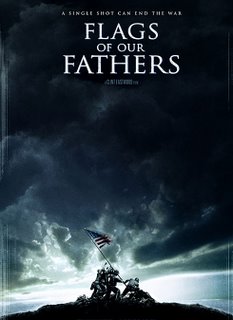
Clint Eastwood makes a new film, and they become instant Oscar-bait. His last one was Million Dollar Baby (Hilary Swank won Best Actress-her second award, and Morgan Freeman won Best Supporting Actor) The year before that, Mystic River (winning Oscars for both Sean Penn and Tim Robbins). Eastwood shoots movies fast in a calm environment and leaves actors alone to do their job. And while most directors are making movies that jump and whirl just to prove they're doing their jobs, Eastwood sets up the shot, does a take or two and moves on. He's efficient, fast, and doesn't do any fancy cutting or post-production. 
In this way, he's very much like his mentor, Don Siegel. Siegel, too, wasn't afraid to throw a little controversy into the mix. Eastwood, a moderate Republican, has made movies recently that have condemned vigilante violence and lack of process (Mystic River), and turned a sympathetic eye to euthanasia (Million Dollar Baby). His recent work is not for the complacent, and Flags of Our Fathers is just as impatient with easy myths and lazy thinking. 
Saving Private Ryan can look at "The Greatest Generation" and sentimentalize them while acknowledging their sacrifice. Eastwood's film has the audacity to question blind patriotism and that sentimentality for the purposes of hucksterism. I'm sure when some neo-con blowhard actually sees this movie there's going to be as much controversy as there was around Million Dollar Baby among panicky right-to-lifers. As it is, I've already heard some CBS radio reporter in Iraq talking about the stationed soldiers "fighting for each other, rather than the cause," a line right out of the movie. How quickly this stuff travels...
Performances are top-notch from a bunch of actors never given their due--here, they shine. Guys like Robert Patrick and Neal McDonough, good actors (whom you know from other things) with odd faces that will never be leading men are revelations here. Gordon Clapp from "NYPD Blue" has one scene of such comic ferocity that you'll never see him the same way again. Ryan Phillipe, thought of as the less-talented of a Hollywood marriage (and ironically they split up right after this film came out), belies that here. Barry Pepper, from Ryan plays an "old vet" of 25, with the slightest veneer of gravitas and bravado. And Adam Beach, of Smoke Signals and the Tony Hillerman adaptations on PBS, has never displayed the potential of his performance here. He has one devastating scene that will get him nominated him for an Oscar and probably win it for him. The day I saw it, there wasn't a dry eye or a nose unsniffled after it. The story of Ira Hayes has been told before on screen and in song, but never so effectively as here.
Eastwood's next movie will be coming out quickly, as he shot it simultaneously with Flags.... It's also about Iwo Jima...from the Japanese perspective-Letters from Iwo Jima.

Eastwood is so good, he's scary.

 -------------------------------------------------------------------------------------------------------------------------

"See you on the other side!"

Somewhere in the planning stages of
Flags of our FathersClint Eastwood had a thought—What was on the minds of the Japanese soldiers who also fought at Iwo Jima? What of the commander who took such a different approach that the badly out-numbered troops could hold off the Americans as long as they did? So with the same crew, and a completely different cast he made another movie on the heels of the previous one that showed the situations and motivations of the defenders of Iwo Jima, based on writings contained in the book "Picture Letters from the Commander in Chief," written and illustrated by the Iwo Jima forces' commander Tadamichi Kurabayashi.

The results,
Letters from Iwo Jima won the National Board of Review's "Best Picture." It's nominated for a Best Picture Oscar, and it incongrouosly won the Golden Globe for "Best Foreign Language Film" ("I guess I have to learn a foreign language now," said Eastwood laconically).
The film is 98% in Japanese with subtitles. Played by a terrific cast (assembled with Eastwood's knack for picking interesting faces) led by Ken Watanabe who after stealing The Last Samurai from Tom Cruise and going to waste in Batman Begins shows how thoroughly he can carry a film. He suggests no one less than Gregory Peck in his portrayal of the American-schooled Japanese tactician who knows the impossible task of defending the last stop to Japan and does so to the best of his ability.
Like that defense strategy Letters is an excavation. In a present day prologue the letters are unearthed by Japanese archaeologists. Flash back to war-time Iwo Jima and the soldiers are digging trenches for the initial beach attack strategy, then digging the elaborate system of tunnels that would prove to be the core of their final strategy. Letters follows several soldiers of various ranks in the days between Kurabayashi's arrival and the fall of the last man. The film wheels between the scenes of the island (filmed in a bleached monochrome broken only by the reds of the Japanese flag, the orange flame of explosions or blood), and of the men's past lives filmed in vivid technicolor. Technically, the film is a wonder. The effects by Digital Domain are photo-realistic, even amidst battles that are shot hand-held and face-close. The explosions singe.
Given the structure, the film is very much in lock-step with such traditonal war-films as, say, The Sands of Iwo Jima, where the personal lives of the individuals in the troop manifest themselves on the battle-field. But the war film it most resembles is the B-movie WWII drama Hell is for Heroes directed by Eastwood's mentor, Don Siegel. Like Letters, Hell... is a view from the trenches, where the conceits of heroism and honor--a constant hook in the dialog of the Eastwood film, everyone talks of honor...or mocks it ("Kashiwara died from honorable dysentery," says a grunt about the whereabouts of a comrade) have no place in the grime and destruction of war. The picking-apart of the hero myth has been the most frequent Eastwood subject. But not even Eastwood has gone as far as Siegel's film to suggest that the maladjusted make the best heroes.
It's interesting that Eastwood has made these two films now: Flags of Our Fathers with its focus on propaganda and the selling of a long war in the face of a populace's flagging enthusiasm, and Letters with its hollow talk of honor and pride in the worst of circumstances. At one point Kurabayashi bitterly reacts to a wire from his superiors, "The Imperial Headquarters is not only deceiving the people, but us as well." The similarities cut across time as well as the disputed borders of the combatants.
And there is a constant reminder of what unites the combatants rather than divides, managing to make the standard war-film trope of "we're more alike than different" that goes all the way back to All Quiet on the Western Front fresh and surprising (that lesson is never hammered home more than in films about the Civil War). The American-trained commanders drink Johnny Walker while grousing about the food, the conditions and their superiors. At times in the dim light the features of the participants blur--it could be any army. Eastwood and his screenwriters--the ubiquitous Paul Haggis and first-time scripter Iris Yamashita work overtime on the ironies, but one stands out. Watch the ivory-handled revolver that Karabayashi wears on his hip. "He must have taken it from an American," says one of the admiring soldiers. He did. But like so many of the twists in Letters from Iwo Jima, it's not in the way you'd think.

Letters from Iwo Jima is an extraordinary film, however, it feels 20 minutes too long (though I've struggled where one can cut it).
Of the two Eastwood Iwo Jima films, I prefer Flags of Our Fathers for being less traditional in its story-telling, and for taking up two subjects--propaganda and the selling of war and patriotism, and survivor's guilt, the practical and mysterious faces of war, that are rarely touched on despite the reels and reels of film that have been dedicated to the subject of battle.


Thursday, February 8, 2018

Hostiles (2017)

Outpost Traumatic Stress Disorder
or
"'Deserves' Got Nothing to Do With It"

Donald E. Stewart died in 1999 after a career as a screenwriter (you may remember his scripts for The Hunt for Red October, Patriot Games, A Clear and Present Danger, and Missing). Now, this is curious: he left a "manuscript" for a project for what was to be Hostiles in the 1980's and Scott Cooper (who directed Black Mass, Crazy Heart, and Out of the Furnace) took up the mantle of the film, seeing it through to completion last year.

Hostiles is in theaters now and the promotion of it, the ads on television of it, has led to a lot of questions on my part—it's a Western (a rarity these days) but what type of "Western" is it going to be? Is it going to be myth or truth? Is it going be clean or messy? Tragedy or triumph? Is it Nation-building or genocide? Is it going to hearken back to Westerns of the past or plow new ground? What sort of animal is this "Western" going to be?

It's opening quote by D.H.Lawrence doesn't help much, except in retrospect: "The essential American soul is hard, isolate, stoic, and a killer. It has never yet melted."

Yep.

We're told it's 1892 in New Mexico and in a valley of scrub squats a naked farmhouse. Riders approach. Wesley Quaid (Scott Shepherd) is working when he sees the five horses appear over a ridge, his wife Rosalie (Rosamund Pike) is teaching adverbs to her daughters ("how where and when"), with the baby asleep in the next room, when Wesley busts in and tells her to run to the woods like they'd planned and don't look back. But, she can't. Wesley shoots, but almost immediately he is shot full of arrows and scalped. Running with the baby in her arms, she is horrified that her daughters are picked off with rifle-fire, but she still runs and hides. The Comanche raiders can't find her, but they set fire to the house. The baby is dead in her arms from a bullet that didn't reach her. 

Captain Joseph Blocker (Christian Bale) returns to Fort Berringer, New Mexico, after capturing an Apache family that has escaped. He and Master Sergeant Tommy Metz (Rory Cochrane) share a bottle and reminisce about their long campaigns fighting the South and then the Plains Indians; Metz has been relieved of his guns due to "melancholia" ("There's no such thing" says Blocker) and confesses he's going to retire, but the Army, as it always does, has other plans.

Berringer's commander, Biggs, (Stephen Lang) has orders—"a cause celehbray"—from President Harrison: one of the fort's prisoners, a Cheyenne Chief named Yellow Hawk (Wes Studi), is dying of the cancer and Biggs wants Blocker—and no one else—to escort him and his family back to "The Valley of the Bear" in Montana so he can die in his homeland. Blocker is adamantly opposed to the idea and refuses, to the point of insubordination. As a conveniently expository reporter for Harper's Weekly informs us, Blocker has probably scalped more men than Sitting Bull "himself," and while Blocker acknowledges that it is not his place to disagree, he will not carry out the orders and would just as soon cut the throats of every member of the family. Biggs tells him to sleep on it; he leaves in the morning.

After a night straight out of a Terrence Malick movie where Blocker walks out to the prairie with a thunderstorm in the distance and screams his protests about it, he gears up and takes a squad with him: Metz (of course); buffalo soldier Corp. Henry Woodson (Jonathan Majors); a rookie out of West Point, Lt. Rudy Kidder (Jesse Plemons); and a Pvt. Phillipe Dejardin (Timothee Chalamet), who everybody calls "Frenchie." Once out of sight of the fort, Blocker stops the party saying "the fuckin' parade's over," takes out two Bowie knives and orders Yellow Hawk to dismount, offering him one of the knives. The Chief scrutinizes the Captain "I do not fear death" he says in Cheyenne, and Blocker orders the two Cheyenne males to be chained up for the rest of journey to Montana.
They don't get too far until they find the Quaid farm, still smoking, the dead unburied, and Mrs. Quaid sitting in the burned out husk of her home, still holding her dead infant, with her daughters tucked neatly into bed. She demands that they not be disturbed, and Blocker, with a career of dealing with tragedies like this, places the emphasis on comfort rather than pushing the realities of the tragedy on someone still in shock. Even the offer of burial of the loved ones is dropped...immediately...when the woman, in her grief, demands she do the job herself. She digs and digs why the soldiers stand by, finally pawing in the dirt (much like Blocker raked the ground in the "Malick segment") until assistance is gently offered and she acquiesces, allowing for a service to be performed just after the sun has dropped below sight.
This hasn't gone unnoticed by Yellow Hawk and his party. The old chief goes to Blocker and requests that he and his son be unchained to better assist in any defense against the Comanche renegades. He is entirely practical and sees danger for all parties "They are snake people," he tells Blocker in Cheyenne. "They do not discriminate." The words weigh on the captain but he will not relent. The chief may make sense, but not enough to soften his caution. For him, it comes down to deeds, not words. It is only after an encounter with the Comanche that leaves Woodson wounded and Dejardin dead (and three of the Comanche dead, one by Yellow Hawk running over him with his horse and another by his son, Black Hawk (Adam Beach) strangling him with the very chains that bind him does he relent. The Captain can be practical, too.  
He's also different than most Western heroes. You know the type. Most of them are fierce subscribers to the idea of "Manifest Destiny," (as in "there's a wilderness to be tamed and, by God, I'm the one to do it"*). The wilderness is one thing, but the indigenous peoples living on it before them is quite another. Most of the time, we just get the settlers' view of things, but about 50 years after movies were created (and "the Western" along with it, scarce decades after the real thing happened), we started to get a thread of the viewpoint of the First Peoples' point-of-view which can be summed up as "there goes the neighborhood" or more contemporaneously "who let all these foreigners in here?" The making of the nation was pretty much boiled down to a governmental experiment combined with a continental race war. But, it really wasn't until John Ford made The Searchers in 1955 that we got to see the racial aspects of the Western, and it was write large when its top-billed star—John Wayne—played the character of Ethan Edwards, a complete and total (and unrepentant) racist.**
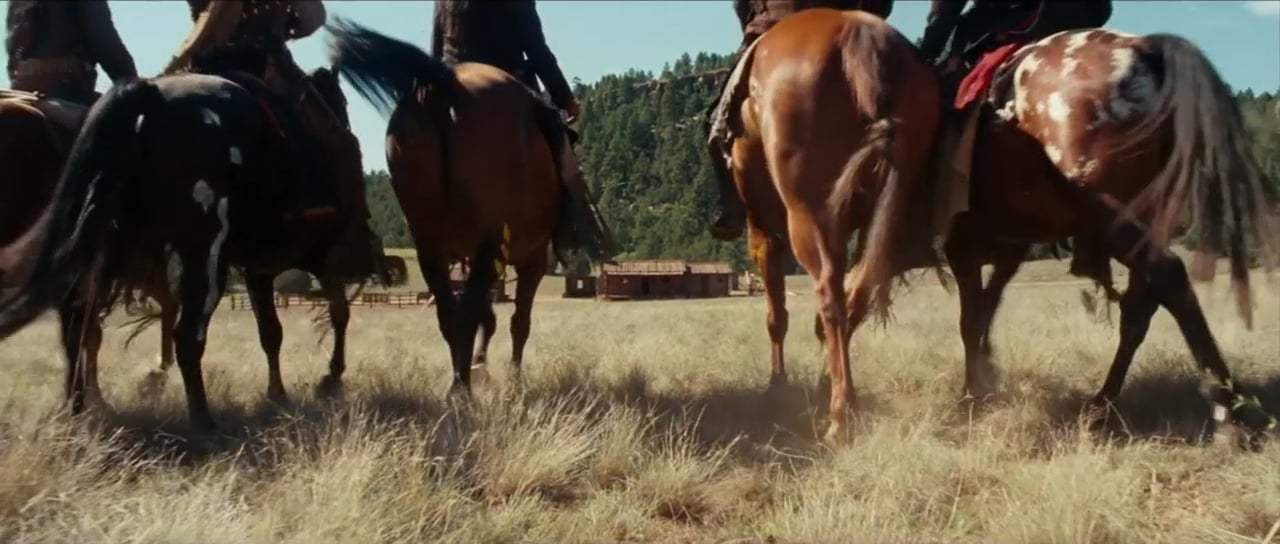
Your initial impression of Captain Joseph Blocker leads you to think he runs along the same lines—and director Cooper nudges the cine-philes in that direction by opening with a similar family massacre and a shot from the interior of the house that frames Nature in a doorway in the same manner that The Searchers did in its initial images. But, Blocker does not see things as merely black or white, but more of a shade of mordant gray. He's not a strict racist, per se (and his tearful leave-taking of Corporal Woodson is meant to dispel the notion), he just hates Indians—at least his experience as a soldier has taught him that that should be his first line of defense. He's seen too much death, and, in turn, caused too much of it to think that any business with Natives is not a good business. And it comes to him as naturally as putting on his uniform.***
And, as if to prove the point, Cooper takes it a step further; at a Colorado outpost along the way (where Woodson can be doctored) and Mrs. Quaid might take her leave, Blocker and his troop are given another task—escort Sgt. Charles Willis (Ben Foster) to Montana to be hanged for murder. He's given a couple more guards, and, despite the offer of sanctuary, Mrs. Quaid opts to continue to ride with the troop to Montana. And it is this portion where most of the reviews of Hostiles has been a might unfriendly.
Some of the accusations against Hostiles comes to its length at just this point—some folks think you don't need the Willis character, but I see it as a bit of reinforcement to shore up what might be a too-easy character arc for Blocker if it did not exist. Willis provides him a chance to look in a dark mirror, and see what might transpire of a man who goes down a wrong path. Willis—who once served with Blocker, and was at Wounded Knee with him—has taken his military experience and gone off the rails, murdering civilians, crimes for which he has been convicted and is on his way to be punished for. It may pad the movie a bit, but it does allow the alternative side to be heard from; Willis and Blocker are not the same man, but their paths are marked by similar times and occurrences, the accumulation of which have created the men they've become. Blocker could let those instances influence his choices, let the past influence the future, holding the names of the men killed under his command as a shield...or an excuse. His prisoner is the bad angel tempting him from the path he appears to be taking—made manifest (in all senses of the term) with his own destiny hanging in the outcome.
As you might be able to guess, I love Westerns. It's one of the two genres (besides science-fiction) that puts a mirror to our current age, speaking to us from the past (or the future), from the "when" about the present, about us and where we are today—about the "why" and the "how". Somehow, putting us in another frame of time puts us in another frame of mind, as well. The locale is different, but we can still recognize the human condition while it teaches us from a different perspective than the familiar, if we choose to recognize it.
Hostiles is of an age, 'way past the films of John Ford (although it pays homage to The Searchers), which dared to even bring up the matter of race in movies that were considered just "cowboys 'n injuns," to consider the Western as myth—and, as such, makes more than a passing reference to Eastwood's Unforgiven (even cribbing a line from it) and bringing a certain spin on the same director's The Outlaw Josey Wales—in how the battle to build a Nation exposes the best and worst of our natures, and, if we survive it, how, after the last echoes of gunfire fade, we choose to continue the journey—by looking back or looking forward? Do we continue it by building or by retrenching? Do we look to our bloody past or look to an uncertain future? Where is there security in either?  
Hostiles has a preference, obviously, but, in its penultimate sequence it still challenges those assumptions, by putting another challenge—another dark mirror—in the way of civilization...of nation-building. The choices are elemental, the ramifications complex, but it comes down to choosing sides...and what side you're on.
Like I said, I love Westerns, and I like them best when they're challenging. And Hostiles is one of the most challenging of the breed.


* See also: "a man's gotta do what a man's gotta do."

** If you could get past the fact that the character was played by traditional Western hero, John Wayne (which a lot of people couldn't). Some people see him as a hero without noticing that the one GOOD thing he does goes entirely AGAINST his previous intentions and inclinations...and that the movie basically shuns the character and bars him from civilization.

*** Christian Bale has a funny little character "tic" when his character is thinking—he rubs his scalp at the line of his hair...as if he's valuing it and saying good-bye to it for the last time if he thinks wrong.