Showing posts with label Ryan Phillipe. Show all posts

Saturday, May 13, 2023

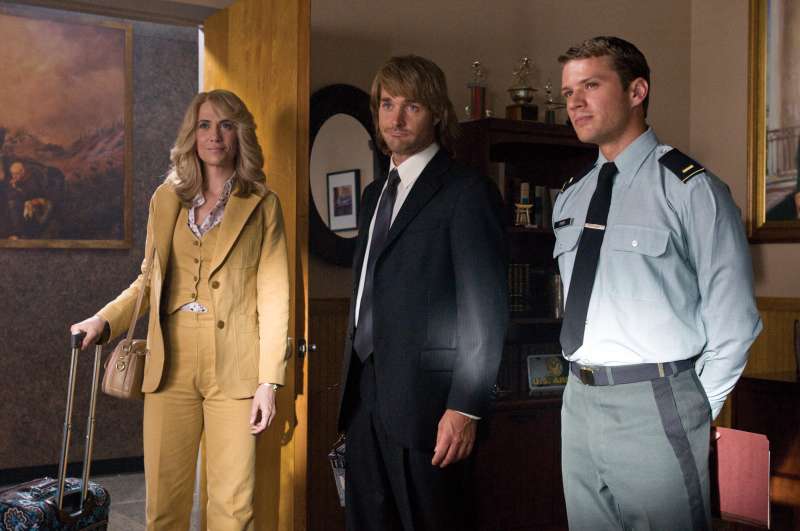
MacGruber

Saturday is traditionally the night for "Saturday Night Live" and...."Take Out the Trash" Day

"Making Something of Spit and Bailing Wire, and Getting...Spit-Covered Bailing Wire"


The track record for any movie coming out of the sketch-comedy of "Saturday Night Live" is pretty abysmal. The Blues Brothers and Wayne's World did fine, but their sequels didn't. We won't bring up A Night at the Roxbury, The Coneheads, The Ladies Man, It's Pat!, Stuart Saves His Family, ad infinitude. The reason is as obvious as a Mike Myers first-draft (are there any others?)—a concept that can, at most, sustain itself for under 10 minutes has chances of "slim" and "none" of being any good stretched to 90 minutes, let alone two hours. Thank God we've never seen "Subliminal Man" made into a movie...or "The Continental."

As a 5-minute sketch idea,
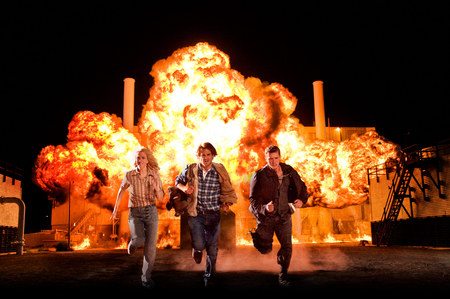
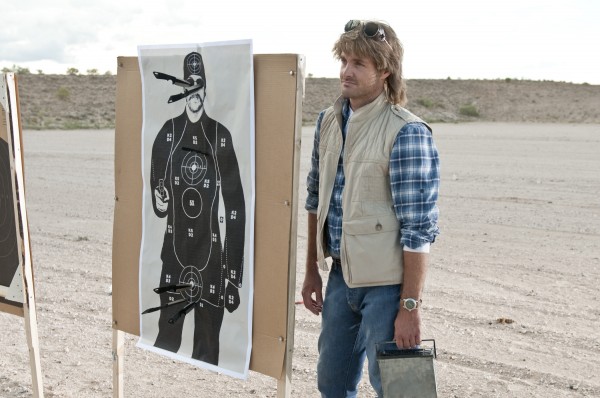
MacGruber fits the bill for an "SNL" skit, although it's concept is the same week after week, the minutest of details being the only things changing. Will Forte plays a dorky McGyver-type, who has mere moments to defuse a bomb by creating something...bomb-defusing...using icky stuff that no one wants to touch let alone re-configure. And, of course, there are complications while Kristen Wiig does a panicked clock-check. The sketch ends with a building blowing up. Cue the Band. Christine Aguilera comes up after the break.
Same joke, every week. If something works once on "Saturday Night Live," they'll keep doing the sketch until that comedian quits or is canned. Somewhere along the way, some exec thought it a good idea to turn that well-tread idea into a feature.
It's sporadically funny in a "I-know-you-are-but-what-am-I" kind of lameness. And it boasts
Ryan Phillippe (in slow-burn mode), the usually drop-dead-funny Wiig, and such good actors slumming as Powers Boothe (good to see him) and Val Kilmer, trying to re-capture his youth with a goofy comedy role (I'm suddenly waxing nostalgic for Real Genius and Top Secret!--the name of Kilmer's character is Dieter von Cunth, which shows you the level of humor, but doesn't clue you in that they will use it over...and over...and over...and over...for a rapidly declining chance of a laugh).
In this, MacGruber is coerced out of retirement ("I thought you were dead, MacGruber.." "So did I") in a remote native village (where he can find peace), when it's learned that von Cunth may be up to something no good.
* Stuck in the 80's with his mullet, his plaid shirt, tan utility vest, and his Blaupunkt removable in-dash tape-player (he takes it everywhere). One wishes there were more entertainment value in seeing the usual action cliche's—the ones that turn up routinely (and straight) in Michael Bay films—played for laughs: the slow motion team walk, the fiery mega-explosions that have no hearing loss attached to them, the smug banter that passes for dialog, but the laughs are few and far between. You'd think given the time and budget they'd have come up with a grander concept—maybe even come up with a clever gadget or two—but there's nothing like that here. The best idea MacGruber (and the movie) can come up with is creating a distraction by going commando and parading around with a celery stalk up his ass.

No. Really. And they do it twice.

They couldn't even think up a "gadget." For pity's sake.
Save yourself. The clock is ticking. Don't go anywhere near this bomb, and watch these "MacGruber" video's instead.
* ...Like the rest of the movie.

Friday, March 25, 2022

Don't HATE HATE HATE Me Because I Like Crash (2004)

Here's another "Best Picture" article from the archives. It's a bit different in that I was addressing the response to Crash—the 2004 film and not david Cronenberg's controversial 1996 film—and the backlash to it winning its "Best Picture" Oscar. Being as it's something I've written in the past, I made a sweep for dead links and was disturbed that writings I had sighted in this have since gone dead, particularly those by critic Jim Emerson that I addressed. I wish they were here. Emerson's a fine writer and critic and his lack of representation, particularly on the rogerebert.com site (which began at the Chicago Sun-Times website) is a crying shame (it should be noted that Ebert hailed Crash as the best film of that year, but I don't think that has anything to do with any of this, but more that the Sun-Times was clearing out articles from the defunct Ebert site to make room on their servers). Anyway, I wish there was something I could do about that, and, sadly, I can't. These articles are just not available anymore. I think that's a great loss. I did find this, though.
 
Mike Lippert of the much-read movie blog "You Talking to Me?" (MIA since 2013) is having a blog-a-thon—one of those community drum-circles, where we pound on a theme and and listen to the echoes it creates. I don't participate very often in these, but when something inspires a surge in heart-beats, I plunge in. This time, the theme is "Justify Your Shitty Taste:" find a movie that has been given short-shrift and explain why you like it—defend yourself and your contrary opinion. Well, I had a piece in the hopper that I wrote years ago to a film that has had its share of acclaim—even winning Best Picture at the Oscars—but meets with such condescending sneers every time it gets mentioned in "movie circles" that I've always felt the need to defend it—up to a point...and then I give up. There's only so many times you can hit your head against a brick wall without doing damage to your own exquisite taste (that was written with sarcasm, btw). Here, from the depths of my ignorance (and my ever-growing "Draft" pile) is my justification of Crash.

Hello, my name is James Wilson, and I like Crash (Paul Haggis, 2004).
 
(Audience response: "Hi, James Wilson")
 
It's really funny...really funny, to the point of out-loud chuckles...the extreme reactions Crash gets from its many, many detractors—there's even a web-site that compares other Best-Picture winners to whether they're "worse than Crash". When Jim Emerson mentioned it as one of his least favorite movies (he has, in the past, listed it as one of his "sociopathic barbarities")* in a recent blog post, the comments section went up in arms with lemming-like ferocity. "I HATE HATE HATE Crash!" yelled (caps indicative) one of the comments.**

I don't. I like it. With the same rictus smile that I appreciate other cynical films.  And the more extreme the reaction to it, the more I smile, because it only drives home the film's point further, and exposes it as true.
Now, some (but only some) of the hatred of Crash comes from folks who consider Crash the usurper that took the "Best Picture" Oscar from *sigh* Brokeback Mountain (as if the Oscars are ever truly the indicator of quality). Now, I didn't mind Brokeback--there was much to admire--the stunning cinematography, Larry McMurtry and Diana Ossana's cruel, no-holds-barred/no-feelings-spared screenplay, and Heath Ledger's performance—someone finally captured the essence of the archetypal head-strong, mumbling western dude (and the guy was Australian, fer cryin' out loud!). Plus, there was something altogether shattering about his memorial to his lost love, in lieu of grave-stone. But, there was nothing in Brokeback Mountain that hasn't been done in every sudsy straight soap of the last eighty years. Nathan Lee of the Village Voice put it far better than I: Ann Proulx's bitter post-Oscar diatribe has a lot of empty fire to it, but, c'mon, honey, you were borrowing Faulkner's pen and you know it. And for anyone who thinks gay cowboys are revolutionary, skip right over the Village People and Jon Voigt for a moment and go directly to Red River. Howard Hawks knew it. Lenny Bruce knew it. Montgomery Clift, no doubt, knew it. "Cultural watershed?" Only if you weren't paying attention.
But Crash is the better movie. Crash is the subtler movie, believe it or not. Crash deserved that Best Picture Oscar, because it pulled off a great trick: it pissed off a lot of people, only proving its point.

Let me just say one thing about Crash: It's not "about" racism.

Yes, yes, I know, racism is all over the thing, morally repugnant, down and dirty, pig-ignorant racism. From all sides, and all races. And if racism was all it was about, yeah, some of the hatred for the film might have a point, because all the movie does is say "racism exists, and there's nothing you can do about it," which doesn't make it the Feel-Good Movie of the Year. If it was only about racism, then it would truly be committing that great movie sin "exemplifying what it rails against" like, say, Rollerball that says violence is a terrible thing and then rubs your nose in it for two hours. Or an "anti-war" movie that relishes its battle sequences. If it were so, 'twas a grievous fault.

But Crash is not just about racism. Racism is a symptom in it, but it's not the "end-all, be-all." Myopia is. The denizens of Crash are all folks (with very few significant exceptions) who've got it all figured out. Entrenched in their lives, in their jobs, in their bureaucracies, they think they've seen it all and they act appropriately. We've seen their type in movies before. Like Bogart's Richard Blaine in Casablanca who "sticks (his) neck out for nobody." Or Jack Nicholson's J.J. Gittes in Chinatown,*** who when asked what he did as a cop down there replies "as little as possible." They're not people of color, they're all gray, walking around with blinders on (which is why the movie's called Crash and not, say, Clash.) They all know "the score" and so they've stopped thinking. They live their cloistered, blindered lives in the grids of L.A. in their own little boxes of assumptions and none of them will try to see beyond them. They are numb to the world, and the cultural clashes are battles over turf, amplified rhetoric and action so (as Don Cheadle—who also produced the film—playing Detective Graham Waters says in the opening line of dialogue) "they can feel something."
Except...except. Haggis has been accused of manipulation (and like, duh, all movies are manipulative, hate to break it to you) but the most egregious examples are the pretty obvious incident of the "invisible cloak." I think every viewer above a third grade education knew what was coming--the kid was going to get "whacked" with her invisible cloak, because, hey, we're all cynics, and the movie has been pretty cynical up to that point--actually the characters IN the movie have been pretty cynical. But not the kid. In an altruistic, completely naive and childlike way, the kid goes beyond what any of the adults would do and makes a sacrifice to save her father. We all assume that to her doom, and Haggis milks the anguish, and delays the inevitable reveal. The kid's not dead. Why? Because the daughter of the angry shop-keeper has also thought outside the box, and bought her old man blank cartridges. Both those individuals have gone beyond the "I stick my neck out for nobody" syndrome, and the synchronicity has pulled off a miracle, or at least, prevented a tragedy, brought on by short-sightedness.
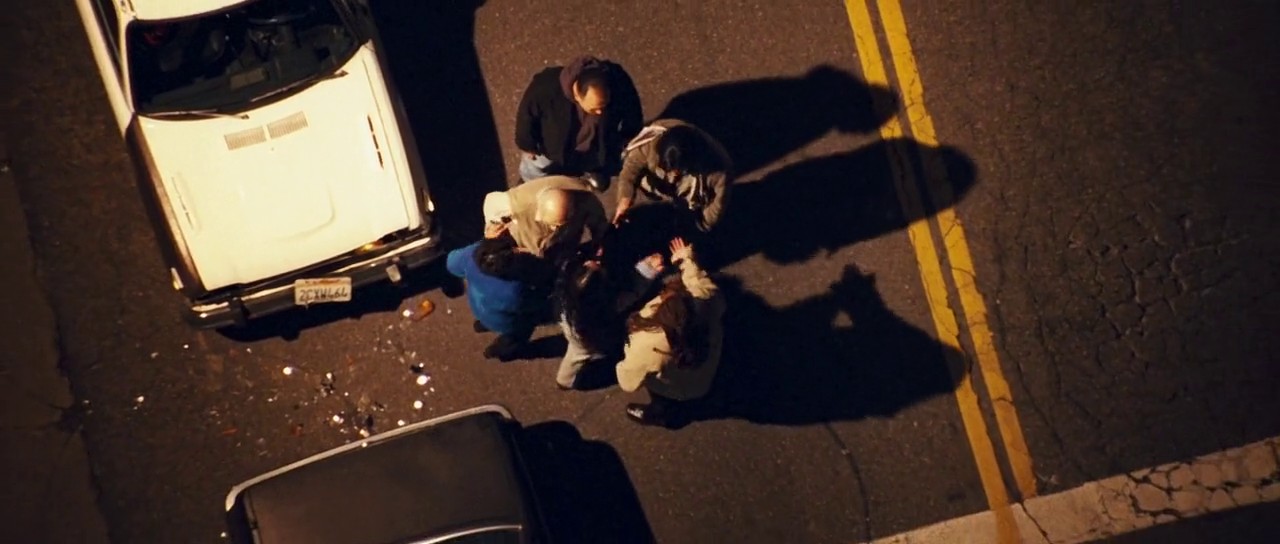
Myopia is all over the movie--even when racism isn't. Because there's more than racism going on. It's blacks against whites, whites against blacks, cops against civilians, politicians against the cops, the bureaucrats against the trench-fighters, upper class against lower class, and the reciprocal vice-versa. Myopia is ever-present, and everybody stops thinking when they reach their assumptions...and look no further. The insurance worker thinks the guy on the line is a dead-beat, the guy on the line thinks she's a bitchy negro. They both have drawn lines in the sand and will go no further. Matt Dillon's bad cop just assumes all the minorities are scum, so he treats them accordingly. Ryan Phillippe's good cop takes the high road and assumes he'll never act like that in any given circumstances. They're both short-sighted fools. And they won't consider any other possibility. They're two sides of the same coin.

For me, Crash plays like a post-modern film-noir, where the world is crummy, people are tarnished (whether they're rich or poor), but there is no "slumming angel" (as
Ross McDonald put it) to try and make things temporarily right—all the characters in Crash have that ability if they choose, if they will, and there is no hand-holding narrator or Stage Manager bringing perspective, merely the dispassionate view from on high. The good that people do are mere slats of light in an all-enveloping darkness, not unlike the the noir's traditional backdrop, the venetian blind, or as the de-focused headlights in the film's credit sequence.

Another criticism: Too many coincidences in Crash? Yep, but that's to be expected with an ensemble cast in a limited area whether it's La Ronde, or Grand Hotel, or even...the acclaimed Babel where the coincidences are hemispheres apart (those butterflies are mighty powerful!). But Crash isn't like any of these films. The one I compare it to, both in tenor and reaction is The Rules of the Game,
Jean Renoir's condemnation of pre-WWII French society going to its ruin in selfishness and self-involvement. French folk hated The Rules of the Game, too. In fact, riots broke out in theaters, and to try and save his investment Renoir kept cutting it and cutting it to try to assuage the angry mob. As a result, after the war when the hysteria died down, it was difficult to find an unexpurgated version of The Rules of the Game until...1958. The tyranny of the mob had done its damage and its only by the luck and a little hard work that a longer copy of this classic exists. Fortunately Crash hasn't had to go that far. Maybe people are just more passive-aggressive these days, content to HATE HATE HATE in the relative anonymity of a bogus screen-name. Maybe that's progress?

So, if I'm in a crowd of people and Crash comes up, and folks get angry about it because it's "about" racism but doesn't "do" anything about it (I suppose a cameo by Rodney King might help...?), I don't say anything. It won't do any good. Folks have already made up their minds about Crash and if I try to point out they might be wrong and consider that possibility...no, no, that won't happen. Their thoughts stop at "racism" and go no further, thus proving the movie's point all over again, and proving, once again, why it's such a good film.


Ultimately it's a tough and pointless duty to watch a film with blinders on.  It's no way to see a film, and it's no way to lead a life...as Crash, for all its flaws, so ably demonstrates.
 
Afterward (2022): If anything the last 17 years have only cemented my feeling that Crash was important and is important. I've read the criticisms—I don't agree that the whites are inspired to become better persons (I think they'll all stay racist —even Matt Dillon's story after pulling Thandiwe**** Newton out of a burning car) as a result of the movie's stories. I think after "The End" title of Crash everybody is going to continue to be racist and myopic for the same reason everybody really is racist and myopic—they don't know any better and it's easier. It's why I don't believe we're in a "post-Racial" period (as so many "glass-half-full" believers seem to think). The slew of African-American deaths at the hands of police, the resulting "Black Lives Matter" demonstrations, the resulting paranoia about and demonizing of the "Black Lives Matter" demonstrations, the emboldening of hate-groups, of white supremacists, the January 6th insurrection, the hysterical terror of some groups that whites will be a minority in the U.S. by 2045, the "faux" CRT uproar—CRT has only appeared in college-level classes and parents should be more worried about calculus being taught K-12—right on up to the recent Supreme Court hearings just goes to prove that lines are drawn and they're drawn in indelible ink. If anything we're worse. And more myopic. And bolder about being proud of it.***** The bubbles we've created around ourselves have only grown thicker with the Internet. And the only way we're going to get out of our protective bubbles is by accident. And (as Major Kong says in Dr. Strangelove) "that goes for every last one of ya, regardless of your race, color, or creed."

And I've given up on Darwin as there's no evidence that the bad die faster.

Oh. And whether I think Brokeback Mountain should have won over Crash? Nope. And I'll use the words of saloon-keeper Richard Blaine as a reason: "The problems of two little people don't amount to a hill of beans in this crazy world."

In fact, if it was up to me, I would have vastly preferred Munich or Good Night, and Good Luck.


* ...which is a far cry from what he wrote in 2006: "As restrictive as the rules of this cycle may be, Crash still manages to be an unusually mechanical instance of it. With numbing predictability, every positive character is revealed to have a negative side (the good, tolerant cop, played by Ryan Phillippe, commits an impulsive, racially-triggered murder), while every negative character is revealed to have his or her positive (the racist cop, played by Matt Dillon, risks his life to save a black woman trapped in a wrecked car). Just about everyone is an instinctive racist, and just about everyone is a victim of racism, who learns his or her lesson when the tables are turned. Haggis piles up the coincidences that bring his characters together without shame or the slightest restraint; he seems to feel that by emphasizing the contrivances of his plotting, he is in fact revealing a hidden pattern, a secret will, that organizes the world. Turning bad writing into a metaphysical principle is indeed an accomplishment, and one that might well deserve an award – though Best Picture of 2005 is going a bit too far." 

From this to "sociopathic barbarity" is quite the change of opinion.  The above is reasoned analysis.  The latter is just hectoring screed.  Hating Crash became easier and more comfortable, then ratcheted up to the extreme.  Now, what was Crash saying again?

Emerson does this at times—I'll be shocked if there is ever a Christopher Nolan film that he will praise, rather than merely dismiss it, and he condemned Clint Eastwood's Flags of Our Fathers (without even seeing it) merely because Haggis had a hand in the screenplay—to his credit, after actually seeing it, he praised it.  This may sound like bashing the man, but Emerson's is a great voice in film criticism, and I love reading his output, whether I agree with it or not.  His is an essential voice in the understanding of the mechanics of how film can touch the eye and the brain and move the heart.  If he ever stops writing, I will mourn that day.

** Which reminds me of the George Clooney retort to the web-site that said he was "GAY GAY GAY:" "Two GAY's, maybe, but the third's a little extreme."

*** Chinatown also makes a point of using prejudice, not just racial, but class prejudice, as a distinctive example of reactive, rather than thinking, behavior.

**** That's not a typo and, yes, you remember it as "Thandie," but she's gone back to the original Zimbabwe spelling because...hey, why not...and you can only assuage Hollywood's simplifications for so long. 

***** I read a slug the other day they there's some Republican buzz about bringing back miscegenation laws. What the hell?

Wednesday, May 13, 2020

Breach

Written at the time of the film's release...

  Breach (Billy Ray, 2007) You look at Billy Ray's CV and you gotta wonder: this guy wrote Color of NightLegalese, Hart's War and Volcano, and he's still working?* 

Yeah, well, he's also directed..with a very clean, unfussy style..the wonderful Shattered Glass (which should be remembered for demonstrating just how GOOD an actor Hayden Christensen is) And he brings that same no-nonsense approach to Breach, the filmed account of the investigation and 2001 arrest of FBI analyst Robert Hanssen who had been selling secrets to the "Bolsheviks" right under the noses and within the confines of the FBI. Like Shattered..., Breach is concerned with the "Who" and "Why," as much as the "How," and Chris Cooper makes the contradictory/unreadable Hanssen a fine screen creep who would freak any employee, much less one recruited to spy and take notes

If Cooper plays a prominent spook, Phillipe has the unglamorous role of the kid who has to do the perversely dirty deed of turning in his boss, appear on the edge of paranoia without being too obvious about it, and walk the moral razor of doing the right thing and being a cheese-eater. Laura Linney's on hand, too, playing one of her few hard-ass roles. It's competent, involving, and scary to know that some semblance of this actually happened

And it has a gut-punching ending that's earned.

* Oh, he's still working, alright and doing quite well for himself, adapting and directing a version of Fitzgerald's The Last Tycoon, developing the original Hunger Games script, as well as Captain Phillips, the weird unique Overlord, contributing to the soufflé that was Terminator: Dark Fate, and taking sole credit on Richard Jewell.

Friday, May 17, 2019

The Battles of Iwo Jima (directed by Clint Eastwood)

Written at the time of each film's release...

Photo Opportunism

Every year, like clockwork,
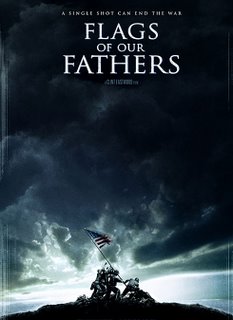
Clint Eastwood makes a new film, and they become instant Oscar-bait. His last one was Million Dollar Baby (Hilary Swank won Best Actress-her second award, and Morgan Freeman won Best Supporting Actor) The year before that, Mystic River (winning Oscars for both Sean Penn and Tim Robbins). Eastwood shoots movies fast in a calm environment and leaves actors alone to do their job. And while most directors are making movies that jump and whirl just to prove they're doing their jobs, Eastwood sets up the shot, does a take or two and moves on. He's efficient, fast, and doesn't do any fancy cutting or post-production. 
In this way, he's very much like his mentor, Don Siegel. Siegel, too, wasn't afraid to throw a little controversy into the mix. Eastwood, a moderate Republican, has made movies recently that have condemned vigilante violence and lack of process (Mystic River), and turned a sympathetic eye to euthanasia (Million Dollar Baby). His recent work is not for the complacent, and Flags of Our Fathers is just as impatient with easy myths and lazy thinking. 
Saving Private Ryan can look at "The Greatest Generation" and sentimentalize them while acknowledging their sacrifice. Eastwood's film has the audacity to question blind patriotism and that sentimentality for the purposes of hucksterism. I'm sure when some neo-con blowhard actually sees this movie there's going to be as much controversy as there was around Million Dollar Baby among panicky right-to-lifers. As it is, I've already heard some CBS radio reporter in Iraq talking about the stationed soldiers "fighting for each other, rather than the cause," a line right out of the movie. How quickly this stuff travels...
Performances are top-notch from a bunch of actors never given their due--here, they shine. Guys like Robert Patrick and Neal McDonough, good actors (whom you know from other things) with odd faces that will never be leading men are revelations here. Gordon Clapp from "NYPD Blue" has one scene of such comic ferocity that you'll never see him the same way again. Ryan Phillipe, thought of as the less-talented of a Hollywood marriage (and ironically they split up right after this film came out), belies that here. Barry Pepper, from Ryan plays an "old vet" of 25, with the slightest veneer of gravitas and bravado. And Adam Beach, of Smoke Signals and the Tony Hillerman adaptations on PBS, has never displayed the potential of his performance here. He has one devastating scene that will get him nominated him for an Oscar and probably win it for him. The day I saw it, there wasn't a dry eye or a nose unsniffled after it. The story of Ira Hayes has been told before on screen and in song, but never so effectively as here.
Eastwood's next movie will be coming out quickly, as he shot it simultaneously with Flags.... It's also about Iwo Jima...from the Japanese perspective-Letters from Iwo Jima.

Eastwood is so good, he's scary.

 -------------------------------------------------------------------------------------------------------------------------

"See you on the other side!"

Somewhere in the planning stages of
Flags of our FathersClint Eastwood had a thought—What was on the minds of the Japanese soldiers who also fought at Iwo Jima? What of the commander who took such a different approach that the badly out-numbered troops could hold off the Americans as long as they did? So with the same crew, and a completely different cast he made another movie on the heels of the previous one that showed the situations and motivations of the defenders of Iwo Jima, based on writings contained in the book "Picture Letters from the Commander in Chief," written and illustrated by the Iwo Jima forces' commander Tadamichi Kurabayashi.

The results,
Letters from Iwo Jima won the National Board of Review's "Best Picture." It's nominated for a Best Picture Oscar, and it incongrouosly won the Golden Globe for "Best Foreign Language Film" ("I guess I have to learn a foreign language now," said Eastwood laconically).
The film is 98% in Japanese with subtitles. Played by a terrific cast (assembled with Eastwood's knack for picking interesting faces) led by Ken Watanabe who after stealing The Last Samurai from Tom Cruise and going to waste in Batman Begins shows how thoroughly he can carry a film. He suggests no one less than Gregory Peck in his portrayal of the American-schooled Japanese tactician who knows the impossible task of defending the last stop to Japan and does so to the best of his ability.
Like that defense strategy Letters is an excavation. In a present day prologue the letters are unearthed by Japanese archaeologists. Flash back to war-time Iwo Jima and the soldiers are digging trenches for the initial beach attack strategy, then digging the elaborate system of tunnels that would prove to be the core of their final strategy. Letters follows several soldiers of various ranks in the days between Kurabayashi's arrival and the fall of the last man. The film wheels between the scenes of the island (filmed in a bleached monochrome broken only by the reds of the Japanese flag, the orange flame of explosions or blood), and of the men's past lives filmed in vivid technicolor. Technically, the film is a wonder. The effects by Digital Domain are photo-realistic, even amidst battles that are shot hand-held and face-close. The explosions singe.
Given the structure, the film is very much in lock-step with such traditonal war-films as, say, The Sands of Iwo Jima, where the personal lives of the individuals in the troop manifest themselves on the battle-field. But the war film it most resembles is the B-movie WWII drama Hell is for Heroes directed by Eastwood's mentor, Don Siegel. Like Letters, Hell... is a view from the trenches, where the conceits of heroism and honor--a constant hook in the dialog of the Eastwood film, everyone talks of honor...or mocks it ("Kashiwara died from honorable dysentery," says a grunt about the whereabouts of a comrade) have no place in the grime and destruction of war. The picking-apart of the hero myth has been the most frequent Eastwood subject. But not even Eastwood has gone as far as Siegel's film to suggest that the maladjusted make the best heroes.
It's interesting that Eastwood has made these two films now: Flags of Our Fathers with its focus on propaganda and the selling of a long war in the face of a populace's flagging enthusiasm, and Letters with its hollow talk of honor and pride in the worst of circumstances. At one point Kurabayashi bitterly reacts to a wire from his superiors, "The Imperial Headquarters is not only deceiving the people, but us as well." The similarities cut across time as well as the disputed borders of the combatants.
And there is a constant reminder of what unites the combatants rather than divides, managing to make the standard war-film trope of "we're more alike than different" that goes all the way back to All Quiet on the Western Front fresh and surprising (that lesson is never hammered home more than in films about the Civil War). The American-trained commanders drink Johnny Walker while grousing about the food, the conditions and their superiors. At times in the dim light the features of the participants blur--it could be any army. Eastwood and his screenwriters--the ubiquitous Paul Haggis and first-time scripter Iris Yamashita work overtime on the ironies, but one stands out. Watch the ivory-handled revolver that Karabayashi wears on his hip. "He must have taken it from an American," says one of the admiring soldiers. He did. But like so many of the twists in Letters from Iwo Jima, it's not in the way you'd think.

Letters from Iwo Jima is an extraordinary film, however, it feels 20 minutes too long (though I've struggled where one can cut it).
Of the two Eastwood Iwo Jima films, I prefer Flags of Our Fathers for being less traditional in its story-telling, and for taking up two subjects--propaganda and the selling of war and patriotism, and survivor's guilt, the practical and mysterious faces of war, that are rarely touched on despite the reels and reels of film that have been dedicated to the subject of battle.