Showing posts with label Laura Linney. Show all posts

Wednesday, May 13, 2020

Breach

Written at the time of the film's release...

  Breach (Billy Ray, 2007) You look at Billy Ray's CV and you gotta wonder: this guy wrote Color of NightLegalese, Hart's War and Volcano, and he's still working?* 

Yeah, well, he's also directed..with a very clean, unfussy style..the wonderful Shattered Glass (which should be remembered for demonstrating just how GOOD an actor Hayden Christensen is) And he brings that same no-nonsense approach to Breach, the filmed account of the investigation and 2001 arrest of FBI analyst Robert Hanssen who had been selling secrets to the "Bolsheviks" right under the noses and within the confines of the FBI. Like Shattered..., Breach is concerned with the "Who" and "Why," as much as the "How," and Chris Cooper makes the contradictory/unreadable Hanssen a fine screen creep who would freak any employee, much less one recruited to spy and take notes

If Cooper plays a prominent spook, Phillipe has the unglamorous role of the kid who has to do the perversely dirty deed of turning in his boss, appear on the edge of paranoia without being too obvious about it, and walk the moral razor of doing the right thing and being a cheese-eater. Laura Linney's on hand, too, playing one of her few hard-ass roles. It's competent, involving, and scary to know that some semblance of this actually happened

And it has a gut-punching ending that's earned.

* Oh, he's still working, alright and doing quite well for himself, adapting and directing a version of Fitzgerald's The Last Tycoon, developing the original Hunger Games script, as well as Captain Phillips, the weird unique Overlord, contributing to the soufflĂ© that was Terminator: Dark Fate, and taking sole credit on Richard Jewell.

Friday, October 14, 2016

Heroes and Villains, Part 1: Sully

"When one is young it seems so very easy to distinguish between right and wrong. But as one gets older it becomes more difficult, the villains and the heroes get all mixed up." 
 Rene Mathis, Quantum of Solace 

The wisdom of the mob plays tricks with reality. You see it a lot, especially as age gives you longevity and experience. You remember incidents that time glosses over in pertinent detail. On the other hand, the demands of the "24 hour news cycle" creates an urgency for happenstance when the "tube" needs to be filled, often with speculation and mis-information that gets refuted later with the clarity of time. Information and time yin and yang separating truth from fiction—but not everybody gets the message. And depending on when the hearing happens, people tend to hear something and believe it, even if it gets refuted. People believe what it is easier to believe...or merely what they want, never mind the facts.

Over the next couple of reviews, recent movies about individuals who are judged by single acts, and whether they are heroes or villains, depends on your point of view in the audience.

Okay, Let's Review...
or
Here, There and Everywhere

Clint Eastwood's new film Sully (based on the events of the US Airways Flight 1549 "Miracle on the Hudson" on January 15, 2009) is a low-key version of Rashomon (directed by Akira Kurosawa, a director Eastwood has some association with), where one event is distilled through different points of view. Eastwood, as is his wont, does it a little differently.

The first version of the flight starts over the standard studio logo's where the events are presented as just sound. These logos have become increasingly interminable and Eastwood, being rigorous, decides not to waste the 30 to 60 seconds of investor credits at the start to prevent just a taste of a normal take-off and the "We've got a problem" moment. Hard cut to Captain Chesley Sullenberger (Tom Hanks) and Captain Jeff Skiles (Aaron Eckhart) in the cockpit making assessments and trying to determine what they have to work with after birds fly into the engines. Both of them are out and Sullenberger calls the control tower to see if there's a landing strip he can get to while he still has momentum and air. The tower suggests either going back to LaGuardia or to Teterboro in New Jersey and he makes the decision to turn and return to New York. 

But, he doesn't have the altitude. With both engines gone, he is a heavy glider and altitude diminishes ever increasingly. Pretty soon, he's over New York tilting the plane to avoid skyscrapers, "deadsticking" it to minimize damage, but it is inevitable that he is going to hit one as he descends. And as alarms are screaming in the cockpit and "Terrain-Terrain-Terrain" monotonously blares over the speakers, he finally crashes into a low building in a fiery holocaust...

Sullenberger wakes up.

He is safe in his hotel room, but can't sleep.  It is the night after the ditching of his plane in the Hudson and he's having nightmares of what might have been, going through PTSD—as most of the crew and passengers did after the incident, (how could you not?). He calls Skiles in his hotel room; he's awake, too, and the two go off on a jog to try to work out the dreams and the memories that are becoming intertwined. It's the middle of the night, so it's the best time to do it...away from people. 
For Sullenberger—or "Sully" as everybody and their brother now calls him—is a hero. He is, at the very least, today's headline—taking a broken plane down in the Hudson without losing a single "soul" (as the air trade likes to call them) will tend to do that to a person. He can't walk out into the street without being mobbed by cameras and strobed by flashes. Questions are screamed at him from desperate reporters trying to get an angle on the story while it's "hot copy," and the experience of the attention and media overload might be a bit of a trauma in and of itself.  
"What just happened?"
People on the street stop and congratulate him. He has a free drink at every bar in town. Hell, the drink might even be named after him. Katie Couric wants an interview. Strangers congratulate him. Strangers hug him. That's all well and good. Weird...and uncomfortable, but okay.
But, inside his head, things aren't all blue skies and absolute ceiling. He's reliving the flight to the minutest detail, going over decision-points and alternatives, and each alteration ends in fiery disaster. He has long talks with Skiles and his wife, Lorraine (Laura Linney—her third film for Eastwood) on the phone, pouring over details. What could he have done different? What could he have done faster? His one take-away, that he clings to, is that no one died. People are hurt. People are suffering. But, no one on that doomed plane died.
It's probably good in the overall scheme, that he keeps worrying the details; the NTSB investigation is why he's being detained in New York. There will be briefings, questions and interrogations. To the public, the decision is over—"it's "The Miracle on the Hudson." But, there's a multi-million dollar plane sunk in the Hudson river and the airlines want to know what happened, the insurance companies are looking at the bottom line, and there will be lawsuits...oh, there will be lawsuits. The suits are in fear that all those lives saved will want money from them. So, fault must be found, and the investigation will find that fault. 
It all starts out civilly enough: good morning, hope you're okay, got a few questions...blah blah blah. And then, the dollars and cents comes into it. And a bombshell: seems that data indicates that one of the engines wasn't dead and Sullenberger might have been able to get it back going again if he had his head about him. And...simulations have been run given the parameters of the flight—the pilots in those simulations made it back to LaGuardia and landed safely. the Captain need never have ditched and the plane could have been salvageable.
Skiles and Sully are devastated by this news. The NTSB is looking for blame and the indication is that they're the ones who are going to take the fall. They're going to be thrown under the airport shuttle for the insurance companies. For both men, it will mean termination and punishment. It doesn't matter the outcome on the Hudson or how many lives were saved—or what the public perception is—Sullenberger and Skiles will be held accountable.

This starts another round of flashbacks and second-guessing, but now there's another element. Before, there was the assumption that nothing else could be done to maximize their chances. But, now with hindsight and digital replication—with all the facts and data at their disposal—there is evidence that,out of all the possibilities, the pilots might have chosen wrong. But, as it's noted in the NTSB hearing, the incident is "unprecedented." "Everything is 'unprecedented' until it happens for the first time." Sully remarks matter-of-factly. But, something about the accusation is starting to rankle him. "In the end, I'm going to be judged on two hundred eight seconds." His accuser is a computer that has all the data of the flight, but was never there. Second-guessing by humans is one thing. But second-guessing by computer? 

It puts the story into the territory of myth, of a John Henry-like competition between man and machine, like computer-chess or Watson "Jeopardy." The two have to defend their instinctual actions for something that's never happened before against a machine using the parameters of a past event—it comes prepared and programmed (it zigs when it's supposed to zig and zags when it's supposed to zag). It has no surprises programmed in, no alternative scenarios to explore, no questions, no doubts, and no instincts. Advantage: computer.
And that's how director Eastwood and screenwriter Todd Komarnicki parse out the 208 seconds over 90 minutes. There are different levels of reality going on, all dissecting the same limited amount of time. That's the basis of a "based on a true story" film anyway, flashing back and looking behind, in a simulacrum of life, where the brain, when not tasked, goes into "Rewind", whether nostalgic or regretful (unless you're a presidential candidate). Eastwood doesn't do anything fancy—no special effects pixels are wasted on anything that doesn't simulate reality. But, at the same time, he has created a complex scenario out of a simple story that everybody already knows. At the same time, he shows the details we may not know, like the efforts of the rescue crews who were johnny-on-the-spot to pluck the crew and passengers out of the freezing Hudson. The film shows that the "one-man-miracle" was a group effort of disparate parts and makes one realize that, perhaps, the movie is called Sully for a different reason—as the definition of the word is "damage the purity or integrity of; defile."

Indeed.

Thursday, July 21, 2016

Genius

The Life of Maxwell Perkins as Edited by Thomas Wolfe
or
You (and by that I mean a person not unlike yourself) Can't, at least in a metaphorical or symbolic sense, return Go to that geographical or existential place we call Home for all intents and purposes Again. Really.

Of all the movies that have been claiming to be based on a true story, Genius (based on a part of A. Scott Berg's biography of Max Perkins, legendary editor at Scribner's) actually hews very, very close to the reality of the story without embellishment and dramatic falderal.

No wonder critics hate it.

But "the truth" (as I see it) is that you won't see a more well performed story of hubris and temptation than this little slice of literary history. Perhaps it's because the reviewers hate editors the way bologna hates the meat-grinder. That's more than likely. In which case, grow up, kids. Not everything you write is gold (I know that because I read you...and cringe when I watch you).
Maxwell Perkins (Colin Firth) is an editor at Scribner's in New York, sitting in a woody office with windows he never looks out of, as he goes through page after page of text with a red pencil, correcting, excising, noting...like the "punctuation police" that constantly annoys you with their comments. He is just as you imagine these people might be—finicky, sphincter-clenched and...here's a wrinkle, constantly wears his hat, even indoors (maybe, like Indiana Jones, it's to allay continuity problems—sounds like something an editor would do).
He takes the train every day with extreme regularity to his work from his stately home in upstate New York, where he lives with his wife (Laura Linney) who aspires to being a playwright, and their five daughters in varying ages and stages of precociousness. He is well-respected in literary circles, having ushered in a new era in literature, helping along the careers of such shaded lights as F. Scott Fitzgerald (Guy Pearce) and Ernest Hemingway (Dominic West, never have so many Brits played so many Americans).
Next thing on Perkins' desk is a huge stack of pages almost a foot high. It's a manuscript titled "Oh, Lost" by Thomas Wolfe and the more Perkins reads, the more he's intrigued. He's touched, touched enough that he takes on the mammoth task of paring the novel down to a manageable length. An effusive visit by Wolfe (Jude Law) who just wants to express admiration comes with a congratulations and an advancement check. Wolfe goes over the Moon. It has been his life-long ambition to be published and every other book publisher has sent him rejections. Perkins, however, sees something special, both in the work and the man and takes the chance.
Perkins has a special mentor-like relationship with all of his writers, but Wolfe is different. Manic and effusive, he talks the way he writes, always "on" and aggrandizing, trying to impress. Perkins reacts (or doesn't react) to this the way he reacts to everything—reservedly and with a quiet civility. He sees the source of this colorful writing and its his mission to reduce it down to the bright shining diamond under the rough anthracite. To do that, he has to tame the man, to make him look critically at his work, to think critically, and trust the core ideas to be presented without unnecessary decoration. Wolfe is instinctual, off-the-cuff, ideas constantly flowing, but as with the way he presents himself, he frequently buries the intent, losing track, and his train of thought derailing.
It's tough work, like nailing Jell-O to the wall, but Wolfe wants to learn, wants to improve, wants to be the best he can be. And Perkins sees that. He brings Wolfe home to his sacred sanctorum for dinner and time with his family and to get him to focus outside the city. The children are charmed. But, wife Louise sees something in Wolfe that the reserved Perkins does not see—when she brings up her play-writing, Wolfe can only relate it to himself, locking her out of the conversation that she started. Wolfe is a total narcissist, and no one can share the stage with him. What he prefers is an audience, not a partner.
When they return to New York, Perkins meets Wolfe's lady-friend and benefactor, Aline Bernstein (Nicole Kidman, all eyes, flashing around stillness) who comes to the train-station "in a mood." She tells Wolfe to come back home with her, but his instinct is to beg off and continue the work with Perkins. Sensing an edge between Aline and Wolfe, Perkins goes off on his own to Scribner's to continue the work, but the scene presents one of the challenges of Genius.
Scanning reviews I see criticism of the acting being too florid, which couldn't be further from the evidence on-screen. If anything, the acting is just the opposite; it is repressed. One of the best examples of this is a drunk scene, but not in playing sloshed, but in the portraying of trying to maintain dignity and not appear drunk. That's what's going on here. Firth gives the most restrained acting I've seen since Anthony Hopkins' butler in The Remains of the Day—his Perkins goes out of the way to not give out emotion, to not inject himself into any drama or conflict. He is an arbitrator, a dispassionate soul, temperate, objective, but not unmoved. The embodiment of taste, but not the creator of it.
Likewise Kidman, who always likes to cut against the grain. Her Aline is brittle, desperate, angry, but determined to maintain civility and decorum, while still making her thoughts known. She is direct, but in an indirect way, maintaining a seemingly genuine smile, belied by the arch of the eyebrows and the intensity in the eye.
This is in marked contrast to the creature of Wolfe in the performance of Law (who I've never thought to be that good an actor, better at character parts than in holding a movie together, except for here), effusive, gesturing, constantly making himself bigger than life. Just as in Wolfe's work, he marks a demarcation point between the old world and the new, from the reflective to the experiential, not giving a damn rather than fearing damnation, less parochial and mindful of consequence, hedonistic not ascetic. Perkins sees in him something of a Lost Boy, and (being a father of girls) sees in Wolfe a chance to shape the Man...and the writer.
It's a thought-provoking, subtle movie of a father-figure looking for a son and of the life-long ambition of growing, and after the long string of revenge dramas and simple solutions, I found it refreshing, challenging, and welcome. 
Good and all...but did you need so many words?

Perkins with Hemingway at Key West; Wolfe with his manuscript for "Of Time and The River"

Wednesday, April 6, 2016

The Fifth Estate

Assuaging Assange
or
Jury Tampering in the Court of Public Opinion

Julian Assange is not a happy camper...camping in the Ecuadorian embassy ("behind Harrod's" as his portrayer Benedict Cumberbatch describes it) in London. He has let it be known in his own little publicity campaign that he does not like The Fifth Estate, and that it is entirely propaganda from unreliable and untrustworthy sources.  I'll take his word for it, as that's been his business model for Wikileaks for quite a few years. 

The problem is that Assange would not be happy with ANY movie of the story unless HE wrote, produced and directed it, so that he could control the information flow to fit his view of events.* Anyone would, really, in the best of all possible worlds. The difference between anyone and Assange is that he actually thinks he could, and not only that, that he should.

The trouble is, "Mendak", it may be your story, but it's not your money financing it, and you're kind of a bad risk, if you know what I mean.  

And, if he would do it, he would insist on doing it himself, even though film is a collaborative medium.  Collaboration, however, might dilute the message, and so, really the only person who could be trusted with it is Assange.  Wait for his version in a couple of decades.  That's the trouble with hubris and megalomania, you always get your message out last and console yourself that you got The Last Word.

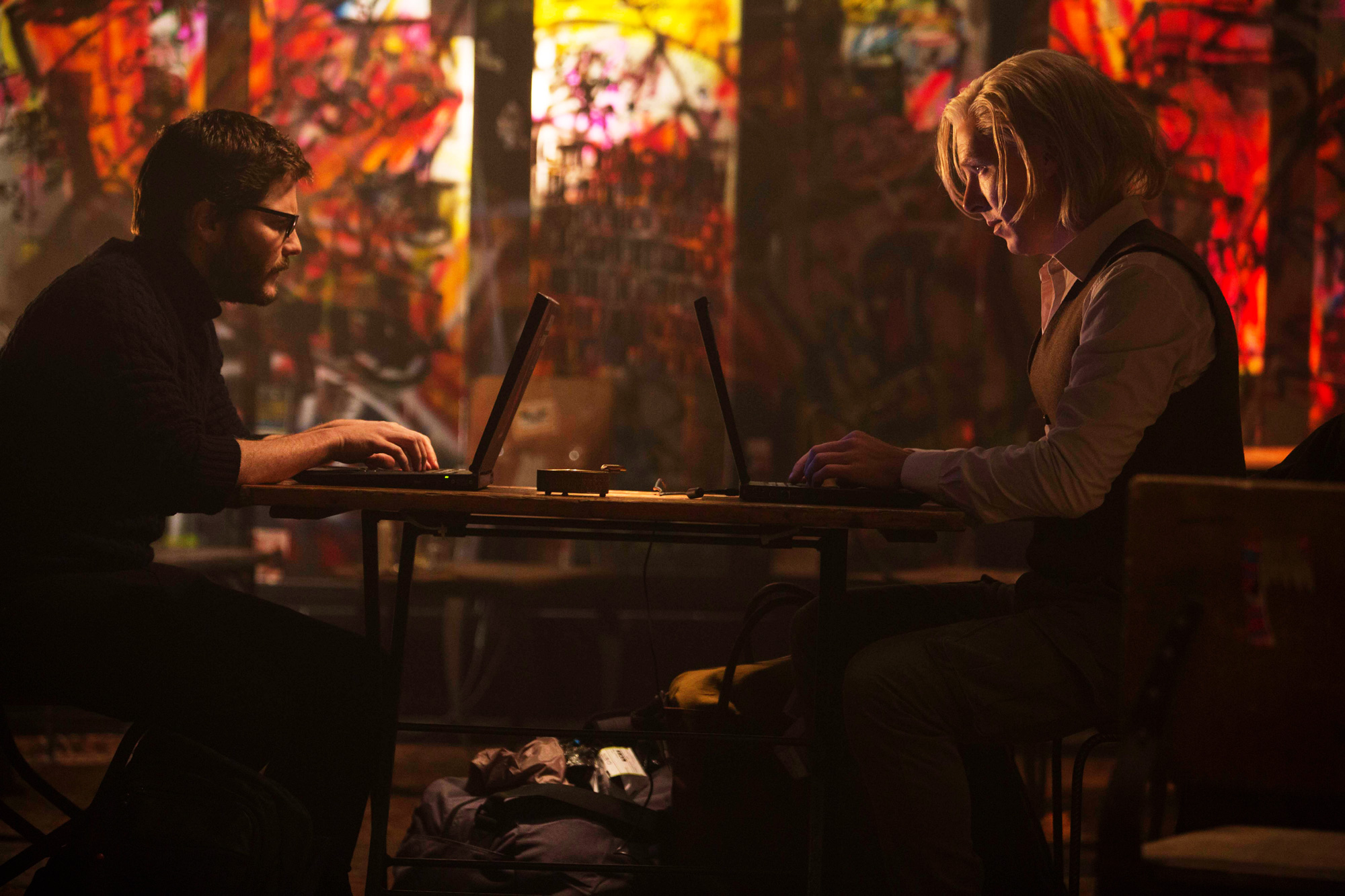
(Well, now that I've revealed my prejudices that I think Assange is a creep and something of a deluded creep...) Bill Condon's The Fifth Estate is a return to form on the controversial biographical films he's done in the past (Kinsey, Gods and Monsters), and after mucking about in the very black and white"Twilight" series, here struggles to have any sort of perspective, controversial or otherwise, for a story that is still in process. It also sweats to make something dramatic out of typing away at laptops, which is intrinsically dull, and about as engrossing as watching a movie about a writer who's writing—good in book form, maybe, but unless you go off into some sort of fantasy-land, it's a completely no-thrills scenario.  
For anyone who's been following the Assange story—which was several headline-making revelations ago—The Fifth Estate does less with the recent Iraq War revelations (some of which—like the "Collateral Murder" video weren't even revelations, having already been published in other sources) than it does with the early ground-breaking days of WikiLeaks, Assange's recruiting of Daniel Domscheit-Berg (Daniel BrĂĽhl)—whose book "Inside WikiLeaks" is one of the sources on which Josh Singer (former writer for "The West Wing" —during the non-Sorkin years—and "Fringe") based his screenplay—and the heady days when it exposed corruption in Kenyan elections and dummy-accounting in the Caymans at Julius-Baer. The worst-kept secret of all was who was running WikiLeaks. Although Assange was the very public face of the site, he would state that there were hundreds of people behind the site, doing due diligence, checking sources, and vetting information that would see the light of scrutiny.
Truth was, there were no "hundreds of people;" it was Assange and Berg and whatever server cluster the two could configure, cobble and co-habit. Vetting was cursory phone calls, or maybe a clandestine meeting beforehand. As far as redacting anything that might threaten lives,** that was nearly impossible (and logistically impossible with the release of diplomatic communications that numbered 400,000 in 2010). As WikiLeaks' revelations become bigger and broader in cope and size, the tiny staff is overwhelmed, keeping an Oz-like public face (Assange's), but not even willing to acknowledge that they might be overwhelmed and out of their depth. Thus, the "open" source hides the biggest secret of all—there's no infrastructure to the web-site other than Assange and Berg.
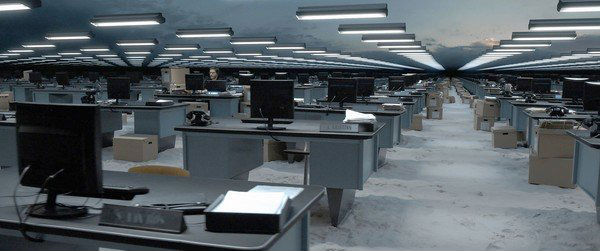
The "reveal" of this information is done in a "cutesy" illustrative manner. At one stage, Berg wants to talk to the other WikiLeaks members that he's been trading communiques with about sources and information, something Assange is initially reluctant to do. Then, when it becomes a "make or break" request, he gives in, showing Berg his "hold card"—that the other people Berg has been instant-messaging and e-mailing have merely been alternate Assange accounts.  He's only been talking to Julian, which Berg imagines as a scene out of Being John Malkovich crossed with The Apartment of an infinite number of desks in an office, all with Julian Assange sitting behind them. It's a little too literal and maybe just a little condescending to spell it out so baldly to the audience, but ultimately that visual metaphor is stretched as, at critical junctures, that infinite number of Assange's keeps coming back to make fantasy-narrative points that seem unnecessary (other than to conjure up that all those Assange's are going to write the complete works of Shakespeare someday).  
The acting is, across the line, superb: Cumberbatch does a fascinating Assange, adroit, and self-contained, like a chess-player, usually thinking about something else than the topic of conversation, and his final bit—an in-character dismissal of "the two films" coming about WikiLeaks (presumably this film and Alex Gibney's documentary) is a cautionary warning; BrĂĽhl, seems to be the go-to guy to play Germanic naifs after Good bye Lenin!, Inglourious Basterdsand Rush, and here plays Berg as an all-too-willing apprentice looking for a mentor; Laura Linney, Stanley Tucci, and Anthony Mackie play American diplomats trying to deal with the fall-out, while David Thewliss and Peter Capaldi play two reporters for The Guardian with suspicious hesitance about their "source."

It's a good dramatization, filling in character holes which Gibney's documentary left unexplored.  The two together make a good summary of events that, as yet, have no ending, but have managed to rock the world, making the cyber-world look frighteningly like a glass-house sitting in a field filled with stones.


* The same attack came from Assange about this year's Alex Gibney documentary We Steal Secrets: The Story of WikiLeaks, which tells the same story, but through interviews and through Gibney's journalistic sensibilities (which produced Enron: The Smartest Guys in the Room, Taxi to the Dark Side, Gonzo: The Life and Work of Hunter S. Thompson, Casino Jack and the United States of Money, and Park Avenue: Money, Power and the American Dream).  Critics have been far harsher on The Fifth Estate than We Steal Secrets, either because 1) the documentary is considered more "legitimate" than the dramatic version; 2) Assange's attacks seem to "stick" better to a dramatic recreation than a documentary, or 3) they actually (at a rate of 95% to 37%—which is quite a swing) prefer the techniques of the documentary to The Fifth Estate . But, then, according to Rotten Tomatoes, they've been harsher on The Fifth Estate than the Stallone-Schwarzenegger yarn Escape Plan, which is just inconceivable, and brings Rotten Tomatoes' validity as an indicator of quality and worth as a taste aggregator into suspicion.

** Assange has said that no "outed" operative has been killed, due to the leaks (although The Fifth Estate fictionalizes one such source (Alexander Siddig) being forced to evacuate with his wife and children (in the same way that Patton fictionalizes what might have happened in WWII if, because of Eisenhower's decision to send gasoline to British tanks instead of American ones, if a tank company all of a sudden ran out of fuel behind enemy lines).  1) Assange is probably not a good source for that kind of information as he'd only get it from "whistle-blowers" who might not want to take claim for any deaths (nor would Assange).  2) It's not going to come from American sources who might not want to further risk others (ie "known associates") of anyone affected by it, despite making the case that there WAS some "collateral murder" (to coin a phrase) and making assange and WikiLeaks look bad.  As someone far more Machiavellian once said "The absence of evidence does not mean the evidence of absence."

Friday, July 31, 2015

Mr. Holmes

The Curious Incident of the Detective in Twilight
or
"The Conscience of Sherlock Holmes" ("I Haven't a Clue...")

Inspector Gregory: 'Is there any point to which you would wish to draw my attention?'
Sherlock Holmes: 'To the curious incident of the dog in the night-time.'
Inspector Gregory: 'The dog did nothing in the night-time.'
Sherlock Holmes: 'That was the curious incident.'
"Silver Blaze"

'I confess that I have been blind as a mole, but it is better to learn wisdom late than never to learn it at all.' 
Sherlock Holmes
"The Man with the Twisted Lip"

In Neil Gaiman's "Sandman" comic series, there is a Library of Dreams that contains literary works that were never written and/or completed and basically, only exist in the authors' dreams. The "one-day-I'll write..." library. One of those books sitting on the shelf of the Never-Was is a collection of stories by Arthur Conan Doyle published under the title "The Conscience of Sherlock Holmes." Gaiman, interviewed, particularly liked "The Conscience of Sherlock Holmes" because "Holmes doesn't have a conscience." He has a sense of justice, of course, which sometimes—rarely—runs counter to the letter of the law (and when it does, it peeves him no end). But, for the most part, he does not let personal feelings interfere with his thought processes. As he explains in "The Sign of Four," "the emotional qualities are antagonistic to clear reasoning." Those "emotional qualities" are best left to others as sources of motivation, incitements and provocations to be discovered, but avoided by the discoverer, lest they cloud the facts.
And so, Mr. Holmes, based on Mitch Cullens' "A Slight Trick of the Mind."  It sees Sherlock Holmes (Ian McKellen) in his waning days, weakened and enfeebled by age, the mind slightly dulled, for which the Great Detective travels the world for some inhibition; royal jelly no longer works, but a trip to post-WWII Japan promises a concoction called "prickly ash." He returns to his Sussex home, tended to by a housekeeper Mrs. Munro (Laura Linney) and her son Roger (Milo Parker).  As they tend to him, he tends to his bees, but he is troubled, haunted. When the mind of Sherlock Holmes is at rest, disaster is sure to follow.  But, his trip has disquieted him and he is not sure why.  
To exercise his mind, he begins to write about his last case (dissatisfied as he is by the account written by his dear friend, Dr. Watson) and in the writing, memories begin to churn, creating a disturbing feeling of disorientation and confusion.  This is aggravating to Mrs. Munro, who already finds Holmes insufferable and worries about the influence the old man has on her son, who is fascinated by Holmes and his storied past. 
But, what is the connection between that last case, his final bow, and the trip to Japan? To Holmes, nothing.  Not in detail, particulars, even country of origin are they similar. But one triggered the other, and Holmes must rely on the most unreliable of witnesses—his own failing memory. This is the Sherlock of old age, not the Sherlock of old. To hear this one tell it, it never was: the deerstalker hat ("an embellishment of the illustrator"); the meerschaum pipe ("I prefer cigars, actually"). He still does "the parlour trick" of dissecting a human being instantaneously from their appearance to their amazement or shame or anger.  And does he regret?  "So much!"
Holmes' last case: surveillance and a tell-tale clue about window-shopping.
Conscience.  His last case was for a client (Patrick Kennedy) who suspected his wife (Hattie Morahan) of...something. She had changed. Yes, she's suffered two miscarriages, but she's acting suspiciously, and Holmes, suspecting "something" nefarious goes on the hunt, observing her day's routine—checking on her husband's will, forging checks, and, last but certainly not least, buying poison. The client must certainly be in danger of a mad housewife's revenge.   
One would deduce. And Holmes finds his instincts right...and wrong.  The aftermath of the case leaves him bereft, back to drugs, and it is only the intervention of Watson, long since gone from the residence at Baker Street (there's a surprise about that, too) that Holmes recovers enough that he can make the decision to retire to Sussex—his own exile from the chaos of the world he could no longer understand, let alone explain.
Aftermath: Watson finds Holmes—"I chose exile."
Bees, however, are easy. They're orderly, unemotional, solid workers, and completely loyal to a Queen. The colony seems to be dwindling a bit after his Japan trip, but he will have to solve that problem later. In the meantime, there are these memories and the Japan trip to solve, and if the tale isn't as snappy as a Doyle yarn, it might be due to the fallibility of the detective who, ultimately, has himself as a client. 
Director Condon keeps things moving quickly and, fortunately, stays out of the way. He is at his best when his directorial hand is invisible, undetectable, trusting enough of the material (and himself) that he doesn't get too fancy with it. He's worked with McKellen before (Gods and Monsters) and Linney (Kinsey) and they are both up to the task—McKellen doesn't have the usual problem with Holmes that actors do (Jeremy Brett and Robert Stephens were both of the opinion that Holmes was "an empty vessel" that would suck the life out of an actor), tasked as he is with playing the same character at two stages in his life 35 years apart, the challenge is to extrapolate the old man with the younger, and so Holmesian tics and theatrics go by the wayside. Nothing outwardly theatrical is betrayed, but gradually and internally, the truth is revealed and a motivation is not realized, but instead created. And the Great Detective who, at one point in the film, says "I haven't a clue," solves his own mystery.

A good Holmes film, not a classic, but a good one.
At one point, the elderly Holmes watches a movie made of one of his exploits.
Who plays Holmes?  Nicholas Rowe, who played Young Sherlock Holmes in 1985.
Deucedly clever, that.

Thursday, October 2, 2014

The Savages (2007)

The Savages (Tamara Jenkins, 2007) Maybe it's a pack-order kind of thing.

I've had enough conversations with children of aging parents complaining about their siblings who want nothing to do with the responsibility (and I usually end up talking to the sibling who enables them).

I say "pack-order" since, once out of the shadow of their parents' influence, the children suddenly see themselves as "top dog" in value, rather than having to be supplicant in the demands of their parents. Then, as time goes by, and the roles of need become reversed—the child must fend for the parent while that parent tries to assert the illusion of authority over the children (something reinforced in the kids by a lifetime of obedience, mixed with bitter defiance).

To disrupt this natural balance leads to the inevitable melt-down of the nuclear family. And both sides resist the change and hold on to their acquired ground, when it's as natural a part of the life-cycle as Death (which we also resist). It's as inevitable as a change in seasons, but it always seems to catch us by surprise.

The parent must learn (if they have a mind to) to accept their diminished capacity. The child must learn responsibility over another human being beyond their own needs. And both resist it, kicking and screaming, sometimes literally.
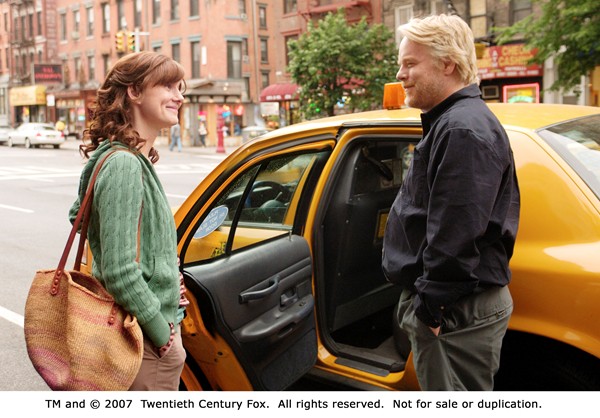
This is rich dramatic ground to till, and The Savages manages to break it down to its basic components. The two siblings (Philip Seymour Hoffman and Laura Linney—who would appear to have nothing in common other than their enormous talents) must deal with their diminished father (Philip Bosco, nicely delineating the edges of gruffness and helplessness), whose longtime companion in an assisted living facility has just died of a sudden heart attack, shattering the illusion of his independence. It's up to the kids, both academics and both lousy at relationships, to suddenly cope with unfamiliar territory: 1) real life and 2) the responsibility of being a partner. Of course, they fight like cats and dogs. Their rivalries, ostensibly for their parent's affection but also over the acquisition of writer's grants, is always churning just below the surface and bubbles up in passive-aggressive little blorps and clumps and repressed urges to kill (Linney and Hoffman excel at unspoken emotion—they wear it in their jaw-lines) and bitter sub-text.

Only a universal event can shock perspective into these two people looking inward for answers, and it is only
the confrontation of common mortality that can civilize these savages.

The
movie is funny and depressing as Hell.

But, that's Life.