Showing posts with label Stanley Tucci. Show all posts

Friday, November 1, 2024

The Conclave (2024)

The Mystery of Faith/The Sin of Certainty
or
"The Church Is What We Do Next"
 
The Pope is dead. Time to find a new one.
 
The Catholic church is steeped in ritual and arcana, seeing as how it's been around for 2000 years. Lord knows when all the niceties were developed (as He didn't come up with them), the breaking of the seal, the sealing of the Pope's quarters, the voting in secret among the council of cardinals in a locked, darkened room with no communion to the outside world. 
 
The smoke. 
 
It's a bit like the electoral college, as the Catholics in the world have no say, only the carefully chosen cardinals, get to choose who will be the next successor to Peter, the first Pope. 
 
But, he will be a man. That is the only certainty. Nuns need not apply. It's the way it's always been and, God only knows, it will be that way for a very long time. For God speaks only through the chosen few and only they have the power to change things...if God lets them know. Pity about Him not speaking to women, although a lot of them, Joan of Arc, being a burning example, would contradict that assumption.
Just ask Cardinal Thomas Lawrence (
Ralph Fiennes) of The Conclave. He was close to the late Pope, close enough that he'd personally asked to resign his special position as dean of the cardinals. But, the Pope refused him to Lawrence's mystification. Lawrence was having a crisis of faith. As he explains to one of his fellow cardinals, Bellini (Stanley Tucci), what he's lost faith in was the Church, he's never lost faith in God. But, now the Pope is dead, and as dean of the cardinals it is Lawrence's function to convene the conclave of cardinals that will select the next Pope, with all the ritual and preparation and in-fighting and...politics. Lawrence is one of the leading contenders, but he doesn't want the job. Not like this. Not like he is. But, he will conduct the conclave. But, he has doubts.
Apparently, so did the late Pope, enough to demand that Lawrence stay at his post. As hard as it is to separate Church and State, it is damn near impossible to keep politics out of the Church and the vacuum of power threatens to suck in the best and the worst of the cardinals, each to their own nature. The world changes fast and the Church (if it does) is slow to catch up. There are those that would see an Italian pope and only an Italian pope and that the Mass and all business be conducted in Latin—most prominent of them would be Cardinal Tedesco (Sergio Castellitto), who is intolerant of change and resentful of changes that have occurred—have a Friday dinner with him and he'll have the fish.
Then, there are Lawrence and Bellini, progressives, who want to see a more inclusive church, changes in doctrine, less fire and brimstone. And there are the moderates, like Cardinal Tremblay (
John Lithgow) and Cardinal Adeyemi (Lucian Msamati), who are highly regarded and well-connected and have a chance at being elected by the conference of cardinals. As they gather from around the world to be locked away in seclusion there is a lot of last-minute maneuvering and...a lot of smoking. It doesn't look to be a slam-dunk for any candidate.
But, Lawrence—who is also a considered candidate and who
(of course) doesn't want the job—has begun to hear things. Things like the late Pope having a last-minute conference with Tremblay where ("they" say) he was asked to resign...but refused. An incident in the lunch-room involving Adeyemi and one of the nun-servers raises questions and temperatures. Lawrence pulls the old "we're priests, you're just nuns" argument to obtain information out of Sister Agnes (Isabella Rossellini) about the parties involved. But, he's more than willing to break tradition (and a couple wax seals) to get to the bottom of things.
Several commandments are revealed broken in The Conclave by the cardinal's detective work (good thing Father Brown wasn't there!) including bribery, subterfuge and a few others that might spoil the resolution and there are a lot of Deadly Sins going on (Bellini challenges Lawrence's supposed lack of ambition by asking him if he's thought of what his Pope-name would be...and, of course, he has), but the only one you won't find anywhere is "sloth."
German director Edward Berger (he made the excellent 2022 version of All Quiet on the Western Front) makes sure that the film has the proper solemnity but not so much that you fall asleep in church. The movie is never less than beautifully shot (by cinematographer
Stéphane Fontaine)—Rome never looked so good (probably because so much of it's in Cinecittà)—and Berger is less dependent on the single-point perspective than normal although he will go to it to make a grand impact (and, really, how could he help it as most churches are designed around a one point perspective.
But, he also has a cast of character actors who are adept at stealing scenes usually in conflict with Fiennes, who has the God-given power to command your attention. Talk all you want about the work that went into recreating the Sistine Chapel for this film, but you have a marvelous opportunity to see a master class in performing sotto voce that can propel you out of your seat when Fiennes turns it into a bark. We're talking measured performances of actors playing characters hiding something and being pious about it. That's some nuanced acting there.
There's a lot of Oscar buzz around this movie, not undeservedly, but, it's mere murmurs now and we'll see if we still hear it by year's end. Certainly there'll be a lot of nominations. But, voting for the Oscar has a lot of the same background as chicanery voting for the Pope. We'll just see what happens when the smoke clears.

Friday, December 24, 2021

The King's Man

Mannered Maketh Malarkey (Dulce et decorum est cogitare hanc pelliculam sugit)
or
The Prequel To End All Prequels
 
I wasn't a fan of Kingsman: The Secret Service, although I enjoyed most of the performances, particularly Taron Egerton's, I felt that it was pretty sloppy without much holding it together, although the satire was there and recognizable as such. It was meant to be a breezy jocular look at spy thrillers,  located somewhere in between the Bond Series and Austin Powers, hewing closer to the latter in terms of cleverness (or lack of it) and amping up the violence to the point that—despite containing the adage that "manners maketh man"—it became decidedly unmannerly.
 
One couldn't take it seriously and so any connection to a thriller goes right down the chute as the stakes are as high as they are in a "Looney Toons" cartoon. Samuel L. Jackson had it right in the first one by playing the arch-villain with a silly lisp, which has become his signature tic for showing he has no respect for the material he's playing—he certainly doesn't use it when hawking Capital One.
So outlandish actions and jolly good manners was the joke of the first two films, but director
Matthew Vaughn's latest, The King's Man—boasting original material from Vaughn and Karl Gajdusek (good villain name, that)—goes back in time to show the origins of the secretive Kingsman organization that bypasses political discussion and goes right for the jugular. Why this was thought necessary is anyone's guess, but I suspect—with another movie featuring Egerton in the works at the same time—they may be offering material that will relate to the next sequel. There are a couple of prominent names in cameo's and perhaps they'll be part of the next one.
The film concerns the exploits of Orlando Oxford (
Ralph Fiennes and bloody good, if seeming like he's in the wrong movie), the Duke of Oxford, who, at the time of the film's opening is a former war officer now working for the Red Cross and inspecting a concentration camp in South Africa in 1902. He is there to see General Herbert Kitchener (Charles Dance) about the deplorable conditions and talk strategy. In the course of the visit, the party comes under attack and Oxford's wife Emily (who encouraged Oxford's humanitarian duties) is killed before the eyes of Oxford—who has been wounded in the attack—and their young son Conrad. With her dying breath, Emily swears Oxford to "protect our son, protect him from this world, and never let him see war again."
When Conrad grows to the age of 17 (and embodied by
Harris Dickinson) is looking for a life of adventure, which his father vehemently opposes. He wants to join the Army when of age, but Oxford keeps him at home under the watchful eyes of associates Shola (Djimon Hounsou) and Polly (Gemma Arterton), who are crack spies and soldiers of fortune, but hide in plain sight as part of the Duke's staff. Presumably, it was so hard to hire good marksmen in that day. Oxford has good reason to be worried. Somewhere on an improbably high, flat and unscalable escarpment a group of terrible people are plotting to destroy the world and make money doing it. Headed by a Scottish separatist code-named The Shepherd, the group contains as members from around the globe including Grigori Rasputin (Rhys Ifans), Mata Hari (Valerie Pachner), Vladimir Lenin (August Diehl) and Gavrilo Princip (Joel Basman). 

Who? Well, I'll bet most audience-members don't know who Rasputin is, so don't feel bad. And I'm sure that a lot of them don't know the significance of Arch-Duke Ferdinand (played in the film—briefly, which is historically accurate, by Ron Cook).
Hell, ask the common man about World War I and you'll get a response like "World War II had a prequel?" or "Yeah, Wonder Woman was in it" Be that as it may, the group is trying to exacerbate the already bad relationship between three head-strong cousins, King George V (of England), Kaiser Wilhelm II (of Germany), and Tsar Nicholas II (of Russia), all played amusingly by Tom Hollander (bravo, sir!),* starting with the assassination of Arch-Duke Ferdinand, and the poisoning of Nicholas' son Alexei.
In his attempts to protect his son Oxford nearly gets him killed protecting the Arch-Duke and taking out Rasputin. But, then, this film has a habit of having people saying things and doing something that is contrary to their words. Oxford makes grand speeches about colonialism and imperialism and the exploitation of the indigenous people, but his comfort in his class and power has him being a very good example of all that. The only folks who seem to actually mean what they say are the villains, who are all so single-mindedly evil that they barely register as real characters—these were all very powerful and influential people and they're treated like puppets in this film's Grand Scheme.
But, at least they're consistent. The movie, on the other hand, careers between goofiness and sanctimony. Words are meant to be taken seriously, but the action sequences not so—deft (and unbelievable) as they are. Rasputin, Oxford, Conrad and Shola have a three-to-one duel set to Tchaikovsky's 1812 Overture, there's a weirdly impractical assault on that villain lair, and there's a World War I trench assault that, as completely unbelievable as it is, is still meant to be taken seriously if we're to have any feelings for the character.
It's a film of duplicity and two-facedness, delighting in "hilt-cams" and elaborate torpedo shots and a flash-zip of two years of World War I to see the the reduction of a hamlet town into a No Man's Land. Jeez, there's even an mustache to mustache edit in the thing. One starts to think that the film-makers are just so pleased with themselves and their own cleverness that they can do such little miracles that they don't see that the movie is clumsy and ham-fisted. So ham-fisted that the "surprise reveal" of "The Shepherd" is easily guessed just by the way shots are held unnecessarily before cutting away from them. Clever.
 
 
So clever it's stupid.
 
* Yes, it's true. Those heads of state were all related to each other (and you thought the Daniel Craig Bond movies were too in-bred!) No wonder the 20th century was so fucked up. And no wonder people wanted to do away with the Right of King's.

Saturday, July 10, 2021

The Lovely Bones

Written at the time of the film's release...

Oh. And Saturday is traditionally "Take Out the Trash" Day.


"My Name is Salmon. Like 'Swimming Upstream.'" 

I had a heated movie discussion with a friend about Mystic Riverone evening. "Explain to me why you don't like it," I said, genuinely curious.For those who haven't seen it (and it is a tough slog), it's Clint Eastwood's film of the Dennis Lehane novel about the death of a hoodlum's daughter and his steps to exact revenge. The object of the hood's scrutiny becomes his childhood friend who was kidnapped by pedophiles as a child, a violent act that has colored his adulthood. Tough stuff, but I have high regard for the film, despite the broad (and Oscar-winning) acting by Sean Penn and Tim Robbins.
But the friend couldn't abide it. "Why?" I kept persisting. And finally it boiled down to "there are some subjects—like the victimization of children—that have no place in movies. Now, I could point out all sorts of films, from The Wizard of Oz to Empire of the Sun, that, unpleasant though they might be at times, convey the theme and are still great films. However, Peter Jackson's film of The Lovely Bones had me recalling this conversation, and sympathizing with my friend's attitude.
The award-winning and best-selling novel tells the story of a murder victim—a child of 14—and her experience after death, watching the effects her non-existence has on her family and murderer, as her sense of unfinished business keeps her tied to a "between-place," unwilling to move on, until there is some sense of closure on several fronts, those being her family's efforts to find her killer, her killer's obsession with her and with other family members, the internment of her corpse, and that first kiss with the boy she was falling in love with.

Eh?

Uh...we'll get back to that.
The Jackson film differs slightly from the novel (the parents' story is given an upbeat resolution and it's a first kiss, rather than a sexual experience with the boy), but, however much he tries to perfume it, it's still the story of a rotting corpse in a bank-safe. That may sound brutal, but that's what The Lovely Bones is, constantly winging back and forth from the girl's conception of heaven(which Jackson conveys as an ever-evolving series of candy-colored landscapes depending on the girl's mood, somewhat reflective of her earthly experiences) and the mordant reality back on terra firma. The lack of satisfying resolutions in some of the cases has a cruel feel to them and, perversely, that may be the only saving grace from the relentlessly oppressive pity-party of "The Lovely Bones"—there is no justice, shit happens and sometimes it happens appropriately in some karmic equation, but it's not the Universe's job to make us feel good by balancing the scales. Jackson provides some lex talionis (at the demand of preview audiences, bless their little Roman hearts), but it's an indifferent cosmos, not a buttoned-up drama, and certainly not a wonderful after-life.
That's the underlying theme of the story, which is creepy and morbid enough, but you throw in Jackson's interpretation and it turns downright cloying. Jackson and his writing collaborators Fran Walsh and Philippa Boyens make it dreamy and moony in that hormone-addled manner that appeals to young teenage girls (and made the "Twilight" series a phenom') and (lest I be accused of being sexist) not far from the über-romantic manner Francis Ford Coppola filmed his gang story The Outsiders.* And Jackson is a precise director, one who delves into the details, rather than the over-arching idea. This helps when given a vague impressionistic series of novels like Tolkien's, but it also leads to things like his monstrous 3-hour King Kong (Jackson's favorite film is the 1933 version), where the journey to Skull Island is interminable, sequences that flew by in the original drag on and on, and the general deep-love lethargy of the thing drops it like the big ape to the side-walk. The Lovely Bones is a series of close-ups, swooping camera moves that graze the edges of things and catch life in clusters and clumps and fussy little details. It has jokey little references to Jackson's other films and a cameo of him that seems indulgent. It's in those little moments that you wonder if the director has forgotten he's making a movie about a girl who's been raped and murdered.
The audience is spared the actual attack (in a spiritual slight-of-hand that sets up the way she can interact with the living that's a wee a bit...convenient), no thanks for small favors. But the creepiest thing about the movie, beyond the trivialization of an After-Life as merely a CGI Disney Channel fantasy (or worse, it reminded me of the land of the Teletubbies), the brutish smugness of its tone, or its moony-goony morbid romanticism is that, of all the characters in the scenario, the one we are given the most information about is the killer. Despite the herculean work of Saoirse Ronan (she was the youngest of the Briony's in Atonement**) as Our Girl in Purgatory, Susie Salmon, where the film-maker gets his jollies is showing the planning, the drafting, the intricate handiwork and the general creepiness of the serial killer hiding in plain sight. That he is portrayed by one of the better actors in the cast doesn't help. Mark Wahlberg, who can be quite good, here has the same puppy-earnestness that threatens to turn him into this generation's Steve Guttenberg, Rachel Weisz seems lost and her complicated motivations are lost between edits somewhere. Worst of all is Susan Sarandon as Susie's grandmother, meant to be comic relief, but who is so cluelessly self-centered and destructive, one can't help the stray thought that she had a hand in the killing. 
I haven't read the novel, so I can't account for the interest—evidently it is written well, but that doesn't translate to the screen. It shares one unique aspect that Jackson is a bit successful in communicating—the empathetic relationship that victims of the same attacker must feel for each other. It stems from author Alice Sebold's own violent attack, and her learning subsequently that an earlier victim had been killed. Certainly a novel life-experience, and probably too common in these berserk days. But, whatever empathy in the original is ground up in the film-making machinery. Perhaps it shouldn't have been made at all.
The only reason I can think of for the film to exist (outside of the monetary gain of the makers) is as a cautionary tale of warning to gullible teens...and fulsome directors.

* Coppola filmed two S.E. Hinton "young adult" stories, "The Outsiders" and "Rumble Fish." The Outsiders, he said, was filmed in the romantic way teenagers would make it, Rumble Fish the way he wanted to make it.

** It is a fine performance, and Ronan at the time of filming two years ago, still had the awkward duckling look of a developing teen. At the premiere, she looks like she could be a Redgrave
.

Tuesday, September 29, 2020

Julie & Julia

"Too Many Cooks Spoil the Froth"


Nora Ephron directed movies have the same half-circle trajectories as "Star Trek" films: you get a good one, the next one stinks. Whether by virtue or vice of over-confidence or coasting, it seems you can't have two good Nora Ephron movies back to back. For every Sleepless in Seattle, there's a Mixed Nuts and for every You've Got Mail there's a Bewitched.

That's if you're a normal person. For me, I have yet to see an Ephron effort that hasn't made my toes curl inward in their shoes. There's a slap-happy spunkiness to her movies that just make me want to plunge my fore-head into the seat-back in front of me. Her nadir came with her last movie: how in the Hell can somebody screw up
Bewitched? It wasn't due to the Kidman Komedy Kurse, but a clear case of a writer-director trying too hard, Bewitched showed the ruination of tailoring material to attract a star—Jim Carrey as Darren—and then not going back to Square One to re-tool it when they don't get him. Will Farrell could be an astonishingly good Darren, but in another movie, not so driven by the character as it was re-tooled. And her efforts to make it a one-off Bewitched just seemed pitifully neutered—here's a concept where the woman has all the power, and Ephron compromised it. I know a lot of women who were fans of the TV show could not believe how badly the movie botched the premise. They felt betrayed.
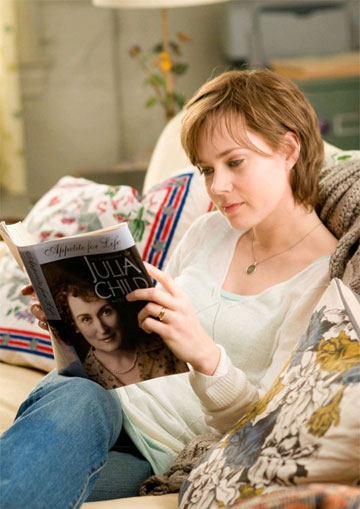
Fans of Julia Child and "The French Chef" might feel the same way, but at least the effort was made to make a better film. Julie & Julia is based on the book written by Julie Powell cribbed from her Salon.com blog, a breezy chatty thing done for the same reasons as the blog you're currently reading: to write. And the only way to improve your writing is by writing, and then writing more. I don't write about cooking (but I know people who do), and it is that discipline to produce and take stock and put it Out There that (supposedly) makes you better at it, whether it's writing or cooking or (non-committal generality). Sometimes, like Powell, you get an audience, but it doesn't matter: becoming a better (non-committal generality) is what matters. This is my way of giving kudos to Powell, who's gotten a lot of stick lately for a) not being a good cook—she blogged about cooking out of a recipe book (doy!) and b) being successful when there are a lot of food-bloggers out there who aren't (see a).*
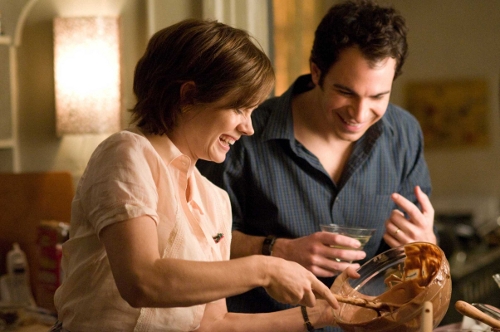
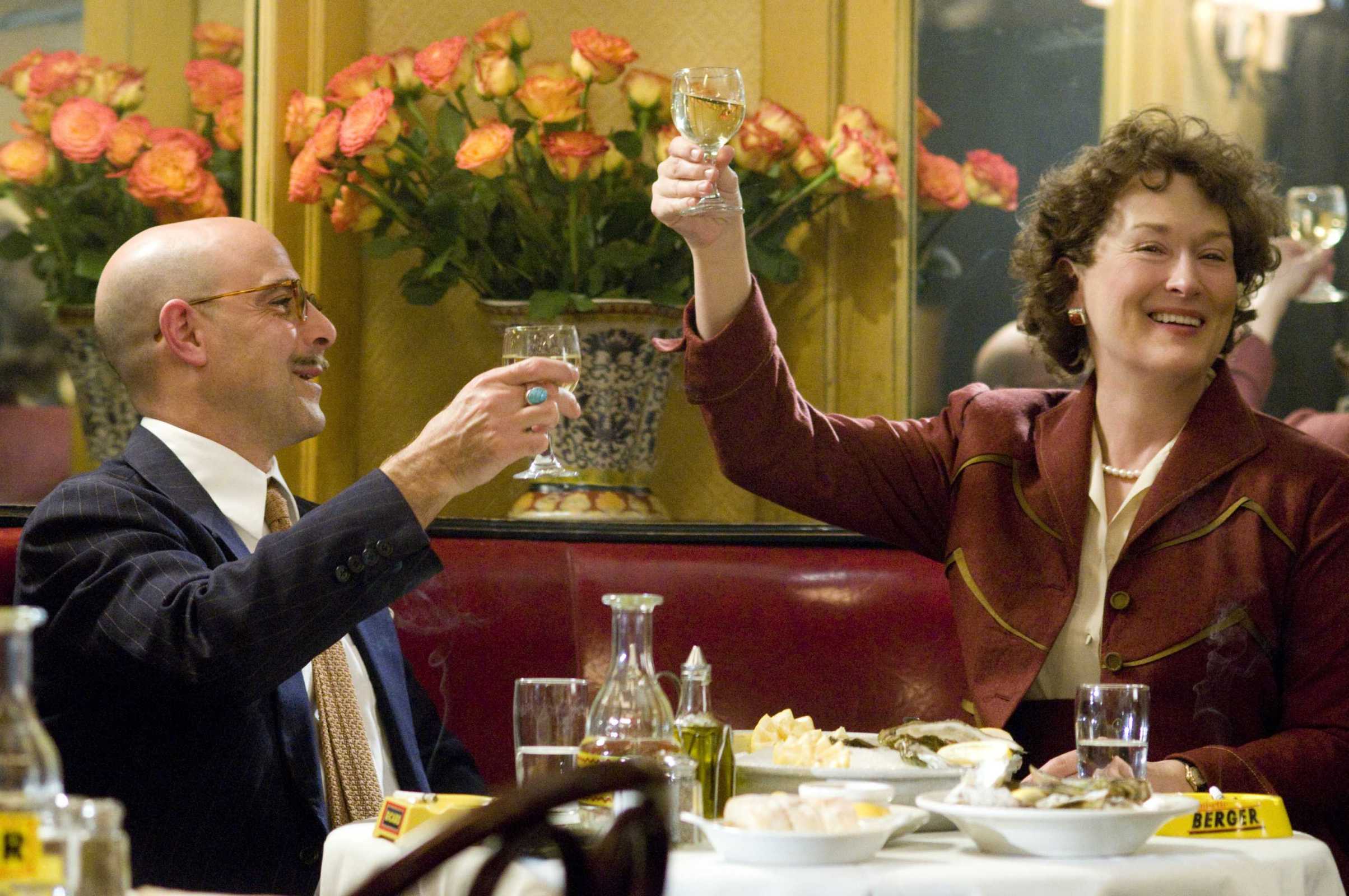
Having said that, Ephron made a stupendously wise choice to actually combine Powell's story with that of 1948 Parisian-based Julia Child (Meryl Streep) on a parallel course. Both women find themselves tethered and adrift: Julia, after working for the OSS, and married to diplomat/spy Paul Child (Stanley Tucci's best role in years) does not know what to do in Paris other than effuse, and Julie Powell (Amy Adams) finds herself in a bad Queens apartment,** at a bad job (at a post 9/11 Lower Manhattan management company), and with nothing satisfying in her life—her dream of writing a distant memory. JC decides to take cooking classes—in a class entirely of men, while JP decides that since she finds solace in cooking she's going to spend a year following Child's recipes and writing about the experience. Ephron's film then follows the two women through their various experiences until reaching their final triumphs—both of which involve being published.
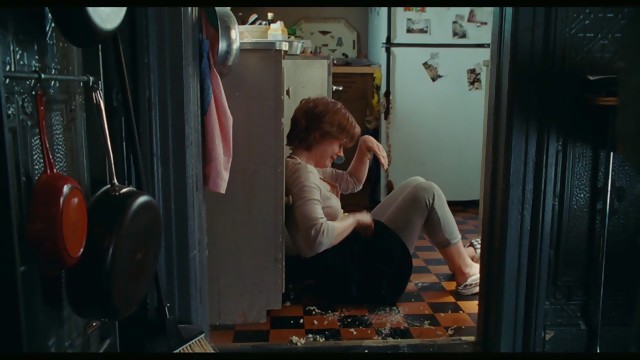
Good enough. Enticing enough, actually. But, truth to tell, despite the best efforts of the impeccable Amy Adams (trooper that she is—she's perfected a mono-syllabic babble in moments of confusion), the movie just stops being interesting every time we jump to the present day story, probably because that story goes through the Ephron story-grinder—get a goal, have your effervescent highs, have your debilitating lows, but everything works out in the end (Cue Uplifting "Standard" Song).

The
Julia Child sections fare much better because Child was doing something a bit revolutionary and she was a fascinating personality and is played wonderfully well by Meryl Streep. But it's like banging the oven door on the soufflé every time we move away from the past because like a good balloon, you can't take your eyes off something that defiantly floats. That Child has interesting people to play off of—Tucci's husband and, in what might be the acting scene of the year, Streep bouncing off the brilliant Jane Lynch playing her sister—while Adams struggles in relative self-involved*** isolation, might be part of the problem.
But, truth be told, just as Julie falls in love with Julia the person, the audience does, too, and the movie falls victim to its own story; when the person keeps stating over and over what a great person "blank" is, you tend to believe it, even over the person who's stating it. And Streep's Child is far more child-like than the real person, finding the charm in everybody and everything, head-strong and a foot taller than everybody else in the vicinity (they did some careful casting and set design for this), crowing with delight and bouncing in triumph, you can't help but love her...and admire, once yet again, how Streep can take ordinary reactions and make them extraordinary.
You can still see Julia Child on TV. There's a new regurgitation by PBS called "Dishing with Julia" which features celebrity chefs watching old episodes of "The French Chef" and making comments—none of which approach critical. The most recent one had Top Chef Carla Hall observing Child slapping bread dough around on a cutting board and doing a hilarious imitation (they all do, actually) with every slap: "THIS isn't precious! THIS isn't precious!"

* Not to belabor the point, but look, she did it for self-improvement—that she made a success of it and is surfing her high tide well is just, well...gravy. Or just desserts.

** That I think New Yorkers might kill for.

*** Ephron hammers the "self-involved" blogger bit a might hard considering the number of bloggers and Facebookers and Twitterers in her audience (so says this self-involved blogger).

Friday, August 10, 2018

Margin Call

The Economy and how it grinds up people has been on my mind of late. Here are some movies I've written about in that subject matter. 

Written at the time of the film's release.

"When The Music's Over (...And the Band Plays On)"
or
"Momma, There's Wolves in the House"

Margin Call begins like The Company Men and Up in the Air—in the midst of a corporate slaughter—people being fired from jobs they've held a long time. Cut-backs. "Generous" severance. Thanks for your service.  Security will escort you out.

Eric Dale (Stanley Tucci) listens to it all, a little stunned, but tentative. "Uh, listen," he says in the middle of the administering of Last Rights, "I was working on something and I'm not finished yet." Doesn't matter. Go to your office. Empty your desk. Proprietary information. Your losing your phone, e-mail, etc."No, really..." he says.
Doesn't matter. He's out. On the way to the elevator, he runs into two of his turks, Peter Sullivan (Zachary Quinto) and Seth Bregman (Penn Badgley). "Am I safe?" asks Seth (as Seth is wont to do). But Peter walks him to the elevator to tell him how much his mentorship meant to him. Dale cuts him off. "I know. I was working on something. They won't let me finish it," says Dale as he hands him a USB drive. And as the elevator doors shut, he has just enough time to say "Be careful."

Fwump. 

It's the "be careful" that gets everybody's attention. "He said that?"
Sullivan begs off the traditional drinks for the battle survivors and takes a look at Dale's figures. Then he sees something. Digs, does some calculations and then stares at his projections screen. Over the next twelve hours, the world will go to Hell and he's the only one who sees the gate.
Margin Call is a boardroom thriller about our recent financial crisis, but its played like a mystery story. Everybody speaks in code. The night is dark and no one is betraying secrets. No one knows what's around the corner and everybody's looking behind them for the knife. Written and directed by J.C. Chandor (Who? This is his first film and it is an impressive debut*), it plays out like a conspiracy—it is—and if so much of it didn't anticipate the dawn, one would be tempted to call it a film noir; there is a palpable air of organized evil, built of greed and self-interest, that hangs over the film, for what is being planned is the crime of the century.
The cast is uniformly superb—how could it not be with the likes of Kevin Spacey, Jeremy Irons, Simon Baker, Paul Bettany, Demi Moore, and Tucci?—but those performances depend on the great dialog generated by Chandor and the way he presents what should be dry material as drama and intrigue.  These are gangsters in Gucci, cold-blooded, playing the long odds and the fast kill, but instead of "going to the mattresses" they are isolated in fancy cars and well-appointed high-rise board-rooms, their views of the world their actions are affecting armored by safety glass. There isn't much soul-searching (they're business-people, so why look in a dry hole?) about what devastation their actions will bring, except for the immediate future and what it will do "for business."  Even then, loyalty to the corporate mantra of "be first, be smarter or cheat" trumps conscience. That would make a hell of a slogan wouldn't it?
If one could gripe (and there is little to gripe about), one could argue that, if anything, this reverse "Godfather"—where business-people are gangsters, rather than gangsters as business-people—is heavily romanticized. There are no "Masters of the Universe" statements coming from these mortgage titans (as one heard from Wall Street bar-recordings on "This American Life," where these mavens crowed about deserving bonuses from bail-outs because "they're smarter than everybody else"), but, rather, short-term hedges about "dog-eat-dog" survival. No cynical betting against failure schemes, but merely making the best out of a bad situation before everyone else does.  
As bad as Margin Call makes its protagonists, the truth is even worse—there were folks betting on things coming crashing down and profiting from it. It doesn't take a rocket scientist to see that a fix was in and that analysts saw it coming, not, suddenly, seeing it and going "Garsh, this looks bad." And the worst thing that's happened to these people is a little traffic congestion on Wall Street.

That is, if they're working at all.


* Hey, there. James from 2018 here.  Chandor was no fluke nor a flash in the pan. He followed up Margin Call with the Robert Redford masterclass All is Lost in 2013 and the woefully unappreciated A Most Violent Year in 2014.

Saturday, December 31, 2016

The Core

The Core (Jon Amiel, 2003) An absolutely goofy high-concept sci-fi movie that has been deplored by scientists for its particularly "bad science." I can't argue with that. It is bad, very bad science and the contrivances of the screenplay are almost too many to mention.

But, I also can't argue that it's a lot of fun to watch, even if the movie fails on almost every technical accomplishment, including special effects.


Oh, that Mother Earth. She really is a Mother. Odd things are happening around the globe. The Northern Lights are heading South. Birds are starting to fly erratically in disorganized flocks and fly into buildings, buses and people. Worst of all, the space shuttle, the biggest bird of all, fires its retro-rockets to return to Earth, but, rather falling to its landing strip in Florida, it ends up off the coast of California, necessitating a landing in the sluices of the Los Angeles River, prompting an investigation of its Commander, Richard Iverson (Bruce Greenwood) and, most especially, its navigator and co-pilot Astronaut Major Rebecca "Beck" Childs (Hillary Swank).

On a less global scale, geophysicist Dr. Joshua "Josh" Keyes (Aaron Eckhart), a professor at the University of Chicago, is pulled out of class by Feds "Indiana" Jones-style, and asked for his expertise on what's going on in the world. His investigations startle him, and he brings in pal Serge Leveque (Tcheky Karyo) and prickly scientific populist Conrad Zinsky (Stanley Tucci) to confirm his findings—the Earth's magnetic field is out of whack and disappearing due to the lack of rotation in the Earth's liquid outer core. If that stuff doesn't start moving pretty quickly, then all electronics on Earth will be disabled throwing us back into the stone-age, and then the Earth will be bombarded by the Sun's micro-waves and solar wind, throwing us into the charcoal age.
Scientifically speaking, this is "bad news." Although, if you can reach into your video screen of this movie and turn on its news-channels, I'm sure you'd find all sorts of "charcoal-age" deniers willing to foam at the mouth on-camera for AFTRA minimum, making as much sense as those saying that the Earth can't have a core because it's flat. Maybe if we threw them down into the liquid core, we'd get enough "spin" to re-start the magnetic field. But, I digress...
That "talking-head-hot-air" option is not explored. Instead, the suggestion is that if somebody can drill down to the molten core and drop nuclear war-heads of sufficient magnitude, it just might work. After all, if you could launch shuttles to blow up asteroids, or shrink scientists and inject them into blood-streams to laser blood-clots, why not? Trouble is, it's hot down there—9,000°F hot—enough to melt steel or any other construct to make nuclear weapons, and there's enough pressure to crush anything down to pancake-width, so what to do?
When you have an impossible task, call an engineer. Fortunately, among the people Pinsky has pissed off in his career is a brilliant one, Dr. Edward "Brazz" Brazzleton (Delroy Lindo—always welcome). He's been living in the desert making very handy, impossible things that no one has heard about. For one thing, he's invented a laser "impeller" system that can liquefy anything in its path...except for the other thing he's invented—a substance called "unobtainium, "* which is a miracle metal that can stand up to incredible heat and crushing pressure—just the sort of thing you'd need to to build a ship to dig to the center of the Earth.** That seems awfully convenient to keep the movie going. But, then, the movie is powered by "suspendbelievium."
Brazzleton's inventions pitted against each other.
Once they have the impossible boring capacity and the material to build a ship that can't be cooked or crushed (and uses those things to supply power—even more convenient), they spend an incredible amount of money to build the good ship "Teflon" (dubbed "Virgil" after the author of "The Aeneid") to carry a crew of specialists to launch the nukes and then get out of town fast enough to get obliterated. Good luck with that. With such a suicide mission, you would think they would come up with a competent but disposable crew to carry it out. But guess who they choose—the very essential designers and theoreticians who came up with the crazy scheme in the first place. Okey-dokey. They only have one chance to do it and not get fried because nobody on Earth would be able to duplicate it.
Everything about this movie makes no sense, whatsoever. But, if something isn't sensible, it's at least Hollywood.
Later we will find out that the whole trip was, essentially, not necessary, and that the phenomenon that's affecting the Earth is not completely the natural disaster that it's presented to be—due to meddling humans, again, who can't leave well enough alone, and if they can't "monetize" something, they'll "weaponize" it. But, forget all that "unobtainium ad absurdium." The best part of the movie is the interplay between the characters once they get on board the good ship "Teflon," and, fortunately, you've got some truly gifted character actors on board, all who know how to fill time quickly and fill holes in the script (some of which are cavernous), even while they're boring holes in the crust, and method-acting staring at green-screens that actually show them nothing.
Sure. It's dumb. Sure, it's unscientific. Sure, it's unbelievable. But, the actors make it work, to the point where they could be fighting flaming Jell-o (sometimes the special effects look like that) and it would still be fun and still be inexplicably watchable. The story, the FX, are merely the crust. It's the actors that make up the solid core of the movie.
* Yeah, yeah, all you Avatar apologists out there—it's the same thing they're after in Avatar. But, The Core preceded Avatar by 6 years.

** When asked how soon he could get a vessel up and running with his inventions, Brazzleton cackles: "Three months?" Fifty billion dollars!" The general in charge of the project (Richard Jenkins, also welcome) deadpans "Will you take a check?" Keyes looks over: "Use a credit card. You'll get miles."