Showing posts with label Charles Dance. Show all posts

Saturday, March 25, 2023

Your Highness

Saturday is traditionally "Take Out the Trash" Day. And I remember this one distinctly because it's one of those comedies that didn't make me laugh much, but, instead, only filled with me a great resentment for whatever hack studio executive green-lit this mess. I'm usually charitable to movies because they are the work and coordination of many people and only some can achieve some sort of magic greatness. But, I can't even be charitable about this one. This crap-fest was a waste of everyone's time...but evidently not their talent.

Written at the time of the film's regrettable release.
 
"Du-uh..."
 or   
"Natalie Portman's Post-Oscar Slump, Part 1"

I've needed a laugh lately. I've been second-and third-guessing myself, not sure which way to go on all sorts of matters. And after seeing two movies, good and bad, in which anyone can be tread upon by the Government (The Conspirator and this Saturday's "Take Out the Trash" entry*), I needed something light, something frothy, something not Hanna or The Lincoln Lawyer.
 
I needed a comedy, dammit! After playing pin-ball in my head for a week and a half, I wanted a new thought to tilt me out of my doldrums. It would be appropriate, too, as every scene we've looked at Sundays of this April Fools Month has been a comedy (this week will be no exception), so a comedy might be just the thing to kick my torpor in the ass, or at least make it slip on a banana peel. 
 
Wish I'd found one, because this isn't it.
Your Highness, in fact, makes me wish I was living in a different era—not the one depicted in the film, of course, but also not in a time when such a movie, with big stars (every Briton who isn't in the "Harry Potter" series, like Charles Dance and Damian Lewis), sumptuous locales and elaborate costuming can be so sloppily put-together that one gets the impression that at every stage the film-makers said "Eh...good enough" and moved on. 
I noticed myself laughing exactly twice, and longing for something—anything—to be half-way clever or even half-way executed.
* I like my comedy to have a brain in its head, and something to say besides what could shock your grandmother. Despite the cast, this one has so little going for it, you start to worry that at least the cast were well compensated. Because it couldn't have been for love.
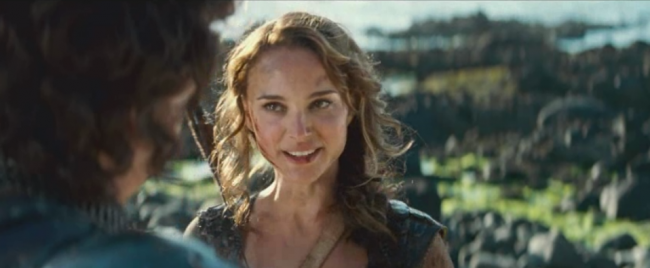
I'm a fan of James Franco, Natalie Portman and Zooey Deschanel, but why they should play second-fiddle to Danny McBride (who's usually lousy...Land of the Lost...and who barely registered as the reluctant groom in Up in the Air) is beyond me. Sure, Franco probably owes director David Gordon Green for his role in Pineapple Express (which I haven't seen, but have heard good things about), but he seems a bit lost in this, although gamely appearing cluelessly cheery throughout.
Borrowing heavily from every fantasy-adventure movie from the last 20 years (and liberally from Star Wars—their take on Yoda is particularly nasty, and they have
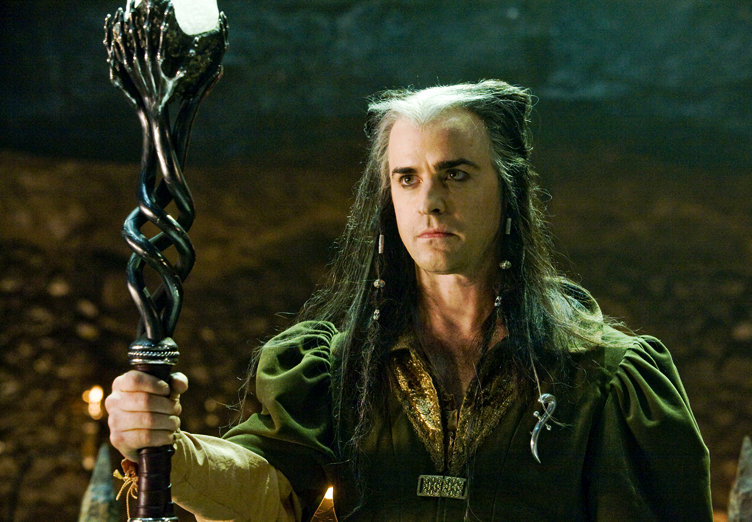
a clockwork bird-familiar after the original Clash of the Titans), Highness tells the story of the sons of King Tallious (Dance) and his two sons—the heir to the throne, Fabious (Franco), and the ne'er-do-well younger Thadeous (McBride) who would appear to be "Your Lowness." Fabious' bride Belladonna (Deschanel) is kidnapped by the evil sorcerer Leezar (Justin Theroux, who co-wrote Tropic Thunder, another high-concept low-result comedy) for his own nefarious plans. Fabious recruits Thadeous to go on the search for Lezar, despite the fact that the younger Prince can't fight, doesn't travel well, and is in all things incompetent. Plus, he's the "troop griper/whiner." Good planning. Dick jokes ensue.
Between the puerile humor
there are some action sequences, but Green has a hard time deciding whether he's playing them for laughs or for jolts. Not that it matters, as they succeed in neither, not even in the way that competent directors can achieve both or even one. And, although things are accomplished, nobody really learns anything so character arcs are as flat as a crushed pixie (the only clever idea I saw in the whole thing).

But, one thing Your Highness did accomplish: I had no second thoughts about it.


Maybe Hanna would have had more laughs.***
"I just won an an Oscar. You want me to what?"

* A complete execution...of me...was what I wanted after seeing this movie!  One thing that is mentioned in all the write-ups I've seen is that the crew went into production with  only a story and everything was ad-libbed on-set.  Really, they shouldn't be boasting about that. Oh...and the film I hinted at for the Saturday "Take Out the Trash" candidate that week was the latest version of Atlas Shrugged (Part 1).

 ** Okay, okay. I dump on Danny McBride—or Danny R. McBride, as he's calling himself these days—a lot. Because I don't see the talent. I don't find him funny, and mostly find him a little desperate. But...he was okay in Up in the Air. And he was superb in Alien: Covenant. When the man is firing on all thrusters—as he had to do in the "Alien" movie—he can be really good. (Here's what I wrote about him then—"I have to confess: while one shouldn't walk into movies with prior expectations, I was really looking forward to a scene where Danny McBride gets offed by one of the xenomorphs—I rarely have seen McBride in anything where I found him with an ounce of talent or charm, he's one of those few actors I actively don't like. But, here, he's terrific, taking an under-written part and bringing a lot of good choices and subtle nuances to the role. I'm now a fan.")

*** It didn't.


Friday, December 24, 2021

The King's Man

Mannered Maketh Malarkey (Dulce et decorum est cogitare hanc pelliculam sugit)
or
The Prequel To End All Prequels
 
I wasn't a fan of Kingsman: The Secret Service, although I enjoyed most of the performances, particularly Taron Egerton's, I felt that it was pretty sloppy without much holding it together, although the satire was there and recognizable as such. It was meant to be a breezy jocular look at spy thrillers,  located somewhere in between the Bond Series and Austin Powers, hewing closer to the latter in terms of cleverness (or lack of it) and amping up the violence to the point that—despite containing the adage that "manners maketh man"—it became decidedly unmannerly.
 
One couldn't take it seriously and so any connection to a thriller goes right down the chute as the stakes are as high as they are in a "Looney Toons" cartoon. Samuel L. Jackson had it right in the first one by playing the arch-villain with a silly lisp, which has become his signature tic for showing he has no respect for the material he's playing—he certainly doesn't use it when hawking Capital One.
So outlandish actions and jolly good manners was the joke of the first two films, but director
Matthew Vaughn's latest, The King's Man—boasting original material from Vaughn and Karl Gajdusek (good villain name, that)—goes back in time to show the origins of the secretive Kingsman organization that bypasses political discussion and goes right for the jugular. Why this was thought necessary is anyone's guess, but I suspect—with another movie featuring Egerton in the works at the same time—they may be offering material that will relate to the next sequel. There are a couple of prominent names in cameo's and perhaps they'll be part of the next one.
The film concerns the exploits of Orlando Oxford (
Ralph Fiennes and bloody good, if seeming like he's in the wrong movie), the Duke of Oxford, who, at the time of the film's opening is a former war officer now working for the Red Cross and inspecting a concentration camp in South Africa in 1902. He is there to see General Herbert Kitchener (Charles Dance) about the deplorable conditions and talk strategy. In the course of the visit, the party comes under attack and Oxford's wife Emily (who encouraged Oxford's humanitarian duties) is killed before the eyes of Oxford—who has been wounded in the attack—and their young son Conrad. With her dying breath, Emily swears Oxford to "protect our son, protect him from this world, and never let him see war again."
When Conrad grows to the age of 17 (and embodied by
Harris Dickinson) is looking for a life of adventure, which his father vehemently opposes. He wants to join the Army when of age, but Oxford keeps him at home under the watchful eyes of associates Shola (Djimon Hounsou) and Polly (Gemma Arterton), who are crack spies and soldiers of fortune, but hide in plain sight as part of the Duke's staff. Presumably, it was so hard to hire good marksmen in that day. Oxford has good reason to be worried. Somewhere on an improbably high, flat and unscalable escarpment a group of terrible people are plotting to destroy the world and make money doing it. Headed by a Scottish separatist code-named The Shepherd, the group contains as members from around the globe including Grigori Rasputin (Rhys Ifans), Mata Hari (Valerie Pachner), Vladimir Lenin (August Diehl) and Gavrilo Princip (Joel Basman). 

Who? Well, I'll bet most audience-members don't know who Rasputin is, so don't feel bad. And I'm sure that a lot of them don't know the significance of Arch-Duke Ferdinand (played in the film—briefly, which is historically accurate, by Ron Cook).
Hell, ask the common man about World War I and you'll get a response like "World War II had a prequel?" or "Yeah, Wonder Woman was in it" Be that as it may, the group is trying to exacerbate the already bad relationship between three head-strong cousins, King George V (of England), Kaiser Wilhelm II (of Germany), and Tsar Nicholas II (of Russia), all played amusingly by Tom Hollander (bravo, sir!),* starting with the assassination of Arch-Duke Ferdinand, and the poisoning of Nicholas' son Alexei.
In his attempts to protect his son Oxford nearly gets him killed protecting the Arch-Duke and taking out Rasputin. But, then, this film has a habit of having people saying things and doing something that is contrary to their words. Oxford makes grand speeches about colonialism and imperialism and the exploitation of the indigenous people, but his comfort in his class and power has him being a very good example of all that. The only folks who seem to actually mean what they say are the villains, who are all so single-mindedly evil that they barely register as real characters—these were all very powerful and influential people and they're treated like puppets in this film's Grand Scheme.
But, at least they're consistent. The movie, on the other hand, careers between goofiness and sanctimony. Words are meant to be taken seriously, but the action sequences not so—deft (and unbelievable) as they are. Rasputin, Oxford, Conrad and Shola have a three-to-one duel set to Tchaikovsky's 1812 Overture, there's a weirdly impractical assault on that villain lair, and there's a World War I trench assault that, as completely unbelievable as it is, is still meant to be taken seriously if we're to have any feelings for the character.
It's a film of duplicity and two-facedness, delighting in "hilt-cams" and elaborate torpedo shots and a flash-zip of two years of World War I to see the the reduction of a hamlet town into a No Man's Land. Jeez, there's even an mustache to mustache edit in the thing. One starts to think that the film-makers are just so pleased with themselves and their own cleverness that they can do such little miracles that they don't see that the movie is clumsy and ham-fisted. So ham-fisted that the "surprise reveal" of "The Shepherd" is easily guessed just by the way shots are held unnecessarily before cutting away from them. Clever.
 
 
So clever it's stupid.
 
* Yes, it's true. Those heads of state were all related to each other (and you thought the Daniel Craig Bond movies were too in-bred!) No wonder the 20th century was so fucked up. And no wonder people wanted to do away with the Right of King's.

Wednesday, January 27, 2021

Mank

The Tale of the Organ-Grinder's Monkey
or
"I built him a water-tight narrative and a suggested destination. Where he takes it, that's his job."

The film Citizen Kane has held such a reputation over the years of being an iron-clad masterpiece and possibly "the greatest film ever made" that, of course, people are going to fight over it. One can't dispute its brio and artistry, especially in comparing it to what had come before. So, the alternative is to fight about something else. Tone problems, maybe? (in a film that centers on child abandonment, it's remarkably free of sentiment and thus—it is argued—"cold").

But, no. The big argument is usually "credit." Who did what (and to whom?). And the history of Citizen Kane has been continually squabbled over in a snow-storm of exhumed scripts, continuity pages, notes, and interviews (usually accompanied by a background whine of axes grinding). It's all such flotsam in a snow-globe, shaken up with little purpose or permanence. Time would have been better spent watching the movie because, like the poster tag-line said, "It's terrific!" 

People are just trying to determine "why" that is.
Fincher not using depth-of-field; the looming shadow is that of Orson Welles

Now comes Mank, directed by David Fincher from a script by his late father (and tinkered-with by Eric Roth, who gets a producer credit in lieu of a writing one, ironically enough) and it's a deliciously inventive stirring of the pot, going maybe a bit too "inside" of Hollywood and the games people play to get work and the compromises they make to keep getting it. It is less about the making of Citizen Kane than the writing of it* and it takes the structure of Kane to tell it, weaving back and forth between screenwriter Herman J. Mankiewicz (Gary Oldman), bed-ridden from an auto accident, holed up in working convalescence in Victorville, California, and his memories—some fueled by alcohol—of his years in Hollywood, when he wrote with the best of them and circled among the powerful, like William Randolph Hearst (Charles Dance) and his mistress, Marion Davies (Amanda Seyfried).
Reaction in the various corners has been predictable. The Welles loyalists  think it's a smear job and "Paulettes" (writers mentored by—or apologists for—Pauline Kael), and the Mankiewicz relations are reserved in their praise. Nobody in the Mank scenario gets out unscathed...or alive (or they couldn't have made the picture). So, if anybody "wins" it would be merely on points, no knock-out. The character assassinations are done in a circular firing squad, but no one's legacy is left un-besmirched. Credit where credit is due.
But, credit is like Truth in Hollywood. If you got it in writing, the odds are in your favor, but Hollywood is filled with myth-makers; how are you going to know if it's true...or just makes a good story. Mank takes the position that Mankiewicz, having proved his worth in Hollywood, started to take his position for granted—he was an alcoholic and a gambler, so someone for whom consequences come later. His work and his attitudes toward his bosses and his worth changed and he saw himself tolerated rather than cherished and so began to pay less fealty to his overlords. He didn't play politics with California power; politics was too important to waste on film studio's.
Burke as Orson Welles

All of this he recounts to himself, both in his proudest moments and in his weakest, as he dictates the promised screenplay "American" for the New Kid on the Block, the Wunderkind with the Iron-Clad Contract, Orson Welles (Tom Burke). Mankiewicz is writing "American" as work-for-hire, so he's getting paid but that's it. He's being overseen by Welles major domo John Houseman (Sam Troughton)—who drops by, fusses and leaves—but the work is done by Mank dictating, which gets typed up by assistant Rita (Lily Collins), whose husband is lost in the opening fires of WWII, while a nurse Freda (Monika Gossmann) handles medical attention.
Oldman's Mankiewicz with Sam Troughton as John Houseman

We talked about truth, earlier. Among other things, Mank is a movie about conspiracy. Everything about it is under the table and understood between friends. No one knows that Mankiewicz is working on a screenplay, Welles—absent while working at RKO on a planned "Heart of Darkness" movie—is kept vague about work accomplished, Houseman doesn't know that Mankiewicz has smuggled in liquor ("exercise equipment" Mankiewicz calls it), although both Freda and Rita know it and aren't disclosing—the work flows with the liquor and progress is being made.
Writers' meeting

Mankiewicz is not shown to be above this sort of "nudge-nuge, wink-wink" flummery in the past as, in flashback, he and an all-star group of studio scribes—like Ben Hecht, S. J. Perlman, George S. Kaufman, Charles McArthur and Ben Hecht go into a script meeting with David O. Selznick and "Joe" Von Sternberg and hash out the progress of an entirely fictional script that they're ad-libbing on the spot; they have been playing cards and other non-writerly things on the studio's dime. It's an intellectual game played on the "rubes" running the studio, a little arrogant "up you" from the smart guys to the dumb, unsuspecting bosses. This mutual loathing/self-loathing society will be Mankiewicz's play-book negotiating around Hollywood.
At San Simeon with Mayer (Howard) and Thalberg (Kingsley)

At parties he's invited to (thank you very much, old sport), he'll always drink too much and talk too loud and be too indiscreet around the likes of the Louis B. Mayer's (Arliss Howard) and Irving Thalberg's (Ferdinand Kingsley) because everyone knows he's clever and he's amusing and a bit of a cheeky sort good for a laugh to fill up uncomfortable party-pauses. It's what brings him to the grounds of San Simeon and the world of William Randolph Hearst, a king-maker as well, but with far more reach than over just stars and starlets. The studio heads are all about fantasy; Hearst makes it real.
Which is fine as long as the liquor is flowing and everybody laughs at—or at least tolerates—your jokes. But, when Hearst and Mayer and Thalberg collude on their own little machinations to influence the vote on the up-coming governor's race (using the M-G-M dream machine to concoct footage to promote fear of a wave of socialism taking people's jobs) that's when Mankiewicz sobers up and loses his sense of humor—and nobody likes that at a Hollywood party. Republican or Democrat.
It spells Mankiewicz's down-fall as a "trustee" and "good ol' boy" and the jobs dry up—without filmed trainloads of migrants having to take them. That and a few other ramifications of the Governor's race gives Mankiewicz the need for the Welles job, the justification for taking it, and the opportunity—and ammunition—to pay back some debts by doing what a writer does best—writing what he knows. Despite having the semblance of a happy ending (wherein Mankiewicz raises another clever middle digit), Mank is a movie that doesn't make him look good. In fact, with the exception of the character of his wife and nurses (and sympathy for the character of Marion Davies), nobody "looks good" in the film. 

But, then, nobody did in Citizen Kane, either.
Mankiewicz's triangulation by Houseman and Welles

The movie certainly looks good, though, even resplendent. Shot in high-res black-and-white that fairly vibrates on the screen, Mank is, in all ways, a labor of love for Fincher. Beyond the parental connection, he revels in the deep-focus compositions and the chiaroscuro lighting pallets in monochrome duly recorded by DP Erik Messerschmidt. Fincher has always been a stickler for composition, but combining the "old movie" format with wide-screen—and the inspiration inherent in the subject, he's like Welles' proverbial "kid in a candy store" even going so far as to include "cigarette burns"—those corner spots indicating reel changes?** (Well, maybe if you're young enough, you don't)—totally unnecessary in a streaming presentation—but here, popping up every 14 minutes or so.*** The projectionist in me was always waiting for the second one and was not disappointed. (No "jump" on the next scene, though).
Although I wasn't exactly the choir Mank was preaching to, I did watch it with a perpetual, appreciative smile on my face. It's great to see this sort of artfulness being festooned over something that merely recreates the past, rather than create a whole new reality. More risk to this, especially for those who'll twitch if they see a flaw in period or manner. 
"...she was carrying a white parasol."

The only caveat I had was one lasting thought on my brain's back-burner almost the entire picture: If Mankiewicz is so much the driving force of the finished work, why then does Fincher follow the visual language and the look of Kane...which was the work of the director?  

Because Kane wouldn't be Kane without it?
"A far too-long screenplay for the ages...John Houseman"


* There are two other films if you want to see vague watered-down versions of that, 1996's "The Battle Over Citizen Kane," an episode of PBS's documentary series "The American Experience"(which seemed to come to the conclusion that Welles and Hearst had a lot in common, which is bosh—other than ego) and RKO 281, a fictionalized account based on that documentary produced by ScottFree Productions and directed by Benjamin Ross for HBO, which is even worse. 

The best place to start is reading Pauline Kael's "Raising Kane"--which appeared in The New Yorker and accompanied Mankiewicz's (and Welles') published shooting script in "The Citizen Kane Book" (Bantam Books, October 1971). Using another scholar's work, Kael built her article on the thesis that whatever is great about Citizen Kane is presaged in the screenplay rather than Welles' interpretation of it. 

Kael was a hell of a writer but a lousy researcher—once she had what she wanted to say on her mind nothing could refute it—nor would she seek out information refuting it. On top of that, she had a running feud with fellow-critic Andrew Sarris who took up the mantle of the French "auteur theory"—that the director is the true author of a film—of which Orson Welles was considered a prime example. The article raised all sorts of holy hell, dented her reputation a tad, but she remained unapologetic. Like most of her writing, it came from her heart, not necessarily any research.

** Fincher used the joke earlier in his career with Fight Club:

*** Reels were traditionally 10 minutes in length.

"Forgive us our trespasses"

Tuesday, June 4, 2019

Godzilla, King of the Monsters (2019)

Doing the Limbo Dance with Godzilla (Faith and Ghidorah)
or
Dr. Serizawa's Magic Bullet

I was anticipating the new Godzilla movie, Godzilla: King of Monsters, when I saw the trailer start to hit theaters. I enjoyed Gareth Edwards' 2014 take on the series, and was suitably impressed with what Legendary Entertainment was doing with their second "Monsterverse" film, Kong: Skull Island. But, to see the trailer for G:KOM, with appearances by other Toho Studio monsters, like Rodan, Ghidorah, and Mothra (especially Mothra) gave me a sense of giddy joy, as in "My God, they're really going to try and do these cheesy monsters with a sense of "real" CGI verisimilitude, instead of the puppeteered, rubber-suited versions we're used to?" And then, to bring a respectable cast of characters actors like David StrathairnKen Watanabe, and Sally Hawkins (all returning from the 2014 film), as well as Bradley Whitford, Kyle Chandler, Charles Dance, Vera Farmiga (!) and Ziyi Zhang (!!!), I was somewhat delirious, as in "Oh My God-zilla, are they actually going to make a decent movie out of this juvenile material? That would be so awesome!"

The answer is "No, they didn't." One wonders if they ever could, but the hope was there, and although the film is semi-successful in some aspects, the conclusion from what I saw was a disappointing result from an over-the-top concept.

But, to get any enjoyment from the experience, a little perspective is required. To illustrate, here is a scene featuring a "pitched" battle between those same four antagonists from the 1964 feature Ghidorah, the Three-Headed Monster*
There, now you should be prepared to see Godzilla: King of Monsters and come out somewhat impressed. Extreme, I know. But, you have to set the bar pretty low to raise expectations.

It's been four years since the appearance of Godzilla—"the day the world discovered that monsters are real"—the film starts with a flashback to the events in San Francisco where two new characters, Mark and Dr. Emma Russell (Chandler and Farmiga), two Monarch** specialists are caught in the fray...with their family for some reason...resulting in the death of one of their kids, their son, Andrew (definitely a downside to "Take Your Child to Work Day" when working for Monarch). This fractures the family (you think?). Mark, embittered and wanting to kill the Titans, and GZ in particular, goes off to study wolves, while Dr. Emma continues her husband's work of creating a communication system, designed to keep whales from beaching themselves. Only she's using it to see if she can communicate with the MUTO's. It's a good way to set up all sorts of "Geez, I hope this works..." scenes.
Their daughter Madison (played by Millie Bobby Brown from "Stranger Things") is keeping up contact with Dad and worrying about Mom's frequent moodiness and is one of those irritating "Wesley Crusher" kids, who can take some wires, a USB cable, and a Brillo-pad and hack into a pay-telephone so it can communicate with the Mars rover Endeavor to save Matt Damon (although she has trouble making breakfast...fake-out!). It's no wonder Dr. Emma takes her to the Monarch project where they're trying to awaken Mothra (Hey, remember "Take Your Child to Work Day?" Worked out real well last time, didn't it?). But, not to worry. Even though Mothra freaks out and kills some techs, Dr. Emma is able to take her "Orca" device, push a button, and translate Louis Armstrong's "What a Wonderful World" into Mothra-song to calm it down. This inspires Madison to confuse the multi-million dollar facility with a petting zoo to reach out and touch the creature bare-handed without a care about communicable disease or some sort of tactile osmosis that would put a Mothra-larvae into her body that will burst out at a later time (possible sequel?).
Dr. Emma worries about how she's going to explain this to CPS
They don't have to think about that, anyway, as, once they have Mothra under control, former MI6 agent and prominent eco-terrorist Alan Jonah (Dance) bursts in with some merc's, seize the Orca device, and take Dr. Emma and Madison hostage for his nefarious plans to do something evil and inspire a rescue operation. Mission accomplished on that last one; Monarch, in the form of Dr. Ishiro Serizawa (Watanabe) and Dr. Vivienne Graham (Hawkins) finds Mark dancing with wolves and tells him what's happened. They set out to track Jonah and his whale-sized ambitions to try and get little Maddy back.
Monarch gets lectured by Dr. Emma (while her ex glowers about "hearing this before"
That, as it is, is the plot. The rest involves globe-trotting to many Monarch outposts, tracking the movements of GZ, and the intentional setting free of the three-headed monster Ghidorah, who has been trapped in Antarctic ice for eons. Once he's—or they, I've have pronoun troubles with three-headed things—thawed, it goes about the world freeing other Titans in its official title as apex predator, which is what Jonah has intended all along. His justification being that the Titans have been here longer, and that we relatively newbie humans are screwing up the planet, so the Titans will fix it all up by getting rid of us. This, then, makes Jonah the ultimate anti-immigration activist (hurts when it's you, doesn't it?). 
Foreshadowing that Godzilla and Mark might some day see eye to eye.
There's more match-up fights than an episode of the WWF—Mothra versus Rodan, Godzilla versus Rodan, Godzilla versus Ghidorah (SPOILER ALERT-he gets his scaly tail handed to him, regroups then comes back and wins, with a little help from his monster friends, and ultimately wins the gold belt-buckle that says "King of the Monsters") and the puny little humans help as best they can, but, basically, they're farm-league, only good at running away and, failing that, becoming kaiju toe-jam .
Ghidorah bug-zaps Mothra
That's what we all go to see—monsters fighting, even if it's in murky darkness, so they don't have to have the CGI be perfect (or it was the low-projection level of the 3-D version, which is the format I saw it in), and despite the creators' earnest intentions, it's the same format that the other films have usually had. Some pretext in the human world sets everything up—in this case, it's the problems with the Russell's, whom we've never heard of before and have the most basic issues on which to hang a monsters-fighting scenario on. At least, it's not manipulation by space-aliens, or venusians, or some other clap-trap that would cause your eyes to roll sop far back in your head that you'd miss the fights at the end.
Rodan goes in for the kill
You have to suspend belief so high that it's achieved orbit, while at the same time lowering expectations so low that your back will be killing you the next day. Either that, or you have to be such a True Believer Fan, that you just don't care, because you get a thrill every time you hear Godzilla amp up like an old diesel generator before he unleashes a force-beam of some completely unfathomable energy that will somehow shred whatever big-thingy he's up against. When you're that deep in the fantasy, there are no rules of engagement, you're just glad for the engagement—like your desperate Aunt Sophie.
Ghidorah provides free WI-FI to everybody.
The human actors do a fine job of spouting techno-babble and mumbo-jumbo as if it makes sense—Whitford seems to be having a good relaxed time (he's had to negotiate Aaron Sorkin dialogue) and Strathairn looks like he's really having to double-down on the glower to prevent himself from cracking up over what he's saying (there are quite a few Oscar and Emmy nominees in this cast, by the way...although this probably won't inspire "For Your Consideration" ads come the next awards season). And they're very good at the Spielberg-trope of looking up with a faraway look as if their lives depended on it.
"For Your Consideration"
There are, despite some of the hammer-hitting lack of subtlety in the film, some nice touches: the constant calling-upon of hieroglyphic evidence of kaiju presence during man's early development (however unlikely that may seem); the sense of glowing myth as the creatures never seem to be present in anything other than strange weather phenomenon, as if they were tied to the very natural forces that soak, electrify, and shake the planet—like some manifestation of Kurosawa's emotional weather conditions; there's even a moment that might be confusing for most audience members—Ziyi Zhang plays two characters in the film, twin sisters, who hearken back to similar twins, the twin fairies, the diminutive shobijin, who summon forth Mothra with their song. It's a tiny little detail, but it set my "mothra-sense" to tingling when I saw the actress appear in a continuity-defying two places at once.

"Please notice that the 'Fasten Your Seat-Belt' sign is on..."
But Godzilla, King of the Monsters is not that great a movie. A pretty darned good giant monster movie and a bit of an improvement over its source material (remember: no venusians...). If it has any luck, it'll become a Saturday afternoon staple on television—which is where I saw most of these things in my youth (and I was cynical about them then). It pays homage to its source by not being too reverential about it or trying to make it more "significant" than it is (despite my comic intentions to politicize it). It was, and still is, a cheese-fest. It's just that the price of cheese has gone up—significantly—over the years.
"Let's get ready to rummmmmblllllle..."
Oh. And one passing thought: despite the dangers displayed by galumphing behemoths of various genera and type, spitting sparks of a source not found in Nature's spectrum, one gets the impression that they are not considered the biggest concern or threat to the filmmakers. Given the evidence of the film and what they choose to show and how they show it, the real danger is...bad mothers.

Hope that doesn't spoil anything.
"King me, baby!"
Prepare for the inevitable cage-match (2020, they're saying)

* Or as it's known in the States, Ghidrah, the Three Headed Monster (with only two syllables).

** Monarch is the secretive Japanese-American organization that studies M.U.T.O.'s (Massive Unidentified Terrestrial Organisms—or the more PC, "Titans") that have emerged from the Earth's hollow interior due to man's atomic experiments and other destructive activities—like building Monarch's massive underground outposts. Monarch seems to have an unlimited budget and unlimited resources, and 61 outposts around the globe to hunt 17 of these things. It's no wonder there is a Senate investigation of the thing in this movie. Next thing you know, Trump will want one of these organizations if he can't get his Space-Rangers.
Oh. One more thing-they always have to fight by power-lines. Always.