Showing posts with label James Franco. Show all posts

Tuesday, June 20, 2023

127 Hours

Written at the time of the film's release...

As I recall, the Best Picture winner for that year was The King's Speech (the nominees were quite impressive that year), although 127 Hours and Franco's performance were nominated.

"Drinking Your Own Epiphany"
or
"Rock On/('Ooops')/Arm(our) Off"

The story of Aron Ralston, extreme....everything, who, on a solo trek through Canyonlands National Park in Utah finds himself stuck in a seam of the Earth pinned down by a boulder he has no way of moving, is a harrowing story of survival, self-reliance and an ultimate example of "a man's gotta do what a man's gotta do."* Beyond the gruesome headlines is the story of a young man, who, faced with a situation;putting him, literally and figuratively "between a rock and a hard place" (the title of his book outlining the story), chose to follow his philosophy to an extreme act, losing a part of himself, but gaining far, far more.

Not your typical film subject. In fact, it would be a daunting thing to film, not only from a technical aspect—limited staging, convincing illusions of the injury—but from a dramatic one, as well (we're talking one-man show in a cave).
Danny Boyle's film of the incident, though,
127 Hours, not only makes the film seem invisibly easy to accomplish—one doesn't think for a moment of the filming difficulties, so engrossed are you in the challenges of the film-Ralston in his tasks trying to extricate himself and survive, basically—it is an intense, kaleidoscopic presentation of a human psyche in solitary duress. Ralston (James Franco) fights the battle on two fronts: physically, dealing with his limited options and the practical, and impractical, tools at his disposal; and mentally, as he struggles with the mental challenges of time, pain and personality. With only 15 minutes of sunlight each day, which he finds the capacity to luxuriate through, he keeps a running countdown of resources, limited food and water, the tools at his command and his own diminished capacity. He knows his time and options are limited, and gradually, as they run out—that poster embedded here suggests, very appropriately, an hour-glass—he must come to grips with his responsibility to himself, and the people in his life that, heretofore, have been merely fleeting encounters, as jettisonable as the wrapper of his last Power bar.

Time wounds all heels. And in his forced imprisonment,
the taking stock of Aron Ralston brings focus and clarity. The hyper-activity of Ralston's previous life, which Boyle crams into a split-screen multi-speed, multi-media format, is stilled, brought to a very narrow range of existence, and places him in the Here and Now, as opposed to the Next Empty Thing. Time and relationships become essentials, and his own self, literally and metaphorically, becomes disposable. He discards, mentally, physically, what has become useless.


And chooses life. 
Wow. Great story. "Intense" (as one Grand Cinema patron remarked leaving the theater gasped) and harrowing.

Don't let the amputation aspects of the film turn you off to a great film experience. Yes, it's graphic (Boyle prepares you for it with early attempts that do nothing to solve the situation—they're more exploratory surgeries), yes, there will be blood...and sinew and gristle...and nerve-slicing—which Boyle and his sound-designers amp up with a dentist-drill irritation—but, nothing that hasn't been CSI'd into our consciousness to the point of numbness. By this time, the identification with Ralston has become so empathetic, that I (perversely, I guess) found the episode liberating, and an act to be cheered.
Boyle's quilting of the movie is brilliant, but he's aided and abetted by an army of technicians who keep things fascinating, not the least of which are cinematographers
Enrique Chediak and Anthony Dod Mantle, and Boyle's Slumdog Millionaire composer A.R. Rahman (and a goofily eclectic soundtrack).

But the hero is Franco. After seeming a bit of a "meh" actor in
the first Spiderman movie, it has been fun to watch him grow as an actor, first in that series, and in the clutch of carefully chosen dramas and comedies he has made since. Boyle has set a fine table, but Franco is the center-piece, the one essential ingredient that had to "work" to pull it all together. This is a sure Oscar-nominated performance, and, if there's any justice, he'll get the statuette, as well.


Oscar-wise, Boyle might even pull a "two-fer." We're on the cusp of December and the Christmas movie crush, but it is not hard to imagine 127 Hours turning out to be the best movie of the year.
Aron Ralston.  Rock On.

* I still remember where I was and what I was doing when I first heard the news reports of his story and what he did. I also recall my reaction, which consisted of taking a deity's name in vain, and contemplating—for several minutes—what I would have done in that situation. I could conjure no definitive answer except "Maybe...but certainly not as well."

Saturday, March 25, 2023

Your Highness

Saturday is traditionally "Take Out the Trash" Day. And I remember this one distinctly because it's one of those comedies that didn't make me laugh much, but, instead, only filled with me a great resentment for whatever hack studio executive green-lit this mess. I'm usually charitable to movies because they are the work and coordination of many people and only some can achieve some sort of magic greatness. But, I can't even be charitable about this one. This crap-fest was a waste of everyone's time...but evidently not their talent.

Written at the time of the film's regrettable release.
 
"Du-uh..."
 or   
"Natalie Portman's Post-Oscar Slump, Part 1"

I've needed a laugh lately. I've been second-and third-guessing myself, not sure which way to go on all sorts of matters. And after seeing two movies, good and bad, in which anyone can be tread upon by the Government (The Conspirator and this Saturday's "Take Out the Trash" entry*), I needed something light, something frothy, something not Hanna or The Lincoln Lawyer.
 
I needed a comedy, dammit! After playing pin-ball in my head for a week and a half, I wanted a new thought to tilt me out of my doldrums. It would be appropriate, too, as every scene we've looked at Sundays of this April Fools Month has been a comedy (this week will be no exception), so a comedy might be just the thing to kick my torpor in the ass, or at least make it slip on a banana peel. 
 
Wish I'd found one, because this isn't it.
Your Highness, in fact, makes me wish I was living in a different era—not the one depicted in the film, of course, but also not in a time when such a movie, with big stars (every Briton who isn't in the "Harry Potter" series, like Charles Dance and Damian Lewis), sumptuous locales and elaborate costuming can be so sloppily put-together that one gets the impression that at every stage the film-makers said "Eh...good enough" and moved on. 
I noticed myself laughing exactly twice, and longing for something—anything—to be half-way clever or even half-way executed.
* I like my comedy to have a brain in its head, and something to say besides what could shock your grandmother. Despite the cast, this one has so little going for it, you start to worry that at least the cast were well compensated. Because it couldn't have been for love.
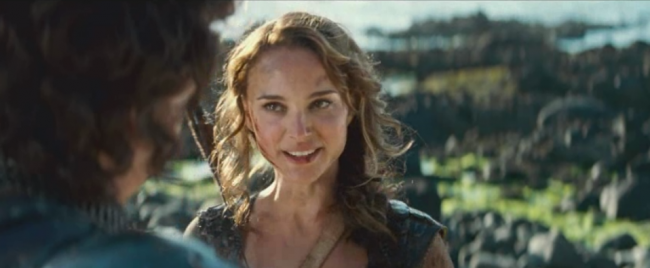
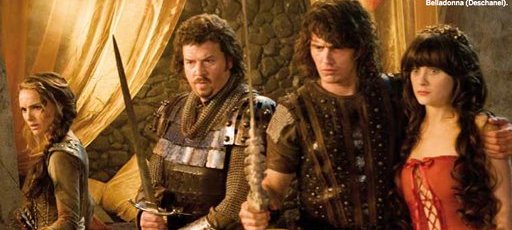
I'm a fan of James Franco, Natalie Portman and Zooey Deschanel, but why they should play second-fiddle to Danny McBride (who's usually lousy...Land of the Lost...and who barely registered as the reluctant groom in Up in the Air) is beyond me. Sure, Franco probably owes director David Gordon Green for his role in Pineapple Express (which I haven't seen, but have heard good things about), but he seems a bit lost in this, although gamely appearing cluelessly cheery throughout.
Borrowing heavily from every fantasy-adventure movie from the last 20 years (and liberally from Star Wars—their take on Yoda is particularly nasty, and they have
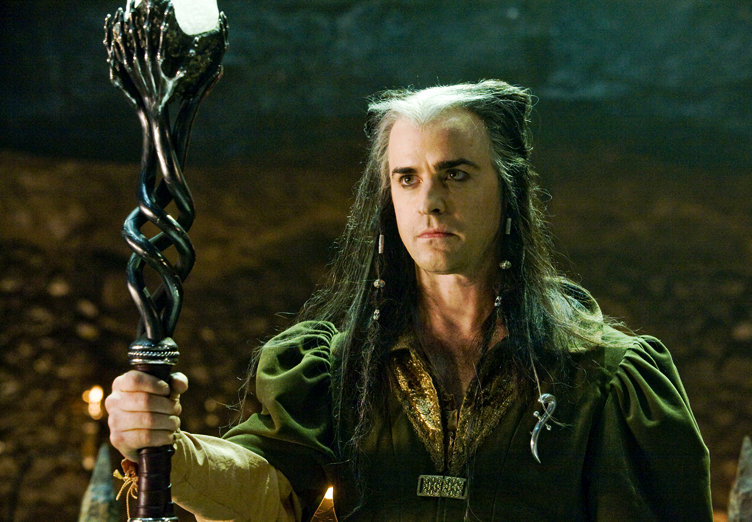
a clockwork bird-familiar after the original Clash of the Titans), Highness tells the story of the sons of King Tallious (Dance) and his two sons—the heir to the throne, Fabious (Franco), and the ne'er-do-well younger Thadeous (McBride) who would appear to be "Your Lowness." Fabious' bride Belladonna (Deschanel) is kidnapped by the evil sorcerer Leezar (Justin Theroux, who co-wrote Tropic Thunder, another high-concept low-result comedy) for his own nefarious plans. Fabious recruits Thadeous to go on the search for Lezar, despite the fact that the younger Prince can't fight, doesn't travel well, and is in all things incompetent. Plus, he's the "troop griper/whiner." Good planning. Dick jokes ensue.
Between the puerile humor
there are some action sequences, but Green has a hard time deciding whether he's playing them for laughs or for jolts. Not that it matters, as they succeed in neither, not even in the way that competent directors can achieve both or even one. And, although things are accomplished, nobody really learns anything so character arcs are as flat as a crushed pixie (the only clever idea I saw in the whole thing).

But, one thing Your Highness did accomplish: I had no second thoughts about it.


Maybe Hanna would have had more laughs.***
"I just won an an Oscar. You want me to what?"

* A complete execution...of me...was what I wanted after seeing this movie!  One thing that is mentioned in all the write-ups I've seen is that the crew went into production with  only a story and everything was ad-libbed on-set.  Really, they shouldn't be boasting about that. Oh...and the film I hinted at for the Saturday "Take Out the Trash" candidate that week was the latest version of Atlas Shrugged (Part 1).

 ** Okay, okay. I dump on Danny McBride—or Danny R. McBride, as he's calling himself these days—a lot. Because I don't see the talent. I don't find him funny, and mostly find him a little desperate. But...he was okay in Up in the Air. And he was superb in Alien: Covenant. When the man is firing on all thrusters—as he had to do in the "Alien" movie—he can be really good. (Here's what I wrote about him then—"I have to confess: while one shouldn't walk into movies with prior expectations, I was really looking forward to a scene where Danny McBride gets offed by one of the xenomorphs—I rarely have seen McBride in anything where I found him with an ounce of talent or charm, he's one of those few actors I actively don't like. But, here, he's terrific, taking an under-written part and bringing a lot of good choices and subtle nuances to the role. I'm now a fan.")

*** It didn't.


Tuesday, June 15, 2021

Oz the Great and Powerful

Written at the time of the film's release...

What a World, What a World;
or
There is no Baum in Gilead

Any movie attempting to resuscitate L. Frank Baum's "Oz" books has to deal with the series' own Wicked Witch of the West—that being M-G-M's musical version The Wizard of Oz, which had Judy Garland in it, and set the bar very high as far as expectations go (for quality that is, whereas for the box-office TWoO was not a box-office success at the time of its release and only became a classic after a couple decades worth of Thanksgiving showings on network TV). Walter Murch's attempt to take an OZ story back to its roots, 1986's Disney's Return to Oz, was an abysmal failure, although artistically it was a terrific show--but probably butted heads with too many memories for its own goodness as, for instance, the Lion, Tin Man, and Scarecrow were not vaudevillians in theater-suits, as was the 1939 version, but looked more in line with the book's illustrations.
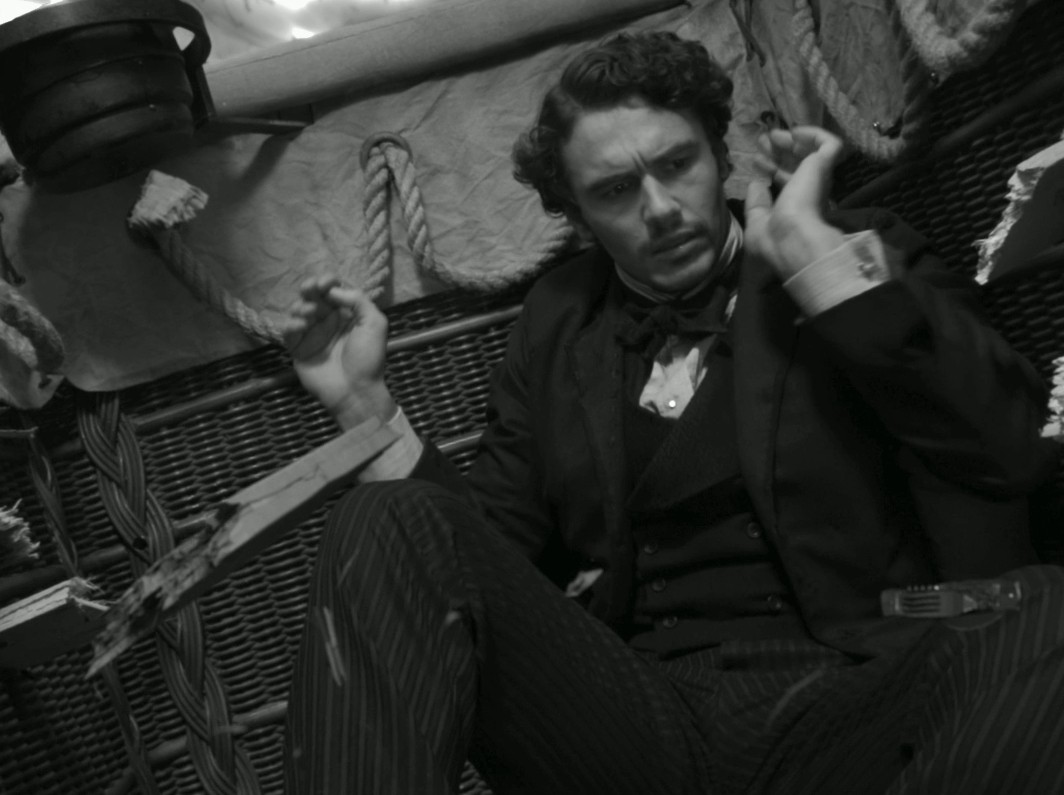
Sam Raimi, he of larky horror films and the Tobey Maguire Spidermen, is probably a very good choice for doing an OZ film, as he has equal qualities of sweetness and sour, where Tim Burton (the next usual suspect*) would have made the film travel heavier to the morose. Raimi's Disney's Oz the Great and Powerful (as convoluted and punctuationally challenged a title if ever, oh ever, there was one) manages to be its own thing while bowing and occasionally scraping to the previous' yellow brick road (which is revealed, as an aside, to have potholes, which nicely sums up the movie's respect, and lack thereof). A prequel, kinda sorta to The Wizard of Oz, it starts out in a black and white box-square format (with a special effect detail amusingly violating it here and there) on a sound-staged Kansas that creepily recalls the musical version. There scam-magician Oscar Diggs (James Franco) is conning rubes and comely assistants alike, and taking advantage of his stage-assistant, Frank (Zach Braff). He's a jerk, only revealed to better purposes when a lost love (Michelle Williams) comes to visit to tell him she's going to marry farmer John Gale (father of Dorothy, making her mother of), and he takes the higher road, telling her she chose the better man.
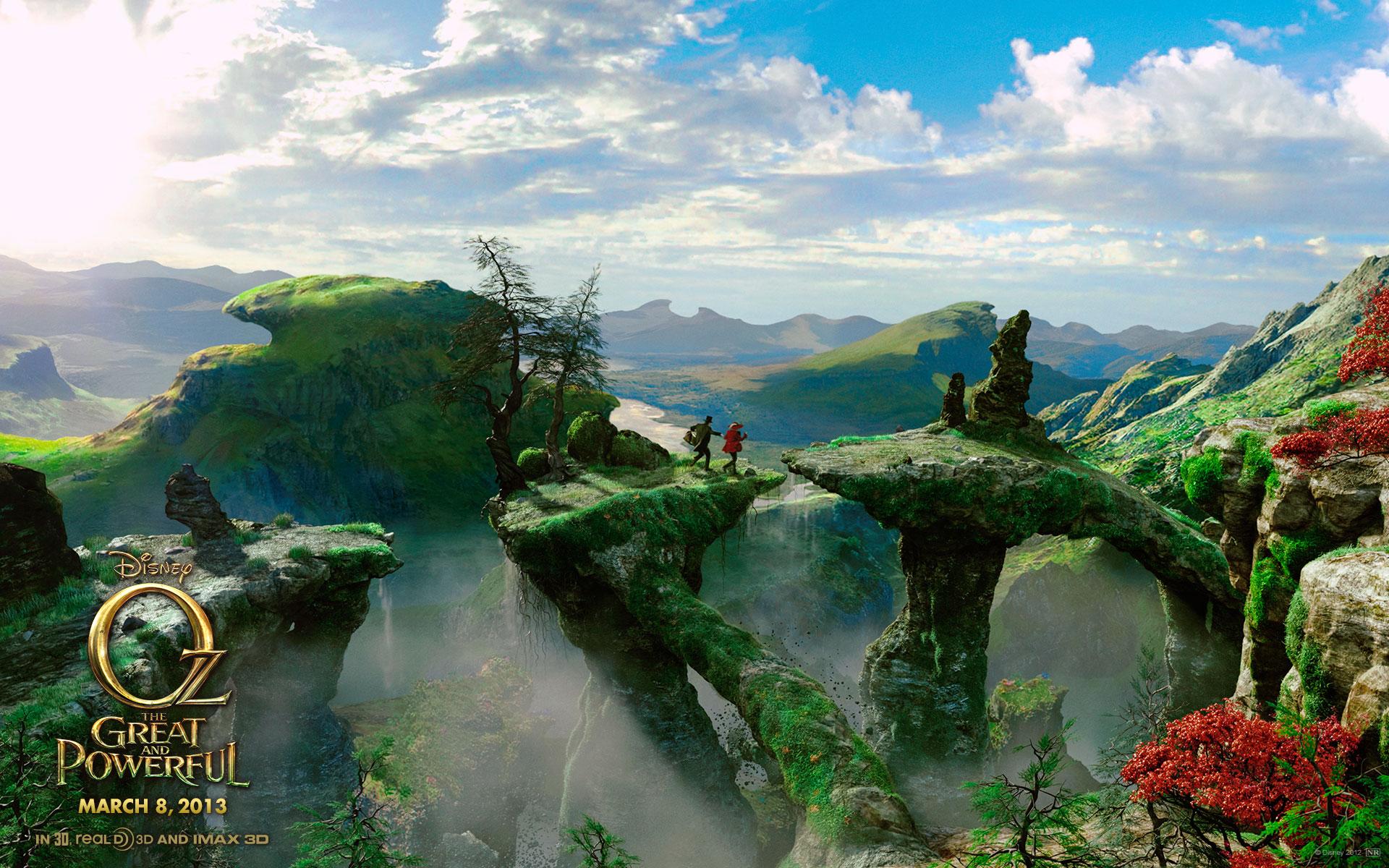
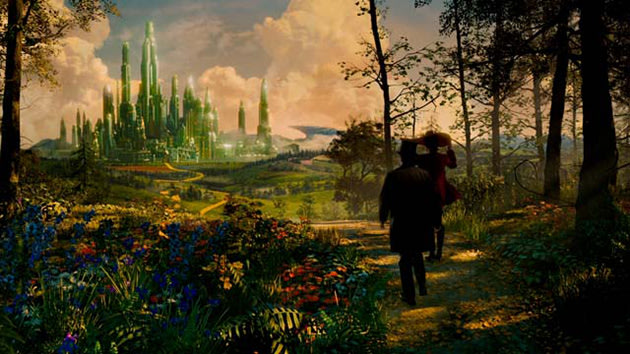
But his past catches up with him...or tries to...and his road goes even higher, escaping a vengeful cuckolded circus strong-man in a helium balloon. Kansas being Kansas, he is caught up in a tornado—one that presumably opens up a rip in the space-time continuum through some sort of meteorological consequence, and winds up in the storied land of Oz, where, true to movie-form, everything turns to color and the screen expands to wide-screen proportions.
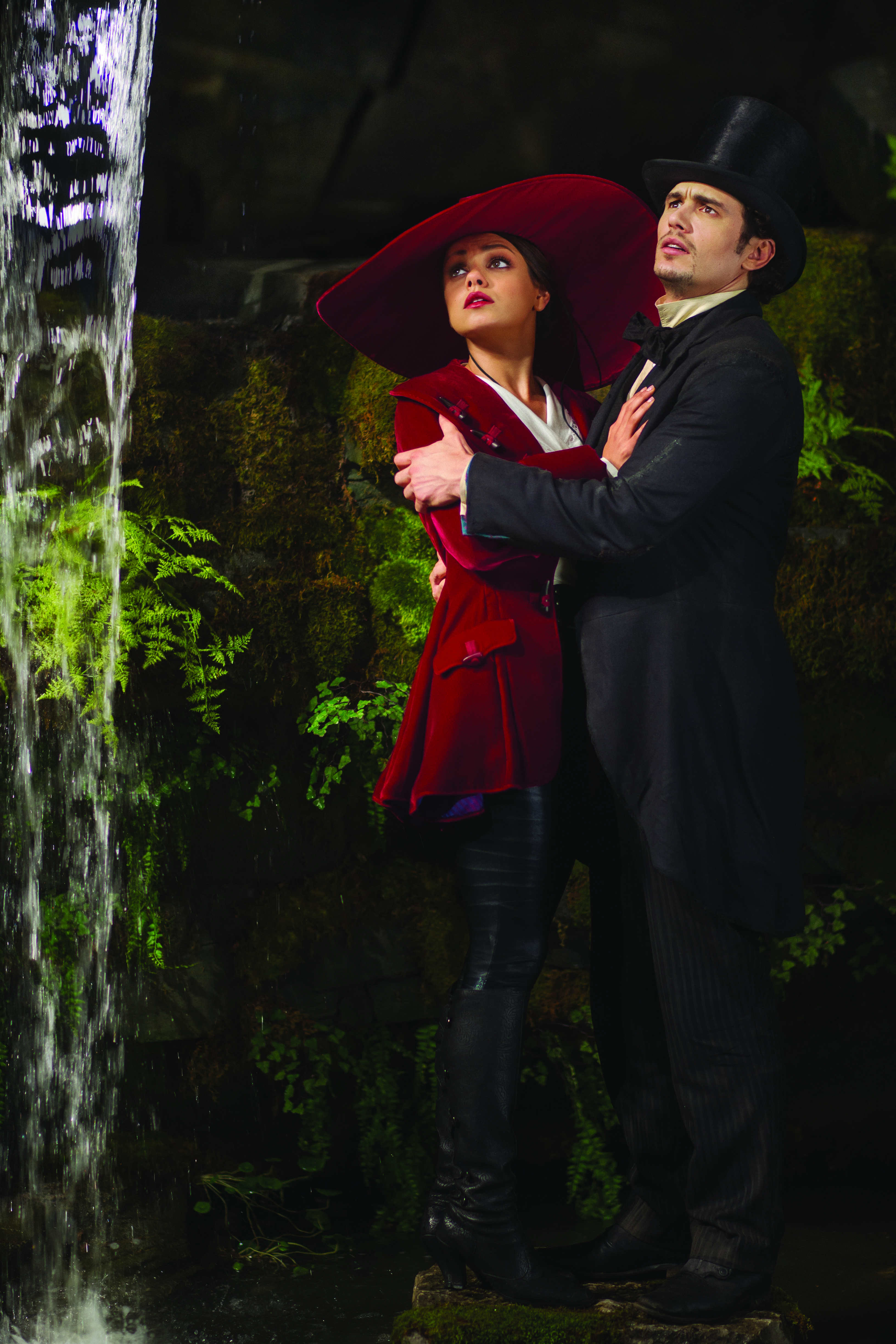
The pattern is set—Diggs is an outsider, a stranger in a strange land, but enough of a roué that any sense of wonder he initially feels is soon replaced by annoyance (Franco is great at that). Oh, it's nice to have a minor seduction with the first female he stumbles on, Theodora (Mila Kunis), but the flying monkeys (in the form of Finley, voiced by Braff), and the girl who comes from hummle beginnings, the fragile porcelain girl (who comes from the neighboring land of China town and voiced by Joey King). 
But before long he's
embroiled in Oz's matriarchal politics between witches Theodora and her evil sister Evanora (Rachel Weisz), 
who are lording it over the Emerald Cityand the witch Glinda (Williams again), who is protecting the provinces from the influence of the Big Bad City
This troika of females all think that Oscar will bring some sort of balance to Oz, and despite himself, he's got enough answers to help Finely and China, who become devotees. Evanora is the first to see Oscar and think "there goes the neighborhood," and the plot and the make-up thickens in a battle royale between the various forces of magic, Evanora and Theodora in the Emerald City, and Glinda and Oscar and her army of tinkers, winkies and munchkins.
Tinkers and winkies and munchkins. Oh my.

As Donald Rumsfeld said, you fight with the army you got.


And just to show this isn't Gramma's OZ (or Louis B. Mayer's) when we get welcomed to Munchkinland this time, and the town's welcome wagoneers start into a bouncy little song with high, tight voices (provided by composer Danny Elfman), Diggs just calls the whole thing off: "Stop! Stop it!" Musical numbers are not tolerated in this more cynical fantasyland. Nor is anything approaching the good-heartedness of Baum or Fleming. 

Even Glinda the Good Witch turns out to be something of a bad-ass here, far badder than in the '39 version. And that's just a little backwards because the original has an empowered little girl who saves the day, while in this one it's a man, a messiah, who must sort things out in the messy rule of a matriarchy.  
This is progress?
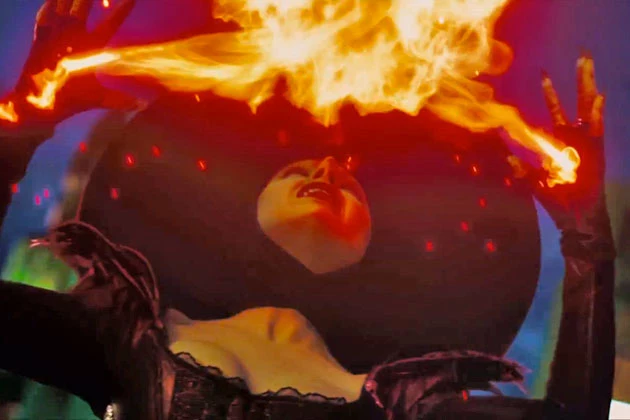
The movie ends with some fantasy-nastiness. Glinda is captured, tortured, and made to grovel before the sisters, Oscar comes to the rescue with his own Earth-bound pyrotechnics, similar to what he's use in the future. But the movie feels very much like a movie of today—things end not with a splash of water, but a lot of impressive fireworks. You want something a little meatier, though, something that might last and impress longer, but given the Oz that will come post-prequel, there's really nothing much to do about it. The great and powerful Oz is merely a humbug, the man behind the curtain. The evil sisters will remain evil, although Evanora's fashion sense (especially regards hosiery) will take a serious hit. And Oscar will become a patriarch based on big promises with nothing much to back it up. Sounds like any politician, really. This Oz is not so magical, not so great and not so powerful. What it needs is more brains, more heart and more courage.

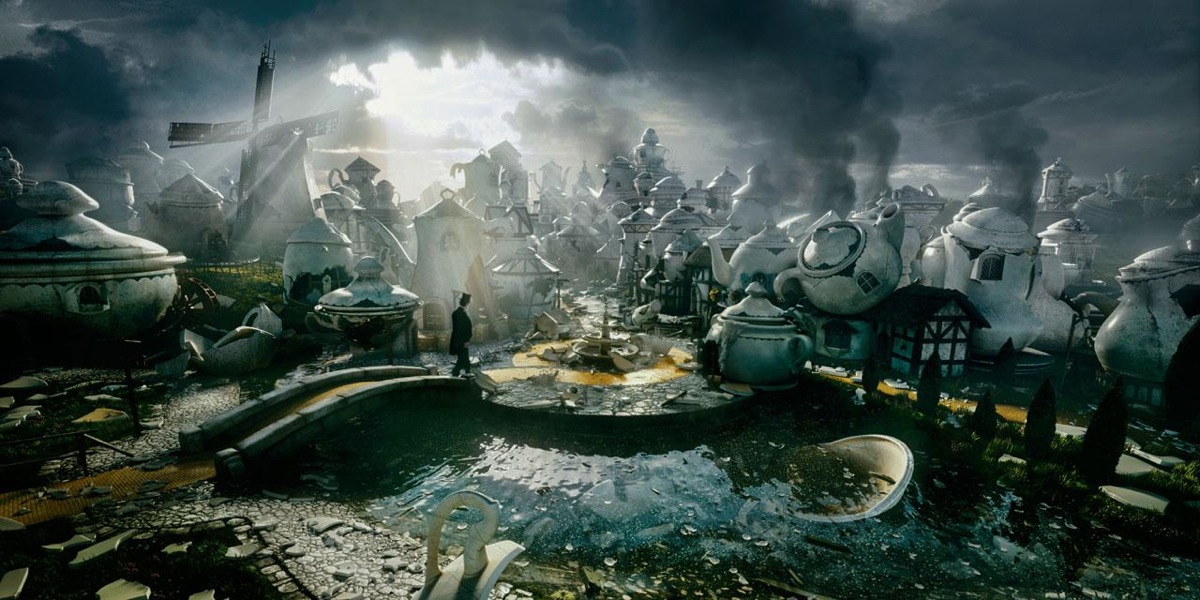
Yellow Brick Road?  Check.  Emerald City? Check.  Dark Forest?  Check.
So...what's wrong with this picture?


* Frequently recalled as this film is scored by Burton co-conspirator Danny Elfman.

Oh, yeah. Flying monkeys.

Wednesday, March 3, 2021

Rise of the Planet of the Apes

I was about to run a past review for another film when I realized I hadn't re-run the review of the first film of the "Planet of the Apes" re-boot. Great Caesar's Ghost, how could I have missed that? 

Herewith, written at the time of the film's release.

"Running the Serkis from the Monkey Cage"

or
"Well...That was Fun..."

Conquest of the Planet of the Apes was always the controversial one in the "Apes" series. Test audiences were so upset at the carnage—rioting apes bludgeoning government officials with rifle-butts—that a drastic re-write and edit was demanded by 20th Century Fox (it's why, when you watch Caesar—Roddy McDowall—delivering his "let's be merciful" speech at the end, you only see his eyes to avoid any lip...er...mask-sync problems).

Tonally, it's jarring...as well as being a load of bananas. Conquest could have been good...in the disquieting way that the "Apes" movies could be. But, instead, the studio ham-strung it's simian rights leader.

It's different times now.  The cities aren't burning down, only our 401K's.  So, along comes Rise of the Planet of the Apes—as unnecessary and pointless as any movie could be in this dull Summer Season for movies—after all, it's not a "tent-pole" franchise and arriving rather late in August. The "Apes" series had already run dry in its first go-'round, and in 2001, Tim Burton put out a "re-imagining" of the original that only proved that a "re-imagining" with better FX and make-up doesn't improve on something that depended on some good ideas first and the rest second. This new one seemed like a too late after-thought, and although the trailers looked intriguing, the ad campaigns and posters were uninspiring—there were no "character" posters, no tie-in cups at the 7-11, no "franchise" buzz—just another "Apes" movie long past its relevancy.
Except it has one thing going for it—good ideas. And when I say "good ideas," I don't mean the lines are clever (they aren't—Caesar gets the best lines, and
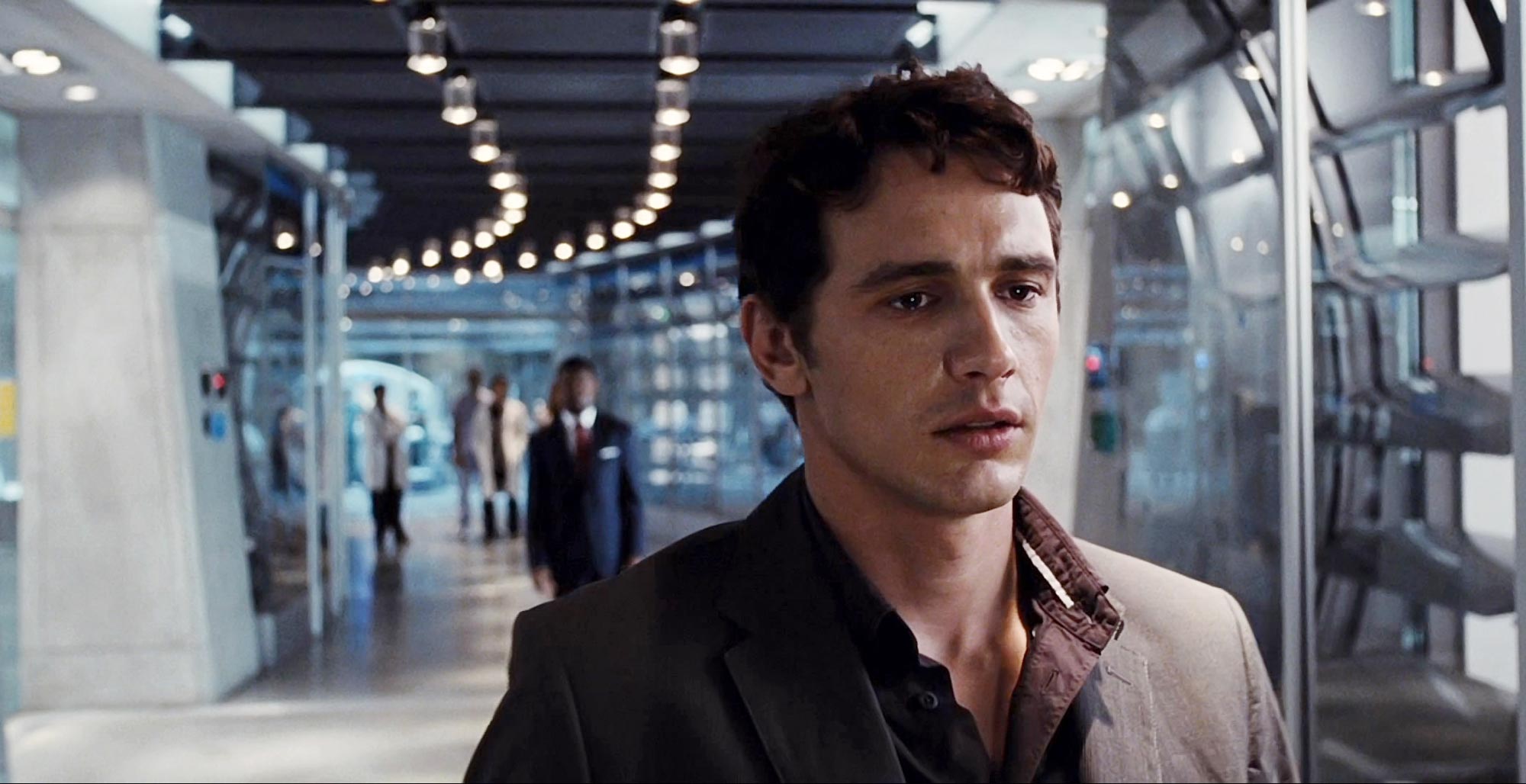
the most effective scenes are played without dialogue) or the acting is anything that will get James Franco another Oscar nomination (he plays it absolutely straight—he has to, and given what surely were bizarre circumstances on the set, that is quite the accomplishment and there's no "hip" attempt to distance himself from the subject). But, at the basic story-telling level of Rise, there are good ideas that play out and lead the audience along, incrementally ramping up the circumstances until you can accept the anarchic and truly mind-blowing with a straight face. Where Burton's Planet billed itself as a "re-imagining," Rise truly is one, turning the circumstances of the first film on its ear, as the circumstances of the Charlton Heston classic turned the evolutionary relations of man and monkey on theirs.
The film starts with a sequence cleverly patterned after "The Hunt" sequence from the 1968 film, and follows its hero's journey through the cruel circumstances of living in Man's World, after having a fairly free existence for most of its growing life,* paralleling Astronaut Taylor's cynically-smug attitude (and subsequent come-down) from the first film. That it goes into different territory, quickly and strategically, is where this film strikes out on equally sure footing.
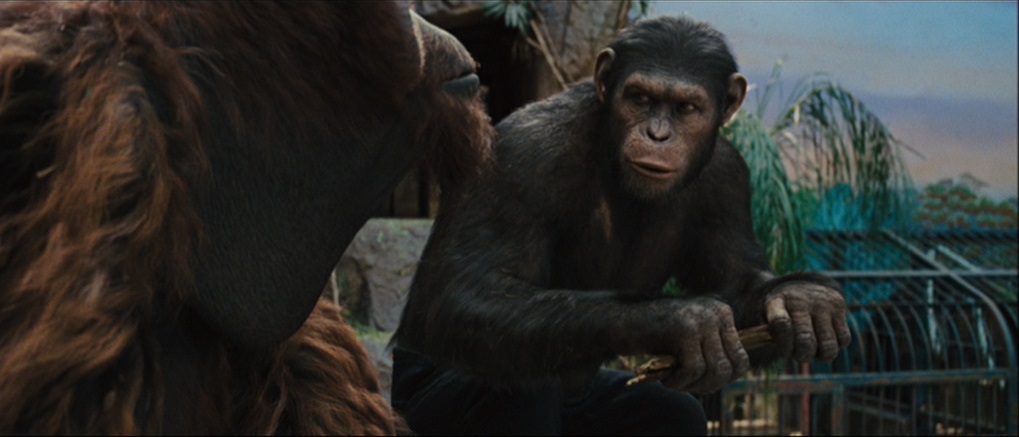
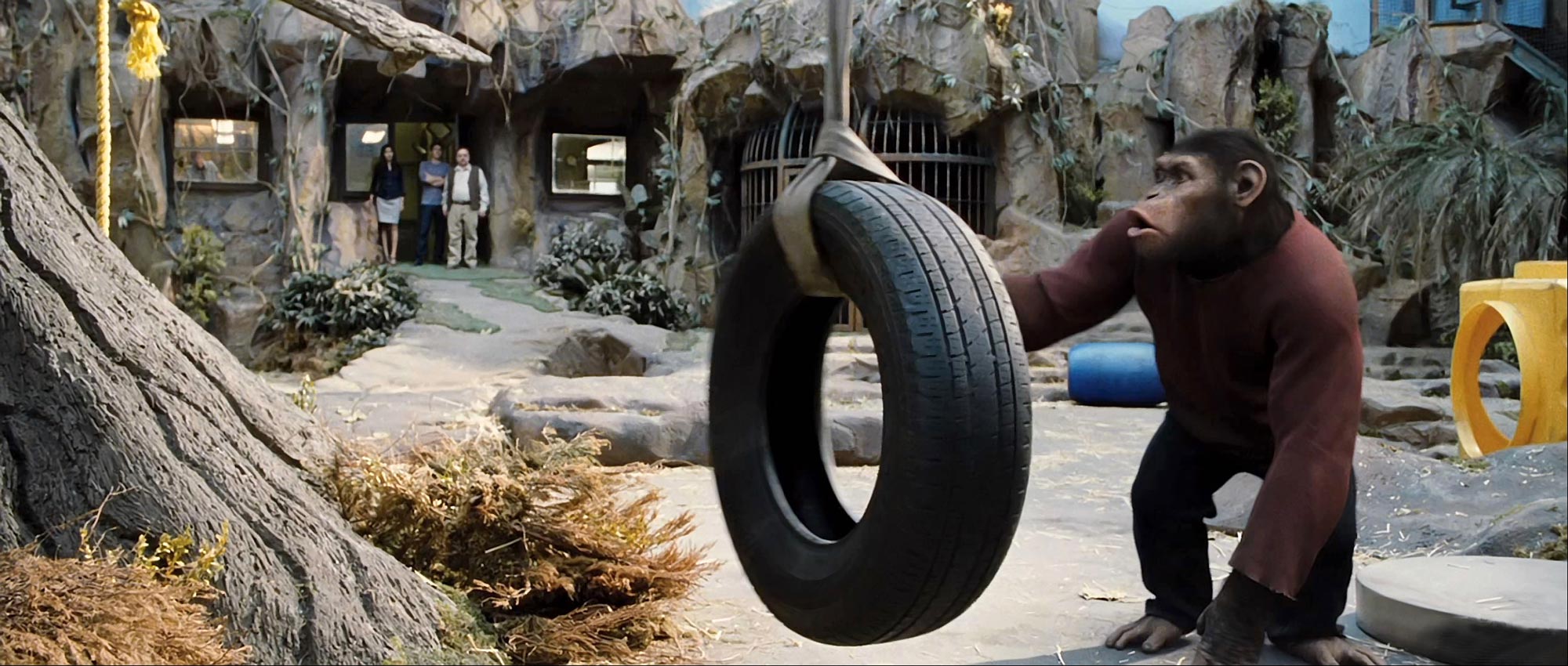
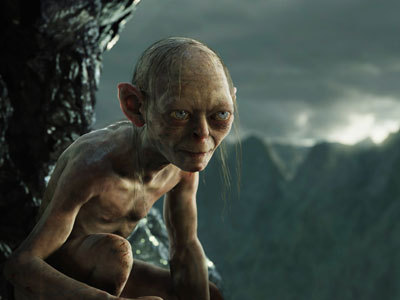
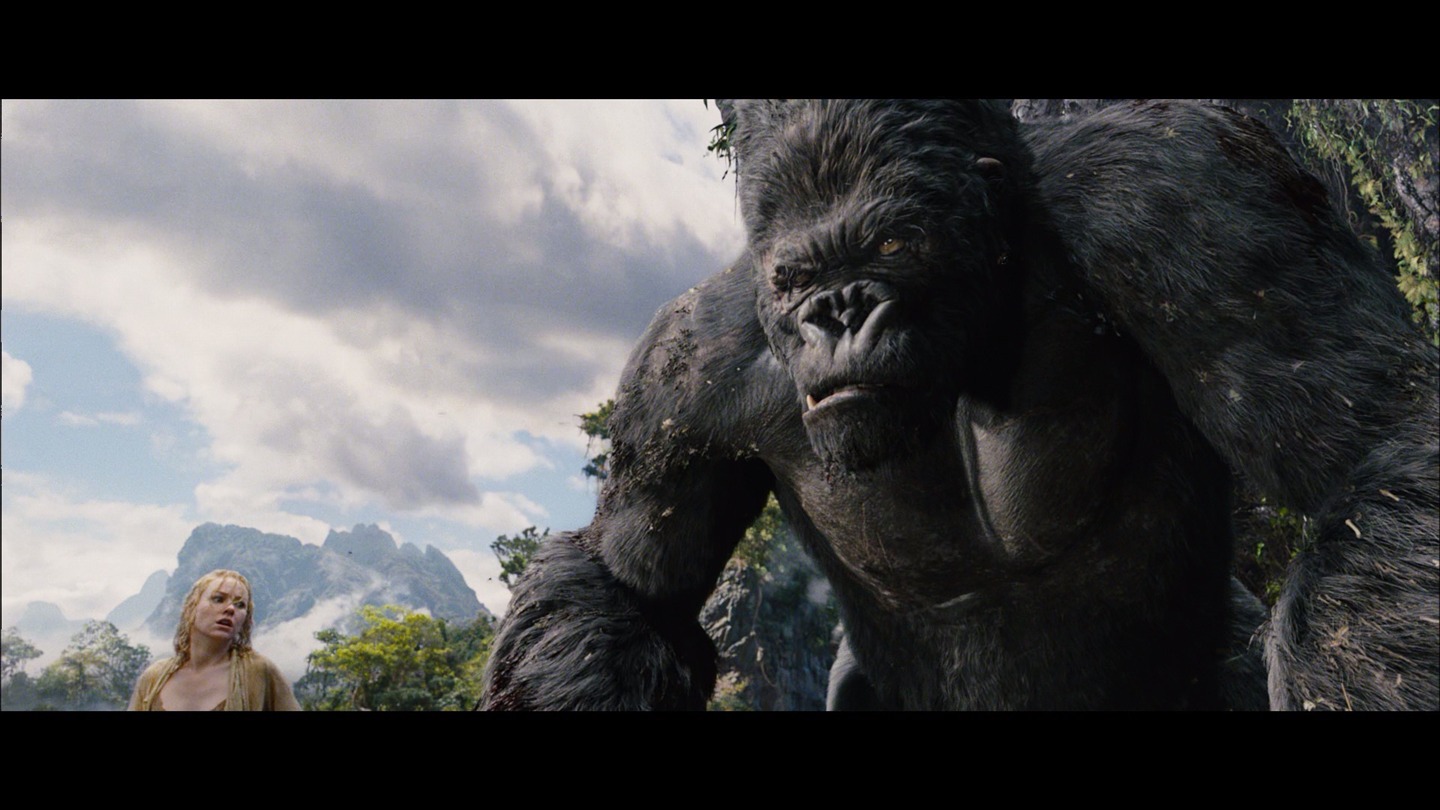
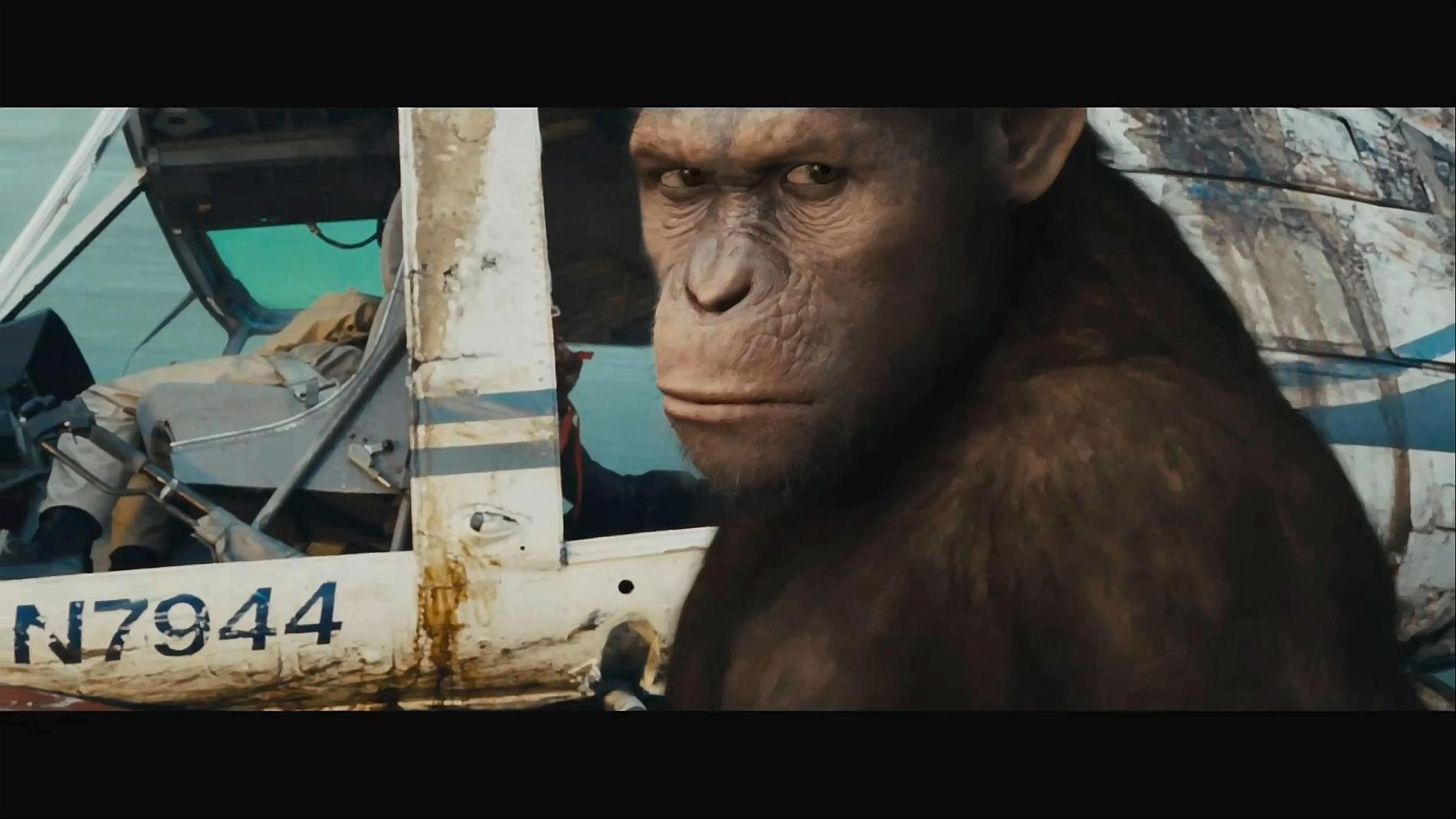
It couldn't have come at a better time, really, when motion capture technology allows abandoning the use of the monkey make-up that has gone before to achieve its animal effects—as well as having Andy Serkis (he was "Gollum" in the Lord of the Rings trilogy and played "Kong" in Peter Jackson's version of King Kong) mime-playing the lead Ape, Caesar,** which elevates the film, and pays off in strange (and surprisingly subtle) ways one couldn't imagine before. Also, that a lot of it hinges on basic silent movie techniques raises this one considerably in my eyes. Kudos to director Rupert Wyatt (only his second feature) for his good, strong story-telling and to writers Rick Jaffa and Amanda Silver for cracking this "Planet" wide open.***
One appreciates the big picture (man's technological hubris is again his downfall as in the first film) and the small (Caesar's symbol for freedom is nicely arced through the film, and it's not coincidence that the lab where Franco's Alzheimer's cure is developed and the primate facility at the Animal Control compound are structurally the same) that neatly draws parallels within itself and the franchise, taking what was good in concept, expanding on it and breaking out from it. The result is a rip-roaring film that stands on its own, yet makes one anticipate, even beg for, a continuation if it can be done as well as this one.
"...paying off in strange (and surprisingly subtle) ways."

Dawn of the Planet of the Apes

* There may be a little too much of that, actually. The structure of the film so complements the first film—to a point—that it seems unnecessary to "gild the lily" with so many call-backs from the original—we didn't need a word for word utterance of the first film's iconic line...and do you think the dullards at the Animal Control facility would REALLY be watching The Agony and the Ecstacy? (They'd be better advised to watch Spartacus, although it isn't owned by 20th Century Fox, nor does it star the appropriate actor). Now, Agony/Ecstacy would work...if the one guard was particularly religious...which could inspire in Caesar the whole concept of "The Lawgiver" that was presented in the original series. But, I digress (fan-boyishly)...

** The same motion-capture process that was employed with Serkis for Gollum and Kong was used here by WETA, Peter Jackson's New Zealand FX company. Some of the early scenes are a bit dicey, but once things start galloping along...the FX work becomes truly amazing. Now, with motion-capture, it's become a unique combination of the mime-work done to portray the pre-human apes in 2001 and John Chambers' enhanced theatrical make-up (Arthur C. Clarke ruefully noted that Chambers won a special Oscar that year for his POTA work, rather than 2001: A Space Odyssey, as the Academy "didn't realize our apes were actors."). And back to the point of Franco's job here (and frankly, everybody's), he had to play it completely disciplined in his scenes with Serkis, even though the latter was surrounded by one of the those crazy "motion-capture" suits, while on location (rather than a green-screen stage), which is a movie first.

*** Glenn Kenney, who writes for MSN Movies, fairly nailed it in the expansion of his review. Kenney's no slouch, but called the film "very nearly close to completely awesome" in the review, and noted that the film had four "Holy Shit!" moments, where something so unexpected happens that you wonder what could happen next (at the packed showing I attended, there were audible gasps at one particular happenstance—even though it parallels something that happens in the first film—followed by very nervous laughter). I counted six (but I have a low threshold for "Holy Shit!" moments), where most of the movies this year have had precisely zero.

Tuesday, September 8, 2020

Milk

Written at the time of the film's release....

"The Plural of 'Us's' is 'I'"

I had all these cute little headlines to put at the top of this review, reflecting my disappointment with Gus Van Sant's bio-pic of slain San Francisco supervisor Harvey Milk—"Condensed Milk," "2% Milk"—but ultimately it comes down to this: you owe it to yourself to see The Times of Harvey Milk, the Oscar-winning documentary on Milk and his efforts to fight discrimination. 

It'll cost you 90 minutes of your time—and I can't find it online without some kind of rental fee. But, it is definitive, and, frankly, more effective. The new film, Milk acknowledges its debt to this film in its final credits. Indeed, you'll see a lot of archive footage shared by both films. And Milk, a features recreations of footage from this film. The film ends with Sean Penn, as Milk, saying the words that you'll find in the video at the bottom of this review into his tape recorder for the prescient "In the Event of My Death by Assassination" tape he made. But that sentiment was not a private one. And the film does a disservice to Milk making it so.
It also inadvertently plays into stereotypes by suggesting that Milk's assassin Dan White was a closeted gay man instead of the mentally ill person he was. White's angry (and public) resignation during a meeting of the Board of Supervisors is also made private in the film. White's sneaking into the city hall with a loaded weapon to avoid metal detectors is alluded to, but not that White re-loaded his pistol after shooting Mayor Moscone and heading to the Supervisor offices to kill three other board members (Milk was the only one present). That the crimes were deliberate seems incontrovertible. But White was only convicted of manslaughter and released after serving five years in prison.
And one can quibble about Penn's performance as well, making Milk more fey in his mannerisms (Milk had hidden his sexuality in New York for years), and giving him a thick Bronx accent more Harvey Fierstein than Harvey Milk (ironically, Fierstein narrates the "Times" documentary).
Still, ya gotta do what ya gotta do. The original documentary is 25 years old and is probably past its shelf-life. A dramatic re-telling of the tale was probably due (a twin project "The Mayor of Castro Street" has been in the works, first by Oliver Stone and more recently by writer Christopher McQuarrie and Bryan Singer for years, and has, for the time being, been abandoned) if only to keep reminding people of the toll closeted life inflicted on the gay population. The battle continues to put a familiar face on homosexuality. And if a melodramatic re-telling of a pivotal story is required, so be it.
Van Sant does a fine job of mixed media cutting between vintage footage, newscasts, and recreations. And he gets great work out of his cast, particularly Penn, who's never seemed so relaxed in a role, James Franco (who gets better with each movie) as his first partner in San Francisco, and Emile Hirsch from Penn's Into the Wild as one of his youngest recruits.

Thursday, August 16, 2018

In the Valley of Elah

There is a gesture...at the end of Spike Lee's Blackkklansman (review tomorrow, fingers crossed)...that some folks may not "get." The best display of it, thus, far was in Paul Haggis' In the Valley of Elah, the review of which, tepid as it is, is below. 

On the occasion of a nationwide calling out of the President's war on the Fourth Estate, I want to state my support for a free press willing to speak truth to power. Rather than being an "enemy of the people," it is, instead, an enemy to tyranny, in whatever guise it trumps itself up in, corporate, political, or religious, especially here at home. 

Written at the time of the film's release....

The Quagmire at Home

This is Paul Haggis' first directorial effort since Crash. In the meantime he wrote three films for Clint Eastwood, The Last Kiss and Casino Royale. He wrote this one for Eastwood, too, but to star in, not direct, which Clintus declined, saying that he's retired from acting. Too bad. This one might have gotten him that Best Actor Oscar. As it is, Tommy Lee Jones has the role, probably does a better job of it, and is certainly deserving of an Oscar. His Hank Deerfield, ex-Army investigator, is a portrait of a guy so meticulous, so disciplined that you wait for him to crack the whole film. It's one of the joys of the film, along with another of Charlize Theron's fine "de-glammed" performances, and Susan Sarandon bringing maximum effort to a small but vital role, all doing great work in a film that tries to be too many things, though it does succeed in many of them.
Part mystery, part war-story, part psychological drama, Elah, punctuates its story with fragments of media recovered from a cell-phone that, like Blow-Up and The Conversation, give tantalizingly legible glimpses into Deerfield's son's tour in Iraq, and frustratingly opaque clues into his post-Iraq behavior. He's gone AWOL, and Dad Deerfield goes to New Mexico to get to the bottom of it, because that's what he does. 
Once there, he and a detective try to piece together the evidence, and fight the bureaucratic red tape that hinders their work. Just as Crash owes so much to La RondeElah calls to mind Courage Under Fire, about the death of a Persian Gulf War veteran, where conflicting stories and the subject of post-traumatic stress disorder are dealt with tangentially. Here, it's more overt, but there is an underlying message of the power of doing nothing, or of passing the buck, even ignoring the buck, taking the easy way out, or as the phrase went in Chinatown, the futility of good intentions, when not backed with action. The characters of In the Valley of Elah do "as little as possible" until provoked, challenged and threatened, and its reach is all-pervasive. In the end there is no one perpetrator, but a constant thread of sins of omission, and therein lies the tragedy.
As he did so much in Crash, Haggis telegraphs too many things, with some pretty obvious set-ups that are none too subtle.** The man just doesn't believe in red herrings, and everything gets used. Maybe that's his buttoned-up-in-25-minutes television writing showing. He's become better at cloaking some, though, hiding them in plain sight until they're trotted out for weighty significance. Some will see his final statement as un-American (which they're looking for, I expect), but a careful reading of what's gone before* reveals exactly what he's saying, and its entirely appropriate and, frankly, completely non-controversial. 
But Haggis seems to invite mis-interpretation. It's what makes him interesting. On top of that, you'll never see better work out of Tommy Lee Jones and Susan Sarandon and their scenes together have a lived-in familiarity and friction that speaks volumes of history and experience. There's some awfully good work in this.

* Easy for me to say, I take notes!

** According to the Addictionary, this is called "five-shadowing"