Showing posts with label John Lithgow. Show all posts

Friday, November 1, 2024

The Conclave (2024)

The Mystery of Faith/The Sin of Certainty
or
"The Church Is What We Do Next"
 
The Pope is dead. Time to find a new one.
 
The Catholic church is steeped in ritual and arcana, seeing as how it's been around for 2000 years. Lord knows when all the niceties were developed (as He didn't come up with them), the breaking of the seal, the sealing of the Pope's quarters, the voting in secret among the council of cardinals in a locked, darkened room with no communion to the outside world. 
 
The smoke. 
 
It's a bit like the electoral college, as the Catholics in the world have no say, only the carefully chosen cardinals, get to choose who will be the next successor to Peter, the first Pope. 
 
But, he will be a man. That is the only certainty. Nuns need not apply. It's the way it's always been and, God only knows, it will be that way for a very long time. For God speaks only through the chosen few and only they have the power to change things...if God lets them know. Pity about Him not speaking to women, although a lot of them, Joan of Arc, being a burning example, would contradict that assumption.
Just ask Cardinal Thomas Lawrence (
Ralph Fiennes) of The Conclave. He was close to the late Pope, close enough that he'd personally asked to resign his special position as dean of the cardinals. But, the Pope refused him to Lawrence's mystification. Lawrence was having a crisis of faith. As he explains to one of his fellow cardinals, Bellini (Stanley Tucci), what he's lost faith in was the Church, he's never lost faith in God. But, now the Pope is dead, and as dean of the cardinals it is Lawrence's function to convene the conclave of cardinals that will select the next Pope, with all the ritual and preparation and in-fighting and...politics. Lawrence is one of the leading contenders, but he doesn't want the job. Not like this. Not like he is. But, he will conduct the conclave. But, he has doubts.
Apparently, so did the late Pope, enough to demand that Lawrence stay at his post. As hard as it is to separate Church and State, it is damn near impossible to keep politics out of the Church and the vacuum of power threatens to suck in the best and the worst of the cardinals, each to their own nature. The world changes fast and the Church (if it does) is slow to catch up. There are those that would see an Italian pope and only an Italian pope and that the Mass and all business be conducted in Latin—most prominent of them would be Cardinal Tedesco (Sergio Castellitto), who is intolerant of change and resentful of changes that have occurred—have a Friday dinner with him and he'll have the fish.
Then, there are Lawrence and Bellini, progressives, who want to see a more inclusive church, changes in doctrine, less fire and brimstone. And there are the moderates, like Cardinal Tremblay (
John Lithgow) and Cardinal Adeyemi (Lucian Msamati), who are highly regarded and well-connected and have a chance at being elected by the conference of cardinals. As they gather from around the world to be locked away in seclusion there is a lot of last-minute maneuvering and...a lot of smoking. It doesn't look to be a slam-dunk for any candidate.
But, Lawrence—who is also a considered candidate and who
(of course) doesn't want the job—has begun to hear things. Things like the late Pope having a last-minute conference with Tremblay where ("they" say) he was asked to resign...but refused. An incident in the lunch-room involving Adeyemi and one of the nun-servers raises questions and temperatures. Lawrence pulls the old "we're priests, you're just nuns" argument to obtain information out of Sister Agnes (Isabella Rossellini) about the parties involved. But, he's more than willing to break tradition (and a couple wax seals) to get to the bottom of things.
Several commandments are revealed broken in The Conclave by the cardinal's detective work (good thing Father Brown wasn't there!) including bribery, subterfuge and a few others that might spoil the resolution and there are a lot of Deadly Sins going on (Bellini challenges Lawrence's supposed lack of ambition by asking him if he's thought of what his Pope-name would be...and, of course, he has), but the only one you won't find anywhere is "sloth."
German director Edward Berger (he made the excellent 2022 version of All Quiet on the Western Front) makes sure that the film has the proper solemnity but not so much that you fall asleep in church. The movie is never less than beautifully shot (by cinematographer
Stéphane Fontaine)—Rome never looked so good (probably because so much of it's in Cinecittà)—and Berger is less dependent on the single-point perspective than normal although he will go to it to make a grand impact (and, really, how could he help it as most churches are designed around a one point perspective.
But, he also has a cast of character actors who are adept at stealing scenes usually in conflict with Fiennes, who has the God-given power to command your attention. Talk all you want about the work that went into recreating the Sistine Chapel for this film, but you have a marvelous opportunity to see a master class in performing sotto voce that can propel you out of your seat when Fiennes turns it into a bark. We're talking measured performances of actors playing characters hiding something and being pious about it. That's some nuanced acting there.
There's a lot of Oscar buzz around this movie, not undeservedly, but, it's mere murmurs now and we'll see if we still hear it by year's end. Certainly there'll be a lot of nominations. But, voting for the Oscar has a lot of the same background as chicanery voting for the Pope. We'll just see what happens when the smoke clears.

Tuesday, October 24, 2023

Killers of the Flower Moon

Coyote Ugly: The Curse of the Pierce Arrow
or
The Conformist of the Plains
 
David Grann's output of articles and books has provided fodder for lots of movies: The Lost City of Z, Dark Crimes, The Old Man and The Gun, Trial By Fire, and now Killers of the Flower Moon (with its director, Scorsese's next film to be based on Grann's latest book "The Wager"). Grann wrote his book about a moment of long forgotten history—The Osage Indian Murder Case, what the newspapers at the time called "The Reign of Terror" from 1918 to 1931. It was one of the first murder cases taken over and solved by the nascent Bureau of Investigation, what would soon become acronymed as the FBI, an attempt to coordinate crime data into a national data resource that could be shared amidst the disparate state jurisdictions and law enforcement agencies. 

Grann's book is a fine read—it spent 49 weeks on the New York Times non-fiction best-seller list—breaking down the story into three narratives: of Mollie Burkhart (played in the film by Lily Gladstone) of the Osage Tribe, who saw three of her sisters and her mother die (under suspicious or downright murderous circumstances) in a short space of a few years; of Tom White (played in the film by Jesse Plemons), a former Texas Ranger, recruited by the Bureau to investigate the murders—his unique way of assembling a team and having them blend in with the community was a bit unpracticed, but did lead to convictions; and a modern post-investigation appraisal. When Martin Scorsese announced it for his next movie with Robert De Niro and Leonardo DiCaprio
starring it was originally just going to focus on the FBI investigation with DiCaprio as White.But DiCaprio had other ideas—he wanted to play "a villain" and so the film was re-tooled by Scorsese and 
Eric Roth to feature more of the role of Ernest Burkhart, husband of Mollie and his role in the web of deceit and murders...all to obtain the headrights (the land mineral rights owned by full-blooded Osage tribe-members) to their oil-rich pocket of Oklahoma, that made the Osage "the wealthiest people per capita" in the nation. The Osage became prosperous with their oil stipend, creating a power dynamic where they ostensibly ran things in Fairfax, Oklahoma, but they were also targets for any scam and flim-flam the other residents could concoct in order to benefit from their prosperity.
And that included marrying into the money, the oldest way for profligate men to get a sustainable nest-egg and not waste it all in a short period of time. If there's children, then there's always inheritance, or better yet, the idealistically labeled "trust-fund," that can be exploited as long as no one is following the trail of money. In Fairfax, Oklahoma, the trail was not only monetary, but one merely had to trace family ties and the obituary column to see that something was surfacing besides oil.
Clocking in at a back-breaking 3 hours 20 minutes, Killers of the Flower Moon begins where most Scorsese movies do, following the bad guys. Ernest Burkhart (DiCaprio) exits the train to Fairfax after serving in the First World War and receives a warm welcome from his uncle, cattleman William Hale (De Niro), who is perfectly agreeable to taking Ernest under his wing, despite his lack of experience. Under an avuncular pretense, Hale gives his nephew the lay of the land, giving him a book on the Osage people ("Do you read?") and asking pointed questions about his taste in women. Hale speaks the Osage language and extends his avuncular charm to express support for the Native land-owners, especially dealing with the white city officials, the police and Sheriff, the local doctors, even the undertaker (that'll come in handy!). He also is quite familiar with the local underworld (even handier!), and his network makes him less than a town father, and more of a puppet-master.
Burkhart is his primary puppet, lending support to a romance between Ernest and Mollie Kyle (Underwood, who in her mandarin understated way, steals the show as well as hearts), who is already seeing signs of poor health in her family, who have a tendency towards diabetes. And when a "specialist" is needed for some special work to be done, Hale uses his nephew as a go-between, the better to keep his immaculate hands clean. 
But, the center cannot hold. In the community, the deaths become less and less isolated and more overt, culminating in a house-bombing that kills Mollie's sister and her husband, who has been asking questions and connecting dots, while resisting any overtures to share information with Ernest. That signs his death warrant and the egregiousness of the crime—the sheer audacity of it—mandates outside help. Private detectives had been hired before...but had disappeared never to be heard from again. A meeting between tribes leaders and President Calvin Coolidge allows Mollie to make an entreaty...and for once, the Great White Father keeps his word.
This is where Plemons' Tom White from the Bureau of Investigation comes into town from Washington, and it only takes a couple of inquiries to determine that he's being stone-walled...by everybody. Evidence goes missing, records disappear, stories are vague and sometimes conflicting. But White brings in some other agents with varying backgrounds to infiltrate the town and integrate themselves into both the White and Native communities. Then, they share information and find the links...and discrepancies. And they attack from within.
If the film has a fault in conception, it is in the sheer repetitiveness of the crimes (although, to be clear, the crimes DID happen as depicted and over that long period of time, which shows how frustratingly slow any shred of justice could be brought to so insular and complicit a community). But, the numbing volume of the crimes strains credulity and patience for an audience, even one used to the slow process of justice and the bull-headedness that passes for politics but stinks like conspiracy. Not to minimize the scope of the crimes, but to see every one of them played out through the machinations of Hale through the prevarifications of DiCaprio's Burkhart makes it a long stretch of the same thing repeated over and over.
Gladstone is the acting highlight of the film, and De Niro—although a bit too long in the tooth to be playing Hale—does a good turn as evil posing as the friendly neighbor.
DiCaprio, though, is an issue. Sure, he's good box-office (and he's an Executive Producer on the film), but it may be time for the long string of Scorsese collaborations to end. At times, one can see him using Brando tricks and an occasional Jack Nicholson strategy in his acting, but mostly he seems to have based his performance on a frowny-face emoji (😠). His face freezes into the same petulant scowl, no matter the circumstances, whether he's unhappy, concerned, frustrated, murderous or cornered. And, the deeper you get into the movie, the lower the corners of his mouth drop until you wonder if his jaw will just drop off once they carve far enough. It's a disappointing performance, considering how integral DiCaprio made himself to the film.
 
It may be time to kick him off the raft, Marty.
As his character is in the film, DiCaprio is the film's weakest link.
Still, Killers of the Flower Moon resonates, as one more early example of a nation's systemic racism hiding in the shadows and swept under the rug, something that, although denied in all corners of the continuing national reckoning, continues to raise its ugly head.
Ernest Burkhart, Mollie Kyle Burkhart (on the right), and William Hale,

Wednesday, October 26, 2022

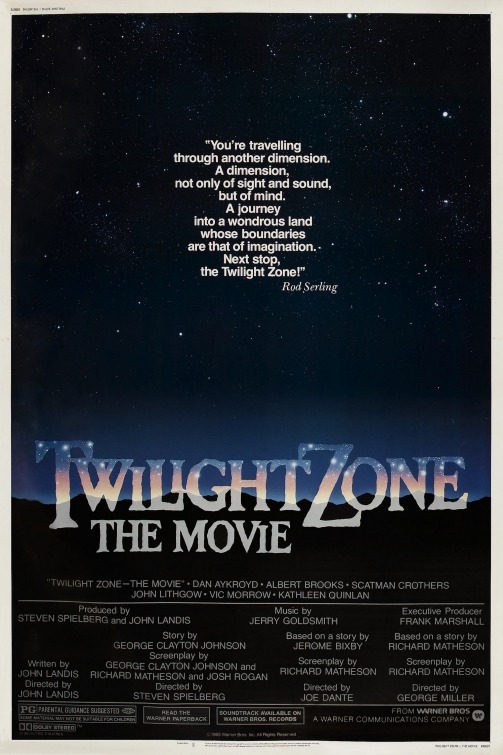
Twilight Zone: The Movie

Twilight Zone: The Movie
(
John Landis, Steven Spielberg, Joe Dante, George Miller, 1983) The well-regarded TV series created by Rod Serling—to create a broader palette to write with, while also giving him a chance to write metaphorically about social themes without the pearl-clutching of sensitive advertisers—is one of those hallmarks of television creativity, as well as being the inspiration for creative thinkers the world over. It's probably running right now, this very minute, on some channel in the world as it's an evergreen series, one that never loses its charm or ability to chill...or preach. Every episode, narrated by Serling himself, offered some little lesson in humanity, some softball sermon, some irony, that offered "for your consideration" that one couldn't escape some aspect of goodness or frailty, even in one's escapism.
 
It could also creep the be-jee-sus out of you.
 
It was a staple for the television viewer uninterested in westerns, soap operas or family comedies, but more invested in science fiction, anthologies and speculative stories with a twist...and a point of view.
That included many of the up-and-coming film-makers learning their craft during the time the series was broadasting, the most prominent of which was Steven Spielberg, who secured a deal with the Serling Estate to make a tribute film, using the anthology format, some old hands, and recreating the show's magic utilizing widescreen, color, and the new diversity in special effects. At the same time he brought in scenarist Richard Matheson (who'd written 16 of the original episodes) and composer Jerry Goldsmith (who'd written the background scores for seven of the original episodes). Three of the four stories would be "re-imaginings" of old episodes and one would be completely original. Four different directors would be involved. The narration for each segment was done by Burgess Meredith, who'd starred in four of the original broadcasts.
 
One cannot discuss the movie without mentioning "the accident" while filming the first segment when star Vic Morrow and two Vietnamese child-actors were killed during a night-time helicopter shoot. All were killed instantly—and horrifically—when the vehicle crashed on them during what looked like a particularly chaotic sequence involving an unsupported vehicle, waist-high water with spray, children being carried by the actor, and explosions. Plus, there were many violations of safety and child employment. The tragedy cast a pall over the movie that it was never able to shake: Spielberg basically disowned the movie, director George Miller quit it, leaving the post-production of his segment to Joe Dante. One has to judge the results of what's on the screen dispassionately, and it's almost impossible to do with Twilight Zone: The Movie.
 
Segment One: Time Out (d: John Landis) 
You're about to meet an angry man. Mr. William Connor, who carries on his shoulder a chip the size of the national debt. This is a sour man, a lonely man, who's tired of waiting for the breaks that come to others, but never to him. Mr. William Connor, whose own blind hatred is about to catapult him into the darkest corner of the Twilight Zone.
 
A bigot, Bill Connor (Vic Morrow),* walks into a bar, but it's no joke. Bitter from being passed over for a promotion, he drown his sorrows and vents his besotted spleen, hurling invective at Jews, African Americans, the "usual suspects" on the White Supremacist List. Leaving the bar, he seems to be walking in other people's shoes...and times...as he is mistaken for a Jew in Nazi Germany, a "Negro" facing a lynching in the 1950's South, and a Vietnamese citizen in the Vietnam War. After caroming from time to time, he is last seen on a transport train headed for a concentration camp, unseen by his companions from the bar.
 
Landis' segment was totally original (if reminiscent of some of Serling's fables of bad men getting their comeuppance ironically while also presaging TV's "Quantum Leap" by a few years) and Morrow's performance in what is basically a one-man show is very strong. Landis shoots it like a low budget TV episode, making it feel much more like an episode from the original series. A not-too good episode, one should mention. One wishes—for Morrow's sake—that they could have hit it out of the park. It would have been small consolation for an unnecessary tragedy.
Segment Two: Kick the Can (d: Steven Spielberg)
It is sometimes said that where there is no hope, there is no life. Case in point: the residents of Sunnyvale Rest Home, where hope is just a memory. But hope just checked into Sunnyvale, disguised as an elderly optimist, who carries his magic in a shiny tin can.
 
Adapted from the original episode written by George Clayton Johnson by Johnson, Matheson and E.T. scenarist Melissa Mathison (credited as Josh Rogan), Spielberg's segment (filmed in six days) takes place at a rest home, which welcomes a new resident, Mr. Bloom (Scatman Crothers), eternal optimist, who encourages the oldsters to think young by the simple act of playing a game—kick the can—and, miraculously (not because it's Spielberg, but because it's John and TZ), they do become young little kids. 
 
That's where the TV episode ended, but the older, wiser scribes continue the story, making the kids realize that they've already had full lives that they couldn't recapture again and so—with one notable adventuring exception—they return to their aged forms, older, if spiritually renewed.
 
Spielberg almost did "The Monsters Are Due on Marple Street" but, after the accident, he changed stories, not wanting to do something with a night-time shoot, special effects and with kids involved. There are still kids in "Kick the Can" (he'd just finished E.T. and loved that shoot, working with children; he hadn't yet made Hook, which cured him of it), but no special effects and no risks. No real enjoyment, either, unless your preference is for oldsters and tykes acting very, very sincerely.

Segment Three: It's a Good Life! (d: Joe Dante) 
Portrait of a woman in transit. Helen Foley, age 27. Occupation: schoolteacher. Up until now, the pattern of her life has been one of unrelenting sameness, waiting for something different to happen. Helen Foley doesn't know it yet, but her waiting has just ended.
One of the creepiest of the original "Twilight Zone" episodes was based on Jerome Bixby's 1953 short story "It's a Good Life!" which featured Bill Mumy as little Anthony Fremont, the six year old "head of the household" due to his murderous psychic powers. A haunting, scary little story—which probably resonates with any adult who has children—"It's a Good Life!" has a nightmarish quality filtered through a young child's imagination, but doesn't offer any way out. Anthony's family is stuck in their situation and the only way to survive is to placate their kid's murderous impulses. The movie version is a bit looser.
 
Dante, working with Matheson's screenplay, complicates it and actually resolves it, while also filling it with childish nightmare images designed to both evoke horror and a laugh at the bizarreness of it all. Foley (Kathleen Quinlan), who is on her way to a new job nearly runs into Anthony (Jeremy Licht) on his bicycle and offers him a ride home. There she meets his family—made up of TZ alums Kevin McCarthy, William Schallert, and Patricia Barry as well as Nancy Cartwright and Cherie Currie—and the one's who are actually ambulatory are a nervous bunch. It turns out Anthony has earlier murdered his family and these people are replacements and subject to his whims, all the products of a child's hyper mind.
And (one should add) Dante's. Dante had just made The Howling and it so impressed Spielberg that he offered the "Twilight Zone" deal to him as well as the directing post for the forthcoming Gremlins. Audiences probably weren't prepared for the combination of goofy nightmare that Dante in all his glory could produce, and his ideas—produced with the help of make-up man Rob Bottin—are giddy atrocities that will either make you spit-up your popcorn or vomit it. It's a wild Easter-egg filled roller-coaster through a spook-house that's creepy-funny. And it even manages to have a happy ending. After Spielberg's segment, Dante's was a sharp slap in the face with a cream-pie. Oh, but just you wait...
 

Segment Four: Nightmare at 20,000 Feet (d: George Miller) 
What you're looking at could be the end of a particularly terrifying nightmare. It isn't. It's the beginning. Introducing Mr. John Valentine, air traveler. His destination: the Twilight Zone.
Please fasten your seat-belts. We're expecting some turbulence. The darling of the Australian film renaissance and director of Mad Max and the recent hit The Road Warrior is restricted to merely the interior of an airplane in this story of a very nervous passenger (John Lithgow) on the worst flight of his life. Already afraid of flying, his terror is increased exponentially by irritating passengers, a flight-path through a thunderstorm, and...a gremlin on the wing of the plane throwing things into a jet engine, threatening to make it crash.
 
The original is remembered for its simple concept and a performance by William Shatner that pre-sages scenery-chewing to come. But, Lithgow out-Shatners by an additional over-the-top 20,000 feet in a performance that is hysterical in both senses of the term. He's aided and abetted by Miller's restless—and at times, anarchic—camera and even some literal eye-popping special effects. Tight, efficient, and relentless, Miller's segment is absolutely brilliant...and always seems to come up in conversations on plane flights. It's the perfect capper in an uneven movie.
John Landis also did a prologue section, which opened the film before the titles—two dudes-in-flannel (
Albert Brooks, Dan Aykroyd) spend a nighttime road-trip amusing each other. First, the driver teases by turning off his headlights at random, then they play a TV-theme song guessing game, which leads to talking about "The Twilight Zone" and ends with "Hey. You wanna see something really scary?"
Besides the Dante and Miller segments, that prelude is one of the things that people remember about the movie. There had been plans for certain characters to cross-over into other segments, but a late-in-the-game reshuffling of their order and a general torpor over the film due to the filming deaths nixed those plans.
 
The film did make money, but suffered blistering reviews—critics always mentioned the deaths and took pot-shots at Spielberg. No movie is worth a human life, but that would be true if the result was a masterpiece, as well. TZ's critics seemed to think the sin worse if the movie is only semi-successful. So much for moral high ground. But, people remember the best things about it—"Really Scary" "It's a Good Life!" and "Nightmare at 20,000 Ft." There have been a few revivals of the series (and probably always will be), and other similarly themed series from "The Outer Limits" to "Black Mirror." Spielberg even tried his hand in the game with his series "Amazing Stories," which served as a clearing house for his ideas and a proving ground for directors, old and new.
 
But, the movie lives up to the Serling grandiloquence—whether intentionally or not—of lying "somewhere between the pit of one's fears and the summit of his knowledge."

* The TZ movie is full of Easter eggs and little buried bits of trivia throughout: Bill Connor's name is a one-off of "Bull" Connor, the Alabama Sheriff known for his brutal treatment of Civil Rights protestors, "Helen Foley" is the name of a teacher of Serling's (and was used in a TZ episode), and Serling himself appears in the blink of an eye in the Main Title. Dante's episode is rife with actors from the series, including a cameo by Bill Mumy, who played the uber-kid in the original episode of "It's a Good Life" as well as mentioning city-names from other episodes.

Wednesday, March 3, 2021

Rise of the Planet of the Apes

I was about to run a past review for another film when I realized I hadn't re-run the review of the first film of the "Planet of the Apes" re-boot. Great Caesar's Ghost, how could I have missed that? 

Herewith, written at the time of the film's release.

"Running the Serkis from the Monkey Cage"

or
"Well...That was Fun..."

Conquest of the Planet of the Apes was always the controversial one in the "Apes" series. Test audiences were so upset at the carnage—rioting apes bludgeoning government officials with rifle-butts—that a drastic re-write and edit was demanded by 20th Century Fox (it's why, when you watch Caesar—Roddy McDowall—delivering his "let's be merciful" speech at the end, you only see his eyes to avoid any lip...er...mask-sync problems).

Tonally, it's jarring...as well as being a load of bananas. Conquest could have been good...in the disquieting way that the "Apes" movies could be. But, instead, the studio ham-strung it's simian rights leader.

It's different times now.  The cities aren't burning down, only our 401K's.  So, along comes Rise of the Planet of the Apes—as unnecessary and pointless as any movie could be in this dull Summer Season for movies—after all, it's not a "tent-pole" franchise and arriving rather late in August. The "Apes" series had already run dry in its first go-'round, and in 2001, Tim Burton put out a "re-imagining" of the original that only proved that a "re-imagining" with better FX and make-up doesn't improve on something that depended on some good ideas first and the rest second. This new one seemed like a too late after-thought, and although the trailers looked intriguing, the ad campaigns and posters were uninspiring—there were no "character" posters, no tie-in cups at the 7-11, no "franchise" buzz—just another "Apes" movie long past its relevancy.
Except it has one thing going for it—good ideas. And when I say "good ideas," I don't mean the lines are clever (they aren't—Caesar gets the best lines, and
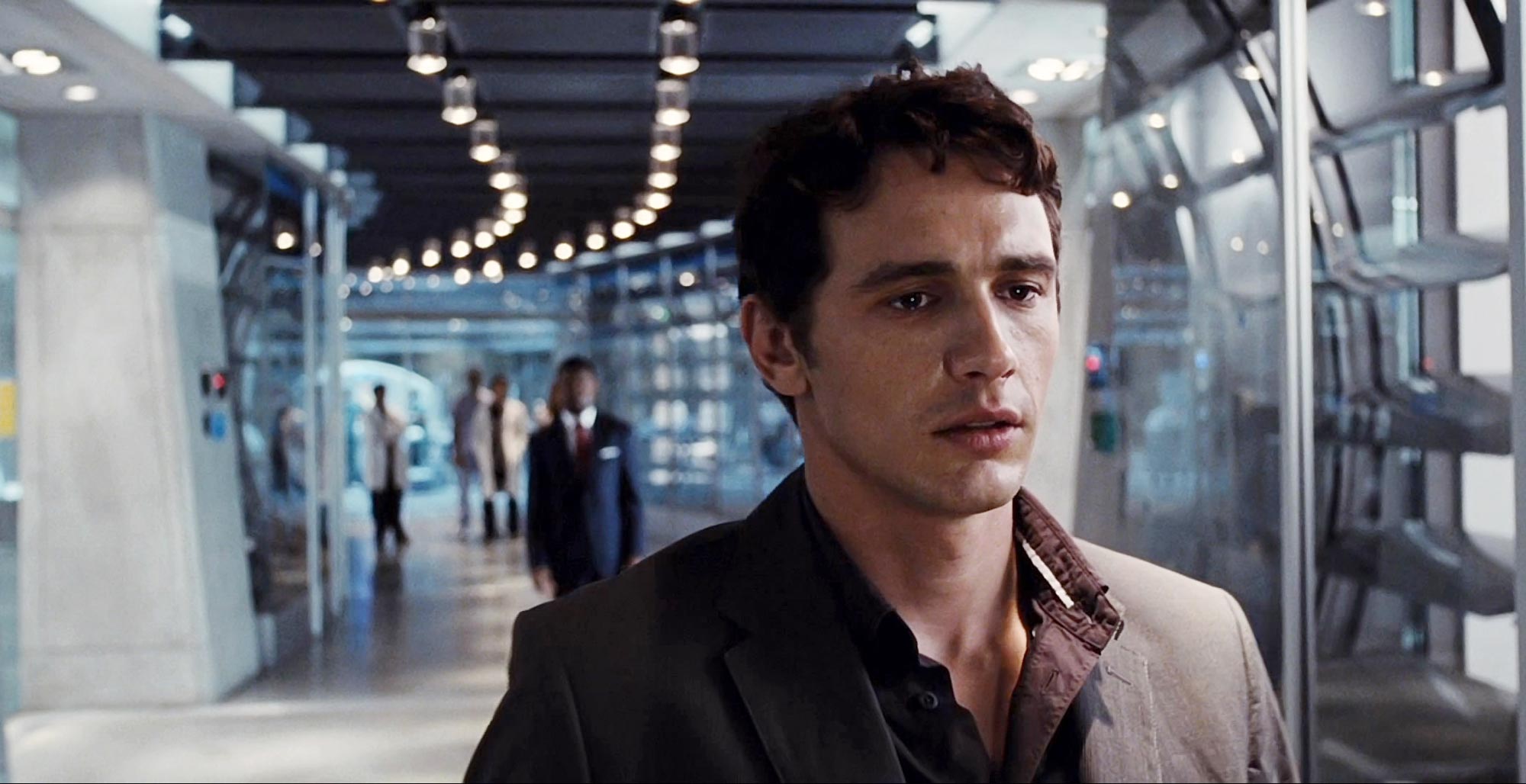
the most effective scenes are played without dialogue) or the acting is anything that will get James Franco another Oscar nomination (he plays it absolutely straight—he has to, and given what surely were bizarre circumstances on the set, that is quite the accomplishment and there's no "hip" attempt to distance himself from the subject). But, at the basic story-telling level of Rise, there are good ideas that play out and lead the audience along, incrementally ramping up the circumstances until you can accept the anarchic and truly mind-blowing with a straight face. Where Burton's Planet billed itself as a "re-imagining," Rise truly is one, turning the circumstances of the first film on its ear, as the circumstances of the Charlton Heston classic turned the evolutionary relations of man and monkey on theirs.
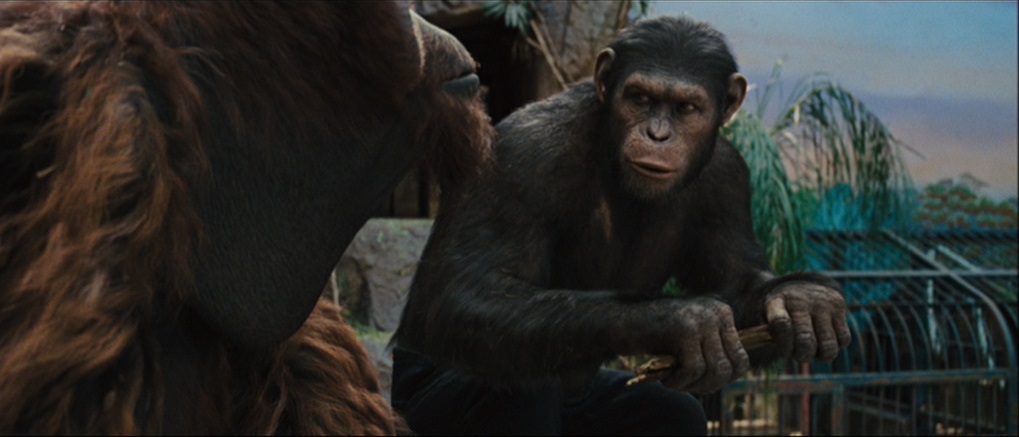
The film starts with a sequence cleverly patterned after "The Hunt" sequence from the 1968 film, and follows its hero's journey through the cruel circumstances of living in Man's World, after having a fairly free existence for most of its growing life,* paralleling Astronaut Taylor's cynically-smug attitude (and subsequent come-down) from the first film. That it goes into different territory, quickly and strategically, is where this film strikes out on equally sure footing.
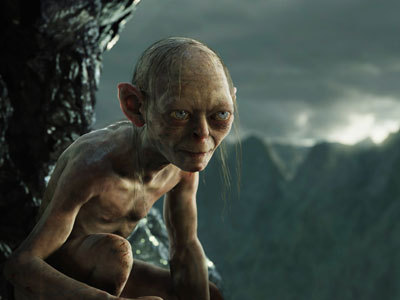
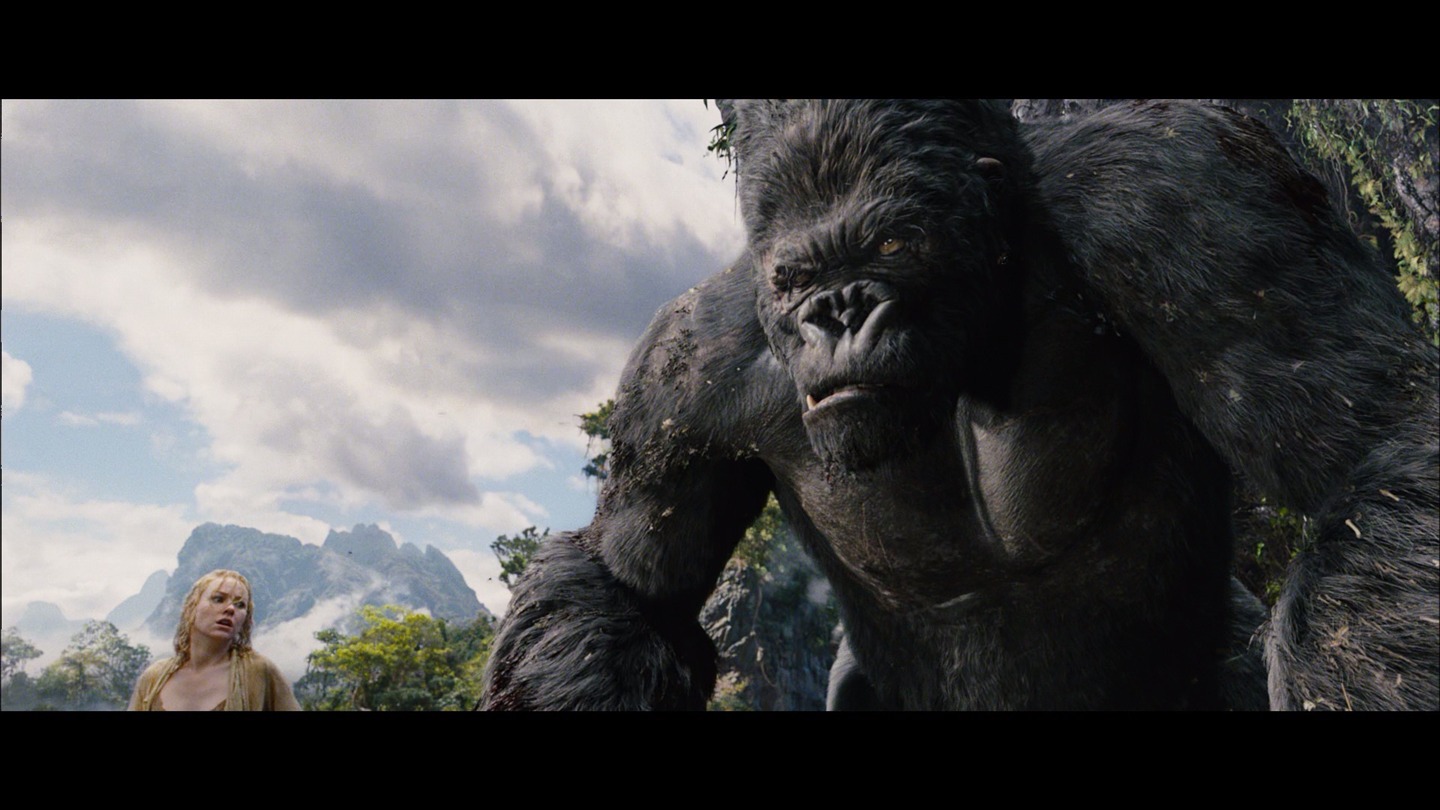
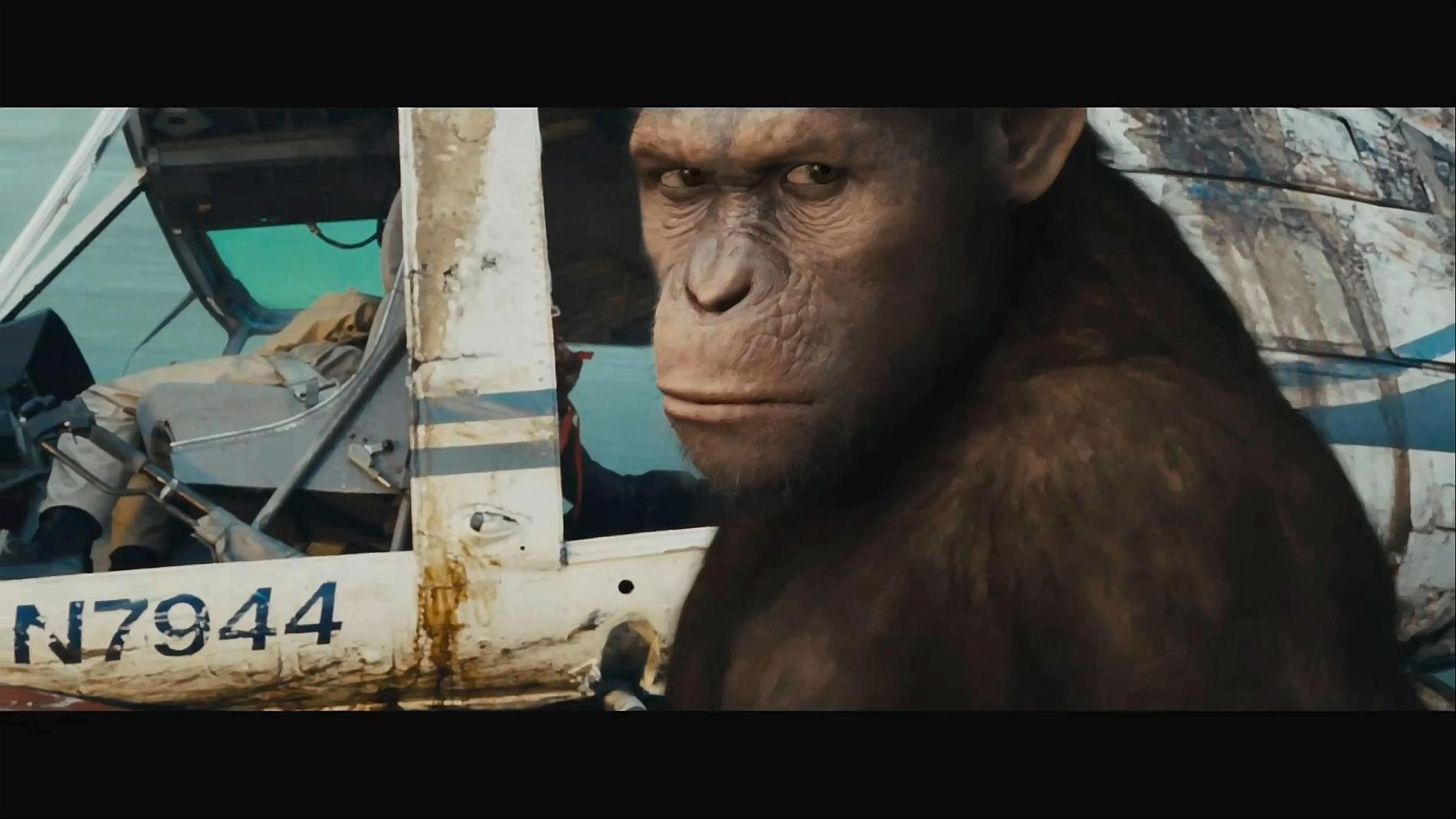
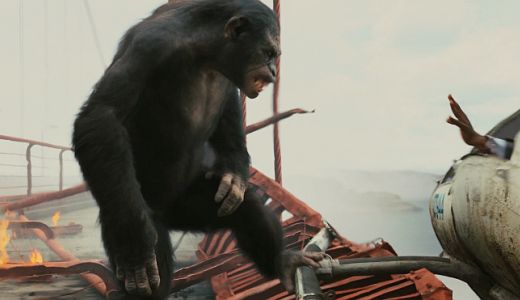
It couldn't have come at a better time, really, when motion capture technology allows abandoning the use of the monkey make-up that has gone before to achieve its animal effects—as well as having Andy Serkis (he was "Gollum" in the Lord of the Rings trilogy and played "Kong" in Peter Jackson's version of King Kong) mime-playing the lead Ape, Caesar,** which elevates the film, and pays off in strange (and surprisingly subtle) ways one couldn't imagine before. Also, that a lot of it hinges on basic silent movie techniques raises this one considerably in my eyes. Kudos to director Rupert Wyatt (only his second feature) for his good, strong story-telling and to writers Rick Jaffa and Amanda Silver for cracking this "Planet" wide open.***
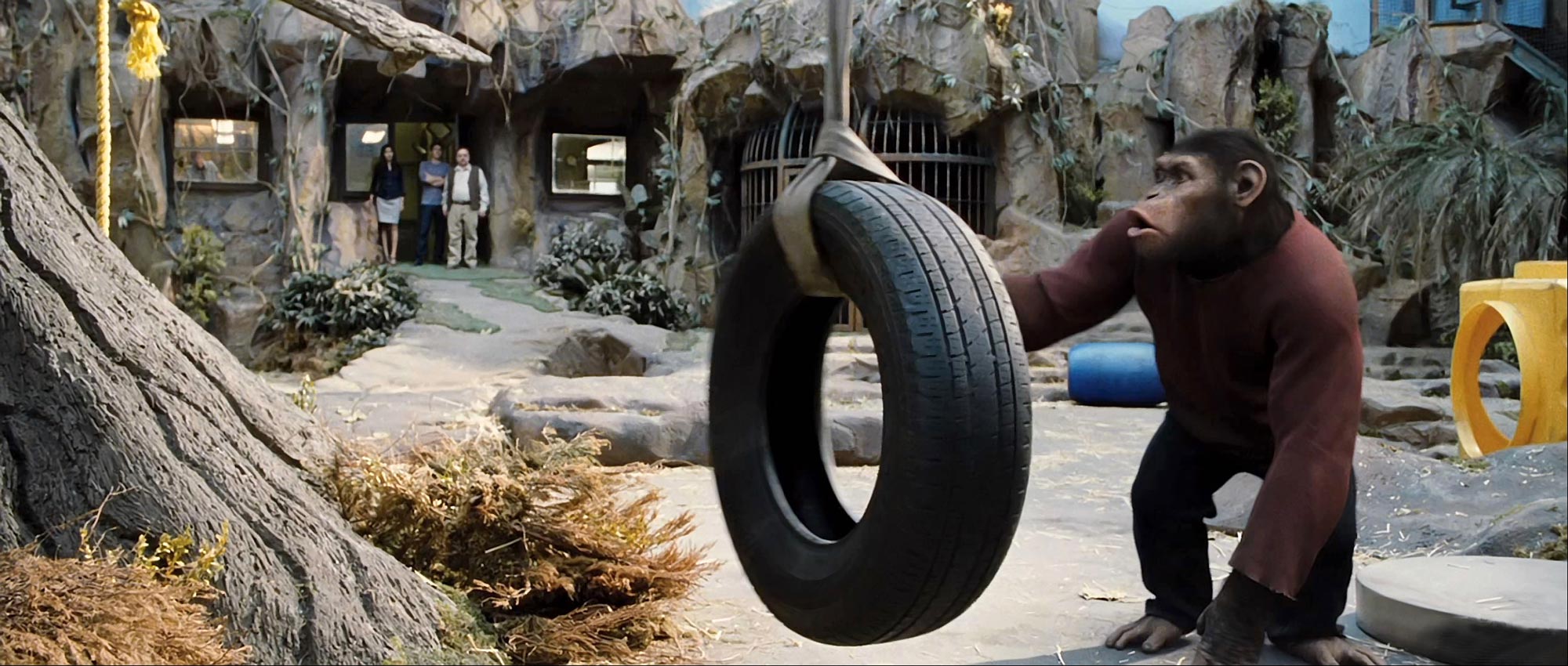
One appreciates the big picture (man's technological hubris is again his downfall as in the first film) and the small (Caesar's symbol for freedom is nicely arced through the film, and it's not coincidence that the lab where Franco's Alzheimer's cure is developed and the primate facility at the Animal Control compound are structurally the same) that neatly draws parallels within itself and the franchise, taking what was good in concept, expanding on it and breaking out from it. The result is a rip-roaring film that stands on its own, yet makes one anticipate, even beg for, a continuation if it can be done as well as this one.
"...paying off in strange (and surprisingly subtle) ways."

Dawn of the Planet of the Apes

* There may be a little too much of that, actually. The structure of the film so complements the first film—to a point—that it seems unnecessary to "gild the lily" with so many call-backs from the original—we didn't need a word for word utterance of the first film's iconic line...and do you think the dullards at the Animal Control facility would REALLY be watching The Agony and the Ecstacy? (They'd be better advised to watch Spartacus, although it isn't owned by 20th Century Fox, nor does it star the appropriate actor). Now, Agony/Ecstacy would work...if the one guard was particularly religious...which could inspire in Caesar the whole concept of "The Lawgiver" that was presented in the original series. But, I digress (fan-boyishly)...

** The same motion-capture process that was employed with Serkis for Gollum and Kong was used here by WETA, Peter Jackson's New Zealand FX company. Some of the early scenes are a bit dicey, but once things start galloping along...the FX work becomes truly amazing. Now, with motion-capture, it's become a unique combination of the mime-work done to portray the pre-human apes in 2001 and John Chambers' enhanced theatrical make-up (Arthur C. Clarke ruefully noted that Chambers won a special Oscar that year for his POTA work, rather than 2001: A Space Odyssey, as the Academy "didn't realize our apes were actors."). And back to the point of Franco's job here (and frankly, everybody's), he had to play it completely disciplined in his scenes with Serkis, even though the latter was surrounded by one of the those crazy "motion-capture" suits, while on location (rather than a green-screen stage), which is a movie first.

*** Glenn Kenney, who writes for MSN Movies, fairly nailed it in the expansion of his review. Kenney's no slouch, but called the film "very nearly close to completely awesome" in the review, and noted that the film had four "Holy Shit!" moments, where something so unexpected happens that you wonder what could happen next (at the packed showing I attended, there were audible gasps at one particular happenstance—even though it parallels something that happens in the first film—followed by very nervous laughter). I counted six (but I have a low threshold for "Holy Shit!" moments), where most of the movies this year have had precisely zero.