Showing posts with label Albert Brooks. Show all posts

Wednesday, October 26, 2022

Twilight Zone: The Movie

Twilight Zone: The Movie
(
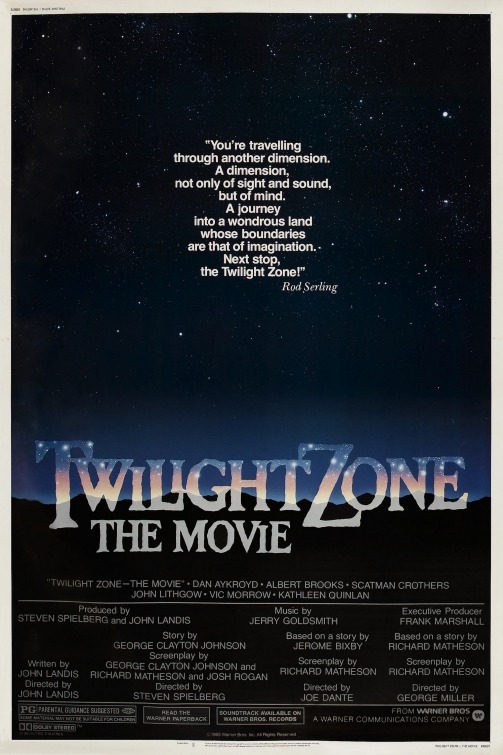
John Landis, Steven Spielberg, Joe Dante, George Miller, 1983) The well-regarded TV series created by Rod Serling—to create a broader palette to write with, while also giving him a chance to write metaphorically about social themes without the pearl-clutching of sensitive advertisers—is one of those hallmarks of television creativity, as well as being the inspiration for creative thinkers the world over. It's probably running right now, this very minute, on some channel in the world as it's an evergreen series, one that never loses its charm or ability to chill...or preach. Every episode, narrated by Serling himself, offered some little lesson in humanity, some softball sermon, some irony, that offered "for your consideration" that one couldn't escape some aspect of goodness or frailty, even in one's escapism.
 
It could also creep the be-jee-sus out of you.
 
It was a staple for the television viewer uninterested in westerns, soap operas or family comedies, but more invested in science fiction, anthologies and speculative stories with a twist...and a point of view.
That included many of the up-and-coming film-makers learning their craft during the time the series was broadasting, the most prominent of which was Steven Spielberg, who secured a deal with the Serling Estate to make a tribute film, using the anthology format, some old hands, and recreating the show's magic utilizing widescreen, color, and the new diversity in special effects. At the same time he brought in scenarist Richard Matheson (who'd written 16 of the original episodes) and composer Jerry Goldsmith (who'd written the background scores for seven of the original episodes). Three of the four stories would be "re-imaginings" of old episodes and one would be completely original. Four different directors would be involved. The narration for each segment was done by Burgess Meredith, who'd starred in four of the original broadcasts.
 
One cannot discuss the movie without mentioning "the accident" while filming the first segment when star Vic Morrow and two Vietnamese child-actors were killed during a night-time helicopter shoot. All were killed instantly—and horrifically—when the vehicle crashed on them during what looked like a particularly chaotic sequence involving an unsupported vehicle, waist-high water with spray, children being carried by the actor, and explosions. Plus, there were many violations of safety and child employment. The tragedy cast a pall over the movie that it was never able to shake: Spielberg basically disowned the movie, director George Miller quit it, leaving the post-production of his segment to Joe Dante. One has to judge the results of what's on the screen dispassionately, and it's almost impossible to do with Twilight Zone: The Movie.
 
Segment One: Time Out (d: John Landis) 
You're about to meet an angry man. Mr. William Connor, who carries on his shoulder a chip the size of the national debt. This is a sour man, a lonely man, who's tired of waiting for the breaks that come to others, but never to him. Mr. William Connor, whose own blind hatred is about to catapult him into the darkest corner of the Twilight Zone.
 
A bigot, Bill Connor (Vic Morrow),* walks into a bar, but it's no joke. Bitter from being passed over for a promotion, he drown his sorrows and vents his besotted spleen, hurling invective at Jews, African Americans, the "usual suspects" on the White Supremacist List. Leaving the bar, he seems to be walking in other people's shoes...and times...as he is mistaken for a Jew in Nazi Germany, a "Negro" facing a lynching in the 1950's South, and a Vietnamese citizen in the Vietnam War. After caroming from time to time, he is last seen on a transport train headed for a concentration camp, unseen by his companions from the bar.
 
Landis' segment was totally original (if reminiscent of some of Serling's fables of bad men getting their comeuppance ironically while also presaging TV's "Quantum Leap" by a few years) and Morrow's performance in what is basically a one-man show is very strong. Landis shoots it like a low budget TV episode, making it feel much more like an episode from the original series. A not-too good episode, one should mention. One wishes—for Morrow's sake—that they could have hit it out of the park. It would have been small consolation for an unnecessary tragedy.
Segment Two: Kick the Can (d: Steven Spielberg)
It is sometimes said that where there is no hope, there is no life. Case in point: the residents of Sunnyvale Rest Home, where hope is just a memory. But hope just checked into Sunnyvale, disguised as an elderly optimist, who carries his magic in a shiny tin can.
 
Adapted from the original episode written by George Clayton Johnson by Johnson, Matheson and E.T. scenarist Melissa Mathison (credited as Josh Rogan), Spielberg's segment (filmed in six days) takes place at a rest home, which welcomes a new resident, Mr. Bloom (Scatman Crothers), eternal optimist, who encourages the oldsters to think young by the simple act of playing a game—kick the can—and, miraculously (not because it's Spielberg, but because it's John and TZ), they do become young little kids. 
 
That's where the TV episode ended, but the older, wiser scribes continue the story, making the kids realize that they've already had full lives that they couldn't recapture again and so—with one notable adventuring exception—they return to their aged forms, older, if spiritually renewed.
 
Spielberg almost did "The Monsters Are Due on Marple Street" but, after the accident, he changed stories, not wanting to do something with a night-time shoot, special effects and with kids involved. There are still kids in "Kick the Can" (he'd just finished E.T. and loved that shoot, working with children; he hadn't yet made Hook, which cured him of it), but no special effects and no risks. No real enjoyment, either, unless your preference is for oldsters and tykes acting very, very sincerely.

Segment Three: It's a Good Life! (d: Joe Dante) 
Portrait of a woman in transit. Helen Foley, age 27. Occupation: schoolteacher. Up until now, the pattern of her life has been one of unrelenting sameness, waiting for something different to happen. Helen Foley doesn't know it yet, but her waiting has just ended.
One of the creepiest of the original "Twilight Zone" episodes was based on Jerome Bixby's 1953 short story "It's a Good Life!" which featured Bill Mumy as little Anthony Fremont, the six year old "head of the household" due to his murderous psychic powers. A haunting, scary little story—which probably resonates with any adult who has children—"It's a Good Life!" has a nightmarish quality filtered through a young child's imagination, but doesn't offer any way out. Anthony's family is stuck in their situation and the only way to survive is to placate their kid's murderous impulses. The movie version is a bit looser.
 
Dante, working with Matheson's screenplay, complicates it and actually resolves it, while also filling it with childish nightmare images designed to both evoke horror and a laugh at the bizarreness of it all. Foley (Kathleen Quinlan), who is on her way to a new job nearly runs into Anthony (Jeremy Licht) on his bicycle and offers him a ride home. There she meets his family—made up of TZ alums Kevin McCarthy, William Schallert, and Patricia Barry as well as Nancy Cartwright and Cherie Currie—and the one's who are actually ambulatory are a nervous bunch. It turns out Anthony has earlier murdered his family and these people are replacements and subject to his whims, all the products of a child's hyper mind.
And (one should add) Dante's. Dante had just made The Howling and it so impressed Spielberg that he offered the "Twilight Zone" deal to him as well as the directing post for the forthcoming Gremlins. Audiences probably weren't prepared for the combination of goofy nightmare that Dante in all his glory could produce, and his ideas—produced with the help of make-up man Rob Bottin—are giddy atrocities that will either make you spit-up your popcorn or vomit it. It's a wild Easter-egg filled roller-coaster through a spook-house that's creepy-funny. And it even manages to have a happy ending. After Spielberg's segment, Dante's was a sharp slap in the face with a cream-pie. Oh, but just you wait...
 

Segment Four: Nightmare at 20,000 Feet (d: George Miller) 
What you're looking at could be the end of a particularly terrifying nightmare. It isn't. It's the beginning. Introducing Mr. John Valentine, air traveler. His destination: the Twilight Zone.
Please fasten your seat-belts. We're expecting some turbulence. The darling of the Australian film renaissance and director of Mad Max and the recent hit The Road Warrior is restricted to merely the interior of an airplane in this story of a very nervous passenger (John Lithgow) on the worst flight of his life. Already afraid of flying, his terror is increased exponentially by irritating passengers, a flight-path through a thunderstorm, and...a gremlin on the wing of the plane throwing things into a jet engine, threatening to make it crash.
 
The original is remembered for its simple concept and a performance by William Shatner that pre-sages scenery-chewing to come. But, Lithgow out-Shatners by an additional over-the-top 20,000 feet in a performance that is hysterical in both senses of the term. He's aided and abetted by Miller's restless—and at times, anarchic—camera and even some literal eye-popping special effects. Tight, efficient, and relentless, Miller's segment is absolutely brilliant...and always seems to come up in conversations on plane flights. It's the perfect capper in an uneven movie.
John Landis also did a prologue section, which opened the film before the titles—two dudes-in-flannel (
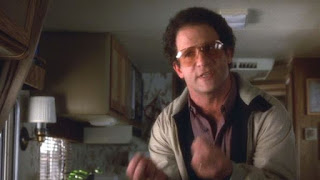
Albert Brooks, Dan Aykroyd) spend a nighttime road-trip amusing each other. First, the driver teases by turning off his headlights at random, then they play a TV-theme song guessing game, which leads to talking about "The Twilight Zone" and ends with "Hey. You wanna see something really scary?"
Besides the Dante and Miller segments, that prelude is one of the things that people remember about the movie. There had been plans for certain characters to cross-over into other segments, but a late-in-the-game reshuffling of their order and a general torpor over the film due to the filming deaths nixed those plans.
 
The film did make money, but suffered blistering reviews—critics always mentioned the deaths and took pot-shots at Spielberg. No movie is worth a human life, but that would be true if the result was a masterpiece, as well. TZ's critics seemed to think the sin worse if the movie is only semi-successful. So much for moral high ground. But, people remember the best things about it—"Really Scary" "It's a Good Life!" and "Nightmare at 20,000 Ft." There have been a few revivals of the series (and probably always will be), and other similarly themed series from "The Outer Limits" to "Black Mirror." Spielberg even tried his hand in the game with his series "Amazing Stories," which served as a clearing house for his ideas and a proving ground for directors, old and new.
 
But, the movie lives up to the Serling grandiloquence—whether intentionally or not—of lying "somewhere between the pit of one's fears and the summit of his knowledge."

* The TZ movie is full of Easter eggs and little buried bits of trivia throughout: Bill Connor's name is a one-off of "Bull" Connor, the Alabama Sheriff known for his brutal treatment of Civil Rights protestors, "Helen Foley" is the name of a teacher of Serling's (and was used in a TZ episode), and Serling himself appears in the blink of an eye in the Main Title. Dante's episode is rife with actors from the series, including a cameo by Bill Mumy, who played the uber-kid in the original episode of "It's a Good Life" as well as mentioning city-names from other episodes.

Sunday, February 6, 2022

Don't Make a Scene: Lost in America

The Story: Mansplaining. Oooh. Let's start off Valentine Month with that.

IF you didn't know, the term "mansplaining" has been around since 2008, and, in 2010, The New York Times designated it one of its "Words of the Year." "The Oxford" gives the definition:
"the explanation of something by a man, typically to a woman, in a manner regarded as condescending or patronizing"
...which is described in such a way as to be its own illustration in the dictionary. Here's another example—approximately one-third of every episode of "I Love Lucy" was "mansplaining."
 
Fully 100% of these little "The Story" bits in Every Sunday Scene feature is "mansplaining." (Well, certainly this one is).
 
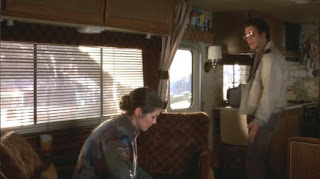
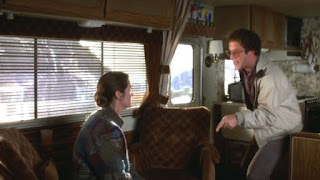
In this scene, David finally "just bursts" after Nancy blows their $100,000 savings on a bad run at the roulette wheel. It is uncomfortable (but not as uncomfortable as the scripted argument is—see below) and is dominated by a David rant that is hysterical and funny and manic—David swings between manic and depressive, and, in fact, their decision to "drop out" has come from his own panic attack before moving into a new house. 
 
It's funny because there's no perspective here. The two have the opportunity to drop out because of their own success. People living paycheck to paycheck don't even consider the move unless they are so desperate they are forced to live in their car, or wander gypsy-like from mobile park to mobile park (I amuse myself sometimes to think what would have happened if the Frances McDormand character in Nomadland had run into the Howards later in life—but, of course, that wouldn't have happened because the Howards barely made it a week in a Winnebago and went back to their past lives because they wanted the romanticism of Easy Rider without the austerity of it—good God, they're in a new Winnebago, for god's sake, not even motorcycles).
 
It just shows what can happen if you believe movies too much—so much of it is myth-making (and manipulative myth-making at that) that (if you WANT to believe it) you can actually believe it might be true. And that goes for television and even so-called "reality" shows (Johnny Carson used to joke that he couldn't get into the "Survivor" series because he knew that just off-camera there was an assistant director with a half-eaten cruller in his hand—so much for privation...and it's why so many people see Donald Trump as competent after watching "The Apprentice"*—and, by the way, "release the out-takes, Burnett").
 
Some might see this scene as male toxicity. I don't. David is so pathetic, one can only see him as funny—he is, after all, the one who got them into this stupid mess, and probably inspired Nancy to "take chances." It IS his fault. And now he's having a tantrum because he is, after all, a child. And so's she. Responsibility makes them both nauseous. It is only when they see that their original life could have been much worse, do they see how good it was and they then go back to it after the biggest detour they've ever taken.
 
The one to reality.
   
The Set-Up: Spurred by the purchase of a new home, upwardly-mobile couple David and Nancy Howard (Albert Brooks, Julie Hagerty) have, instead, "pulled a lateral" and "dropped out" "like in Easy Rider" in order to "touch Indians, see the mountains and the plains and all the things in the song." They get as far as Las Vegas where their liquidated assets are vaporized by Nancy's nighttime binge at a roulette table. Now, at Hoover Dam, after an extended period of passive aggressive silent treatment from David, the two "have it out."

Action!

34 EXT. SIDE OF ROAD - HOOVER DAM VISITOR AREA 
DAVID Where are you going?
NANCY Please come inside?
DAVID What is it? 
NANCY Sit down.
DAVID What is it?
NANCY Just sit down. Now, listen...
NANCY I apologize from the bottom of my heart. I'll make it up to you. 
NANCY I'll make you breakfast in bed for life.
DAVID No, stay away from the food—you'll lose it. 
DAVID I just want to know how this happened. I, I can't understand it. How did it happen?
NANCY I don't know; 
NANCY I just held things in for so long, I just burst.
DAVID What did you hold in? What were you holding in?
NANCY Everything. 
NANCY Listen, you know, you weren't the only one whose life wasn't satisfying. I sat in that office for seven years without a window. Sometimes I felt like I was going crazy.
DAVID Why didn't you wake me up? Why didn't you tap me on the shoulder and say "I think I'm having this problem. Is it okay if I go down and lose everything?" Then I could have helped. Maybe I could have said no. 
DAVID I'm sure the Desert Inn has an all-night shrink service along with a spa facility, don't they? 
DAVID Don't you think someone could have counseled us? He would have said, "Look..."
DAVID "...she's gotta let it go somehow. Why don't you spend $10,000 and rent the Goodyear blimp, and then it will fly around and flash positive things." Much cheaper, same result! 
DAVID Why didn't you wake me up? We could have discussed this.
NANCY I didn't understand it until now.
DAVID Oh, great, okay. Well...
DAVID ...congratulations, I'm glad. I mean I'm glad you understand everything. Unfortunately, I'm still screwed up! And we don't have the money to fix me. You're fixed! And now we have like, you know, a couple hundred for me. A hundred thousand for you, a hundred for me. I think I was sicker than you to begin with! 
DAVID Oh, God
DAVID I guess this was my fault. That's what I'm thinking. Maybe I just didn't explain the nest egg well enough. If you had understood—you know, it's a very sacred thing, the nest egg. And if you had understood the nest-egg principle—as we will now call it in the first of many lectures that you will have to get, 
DAVID ...because if we are to acquire another nest egg, we both have to understand what it means. 
DAVID The egg is a protector, like a god, and we sit under the nest egg and we are protected by it. Without it—no protection. Want me to go on? It pours rain. Hey, the rain drops on the egg and falls off the side. Without the egg? Wet! It's over. 
DAVID But you didn't understand it, and that's why we're where we are.
NANCY I understood the nest egg.
DAVID Please do me a favor. Don't use the word. You may not use that word! It's off-limits to you. 
DAVID Only those in this house who understand nest egg may use it. And... 
DAVID ...don't use any part of it, either. Don't use nest, don't use egg. If you're out in the forest, you can point: "That bird lives in a round stick." And, and, you have things over-easy with toast. 
DAVID Oh, gee, 
DAVID ...you know what I'd like to do? I'd like to give you a small punishment before lunch, and I'd like you to write 1,000 times on the pavement: I LOST THE NEST EGG. Come on, "I lost the nest egg"—say it, say it 500 times. 
DAVID "I lost the nest egg. I lost the nest egg. I lost the nest egg. I lost the nest egg. I'm startin' it for you...
DAVID ...you jump in anywhere. I lost the nest egg. I lost the nest egg. I lost the nest egg. I lost the nest egg."
DAVID "I lost the nest egg!"
NANCY Shut up with the nest egg!! 
NANCY And let me tell you something. That's not how you drop out, anyway. 
NANCY If you're really going to drop out, you drop out with nothing.
[She leaves the Winnebago.]
DAVID Oh, you do? 
DAVID Well, where did you read that? The Las Vegas Guide?
NANCY I didn't read it. Friends told me—people who know!
DAVID You don't know anybody who knows. You don't know anybody who ever dropped out, except for us. What are you talking about?
NANCY Alright! Alright! Well, the movie you're basing your whole life on, "Easy Rider," they had nothing. They had no...
NANCY ...nest egg. 
DAVID Bullshit. They had a giant nest egg. They had all this cocaine.
NANCY That's not true. 
DAVID It is true! 
DAVID Linda. They sold cocaine. Okay, wait a second! Wait, wait, wait, wait, wait, wait.
[They both stop.]
DAVID I'm not going to stand here, in front of one of the great wonders of the world and argue about an old movie. 
DAVID I'll go back inside. If you can figure out some plan to make eight hundred bucks last a lifetime, 
DAVID ...
knock on the door. I'll be in there.
[David turns around and walks towards the motor home.]
 
 
Words by Albert Brooks and Monica Mcgowan Johnson
 
 
Lost in America is available on DVD and Blu-Ray from Warner Home Video.


Here is the scripted version of this scene:
 
NANCY I don't want to have an argument in front of those people. 
DAVID Why not? I think those people are entitled to know how stupid you are. 
NANCY This is going to turn into a personal attack, isn't it? 
DAVID What else? A general attack? Who am I going to attack? Nevada? I can't attack the state. It wasn't their fault. I can't attack the motor home. It stayed in the parking lot. I can't attack me. I was fast asleep. By process of elimination, who's left? 
NANCY I am. I'm left, okay? And I'll say it one more time - I'm sorry. 
They are off by themselves now. They have reasonable privacy. They are both very upset. 
DAVID I don't want your apologies. I want to know why? I want to try to understand how it happened. Tell me. How did it happen? 
NANCY I couldn't sleep. 
DAVID You couldn't sleep. I see. Now, I remember nights where I couldn't sleep. I'm just trying to think what I did. Let's see. I tried warm milk or I took a long walk or I took Nytol and then, if all that didn't work, I gave away all the money I ever earned. But you didn't try any of those things first. You just gave away the money first, right? What did you intend to do? Have warm milk afterwards? Tell me. I'm mixed up. 
NANCY You're not even listening. 
DAVID I'm sorry. You're right. Go ahead. You couldn't sleep. Then what happened? 
NANCY I don't remember. I just went downstairs. 
DAVID Why didn't you wake me up? 
NANCY What would you have done? 
DAVID What would I have done? I would have followed you. I would've seen you. I would have watched you take your money and begin to lose it and I would have stopped you at thirty dollars, maybe thirty-two dollars, at the most. I would have said, "Sweetheart, come back to bed. We don't want to fool with our nest egg." You know, Nancy, I think you just considered nest egg to be a term but to me, it was a key to this whole experiment. Why, I considered it like a third person. It was our best friend, our guardian angel. It was going to allow us to do everything we wanted to do. It was going to watch over us during bad times and laugh with us during good times. It was going to help us roam and purchase and eat and explore. It was going to help us make love and laugh and cry and now, it's gone and who's got it? The Desert Inn! They've got our nest egg. They can sure use it, can't they? They don't have their own. They're a poor little organization. They need our nest egg. Gee, I hope they use it wisely. I know someday those mirrors are going to have to be reflocked and the red velvet was looking kind of worn. And those little heart beds are going to need new sheets. I'm glad we could help them pay for that. I'm glad our life savings will go towards making that room look a little prettier. I'm glad we gave it all to them, Nancy. I'm just going to miss the little nest egg, that's all. Won't you, sweetheart? Won't you miss the nest egg? In the middle of the night, won't you feel kind of lonely because little nest egg is paying for the gas in Frank Sinatra's limo? 
NANCY Shut up, David! (begins to cry; she's getting hysterical) Shut up! I don't want to hear nest egg anymore! I don't want to hear that word. Let me tell you something. That's not the way you drop out anyway. If you're really going to drop out, you drop out with nothing! 
DAVID You drop out with nothing? Oh where did you read that? In the Las Vegas Guide? 
NANCY I didn't read that. I know that. 
DAVID Oh, I see. Who told you? 
NANCY Friends, people who know. I don't have to answer you. 
DAVID No. You don't have to answer me. You can't answer me because no one ever told you that. You never had friends who dropped out. You don't know anybody who dropped out except for us. So how the hell did you know that? Come on, tell me? 
NANCY Alright. The movie you're basing your whole life on, "Easy Rider," they dropped out with nothing. They had no nest egg. 
DAVID Bullshit. They had a huge nest egg. They sold cocaine. They didn't get on their motorcycles till their nest egg was giant, fifty times the size of ours. 
NANCY That's not true. 
DAVID Oh, look. I'm not going to stand here, in front of one of the seven wonders of the world and argue about an old movie. I'm going to go now and get back in the motor home and maybe you can wander around out here and figure out something to do. We have eight hundred dollars left and an entire lifetime. See what you can come up with. 
David starts to walk away. 
NANCY We could sell cocaine. 
DAVID (stops and turns around) Well, my God. Why didn't I think of that? Great idea. As a matter- of-fact, I remember after seeing "Midnight Express" I went out of the theater saying to myself, "That's for me. Sex with hundreds of Turkish men." 
David turns around and walks towards the motor home.
 
* Trump initially didn't want to do "The Apprentice" as he thought reality television was "for the bottom-feeders of society." I can see chests swelling with pride over THAT statement. To me, it sounds like a mission statement.