Showing posts with label George Miller. Show all posts

Tuesday, May 28, 2024

Furiosa: a Mad Max Saga

"Do You Have What It Takes To Make It Epic?"
or
"Bigger. Stronger. Faster. Further."

Dr. George Miller is fast approaching the age of 80 years old, and whereas most film directors lucky enough to be working at that age have a tendency to make their films slower-paced and more contemplative in nature the older they get, he has gone the opposite direction (and faster!) making movies more expansive and more energetic the more he works. 
 
Not only that, Miller's movies are getting denser—as in having more depth (rather than merely being stupid, which they most certainly are not). There are sub-texts (that aren't merely superficial call-backs to other movies, but to Myth and literature), amazing images (that sometimes recall the after-image of a Fritz Lang or of William Wyler religious epics), a sumptuousness of detail—in environments, costuming, machines—that can't be contained by mere budgets, and a pace that has only gotten faster and more daring as the years have gone on, while also NOT depriving any essential information for an audience to understand exactly what is happening. 
George Miller, at 79, is still showing young turk wannabe directors not only how to make movies (and good ones!), but leaving them in his considerable cloud of dust as he out-paces and out-flanks them.

Now, after a jaw-dropping return to making live action movies (after a 17 year absence—during which he made two "Happy Feet" animated features) with his Mad Max: Fury Road (big hit!) and Three Thousand Years of Longing (no one saw it), he's back to his Australian dystopia with a prequel to Fury Road called Furiosa: a Mad Max Saga, relating the origin story of Charlize Theron's amazon fury-imperator (now played by Anya Taylor-Joy). 
Set in five chapters (1. The Poles of Possibilities; 2. Lessons from the Wasteland; 3. The Stowaway; 4. Homeward; 5. Beyond Vengeance), it tells the story of Furiosa's abduction as a child from "The Green Place of Many Mothers", kept as a trophy by the Wasteland biker-warlord, Dr. Dementus
(
Chris Hemsworth—in a performance somewhere between a Bond villain and a mad Peter O'Toole), her trade to the Citadel to become a bride of Immortan Joe (now played by Lachy Hulme), and her escape to hide in plain sight as a Citadel worker.
Her ultimate goal is to return to "The Green Place" (we learned what became of that in Fury Road) but, for the purposes of this movie, she is concerned with vengeance against Dementus as the off-kilter boss-wannabe had killed her mother, who had come after the bikers in an attempt to get Furiosa back. And to do that, she must first shed her disguise and become mobile—which she does in "The Stowaway" section (which is one big chase sequence), gaining access to Dementus' "War Rig" and assisting its driver Praetorian Jack (Tom Burke) to ward off pirate attacks in its supply efforts across The Wasteland.
What we've got here is a feminist version of The Searchers, where the kidnap-victim takes it upon herself to free herself from her captors, rather than waiting around for someone else to do it (hard to do as her only known relative was her mother). And along the way, we learn how Furiosa gained her "mad" skills, and how she managed to lose her left arm (and its significance to her quest).
Furiosa has all the hallmarks of a "Mad Max" movie—despite having only one shot of "Max" (
Jacob Tomuri) in the entire thing. It careens, it propels, it defies expectations—except to pump adrenaline and amaze in how it builds its world out of spare parts (Dementus drives a chariot pulled by three motorcycles)—and does the vast majority of it using practical effects (a few of the explosions and other bits of business are augmented by CGI) and some of the most daredevil-ish stuntmen on the planet.
But, Miller is pushing the film-making illusions, as well. There's always been a bit of under-cranking (the act of filming at a lower frame-rate to make the action appear faster on the screen) in the "Mad Max" films, but here Miller takes it even farther. If Fury Road was a "10" in that department, Miller risks taking it to "12." There's always the danger of making things look cartoonish that way, but Miller, at this point, doesn't seem to care. There are parts of Furiosa that feel like you're watching it dosed on Ambien, so hyper-kinetic is the result, and the effect is unnerving. But, it works subjectively, despite the objections of some purists.
It's also one of the most "in-your-face" movies in my memory, with quite a few shots that literally zoom in to characters' faces and might cause your foot to instinctively stamp on an imaginary brake pedal (there's one that propels into a face as it explodes in the last frame!). It is dizzying and quite the rush, all the more so because Miller is a director who keeps you aware of where things are and where they relate to the camera. There is nothing scatter-shot about what he does; the only hap-hazardness is what he has happen on-screen.
It's great. Wonderful story-telling. But, it's not for the sensitive—"sequences of strong violence and grisly images" and all that—but apocalyptic dystopias rarely are. And Furiosa is a nice little dervish-y spin on the Mad Max Universe and a fresh take on its tropes.
 
Miller's got another story ready to film out of this Fury Road saga. It'll probably be even more dynamic. Miller, approaching 80, isn't one to slow down.

Wednesday, October 26, 2022

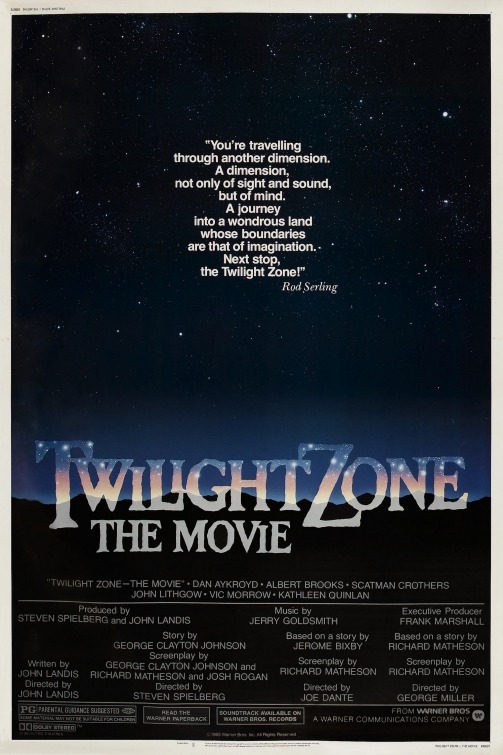
Twilight Zone: The Movie

Twilight Zone: The Movie
(
John Landis, Steven Spielberg, Joe Dante, George Miller, 1983) The well-regarded TV series created by Rod Serling—to create a broader palette to write with, while also giving him a chance to write metaphorically about social themes without the pearl-clutching of sensitive advertisers—is one of those hallmarks of television creativity, as well as being the inspiration for creative thinkers the world over. It's probably running right now, this very minute, on some channel in the world as it's an evergreen series, one that never loses its charm or ability to chill...or preach. Every episode, narrated by Serling himself, offered some little lesson in humanity, some softball sermon, some irony, that offered "for your consideration" that one couldn't escape some aspect of goodness or frailty, even in one's escapism.
 
It could also creep the be-jee-sus out of you.
 
It was a staple for the television viewer uninterested in westerns, soap operas or family comedies, but more invested in science fiction, anthologies and speculative stories with a twist...and a point of view.
That included many of the up-and-coming film-makers learning their craft during the time the series was broadasting, the most prominent of which was Steven Spielberg, who secured a deal with the Serling Estate to make a tribute film, using the anthology format, some old hands, and recreating the show's magic utilizing widescreen, color, and the new diversity in special effects. At the same time he brought in scenarist Richard Matheson (who'd written 16 of the original episodes) and composer Jerry Goldsmith (who'd written the background scores for seven of the original episodes). Three of the four stories would be "re-imaginings" of old episodes and one would be completely original. Four different directors would be involved. The narration for each segment was done by Burgess Meredith, who'd starred in four of the original broadcasts.
 
One cannot discuss the movie without mentioning "the accident" while filming the first segment when star Vic Morrow and two Vietnamese child-actors were killed during a night-time helicopter shoot. All were killed instantly—and horrifically—when the vehicle crashed on them during what looked like a particularly chaotic sequence involving an unsupported vehicle, waist-high water with spray, children being carried by the actor, and explosions. Plus, there were many violations of safety and child employment. The tragedy cast a pall over the movie that it was never able to shake: Spielberg basically disowned the movie, director George Miller quit it, leaving the post-production of his segment to Joe Dante. One has to judge the results of what's on the screen dispassionately, and it's almost impossible to do with Twilight Zone: The Movie.
 
Segment One: Time Out (d: John Landis) 
You're about to meet an angry man. Mr. William Connor, who carries on his shoulder a chip the size of the national debt. This is a sour man, a lonely man, who's tired of waiting for the breaks that come to others, but never to him. Mr. William Connor, whose own blind hatred is about to catapult him into the darkest corner of the Twilight Zone.
 
A bigot, Bill Connor (Vic Morrow),* walks into a bar, but it's no joke. Bitter from being passed over for a promotion, he drown his sorrows and vents his besotted spleen, hurling invective at Jews, African Americans, the "usual suspects" on the White Supremacist List. Leaving the bar, he seems to be walking in other people's shoes...and times...as he is mistaken for a Jew in Nazi Germany, a "Negro" facing a lynching in the 1950's South, and a Vietnamese citizen in the Vietnam War. After caroming from time to time, he is last seen on a transport train headed for a concentration camp, unseen by his companions from the bar.
 
Landis' segment was totally original (if reminiscent of some of Serling's fables of bad men getting their comeuppance ironically while also presaging TV's "Quantum Leap" by a few years) and Morrow's performance in what is basically a one-man show is very strong. Landis shoots it like a low budget TV episode, making it feel much more like an episode from the original series. A not-too good episode, one should mention. One wishes—for Morrow's sake—that they could have hit it out of the park. It would have been small consolation for an unnecessary tragedy.
Segment Two: Kick the Can (d: Steven Spielberg)
It is sometimes said that where there is no hope, there is no life. Case in point: the residents of Sunnyvale Rest Home, where hope is just a memory. But hope just checked into Sunnyvale, disguised as an elderly optimist, who carries his magic in a shiny tin can.
 
Adapted from the original episode written by George Clayton Johnson by Johnson, Matheson and E.T. scenarist Melissa Mathison (credited as Josh Rogan), Spielberg's segment (filmed in six days) takes place at a rest home, which welcomes a new resident, Mr. Bloom (Scatman Crothers), eternal optimist, who encourages the oldsters to think young by the simple act of playing a game—kick the can—and, miraculously (not because it's Spielberg, but because it's John and TZ), they do become young little kids. 
 
That's where the TV episode ended, but the older, wiser scribes continue the story, making the kids realize that they've already had full lives that they couldn't recapture again and so—with one notable adventuring exception—they return to their aged forms, older, if spiritually renewed.
 
Spielberg almost did "The Monsters Are Due on Marple Street" but, after the accident, he changed stories, not wanting to do something with a night-time shoot, special effects and with kids involved. There are still kids in "Kick the Can" (he'd just finished E.T. and loved that shoot, working with children; he hadn't yet made Hook, which cured him of it), but no special effects and no risks. No real enjoyment, either, unless your preference is for oldsters and tykes acting very, very sincerely.

Segment Three: It's a Good Life! (d: Joe Dante) 
Portrait of a woman in transit. Helen Foley, age 27. Occupation: schoolteacher. Up until now, the pattern of her life has been one of unrelenting sameness, waiting for something different to happen. Helen Foley doesn't know it yet, but her waiting has just ended.
One of the creepiest of the original "Twilight Zone" episodes was based on Jerome Bixby's 1953 short story "It's a Good Life!" which featured Bill Mumy as little Anthony Fremont, the six year old "head of the household" due to his murderous psychic powers. A haunting, scary little story—which probably resonates with any adult who has children—"It's a Good Life!" has a nightmarish quality filtered through a young child's imagination, but doesn't offer any way out. Anthony's family is stuck in their situation and the only way to survive is to placate their kid's murderous impulses. The movie version is a bit looser.
 
Dante, working with Matheson's screenplay, complicates it and actually resolves it, while also filling it with childish nightmare images designed to both evoke horror and a laugh at the bizarreness of it all. Foley (Kathleen Quinlan), who is on her way to a new job nearly runs into Anthony (Jeremy Licht) on his bicycle and offers him a ride home. There she meets his family—made up of TZ alums Kevin McCarthy, William Schallert, and Patricia Barry as well as Nancy Cartwright and Cherie Currie—and the one's who are actually ambulatory are a nervous bunch. It turns out Anthony has earlier murdered his family and these people are replacements and subject to his whims, all the products of a child's hyper mind.
And (one should add) Dante's. Dante had just made The Howling and it so impressed Spielberg that he offered the "Twilight Zone" deal to him as well as the directing post for the forthcoming Gremlins. Audiences probably weren't prepared for the combination of goofy nightmare that Dante in all his glory could produce, and his ideas—produced with the help of make-up man Rob Bottin—are giddy atrocities that will either make you spit-up your popcorn or vomit it. It's a wild Easter-egg filled roller-coaster through a spook-house that's creepy-funny. And it even manages to have a happy ending. After Spielberg's segment, Dante's was a sharp slap in the face with a cream-pie. Oh, but just you wait...
 

Segment Four: Nightmare at 20,000 Feet (d: George Miller) 
What you're looking at could be the end of a particularly terrifying nightmare. It isn't. It's the beginning. Introducing Mr. John Valentine, air traveler. His destination: the Twilight Zone.
Please fasten your seat-belts. We're expecting some turbulence. The darling of the Australian film renaissance and director of Mad Max and the recent hit The Road Warrior is restricted to merely the interior of an airplane in this story of a very nervous passenger (John Lithgow) on the worst flight of his life. Already afraid of flying, his terror is increased exponentially by irritating passengers, a flight-path through a thunderstorm, and...a gremlin on the wing of the plane throwing things into a jet engine, threatening to make it crash.
 
The original is remembered for its simple concept and a performance by William Shatner that pre-sages scenery-chewing to come. But, Lithgow out-Shatners by an additional over-the-top 20,000 feet in a performance that is hysterical in both senses of the term. He's aided and abetted by Miller's restless—and at times, anarchic—camera and even some literal eye-popping special effects. Tight, efficient, and relentless, Miller's segment is absolutely brilliant...and always seems to come up in conversations on plane flights. It's the perfect capper in an uneven movie.
John Landis also did a prologue section, which opened the film before the titles—two dudes-in-flannel (
Albert Brooks, Dan Aykroyd) spend a nighttime road-trip amusing each other. First, the driver teases by turning off his headlights at random, then they play a TV-theme song guessing game, which leads to talking about "The Twilight Zone" and ends with "Hey. You wanna see something really scary?"
Besides the Dante and Miller segments, that prelude is one of the things that people remember about the movie. There had been plans for certain characters to cross-over into other segments, but a late-in-the-game reshuffling of their order and a general torpor over the film due to the filming deaths nixed those plans.
 
The film did make money, but suffered blistering reviews—critics always mentioned the deaths and took pot-shots at Spielberg. No movie is worth a human life, but that would be true if the result was a masterpiece, as well. TZ's critics seemed to think the sin worse if the movie is only semi-successful. So much for moral high ground. But, people remember the best things about it—"Really Scary" "It's a Good Life!" and "Nightmare at 20,000 Ft." There have been a few revivals of the series (and probably always will be), and other similarly themed series from "The Outer Limits" to "Black Mirror." Spielberg even tried his hand in the game with his series "Amazing Stories," which served as a clearing house for his ideas and a proving ground for directors, old and new.
 
But, the movie lives up to the Serling grandiloquence—whether intentionally or not—of lying "somewhere between the pit of one's fears and the summit of his knowledge."

* The TZ movie is full of Easter eggs and little buried bits of trivia throughout: Bill Connor's name is a one-off of "Bull" Connor, the Alabama Sheriff known for his brutal treatment of Civil Rights protestors, "Helen Foley" is the name of a teacher of Serling's (and was used in a TZ episode), and Serling himself appears in the blink of an eye in the Main Title. Dante's episode is rife with actors from the series, including a cameo by Bill Mumy, who played the uber-kid in the original episode of "It's a Good Life" as well as mentioning city-names from other episodes.

Thursday, September 15, 2022

Three Thousand Years of Longing

Be Careful What You Wish For (Three Thousand Years of Writing)
or
"My Imagination Has Been Getting the Better of Me"
 
Alithea Binnie (Tilda Swinton) is a "narratologist" by trade and preference, an academic, content to live alone, although she will attend a convention or two, give a lecture, but mostly study the story-form, which she speed-reads while her foot is nervously keeping a rhythm of what she absorbs. That's the only action she gets out of life, her scholarly ruminations being a way to avoid it, like so many cinema-collegiates of the past (and film critics for that matter). They're book-learned but street-dumb, cloistered in the metaphorical Ivory Tower that keeps them high above the fray. They can study, but only vicariously experiencing life through witness testimony. She is—to quote a line from Play It Again, Sam—"one of the world's great watchers" ("great" being used ironically). 
 
While on a working vacation to Istanbul, she has two instances of hallucinations—walking through the airport, a wizened little person accosts her rolling luggage and when she protests—and her minders at a conference approach her—it runs away and disappears in the crowd. Then, after going to her hotel and settling in, she is sitting on stage preparing to be introduced to speak when she sees a demonic shamanic figure sitting in the audience, shifting into increasingly closer seats until, with a blink, he is standing before her and....
She faints. She recovers, but shakily, and insists on going on, what, to her, is a traditional addition to her every itinerary—a visit to a bazaar to purchase a memorial trinket, usually of glass. She becomes enamored of a fluted bottle, deeply encrusted with age and the dust of ages and determines to clean it in her hotel room sink. Before doing that, one should always check about double occupancy with the concierge (and if you've booked a smoking room).
And, of COURSE, a genie (Idris Elba) comes out of the bottle—haven't you seen the previews? After a slight period of adjustment—language, electronics—we get down to the essential matter: freed from the lamp, blah-blah-blah, three wishes, Heart's desire, blah-blah-blah, don't ask for any more wishes,* and we don't even have to sing along to "A Friend Like Me." Alithea is familiar with all of that—she's read all the stories. She knows the tropes. She's an academic! And the problem is academic. Three wishes? "There's no story about wishing that isn't a cautionary tale." Damn straight! The iconography is full of people who end up with a million ducks or a twelve-inch pianist or end up as Hitler. So...she just doesn't want to do it. She's happy. She's comfortable. She makes a living, if not exactly living, but she's okay with that. Why risk it, when there's the possibility that her djinn is a trickster...or worse, a literalist? Three wishes? Go blow smoke!
This is very frustrating for the djinn.
"There is no human, nor angel, nor demon, who wouldn't grasp at the chance to fulfill their deepest longings. And I am saddled with the one who claims to want nothing at all? Alithea Binnie, you are a liar!" Not really, though. What sort of teacher would she be? But, without a hat-trick of granted wishes, he is tied to her and can't be released to his freedom in Djinnsleyland. Such a fate would even make Barbara Eden grumpy. Intrigued by his frustration and because she is who she is, Alithea compels the djinn to tell his story of the three "incarcerations" (as he calls them) that have kept him trapped for three thousand years. The first of which involves Solomon and Sheba, the second involves the court of Suleiman the Magnificent, where the the Djinn is forced to wander for 100 years, and finally, the third, of the wife of a Turkish merchant, whose final wish banishes the djinn to the bottle where Alithea has found him, trapped. Hence, the title Three Thousand Years of Longing.

Writer-director (phd) stages these events with the same characteristic inventiveness and momentum that he brings to his "Mad Max" films, but where those films (and most of his output) has had a boy's own hard edge to them, this tale (from the  77 year old director) shows itself to be not only a rich fantasy film, but a resonant and uncynical love story as well. For all the djinn's stories have, as their basis, the djinn's devotion to his "masters" and their resolution by repaying that devotion with some form of rejection. The first by replacement, the second by forgetting, the third by denial. They are all melancholic, sad stories from the djinn's point of view, in which he is the one who is tricked and suffers his own forms of banishment by those he was bound to serve. Alithea hears these stories and realizes the djinn is no trickster—just the opposite—and resolves to find a different solution to his problem, all the while keeping wishes in reserve.

The stories are fascinating and rich in detail and color, like a Korda film gone riotous, taking you from palaces to sewers in vivid compositions that sometimes feel like an assault, sometimes a caress, all at the service of a debate between a scholar and all-powerful spirit about the dangers of service and promises and of love, none of which are for the faint of heart or shallow of character.
The heavy-lifting acting goes to Elba who is ever-present as narrator and djinn and clicks on all cylinders here with maximum effectiveness (as he can be when he's given something to work with). He's ably helped by Swinton's Alithea, who's so suffused with myth that she takes a djinn in stride and keeps her head about her to counter his arguments. Swinton's "read THAT story already" sensibility in her interactions has its own Buster Keaton-ish "squareness" and dead-pan humor that keeps the two engaging.**
And the film is enriched by a wealth of actors with short CV's but have the proper look even if they don't have a word of dialogue to speak. It's a sumptuous banquet of a movie, filled with wonders for the eyes and ears and heart.
But, then, this film is right in my emotional wheel-house. I think of myself as a "cynical sentimentalist." I can be moved by a film of feeling even while I know that I'm being manipulated at 24 frames per second. At the same time, I have a jaundiced, less-romantic view of what "love" is. "Love" is a stew of hormones and serotonin, influenced by subconscious memory and sociological prodding. And marketed beyond all reasonableness. Given that description, Big-L "Love" is reduced to a form of mental illness, a chemical imbalance, like depression, only with the sparks dialed up to "11".
To counter that curmudgeonly view, I look to the Bible's analysis of "Love" (or "Charity" depending on your printing, which calms things down a bit) via Paul's First Letter to the Corinthians for a better understanding...at least, a more subdued one...that explores that "mystery" in a behavioral context, one that might explain such actions of love as self-sacrifice. And there, Three Thousand Years of Longing seems to have its Rosetta Stone, with its mentioning of fantastical elements of moving mountains and knowing all things, which the movie shows or implies. It certainly puts it head and shoulders above your standard Julia Roberts/J-Lo rom-com where the stakes and aspirations are considerably lower. And, for me, it makes it the love story of the year.
That Dr. Miller has made such a voluptuous film of it—and Tom Holkenburg's score even uses melody!—just makes it a wish fulfilled.

My three wishes would be that everybody go see this in a theater in a big screen for its visual splendor, its inventive use of ATMOS sound and the ability to be swept away. Seeing it at home or streaming would be so much dust.
 
*Someone came up with a great solution for this: "I wish you'd forget how to count..."

** In a recent podcast about the film that I participated in, there was much critical emphasis on Tilda Swinton's accent swerving. I haven't paid attention to accents at all since Sean Connery's Scottish burr coming out of an Arab Berber worked in The Wind and The Lion. One can be too Henry Higgins about these things, especially in a multi-national world where communications is no longer an issue. Is the performance good or is it a phonics test?

Tuesday, May 26, 2015

Mad Max: Fury Road

The Mother of All Chase Movies
or
My Sister Looks Cute in Her Mech-Arm and Boots,
A Hand-full of Grease is Her Hair.*

Kinetic.

That one word sums up Mad Max: Fury Road—itself a film of few words, made up of a story-line propelled by images of such kinetic energy it feels like an assault.  

We've had a lot of those lately, but the difference between this latest "Mad Max" installment, the fourth,** shepherded (the appropriate term) by its originator, the now-70 years old Dr. George Miller, and your typical action movie—say The Avengers: Age of Ultron—is that the action is part and parcel of the story, and rather than being a one hundred twenty minutes-long diversion, with hyper tent-poles to goose the movie along, it is the story, the images communicating the message, as most superior movies do...as most movies should.
The energy is so palpable, in varying frame-rates for emotional intensity, that it almost feels like one of the "Crank" movies of Neveldine and Taylor (except Miller was doing these tricks when they were just kids).  But, it's more than frame rates. Miller's post-apocalyptic films feel relentlessly imaginative, sometimes repulsively so—you are frequently shocked by what he shows (and that's been true, even from his first "Max"—shocking, yes, but darned good ideas, nonetheless), and this latest is just as tough and unsentimental, even if the base subject matter is The Movies' most obvious road to sentiment.
Tom Hardy takes over the role of Mad Max from Mel Gibson
The previous Gibson "Max's" have dealt with vengeance (in the first, road cop Max Rockatanski has his family murdered and brings the street racers responsible to pay for it).  In the second, the world has gone through a nuclear disaster, and gasoline is a precious commodity.  In this one, it's raw power and influence.  In the third, it's water...and basic human rights—specifically, women's rights (Stop rolling yer damn eyes, boys. Let me explain).
Not sure where we are in continuity here—methane is a main source of power as well as human labor, but gasoline can still be found in Gas Town and ammunition at a place called The Bullet Farm. Max is alive, hair long and shaggy (as it was in Thunderdome) and still in possession of his MFP Pursuit Special (he was driving a camel-powered wagon in Thunderdome) and is looking out over a bleak landscape of desert. A two-headed lizard appears behind him and Max steps on it and eats it. So much for survival. He gets in the PS and is being pursued by a vehicle gang from The Citadel. Max is out-chased and taken captive, his skills and stats tattooed on his back for reference. His job is to be a "blood-bag," catheterized up to one of the many raiding party "War Boys," Nux (Nicholas Hoult), the sickly son of the Citadel's leader Immortan Joe (Hugh Keays-Byrne), absolute ruler over the many slaves of the Citadel, controlling the only known water supply (from deep underground) and farming breast-milk from the Citadel's women—several of whom are kept aside as "breeders" for Joe. One learns early on in Fury Road that your only identity is by your usefulness
Hugh Keays-Byrne returns to the Mad Max series as Immortan Joe
Joe's lieutenant, the imperator Furiosa (Charlize Theron) is charged with leading a convoy to Gas-Town for supplies. She looks hard and seems very capable despite that her left arm is gone from the elbow and has been replaced (when necessary) by an armored robotic arm. With a variety of vehicles on-guard, she takes the point in a converted 18-wheeler War Machine, but before reaching Gas-Town, she declares to the War-Boys watching for attacks that they're going to take a little detour and veers off the road.
Meanwhile, back at The Citadel, Joe realizes that his breeders are missing. Being no sign of them, he believes Furiosa might be behind their disappearance (especially as she has not kept the appointment at Gas-Town. So, with a flotilla of vehicles, he and the Mad Boys go off to the desert in pursuit. Max is taken along as blood supply, strapped to the front of Nux's car, like a bizarre hood ornament, given a front row seat to the chase.

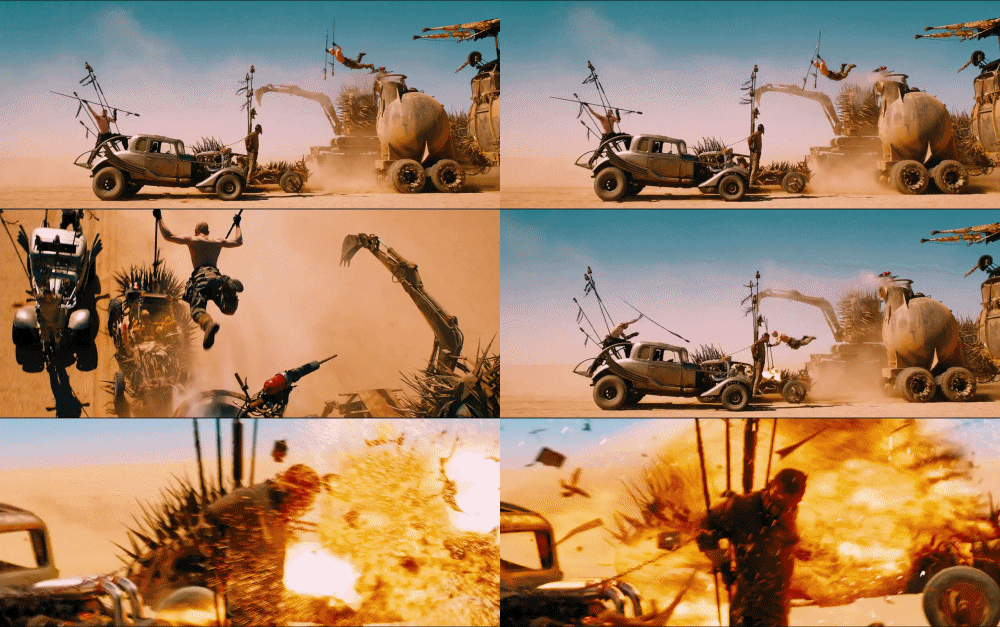
That chase, like the movie, is relentless, violent, savage...and a lot of brutish fun. Done with little CGI and employing an army of stunt-persons (even some Cirque Du Soleil performers) it is a series of challenges and explosive results, done practically (I use that term semi-seriously—a lot of budget and design work goes up in wanton fiery smoke—hardly practical) with little or no digital enhancement, save for some editing crunches and picture-tinting. The rest of the movie is taken up with the chase, with little respite or breathing room. Like The Road Warrior before it, Fury Road thrills, surprises and horrifies, and sets nervous legs pumping with adrenaline all through the theater, while also hiding in plain sight Miller's message amid the pyrotechnics.
And what is that message? Well, that Immortan Joe is right in his paranoia: Furiosa has, indeed, smuggled the women, all pregnant, in the War Machine, and her ultimate goal is the same as in the other "Mad Max" movies—to find Valhalla among the madness. In this case, it is the home Furiosa was stolen from as a child—The Green Zone. There, the women have a chance of raising their children in a sane environment, out of the control of the male despot who has fathered them. The movie is one hell of a protracted custody battle.
Super-models and Elvis' granddaughter are the precious cargo
in Mad Max: Fury Road
Having a feminist message inside Mad Max is hardly surprising. Miller likes strong female characters, whether in this series or any movie he makes—The Witches of Eastwick, Lorenzo's Oil—and he cleverly couches it in an action movie...a bit like hiding runaway brides in a tanker-truck. Miller has said his "Mad Max" movies are basically westerns—and they do recall high-octane versions of John Ford's hell-bent-for-leather cavalry chases through Monument Valley, combined with the more female-empowering leanings (as opposed to his usual worshipful regard) of The Master's last film Seven Women.***  The chasing War Boys are all albino-pigmented (to favor dad) and have all the individuality of crash-test dummies (handy for the stunts!), but the "Mothers of Detention" are all distinctive and diverse (with the exception that they're all attractive)—their very appearance takes them out of the norm and makes them visual rebels.
Summing up Mad Max: Fury Road in one image.
It is Max's role (as it has been in the other "Mad Max" movies, save the first one) to shepherd these new heroes to the point where they can be heroic—to start anew amidst the rubble of the old, to strike a beginning out of the ruins of Man and start fresh, apart from the devastation, and then, having accomplished the task to disappear out of sight, back to the ruins that he still belongs in, becoming a part of History...even of Myth. 

In a Summer season of movies that has begun rather inauspiciously, the sheer brio and audaciousness of Mad Max: Fury Road is a welcome relief—a bit of oasis in a desert of unremarkable and disappointing entries so far. That it does so with such energy and visual acuity makes it even more remarkable, the work of a true artist of movies, more interested in the power of the medium and reaching its potential, than merely racing to a release date. That it does so with a statement hidden in it just makes it that much more special and appreciated.

Remember that it's called "Fury Road," as in "Hell hath no..."
The two release trailers for Mad Max: Fury Road.
Actually, the pace of them is only a little faster than that of the entire film.
* The soundtrack for Mad Max: Fury Road is pretty darned magnificent, but the thing in hindsight seems to jam to "Saturday Night's All Right for Fighting" in its sheer frenetic forward energy.

** They are, in order, Mad Max (1979), The Road Warrior (1981) and Mad Max Beyond Thunderdome (1985), all starring Mel Gibson in the title role.

*** ...which, itself, is a tip of the director's fedora to the films of fellow-director Howard Hawks with their girls-will-be-boys bent and the "strength of many" point of attack.