Showing posts with label Martin Scorsese. Show all posts

Tuesday, November 12, 2024

Made in England: The Films of Powell and Pressburger

Made in England: The Films of Powell and Pressburger (David Hinton
, 2024) The Cohen Media Group is getting more than their fare share of attention from me the last few weeks. In addition to Merchant Ivory and another documentary I'll be writing about in August next year, they've also released a nifty little overview about the film career of Michael Powell and Emeric Pressburger, and we're using the singular "career" as the two men formed a creative alliance called "The Archers" and, as such, made some of the more arresting, deep-dish films that came out of England during the 1940's and 1950's. Because they were made in England, some of them are not so widely known as the Hollywood product—in fact, most people got their first looks at them in the early days of television, something of a technological crime, really, as some of these vividly Technicolor films could only be viewed on black-and-white television receivers. That's certainly how Martin Scorsese first encountered them—watching them on TV growing up. And those films were his Rosetta Stone for understanding what movies could do, what they were capable of and how they were art. But, they also influenced Coppola (some of Coppola's more fantastical images are based on their work or at least the "spirit" of them), De Palma, and I would dare say Hitchcock was looking over his shoulder at them, as well.*
I've done individual reviews of early "Archers" movies (including the first five pictured above), but I've missed quite a few of them and this documentary does exactly what it ought to do: whet the appetite to see the unseen. And it reminds you of what made the things great that you have experienced—moments that might have got by you while you were immersed in the story or plot. Now, I really want to see A Canterbury Tale, Gone to Earth and The Tales of Hoffman. Even odd entries like Oh...Rosalinda!, Pursuit of the Graf Spree, and The Queen's Guards. Gee, I even want to see the episode of the American TV series "The Defenders" Powell directed.
Pressburger and Powell couldn't be more different as people—different temperaments, different backgrounds—but they brought out the best in each other and raised the bar for cinematic expressiveness amid emotional repression that veered between the manic and the imperceptible. Plus, they were capable of making movie magic as far as design and effects that veered on the magical. Or the insane. And they were an intertwined team: Pressburger wrote the story and the two would hammer out the script. Together, they'd cast and Powell would direct (with Pressburger on set if changes to the script needed to be made). Powell would go off to Scotland, while Pressburger supervised editing and music. Pressburger dealt with the studios. Powell dealt with cast and crew.
 
And they had a manifesto:
  1. We owe allegiance to nobody except the financial interests which provide our money; and, to them, the sole responsibility of ensuring them a profit, not a loss.
  2. Every single foot in our films is our own responsibility and nobody else's. We refuse to be guided or coerced by any influence but our own judgement.
  3. When we start work on a new idea, we must be a year ahead, not only of our competitors, but also of the times. A real film, from idea to universal release, takes a year. Or more.
  4. No artist believes in escapism. And we secretly believe that no audience does. We have proved, at any rate, that they will pay to see the truth, for other reasons than her nakedness.
  5. At any time, and particularly at the present, the self-respect of all collaborators, from star to propman, is sustained, or diminished, by the theme and purpose of the film they are working on.
As a primer on all things "Archers" it's a cracker-jack presentation, audited, guided, and presented by Martin Scorsese (who executive-produced). As he's done with a lot of his film documentaries, it's "a personal journey" talking of how he found movies by "The Archers" playing on New York television channels—as mentioned in black-and-white—and his discovery of the films in color, his friendship and correspondence with Powell in his later years, and the influences on his films throughout his own directorial career, even illustrating with comparative clips.
If the film has a flaw, it is that there's a little too much of that. Showing the one clip from Raging Bull—or any one film sequence where the aesthetic applies—would have been enough. We believe you, Marty, "The Archers" were a BIG influence. But, the point doesn't need to be made more than once, and the time spent on other instances would rightly have been better spent on the work of the gentlemen the movie is about, as their films are the ones that need exposure.
 
But, I suppose...with a younger audience, there needed to be some additional hand-holding in explaining that Powell and Pressburger's work is evergreen, that it is still culturally and artistically significant no matter how many young turks get behind a movie camera. And how timeless.

* Over the last few weeks, seeing documentaries and such, you can see the close visual proximity that some of these movies shared at the times of their creation, and one starts to see films echoing off each other rather than single films in the work of one particular artist. These people were visual artists—they watched things, studies the eddies of the art and the business—and you can't help but see comparisons between them.

Tuesday, October 24, 2023

Killers of the Flower Moon

Coyote Ugly: The Curse of the Pierce Arrow
or
The Conformist of the Plains
 
David Grann's output of articles and books has provided fodder for lots of movies: The Lost City of Z, Dark Crimes, The Old Man and The Gun, Trial By Fire, and now Killers of the Flower Moon (with its director, Scorsese's next film to be based on Grann's latest book "The Wager"). Grann wrote his book about a moment of long forgotten history—The Osage Indian Murder Case, what the newspapers at the time called "The Reign of Terror" from 1918 to 1931. It was one of the first murder cases taken over and solved by the nascent Bureau of Investigation, what would soon become acronymed as the FBI, an attempt to coordinate crime data into a national data resource that could be shared amidst the disparate state jurisdictions and law enforcement agencies. 

Grann's book is a fine read—it spent 49 weeks on the New York Times non-fiction best-seller list—breaking down the story into three narratives: of Mollie Burkhart (played in the film by Lily Gladstone) of the Osage Tribe, who saw three of her sisters and her mother die (under suspicious or downright murderous circumstances) in a short space of a few years; of Tom White (played in the film by Jesse Plemons), a former Texas Ranger, recruited by the Bureau to investigate the murders—his unique way of assembling a team and having them blend in with the community was a bit unpracticed, but did lead to convictions; and a modern post-investigation appraisal. When Martin Scorsese announced it for his next movie with Robert De Niro and Leonardo DiCaprio
starring it was originally just going to focus on the FBI investigation with DiCaprio as White.But DiCaprio had other ideas—he wanted to play "a villain" and so the film was re-tooled by Scorsese and 
Eric Roth to feature more of the role of Ernest Burkhart, husband of Mollie and his role in the web of deceit and murders...all to obtain the headrights (the land mineral rights owned by full-blooded Osage tribe-members) to their oil-rich pocket of Oklahoma, that made the Osage "the wealthiest people per capita" in the nation. The Osage became prosperous with their oil stipend, creating a power dynamic where they ostensibly ran things in Fairfax, Oklahoma, but they were also targets for any scam and flim-flam the other residents could concoct in order to benefit from their prosperity.
And that included marrying into the money, the oldest way for profligate men to get a sustainable nest-egg and not waste it all in a short period of time. If there's children, then there's always inheritance, or better yet, the idealistically labeled "trust-fund," that can be exploited as long as no one is following the trail of money. In Fairfax, Oklahoma, the trail was not only monetary, but one merely had to trace family ties and the obituary column to see that something was surfacing besides oil.
Clocking in at a back-breaking 3 hours 20 minutes, Killers of the Flower Moon begins where most Scorsese movies do, following the bad guys. Ernest Burkhart (DiCaprio) exits the train to Fairfax after serving in the First World War and receives a warm welcome from his uncle, cattleman William Hale (De Niro), who is perfectly agreeable to taking Ernest under his wing, despite his lack of experience. Under an avuncular pretense, Hale gives his nephew the lay of the land, giving him a book on the Osage people ("Do you read?") and asking pointed questions about his taste in women. Hale speaks the Osage language and extends his avuncular charm to express support for the Native land-owners, especially dealing with the white city officials, the police and Sheriff, the local doctors, even the undertaker (that'll come in handy!). He also is quite familiar with the local underworld (even handier!), and his network makes him less than a town father, and more of a puppet-master.
Burkhart is his primary puppet, lending support to a romance between Ernest and Mollie Kyle (Underwood, who in her mandarin understated way, steals the show as well as hearts), who is already seeing signs of poor health in her family, who have a tendency towards diabetes. And when a "specialist" is needed for some special work to be done, Hale uses his nephew as a go-between, the better to keep his immaculate hands clean. 
But, the center cannot hold. In the community, the deaths become less and less isolated and more overt, culminating in a house-bombing that kills Mollie's sister and her husband, who has been asking questions and connecting dots, while resisting any overtures to share information with Ernest. That signs his death warrant and the egregiousness of the crime—the sheer audacity of it—mandates outside help. Private detectives had been hired before...but had disappeared never to be heard from again. A meeting between tribes leaders and President Calvin Coolidge allows Mollie to make an entreaty...and for once, the Great White Father keeps his word.
This is where Plemons' Tom White from the Bureau of Investigation comes into town from Washington, and it only takes a couple of inquiries to determine that he's being stone-walled...by everybody. Evidence goes missing, records disappear, stories are vague and sometimes conflicting. But White brings in some other agents with varying backgrounds to infiltrate the town and integrate themselves into both the White and Native communities. Then, they share information and find the links...and discrepancies. And they attack from within.
If the film has a fault in conception, it is in the sheer repetitiveness of the crimes (although, to be clear, the crimes DID happen as depicted and over that long period of time, which shows how frustratingly slow any shred of justice could be brought to so insular and complicit a community). But, the numbing volume of the crimes strains credulity and patience for an audience, even one used to the slow process of justice and the bull-headedness that passes for politics but stinks like conspiracy. Not to minimize the scope of the crimes, but to see every one of them played out through the machinations of Hale through the prevarifications of DiCaprio's Burkhart makes it a long stretch of the same thing repeated over and over.
Gladstone is the acting highlight of the film, and De Niro—although a bit too long in the tooth to be playing Hale—does a good turn as evil posing as the friendly neighbor.
DiCaprio, though, is an issue. Sure, he's good box-office (and he's an Executive Producer on the film), but it may be time for the long string of Scorsese collaborations to end. At times, one can see him using Brando tricks and an occasional Jack Nicholson strategy in his acting, but mostly he seems to have based his performance on a frowny-face emoji (😠). His face freezes into the same petulant scowl, no matter the circumstances, whether he's unhappy, concerned, frustrated, murderous or cornered. And, the deeper you get into the movie, the lower the corners of his mouth drop until you wonder if his jaw will just drop off once they carve far enough. It's a disappointing performance, considering how integral DiCaprio made himself to the film.
 
It may be time to kick him off the raft, Marty.
As his character is in the film, DiCaprio is the film's weakest link.
Still, Killers of the Flower Moon resonates, as one more early example of a nation's systemic racism hiding in the shadows and swept under the rug, something that, although denied in all corners of the continuing national reckoning, continues to raise its ugly head.
Ernest Burkhart, Mollie Kyle Burkhart (on the right), and William Hale,

Friday, August 18, 2023

Woodstock

 
Interviewer: What do you think about the kids?
Police Officer: From what I've heard from the outside sources for many years I was very, very much surprised and I'm very happy to say we think the people of this country should be proud of these kids, not withstanding the way they dress or the way they wear their hair, that's their own personal business; but their, their inner workings, their inner selves, their, their self-demeanour cannot be questioned; they can't be questioned as good American citizens.

Well, what do you say about Woodstock, the documentary film of the rock festival that made history in the short-lived Summer of Love? That was—what?—54 years ago?

Chaotic, but, as such, it was true to its subject.
As
with most documentaries, "it is what it is." But—even though it is a documentary—it is, as such, subject to a narrative thrust that is imposed in the editing phase, which was daunting. Look at the statistics: There were 14 to 18 cameras filming it over three days, under strenuous conditions, night-shots, in the rain and mud, by camera-men with very little sleep, who would circle the acts like gladiators, sometimes catching each other in the frames, at angles looking up at the performers, meaning they were on their knees or hunched, trying to maintain their positions and their angles. They brought back 50 miles of film—one hundred and twenty hours of exposed film. Just to watch all of it took two weeks, even before editing started.
"Somebody was saying this is the second largest city in New York. There's been no police. There's been no trouble. If you check the statistics out, you'll find out these people at three hundred plus thousand people have lived together peacefully."
 
Then, they had to sync picture to sound, and picture to picture—opposing angles from different sources had to match frame or it would destroy the illusion of watching a performance in real-time. Then, they had to make sense of it all, not just the performances, which would be the "draw" for the audience, but also those in attendance, which was the biggest story (so many people—400,000—crammed into such a small space, experiencing—only a couple thousand could actually see the acts, most just getting the sound, usually at a distance). The crews that built the stage, lit the stage, cleaned the stage, in rain or sun. The massive undertaking to get people on the stage to entertain a small city. Interviews with townsfolk who looked at the spectacle and supposed it was a disaster or a triumph, even the local merchants, who pitched in to feed the overflow crowd. 
All were photographed dutifully, painfully. And at a Warner Brothers-stipulated running time of 3 hours, the editors had to cull the highlights, choosing to put as much footage as possible on the screen, choosing a three-screens-in-one widescreen presentation, that, in certain moments becomes phantasmagorical.*
"The forecast for this afternoon is: intermittent entertainment between intermittent showers."
 
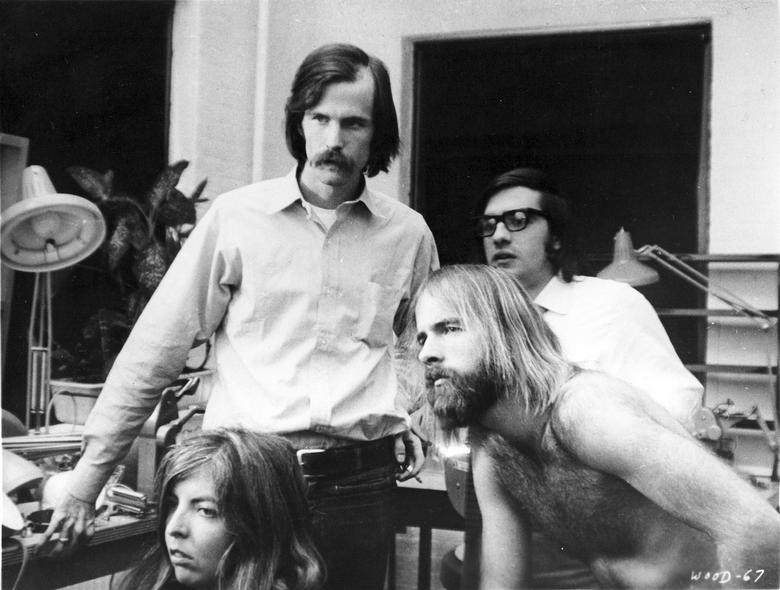
Under Wadleigh's supervision, the editing team led by Martin Scorsese and his editor Thelma Schoonmaker (with an uncredited assist from Walter Murch and a squadron of other editors) began to shape a story out of the chaos, that, in its long-form, captures a moment in a declared state of emergency where the music was really good, and the crowd was appreciative and "made do."
 
Two people died at Woodstock. Two were born. Statistically, that makes for a zero population growth, one of the many societal concerns at the time. There was also a war going on, which was ridiculed and mocked by the performers on-stage, but when the U.S. Army started supplying helicopters to transfer sick, injured and overdosed to nearby hospitals, their efforts were lauded from the stage ("Somebody may have noticed or all of you may have noticed, our familiar colored helicopter over there. The United States Army has lent us some medical teams and giving us a hand. They're with us, man! They are not against us! They're with us and they're here to give us all a hand and help us."). Survival was the order of the day. Survival with some of the best musical acts extant.
"Lotta freaks!"

Here's who appears in the film:
Richie Havens—an intense set of "Handsome Johnny" and "Freedom"/"Sometimes I Feel Like a Motherless Child." Havens was the first artist to perform, even though he was scheduled to be fifth. But, the opening act was Sweetwater, was stuck in traffic—so was Havens' bass player, for that matter—and Havens reluctantly took the stage, telling promoter Michael Lang that he would owe him big-time if the crowd threw bottles at him. He needn't have worried. Havens' set went on for nearly an hour, including three encores—the third, an entirely impromptu song he made up on the spot, "Freedom." Havens would joke that he had to go see the movie to write down what it was he actually sang!
Canned Heat—the Director's Cut contains one song—"A Change is gonna Come" from their one hour set, although their hit "Goin' Up the Country" is played over the opening credits.
Joan Baez—although six months pregnant at the time of the concert, and with her husband in prison, Baez performs "Joe Hill" and "Swing Low Sweet Chariot" in the film.
The Who—in what may be the longest sequence in the film, play "We're Not Going to Take it" and "See Me, Feel Me" from the concept album/opera "Tommy" and "Summertime Blues."
Sha-Na-Na—the classic oldies rock group play "At the Hop."
Joe Cocker—in one of the more classic sequences from the film, Cocker belts his hit waltz-time man-possessed soul cover of the Beatles' "With a Little Help From My Friends."
Country Joe and the Fish—the first film sequence featuring the band is their song "Rock and Soul Music." 
Arlo Guthrie—Guthrie looked out at the huge crowd, noted the numbers and commented "Lotta freaks!" then launches into "Coming into Los Angeles"
Crosby, Stills, and Nash—new member Neil Young played in their electric portion, but when the harmonizing trio went acoustic he bowed out. The film features a performance of "Suite: Judy Blue Eyes" followed by a comment from Stills:
This is the second time we've ever played in front of people, man, we're scared shitless.
Ten Years After—Alvin Lee's blues band plays an intense version of "I'm Going Home" and the film has a three-screen presentation set mostly on Lee's face.
Jefferson Airplane—in the initial cut, the band's relegated to one song "Saturday Afternoon", but the Director's Cut includes two more, "Won't You Try" and "Uncle Sam's Blues."
John Sebastian—the front-man for The Lovin' Spoonful wasn't even scheduled, but was in the audience and coached onto the stage to fill time for the next act to arrive. He sings "Younger Generation."
Country Joe and the Fish return for "The FISH cheer" and the acerbically cheeky "Feel-Like-I'm-Fixin'-To-Die-Rag"
Santana—Carlos Santa's jazz-rock band performs a furious version of "Soul Sacrifice" and while the film does give Santana his solo shots, the emphasis is on the band's incredible rhythm section.
Sly and the Family Stone—the eclectic generator of hits puts on a great show, encouraging the huge crowd to sing-along to "I Want to Take you Higher" after finishing off a thumping version of "Dance to the Music."
Janis Joplin—"Pearl" does an ecstatic version of "Work Me, Lord" (which was—stunningly—left off the original cut, but re-instated to the Director's Cut). Joplin did her show at 2 in the morning, but she doesn't betray any tiredness in a rangy voice that never wavers from her dancing performance, accompanied by the Kozmic Blues Band.
Jimi Hendrix—the final act, done on the last day, where half of the audience had already left, anticipating the grueling exit from Yasgur's farm through the small town of Bethel. The 1970 version leaves out his performance of "Voodoo Child" and starts with Hendrix's iconic stunning electric version of "The Star-Spangled Banner" and finishes with a stormy haunting performance of "Purple Haze" to bring the curtain down...if there was a curtain.
(Jeez, I'm exhausted!)
 
Quite the presentation. But, still, even the four hour edit leaves out such bands as "The" Band, Creedence Clearwater Revival, The Grateful Dead, Blood, Sweat and Tears, Ravi Shankar, Tim Hardin, Melanie, Johnny Winter, and The Paul Butterfield Blues Band. One should be grateful for what one has, and agreements had been made with some of the performers for various reasons (B,S,&T, for example, didn't like how their performance sounded). But, it's a great highlights reel, condensation, and representation, and maybe a palimpsest for another cut somewhere down the long road.


But, Woodstock did its job. The film saved the promoters of the festival from financial ruin after giving up trying to sell tickets to a crowd that just showed up.
 
In 1996, Woodstock—which won the Best Documentary Oscar in 1971—was inducted into the National Film Registry by the Library of Congress for being "culturally, historically, or aesthetically significant." All the films put in the Registry fill that bill, in one way, or another, but, with Woodstock, it feels like an understatement.

Woodstock, the festival and film, are equally and separately, something of a miracle.
The crowd: too big to fit the frame
The cutters: trying to get it down to size.
Schoonmaker, Murch, Wadleigh and Scorsese

 * The Director's Cut, released in 1994, runs 224 minutes and that's the version I watched.

Sunday, July 30, 2023

Don't Make a Scene: The King of Comedy

The Story:  Although, he was never given much of a chance to do it, the mercurial comedian Jerry Lewis could be very good—very good—at drama. Like here, in this scene from The King of Comedy (directed by Martin Scorsese), where Rupert Pupkin has lunch with his idol/mentor Jerry Langdon (a thinly-veiled version of Johnny Carson—they even share the same producer, Freddy DeCordova).

Well, they're not exactly having "lunch-lunch." The King of Comedy is a story about fame, and the insane greed for it. Rupert wants it. He doesn't have the talent to have it, but, in his mind (where a good deal of The King of Comedy takes place) he does. He deserves it. He just doesn't have "the contacts" to get his foot in the door. He's going to need very big clown-shoe sized loafers to be able to squeeze through to get his "Big Break." Really big, because Rupert has to get his "Big and Tall Shop" ego through, as well.

That ego has a lot of room in it, an Imax theater dimensioned amphitheater where Rupert plays out his famous fantasies (that is, fantasies about being famous), although the actual location is the basement of his mother's brownstone.

In this film, Scorsese plays a disorienting guessing game. Frequently, he'll cut from one scene to another, as simple as changing locations. But, often, they'll go from Rupert's day-to-day existence to a fantasy (without so much of a clue-in as a fade or the horried bell-tree gliss). Suddenly, you're there...and reality is different, things are not as you know them and you wonder if you're missing something (or, if seeing it in a theater, the projectionist has the reels flipped).  You're not missing anything; Scorsese is not doing a documentary here, but, instead, showing the inner workings of Rupert's mind. There IS no difference between reality and fantasy* there—it's all one big muddled jumble. But, it's a focused jumble.

The King of Comedy has some of Lewis' best, most subtle, acting in a career of taking things to the edge and beyond. This will do.

The Set-Up: Rupert Pupkin (Robert De Niro), messenger-boy and aspiring comedian, is trying to set up a meeting with talk-host Jerry Langdon (Jerry Lewis) to audition for his show. He has to get noticed for the great talent that he thinks he is, and Jerry is the key. While he works at creating the life he deserves, he fantasizes about what that life will be like, even its pressures and frustrations.

Action! LANGFORD Hey, Rupe, before I forget...I really appreciate you meeting me for lunch. I know how busy you are and how tired you are.
PUPKIN What are friends for, Jerry?
PUPKIN Talking about schedule, you're the one who looks tired.
LANGFORD Yeah, I know.
LANGFORD It's the show.
LANGFORD The pressure, the ratings.
LANGFORD The same guests, the same questions. I'm just not enjoying it anymore.
PUPKIN That's... the worst.
LANGFORD Listen, I... I really wish you would think about it again.

Eddie arrives. He is a small, slightly-bald man with greying hair and a goatee. He wears a foulard under an open-necked shirt. He carries a long sketch pad. He immediately sets up a small easel and starts sketching.
PUPKIN  Again...Wait a minute. You-you're starting again. You're starting up again.
LANGFORD It's not that big a deal to think. I'm asking you to think.
PUPKIN I'm thinking. That's all I do is think day and night about it.
PUPKIN How can I not think about it? I mean, I've been sitting here at lunch with you... which I knew is why you invited me from the first place...
PUPKIN ...and all I'm sitting and eating here to get guilty with you, right?
LANGFORD I'm asking you to take over the show for six weeks. What's six weeks?
PUPKIN I'll give you anything, but don't ask me to do six weeks. I can't take over the show for six weeks. I can't even take over my own life for six weeks. And you're asking me to do something that's impossible!
MRS.PUPKIN** Rupert!
PUPKIN It's impossible!
MRS.PUPKIN Rupert!
PUPKIN Don't you understand...
PUPKIN What?!
MRS.PUPKIN What are you doing down there so late?
PUPKIN It's impossible! I'm trying to tell you that.  What do want?  You want the tears to come out of my eyes?.
LANGFORD There's gotta be...there's gotta be a way to work it out. It's just six weeks.
A YOUNG GIRL stands before PUPKIN and LANGFORD. She hands PUPKIN her autograph book.
GIRL Excuse me. Um, Mr. Pupkin? You think you could...
PUPKIN Yeah, sure. What's your name, dear?
GIRL Dolores.
PUPKIN - Dolores? That was my father's name.
PUPKIN (writing) To Dolores, who sensed greatness. Rupert Pupkin.
PUPKIN There ya go, sweetheart.
GIRL (reading it) Thanks, Mr. Pupkin.
PUPKIN Don't mention it.
The GIRL leaves.
MRS.PUPKIN  Rupert! Rupert, who you talking to?
PUPKIN Mo-o-o-m!
MRS.PUPKIN What is it?
PUPKIN Pleeeeease stop calling me!
PUPKIN It's terrific. It's great.
PUPKIN There's only one problem, though. He made-he made you bigger.
LANGFORD Would you answer me?
PUPKIN All right! You've got the six weeks! Don't bother me! I'll give you the six weeks! What can I say? You happy now?
LANGFORD You're a tough man, Rupe.
PUPKIN You got to be in this business. (laughs)
LANGFORD Ha ha ha ha ha!
PUPKIN Ha ha ha ha ha!
Back in his mother's basement, Rupert laughs, then takes Jerry's place and laughs. The laughter builds.

The King of Comedy

Words by Paul D. Zimmerman

Pictures by Fred Schuler and Martin Scorsese

The King of Comedy is available on DVD and Blu-Ray from Warner Home Video.

* Scorsese and writer Paul Schrader show you the inner thoughts of Travis' Bickle in Taxi Driver (or rather let you hear them), but there are no fantasy sequences—Travis doesn't have that rich an imagination...at best, he can only interpret (through slow-motion and color-grading).

** By the way, the unseen Mrs. Pupkin? She's played by Scorsese's mother.