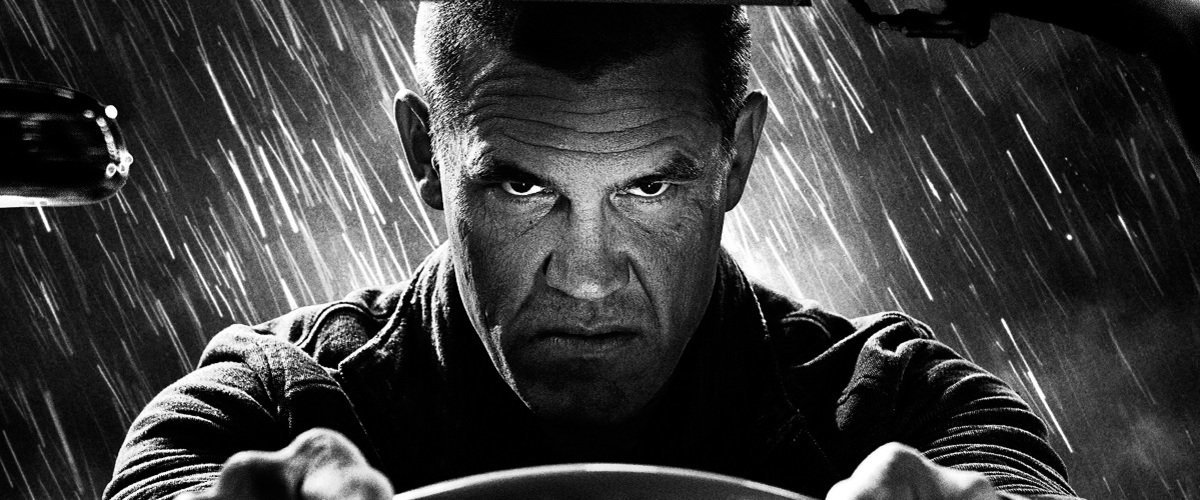
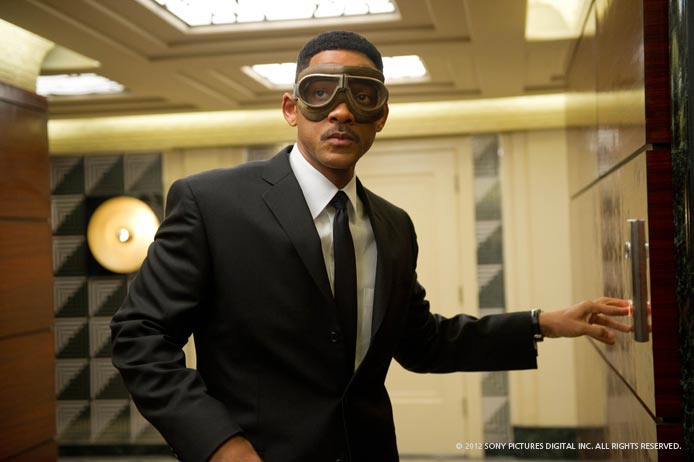
Showing posts with label Josh Brolin. Show all posts

Tuesday, July 22, 2025

Men in Black III

Sunday was International Moon Day (yes, that's a "thing") commemorating the date that human beings first put boot-treads on the Moon. That historic mission figured fictionally in this movie.

Written at the time of the film's release. 

Time Wounds All Heels
or
"Don't Ask Questions You Don't Want to Know the Answer To..."

The third "Men in Black" film had to go somewhere else but up. The first two films were variations on the "illegal alien" theme about a government organization that monitored the activities of extraterrestrials in the world and specifically New York City, and revolved around alien invasions and the containment of said aliens. And when you've seen one alien invasion directed by Barry Sonenfeld, you've seen them all, and hyper-kinetically at that. And once it's been established that "aliens can be anywhere" the joke runs a bit dry pretty quickly, especially when the sub-species can contain pug-dogs and large cockroaches. The second film tried to expand on those concepts and felt a bit thin in the process, concentrating a bit too much on the secondary characters rather than the basic plot and the character interactions.

So, where does Men in Black III go from there?
One of the nice aspects of the series has been its ability to still think outside the box, while expanding the horizons of just what that box might contain, be it variations of scale and dimension, even if only in afterthought. With the infinite reaches of space seemingly exhausted, the group (based, supposedly on an idea by Will Smith) has the series going back in time. Naturally. It ostensibly revolves around an Earth-takeover plot by another alien (one must ask at some point "why always us?"), "Boris the Animal" (who seems based on the DC Comics "Hell's Angel in Space" Lobo and is played with growly gutteral responses by Jemaine Clement from "Flight of the Conchords") who escapes from his maximum (and we mean maximum) security prison to find the man who sent him there 40 years ago—Agent K (Tommy Lee Jones). When he's unable to kill him here, the Boglodite finds another means to do so, and Agent J (Smith) wakes up the next morning, the only one with any memories of K past July, 1969. Agent K has been killed by Boris in the past, and J must journey back to try and save him.*
Once back there, J negotiates his way through a 1960's era way of doing things. Everything's a little less high-tech (a little less), but the MIB Agency is still there, as is the much younger Agent K (Josh Brolin, doing a bang-on interpretation of Jones) and J must solve the puzzle of saving the Earth (of course), while keeping K safe. The past sequences are great—Men in Black has exploited the "fish-out-of-water" angle perpetually—and new corners are being thrown out the whole time (My favorite being a brief glimpse of a "Barbarella"-type being escorted around MIB, and although Smith is a bit too "Red Bull" throughout the entire movie, check out his understated reaction to some Black Panthers). 
Great cast, too. Rip Torn is gone, but David Rasche plays him in the past, Emma Thompson is on hand as the new MIB head, Will Arnett makes a brief appearance as does Bill Hader. Toss in the chameleon-like Michael Stuhlbarg as an alien able to read multiple time-lines and there's always someone to deflect the eye, or hand things off from Smith.
But, the best thing about this "Men-in-Black" installment is resonance. The other two were fine, the first better than the second just for its novelty, but had a shelf-life of three minutes. Part of it is Sonenfeld's way of comically undercutting any meaning to the thing, by changing perspective—"you think you got a handle on it yet? Well, let me throw THIS at you!" The whole "the Universe is so big and cosmic that there's no way you can understand it because there's so many mysteries, so nothing is real" concept, which is the backbone of the series (and the source for most of its humor) leaves one with a feeling of "meh"—nothing matters in a vast uncaring, unfathomable Universe. 
Not here. The cold of Space has nothing to do with the leavening of Time, and, in this case, the franchise plays it straight, without a wink, a nod, a reveal, or a goo-spraying splat. For once, something really means something in the "Men in Black" Universe, and that venturing into uncharted territory makes the third time the charm.

  * I'm not saying anything here that isn't revealed in the trailer.

Saturday, March 30, 2024

Frank Miller's Sin City: A Dame To Kill For

It's "Just Another Saturday Night" and Saturday's are usually "Take Out the Trash" Day...
 
Frank Miller's Sin City: A Dame To Kill For (Robert Rodriguez, Frank Miller, 2014) Frank Miller became the darling of comic-book fans by bringing a mature, gritty, often brutal, sometimes mystical approach to iconic comic-book heroes—specifically Marvel's Daredevil and DC's Batman—when he got the chance to write them and mark them with a stamp of more than just india ink. He could be radically forthright in his interpretations, and for young men—and women—enamored of four-color literature (people who read comic books and take them seriously), he became one of the top-tier of comic-creators.

But, writing for "Daredevil" and "Batman", owned by corporate interests who were also interested in the longevity of the character and its marketability for selling T-shirts and toys—sorry, action figures—there was only so much creative lee-way he was allowed. Creating his own works—like the Samurai series "Ronin" or his spartan graphic novel about the Spartans, "300," let his talents bloom full-flower. His "Sin City" series let him tackle the noirish aspects of pulp novels, filled with roughneck men and soft women who were hard as nails, while employing a radical design sense of dark pages (rather than the usual white) blasted by white highlights of louvered light with just a dash of color. Miller allowed his drawing to become blocky and stark, emphasizing the filmic frame, rather than graphic details. And he bleached the traditional four colors of comics—just as the industry was benefiting from more sophisticated color printing—to a monochromatic night-scape (something artist Jim Steranko had used to great effect in his graphic novel "Chandler: Red Tide").

Miller's influence could be seen when the Batman character returned to the screen under Tim Burton's direction (but, more especially when Zack Snyder was allowed to tinker with the character later), and he was approached to do script-work, turning out the screenplays for Robocop 2 and Robocop 3. His graphic novels started to make their way to film and he was approached by Robert Rodriguez to script a film version of his "Sin City" series, to which he was added as co-director as the resulting film took so many cues from the original work—Rodriguez was even using the graphic novels as story-boards.
That movie, Sin City, was a success, making a lot of money and revived the careers of a lot of people, including Mickey Rourke, who was encased in so much prosthetics to play the character of "Marv", but it didn't distract from his acting (he even did press interviews in the make-up which was...weird). Sin City looked different. It felt different. Plus, there was the eerie feeling that you were watching a comic-book literally come to life—the same impression evoked by Zack Snyder's adaptation of Miller's 300—that the film was merely filling in the missing parts of the "money shots" displayed in the comics. But, it wasn't a movie you could take seriously—you needed a jaded humor to appreciate that it was over-the-top satire and not really reflective of the noir genre Miller wanted to ape. The dialogue was bad, clipped less from the gritted-teeth jargon of B-movie writing and more like Spillane spillage. What movie was it that said "the cheaper the hood, the gaudier the patter?"*  
Sin City (both the books and film) should be so lucky. It's a distillation of Hemingway minimalism and thug-mumbling, with punch-lines of nihilism that are supposed to be funny, but ultimately are just for an audience so low on Gustav Hasford's "phony tough and crazy brave" index that they think it's sophisticated. A.O. Scott had it right when he said that Sin City "offers sensation without feeling, death without grief, sin without guilt, and, ultimately, novelty without surprise." That's what they would call in these things "a head shot"—couldn't've been put better.

The financial success of the first Sin City led to a sequel of sorts—released nine years after the first one—featuring two original Miller tales as well as adapting his short story "Just Another Saturday Night", as well as the tale the film is titled for, "A Dame To Kill For".
The first film was a true anthology, with one of the stories being split up for a final resolution at the end. A Dame To Kill For jumps around, allowing time to pass for the healing of wounds and grudges to fester. The film also brings back characters from the first film—forget the fact that they might have died!—to continue stories or serve as prequels to the previous film.
The first story is one of Miller's shorter stories (from "Dark Horse Comics Presents") called
"Just Another Saturday Night" in which his character "Marv" (
Mickey Rourke) wakes up from an auto accident on the edge of town with no idea how he got there. This has to be an early tale—a prequel, if you will—because if you've seen the first Sin City movie, Marv was executed in it...by the electric chair.
The second story,
"A Long Bad Night" stars 
Joseph Gordon-Levitt as Johnny, a cocky gambler who comes into town for a big score with under-pinned reasons. He goes to what seems to be the only bar in town—Kadie's Place, where all the Sin City regulars hang out, like Marv, and where Nancy Callahan (Jessica Alba) dances. But, like everything in Sin City, it has a hidden side (given everybody's instincts one would think nothing would be hidden in that burg).
Senator Roark (Powers Boothe) arrives at Kadie's for the poker game in the back room—just missing being plugged by a vengeful-but-chicken Nancy for the death of her guardian angel, Hartigan (Bruce Willis—his character died in the last movie, but this is based on a comic book and nobody really dies in comics, even ones written by Frank Miller). Johnny, who's had a string of wins on the slots, uses one of the waitresses, Marcie (Julia Garner) to buy in on the game. 
 
He cleans out the Senator—who, of course, has a reputation and everybody named Roark in Sin City is not only a psychopath but a corrupt psychopath. With Roark seething, Johnny is advised by the police lieutenant in the game to blow Sin City and pronto, but, as nobody in town seems to have any sense whatsoever, Johnny takes Marcie and they decide to have a night on the town. It should be noted that, as this is an original Miller story for the movie, Rodriguez isn't depending on Miller's comics for story-boarding and shot-lists, but delves into something Miller doesn't do in his graphic work, which is to resort to surrealism.** It causes a bit of a disconnect when it happens, like suddenly a musical sequence pops into a kitchen-sink drama. Yes, it's a transition device, but it's something that Miller never resorted to, short of impossible acrobatics and virtiginous angles.
As soon as you can say the words "predictably obvious" Johnny is attacked in town by Roark's goons, which he manages to dispatch and tells Marcie he'll hook up with her later at a hotel. But, before he can high-tail it to safety, he's manhandled into Roark's limousine where his winnings are stolen, his fingers broken and he's left in the street with an added bullet in his leg and Roark telling him he's his bastard-son ringing in his ears. Johnny swears revenge because that's the chief economic product in Sin City. Fade to monochromatic black.
Cut to "A Dame To Kill For" featuring 
Josh Brolin as Dwight McCarthy (played by Clive Owen in the "The Big Fat Kill" in the first Sin City movie and Dame is a prequel to that story). Dwight is sober now, a private detective, and after a late-night rescue of a hooker (Juno Temple) from her corporate lover (Ray Liotta), he is contacted by an old flame Ava Lord (Eva Green) asking to meet him at Kadie's Place (natch!) to tell him that the fat-cat (quite literally) she left him for years a go is a violent abuser and that she now fears for her life. Dwight is non-committal, but he's an addict (isn't he?), so he can't help but go back to the Lord compound to see what he can do about her situation. What he spies doesn't tell him anything about abuse—Ava is swimming nude, obviously not showing any bruises and contusions—but, investigating further, he's beat up and tossed off the Lord property.


He goes home only to find a naked Ava in his bed. And, as Sin City people, apparently can't feel pain, he succumbs and the two frantically make love, despite his not trusting her and being beat up within an inch of his life. 
 
Another thing: With "A Dame To Kill For" Miller began experimenting with how much nudity he could get away with in his comics, usually with his by-now draping shadows, which, when Rodriguez replicates it for the screen, merely comes off as slightly ridiculous, along the lines of an Austin Powers "hide-the-wiener" sequence. Things are exposed, alright, but exposed as juvenile and puerile.
Yeah, yeah...I kvetch about the nudity, but I put these up...(for illustrative purposes, of course!)
And I might get a couple of extra puerile "clicks" for it.
Any after-glow he might have is interrupted by the Lord chauffeur-bodyguard Manute (Dennis Haysbert, replacing Michael Clarke Duncan, who had died in the 7-year lag between producing Sin City and Sin City: A Dame To Kill For) who beats Dwight up and tosses him out the window. So, Dwight has been beaten up twice over this woman—anybody detecting a flat learning curve?
Dwight's determined to save Ava, so he teams up with Marv (hey, it's a small town...) to strike the Lord compound and get her out, and although a fair amount of wet-work is done, the results are not optimum—Dwight ends up falling out another window after a few bullets to the body—and one to the face. Marv scoops up what's left and takes him back the detectives Old Town haunts, where he is tended to by a gang of assassin-hookers led by another old flame (Rosario Dawson) and the very dangerous ninja-assassin Miho (Jamie Chung), who heel his wounds and do some reconstructive surgery, presumably to help him look more like Clive Owen. The instruments probably won't need to be sharp as Dwight isn't that sharp himself, planning on making one more excursion to Lord Manor after his recuperation. The girls evidently don't do brain transplants...or extensive therapy.
 Here's another "film noir quote" for you: "So many guns. So few brains."***
Okay, enough about "A Dame To Kill For". Once enough people are pushing black-and-white daisies in that one, Rodriguez and Miller pick up the "Long, Bad Night" story...
Johnny, probably reading a Yelp! review of the reconstructive surgery-hookers, goes to see another saw-bones (Christopher Lloyd), a heroin addict, who resets Johnny's fingers (not sure why, as he presumably can look at his cards one-handed—it's not like he's a pool-hustler or anything) and sets out to get his revenge on his legitimately illegitimate Dad, the Senator. Absolutely busted, Johnny borrows a single dollar from a waitress (Lady Gaga...LADY GA-GA!?) and repeats the strategy that got him into the poker game at Kadie's...and cleans the Senator out...again. So...dear old Daddy shoots him in the head. End of story. We waited through the peek-a-boo idiocy of "A Dame To Kill For" to get this?
Yeah. But, it ain't over. There's still "Nancy's Last Dance"—remember the stripper at Kadie's...Jessica Alba/Bruce Willis...didn't shoot the Senator? Sounds like there's a revenge story going wasting. Can't have that.
Nancy decides to go after the Senator after spiraling into depression and drink and giving herself a bad hair-cut, all the time being watched over by the ghost of Hartigan...

Wait. Wait, wait, wait, wait, wait. Isn't "Sin City"—the concept—derived from the hard-scrabble reality of B-movies and pulp-books? Aren't they supposed to be rooted in the American Promise Unfulfilled, where the well-intentioned are driven to desperation due to the economic inequities that reward the retention of wealth by any means necessary, while the principled person "doing the right thing" can't even catch a break? Isn't the basis of these things the "Reality-Is-A-Bitch" principle (if you can call it that)?

And we got a ghost? What the Hell?
I'll go out on the shakiest limb—Stanley Kubrick once said that his version of "The Shining" couldn't be depressing because it implied the existence of an after-life. Right? It doesn't all end with death. We go on. There is no such thing as extinction. Even a BAD after-life is better than no after-life at all. You get a do-over. Another chance. You don't get "second chances" in film-noir unless "the other guy" is a sucker. And you don't wake up from "The Big Sleep" that's what makes it so bad. Death eliminates Hope...and the near-occasion of fooling yourself.

And yet, here's Frank Miller going all-Shirley Jackson on us. What a bunch a' hooey.
Or...maybe they just wanted Willis back, however implausibly, to boost audience recognition and as a box office draw. Talk about "hope". Didn't work, though; Sin City: A Dame to Kill For was an aesthetic failure, a critical failure, and a box office failure, the full negative-Hat Trick.
There's only so many times you can go to the well, when it's basically a dry hole. It's a parody. It's like telling the same joke twice in a row. Don't expect the same results both times. Resurrect all the characters you want; all you're showing is that you've run out of ideas.
One thing you can say, for sure, about Sin City: They've got a hell of a recycling center.

* Dashiell Hammett wrote it for "The Maltese Falcon." I've read everything Hammett ever wrote. He knew he was writing trash, but, by god, he made sure it was the BEST trash, and elevated the genre.

** Although he would when he was directing his film of The Spirit.
 
*** Yeah, that's Raymond Chandler from "The Big Sleep"

Friday, March 1, 2024

Dune: Part 2

Lead Them to Paradise
or
You Can't Have a Messiah Without a Mess at the Beginning.
 
"God created Arrakis to train the faithful"
from "The Wisdom of Muad'Dib" by the Princess Irulan

When last we left Paul Atreides (Timothée Chalamet), he and his Mother Jessica (Rebecca Ferguson) were the last survivors of an attack on their new home on Arrakis by the House Harkonnen, in order to win back the all-important spice-mining business, around which the very Universe itself depends. 

The first film ended with Paul's pivotal killing of the Fremen Jamis—his first real doubter of the Arrakis indigenous tribe—in order to become part of their number and learn their ways, and Dune: Part 2 begins almost immediately after that act.

It is clear—even without a viewing of his continuation—that writer-director Denis Villeneuve dearly loves Frank Herbert's story, and, as a result, it's more faithful than the previous versions (the story is so dense, with plots, sub-plots, and arcana that is was dubbed "unfilmable"), certainly in regards to the ways of Arrakis' inhabitants, the Fremen and their relationships with water and the predatory sand-worms—the "Shai-Hulud"—while also delving a bit more into the ways of the manipulative Bene Gesserit sisterhood, of which Jessica is a part.*
So, along with the blistering action sequences, the vast desert vistas, and the Leni Riefenstahl-styled troop formations, we get a bit more of the sociology of the Fremen, their belief systems, their legends...and that, though they may be monolithic, they are not as homogeneous in their ways as in prior depictions. These Fremen actually have personalities, as opposed to the stoic stalwarts they've been portrayed as before. 
That's good. And it gives them a chance to shine (seeing as how they dominate this second act), and provide rich characters for 
Javier Bardem and Zendaya to play around with, rather than as merely devoted followers to be led. Bardem's Stilgar is shown to be a bit of a romantic zealot, but with enough years to still be suspicious of the legends coming true, while Zendaya's Chani distrusts the prophecies, knowing full well that giving in to a messianic leader is just another form of slavery.
Those are good concepts, part of a couple of the dualities that Dune: Part 2 leans in on—dualities which Herbert chose not to spell out, but merely allowed to percolate as sub-text. And it shows that Villeneuve is confident enough in his work that he complicates it even more than the original author did.
So, there was quite a death-toll among the A-listers in the first Dune, so, right off the studio logos, we start being introduced to the new cast-members, starting with 
Florence Pugh as Princess Irulan, daughter of the Emperor Shaddam IV (Christopher Walken, and it's nice that composer Han Zimmer didn't give him any background music with cow-bells), as the Princess notices the Emperor's ruminating silence over the death of Duke Leto Atreides in the previous film; she is the chronicler of the tale, and it's a good thing because there's quite a lot of catching up to do.
We also get to meet Feyd-Rautha (Austin Butler, proving he's not a one-trick-pony depending on his looks) the Baron Harkonnen's younger, more psychotic son, who is Paul's final test, and, as well, a character no one's bothered with before, Lady Margot Fenring (Léa Seydoux) who's deep in the depth's of the Bene Gesserit conspiracy.
"I'd wish you the (best of luck), but it seems you've won your battle."
Then, there's one character, who's always problematic—Paul's sister Alia (yeah, I'm not going to tell you), the last child of Duke Leto Atreides. Villeneuve eliminates the two year gap that Herbert inserted into the book, so we don't get to see a walking talking two year old, instead we see the child in Jessica's womb, talking to both mother and brother through her thoughts. Okay, weird, but not as weird as it could have been.
A lot of set up here, much like you could say Dune was merely the set-up for Part 2 (which is accurate, but there was so much of worth in the first one that it wouldn't be a fair assessment). It is nearly three hours of non-stop posturing, gritty action and a soundtrack you can feel in your ribs, with all sides circling around each other for a big pay-off that is, justifiably, a little melancholic. Think of The Godfather meeting "Game of Thrones". It certainly does the book justice, and although "Dune" devotees may quibble with a couple of changes—no two year gap, so no Alia and no Guild and the changes to Chani (which I'll get to in a second)--one can't deny that this is as close to movie-form as we're going to get. It's amazing. It's fantastic. It's a must-see. Simple as that for being as complex as that.
And I want to see where they go with the next one ("Next one?" Yeah...author Herbert wrote a few books!). They've done a very logical, character-driven change to the character of Chani...to the betterment, I'd say, as I've always had an uneasiness about her character, previously. It will add a complication, and a personal element to the road ahead (if they follow Herbert's road-map) and if Villeneuve is willing to already muddy the...er.. sand and stir things a bit, I'm all for it.
It's one of those movies that I can recommend without hesitation, and those are few and far between. And I'd love to be able to eavesdrop some of the post-viewing discussions. 
 
For me, being a fan of the book (and a couple of the others), it's nice to be able to look at these two films back-to-back and say that we finally have a "Dune" adaptation, we don't have to make excuses for.
He was warrior and mystic, ogre and saint, the fox and the innocent, chivalrous, ruthless, less than a god, more than a man was. There is no measuring Muad'Dib's motives by ordinary standards. In the moment of his triumph, he saw the death prepared for him, yet he accepted the treachery. Can you say he did this out of a sense of justice? Whose justice, then? Remember, we speak now of the Muad'Dib who ordered battle drums made from his enemies' skins, the Muad'Dib who denied the conventions of his ducal past with a wave of the hand, saying merely: "I am the Kwisatz Haderach. That is reason enough."
--from "Arrakis Awakening" by the Princess Irulan
 
* In fact, the only thing Villeneuve ignores is the Spice Guild, particularly its Navigators, spice-mutated humans who have attained the power to "bend space" and thus travel between worlds, a necessary component in a story about commerce, and the resources needed to maintain them for power. 

Saturday, September 2, 2023

Gangster Squad

Saturday is traditionally "Take Out the Trash" Day.
 
Written at the time of the film's release...
 
Manifest Density
or
The War for the Soul of Los Angeles (such as it is)
 
Ruben Fleischer's third film (after the very good Zombieland and the excremental 30 Minutes or Less) is Gangster Squad, a Hollywoodized version of the efforts by the LAPD to take down the efforts of Mickey Cohen, the lieutenant of Bugsy Siegel's Jewish mafia, who took over Siegel's interests when the mob kingpin was murdered in 1947.

If one is looking for a history lesson, one should look elsewhere. This is a glamorized, fictionalized version of the events set in some art-deco post-war version of Los Angeles that doesn't seem to have existed anywhere except the Warner Brothers gangster films and Brian de Palma's The Untouchables, to which this film owes a great debt. The gangsters all wear dark clothes with long coats (the better to identify them) and are all greasy and ugly, while the police are all good-looking guys in nice suits who bend the rules a bit (with the possible exception of Chief Parker, played with a gruff somnambulance by Nick Nolte, who headed up the similar "Hat Squad" in Lee Tamahori's Mulholland Falls).*

It all feels very false, from how the gangsters rarely hit anything despite the thousands of rounds shot from tommy-guns, and the Gangster Squad "hit" ratio usually fares better. The Squad (hand-picked by the leader's wife, played by Mireille Anos, for being rough-necks and not promotion-headed top-of-their-classers) consists of boss John O'Mara (who did exist, but did not run the unit) as played by Josh Brolin, Jerry Wooters (played by Ryan Gosling), Max Kennard (Robert Patrick)—a sharpshooter, Conway Keeler (Giovanni Ribisi) a surveillance/electronics expert, as well as two PC members for the 21st century audience—Anthony Mackie (so good in The Adjustment Bureau) and Michael Peña. Their target is Mickey Cohen (Sean Penn in a make-up that makes him look like he walked out of Warren Beatty's Dick Tracy), who's reputation is movie-inflated to make him seem like he's an empire-building Al Capone, rather than the cheap hood with star connections he ultimately was.
Fleischer is more interested in flash than being true to the source. His fights are surprisingly well-staged, one shot per flying fist, but not Bourne-edited so one can easily follow it—an early fight in an elevator borrows heavily from a similar scene in a James Bond movie but actually goes places the 007 film merely used for suspense. Once in awhile, he'll go for a Matrix-y slo-sloo-slooo-mo effect (rather than a fleeting Peckinpah image) just to make a point of something, like cartridges flying out of a machine gun, or a Christmas ornament exploding due to gunfire, but it's just slowing things down as opposed to telling a story. Brolin's fine, nuanced even, but Gosling's McQueen-ish hipster act is wearing a little thin, and the chemistry exhibited between he and Emma Stone from Crazy, Stupid Love is completely missing here. Mackie, Peña, and Patrick are far more engaging probably because they don't fit the established mold.
It's entertaining, to a certain extent, but one gets the feeling, after patterns have been set that bring to mind other films, that one is being sold a bill of goods, and we are.
The real-life Cohen was convicted of tax evasion (not murder) in 1950, serving four years. Upon his release, he established several businesses (the ones portrayed in the film) and was again convicted of tax evasion in 1961 and released (again) in 1972. Cohen died in his sleep in 1976.
The real Mickey Cohen, photographed in 1950
The real "Gangster Squad"

* Amusingly, his driver is Officer Darryl Gates (played by Josh Pence) who would be Chief from 1978 to 1992.