Showing posts with label Bruce Willis. Show all posts

Thursday, August 1, 2024

What Just Happened

I'd say "written at the time of the film's release" but I mention the DVD commentary, so it must have been a year later or so.

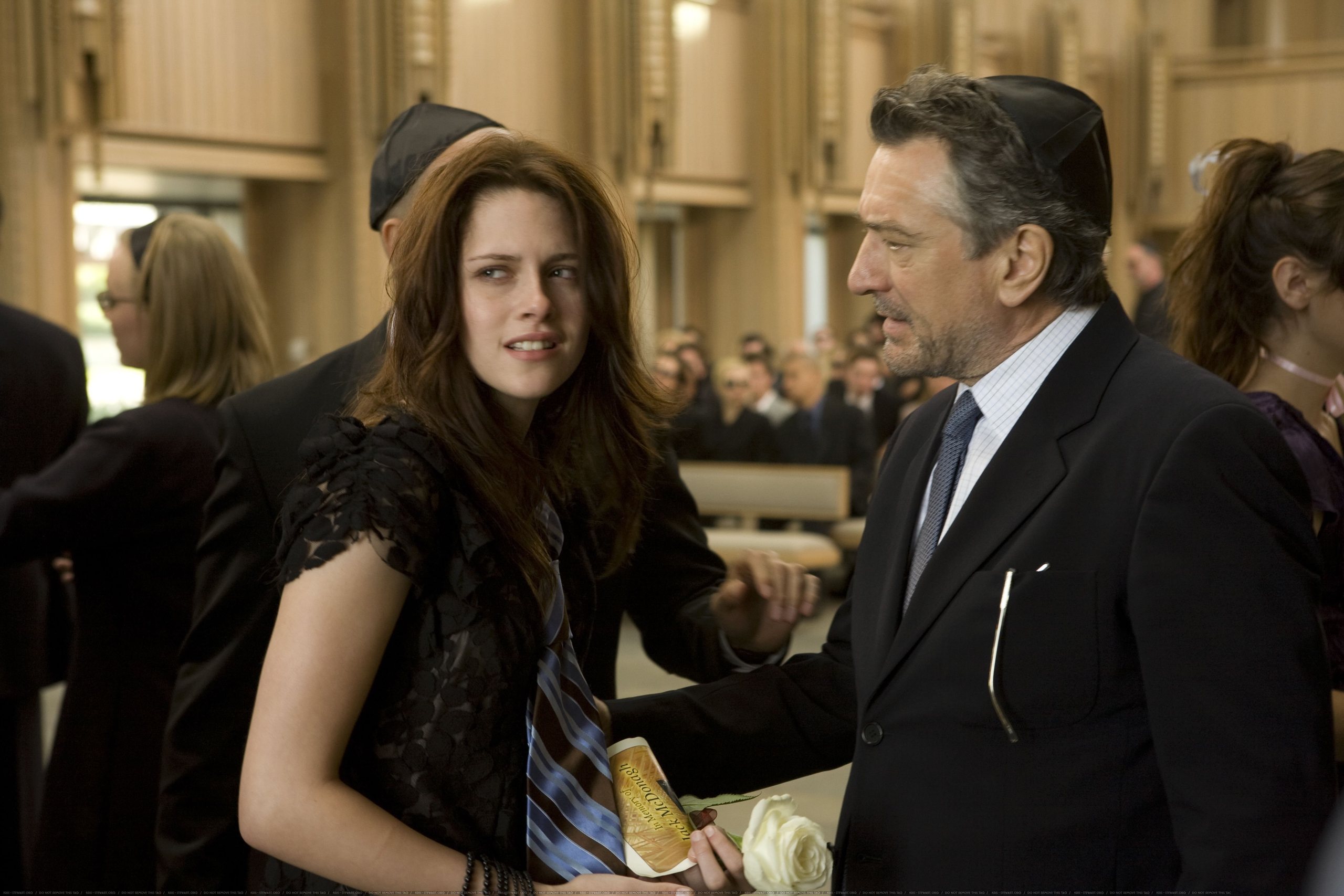
What Just Happened (Barry Levinson, 2008) Ben (Robert De Niro) is a producer in Hollywood and he has a tough life. His new movie starring Sean Penn just previewed and the audience reaction cards don't look good. The director, wanting to be "edgy," has a scene where the bad guys shoot Penn's dog, then kill Penn. Audiences are upset about the dog. The studio (run by Catherine Keener) is upset about the audiences and wants to re-cut the film, the director is upset about his "vision" being changed and refuses to cooperate. Ben wants the to keep the director happy, the studio happy, the audiences happy, the two ex-wives (including Robin Wright) and three ex-children (including Kristen Stewart) happy, while still worrying about where he's standing in a Vanity Fair "Power in Hollywood" photoshoot.

On top of that, he's got a big budget movie starting its shoot on Friday and the star (Bruce Willis playing Bruce Willis) is being payed $20 million to star in it, but there's one little hitch—he's grown "a Grizzly Adams" beard, and the studio is panicking—people want to see Bruce Willis when they see Bruce Willis and they want Ben to coax the temperamental star to shave it off, which he refuses to do for "artistic reasons."* Ben's life is an endless soliloquy of superficial arguments, hastily-composed rationalizations and insincere ego-stroking in the gamesmanship of Hollywood, played over a Blue-Tooth behind the wheel of a constantly in-motion Lexus. 
Based on producer
Art Linson's book (sub-titled "Bitter Hollywood Tales From the Front Line") and adapted by him for this film, it's a nice study of how removed from reality, logic and best practices the industry is. But, at the same time Barry Levinson's film of it, while duly making note of the sliding loyalties Ben displays, also seems to expect you to feel sorry for him. One would, if one didn't want to have this life. There is no tragedy here, merely minor inconveniences that whittle away at Ben's soul and career. But, he still has a roof over his head. He has a car (and the insurance for it), a cell-phone, a blue-tooth, a fancy-schmancy espresso machine, the ear of many Hollywood players, and the phone numbers of ambitious actresses. Boo to the Hoo. Yes, Hollywood's crazy...but it's not homeless and crazy.

That's why backstage dramas in tinsel-town are really only good when played for laughs, and should only be reserved when the writer-director-producer has completely run out of ideas (and when that happens, they should read a book, instead). You look at movies like
The Oscar, or The Big Knife, with the hand-wringing of the elite, and you can look right into the soul of industry people who have lost touch with their audiences**...like Norma Desmond screeching about her woes. It's why Sunset Blvd. is such a classic gem of a movie. Norma is crazy...and pathetic...and clueless.

Howard Hawks
had it right. After awhile, he was making movies about making movies—but, they were well-veiled allegories. Anytime Hawks had a group of disparate people coming together with a single goal in mind, he was talking about what he and his crew did for a living...only they were flying the mail, or capturing live rhinos, driving the cattle, getting the headline, or battling the monster at the research station...anything but making movies. That would be as much fun as watching sausages being made. If you want to complain about being in the entertainment industry, try pumping gas...then, have a drink or climb onto the shrink's couch. Don't get "meta" on the audience. They go to the movies to escape their troubles, not hear about yours.
But, like Fellini, pretty soon the writers start penning their autobiographies.  Linson might be thinking that he did a good job changing the names to protect the innocent, but listening to  his DVD audio commentary with director Levinson, one hears the vagueness, the "rote"-ness of his expressions, as if he's just passing through, and once the credits come up, he's already out the door (he's gone before the "A Barry Levinson Film" credit comes up). The two were in separated facilities recording their tracks, and as Linson gets up he says "Good seein' ya, Barry" "uh...talking to ya," says Levinson. "Oh.  Yeah...well..." says Linson. "We should get together when you come to New York."

Yes, we "really" should.

* True story, although I won't mention the movie or the star (it's easily found, actually).  But, it reminds me of the struggles Richard Donner had while making Superman, the Movie—making a man fly was easy compared to star-negotiations.  Donner had a meeting with Marlon Brando, where the actor was pitching character ideas that would keep him from having to appear on camera, like playing Superman's kryptonian father as a suitcase or "a green bagel," and Gene Hackman didn't want to shave his moustache to play Lex Luthor.  Donner finally said to Hackman on-set. "Look, Gene, you shave yours off and I'll shave mine off."  Hackman agreed, shaved and came back on-set.  "Okay, now it's your turn."  Donner then peeled off the fake moustache he'd been wearing, which delighted Hackman.

** (The same could be said for politicians—anybody in Washington looking at cutting the health-plans for those in the legislative branch...if not, why not?)

Saturday, March 30, 2024

Frank Miller's Sin City: A Dame To Kill For

It's "Just Another Saturday Night" and Saturday's are usually "Take Out the Trash" Day...
 
Frank Miller's Sin City: A Dame To Kill For (Robert Rodriguez, Frank Miller, 2014) Frank Miller became the darling of comic-book fans by bringing a mature, gritty, often brutal, sometimes mystical approach to iconic comic-book heroes—specifically Marvel's Daredevil and DC's Batman—when he got the chance to write them and mark them with a stamp of more than just india ink. He could be radically forthright in his interpretations, and for young men—and women—enamored of four-color literature (people who read comic books and take them seriously), he became one of the top-tier of comic-creators.

But, writing for "Daredevil" and "Batman", owned by corporate interests who were also interested in the longevity of the character and its marketability for selling T-shirts and toys—sorry, action figures—there was only so much creative lee-way he was allowed. Creating his own works—like the Samurai series "Ronin" or his spartan graphic novel about the Spartans, "300," let his talents bloom full-flower. His "Sin City" series let him tackle the noirish aspects of pulp novels, filled with roughneck men and soft women who were hard as nails, while employing a radical design sense of dark pages (rather than the usual white) blasted by white highlights of louvered light with just a dash of color. Miller allowed his drawing to become blocky and stark, emphasizing the filmic frame, rather than graphic details. And he bleached the traditional four colors of comics—just as the industry was benefiting from more sophisticated color printing—to a monochromatic night-scape (something artist Jim Steranko had used to great effect in his graphic novel "Chandler: Red Tide").

Miller's influence could be seen when the Batman character returned to the screen under Tim Burton's direction (but, more especially when Zack Snyder was allowed to tinker with the character later), and he was approached to do script-work, turning out the screenplays for Robocop 2 and Robocop 3. His graphic novels started to make their way to film and he was approached by Robert Rodriguez to script a film version of his "Sin City" series, to which he was added as co-director as the resulting film took so many cues from the original work—Rodriguez was even using the graphic novels as story-boards.
That movie, Sin City, was a success, making a lot of money and revived the careers of a lot of people, including Mickey Rourke, who was encased in so much prosthetics to play the character of "Marv", but it didn't distract from his acting (he even did press interviews in the make-up which was...weird). Sin City looked different. It felt different. Plus, there was the eerie feeling that you were watching a comic-book literally come to life—the same impression evoked by Zack Snyder's adaptation of Miller's 300—that the film was merely filling in the missing parts of the "money shots" displayed in the comics. But, it wasn't a movie you could take seriously—you needed a jaded humor to appreciate that it was over-the-top satire and not really reflective of the noir genre Miller wanted to ape. The dialogue was bad, clipped less from the gritted-teeth jargon of B-movie writing and more like Spillane spillage. What movie was it that said "the cheaper the hood, the gaudier the patter?"*  
Sin City (both the books and film) should be so lucky. It's a distillation of Hemingway minimalism and thug-mumbling, with punch-lines of nihilism that are supposed to be funny, but ultimately are just for an audience so low on Gustav Hasford's "phony tough and crazy brave" index that they think it's sophisticated. A.O. Scott had it right when he said that Sin City "offers sensation without feeling, death without grief, sin without guilt, and, ultimately, novelty without surprise." That's what they would call in these things "a head shot"—couldn't've been put better.

The financial success of the first Sin City led to a sequel of sorts—released nine years after the first one—featuring two original Miller tales as well as adapting his short story "Just Another Saturday Night", as well as the tale the film is titled for, "A Dame To Kill For".
The first film was a true anthology, with one of the stories being split up for a final resolution at the end. A Dame To Kill For jumps around, allowing time to pass for the healing of wounds and grudges to fester. The film also brings back characters from the first film—forget the fact that they might have died!—to continue stories or serve as prequels to the previous film.
The first story is one of Miller's shorter stories (from "Dark Horse Comics Presents") called
"Just Another Saturday Night" in which his character "Marv" (
Mickey Rourke) wakes up from an auto accident on the edge of town with no idea how he got there. This has to be an early tale—a prequel, if you will—because if you've seen the first Sin City movie, Marv was executed in it...by the electric chair.
The second story,
"A Long Bad Night" stars 
Joseph Gordon-Levitt as Johnny, a cocky gambler who comes into town for a big score with under-pinned reasons. He goes to what seems to be the only bar in town—Kadie's Place, where all the Sin City regulars hang out, like Marv, and where Nancy Callahan (Jessica Alba) dances. But, like everything in Sin City, it has a hidden side (given everybody's instincts one would think nothing would be hidden in that burg).
Senator Roark (Powers Boothe) arrives at Kadie's for the poker game in the back room—just missing being plugged by a vengeful-but-chicken Nancy for the death of her guardian angel, Hartigan (Bruce Willis—his character died in the last movie, but this is based on a comic book and nobody really dies in comics, even ones written by Frank Miller). Johnny, who's had a string of wins on the slots, uses one of the waitresses, Marcie (Julia Garner) to buy in on the game. 
 
He cleans out the Senator—who, of course, has a reputation and everybody named Roark in Sin City is not only a psychopath but a corrupt psychopath. With Roark seething, Johnny is advised by the police lieutenant in the game to blow Sin City and pronto, but, as nobody in town seems to have any sense whatsoever, Johnny takes Marcie and they decide to have a night on the town. It should be noted that, as this is an original Miller story for the movie, Rodriguez isn't depending on Miller's comics for story-boarding and shot-lists, but delves into something Miller doesn't do in his graphic work, which is to resort to surrealism.** It causes a bit of a disconnect when it happens, like suddenly a musical sequence pops into a kitchen-sink drama. Yes, it's a transition device, but it's something that Miller never resorted to, short of impossible acrobatics and virtiginous angles.
As soon as you can say the words "predictably obvious" Johnny is attacked in town by Roark's goons, which he manages to dispatch and tells Marcie he'll hook up with her later at a hotel. But, before he can high-tail it to safety, he's manhandled into Roark's limousine where his winnings are stolen, his fingers broken and he's left in the street with an added bullet in his leg and Roark telling him he's his bastard-son ringing in his ears. Johnny swears revenge because that's the chief economic product in Sin City. Fade to monochromatic black.
Cut to "A Dame To Kill For" featuring 
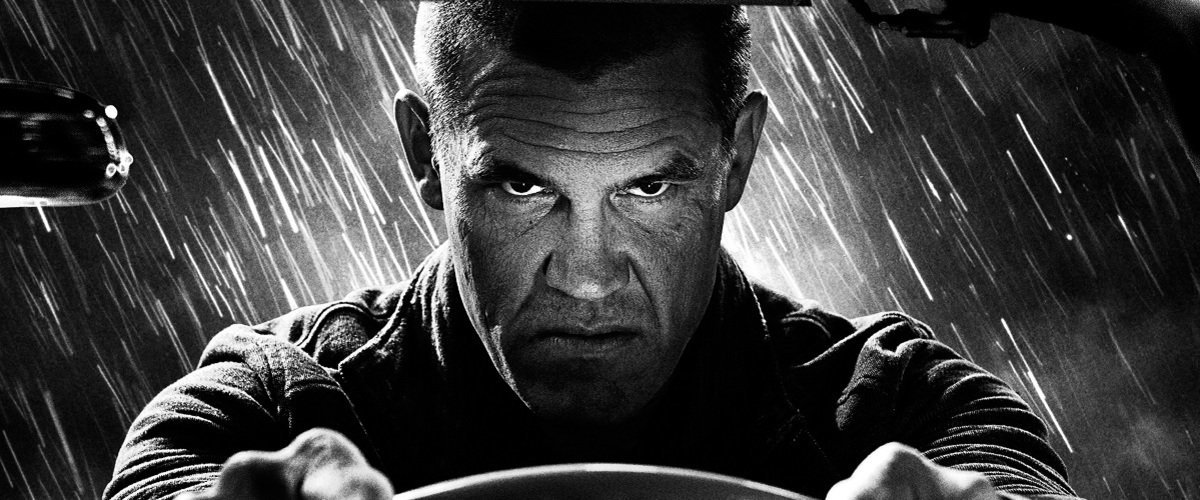
Josh Brolin as Dwight McCarthy (played by Clive Owen in the "The Big Fat Kill" in the first Sin City movie and Dame is a prequel to that story). Dwight is sober now, a private detective, and after a late-night rescue of a hooker (Juno Temple) from her corporate lover (Ray Liotta), he is contacted by an old flame Ava Lord (Eva Green) asking to meet him at Kadie's Place (natch!) to tell him that the fat-cat (quite literally) she left him for years a go is a violent abuser and that she now fears for her life. Dwight is non-committal, but he's an addict (isn't he?), so he can't help but go back to the Lord compound to see what he can do about her situation. What he spies doesn't tell him anything about abuse—Ava is swimming nude, obviously not showing any bruises and contusions—but, investigating further, he's beat up and tossed off the Lord property.


He goes home only to find a naked Ava in his bed. And, as Sin City people, apparently can't feel pain, he succumbs and the two frantically make love, despite his not trusting her and being beat up within an inch of his life. 
 
Another thing: With "A Dame To Kill For" Miller began experimenting with how much nudity he could get away with in his comics, usually with his by-now draping shadows, which, when Rodriguez replicates it for the screen, merely comes off as slightly ridiculous, along the lines of an Austin Powers "hide-the-wiener" sequence. Things are exposed, alright, but exposed as juvenile and puerile.
Yeah, yeah...I kvetch about the nudity, but I put these up...(for illustrative purposes, of course!)
And I might get a couple of extra puerile "clicks" for it.
Any after-glow he might have is interrupted by the Lord chauffeur-bodyguard Manute (Dennis Haysbert, replacing Michael Clarke Duncan, who had died in the 7-year lag between producing Sin City and Sin City: A Dame To Kill For) who beats Dwight up and tosses him out the window. So, Dwight has been beaten up twice over this woman—anybody detecting a flat learning curve?
Dwight's determined to save Ava, so he teams up with Marv (hey, it's a small town...) to strike the Lord compound and get her out, and although a fair amount of wet-work is done, the results are not optimum—Dwight ends up falling out another window after a few bullets to the body—and one to the face. Marv scoops up what's left and takes him back the detectives Old Town haunts, where he is tended to by a gang of assassin-hookers led by another old flame (Rosario Dawson) and the very dangerous ninja-assassin Miho (Jamie Chung), who heel his wounds and do some reconstructive surgery, presumably to help him look more like Clive Owen. The instruments probably won't need to be sharp as Dwight isn't that sharp himself, planning on making one more excursion to Lord Manor after his recuperation. The girls evidently don't do brain transplants...or extensive therapy.
 Here's another "film noir quote" for you: "So many guns. So few brains."***
Okay, enough about "A Dame To Kill For". Once enough people are pushing black-and-white daisies in that one, Rodriguez and Miller pick up the "Long, Bad Night" story...
Johnny, probably reading a Yelp! review of the reconstructive surgery-hookers, goes to see another saw-bones (Christopher Lloyd), a heroin addict, who resets Johnny's fingers (not sure why, as he presumably can look at his cards one-handed—it's not like he's a pool-hustler or anything) and sets out to get his revenge on his legitimately illegitimate Dad, the Senator. Absolutely busted, Johnny borrows a single dollar from a waitress (Lady Gaga...LADY GA-GA!?) and repeats the strategy that got him into the poker game at Kadie's...and cleans the Senator out...again. So...dear old Daddy shoots him in the head. End of story. We waited through the peek-a-boo idiocy of "A Dame To Kill For" to get this?
Yeah. But, it ain't over. There's still "Nancy's Last Dance"—remember the stripper at Kadie's...Jessica Alba/Bruce Willis...didn't shoot the Senator? Sounds like there's a revenge story going wasting. Can't have that.
Nancy decides to go after the Senator after spiraling into depression and drink and giving herself a bad hair-cut, all the time being watched over by the ghost of Hartigan...

Wait. Wait, wait, wait, wait, wait. Isn't "Sin City"—the concept—derived from the hard-scrabble reality of B-movies and pulp-books? Aren't they supposed to be rooted in the American Promise Unfulfilled, where the well-intentioned are driven to desperation due to the economic inequities that reward the retention of wealth by any means necessary, while the principled person "doing the right thing" can't even catch a break? Isn't the basis of these things the "Reality-Is-A-Bitch" principle (if you can call it that)?

And we got a ghost? What the Hell?
I'll go out on the shakiest limb—Stanley Kubrick once said that his version of "The Shining" couldn't be depressing because it implied the existence of an after-life. Right? It doesn't all end with death. We go on. There is no such thing as extinction. Even a BAD after-life is better than no after-life at all. You get a do-over. Another chance. You don't get "second chances" in film-noir unless "the other guy" is a sucker. And you don't wake up from "The Big Sleep" that's what makes it so bad. Death eliminates Hope...and the near-occasion of fooling yourself.

And yet, here's Frank Miller going all-Shirley Jackson on us. What a bunch a' hooey.
Or...maybe they just wanted Willis back, however implausibly, to boost audience recognition and as a box office draw. Talk about "hope". Didn't work, though; Sin City: A Dame to Kill For was an aesthetic failure, a critical failure, and a box office failure, the full negative-Hat Trick.
There's only so many times you can go to the well, when it's basically a dry hole. It's a parody. It's like telling the same joke twice in a row. Don't expect the same results both times. Resurrect all the characters you want; all you're showing is that you've run out of ideas.
One thing you can say, for sure, about Sin City: They've got a hell of a recycling center.

* Dashiell Hammett wrote it for "The Maltese Falcon." I've read everything Hammett ever wrote. He knew he was writing trash, but, by god, he made sure it was the BEST trash, and elevated the genre.

** Although he would when he was directing his film of The Spirit.
 
*** Yeah, that's Raymond Chandler from "The Big Sleep"

Wednesday, May 17, 2023

Moonrise Kingdom

Written at the time of the film's release. A re-viewing of it recently, anticipating his new film, Asteroid City (due June 16th) only reinforced my joy watching it.

A Troubled Young Person's Guide to Themes of Defiant Youth (ala Antonioni) with Kubrickian Stylistics (as interpreted by Wes Anderson)
or
Full Metal Jackasses

Moonrise Kingdom might be my favorite Wes Anderson film yet.* The films of Wes Anderson have gotten more and more juvenile, regressing in sensibility, but progressive in terms of connecting with a child-like world-view. Like his dark companion in film, Tim Burton, Anderson chooses subjects and styles that appeal to his inner kid, pulling in favorite things from his growing up years  to include in his films. But, unlike Burton, he doesn't concentrate on the dark and morose, focusing instead on a sense of wonder, even if in his world-view the adult act like children and the children try to act like adults.
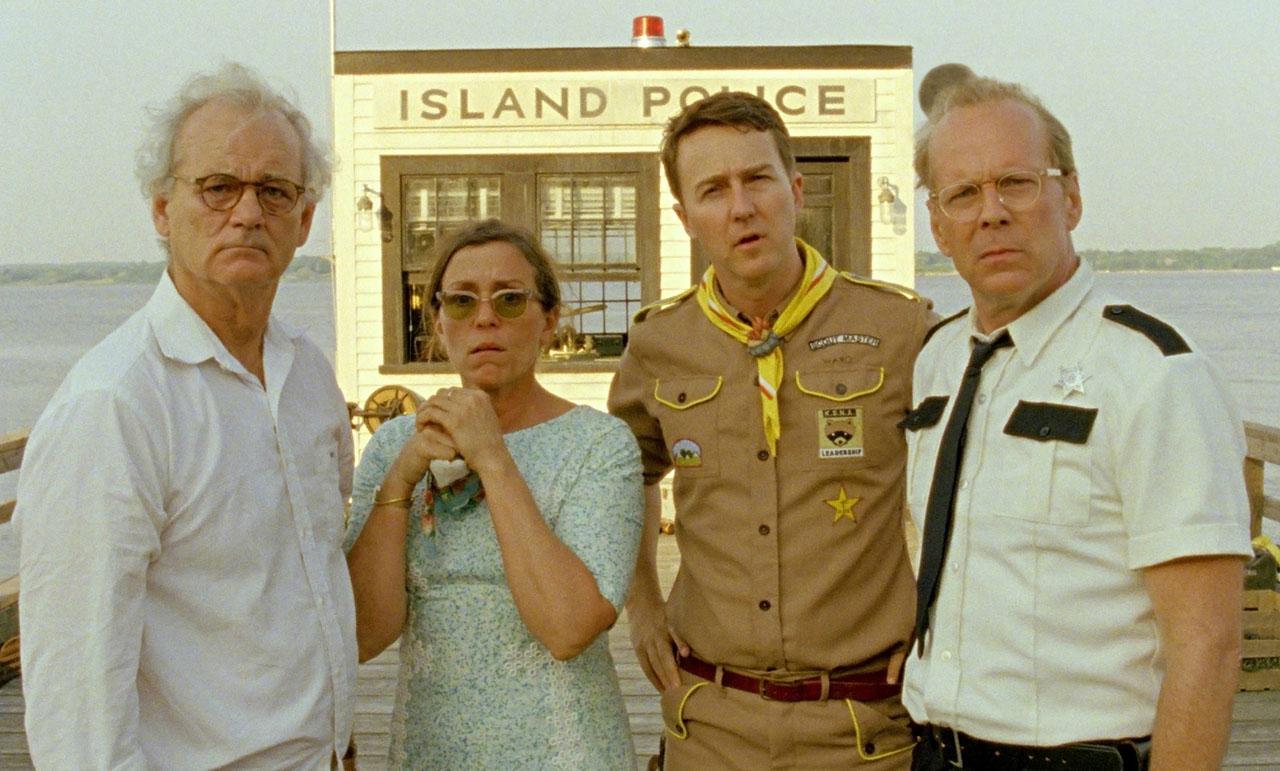
So, Moonrise Kingdom, co-written by Anderson and Roman Coppola (Francis' iconoclastic kid), set in the mid-60's and involving an East coast island community. There are two factions, the authorities, represented by island law enforcement—Captain Sharp (Bruce Willis) and the troop leader of a group of "Khaki Scouts"—Scout Master Ward (Edward Norton). There is a dysfunctional family, the Bishops (led by Bill Murray and Frances McDormand). Both factions represent authority, and empty authority at that. Their worlds are controlled, regimented, but still subject to outside forces and acts of God, like weather—there's a storm approaching as the film's exposition expert (played by Bob Balaban) is only too quick to report.

Into this mix come a pair of star-crossed likers, outcasts from both houses, like Romeo and Juliet.
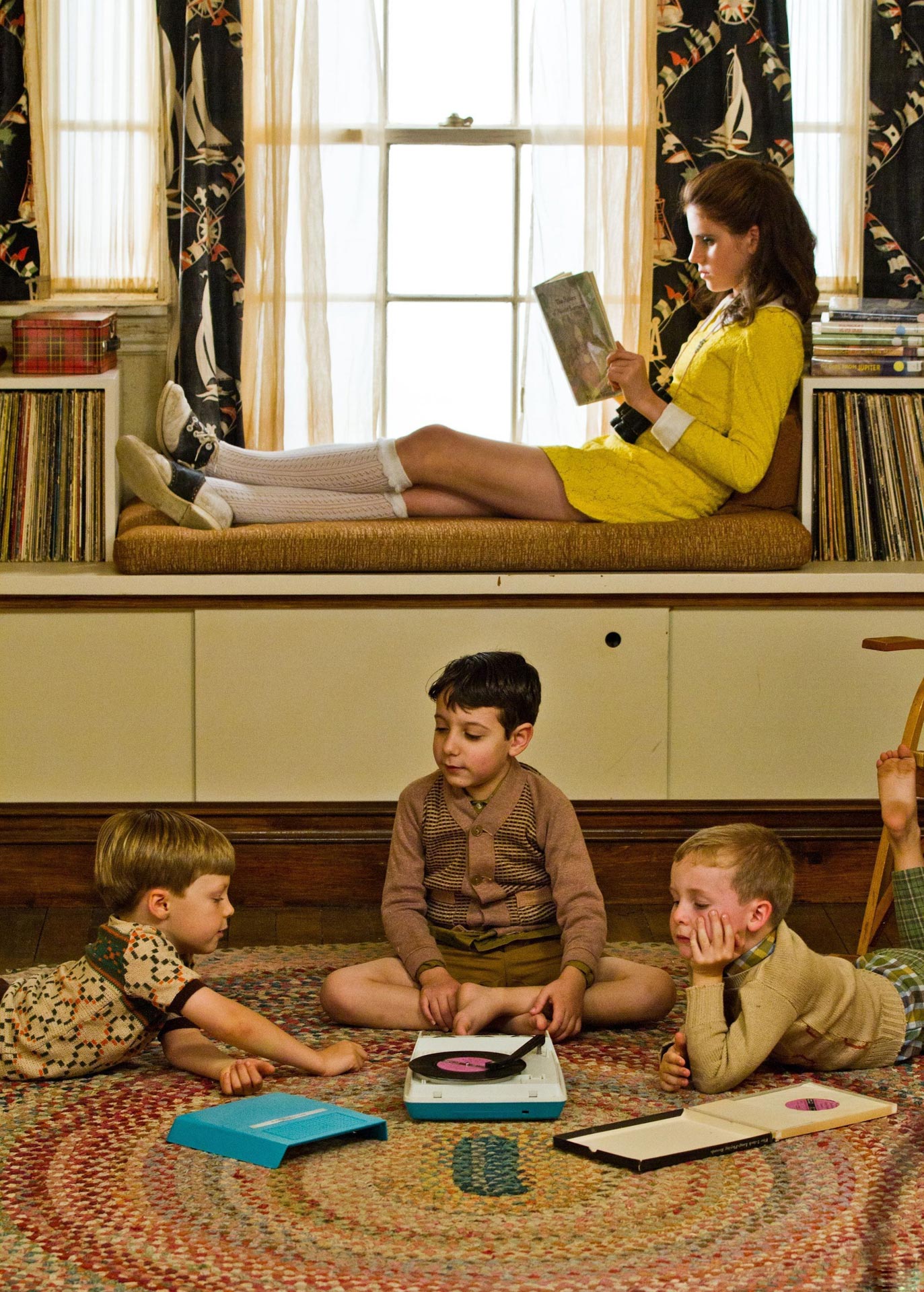
Sam (Jared Gilman) is an orphan with enough issues that his foster parents no longer want him; Suzy (Kara Hayward) is the oldest child of the Bishops and already is labeled as a "very troubled child." They meet at an amateur production of Benjamin Britten's "Noye's Fludde"
**—he's on a scout outing, she plays a raven.
They begin corresponding in secret, and then both escape their cloisters, he from the Khaki Scouts camp, she from her family home.
They live off the land, he with his survival skills and supplies, she with her books and records, a mutually dependent family with different roles. It doesn't take long for their disappearance to be discovered and the search parties form, the police led by Sharp and the Scouts, led by Ward, with the Bishops poking, prodding and threatening lawsuits. The kids lead them all a not-so-merry chase, and there are casualties along the way. But, the fugitives press on, despite the fact that, on an island, they can never really escape.

It's a romantic's version of 'the barefoot bandit" story
, but without the issues of ego, narcissism, and general public nuisance, and Anderson couches it all in an idiosyncratic format with scrupulous Kubrickian stylistic fluorishes—the measured tracking shots, the hand-held shots of freedom and chaos; the stylized expressionless acting, the structured mise en scene, perfectly balanced on a central fulcrum. On top of that, it's hilarious, with dialogue that's formal, distinct, played absolutely straight, betraying no irony, delivered in a deadpan lack of elevation.

It's charming
-no wonder these kids want out, left to their own devices. They still want structure, just their own structure, and, although self-imposed outcasts, seem far more together than those of their "betters."

It's fun
, odd, and rebellious in Anderson's over-stated understated fashion. Wonder what he'll do when he grows up.

* Oh, maybe this was premature. Anderson has since made The Grand Budapest Hotel, The French Dispatch (of the Liberty Kansas Evening Sun), and the wonderful animated Isle of Dogs, each getting increasingly richer, denser, and more sophisticated, all the while maintaining his quirky sense of humor and an almost child-like delight, as if he were playing (as Orson Welles put it) with "the greatest train set a boy ever had."

** Britten is the classical composer-thread rolling throughout Moonrise Kingdom, and his "Young Person's Guide to the Orchestra" is the starting theme for the film's opening sequence—a gliding, tracking tour of the Bishop's house.  They'll also do a version of it over Alexander Desplat's closing music over the credits.

Tuesday, July 6, 2021

16 Blocks

Richard Donner died Monday at the age of 91. I don't do obituaries, but I've seen every movie Donner ever made—with the exception (drat!) of one. He started in television directing episodes of your favorite television series if you're in your 60's, 50's or 40's, starting in 1960—with "Zane Grey Theater" up through "Kojak" and "Bronk" in 1975. One of those episodes is an all-time favorite of "The Twilight Zone" is "Nightmare at 20,000 feet" starring a peripatetic William Shatner. He dabbled in movie-programmers until making his mark with 1976's The Omen, which caught the attention of the producers of Superman—the film he's most known for (along with the "Lethal Weapon" series). He is probably the "godfather" of the current glut of superhero movies, not only from Superman, but also shepherding the "X-Men" series for his production company, run with his wife Lauren Shuler Donner.

This is the only review I have of his considerable work (a capsule from a couple web-sites ago) and it contains a summation of his work—"seems completely incapable of placing his camera in any place but the best position to convey action and meaning." Just so. When I've found "that one film" I'll, of course, do a "Now I've Seen Everything" write-up.

16 Blocks
 (Richard Donner 2006) An odd, efficient little thriller about a broken down cop who gets the bad assignment of driving a police whistle-blower sixteen blocks to the courthouse to testify before the Grand Jury about police corruption. But first he has to run a gauntlet of New York's less-than-finest who all could be sent to the pokey if the kid talks. And after hearing Mos Def's high-pitched, cleft-pallet-patter-way of talking, you start feeling some sympathy for their thinking, too. Cop and whistle-blower have two things in their favor: a populace more suspicious of the police than those running from them, and director Richard Donner, who, though he may have problems with pacing, seems completely incapable of placing his camera in any place but the best position to convey action and meaning, no matter how claustrophobic the surroundings. Bruce Willis is the reliably unreliable cop drinking to retirement, who finds one last thing to fight for, although his persona tends to shift a bit from barely functioning to resembling an older John McClane without a sign of shakes as he draws down on a colleague. Willis is fine, though, as is David Morse as the crooked cop with the most to lose. Of the two endings shot, the one attached to the film is the most "blue sky," and it's not really satisfying. The better down-beat ending, unfortunately, depends on a character turning when he's shown no previous sign of doing so. Neither one works completely, but at least the "Happy" ending strains credulity a bit less. Over all, not bad, really.

Saturday, July 25, 2020

The Expendables (2010)

Written at the time of the film's release....you can tell because it mentions Arnold Schwarzenegger having a political career...before we'd all heard of "Maid-gate."

Do I have to mention Saturday is "Take Out the Trash" Day?


"The Most Appropriately Titled Movie of the Year!!"

or
The Answer to Where All the hGH in Hollywood Went

First, to be fair, one does not walk into a movie like The Expendables to judge the line-readings. It's a good thing, as the only performance worth a damn is Mickey Rourke's beautifully played monologue in the middle of the movie, which stands out like an ice-swan at a spam-carving contest.  Everybody else, it's a crap-shoot (emphasis before the dash).

"Crap-Shoot" might have been a better title for the movie, as it's equal parts both. The latest in a series of 2010 "Dirty Dozen" knock-offs (after The Losers and The A-Team), this one takes its appeal in gathering so many testosteroasted hams, all of whom have seen better days. The main stars are Sylvester Stallone (who directed), Jet Li, and Jason Statham, with extended cameos from the rest of the cast (why, there's even a brief, unnecessary "Planet Hollywood" board meeting between Stallone, Bruce Willis, and the non-acting Gubernator of Kullyfarnyah, Mr. Schwarzenegger*—who seems to have forgotten how to act, along with all his campaign promises). The only stand-outs are the vascularity on the prominently displayed biceps, not that anyone would look good barking the inane juvenilia contained in the script.  
Okay, so let's forget "art," for a moment, and lower the squat bar to "execution" (*sigh*  "if only..."). The action scenes (supervised by 2nd Unit Director Terry Leonard, who has done good work in the past) are sloppy, jam-edited for intensity, and often laughable (I lost count of how many times they pulled the never-believable "guy-holds-a-knife-handle-to-his-throat-like-somebody-just-threw-it-at-him" trick), and that applies to whether the "E's" are fighting the bad guys, or amongst themselvesThese guys can hold a gun—and maybe not blink when firing one, I didn't notice—grunt when they're hit, and simulate rough-necking (except for "Stone Cold" Steve Austin, who A) can't act, and B) broke Stallone's neck during a choke-hold), but anything else is far more taxing—like, you know, keeping an accent, or even a consistent personality, throughout the proceedings.
But, there are the numerous neck-twists, blood-spurts, and even the occasional spaghettification of an extra every few minutes, but one wonders why some of these guys, who made their reputations on better product in the 80's, would decide to come out of retirement (or exile) to appear in such a worthless piece of trash. There's a lot of Human Growth Hormone under the skin of these guys (Stallone, particularly, is starting to look like Robert Evans!), but any other growth—well, they haven't made a pill for that. After all, the phrase isn't "Better acting through chemistry." As it is, this film feels lame, and aged—like Wild Hogs with evisceration. 
* Stallone must have promised to wash their windows, or something. The novelty of seeing Schwarzenegger back on anything but a political stage has been heavily promoted in the ads, but he's there for four minutes, tops—hardly enough to get in shape for.  I'm sure there's SOME-one out there, outside of a day-care or the Democratic Party, that's been hoping for Schwarzenegger's screen return, but I think that may be a side-effect of extensive steroid use. 
2020 Hindsight Addition: There was a link to Arnold's Governor page under the "Kullyfarnia" but when I checked on it, it took me to a "This Page Has Moved" place-holder. Boy Howdy.

I wrapped up the review with this: "The Expendables" is a Waste of Time, Money and an army of Ballistic Gel Dummies!

The thing has generated a few sequels, though. Something to be said for that.