It's "Just Another Saturday Night" and Saturday's are usually "Take Out the Trash" Day...
Frank Miller's Sin City: A Dame To Kill For (Robert Rodriguez, Frank Miller, 2014) Frank Miller became the darling of comic-book fans by bringing a mature, gritty, often brutal, sometimes mystical approach to iconic comic-book heroes—specifically Marvel's Daredevil and DC's Batman—when he got the chance to write them and mark them with a stamp of more than just india ink. He could be radically forthright in his interpretations, and for young men—and women—enamored of four-color literature (people who read comic books and take them seriously), he became one of the top-tier of comic-creators.
But, writing for "Daredevil" and "Batman", owned by corporate interests who were also interested in the longevity of the character and its marketability for selling T-shirts and toys—sorry, action figures—there was only so much creative lee-way he was allowed. Creating his own works—like the Samurai series "Ronin" or his spartan graphic novel about the Spartans, "300," let his talents bloom full-flower. His "Sin City" series let him tackle the noirish aspects of pulp novels, filled with roughneck men and soft women who were hard as nails, while employing a radical design sense of dark pages (rather than the usual white) blasted by white highlights of louvered light with just a dash of color. Miller allowed his drawing to become blocky and stark, emphasizing the filmic frame, rather than graphic details. And he bleached the traditional four colors of comics—just as the industry was benefiting from more sophisticated color printing—to a monochromatic night-scape (something artist Jim Steranko had used to great effect in his graphic novel "Chandler: Red Tide").
 Miller's influence could be seen when the Batman character returned to the screen under Tim Burton's direction (but, more especially when Zack Snyder was allowed to tinker with the character later), and he was approached to do script-work, turning out the screenplays for Robocop 2 and Robocop 3. His graphic novels started to make their way to film and he was approached by Robert Rodriguez to script a film version of his "Sin City" series, to which he was added as co-director as the resulting film took so many cues from the original work—Rodriguez was even using the graphic novels as story-boards.
 That movie, Sin City, was a success, making a lot of money and revived the careers of a lot of people, including Mickey Rourke, who was encased in so much prosthetics to play the character of "Marv", but it didn't distract from his acting (he even did press interviews in the make-up which was...weird). Sin City looked different. It felt different. Plus, there was the eerie feeling that you were watching a comic-book literally come to life—the same impression evoked by Zack Snyder's adaptation of Miller's 300—that the film was merely filling in the missing parts of the "money shots" displayed in the comics. But, it wasn't a movie you could take seriously—you needed a jaded humor to appreciate that it was over-the-top satire and not really reflective of the noir genre Miller wanted to ape. The dialogue was bad, clipped less from the gritted-teeth jargon of B-movie writing and more like Spillane spillage. What movie was it that said "the cheaper the hood, the gaudier the patter?"*
  Sin City (both the books and film) should be so lucky. It's a distillation of Hemingway minimalism and thug-mumbling, with punch-lines of nihilism that are supposed to be funny, but ultimately are just for an audience so low on Gustav Hasford's "phony tough and crazy brave" index that they think it's sophisticated. A.O. Scott had it right when he said that Sin City "offers sensation without feeling, death without grief, sin without guilt, and, ultimately, novelty without surprise." That's what they would call in these things "a head shot"—couldn't've been put better.
The financial success of the first Sin City led to a sequel of sorts—released nine years after the first one—featuring two original Miller tales as well as adapting his short story "Just Another Saturday Night", as well as the tale the film is titled for, "A Dame To Kill For".

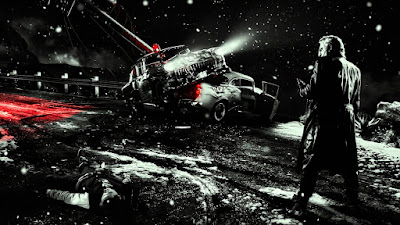 The first story is one of Miller's shorter stories (from "Dark Horse Comics Presents") called "Just Another Saturday Night" in which his character "Marv" (Mickey Rourke) wakes up from an auto accident on the edge of town with no idea how he got there. This has to be an early tale—a prequel, if you will—because if you've seen the first Sin City movie, Marv was executed in it...by the electric chair.
 The second story, "A Long Bad Night" stars Joseph Gordon-Levitt as Johnny, a cocky gambler who comes into town for a big score with under-pinned reasons. He goes to what seems to be the only bar in town—Kadie's Place, where all the Sin City regulars hang out, like Marv, and where Nancy Callahan (Jessica Alba) dances. But, like everything in Sin City, it has a hidden side (given everybody's instincts one would think nothing would be hidden in that burg).


 As soon as you can say the words "predictably obvious" Johnny is attacked in town by Roark's goons, which he manages to dispatch and tells Marcie he'll hook up with her later at a hotel. But, before he can high-tail it to safety, he's manhandled into Roark's limousine where his winnings are stolen, his fingers broken and he's left in the street with an added bullet in his leg and Roark telling him he's his bastard-son ringing in his ears. Johnny swears revenge because that's the chief economic product in Sin City. Fade to monochromatic black.
 Cut to "A Dame To Kill For" featuring Josh Brolin as Dwight McCarthy (played by Clive Owen in the "The Big Fat Kill" in the first Sin City movie and Dame is a prequel to that story). Dwight is sober now, a private detective, and after a late-night rescue of a hooker (Juno Temple) from her corporate lover (Ray Liotta), he is contacted by an old flame Ava Lord (Eva Green) asking to meet him at Kadie's Place (natch!) to tell him that the fat-cat (quite literally) she left him for years a go is a violent abuser and that she now fears for her life. Dwight is non-committal, but he's an addict (isn't he?), so he can't help but go back to the Lord compound to see what he can do about her situation. What he spies doesn't tell him anything about abuse—Ava is swimming nude, obviously not showing any bruises and contusions—but, investigating further, he's beat up and tossed off the Lord property.


Any after-glow he might have is interrupted by the Lord chauffeur-bodyguard Manute (Dennis Haysbert, replacing Michael Clarke Duncan, who had died in the 7-year lag between producing Sin City and Sin City: A Dame To Kill For) who beats Dwight up and tosses him out the window. So, Dwight has been beaten up twice over this woman—anybody detecting a flat learning curve?

But, writing for "Daredevil" and "Batman", owned by corporate interests who were also interested in the longevity of the character and its marketability for selling T-shirts and toys—sorry, action figures—there was only so much creative lee-way he was allowed. Creating his own works—like the Samurai series "Ronin" or his spartan graphic novel about the Spartans, "300," let his talents bloom full-flower. His "Sin City" series let him tackle the noirish aspects of pulp novels, filled with roughneck men and soft women who were hard as nails, while employing a radical design sense of dark pages (rather than the usual white) blasted by white highlights of louvered light with just a dash of color. Miller allowed his drawing to become blocky and stark, emphasizing the filmic frame, rather than graphic details. And he bleached the traditional four colors of comics—just as the industry was benefiting from more sophisticated color printing—to a monochromatic night-scape (something artist Jim Steranko had used to great effect in his graphic novel "Chandler: Red Tide").


The financial success of the first Sin City led to a sequel of sorts—released nine years after the first one—featuring two original Miller tales as well as adapting his short story "Just Another Saturday Night", as well as the tale the film is titled for, "A Dame To Kill For".

The first film was a true anthology, with one of the stories being split up for a final resolution at the end. A Dame To Kill For jumps around, allowing time to pass for the healing of wounds and grudges to fester. The film also brings back characters from the first film—forget the fact that they might have died!—to continue stories or serve as prequels to the previous film.


Senator Roark (Powers Boothe) arrives at Kadie's for the poker game in the back room—just missing being plugged by a vengeful-but-chicken Nancy for the death of her guardian angel, Hartigan (Bruce Willis—his character died in the last movie, but this is based on a comic book and nobody really dies in comics, even ones written by Frank Miller). Johnny, who's had a string of wins on the slots, uses one of the waitresses, Marcie (Julia Garner) to buy in on the game.
He cleans out the Senator—who, of course, has a reputation and everybody named Roark in Sin City is not only a psychopath but a corrupt psychopath. With Roark seething, Johnny is advised by the police lieutenant in the game to blow Sin City and pronto, but, as nobody in town seems to have any sense whatsoever, Johnny takes Marcie and they decide to have a night on the town. It should be noted that, as this is an original Miller story for the movie, Rodriguez isn't depending on Miller's comics for story-boarding and shot-lists, but delves into something Miller doesn't do in his graphic work, which is to resort to surrealism.** It causes a bit of a disconnect when it happens, like suddenly a musical sequence pops into a kitchen-sink drama. Yes, it's a transition device, but it's something that Miller never resorted to, short of impossible acrobatics and virtiginous angles.

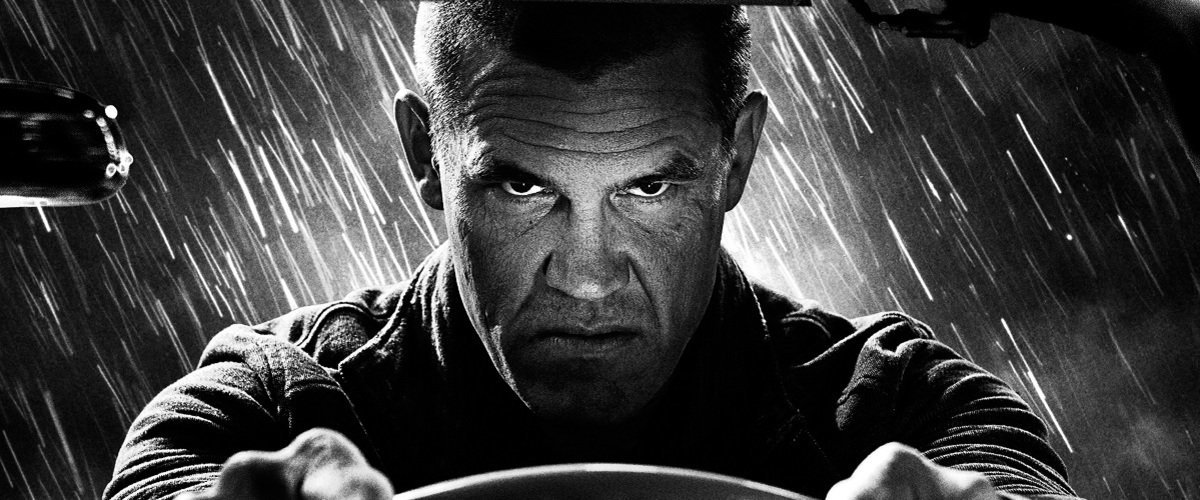


He goes home only to find a naked Ava in his bed. And, as Sin City people, apparently can't feel pain, he succumbs and the two frantically make love, despite his not trusting her and being beat up within an inch of his life.
Another thing: With "A Dame To Kill For" Miller began experimenting with how much nudity he could get away with in his comics, usually with his by-now draping shadows, which, when Rodriguez replicates it for the screen, merely comes off as slightly ridiculous, along the lines of an Austin Powers "hide-the-wiener" sequence. Things are exposed, alright, but exposed as juvenile and puerile.


Yeah, yeah...I kvetch about the nudity, but I put these up...(for illustrative purposes, of course!)
And I might get a couple of extra puerile "clicks" for it.

Dwight's determined to save Ava, so he teams up with Marv (hey, it's a small town...) to strike the Lord compound and get her out, and although a fair amount of wet-work is done, the results are not optimum—Dwight ends up falling out another window after a few bullets to the body—and one to the face. Marv scoops up what's left and takes him back the detectives Old Town haunts, where he is tended to by a gang of assassin-hookers led by another old flame (Rosario Dawson) and the very dangerous ninja-assassin Miho (Jamie Chung), who heel his wounds and do some reconstructive surgery, presumably to help him look more like Clive Owen. The instruments probably won't need to be sharp as Dwight isn't that sharp himself, planning on making one more excursion to Lord Manor after his recuperation. The girls evidently don't do brain transplants...or extensive therapy.


Here's another "film noir quote" for you: "So many guns. So few brains."***
Okay, enough about "A Dame To Kill For". Once enough people are pushing black-and-white daisies in that one, Rodriguez and Miller pick up the "Long, Bad Night" story...

Johnny, probably reading a Yelp! review of the reconstructive surgery-hookers, goes to see another saw-bones (Christopher Lloyd), a heroin addict, who resets Johnny's fingers (not sure why, as he presumably can look at his cards one-handed—it's not like he's a pool-hustler or anything) and sets out to get his revenge on his legitimately illegitimate Dad, the Senator. Absolutely busted, Johnny borrows a single dollar from a waitress (Lady Gaga...LADY GA-GA!?) and repeats the strategy that got him into the poker game at Kadie's...and cleans the Senator out...again. So...dear old Daddy shoots him in the head. End of story. We waited through the peek-a-boo idiocy of "A Dame To Kill For" to get this?

Yeah. But, it ain't over. There's still "Nancy's Last Dance"—remember the stripper at Kadie's...Jessica Alba/Bruce Willis...didn't shoot the Senator? Sounds like there's a revenge story going wasting. Can't have that.

Wait. Wait, wait, wait, wait, wait. Isn't "Sin City"—the concept—derived from the hard-scrabble reality of B-movies and pulp-books? Aren't they supposed to be rooted in the American Promise Unfulfilled, where the well-intentioned are driven to desperation due to the economic inequities that reward the retention of wealth by any means necessary, while the principled person "doing the right thing" can't even catch a break? Isn't the basis of these things the "Reality-Is-A-Bitch" principle (if you can call it that)?
And we got a ghost? What the Hell?

And yet, here's Frank Miller going all-Shirley Jackson on us. What a bunch a' hooey.

Or...maybe they just wanted Willis back, however implausibly, to boost audience recognition and as a box office draw. Talk about "hope". Didn't work, though; Sin City: A Dame to Kill For was an aesthetic failure, a critical failure, and a box office failure, the full negative-Hat Trick.


* Dashiell Hammett wrote it for "The Maltese Falcon." I've read everything Hammett ever wrote. He knew he was writing trash, but, by god, he made sure it was the BEST trash, and elevated the genre.
** Although he would when he was directing his film of The Spirit.