"Turning Air to Gold:
The Transmutation of 'Watchmen' from Graphic Novel to Silver Screen"
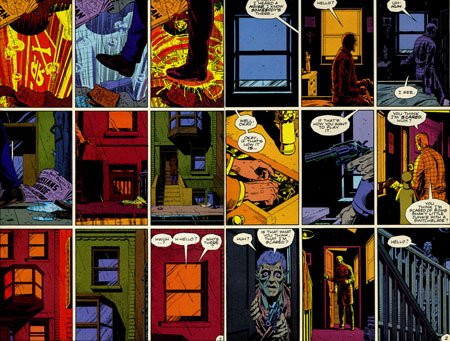
After years of failed attempts by various studios and directors, "Watchmen", Alan Moore and Dave Gibbons' epic deconstruction of super-hero stereotypes in graphic-novel form has finally made it to the screen. Two studios financed it (with proceeds going to a third) and the director is Zack Snyder, who did an interesting re-make of Dawn of the Dead, and the film adaptation of Frank Miller's "300." 300 (the film) was a somewhat mixed result due to the weakness of its source material, and Snyder's reliance on a bleached CG oppressiveness, but one could see him trying to find interesting ways to make Miller's panoramas and boxes translate to interesting moving images, if not a fully-realized film.
When one heard that his next project was to film the unfilmable "Watchmen," there was some cautionary hope: Moore's works "From Hell," "V for Vendetta," and "The League of Extraordinary Gentlemen" were not the movies they should have been, mostly due to liberties taken to Moore's blue-print (and as a result, Moore has refused any interest, personal or financial, from filmed adaptations of his writing—his lack of credit yawns like a big black hole in the film's credits).

Snyder and his scriptwriters David Hayter and Alex Tse have compressed the story, eliminating some second and third-tier characters (although they appear in the movie if you're looking for them), completely eliminating the parallel stories (in comic form) of "Tales of the Black Freighter" and the super-hero memoir "Under the Hood" (which will appear on a separate DVD, apparently) and concentrating on the main thread of the story: "Somebody is killing the Great Retired Superheroes of America."** It follows the investigation of never-realized super-group The Watchmen into who might be killing their members, starting with The Comedian, a government-sanctioned vigilante. All the Watchmen are vigilantes and, to some degree, fascists breaking arms and legs in brutal fist-fights that are, in the film, probably the best realized comics-fights yet filmed—like cage-matches in the open air. They all dress in the spandex kicking heads for different reasons and their very differences in attitude, sense of justice and heritage are what make the characters interesting, not the justice dispensed. There's action aplenty,*** but where Snyder has excelled and made the film his own is to take Moore's example and kick it up a notch. Moore's super-America of 1985 has Nixon still in the White House for an unprecedented sixth term, the Viet Nam War having been won by Watchmen incursion. But Snyder doesn't stop there. There are all sorts of cultural references spread throughout the film mixing History with heroes. TV, political and business personalities are recognizable from their Real World counter-parts. Moore piled on the culture references but Snyder takes advantage of the audio-visual tools he has to provide a great soundtrack of hits from a diverse group of Bob Dylan, Simon and Garfunkle, Leonard Cohen, and Phillip Glass. Compositions and dialog are taken from other movies to sometimes hilarious effect, and although one doesn't want to give away too many of Snyder's surprises, to not acknowledge them would be giving this film's own strengths short-shrift. It is its own animal—a fully functional moving picture that takes the strengths of the comics medium source, but builds on it and takes the viewer between the panels without a sense of filler or extraneous material.
"But my Eyes were stabbed by the flash of a neon light/That split the night"
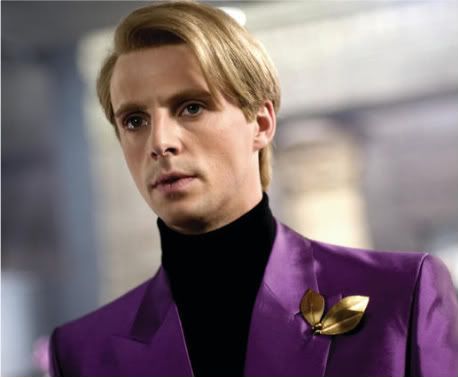
Just as Moore nested references throughout the series, Snyder takes visual cues and unites them throughout the film. Where Moore has his "Smiley Face" icon throughout (a device that seems a shade contrived in the film), Snyder's white-bright light flashes carry resonances throughout the film, especially in an ages spanning credit-sequence (which contains one of the best comics call-backs in the film). Those flashes will carry dramatic weight throughout the movie right up to the ending (which manages to logically improve on the novel's proposition-of course, that's how you solve "the problem," it's been staring us in the face all along). But, you can have all the CG wizardry in many worlds if the organic part of things, the actors, don't breathe life into the characters, and here "Watchmen" excels. Patrick Wilson has spent too much time being the handsomely bland blonde guy that it's a welcome relief to see him stand out appreciably as Dan Dreiberg, The Nite-Owl. Matthew Goode as Ozymandias has a lazy, lithe, slurry quality that shows how used he is to being The Smartest Man in the Room, always. Jeffrey Dean Morgan has the hardest role as The Comedian, but makes it work, as Malin Akerman does for The Silk Specter. But the big raves go to to guys who spend most of the time hidden: Billy Crudup, who manages to make a character of Dr. Manhattan despite the fact that it's all CGI imagery (can you believe they wanted Schwarzenegger for the role?), and Jackie Earle Haley, who does wonders as Rorschach. The stand-out character of the series needed a superb performance and Haley, who's made few mis-steps since re-igniting his peculiar acting career slams it home. One hopes that his talent is acknowledged soon.I was surprised and delighted by Watchmen, the movie re-creating the same emotions I had reading the book all those years ago. But I wonder how much information one would get from the movie without having read the source. For me, there was recollected information bursting out of every frame, but to someone without the book in their banks those frames might seem over-crowded with useless knick-knacks...instead of pieces of the puzzle. Without that fore-knowledge, is the movie as compelling, or does one take a Manhattan-ish dis-interest?

* There have been some review complaints of "slavish" adherence to the source material. Whole sections have been lifted, but it's only once in awhile when those sections encompass a lot of material (usually from a God's eye perspective). "Slavish adherence" is simply not true. Even if it was, when was that ever a movie sin? Nobody complained when "Lonesome Dove" stuck so close to Larry McMurtry's novel. Why is it an issue now? Nothing else to write about?
** "Watchmen" grew out of Alan Moore proposing a 12 issue series based on characters acquired by DC Comics when it bought the Charlton Comics line. DC wanted to use those characters in the regular comic-line, but wanted Moore's story, too. So, Moore created new heroes based on those characters: Captain Atom became Dr. Manhattan; Blue Beetle became Nite-Owl; The Question became Rorschach; Pete Cannon-Thunderbolt inspired Ozymandias; The Peacemaker became The Comedian; Nightshade became The Silk Specter.
*** Watchmen is a hard "R" for moments of sexuality, nudity and stomach-churning violence, for instance, characters are meat-cleavered in the head, one criminal has his hands tied to prison bars and his arms sawed off, not to mention the near-occasion of brutal fights—The Silk Specter breaks an arm so hard the bone pierces the skin — and a prison fight ends when a prisoner is dowsed with boiling oil. The movie begins with a bone-crunching fight between The Comedian and an unknown assassin, leading to his being thrown through a plate-glass window a couple dozen stories high. The movie's lone super-powered hero, Dr. Manhattan, explodes people with a wave of his hand. The show I went to, a couple brought their five year old son. He's gonna be in therapy for months.
 , 2006) One I've been wanting to see but avoiding. Again, bad decision.
.jpg)