Showing posts with label Billy Crudup. Show all posts

Wednesday, February 17, 2021

Watchmen (2009)

"Turning Air to Gold: The Transmutation of 'Watchmen' from Graphic Novel to Silver Screen"
 

After years of failed attempts by various studios and directors, "Watchmen", Alan Moore and Dave Gibbons' epic deconstruction of super-hero stereotypes in graphic-novel form has finally made it to the screen. Two studios financed it (with proceeds going to a third) and the director is Zack Snyder, who did an interesting re-make of Dawn of the Dead, and the film adaptation of Frank Miller's "300."

300 (the film) was a somewhat mixed result due to the weakness of its source material, and Snyder's reliance on a bleached CG oppressiveness, but one could see him trying to find interesting ways to make Miller's panoramas and boxes translate to interesting moving images, if not a fully-realized film. When one heard that his next project was to film the unfilmable "Watchmen," there was some cautionary hope: Moore's works "From Hell," "V for Vendetta," and "The League of Extraordinary Gentlemen" were not the movies they should have been, mostly due to liberties taken to Moore's blue-print (and as a result, Moore has refused any interest, personal or financial, from filmed adaptations of his writing—his lack of credit yawns like a big black hole in the film's credits).

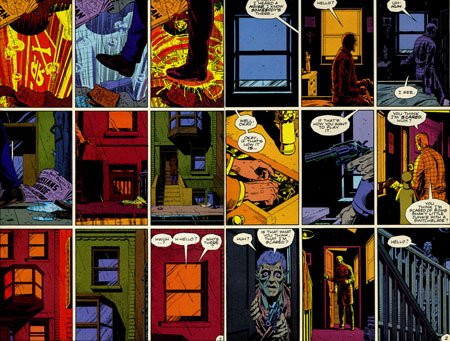
His "Watchmen" is another animal—a sprawling 12 issue serial based on an alternate Earth where masked vigilantes do exist, it crossed eras and locations in a blink, played on nesting cultural references and on-the-nose word-play, while having the look and feel of a movie story-board. It looked like it should be filmed, even though its nudity, ultra-violence and political satire made it somewhat over the heads of the casual movie-goer and beyond the scope of the MPAA. Given Moore's history, the expectations were another bastardization, or, given Snyder's, a by-the-numbers adaptation with nothing new to offer. The result, though, is neither extreme. It's a faithful adaptation that doesn't mind sharing in the fun of creation.*
"Structurally, There's No Difference"
 
Snyder and his scriptwriters David Hayter and Alex Tse have compressed the story, eliminating some second and third-tier characters (although they appear in the movie if you're looking for them), completely eliminating the parallel stories (in comic form) of "Tales of the Black Freighter" and the super-hero memoir "Under the Hood" (which will appear on a separate DVD, apparently) and concentrating on the main thread of the story: "Somebody is killing the Great Retired Superheroes of America."** 
It follows the investigation of never-realized super-group The Watchmen into who might be killing their members, starting with The Comedian, a government-sanctioned vigilante. All the Watchmen are vigilantes and, to some degree, fascists breaking arms and legs in brutal fist-fights that are, in the film, probably the best realized comics-fights yet filmed—like cage-matches in the open air. They all dress in the spandex kicking heads for different reasons and their very differences in attitude, sense of justice and heritage are what make the characters interesting, not the justice dispensed.
There's action aplenty,*** but where Snyder has excelled and made the film his own is to take Moore's example and kick it up a notch. Moore's super-America of 1985 has Nixon still in the White House for an unprecedented sixth term, the Viet Nam War having been won by Watchmen incursion. But Snyder doesn't stop there. There are all sorts of cultural references spread throughout the film mixing History with heroes. TV, political and business personalities are recognizable from their Real World counter-parts. Moore piled on the culture references but Snyder takes advantage of the audio-visual tools he has to provide a great soundtrack of hits from a diverse group of Bob Dylan, Simon and Garfunkle, Leonard Cohen, and Phillip Glass. Compositions and dialog are taken from other movies to sometimes hilarious effect, and although one doesn't want to give away too many of Snyder's surprises, to not acknowledge them would be giving this film's own strengths short-shrift. It is its own animal—a fully functional moving picture that takes the strengths of the comics medium source, but builds on it and takes the viewer between the panels without a sense of filler or extraneous material.
"But my Eyes were stabbed by the flash of a neon light/That split the night" 

Just as Moore nested references throughout the series, Snyder takes visual cues and unites them throughout the film. Where Moore has his "Smiley Face" icon throughout (a device that seems a shade contrived in the film), Snyder's white-bright light flashes carry resonances throughout the film, especially in an ages spanning credit-sequence (which contains one of the best comics call-backs in the film).
Those flashes will carry dramatic weight throughout the movie right up to the ending (which manages to logically improve on the novel's proposition-of course, that's how you solve "the problem," it's been staring us in the face all along).
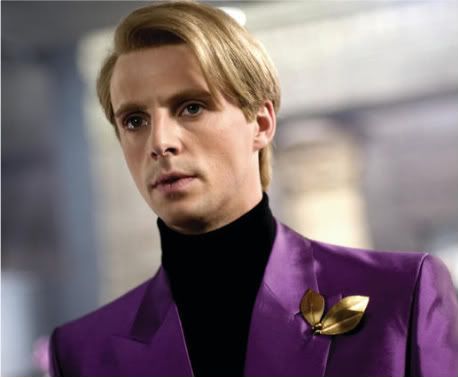
But, you can have all the CG wizardry in many worlds if the organic part of things, the actors, don't breathe life into the characters, and here "Watchmen" excels. Patrick Wilson has spent too much time being the handsomely bland blonde guy that it's a welcome relief to see him stand out appreciably as Dan Dreiberg, The Nite-Owl. Matthew Goode as Ozymandias has a lazy, lithe, slurry quality that shows how used he is to being The Smartest Man in the Room, always. Jeffrey Dean Morgan has the hardest role as The Comedian, but makes it work, as Malin Akerman does for The Silk Specter
But the big raves go to to guys who spend most of the time hidden: Billy Crudup, who manages to make a character of Dr. Manhattan despite the fact that it's all CGI imagery (can you believe they wanted Schwarzenegger for the role?), and Jackie Earle Haley, who does wonders as Rorschach. The stand-out character of the series needed a superb performance and Haley, who's made few mis-steps since re-igniting his peculiar acting career slams it home. One hopes that his talent is acknowledged soon.
I was surprised and delighted by Watchmen, the movie re-creating the same emotions I had reading the book all those years ago. But I wonder how much information one would get from the movie without having read the source. For me, there was recollected information bursting out of every frame, but to someone without the book in their banks those frames might seem over-crowded with useless knick-knacks...instead of pieces of the puzzle. Without that fore-knowledge, is the movie as compelling, or does one take a Manhattan-ish dis-interest?

* There have been some review complaints of "slavish" adherence to the source material. Whole sections have been lifted, but it's only once in awhile when those sections encompass a lot of material (usually from a God's eye perspective). "Slavish adherence" is simply not true. Even if it was, when was that ever a movie sin? Nobody complained when "Lonesome Dove" stuck so close to Larry McMurtry's novel. Why is it an issue now? Nothing else to write about? 

** "Watchmen" grew out of Alan Moore proposing a 12 issue series based on characters acquired by DC Comics when it bought the Charlton Comics line. DC wanted to use those characters in the regular comic-line, but wanted Moore's story, too. So, Moore created new heroes based on those characters: Captain Atom became Dr. Manhattan; Blue Beetle became Nite-Owl; The Question became Rorschach; Pete Cannon-Thunderbolt inspired Ozymandias; The Peacemaker became The Comedian; Nightshade became The Silk Specter. 

*** Watchmen is a hard "R" for moments of sexuality, nudity and stomach-churning violence, for instance, characters are meat-cleavered in the head, one criminal has his hands tied to prison bars and his arms sawed off, not to mention the near-occasion of brutal fights—The Silk Specter breaks an arm so hard the bone pierces the skin — and a prison fight ends when a prisoner is dowsed with boiling oil. The movie begins with a bone-crunching fight between The Comedian and an unknown assassin, leading to his being thrown through a plate-glass window a couple dozen stories high. The movie's lone super-powered hero, Dr. Manhattan, explodes people with a wave of his hand. The show I went to, a couple brought their five year old son. He's gonna be in therapy for months.

Tuesday, May 12, 2020

The Good Shepherd (2006)

Written at the time of the film's release...

  The Good Shepherd (Robert DeNiro, 2006) Eric Roth's screenplay for The Good Shepherd seems to have gone through as many hands as states' secrets before actually being put before the cameras. A "personal" telling of the formation of the CIA, Francis Ford Coppola was the first director to have signed to it—then retained enough interest to keep an "executive producer" credit (although Wayne Wang, Philip Kaufman and John Frankenheimer—who interested his Ronin star, Robert De Niro in the project—were also briefly attached before De Niro, who was working on his own CIA project, took it over). Bless my tapped telephone line it has that same sort of "Godfather" family epic-feel to it, with just enough schmaltz and soap to keep it from getting too caught up in its overarching theme of constant paranoia. It also carries the similar pall of "the sins of the father" to it. You just know that the ambitions of the men in the movie will doom their families, if not themselves.
Edward Wilson (Matt Damon) is recruited out of college to join the Skull and Bones secret society, and with his first ratting out of a professor (Michael Gambon), his career as a spy takes the fast track. It's derailed slightly when a quickie with the Boss's precocious daughter (Angelina Jolie) results in pregnancy and a marriage of convenience. Then, when fencing with the Soviets keeps him overseas for years, his fair-weather family-life causes a Cold War on both sides of the Atlantic. 
Soon, Wilson learns, a little too late, that he should trust no one, as he plays against (and develops a mutual admiration with) his equal in the KGB. But its the same old story we've gotten used to in the spy genre. Everybody's a snake looking out for Number One, and trying to make "that Big Score," and yeah, okay, there's only a gray flanneled thread of difference between the spy network and Corporate America
Which brings us right back to "Godfather" country. CIA-Mafia-GM, there's no (*yawn*) difference. The only likable character in the entire film is director Robert DeNiro's turn as "Bill Sullivan"--a veiled version of Bill Donovan, but he's there for two quick dashes of cold-water perspective and is gone. Matt Damon seems not to age at all during the film, whereas Angelina Jolie does seem to gain twenty years. This film came out at the same time as The Good German, and I was hoping someone would combine them into "The Good German Shepherd". Well, I can dream...
It's interesting (well, to me, anyway) to wonder why Damon chose this part, seeing as how his "Bourne" films are merely the "fantasy" side of the "spy" franchise. If he thought that playing the "button-pusher," rather than the blunt instrument was an acting "stretch," he couldn't be more wrong.


Friday, June 2, 2017

Alien: Covenant

The Horrifying Hybrid
or
I think I was trying to suggest something about the duality of man, sir.
The what?
The duality of man. The Jungian thing, sir.
Whose side are you on, son?

Ridley Scott is a really frustrating director (for me, one should reiterate). He is a master of the image. Think of a movie of his and some image will pop into your mind that is so beyond the norm of what has gone before that it takes your breath away. Below are a bunch of screen-captures of various Scott movies.* None of them have movie-star's faces in them, they're scattered throughout Scott's filmography (and thus, were achieved either photo-chemically or by CGI and, amazingly, it doesn't make a difference), but if you've seen these films, you can identify which of Scott's films they are from, just from the indelibility of the image. 

Take a look:
Beautiful. Amazingly composed, with a painterly color pallette, and exquisite in its detail. Artistic.

It's just too bad some of them are really bad movies. Gorgeous, sure. But bad.

And you're never sure what you're going to get with a Ridley Scott movie; it might be beautiful to look at, but also completely lunk-headed, insufferable, or botched, whether by studio interference (Blade Runner and Legend) or by Scott's way of over- or under-thinking his movies, so that he forgets what they're actually about in the process. It's why Ridley Scott is a well-regarded director, but he's not in the pantheon of innovators or "great" directors. He may make great looking art, but is not considered an artist pushing the art-form forward, sort of a Thomas Kincade of directors.

So, here's Alien: Covenant, Scott's second sequel to his 1979 Alien, his sequel (of a sorts) to 2012's Prometheus, and a return to form of what the series is—not speculative fiction as Prometheus lurched towards, but back to horror, as in the original.**  
After a brief scene between the android David (Michael Fassbender again) and his manufacturer's CEO Peter Weyland (Guy Pearce again) where they discuss "the big question" (where do we come from?), we jump forward in time (past Prometheus, time-wise, by ten years, to 2104) to the good ship Covenant, a colony spaceship tasked with establishing an outpost on a distant planet that has been surveyed from Earth, Origae-6. The ship is tended by its onboard computer, "Mother" and a lone android, Walter (Michael Fassbender...again), who oversees the automated systems*** keeping the cryo-sleeping crew and colonists, as well as a couple thousand embryo's to, I don't know, "seed" the planet (first thing they need to build on this planet is an orphanage!).
The crew of The Covenant: don't get too attached to any of them...
The ship is damaged in an ion storm (caused, presumably, by the meteor shower that damaged the Avalon from Passengers, six months earlier)**** which wakes up the crew before their appointed time. The captain of the vessel, Branson (an unbilled and only briefly seen James Franco) is killed in the resuscitation, leaving the ill-prepared First Mate Oram (Billy Crudup) as captain, and Branson's widow, terraforming expert Daniels (Katherine Waterston) grieving and alone. After making repairs to the ship, the pilot Tennessee (Danny McBride*****) receives a weird ghostly transmission in his helmet communicator that interferes with him getting back to the ship. Analysis of the signal shows it coming from a relatively nearby planet with Earth-like conditions. In a weird moment of "the-only-reason-to-do-this-is-to-keep-the-movie-going," the usually careful captain decides to check it out, rather than continue on the prescribed mission to the original destination.
Once in orbit, a landing party descends to the surface and they find an idyllic, if dramatic landscape of flora, but no fauna. Daniels remarks that there is no sound—no birds, no animals, nothing. To any rational person that would make one think that maybe, because they're the only life detectable on the planet, they should maybe get those thrusters warmed up and get out of there, but, no.
Recently, I heard some wag say that it doesn't matter what the first thing you say is important, but it will get really interesting if the second thing you say is  "...and then people began to die." Well, after some exploration of the planet and tromping around as humans do so delicately, that's exactly what happens—people begin to die. And they die in spectacular fashion, hatching those critters that we've come to expect. And then, because it needs to, their lander blows up.
So, after everybody's trapped on the surface with a couple rampaging beasties skittering through the high grass and their communication cut off from the main ship, they're rescued by a familiar face—it's the android David, who's been living on the planet for ten years after the crashing of the ship from Prometheus carrying him and Dr. Elizabeth Shaw (Noomi Rapace) in their quest to find the planet of the Engineers, whose little weapons experiment facility they found in the previous movie. David takes them to his hideout, while they figure out how to contact the Covenant and get out of there.
Really, that's all you need to know if you want a spoiler-free review, but, any viewing of the previous Alien films tells you exactly what will probably happen. It's familiar killing grounds in Alien: Covenant, it's just the way that they occur that makes them unique. Then, there's the added wrinkle that we have two androids in the series, David and Walter (Fassbenders, both) who are interacting with each other: David, with his Lawrence of Arabia fetish and genteel British accent and perverse curiosity, and Walter, whose accent is very American and is a bit of a neophyte...for an android, that is.
So, expect a lot of the expected in Alien: Covenant. That Scott abandoned the "Paradise Lost" project (albeit mentioning events briefly in flashback) and went back to "formula" is a bit of a disappointment. That he has made a hybrid film, borrowing liberally from the James Cameron episode and from his own Blade Runner (even to the admiration, even preference, that he showed for the synthetics rather than the humans involved) is also a bit of a downer, calling back elements from those films rather than offering something more challenging to the audience. One wishes there were some hope for the series going on (Scott is saying that he'll make two, no, three more sequels before we get to the original's time-line), but, really, there's no place for the series to go except to endlessly re-generate the same scenario in a nihilistic fashion.
That leaves me rather bugged.


* They are (in order): Alien (1979), The Counselor (2013), Legend (1985), Black Rain (1989), The Duellists (1977), Gladiator (2000), Blade Runner (1982), Thelma & Louise (1991), White Squall (1996), The Duellists, Prometheus (2012), 1492: Conquest of Paradise (1992), Gladiator, The Martian (2015), Blade Runner, The Duellists, Black Rain, Thelma & Louise, Legend, Gladiator.

** Scott originally wanted this to be a direct sequel to Prometheus, entitled "Alien: Paradise Lost", but when Prometheus proved divisive among the populace, he chucked that notion, handling the plot components in flash-backs (and internet-only sneak-peeks), and went with something a bit more like the original. Why Scott came back to Alien is a question in itself. The man's 80 years old now and perhaps he tired of working on things like The Counselor and Exodus: Gods and Kings that flop at the box-office and went the George Lucas route of going with "what works."

*** There would appear to be gravity and life-support on a ship where everybody human is in cryo-sleep, presumably to protect the very resources that are being squandered on one non-breathing android. Why?

**** And that wouldn't be as far-fetched a coincidence as some of the ones in the Alien series where the tag-line should be "In space, everybody runs into each other..."

***** I have to confess: while one shouldn't walk into movies with prior expectations, I was really looking forward to a scene where Danny McBride gets offed by one of the xenomorphs—I rarely have seen McBride in anything where I found him with an ounce of talent or charm, he's one of those few actors I actively don't like. But, here, he's terrific, taking an under-written part and bringing a lot of good choices and subtle nuances to the role. I'm now a fan.