Showing posts with label Alec Baldwin. Show all posts

Thursday, May 2, 2024

Blue Jasmine

Depending on the Kindness (Enabling) of Strangers
or
Being Entitled to Your Opinion

Blue Moon/You saw me standing alone/
Without a dream in my heart/Without a love of my own/
Blue Moon/You know just what I was there for/
You heard me saying a prayer for/Someone I really could care for/
And then there suddenly appeared before me/

The only one my arms will hold/
I heard somebody whisper please adore me/
And when I looked to the Moon it turned to gold
Blue Moon/Now I'm no longer alone
Without a dream in my heart/Without a love of my own


Woody Allen's 21st century version of Tennessee Williams' "A Streetcar Named Desire," Blue Jasmine, is a contemporary version of the play's tragedy in an unsympathetic post-Bernie Madoff/Wall Street Bail-Out world, turning it into a moralistic comedy. It may seem a little misogynistic to be so mocking to someone as Williams' Blanche DuBois who has suffered a cataclysm, but when the someone is as cluelessly entitled and myopic as Allen's Jasmine (nee Jeanette) Francis (Cate Blanchett), there is a very real glee to see them get their, as the term is used in The Magnificent Ambersons, "comeuppance."
It's a brilliant conceit, combining Allen's love for classic literature and forms, tossing his own hang-dog spin onto it, while, for once, being refreshingly contemporary—something Allen hasn't really done of late, as he's had a depressive's obsession with the past for the past couple of decades (no matter how fresh the cast may be).

Allen starts his film (after the standard black background with white credits backed this time by '30's depression era rhythm and blues) with an (unusual for him) CGI shot of a jet approaching the camera, sailing by and moving away. Jasmine Francis ("I fell in love with the 'Jasmine.' 'Jeanette' has no panache") is on that jet flying from New York to San Francisco to move in with her sister Ginger (Sally Hawkins—her second film for Allen) for a fresh start after losing everything in her life. They're both adopted and couldn't be more different (As Sally says "She got the good genes."); Jeanette is all high cheek-bones and au couture, while Sally is low class and all teeth, surrounded by Guido's and roughnecks. Jasmine has suffered a reversal of fortune as her husband Hal (Alec Baldwin) has been caught wheeling and dealing in real estate schemes, ending up in prison, and committing suicide. Her extended visit delays Ginger's boyfriend Chili (Bobby Cannavale) moving in with her and her two kids by Augie (Andrew Dice Clay), her ex-husband. There's a bit of a sandpaper quality to Ginger and Jasmine's relationship; when Ginger and Augie were married, they lost a lottery nest-egg investing in one of Hal's "get-rich-quick" investment schemes, something Jasmine forgets when she drama-queens over her own plight, and dismisses entirely when confronted with it.

Jasmine (Blanchett) and Ginger (Hawkins)
So it rankles when Jasmine pulls a Mrs. Madoff and claims victim-hood about the money she's lost. Jasmine has no plans, no prospects, and there are hints of a nervous breakdown after she was found wandering the streets talking to herself. Now, she's popping Xanax with a vodka chaser and barely keeping ahead of anxiety attacks and comatose fugue states as she barrels through the lower echelons of San Francisco, trying to latch onto opportunities.
She decides to go back to school, learning computers so she can go "into" interior design, taking a job at a dentist's (Michael Stuhlbarg)—for which she is totally ill-suited (anything with the words "customer" and "service" in any combination would be)—to fund the courses. In the meantime, from her lowly status, she lords it over the family and friends she finds beneath her. That meaning everyone.

The flip-side to this is that people still find her attractive, as she puts up a great, if shallow, front, speaking of her glory days—which segue into flashbacks of her privileged happy life, only to find that once the flashback has ended, that she's still carrying on the conversation inside the flashback, and whoever she was talking through previously has left.
* It's a clever use of flashback as psychosis, a clever, nearly invisible off-shoot of the film-star (played by Jeff Daniels) stepping out of the film in The Purple Rose of Cairo. Where Allen has been living in the past the last few films, Jasmine is doing the same thing, to her detriment, as, whether in flashback or real life, it comes back to haunt her and take her away from the present and any future she might aspire to.

It's a return to near perfect form without the tricks and conceits that Allen used (during his "earlier, funny" films) and nicely merges the bi-polar extremes of comedy and tragedy that the more mature filmmaker in Allen has aspired to.  It also feels less fussy and musty than the after-taste some of the lesser Allen films have left of late. After a lifetime of making good films, some classic and some merely pedantic, and eschewing his earlier stylistic tricks, one wonders if, at the age of 78, Allen's best films might still be ahead of him and that's an exciting prospect.

Jasmine in her "fugue" state

* It's a bit like the Larry David monologues-to-the-camera in Whatever Works, only there's no child around to ask "Who's that man talking to, Mommy?"

Tuesday, April 16, 2024

It's Complicated

Written at the time of the film's release...

"Karma is the Ultimate Bitch in this One"
or,
If You Can't Stand the Hot-Flash, Get Out of the Kitchen.


It's refreshing to see a movie about a mature couple of advanced age—mine—dealing with post break-up issues. I just wish they weren't being so immature while doing it.

Jane Adler (Meryl Streep) is reaching a transition point in her life—approaching "empty nester" age: her oldest daughter Lauren (Caitlin Fitzgerald) is engaged to Harley (John Krasinski), middle daughter Gabby (Zoe Kazan) is moving out of the house, and youngest, Luke (Hunter Parrish) is graduating from college. Her ex-husband Jake (Alec Baldwin) is now married to young "Ms. Thang" Agness (Lake Bell), with an inherited son (from her last affair), Pedro (Emjay Anthony). She has decided that she's going to expand her nest...er, house so she can have "the kitchen she's always dreamed of;" she runs a salonish bakery, and she can cook (second movie this year—Julie & Julia from Nora Ephron, this one from Nancy Meyers, both of whom seem to be trying to keep Streep in the kitchen).
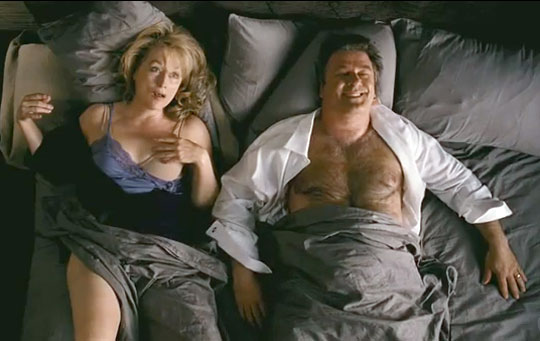
Youngest son's graduation pulls the whole family together in New York, with Jake "flying solo" due to family illness. Once there, the two old marrieds hook up, and once Jane is tanked, there occurs a "once more for old times' sake" canoodling that leaves him satisfied and her vomiting.
Most guys would take that as a sign, but not Jake
. Soon, he's spending too much time at Jane's, telling his ex-wife that his current wife doesn't understand him, and while it may seem like sweet revenge for Jane, she's also creeped out by it, so much so that she won't tell the kids, and allows it to interfere with a budding romance with her architect (Steve Martin). Now, maybe I've been watching too many "Nature" shows on elephants lately, but I could have used David Attenborough to explain this mating ritual to me.
Maybe it's that Martin and Baldwin are playing the roles the other should have taken:
Martin's love interest is a deferential, shell-shocked divorcee with a manner that reminded me of Charlie Ruggles, and Baldwin's in full pursed lips obnoxious priss mode (without the "30 Rock" irony) that makes his character not so much funny as alarming. And Streep, consummate pro that she is, works the material for all its worth, fluttering and kvelling and kvetching, making Jane seem two pastries shy of a brunch. There are times when there seems to be some acknowledgment of time—Jane is constantly fanning herself, as if caught in a hot-flash, but the next instant she's giggling like Juno.
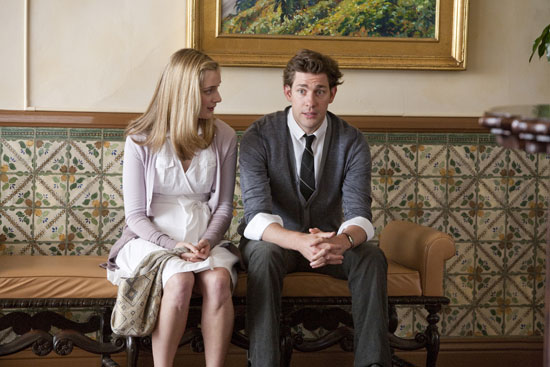
The one guy who seems to be doing something interesting is John Krasinski, as the not-yet husband who finds he's baby-sitting his future in-laws, and is the only one who seems to rise above the material to be doing something interesting—interesting and funny. As the only fully-informed character in the cast, he manages to convey the screwball nature of the situation, acting as the surrogate audience, eyes widening with each embarrassing compromise. He makes Meyers the director—with her sledge-hammer reaction shots and uneven pacing seem far more successful than she is.

Wednesday, March 27, 2024

To Rome With Love

Written at the time of the film's release...

Around the World in Woody's Malaise
or
The Ozymandius Melancholia Gambit ("Turbulence!  My Favorite!")

Far be it for me to suggest that Woody Allen might actually be comfortable in his own skin as a storyteller. but when it has come time for him to do his own "Roman Holiday" film, To Rome With Love, there's not a hint of Fellini in it (Been there, done that—specifically, way back in 1980, when he made his Stardust Memories in tribute to the great Italian film-maker). 

Truth to tell, his latest has more in common with the Italian "anthology" films of the 1960's, where directors would tackle similar themes in short personal films.

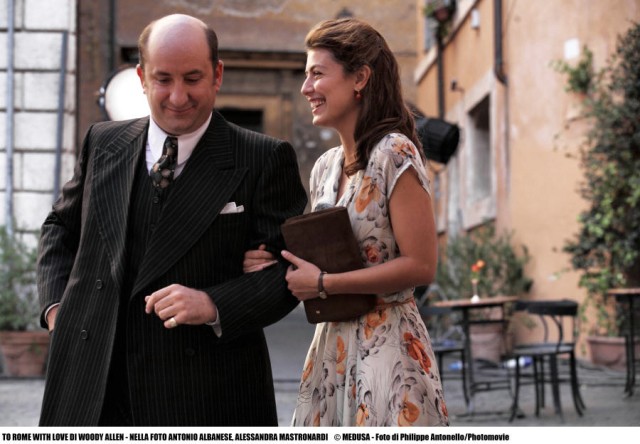
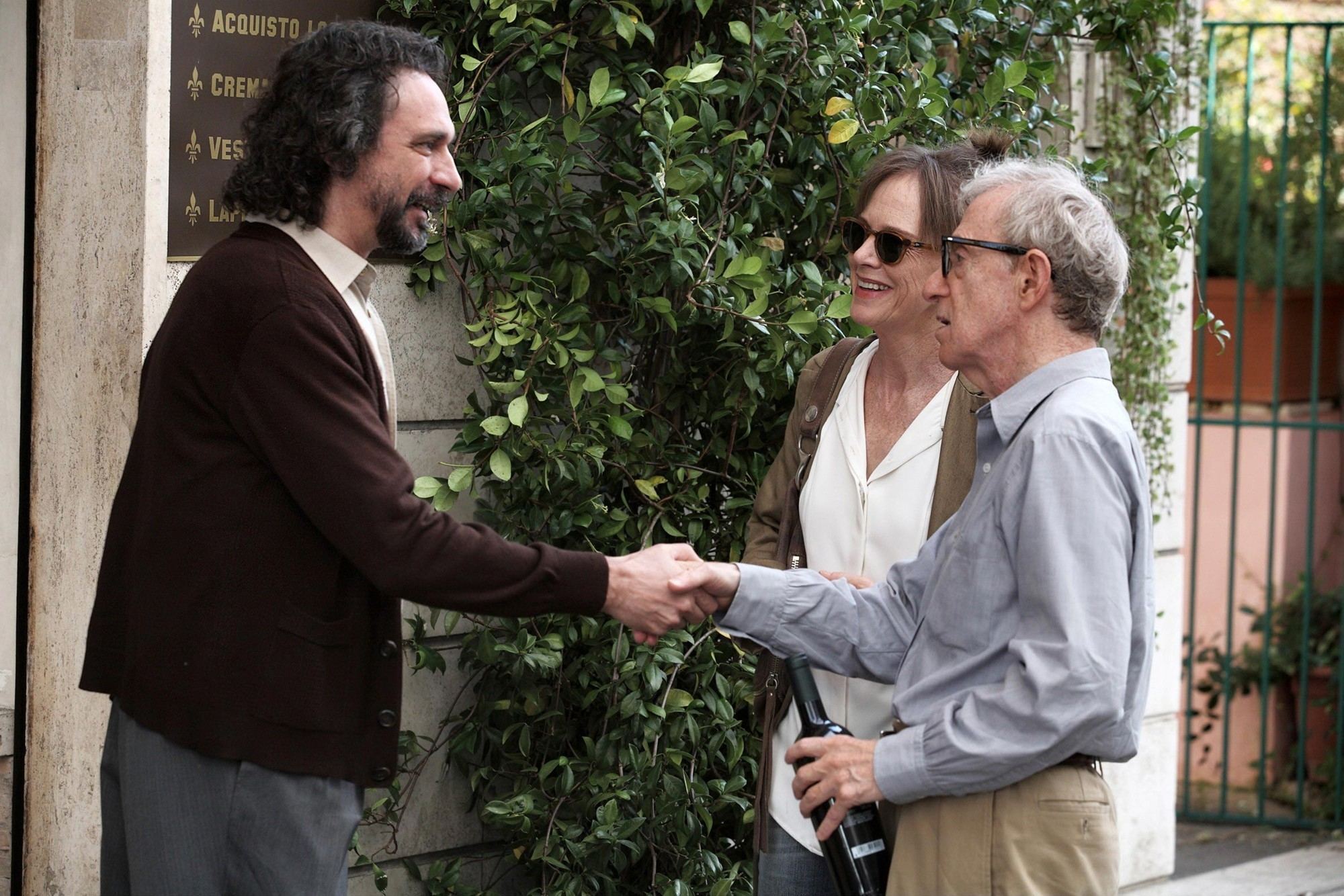
To Rome With Love has four interlocking fantasias about love and personal dissatisfaction: in the first, a young married couple (Alessandro Tiberi and Alessandra Mastronardi) come to Rome, where he is to be introduced to his new work situation—eager to make a good impression, the wife goes shopping and ends up getting lost and involved with an Italian film-star, and hubby, thanks to a case of mistaken identity, must go to his functions in the company of a pre-arranged hooker (Penelope Cruz); the second involves two architects, one seasoned (Alec Baldwin), the other just starting out (Jesse Eisenberg) who become each other's fantasy figures (of a sorts) when the young architect, already attached to Sally (Greta Gerwig), falls for her best friend Monica (Ellen Page), a self-involved, if fascinating, actress.
The third involves a "normal member of the middle class" in Rome (Roberto Benigni) who suddenly becomes "famous for being famous," and is pursued and interviewed by an indiscriminate paparazzi; the fourth involves a former classical music executive (Allen), who discovers a great opera singer (Fabio Armiliato) in the family of his potential son-in-law..with conditions.

The setting is Italian, but the themes are pure "Allen-town." Each of the characters get a brief glimpse of "life on the other side," gingerly placing their toes where the grass is greener, and find it wanting, but themselves enriched from the experience, survived without harm or consequences paid. Baldwin's architect gets to play devil's advocate (much the same way as Bogart did in Play It Again, Sam) with a realist's wisdom, as opposed to a romantic's fool-hardiness—a good cure for his nostalgia. The Italian couple experience romantic fantasies before settling down to domestic bliss, not older but wiser.
Benigni's civil-functionary briefly enjoys cultural significance, with all the invasiveness and dissection of minutiae, before returning to anonymity and the value of a private life, and Allen's retiree gets to witness a fulfillment of his dreams by providing a channel for another, and, having achieved it, returning to his normal life.
Any of these stories could be set anywhere. Rome provides a nice catalyst for these quick short pieces that summarize the Allen world-view: "Life is terrible, but it beats the alternative." And it's buttressed by the standard "Volare"...which mean "to fly." 
Happy landings.

Tuesday, September 20, 2022

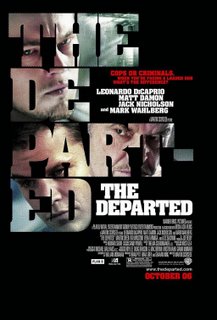
The Departed

Written at the time of the film's release...

Institutionalized Ball-Busting  
 
Call it the Scorsese Thesis: First a guy tells you what he's gonna tell ya, then Marty shows ya, then you're on your own. 
 
In the case of The Departed "the Guy" is Jack Nicholson's Frank Costello, a seedy Boston crime-lord from "some years ago." "I don't want to be a product of my environment," says the shadowy Frank (Scorsese's way of showing Frank as a younger man). "I want my environment to be a product of me."
 
Nicholson's Costello makes good on that promise on two fronts—in the scenario of The Departed, and the movie, itself.  Costello's control over his Boston turf (or, using the accent Martin Sheen employs here, "too-urf") is so absolute, his reach extends from his surly band of criminals to the police department, culminating in one of his own crew (Matt Damon) infiltrating the very task force investigating his activities. Simultaneously, the player on the other side, Captain Queenan (Sheen) has trolled the new recruits to find his own mole (Leonardo DiCaprio) to infiltrate Costello's crew. 
It turns into a complicated
Spy Vs. Spy with both moles straddling the moral fence, while completely unsure of their footing on either side. And while trying to rat out their suspected counter-part while not drawing attention to their own treacheries. They're mutually duplicitous. As Costello says in the Thesis: "When I was growing up, they would say you could become cops or criminals. But what I'm saying is this. When you're facing a loaded gun, what's the difference?"
It's a complicated game of
Jack's Straws...set in a house of mirrors. Drop Nicholson's weight into the middle of it, and the whole thing threatens to pancake...much like the movie. This first collaboration with Scorsese is similar to
Marlon Brando's eccentric performance in The Missouri Breaks, where an actor so drapes himself in business that he attracts the eye in the same way as a car-wreck—you wonder what in Hell this crime-clown (it is much like Nicholson's Joker in Batman without the make-up) is going to do next. Damon and DiCaprio were not clued into his on-set antics and so their scenes are played with the right touch of paranoid hesitancy. There's a strained wariness behind their eyes and they've rarely been better.
As good as they are (and excessive as Nicholson is) best among the cast is
Alec Baldwin as a fast-talking division head, but the real revelation here is Mark Wahlberg. Marky-Mark walks away with the picture and dominates every scene he is in, no matter who's in it with him. In fact, in the one scene Baldwin and Wahlberg share, Scorsese throws in a couple of Raging Bull camera moves for a verbal feint and parry between the two. It's a director's nod to two extraordinary actors doing solid work, free of gimmicks.
As for Scorsese, if you're looking for a return to his greatest efforts, this isn't it. It makes you wonder what he's up to. This story is nothing new, and is in fact based on a Chinese film (and its two sequels, actually) that owes more to the early personal style that he fails to deliver on here. What's the fascination? We've seen the cop/criminal discotomy, as well as the conflicts of working undercover in better films. He's doing program work, not personal work. This isn't Raging Bull or Mean Streets or KunDun or Goodfellas. This is Alice Doesn't Live Here Anymore. Or New York New York. Or The Aviator. One senses he's pacing himself, keeping his hand in the game doing agency "package" movies until the next inspiration comes along. Perhaps he should ditch DeCaprio, and find that last, good DeNiro project. He's too good a film-maker to waste on remakes and empty biographies. Maybe after the struggles he went through to bring his last personal project to the screen he's asking himself at this point in his career "What's the difference?"

Thursday, June 17, 2021

The Boss Baby

They've made a sequel to this one—coming out (so to speak) July 2nd—but, like Problem Child 2 and Look Who's Talking Too (and most families), the sequel will probably get less attention paid to it, so I guess I better publish the "long-in-gestation" review of the original.

Enfant Terrible
or
"A Movie That Combines the Unbearable Smugness of Alec Baldwin with the Unbearable Smugness of...a Baby." -- John Oliver

So many movies have come down the pike, but few have touched on the first crisis in a person's life—that little slice of time when a kid goes from being "the pride and joy" to "the old baby." There are a lot of hard issues there—displacement, abandonment, and dealing with sharing the attention and affection that was previously exclusive. "Only child" is a lofty perch to fall from.

Take Tim Templeton (voiced by Tobey McGuire as an adult/Miles Bakshi as a 7 year old): he had the full attention of two (count 'em) two parents—dedicated employees of PuppyCo.—who would read to him at night and sing his favorite song to him as he drowsed to sleep (for the "record:" "Blackbird" by Lennon-McCartney, but...McCartney). Then, the "second child" comes along and things change. Radically.

It's hardly fair. Tim hasn't changed. He's merely...redundant. The "new baby" is Theodore "The Boss", inexplicably wearing a business suit—and in Tim's view, anyway—can talk (with the voice of Alec Baldwin). His parents (voiced by Jimmy Kimmel and Lisa Kudrow) are seemingly oblivious to this, making the 7 year-old the only one who can see "the truth" about his younger sibling. This creeps Tim out, and he's determined to expose the truth about Theodore by providing proof of his abilities to Mom and Dad.
Already, a "Calvin and Hobbes"-ian kiddie-verse has been established, where the realities of kids is far different than that of the clueless parents. It's not as extreme as "Toy Story" where alternative view-point is that of inanimate objects, but, still the efforts it takes to keep the kiddie-world-view under wraps is far more complex than the Pixar's series' "Okay, toys! Drop in place!" Fortunately, the older generation has a low threshold for exhaustion, so while Mom and Dad conk out, the kids are unsupervised and counter-conspiring. Much like real-life.
Tim's initial strategy is to expose Theodore's ability to talk to the parents by gathering some evidence, which he manages to acquire when a "play-date" is arranged with other local babies. In reality—or the babies' reality, anyway—it is a BabyCorp. corporate presentation on the danger of a rival company, PuppyCo (why, that's where Tim's parents work!) that plans to create the ultimate pet to supplant babies for the little limited love the world has to offer—they don't say that, but it's my take on it. Theodore, because he doesn't react to being tickled, is one of the babies chosen to be management, and so, he's been sent to find out what's going on at PuppyCo. in order to...I dunno...start a Disney franchise about a fashion designer who kills puppies. Sounds reasonable.
Anyway, Tim and Theodore decide to join forces, so that they both get what they want: Theodore gets a promotion and a corner office, and Tim gets Theodore promoted and out of his house. Along the way, we learn that if you want to visit BabyCorp. all you need to do is suck on a special pacifier—which sounds problematic in a world of baby monitors—and that the Corporate babies at BabyCorp. stay babies by sucking on a secret formula that stops their aging process. It all sounds very complicated and messy, not unlike babies, but basically it boils down to Babies and Puppies are in a war for being the cutest generators of affection and that it somehow matters.
It doesn't. It really doesn't. While the idea of corporate robber barons being just big babies has a kind of snarky, cynical appeal, the machinations to create the house-of-cards plot are far too complicated to sustain. And while the film breezes us along, lulling us with jokes featuring big-eyed babies and bigger-eyed puppies, it can't completely stall the feeling that we're being had, with a combination of gooey sentiment and veiled sarcasm, to keep us from thinking about it too much.  
One always looks at movies with an appreciation towards the efforts to bring it to the screen. The voices are well-cast, the colors bright and the drawing/pixilation all imaginatively smooth and un-glitchy. I particularly liked its comic timing. That's a lot of effort. It's in service to a slight story, however, that doesn't have much internal logic to it...in this reality, or the alternate one it conveys.

I mean, if you can't believe in babies and puppies, what's the point??

Tuesday, May 12, 2020

The Good Shepherd (2006)

Written at the time of the film's release...

  The Good Shepherd (Robert DeNiro, 2006) Eric Roth's screenplay for The Good Shepherd seems to have gone through as many hands as states' secrets before actually being put before the cameras. A "personal" telling of the formation of the CIA, Francis Ford Coppola was the first director to have signed to it—then retained enough interest to keep an "executive producer" credit (although Wayne Wang, Philip Kaufman and John Frankenheimer—who interested his Ronin star, Robert De Niro in the project—were also briefly attached before De Niro, who was working on his own CIA project, took it over). Bless my tapped telephone line it has that same sort of "Godfather" family epic-feel to it, with just enough schmaltz and soap to keep it from getting too caught up in its overarching theme of constant paranoia. It also carries the similar pall of "the sins of the father" to it. You just know that the ambitions of the men in the movie will doom their families, if not themselves.
Edward Wilson (Matt Damon) is recruited out of college to join the Skull and Bones secret society, and with his first ratting out of a professor (Michael Gambon), his career as a spy takes the fast track. It's derailed slightly when a quickie with the Boss's precocious daughter (Angelina Jolie) results in pregnancy and a marriage of convenience. Then, when fencing with the Soviets keeps him overseas for years, his fair-weather family-life causes a Cold War on both sides of the Atlantic. 
Soon, Wilson learns, a little too late, that he should trust no one, as he plays against (and develops a mutual admiration with) his equal in the KGB. But its the same old story we've gotten used to in the spy genre. Everybody's a snake looking out for Number One, and trying to make "that Big Score," and yeah, okay, there's only a gray flanneled thread of difference between the spy network and Corporate America
Which brings us right back to "Godfather" country. CIA-Mafia-GM, there's no (*yawn*) difference. The only likable character in the entire film is director Robert DeNiro's turn as "Bill Sullivan"--a veiled version of Bill Donovan, but he's there for two quick dashes of cold-water perspective and is gone. Matt Damon seems not to age at all during the film, whereas Angelina Jolie does seem to gain twenty years. This film came out at the same time as The Good German, and I was hoping someone would combine them into "The Good German Shepherd". Well, I can dream...
It's interesting (well, to me, anyway) to wonder why Damon chose this part, seeing as how his "Bourne" films are merely the "fantasy" side of the "spy" franchise. If he thought that playing the "button-pusher," rather than the blunt instrument was an acting "stretch," he couldn't be more wrong.


Wednesday, December 4, 2019

Motherless Brooklyn

The Big "If"
or
Do You Have the First Inkling of How Power Works?

Listen. This won't do any good. You'll never understand me, but I'll try once and then give it up. When a man's partner is killed, he's supposed to do something. It makes no difference what you thought of him. He was your partner, and you're supposed to do something about it...and it happens we're in the detective business. Well, when one of your organization gets killed, it's...it's bad business to let the killer get away with it...bad all around, bad for every detective everywhere. 
Sam Spade, The Maltese Falcon


"Leave it alone or you'll make a mess." Gil Coney (Ethan Suplee) keeps telling his twitchy partner Lionel Essrog (Edward Norton) while they're waiting for a stake-out. They're providing back-up for the Chief Investigator for their detective agency, Frank Minna (Bruce Willis), and Lionel is starting to lose it. He keeps picking at his sweater and if he keeps doing it, it's going to unravel. He knows he shouldn't, he knows what will happen, and it's not that Lionel is dumb (which everybody thinks), it's just that he has Tourette's and unless he has a drink, or chews gum, or smokes dope, or has his mother rub his neck, he's kinda at the mercy of it. He's just a massive tic. And when he's waiting for something to go down, he's a mess. A blurting, shaking, quaking mess. Admittedly.
But, Minna trusts him. All the crew went through the war together, and it's Lionel that Minna trusts most. Because, yeah, he has Tourette's, but he's also a bit of a savant with a photographic memory. Lionel's good with details and when Minna goes over last minute instructions, he leaves with "Lionel's got it. Follow his lead." Of course, Lionel's got it; he's got it chapter and verse, and he'll be instrumental enough to listen in on the meeting, of which he knows nothing because Minna hasn't told anybody, but he will know everything by the end of it—he just won't understand why.
This being 1950's New York, Minna gives Lionel a phone booth to wait in and, once the older man's in place he calls Lionel and hides the phone in a drawer, so that Essrog can monitor the conversation in the room, and if Minna thinks something's going south, he'll make an innocuous "safe" remark for Lionel to hear in order to know where to take the next step—fight or flight.
It turns out to be a bit of both. Minna is taken by a couple of goons to another borough across one of New York's bridges—the goons in the car flash a badge and don't have to pay a toll—while Coney and Essrog struggle to keep them in sight. They catch up just in time to see the sight of Minna running to escape from his captors, but he can't outrun a bullet and he gets gunned down in an alleyway. It's a fast trip to an emergency room where Minna can only gasp out words with his last breath—"Brooklyn, she's in trouble now..."—before Essrog is escorted out...STAT.
Minna doesn't make it. And it shakes his detective agency to its core. There is a some business to take care of—tell the wife, re-arrange the org chart (if they had org charts)—but Essrog feels like they have to find out who killed Frank and to find that out, he wants to find out what he was working on. The others in the agency are all for it to a certain degree, but there's no money to be made finding out Frank's killing, so it's put on the back-burner, which means Essrog can handle it. All the other guys see Lionel as a handicap, but it was Minna who saw him as an asset.

And besides, Lionel has his hat now.
Edward Norton has wanted to make Motherless Brooklyn for a couple decades. Sure, he did. It's got a "tic-y" part, one of those ones that he excels at, even if he'd rather do something with less obvious "character." But, it's one of those detective stories that starts with a little thing, but mushrooms into the world of noir—even if so much of it is photographed in the clearest of New York daylight—where one realizes that the odds are stacked against because the fix is in and the fixers are too big and too powerful. You're lucky if you get out alive.
And where the evil is so big and so ever-present that you can only see it for the details and the anomalies. And Essrog is good at those. So, he picks at the threads of what Minna was doing, back-tracking and going forward which takes him from the highs and lows of New York, from gleaming City Hall Park to decaying Harlem and the strings that tie them together while tearing the city apart. "Leave it alone or you'll make a mess." But, Essrog can't leave it alone. He's wearing Minna's hat and his coat, and walking backwards in his footsteps, and slowly, but less than surely, he will be making them his own.
The original novel (by Jonathan Lethem) is set in contemporary times, but Norton, sets his screenplay in the 1950's and it's a good fit, taking advantage of the echoes in the detective movie boom, shadowed as it is with the era of film noir, the mainstream popularity of jazz as its soundtrack, amidst a back-drop of the post-war boom in building, an up-sweep in the economy, with the resulting gentrification and the fall-out of segregation inherent in it all. But, it's also in that valley between the increased presence of minorities in the war effort and the Civil Rights movement of the 1960's, where any progress their service might have engendered never materialized amid the same Jim Crow laws and racial covenants placed in the suddenly mushrooming suburbs.   
The time-shift fits the material like an old battered trench-coat and manages to keep it relevant even though relocating it to the past. It also manages to nestle comfortably in the distracted Eisenhower era, where social engineering could be accomplished over long periods of time in the name of progress where little attention would be payed to the changes, lest activists toss their wrenches into the gears.
If the movie reminds me of anything, it's the movie Chinatown, where the machinations of the powerful to manipulate society into protecting their plutocracy happens in broad daylight among the disenfranchised and the under-represented, and where subtle changes to infrastructure uproot lives and undermine neighborhoods and whole communities, turning urban planning into urban "plotting," designed to line pockets while society unravels. And that makes a mess—if not now then certainly for the future.
"The Future, Mr. "Gitts", the future!" Those are the words of Chinatown's Noah Cross (John Huston) when asked by Jake Gittes (Jack Nicholson) why it is that he does what he does, he being so rich and all. At least, he was thinking about the future. Motherless Brooklyn has its "big bad" just like Chinatown had its Noah Cross. It's in the character of a similarly biblically-named Moses Randolph (Alec Baldwin in a part that wasn't in the book, but is based on New York developer Robert Moses). Randolph is more of a short-time thinker, having a vision of his goal but myopic about the ultimate ramifications when it comes to human beings. His eye is on the ledger, the fiscal year, and the next election cycle and what can be done to cook the books. Where Cross wants a kind of immortality from his works, Randolph wants the power to do as he pleases in some Randian plutocracy, where he sees himself as the engine, rather than by the funds provided by people who actually fund it. They pay taxes. They have no power. And so, they can be dismissed. They don't matter. 
In fact, they're pests. "They're invisible. They don't exist." Not Government of the people by the people for the people. Government despite the people. And often, to spite the people.

"Do you have the first inkling of how power works? It means you can do anything." 
My, how that line resonates these days. It should resonate all the time, but people have short memories and the powerful depend on that to survive in a perpetual shell-game, playing the public like a cat-owner with a laser-pointer. And we chase the light, never suspecting we're being manipulated from on high, given new concerns, new enemies, new priorities that are turned on and off—like a laser pointer—when it suits the powerful.

If you think Randolph is a Trump stand-in (it's Alec Baldwin, right? "Duh!"), one should consider that his character builds bridges, not walls. But bridges are just as effective.

Motherless Brooklyn is a great meal of a movie, one of the kind that come out of left-field and is just so good that you wish it wouldn't end. I haven't mentioned 3/4 of the plot because it's one of those things you don't want to spoil, and that neglects great work by Willem Dafoe, Gugu Mbatha-Rawe, and Cherry Jones (as well as stellar production design by Beth Mickle and art direction by Michael Ahern). It's nearly perfect, with its only sin being it might be a bit "on the nose" when it reaches its resolution. But, it still manages to surprise, and gives Norton another one of those flashy performances he can sink his considerable acting chops into. That is has more than that with sub-texts both in the script and the imagery shows that he's come a long way as a director since his last film, 2000's Keeping the Faith.

Hope he doesn't wait so long to make another one.