Showing posts with label Detective. Show all posts

Saturday, April 26, 2025

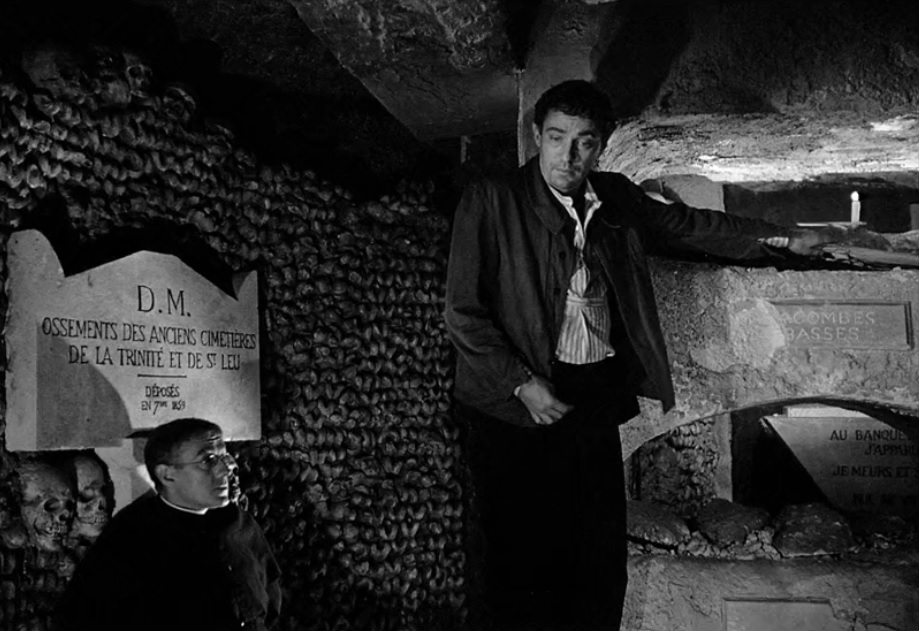
The Man with Bogart's Face

Saturday is traditionally "Take Out the Trash" Day...

The Man with Bogart's Face
(Robert Day
, 1980) With some television series ("The Rebel" and "Branded"), a couple movies (like Chisum) and a long association with director Irvin Kershner on his resume, writer-actor-producer Andrew J. Fenady began work on his first book, "The Man with Bogart's Face" which was first published in 1977. 

I read it not long after that--the title caught my attention-- but it didn't leave much of an impression on me, other than the guy had done his research and that he had an obvious love for the detective films of the 1940's and '50's. It tells the story of a man so obsessed with Humphrey Bogart, he has plastic surgery done on his face and changes his name to Sam Marlow, all the better to become what he's always dreamed of being—a private detective. 

Fenady had an eye to making a movie of the book, wrote a screenplay, got financing from Melvin Simon—Fenady wrote it to be low-budget—and started the process of getting the movie on the screen.
But, who would play Sam Marlow, the man with Bogart's face? Supposedly, an actor had been cast* when in walked a little known thesp' named Robert Sacchi. Saachi had his own one-man Bogart-tribute touring show which he took around the country and from most angles, he was a dead ringer for Bogart (who'd passed away in 1958), and did an impeccable mimicry of him, if slightly limited in range. Put him in a trench-coat and a fedora and he fit the bill like a slightly rumpled suit. 
George Raft (in his last role) confronts Sam Marlow
But for an entire feature film? Maybe that's going a bridge too far. The plot follows the outline of The Maltese Falcon: after unveiling his new plastically-surgeoned face (in a sequence that resembles a similar sequence in Dark Passage), a valuable "whatsit" is coveted by a variety of outlandish characters and newly-chiseled Sam Marlow (Sacchi), with a newly installed ditsy secretary he calls "Duchess" (Misty Rowe), is employed by almost all of them for the prized "McGuffin." That they all vaguely resemble characters from Dashiell Hammett's original only proves that the falcon doesn't fall far from the tree.
 
But, it's The Maltese Falcon-light.
Light, but not so nimble. His first case is with his sizable landlady whose husband is missing. Then he gets a call from Elsa Borscht (
Olivia Hussey), who tells him that her father, Horst, a former prop-man for the pictures, has been getting threatening phone-calls. She tells him this right before they get attacked by two masked gun-men at the Hollywood Bowl. It's enough action to almost make you forget that a character's name is Horst Borscht. It's going to be that kind of picture.
It seems everybody is looking for "The Eyes of Alexander" two perfect blue sapphires once a part of a statue of Alexander the Great. Among the many coveters is Commodore Anastas (
Victor Buono)—whose daughter Gena (Michelle Phillips) Marlow thinks looks just like Gene Tierney in Laura (he even has "the portrait" hanging in his office)—the fey-caricatured Mr. Zebra (Herbert Lom), the slimy club-owner Hakim (Franco Nero), and the former Nazi general (with a wooden arm) Wolf Zinderneuf (Jay Robinson, considerably toned down from his performance as Caligula in The Robe). All have eyes on the Eyes and are ready to resort to any sort of skullduggery to get them. And Marlow is forced to dodge bullets and search for the sapphires in some of the seedier, less photogenic sides of Los Angeles.
It starts to get formulaic very quickly: everybody who meets Marlow has to ask: "Has anyone ever told you you look like..." before he cuts them off with a pivot, Marlow's dialogue is always a little too clever by half and sometimes downright irritating at any quarter. Then, there's an omnipresent narration where he waxes philosophic and usually has to include an old movie reference ("Hollywood Boulevard isn't what it used to be, but then it never was" huh?).
 
After awhile, it gets to be a drag, the kind of movie Bogie would say "only phonies like it."
It gets so bad that Sacchi's performance starts to wear a little thin and you start to notice the differences instead of getting comfortable with them. For examples, the forehead is too high, the nose a little pudgy and the chin weak. Plus, every chance he gets, Sacchi runs a finger across his lip "just like Bogie did" but, he never did it this much and although imitation is the sincerest form of flattery, too much of it is the sincerest form of boredom.

Things get really ugly when things get deadly serious and the most sympathetic (although sadly also the most dull) character gets killed. And the movie begins to drag and Sacchi's impression starts going stale. The real Bogie would risk looking ugly or tortured or something at this stage of the mystery, but Sacchi doesn't dare lest the Bogie-illusion suffers for it. And one realizes then that the performance is relentlessly one-note and the whole enterprise starts to slide downhill.
The movie is of its time and you can't change that—the direction and cinematography looks like that of every run-of-the-mill detective television series of the 1970's—But one would think this thing might have played better during the "Bogie renaissance" when he started being a cult-figure on college campuses during the 1960's.

The Man with Bogart's Face just goes to show that unique can't be imitated and that Bogart was and remains inimitable.

* I'm guessing Jerry Lacy, the most obvious choice. Lacy did commercials as a Bogart look-alike and starred as the phantom-Bogart in Woody Allen's "Play it Again, Sam" both on-stage and film. If he was considered, the loss shouldn't have been too upsetting, as The Man with Bogart's Face died a quick death at the box-office. Sacchi died in 2021, outliving Bogart by over 30 years. Lacy is still quite alive at the age of 89.

Thursday, March 27, 2025

The Detective (1954)

The Detective
(aka Father Brown)(Robert Hamer, 1954) It's quite the scandal when Father Brown (Alec Guinness) is arrested by the local constabulary when he is caught in the act of "burglarious purposes" in front of an open safe. At police headquarters, the humble English vicker tries to explain that he was only trying to return the "swag" ("I believe that's what it's called—'swag'") for one of his parishioners (he admonishes him for being "an incompetent thief...clearly incapable of earning a dishonest living") whom he had convinced to forego a life of petty thievery and, in return, Brown would return the stolen good to the rightful place. That's when the police arrived.
 
A night in the hoosegow (which he finds "most interesting" and thanks the police for their "hospitality") and he's identified by the church authorities and sprung. So, of course, when he's hauled before the Bishop, he assumes it's for the arrest—he having a reputation in the diocese as "an odd one". But, it's of another matter entirely: it's seems that the Eucharistic Congress is soon to be held in Rome. And the Bishop has decided to send the Holy Cross of St. Augustine, which is twelve centuries old and currently resides in Father Brown's parish church. Father Brown considers the cross "not valuable...priceless," so he's alarmed when informed by a local Inspector than an "imminent criminal is intent to intercept the cross en route." The criminal's name is Gustav Flambeau* (Peter Finch) and Father Brown is only too aware of the master-thief's reputation—"a human chameleon" such an expert of disguise that no one knows what he looks like.
When Brown is informed of the precautions, the father-detective goes into a sort of distracted trance—in his mind, he's figured out three different way that the cross could be stolen. "So, if I, an amateur, can steal the cross in
three ways , one can only think what Flambeau will do!" Brown volunteers to take the cross himself—"one priest indistinguishable from hundreds carrying one cross undetectable from hundreds" But, the inspector and the Bishop are in agreement: they will have undercover men make their way to Rome in the hopes of intercepting the wiley thief. To Brown, this is "lunacy!" He makes his own arrangements to carry out his conception of a plan.
Now, as a recovering Catholic, I must confess that the closest I get to religion these days is through Father Brown, the sleuthing priest created by author G.K.Chesterton in 1910 (predating Agatha Christie's sleuths by a decade). I've watched the Mark Williams series, having seen nearly every episode, and read a few of the stories and have always found a kind of solace in the character's rock-solid faith and his unorthodox application of it when dealing with the near-occasion of sinners. He does not judge, believing not that people are good or evil, but merely people, and those that have strayed can always be moved on to the better path. He is not naive, or a cross-eyed optimist, but will argue that his faith is even more pertinent in a world where virtue is challenged. At one point in The Detective, he says: "
My son, you think that you are a man of the world and that I am not. But I assure you, my 'innocent' ears encounter every day stories of a horror that would make your sophisticated hair stand on end. Although I wear funny clothes, and have taken certain vows, I live far more in the world than you do." It's a world where his ability to pick locks, or judo-wrestle are useful tools, particularly when employed for good. He'll even pick a pocket (but only to prove a point when he returns the "swag").
When I found that there was a "Father Brown" movie, particularly to my delight that Alec Guinness played the part, I began an exhaustive search to find it. It took years, but it can now be found** And it exceeded my expectations. I've never been disappointed by a Guinness performance*** and his Brown is very much a sheep in wolfs clothing. He's as sharp as they come, if a bit idiosyncratic, and when called upon Guinness overplays the "twee" nature of Brown, his awkwardness hiding a quick-wittedness—although his humility will never allow him to admit it.
The Detective also has two of my favorite British performers: the ever-beguiling 
Joan Greenwood, (who'd starred with Guinness in a couple of his comedies) as one of Father Brown's more well-off parishioners and confidantes; and Bernard Lee (who would go on to play MI6 head "M" in the first 16 films of the Bond series) as an undercover police officer doggedly pursuing Flambeau, and who finds Brown's deft interference almost in itself criminal.
But, the surprise is Peter Finch as master-thief Flambeau. Up to this point, Finch could be rather stiff in his roles, but, here, he's light-hearted and charming, pulling off the character-work in disguise, and, when unmasked, giving off the air of a bon-vivant, quite happy in his mis-deeds. Guinness and he have a lot of dialog together and they spar winningly.
Based rather loosely on Chesterton's first Father Brown story "The Blue Cross," It's absolutely delightful and was well worth the wait.

* Interesting that they call him "Gustav" Flambeau as Chesterton gave him the christian name of "Hercule"—perhaps to not confuse him with Christie's Poirot, who debuted 10 years later—and the character is supposed to be French, and Gustav is considered a Swedish or German name.
 
** On the streaming service Tubi, but the Lord only knows how long it will remain there. 

*** Okay, there is one. It is Hitler: The Last Ten Days where I found his performance as The Führer rather dull. Time Magazine's critic said it was only useful in showing "the banality of evil." Curiously, IMDB says it's the only performance Guinness was completely happy with, having campaigned actively to play it.

Tuesday, November 14, 2023

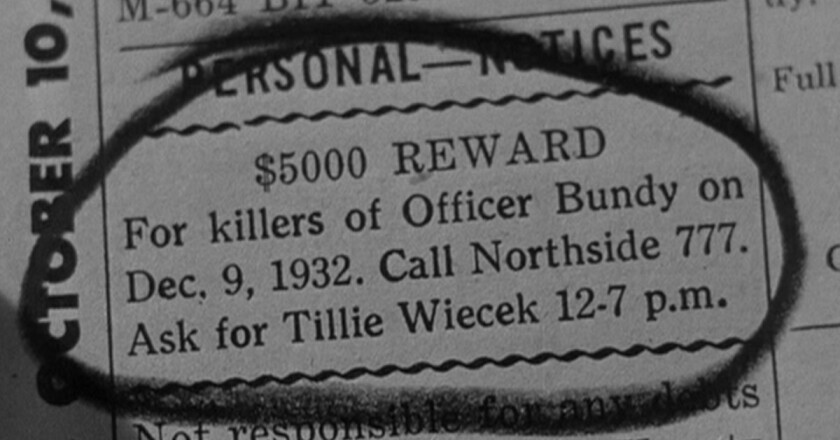
Call Northside 777

Call Northside 777 (Henry Hathaway, 1948) There was a brief period in American films where Hollywood embraced the neo-realist school coming out of Italy—where stories were filmed out in the streets, not in the rarefied atmosphere of a film-studio (It started in Italy because their huge studio, Cinecittá, was being used to house refugees), and it dove-tailed (if one can use so plumy a word) with the gritty post-war world of film-noir and crime-thrillers. Elia Kazan made one, even Hitchcock did.

But the most well-remembered of them was
Call Northside 777 with James Stewart as blasé "Chicago Times" reporter Jim McLane, who, upon taking an assignment he doesn't want, turns it into a cause celebre and his own obsession to see Justice done.
This was one of the first movies
Stewart did after his Air Force service, as he was beginning to challenge and even destroy his callow image audiences were used to at the beginning of his career. Now, with an added maturity he could actually pull off the cynical journalist role he wasn't too convincing as in The Philadelphia Story (which won him a "sympathy" Oscar after losing the previous year for Mr. Smith Goes to Washington the year before) He returned from the war determined to play characters with a darker edge.
Henry Hathaway
directed with a subtle eye, finding interesting deep-focus shots in lackluster surroundings. McLane's first encounter with a scrub-woman washing the stairs of a cathedraled office building carries the visual weight of years of work needed to raise the reward-money to help spring her imprisoned son (Richard Conte). The jailhouse of the visitation scenes IS the jailhouse, and the arrest of Conte's character looks and feels like actual newsreel footage. Finally, you get to go back in time and watch vital clues produced by the old technology of wire-photo transfer. It's another instance where the straight-laced neo-noir style goes a long way in selling the truth of a story, however implausible it might seem.

Tuesday, August 8, 2023

Laura

Laura
(
Otto Preminger, 1944) A favorite for many film-goers for the unique reason that it's a multi-hyphenate of genres. Laura ticks off many boxes: a detective story, a murder mystery, a love story, a ghost story, a "woman's picture," and a proto-film noir.

The story of the murder of advertising executive Laura Hunt (played by Gene Tierney) is an investigation into the gossipy underbelly of New York high society, contrasting the low-down jealousies and back-biting of the rich and famous amid the glamorous fashions and elite penthouse settings, all seen through the eyes of an unimpressed gumshoe trying to see the truth behind the lace curtains.
 
The film's production history is a tempestuous one, filled with office politics at 20th Century Fox--studio head Darryl F. Zanuck had an on-going feud with producer Otto Preminger, but with Zanuck in Europe with the Army Signal Corps documenting the war effort, he had no say in Preminger's work on an adaptation of the property, which came to him when it was still the first draft of a stage-play called "Ring Twice for Laura" written by Vera Caspary. Preminger saw it as a good vehicle to make his directorial debut, and tried collaborating with the author to make it a viable project for the stage...and screen.

Ultimately, the two parted ways and Caspary turned her story into a 7-part serial for Collier's magazine with play's original title, which when re-published in book-form was shortened to, simply, "Laura" and was bought for development at 20th Century Fox.
It falls on jaded New York police detective Mark McPherson (Dana Andrews) to find out who murdered the influential ad executive Laura Hunt (Tierney), and forensics doesn't help as she was killed by a shotgun blast to the face just inside her swanky apartment. No murder weapon has been found, so he makes the rounds of Laura's acquaintances to see if he can come up with any motivation behind the killing. First, he sees Waldo Lydecker (Clifton Webb), notorious newspaper columnist, who, after initially dismissing the ambitious Miss Hunt, became her Svengali/mentor. Lydecker used his column to promote the up-and-coming designer, but also to disparage any suitors approaching Laura on a romantic basis.
That didn't seem to dissuade Shelby Carpenter (
Vincent Price), Laura's fianceé at the time of her death and boy-toy of her aunt (Judith Anderson). McPherson gives them all third degree burns, but is no closer to cracking the case: which of these high-toned, impeccably-dressed lizards would have, well, just the bad taste to do in Laura? Appearances may be deceiving, so he doubles down on Laura's old haunts, her apartment, going through her letters and diary, trying to read between the lines, looking to her thoughts on who might be the culprit. Instead of learning more about any suspects, he learns more about the girl, finding a woman of ambition, yes, but, a different sort than the duplicitous phony-balonies she was navigating amongst.
That's where "the twist" comes in. McPherson finds himself falling in love with the dead woman, and things only get more complicated from there, deepening the resentments that the suspects have against the lower-class detective.
Once Preminger had the script he wanted (with some venomous contributions from 
Ring Lardner Jr.), but his plans to direct were vetoed when Zanuck came back from Europe. Preminger was relegated to producer, and the studio head ultimately gave the director's chair to Rouben Mamoulian, who must have sensed that his producer would lose in any battle with Zanuck, and so started to re-write the script and do his own casting, using a painting by his wife for the portrait of Laura, and favoring the more sinister Laird Cregar (Hitchcock's The Lodger) as Lydecker over Preminger's choice, the slight and haughty Clifton Webb.
 
Preminger and Webb prevailed, but none of the cast was happy with Mamoulian's direction in the first days of filming, where he ignored Tierney, Andrews and Webb, and encouraged a stagey performance by Anderson. A mutiny began among the cast and Zanuck was forced to fire Mamoulian and replace him with his antagonist, Otto Preminger. Preminger kept the cast, but re-staged all of Mamoulian's work, even going so far as to toss the portrait by the director's wife.
But, there was one more ingredient that was needed to make the film an immortal classic. Zanuck assigned 
David Raksin to do the score and the composer met with the TCF head following a screening: "I liked the picture at once but was disheartened to hear [producer Darryl] Zanuck immediately zero in on an essential scene in which...the detective assigned to solve the ostensible murder, wanders disconsolately around Laura's apartment at night. I gathered that the sequence had already been severely shortened, and now it was about to be reduced still further. . . . There was a horrified hush when I was heard to interject, 'But, if you cut that scene, nobody will understand that the detective is in love with Laura.' Zanuck turned toward me, then ... told me that he was about to trim the sequence again precisely because he felt that as it stood the audience would not understand it. . . . I persisted. 'This is one of those scenes,' said I, 'in which music could tip the balance--tell the audience how the man feels. And if it doesn't work, you can still trim the sequence.'"
Meeting with Preminger, Raksin was also disheartened to hear the director had planned to use Duke Ellington's "Sophisticated Lady" for the score, and told the director that he would have a better substitute by the next Monday morning. He was dissatisfied with his work—the legend goes—until he finally got around to reading the "Dear John" letter his wife had sent him. That was the inspiration for the "Theme from Laura", which Preminger was impressed by, Zanuck approved (the sequence wasn't trimmed any further) which became a huge hit, quite apart from the movie. It did add one element that was missing from the movie, even if it hinted at motivation—sentimentality, the melancholy sort. And it hammers home the point that love is such a strange beast that it can make one fall in love with a ghost. It is a love story, after all.
It was nominated for five Oscars (winning for Cinematography) and in 1999, it was voted into the National Film Registry. But, the ultimate test is that it still holds up today (even after being copied for at least one episode of every detective show on television) for its wit, sophistication, and downright grisliness. Good movies are not all that common. It takes a certain magic, an indefinable "something" of happenstance that makes one more than its separate elements. Given its turbulent production history and how many times it avoided mis-steps, Laura is something of a miracle.
Frank Sinatra had a hit with "Laura"
but there's something about Raksin's scoring that is...haunting.

Saturday, February 18, 2023

Marlowe (2022)

Saturday is traditionally "Take Out the Trash" Day...

The Permanent Wave
or
A Tarantula on an Angel Food Cake

I have read everything by Raymond Chandler—the novels, the short-stories, the essays—and I've always loved his writing. His plots sometimes suffered, but the writing...the prose. The hysterical metaphors. There was a bemused humor behind the familial carnage that Chandler cranked out, and a jaded realization that behind every fortune there was some crime involved, and that, if you looked close enough, Tinsel-town was as rusty an old scow. What Chandler wrote was thrilling, even if the plots were mundane, with a depth of consciousness and virtue that a lot of pulp-writers couldn't be bothered with.  
 
Chandler wrote: “Without magic, there is no art. Without art, there is no idealism. Without idealism, there is no integrity. Without integrity, there is nothing but production." Philip Marlowe, Chandler's private detecting knight in crusted armor could have easily said those words, but he wouldn't. Especially the "magic" part. Marlowe would be watching the hands and checking for wires, and be amused while he was doing it. Like his perpetual solo chess-games.
And I've written a lot about Chandler here: the movies—a lot of them—and I had a deep affection for the TV series out of Canadian TV and HBO decades ago, the ones that starred Powers Boothe as "Philip Marlowe, Private Eye." Marlowe's a good part and most people are good at playing him—Bogart, Powell, Mitchum, both Montgomery's, Garner—even Elliott Gould had a nice "take" on the character, although director Robert Altman seemed to think of Marlowe as an out-of-date fool—"Rip Van Marlowe", he called him. So, Marlowe is good for the most part.
But, you can get Chandler wrong. One has to merely look at Michael Winner's remake of The Big Sleep, with Mitchum (who came to the part late), for what "stands out like a tarantula on an angel food cake." The money for that production came from Lord Lew Grade, so (of course) it had to be set in England. Metaphorically speaking, it's the wrong side of the road. America—and Los Angeles, in particular—was young and finding its feet, exploding with development and cash (but no water) but (changing tenses here) with the rush of money comes an emotional adolescence, that one couldn't conceive of in "old money" families. Every family has a black sheep, or secret. But, there are usually structures in place to keep everything "in house." Marlowe's job was usually to roust the cattle after the proverbial barn-door was left negligently open.
Marlowe, the latest film with the character—titular because the source novel, "The Black-Eyed Blonde"* (written by John Banville under the nom de plume Benjamin Black) has a title that implies abuse—tries to evoke the period and the convoluted scenarios that Marlowe regularly skulked, but is a misfire in so many ways that one is just tempted to ash-can with the couple other bad adaptations that have rumbled down the boulevard over the years. And one should state the obvious first: Neeson is too old to be playing Marlowe. True, there is less stunt-work needed to be done, so it's more suitable for the actor's age, but Marlowe was a perpetual 37-45 in the books. Mitchum was too old to play him at 57 in Farewell, My Lovely. Neeson is 70. It makes the redundant smashing of a chair over an already out-cold sparring partner entertainingly apt, but this Marlowe is decades too old to be duking it out with thugs and peeping through people's windows. Marlowe would regularly have his bell rung in the books, but this is the first time I've ever worried about him breaking a hip. There's a difference between being world-weary and just-plain haggard.
And, yes, the film is financed by Irish firms for Irish artists—Neil Jordan directs—but Neeson is also too Irish to be playing Marlowe, his Americanisms slipping with "yer's" and dropped "g's" (although accents usually don't bother me). He wears a three-piece suit—which I can't imagine Marlowe doing unless it was a formal dinner—and (for cryin' out loud), he has a secretary in the office. Marlowe was too loan-wolfish and, more importantly, not that successful to afford one.
They got the louvers right...
 
The story (adapted by William Monahan, who hasn't done an improvement on anything except The Tender Bar) is not much: Clare Cavendish (Diane Kruger) is shown into Marlowe's office ("How private are you?") with a job that requires discretion: her lover Nico Pederson (François Arnaud) has disappeared and she wants to know what happened to him without alerting her jerk of a husband. Nico was doing some studio work, but also had a, shall we say, "importing business" as well, the likes of which involve local crime-boss Lou Hendricks (Alan Cumming), local "bordello" manager Floyd Hanson (Danny Huston), a well-connected studio-head (Mitchell Mullen), who just happens to be involved with star Dorothy Quincannon (Jessica Lange, who is doing a tremendous job at the start of her "Kate Hepburn" eccentricity-acting phase). To paraphrase the detective: So many relations, so few brains. You could figure things out, just by following the strings attached.
Any joys are few and far between: everybody smokes, the women all have shellaced permanent waves, and sometimes the location work done in Barcelona, Spain could make you believe they found some un-gentrified corner of Los Angeles—if you squinted through the bottom of a half-empty shot-glass, that is. It doesn't quite pencil and smacks of trying to stretch a budget until you hear it snap. That stuff's always trouble. And the dialog by everybody is too clever by-half. You want them to just talk without being so damned witty. There is a nice line of dialog as Cavendish exits Marlowe's office, "You're very perceptive and sensitive, Mr. Marlowe. I imagine it gives you trouble."
I imagine a better movie, maybe finding something a little closer to home, maybe with Ron Livingston or Kyle Chandler as Marlowe, and fewer Chinatown call-backs (although the movie-eye-make-up bit produced a snort out of me). I imagine a lot of things, but I can't imagine a duller version of Chandler—or Banville—than this one.

* "The Case of the Black-Eyed Blonde" was the 37th episode of the Raymond Burr "Perry Mason" series, based on Earle Stanley Gardner's 25th book, published in November, 1944.

Wednesday, January 19, 2022

The Long Goodbye

The Long Goodbye (Robert Altman, 1973) Wise-acre. Ass-hole. Cutie-pie. Philip Marlowe's called a lot of names, but in Robert Altman's version of "The Long Goodbye," he's also "The Marlboro Man, The Duke of Bullshit."
 
As Elliott Gould's Phillip Marlowe says again and again "It's okay with me." 

It was supposed to be a straight-ahead adaptation of the Raymond Chandler novel. Leigh Brackett, who had written a lot of Howard Hawks' films (including his adaptation of Chandler's "The Big Sleep") changed the ending, added some characters and complications and Hawks was contacted to direct. Nope. Then Peter Bogdanovich, who also passed, but mentioned Robert Altman for director. Altman loved the new ending, had already worked with the then-cast Elliott Gould for Marlowe and a deal was made.

And that's where the changes come in. Because the last adaptation of a Chandler Philip Marlowe story was the somewhat irrelevant Marlowe starring laconic James Garner in the title roll. Created deep in the 60's, that film feels old-fashioned and a bit musty (even with Bruce Lee kicking apart Marlowe's office!). But for The Long Goodbye, Altman was going to drop Marlowe into early 70's era Los Angeles, where everybody wore caftans and bushy sideburns, were into macrobiotics, EST and pot—a post-hippie era of conspicuous consumption that had trickled down from Marlowe's beat (problems with the rich) to the exotic dancers and truck-drivers of the pre-disco era.* Marlowe and his code of honor would seem out-of-touch in such a world. 
Then throw in Elliott Gould's rat's nest interpretation of the character and you get a completely other sensibility—one begins to suspect Marlowe of being incompetent in such a world, unable to function (he can't even find his own cat), but he does, snapping to whenever some dies (or is about to). And another nice touch is Gould's mumbling patter along the way, supplying his own first-person narrative, ala Chandler.
L.A. in twilight is still the same
and the supporting cast of hoods and thugs (including a before stardom Arnold Schwarzenegger) as menacing as the time the Marlowe books encapsulated (late '30's to mid-50's), but now they're more than just socially deviant, they're demonstrably sociopathic in the form of Marty Augustine (director Mark Rydell), with twisted justifications for their actions, which can sometimes be just a sadistic play of power. And that's what makes Leigh Brackett's screenplay a bit different than the tone she took 'way back in 1945 when she and William Faulkner adapted Chandler's "The Big Sleep" for Howard Hawks and Bogey and Bacall: there's no sense of right and wrong, it's a sense of right and wrong for "me." And Brackett allows Marlowe to make a final statement condemning that world. It's the only way that this Marlowe...in this world...can "make it right." 
There are problems—some stunt-casting—
Nina Van Pallandt (mistress of Howard Hughes scammer Clifford Irving) and Jim Bouton (former Seattle Pilot and author of "Ball Four!")—call more attention to the actors than the characters and Altman regular Henry Gibson has no steel core to speak of for his predatory doctor, but throughout, Altman and ace cinematographer Vilmos Zsigmond bring a formal off-the-cuff look to everything in L.A., culminating in two beach shots reflected in windows that present two perspectives on conversations, while in a push-focus the audience is clued in to happenings going on at the surf's edge, one inconsequential, the other, irretrievable. It's a fine example of Altman's ability as a seamless film-maker making his movie in the camera and relying less on the unique art to film-making of editing.

Three posters/One film: The original film-poster that confused L.A. audiences into thinking they'd be seeing a straight-ahead thriller. The film was withdrawn for six months and re-instated with the  Jack Davis-designed "Mad" style poster—in the upper right of this article—for the New York run, where it was very successful. The international poster ("Nothing says goodbye like a bullet") is included next to the initial poster.
 
* And in a running gag, the percolating presence of a mordant "Long Goodbye" theme (written by Johnny Mercer and John "T." Williams--two years before Jaws) pervades everything in Los Angeles—right down to the mantras and door-bells. Good thing there weren't cell-phones back then.