Showing posts with label Raymond Chandler. Show all posts

Saturday, February 18, 2023

Marlowe (2022)

Saturday is traditionally "Take Out the Trash" Day...

The Permanent Wave
or
A Tarantula on an Angel Food Cake

I have read everything by Raymond Chandler—the novels, the short-stories, the essays—and I've always loved his writing. His plots sometimes suffered, but the writing...the prose. The hysterical metaphors. There was a bemused humor behind the familial carnage that Chandler cranked out, and a jaded realization that behind every fortune there was some crime involved, and that, if you looked close enough, Tinsel-town was as rusty an old scow. What Chandler wrote was thrilling, even if the plots were mundane, with a depth of consciousness and virtue that a lot of pulp-writers couldn't be bothered with.  
 
Chandler wrote: “Without magic, there is no art. Without art, there is no idealism. Without idealism, there is no integrity. Without integrity, there is nothing but production." Philip Marlowe, Chandler's private detecting knight in crusted armor could have easily said those words, but he wouldn't. Especially the "magic" part. Marlowe would be watching the hands and checking for wires, and be amused while he was doing it. Like his perpetual solo chess-games.
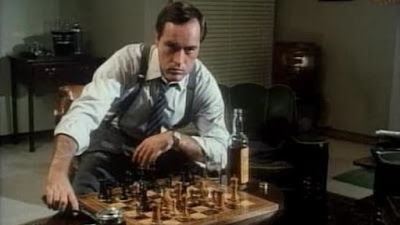
And I've written a lot about Chandler here: the movies—a lot of them—and I had a deep affection for the TV series out of Canadian TV and HBO decades ago, the ones that starred Powers Boothe as "Philip Marlowe, Private Eye." Marlowe's a good part and most people are good at playing him—Bogart, Powell, Mitchum, both Montgomery's, Garner—even Elliott Gould had a nice "take" on the character, although director Robert Altman seemed to think of Marlowe as an out-of-date fool—"Rip Van Marlowe", he called him. So, Marlowe is good for the most part.
But, you can get Chandler wrong. One has to merely look at Michael Winner's remake of The Big Sleep, with Mitchum (who came to the part late), for what "stands out like a tarantula on an angel food cake." The money for that production came from Lord Lew Grade, so (of course) it had to be set in England. Metaphorically speaking, it's the wrong side of the road. America—and Los Angeles, in particular—was young and finding its feet, exploding with development and cash (but no water) but (changing tenses here) with the rush of money comes an emotional adolescence, that one couldn't conceive of in "old money" families. Every family has a black sheep, or secret. But, there are usually structures in place to keep everything "in house." Marlowe's job was usually to roust the cattle after the proverbial barn-door was left negligently open.
Marlowe, the latest film with the character—titular because the source novel, "The Black-Eyed Blonde"* (written by John Banville under the nom de plume Benjamin Black) has a title that implies abuse—tries to evoke the period and the convoluted scenarios that Marlowe regularly skulked, but is a misfire in so many ways that one is just tempted to ash-can with the couple other bad adaptations that have rumbled down the boulevard over the years. And one should state the obvious first: Neeson is too old to be playing Marlowe. True, there is less stunt-work needed to be done, so it's more suitable for the actor's age, but Marlowe was a perpetual 37-45 in the books. Mitchum was too old to play him at 57 in Farewell, My Lovely. Neeson is 70. It makes the redundant smashing of a chair over an already out-cold sparring partner entertainingly apt, but this Marlowe is decades too old to be duking it out with thugs and peeping through people's windows. Marlowe would regularly have his bell rung in the books, but this is the first time I've ever worried about him breaking a hip. There's a difference between being world-weary and just-plain haggard.
And, yes, the film is financed by Irish firms for Irish artists—Neil Jordan directs—but Neeson is also too Irish to be playing Marlowe, his Americanisms slipping with "yer's" and dropped "g's" (although accents usually don't bother me). He wears a three-piece suit—which I can't imagine Marlowe doing unless it was a formal dinner—and (for cryin' out loud), he has a secretary in the office. Marlowe was too loan-wolfish and, more importantly, not that successful to afford one.
They got the louvers right...
 
The story (adapted by William Monahan, who hasn't done an improvement on anything except The Tender Bar) is not much: Clare Cavendish (Diane Kruger) is shown into Marlowe's office ("How private are you?") with a job that requires discretion: her lover Nico Pederson (François Arnaud) has disappeared and she wants to know what happened to him without alerting her jerk of a husband. Nico was doing some studio work, but also had a, shall we say, "importing business" as well, the likes of which involve local crime-boss Lou Hendricks (Alan Cumming), local "bordello" manager Floyd Hanson (Danny Huston), a well-connected studio-head (Mitchell Mullen), who just happens to be involved with star Dorothy Quincannon (Jessica Lange, who is doing a tremendous job at the start of her "Kate Hepburn" eccentricity-acting phase). To paraphrase the detective: So many relations, so few brains. You could figure things out, just by following the strings attached.
Any joys are few and far between: everybody smokes, the women all have shellaced permanent waves, and sometimes the location work done in Barcelona, Spain could make you believe they found some un-gentrified corner of Los Angeles—if you squinted through the bottom of a half-empty shot-glass, that is. It doesn't quite pencil and smacks of trying to stretch a budget until you hear it snap. That stuff's always trouble. And the dialog by everybody is too clever by-half. You want them to just talk without being so damned witty. There is a nice line of dialog as Cavendish exits Marlowe's office, "You're very perceptive and sensitive, Mr. Marlowe. I imagine it gives you trouble."
I imagine a better movie, maybe finding something a little closer to home, maybe with Ron Livingston or Kyle Chandler as Marlowe, and fewer Chinatown call-backs (although the movie-eye-make-up bit produced a snort out of me). I imagine a lot of things, but I can't imagine a duller version of Chandler—or Banville—than this one.
* "The Case of the Black-Eyed Blonde" was the 37th episode of the Raymond Burr "Perry Mason" series, based on Earle Stanley Gardner's 25th book, published in November, 1944.

Wednesday, January 19, 2022

The Long Goodbye

The Long Goodbye (Robert Altman, 1973) Wise-acre. Ass-hole. Cutie-pie. Philip Marlowe's called a lot of names, but in Robert Altman's version of "The Long Goodbye," he's also "The Marlboro Man, The Duke of Bullshit."
 
As Elliott Gould's Phillip Marlowe says again and again "It's okay with me." 

It was supposed to be a straight-ahead adaptation of the Raymond Chandler novel. Leigh Brackett, who had written a lot of Howard Hawks' films (including his adaptation of Chandler's "The Big Sleep") changed the ending, added some characters and complications and Hawks was contacted to direct. Nope. Then Peter Bogdanovich, who also passed, but mentioned Robert Altman for director. Altman loved the new ending, had already worked with the then-cast Elliott Gould for Marlowe and a deal was made.

And that's where the changes come in. Because the last adaptation of a Chandler Philip Marlowe story was the somewhat irrelevant Marlowe starring laconic James Garner in the title roll. Created deep in the 60's, that film feels old-fashioned and a bit musty (even with Bruce Lee kicking apart Marlowe's office!). But for The Long Goodbye, Altman was going to drop Marlowe into early 70's era Los Angeles, where everybody wore caftans and bushy sideburns, were into macrobiotics, EST and pot—a post-hippie era of conspicuous consumption that had trickled down from Marlowe's beat (problems with the rich) to the exotic dancers and truck-drivers of the pre-disco era.* Marlowe and his code of honor would seem out-of-touch in such a world. 
Then throw in Elliott Gould's rat's nest interpretation of the character and you get a completely other sensibility—one begins to suspect Marlowe of being incompetent in such a world, unable to function (he can't even find his own cat), but he does, snapping to whenever some dies (or is about to). And another nice touch is Gould's mumbling patter along the way, supplying his own first-person narrative, ala Chandler.
L.A. in twilight is still the same
and the supporting cast of hoods and thugs (including a before stardom Arnold Schwarzenegger) as menacing as the time the Marlowe books encapsulated (late '30's to mid-50's), but now they're more than just socially deviant, they're demonstrably sociopathic in the form of Marty Augustine (director Mark Rydell), with twisted justifications for their actions, which can sometimes be just a sadistic play of power. And that's what makes Leigh Brackett's screenplay a bit different than the tone she took 'way back in 1945 when she and William Faulkner adapted Chandler's "The Big Sleep" for Howard Hawks and Bogey and Bacall: there's no sense of right and wrong, it's a sense of right and wrong for "me." And Brackett allows Marlowe to make a final statement condemning that world. It's the only way that this Marlowe...in this world...can "make it right." 
There are problems—some stunt-casting—
Nina Van Pallandt (mistress of Howard Hughes scammer Clifford Irving) and Jim Bouton (former Seattle Pilot and author of "Ball Four!")—call more attention to the actors than the characters and Altman regular Henry Gibson has no steel core to speak of for his predatory doctor, but throughout, Altman and ace cinematographer Vilmos Zsigmond bring a formal off-the-cuff look to everything in L.A., culminating in two beach shots reflected in windows that present two perspectives on conversations, while in a push-focus the audience is clued in to happenings going on at the surf's edge, one inconsequential, the other, irretrievable. It's a fine example of Altman's ability as a seamless film-maker making his movie in the camera and relying less on the unique art to film-making of editing.

Three posters/One film: The original film-poster that confused L.A. audiences into thinking they'd be seeing a straight-ahead thriller. The film was withdrawn for six months and re-instated with the  Jack Davis-designed "Mad" style poster—in the upper right of this article—for the New York run, where it was very successful. The international poster ("Nothing says goodbye like a bullet") is included next to the initial poster.
 
* And in a running gag, the percolating presence of a mordant "Long Goodbye" theme (written by Johnny Mercer and John "T." Williams--two years before Jaws) pervades everything in Los Angeles—right down to the mantras and door-bells. Good thing there weren't cell-phones back then.

Saturday, January 30, 2021

The Big Sleep (1978)

Saturday is usually "Take Out the Trash" Day...

The Big Sleep (Michael Winner, 1978) You already know that it's going to be a bit problematic with the very first shot of this adaptation. This later version of Raymond Chandler's first detective novel—cobbled together from elements of his short stories and published in 1939—starts right where the novel starts—with detective Philip Marlowe (played, as in 1975's Farewell, My Lovely, by Robert Mitchum) driving up to the Sternwood Estate for an interview to taking a job. 

The thing is he's driving on the wrong side of the road. That's a clue. When you've been over-stewed in Chandler pot-boilers about L.A.'s most geographically-associated gumshoe that sort of thing stands out like the proverbial tarantula on angel food. He's not in Los Angeles, where they drive on the right (that is "non-left") side of the road, he's in London, held over from The War, it seems, and he's driving a Mercedes. Already you feel that something is very wrong, even before he does his interview. It's not your Grandfather's Philip Marlowe.
The interview with Sternwood (James Stewart) goes well, as far as it goes. The General is being blackmailed—it's not the first time—and his son-in-law Rusty Regan usually handled such things one way or another. But, Rusty has disappeared. There are rumors, but just that. Marlowe has been recommended by Scotland Yard and he accepts the assignment, but not before he's been told about the Sternwood girls, Charlotte (Sarah Miles, Mitchum's co-star in Ryan's Daughter) and Camilla (Candy Clark), who Marlowe has already met ("She tried to sit on my lap...while I was standing up," a line used in the book and both movies. For this version, the names have been changed—from "Vivian" and "Carmen"—to protect the not-so-innocent.
After taking his leave of the General, who has complained of fatigue, he is commanded to the bedroom of Charlotte, who demands to know what Marlowe has been hired for—possibly to find her missing husband? Marlowe says it's the general's business and none of hers, and she leaves unsatisfied and unimpressed.
Marlowe's first stop is to the bookstore of H. R. Geiger, whose name is on the notes. By subterfuge, he concludes that the shop is not a book store, per se, but rather a front for a pornography distributor. He has a bit of disagreement with the shop's receptionist, Agnes (Joan Collins), who develops an instant dislike to Marlowe's pestering.
Marlowe stakes out Geiger's flat and sees lights flashing inside. The last flash, though, is from a gun-shot and Marlowe breaks in to find much amiss: Camilla, drugged and naked in front of a camera, the film missing, drug paraphernalia  strewn about, and Geiger dead on the floor with a gunshot wound in the forehead. He checks the backway to look for the killer, but has missed him. Camilla is certainly in no shape to have done it, she's high out of her mind, the bar of which is set pretty low to begin with. The best thing to do is throw something on Camilla and get her home, pronto. He'll come back to the house later.
That's after he gets some well-deserved shut-eye; the bags under Mitchum's eyes are starting to look like suitcases. But, he gets called by The Yard (in the person of John Mills) to watch a car being dragged from the water. In it is the Sternwood's chauffeur, dead. A little too close to home, even if your home is a mansion, ain't it? Heading back to his office, Marlowe finds older sister Charlotte waiting for him, still wanting to know what the General has hired him for—no dice, lady—and to tell him they're being blackmailed by somebody else, this time with naked pictures of Camilla...from the previous evening's recreations. Marlowe tells her to pay up and she says she can borrow the money from gambling boss Eddie Mars (Oliver Reed in full hissing snake mode). Hmmm. Isn't there a rumor that Rusty ran off with Mars' wife? Bears investigating.
Well, one can get into the weeds very quickly here, and the movie's only 30 minutes in. There is a famous story about the Howard Hawks-Humphrey Bogart-Lauren Bacall version done in the 40's where there was a body but nobody had any idea who killed him. The writers didn't know. Hawks didn't know. Chandler didn't care—"that's your job" he told the movie-makers. By that time, Hawks didn't care, either. There's a line in both movies "so many guns. So few brains." Well, there are so many corpses that keeping track of them all without a toe-tag is an exercise in fatality. The 1978 version wants everything nice and tidy and explained, whether we care or not. Where, the 1946 version kept that information vague and unresolved, Winner doubles down to explain it with voice-over and a flash-back sequence introduced with a picture-spinning rotation (the edge of the frame threatening to slap us awake). He needn't have bothered.
What this version of The Big Sleep does well is to fill the film with so many good British actors that one gets dizzy remembering them all: Miles, Mills, Reed, Harry Andrews, Collins, Edward Fox (he's good!), Colin Blakely, Richard Todd, James Donald, who are clearly enjoying their versions of American 1940's types. It's just that it's set in the 1970's and the transition makes some of the scenes a little bit campy, like the actors are having too good a time "slumming." But, this one doesn't feel like one of those old B-movie shadow-fests. It's film-noir with the lights on, and one fairly squints from that and volunteering too much information. 
There's no style, just a lot of substance. And although it's a slightly more faithful version of the Chandler novel in the tawdry specifics, thanks to deep-sixing the Hays Code, nothing much is gained—other than the feeling that this would have been really racy in the 1940's, but in the era of buying nudie mags at the 7-11, it's merely people going to too much trouble for little return.
One of my favorite lines from the earlier version is in the scene when Vivian comes to Marlowe's office and gives him the envelope with Carmen's nudes. He takes a look at them and cracks "She takes a good picture..." It's funny and sick and rude and if you didn't know what he was talking about, you'd never know, so far does it fly beneath the censor's radar.

And it's clever, something that Winner's "bleed-by-the-numbers version" never really achieves. Should have known when I first saw the Mercedes driving up the left lane. This movie was going the wrong way.

Tuesday, September 4, 2018

The Lady in the Lake

Lady in the Lake (Robert Montgomery, 1947) Call it an experiment that fails—but a noble try.  Bob Montgomery took his opportunity to make a low-budget pot-boiler of Raymond Chandler's Philip Marlowe mystery and take it as close to the source as he could...in spirit, anyway. Taking Chandler's first-person narration-style and translating it into cinematic terms. Instead of reading inside Marlowe's head, we're seeing out of his eye-sockets—I didn't know Marlowe was monocular. Nor did I know he was borderline schizophrenic—with cooing voices in the background, passing for a dramatic score (at least it's organic).

Chandler hated this one. He'd written his own screenplay adaptation (that wasn't used) and thought the POV work...didn't work. It doesn't, really. In fact, it's creepyWe, the audience, are constantly being talked to directly, with Marlowe's replies in voice-over—but because we don't see him, those replies are so "on-the-nose" as to be bluntly obvious. In a way, this direct method robs us of actually seeing Marlowe's thoughts, playing across the face of the actor portraying him. No, Marlowe has to say everything on his mind, making him the lamest of detectives—he's always telling people of his suspicions of them. Nice detective work, there, shamus.
But, it does follow the story...in the same way a stage play might follow it. We're kinda "stuck" inside Marlowe's head, and any investigation—the thing that distinguishes this story in the Marlowe canon is that it takes him out of L.A. But, we never get out of rooms. We lose some characters, and the bigger shocks (the discovery of "the lady in the lake," for instance, which they probably couldn't show as it's pretty gruesome in the book) are talked about happening off-camera. Nope. Everybody's standing around talking to each other...actually they're standing around talking to us.
Like I said, creepy.
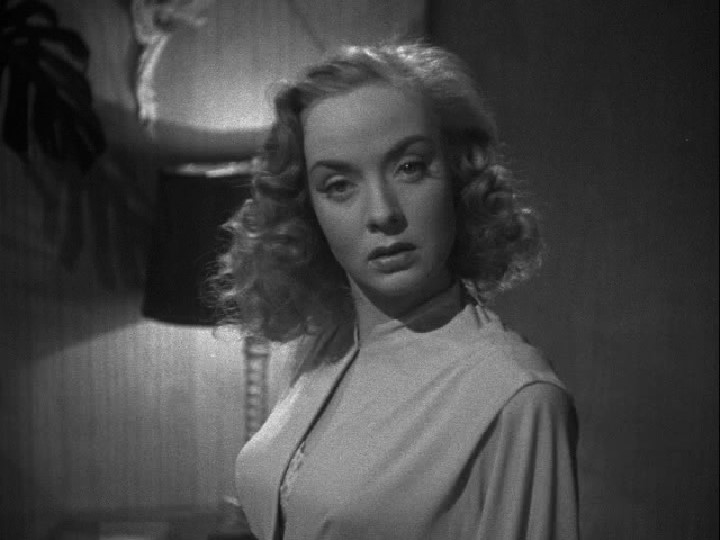
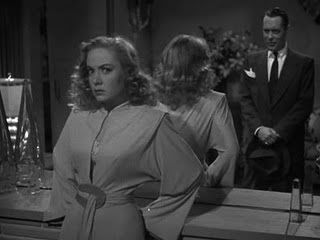
It also kills any momentum. Because the camera is the only thing that has any action to itWe see what he sees, following babes—rather obviouslyevery door-knob that is reached for (how exciting!), and only see our hero in the mirror. It doesn't help the actors, either. Montgomery might have been a great Marlowe—we just don't see it. And poor Audrey Totter—her character doesn't even make any sense. She whip-saws between emotions in a bi-polar performance, that when Marlowe's supposed to trust her, you just don't buy it...or buy him for doing it. The technique works against everything here. The only one who adapts well to it is Lloyd Nolan, but he'd already done an adaptation of Chandler's "The High Window" as the Marlowe stand-in, and already had the "cracking wise" patter down cold.
The thing is, POV can work. It works to a certain extent in Dark Passage, and  Jonathan Demme employed it amazingly well—and sparingly—in The Silence of the Lambs, where audience identification is only enhanced by our seeing the direct play of emotions across faces. Montgomery was an actor, and a good one, so it's amazing that he would choose to do this experiment rather than trust his own craft; it's a hard lesson to learn, but an easy one when you think about it—you can tell an audience anything you like, but to use the medium of movies to its best extent—you should show them.
Robert Montgomery as Phillip Marlowe in the only way we see him
(except when addressing the audience)—in a mirror. 


Thursday, August 17, 2017

Murder, My Sweet

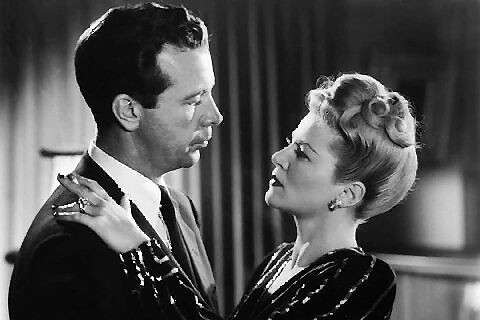
Murder, My Sweet (Edward Dmytryk, 1944) A neat trick, this. Although the third Raymond Chandler adaptation to make it to the screen—the first being The Falcon Takes Over (taken from the same source novel as this—Farewell, My Lovely) co-opted as a story-line in the George Sanders "Falcon" movie series, and the second, Time To Kill (based on "The High Window") featuring Lloyd Nolan's popular Michael Shayne character, Murder, My Sweet is the first to feature Raymond Chandler's "slumming angel", Philip Marlowe.*  

The main departure is the title: Chandler's choice, "Farewell, My Lovely," was ditched after a preview screening because those first viewers were expecting more of a musical, as the movie starred Dick Powell, who was a mainstay of that genre and not the first person casual movie-goers would think of as a slightly soft-boiled detective sifting through the grime of Los Angeles. The name was thus changed to something suggesting more violence than tap-dancing...and probably to protect the innocent.**
Dmytryk and writer John Paxton do a fair job of keeping the first-person narration intact (the set-up is that Marlowe is being grilled by the usual suspicious police and he's giving his side of how things went down), and keeping a steady pace that's surprisingly fast. Although they didn't use Chandler's exact phraseology, they do a nicely watered down, tightened-up version of it for cinema audiences for whom thinking too much of the cleverness of a metaphor as it passes by their cerebellum might slow down a film's momentum. Call it "Chandler Lite." Although a lot of it is quite good, if less surly. One of my favorites is when someone says they don't like Marlowe's manners: "Yeah, I've gotten complaints, but they keep getting worse."
Powell can't get too far from his roots—he does a fancy two-step
in the "mausoleum" of a foyer.
It works, especially for the speed of this film. For the role of Marlowe, especially the first one, Dmytryk and the studio made an odd choice in Dick Powell, an A-lister in musicals. But, he's very effective. He's got a lived-in face, like a hound's, not a matinee idol's, slightly doughy (as is his body-type, despite being told he's "in good shape"—that's Marlowe to a wife-beater "T."), and you believe that Powell would be a reflexive weisenheimer—something about the "hoofer" background. The light comedy experience makes the sarcasm go down very well.
And Dmytryck has the noir feeling down, too, being as he was one of the architects of the style. Begin your movie in transition so the audience has a lot of questions it has to answer, go heavy on the atmosphere and always exit the scene with a sardonic quip. You already know you're in the hands of a master with the sequence that introduces "Moose" Malloy (Mike Mazurki) who just suddenly appears as a menacing reflection in the window that only appears because of the intrusion of a nearby flashing neon light. It's as disconcerting...well, as disconcerting "as a tarantula on an angel food cake", thank you very much! Dmytryck also has fun dancing around the brim of the Hayes Code in the two knock-out sequences of Marlowe being knocked out—always a hallmark of Marlowe stories and fans of inky pools of blackness, Long Goodbyes and Big Sleeps (or "Big Lebowski's," if you'd rather, later).
Indispensible in the mix is a high concentration of sass which is provided by that queen of the formClaire Trevor, whose performance as an evil step-monster is almost too much of a good thing. Murder, My Sweet would have been a rich enough story without her. Her presence and its tilting of the sexual equation slams this one deep onto the classic shelf. Powell would play Marlowe again on television, but this initial outing made him definitive...until Bogart came along.
But, for the record books...Chandler always said that Powell was his favorite version of Marlowe.

* The Big Sleep with Bogart as Marlowe was made the same year, but not released until two years later.

** They finally got around to using the title in the 1975 Dick Richards remake that starred Robert Mitchum, who would have been too pretty for Marlowe in his youth, but had aged into a wrinkled world-weariness that worked. When he was approached by producer Elliott Kastner and financier Sir Lew Grade to play the part—after their first choice, Richard Burton (??!!), had turned it down—Mitchum says that he said: "Why don't you just re-release Murder, My Sweet with Dick Powell and we can all go to the beach?"