Showing posts with label Robert Montgomery. Show all posts

Friday, January 29, 2021

Haunted Honeymoon (1940)

Haunted Honeymoon
 (aka Busman's Honeymoon) (Arthur B. Woods, Richard Thorpe, 1940) 
During the COVID shutdown I retreated to books rather than online films. This was made problematic when libraries were shut down for the initial blast of lockdown/containment. An e-book reader (which I never really cottoned to) had access/account issues that I was never able to resolve. My brother, however, took pity on me and sent me a CARE package of lots and lots of books, mostly in the "Mystery" genre—lots of Hammett's (I'd never read any of the "Continental Op" stories and now I've read them all), some McDonald's (Ross) and some more contemporary ones that I found intriguing.

Most of them, however, were from the Golden Age of Mystery—the line from "Sleuth" says "when every cabinet minister had a thriller on their nightstand and all detectives were titled." The ones I received were by Dorothy Sayers, a name that was on the back-burner of my mind from browsing at book-stores, but I never entertained reading.

Sayers' most remembered creation is Lord Peter Wimsey—upper-crust, refined, WWI veteran and survivor, a book-collector and frequent "quoter," considered flippant and frivolous, but managed to "fit in" with gentry and commoner alike. He and his loyal butler, Mervyn Bunter, would take on the mantle of amateur sleuths when requested of "The Yard" or when a curious death merely crossed their paths. 

During one of those investigations ("Strong Poison" published 1930), Lord Peter falls in love with the object of his investigation, novelist Harriet Vane, who is accused of murdering her lover with arsenic—during their first meeting in the London dock he asks her to marry him, which she refuses, aghast). Over the course of three novels, Wimsey pursues Harriet, until they are finally marry in "Busman's Honeymoon" published 1937.
But, before that, that last was a stage play of the same title, first performed in December 1936. It is for that reason—the adaptation to another medium along with Sayers' aversion for screen adaptations of her work—that it is the only Wimsey story ever filmed (although television serials have been done subsequently). 

Raymond Chandler (in his essay "The Simple Art of Murder") griped about the story “a murderer who needs that much help from Providence must be in the wrong business.” One sees his point. The elaborate way in which the murder is committed—and recreated—beggars the logical, but one CAN see where it might make for an entertaining experience for a stage audience.
M-G-M acquired the rights to film the play and three screenwriters are credited with it. There is an extensive re-write as fall as dialogue but everything basically follows the original structure...with some shifting of the weight of exposition. The set-up is this: Lord Peter and Harriet get married and having won his intended, Wimsey, in a sentimental gesture, has purchased the estate of "Tallboy's"—"Elizabethan, very pretty," "a huddle of black gables with two piled chimney stacks"—in the village of Paggleham, not far from where Harriet was raised as a child, and the site of many fondly-remembered visits to the Bateson's who lived there at the time. Harriet had once vowed that should she be able to afford it, that she would purchase it one day. That day has come, purchased from a blunt man called Noakes, who says he will arrange that the place will be set up for the honeymooners. After the wedding and reception the now-newly designated Lord and Lady Wimsey set off for their honeymoon...with butler in tow, gingerly minding their crate of port.
Once there, though, they find the place altogether not ready. Vacated, yes. But, there is still a meal on the table (dash it all!) and no keys made available for easy entrance. What has happened to the man Noakes and why are things in such disarray?
That's the novel's perspective, anyway. Haunted Honeymoon gives us a little more back-story. In the book, we never meet Tallboys' present owner, Noakes. But, the movie has an extended scene where we see a great deal of him, and the various squabbles he has with employees, neighbors, and locals acted out (which we receive in the novel from gossipy hear-say in various interrogations, which, in a movie, might have become tiresome and pedantic). The movie cleans up any extended dialog and things bustle and bounce along with charming village quaintness displayed, giving the impression of Wimsey and Harriet understanding the situation with just the merest mention.

In fact, the reveal and denouement occur so quickly that one may suspect that the two have some sort of precognitive power, rather than any method of deduction. It's no wonder Sayers was horrified, thoroughly dis-owned it, and stated that she would never watch it. The idea!
And let's just be chauvinistic about it: Robert Montgomery just isn't suave, sophisticated, or silly enough to be Peter Wimsey. There's no monocle, he's thoroughly Americanized wisenheimer with an attempt at "jolly-good" positivity thrown in, but it's never consistent like the accent (he's like the "thinnest" of "Thin Men")—Constance Cummings fares better with her formal M-G-M elocution-speech-patterns resembling high talk. Seymour Hicks is much, much too old an actor to be playing Bunter—one could hardly believe that he served with Wimsey during The War, and wouldn't just be patted on the back at the recruiting office and told he'd be better doing "civilian service" 'round 'ome.

Still, it's something. Not unlike the Basil Rathbone Sherlock Holmes series that seems like they should be faithful renditions of the source, but simply aren't, merely neutered imitations to satisfy the folks who've never read them and wouldn't know the difference. The thing is, Sayers is just too complicated and methodical a writer to shoe-horn her stuff into a two-hour movie. Better that they were adapted as a mini-series, and a rather leisurely mini-series at that.


Tuesday, September 4, 2018

The Lady in the Lake

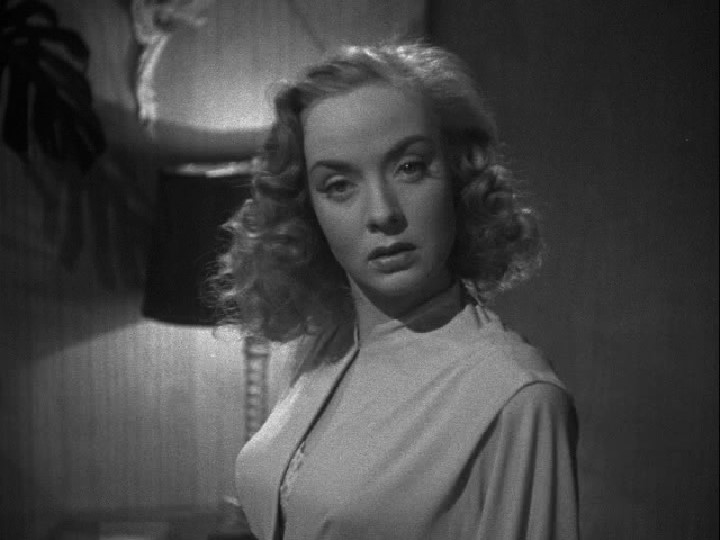
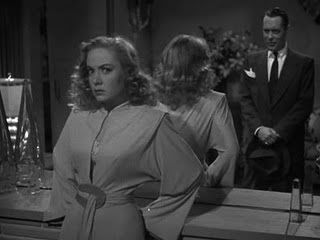
Lady in the Lake (Robert Montgomery, 1947) Call it an experiment that fails—but a noble try.  Bob Montgomery took his opportunity to make a low-budget pot-boiler of Raymond Chandler's Philip Marlowe mystery and take it as close to the source as he could...in spirit, anyway. Taking Chandler's first-person narration-style and translating it into cinematic terms. Instead of reading inside Marlowe's head, we're seeing out of his eye-sockets—I didn't know Marlowe was monocular. Nor did I know he was borderline schizophrenic—with cooing voices in the background, passing for a dramatic score (at least it's organic).

Chandler hated this one. He'd written his own screenplay adaptation (that wasn't used) and thought the POV work...didn't work. It doesn't, really. In fact, it's creepy. We, the audience, are constantly being talked to directly, with Marlowe's replies in voice-over—but because we don't see him, those replies are so "on-the-nose" as to be bluntly obvious. In a way, this direct method robs us of actually seeing Marlowe's thoughts, playing across the face of the actor portraying him. No, Marlowe has to say everything on his mind, making him the lamest of detectives—he's always telling people of his suspicions of them. Nice detective work, there, shamus.
But, it does follow the story...in the same way a stage play might follow it. We're kinda "stuck" inside Marlowe's head, and any investigation—the thing that distinguishes this story in the Marlowe canon is that it takes him out of L.A. But, we never get out of rooms. We lose some characters, and the bigger shocks (the discovery of "the lady in the lake," for instance, which they probably couldn't show as it's pretty gruesome in the book) are talked about happening off-camera. Nope. Everybody's standing around talking to each other...actually they're standing around talking to us.
Like I said, creepy.
It also kills any momentum. Because the camera is the only thing that has any action to it. We see what he sees, following babes—rather obviously—every door-knob that is reached for (how exciting!), and only see our hero in the mirror. It doesn't help the actors, either. Montgomery might have been a great Marlowe—we just don't see it. And poor Audrey Totter—her character doesn't even make any sense. She whip-saws between emotions in a bi-polar performance, that when Marlowe's supposed to trust her, you just don't buy it...or buy him for doing it. The technique works against everything here. The only one who adapts well to it is Lloyd Nolan, but he'd already done an adaptation of Chandler's "The High Window" as the Marlowe stand-in, and already had the "cracking wise" patter down cold.
The thing is, POV can work. It works to a certain extent in Dark Passage, and  Jonathan Demme employed it amazingly well—and sparingly—in The Silence of the Lambs, where audience identification is only enhanced by our seeing the direct play of emotions across faces. Montgomery was an actor, and a good one, so it's amazing that he would choose to do this experiment rather than trust his own craft; it's a hard lesson to learn, but an easy one when you think about it—you can tell an audience anything you like, but to use the medium of movies to its best extent—you should show them.
Robert Montgomery as Phillip Marlowe in the only way we see him
(except when addressing the audience)—in a mirror. 


Friday, March 16, 2018

Free and Easy (1930)

Free and Easy (Ed Sedgwick/Buster Keaton, 1930) Gosh, this is a tough one to write and I've been avoiding it for over a year as it is just too depressing. Free and Easy was a couple of films into Buster Keaton's new contract with M-G-M after buying his Keaton Studios, his first "talking" picture, and the first attempt by the studio to "shoe-horn" him into a star of the M-G-M caliber. 

And...they put him into a musical. After all, when something is successful, do something completely different and expect the same results. For all of Irving Thalberg's reputation of being a movie "genius," his work to "improve" Buster Keaton shows him to be not only fallible, but thuddingly so. Of all the pratfalls Keaton took, this one is the most painful to watch...because it's not under his own power.
In Free and Easy, Keaton plays Elmer Butts, a gas station attendant, who seeks to be the manager and very unlikely paramour of Elvira Plunkett (Anita Page), winner of the Gopher City Kansas beauty pageant, who is travelling to Hollywood to seek fame and fortune and/or a movie contract. Along for the ride, chaperoning, is Elvira's indomitable mother (Trixie Friganza) who thinks Elmer is a sap and is in no way shy of expressing that thought...or any other. But, Elmer is smitten, and after nearly being left behind by the train, finds himself perpetually frustrated trying to talk to Elvira.

The description makes it sound like a typical Keaton script, but, this time it's with sound, and immediately, you sense a problem: the timing's off. Comedy has a rhythm and its timing is critical in order to produce a laugh. The hi-jinx getting on the train in the opening scenes all try to play for big laughs, but come up short, and they stutter as the physical comedy that, before, propelled a Keaton comedy is replaced by broad dialogue. The film will improve the ratio a bit as it goes along, but, initially, it's a bit of a shock, especially when compared to the momentum of Keaton's silent's, which were cut to the action, not to the dialogue.

There must always be a rival for the girl's affections in a Keaton film, and it arrives early in the form of a studio contract player named Larry Mitchell (Robert Montgomery in only his 6th on-screen role), who is suave, debonair, and a bit of a cad. He convinces Elvira that he can do great things for her with his contacts in Hollywood, and it may be only a ruse to seduce her (the film is pre-Code, so you could get away with things like that), which puts us clearly on Team Keaton. Even as he bumbles his way through trying to connect with Elvira—he drives her and Mom to a big Hollywood premiere only to not be able to attend with her himself because he can't find a parking space—one senses a change in character under the mis-direction of MGM. Keaton always played something of a rube, but he was always a resourceful one, practically willing himself to get out of predicaments; how he would extricate himself out was always part of the surprise and part of the charm of his work.
He, he's merely hapless—a Kansian lost in the glitter and absurdity of Hollywood (ironically, Keaton actually WAS from Kansas). He's out of his depth in all the shallowness, a decent-enough fellow in an environment where glitz and glamour are what is valued. The conceit of the film is that of What Price, Hollywood (to be filmed two years later)—that Page's Elvira gets to Hollywood where she decides that what she wants is stability, and it is actually the unsophisticated Elmer who gets a Hollywood contract, getting something he doesn't really want, but losing what he does. Career and love go on parallel tracks of desire, but never in the same direction.
Elmer goes skulking around the MGM lot trying to find Elvira while trying to avoid studio security, screwing up shots, destroying sets, and being a typical bull in a china-shop, when he stumbles into an audition with director Fred Niblo—Free and Easy is full of cameo's by MGM stars and directors that it almost feels like a presentation to its board of directors—who can't seem to get a decent line reading of "Woe is me, the Queen has swooned!" Despite the difficulties with lines, he nevertheless manages to get a featured musical-comedy role—improbably playing against Elvira's mother!—in a large production that's run like a Broadway show—even though it's a movie, it's all presented as if they do it in one amazing shot, without the necessity of editing away (except in the magical way that MGM musicals do).
It's a testament to Keaton's talent that he even brings the musical number off...despite his low bass voice, being "boxed" away for a part of the number, and being "Peter Panned" around on ropes in a weird puppet dance (one could "read" something into that as a comment of the studio's treatment of him, but we'll let that go).

Perhaps we should leave that for the ending, with a successful Elmer in sad clown make-up, bravely keeping the show going on, while holding back tears for his lost lady-love. Sentimentality was never a strong suit for Keaton—that's in Chaplin's bag of manipulations—he would always undercut it with a joke and move on, but, here, the filmmakers linger on the pathos...and it just...feels ...wrong. Sad, yes, but not in the way it's intended. Sad because it's a great comic artist—nay, genius—being misused in a way that he never would have planned at his own studio. But, Keaton was no longer considered an artist, but  just a commodity. And if MGM saw him as a "fall-guy," rather than as a comedian, then he would take the fall. And for a comedy called Free and Easy, that's a tragedy.

Free and Easy did make money, though, which only encouraged MGM to continue their folly. Keaton's next movie, though, would see a return of his comic snap.


Wednesday, February 21, 2018

The History of John Ford: They Were Expendable

When Orson Welles was asked what movies he studied before embarking on directing Citizen Kane he replied, "I studied the Old Masters, by which I mean John Ford, John Ford, and John Ford."

Running parallel with our series about Akira Kurosawa ("Walking Kurosawa's Road"), we're running a series of pieces about the closest thing America has to Kurosawa in artistry—director John Ford. Ford rarely made films set in the present day, but (usually) made them about the past...and about America's past, specifically (when he wasn't fulfilling a passion for his Irish roots).

In "The History of John Ford" we'll be gazing fondly at the work of this American Master, who started in the Silent Era, learning his craft, refining his director's eye, and continuing to work deep into the 1960's (and his 70's) to produce the greatest body of work of any American "picture-maker," America's storied film-maker, the irascible, painterly, domineering, sentimental puzzle that was John Ford, John Ford, and John Ford.
They Were Expendable (John Ford, Robert Montgomery, 1945) First things first: John Ford set up and shot the vast majority of They Were Expendable. He was adjusting a light on an elevated platform when he fell off of it, breaking his right leg. When a concerned M-G-M exec called Ford at the Florida hospital—they shot in Key Biscayne Florida—where he was in traction and asked when he was coming back to work, Ford barked back that he wasn't, that Montgomery was going to finish the picture. "First I've heard of it," Montgomery remembers thinking when he heard Ford say it (top-liners Montgomery and John Wayne drove him to the hospital at his insistence). Montgomery who had jitters about acting in the picture after serving in the Navy for 4 years, knew it wasn't going to be tough—all Ford had left were some close-up's of things already shot and he proceeded to "just think like Ford" and finished it up, except for the last scene which Ford directed after leaving his hospital bed against doctor's orders. So, that's why the co-directing notice at the top.
The movie didn't do well at the box-office; in 1945, when it was released right after V-J Day, movie-goers had become bored with the saturation of war movies in the theaters. And They Were Expendable told about the dark days of the Pacific War—after Pearl Harbor but before Midway and just after the evacuation of the Philipines—when things didn't look so positive. It might have been a case of battle-footage fatigue; the book on which it's based—"They Were Expendable" by William L. White—was a bestseller, and those who didn't buy the book might have read portions of it in Reader's Digest and Life Magazine. Plus, at the time of the book's events, the Japanese Navy was handing the Allied effort a severe whipping. Except for scenes where the crews' PT Boats achieve some sinkings in their few skirmishes with the Japanese Navy and the successful evacuation of MacArthur and his family, the command of Lt. John Brickley (Montgomery, based on Lt. John Bulkeley who received the Medal of Honor for his service) takes it from all sides: the Japanese Navy, which picks off the individual ships one by one, whittling their numbers and crews, and his own Navy that considers the small vessels capable of messenger duty and nothing more. 
The situation is frustrating enough that Lt. J.G. "Rusty" Ryan (Wayne) wants to transfer to destroyer duty and away from skippering "high-powered canoes", but keeps getting turned down. There's no doubting his devotion, though; during one run, he's injured but refuses medical care until he's finally hospitalized with blood poisoning, but only after he's been ordered to by "Brick." This does not sit well with "Rusty" in creasing his obstinacy, which doesn't ingratiate him with the hospital staff. Only one Army nurse, Sandy Davyss (Donna Reed)—after getting the brusque end of Ryan's frustrations—starts to break through his crust and the two begin an awkward often-interrupted romance.
Cribbing any munitions they can and keeping the PT boats together with spit and bailing wire, the boats manage to do some damage, but, at best, it's a stalling game, trying to keep Japanese forces from advancing, while the Navy rebuilds its fleet and repairs their carriers in the immediate aftermath of the Pearl Harbor attack. But, it's merely staving off the inevitable as more men die and more island terrain gets occupied, getting ever closer to their positions.
But, it becomes clear that the inevitable cannot be forestalled. Evacuation of all the Navy men is impossible, and those that can fight are turned over to the infantry, to face death or capture. Brickley and Ryan are two of the few who are shipped off for reassignment of training and building more PT boats, guiltily leaving their commands to their fates.
It's an unconventional war movie—certainly serving its propaganda purposes showing the spirit of the Naval forces despite the merciless conditions (Ford was right in the middle of his duties overseeing films for the Navy as part of the war effort and his experiences on Midway Island during that battle informed a lot of the work on this film), but it's completely atypical for its time in that it is not a story with the confidence of a victorious ending. They Were Expendable—despite being released after the war's end with an Allied victory—shows the U.S. Navy still reeling from the Pearl Harbor attack and trying to "make-do" in any way it can, the top brass, used to its aircraft carriers and destroyers at the ready, having to regroup and re-think its strategy (and being none too quick about it) with further attacks and certain capture right over the horizon for the forces stationed there. Any victories are piece-meal and certainly not decisive in the overall scheme of things. And we see the men go from "spit-and-polish" regimentation to looking like bedraggled castaways, uniformity going by the wayside in its efforts just to survive.
Soon, it is difficult to tell Navy from Army or Marines, their PT boats taken away or having to be abandoned, the sailors transformed to infantry and ground troops, because that is what it takes to survive, if survive is what they hope to do in a war-zone. Ultimately, Brickley has to even abandon his men to their fates because...orders. It doesn't sit well with him, eats at him even if he does all he can to have them prepared on that small little island, but it ties in with the whole theme of the film of service...and sacrifice. With more sacrifices to come.
But, it's strange to put this in the "History" of John Ford, although it's essential that it be there. The events were only a couple years old when the film was made, but given Ford's time working for the OSS—especially in his time on Midway just before the attack—he had a feel for how Navy-men worked, spent their time waiting, and how they dealt with stress...or didn't deal with it, it is a document of the American history that Ford was starting to specialize in, even as it was being made. Ford's picture is sentimentalized a bit (it IS Ford, after all), but with its interrupted romance, the military conflict with no resolution, and lives left in the balance, it is also one of his most melancholy films, far from a Hollywood standard crowd-pleaser, let alone a gung-ho war-film, so it was far more unconventional and rougher than most American movie-goers were used to.* 
It is also one of his best films, done on a tight schedule, but still with the sensitivity and artistry that Ford—at his best—could command. It is essential viewing for anyone interested in John Ford and the History of John Ford.

Ford put everybody's rank in the service in the credits, both out of pride
and to get a dig at John Wayne and Ward Bond, who did not serve.
Ford, Wayne and Wead would work together again, and a scene from that film will be Sunday's Scene.


* Compare it to Howard Hawks' Air Force, released the year before. It's essentially the same time-frame, same area of combat, much more fictionalized, with a clear "boo-yah" victory in its story-line. We'll take a look at THAT one in the foreseeable future.

Tuesday, June 21, 2016

The Last of Mrs. Cheyney (1937)

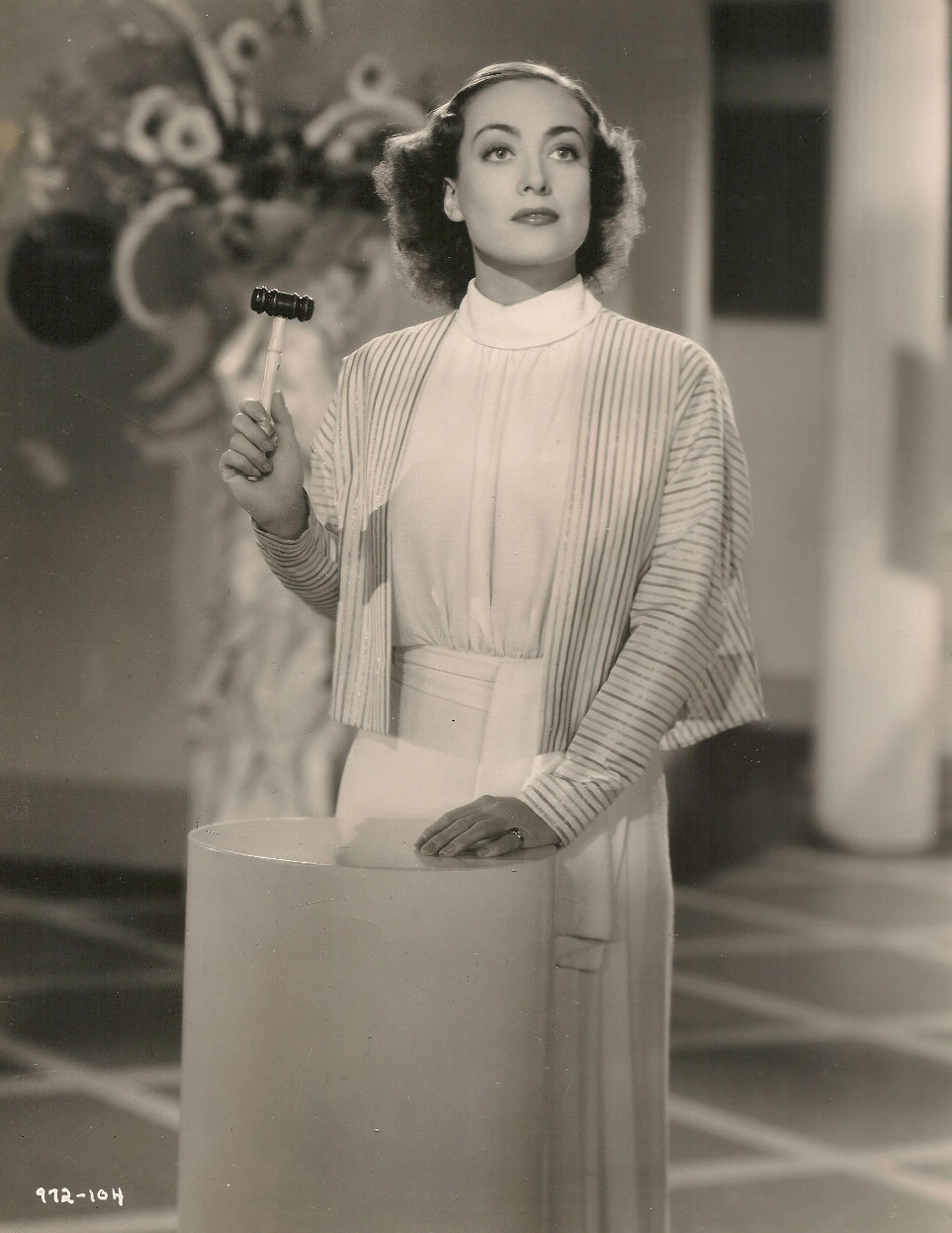
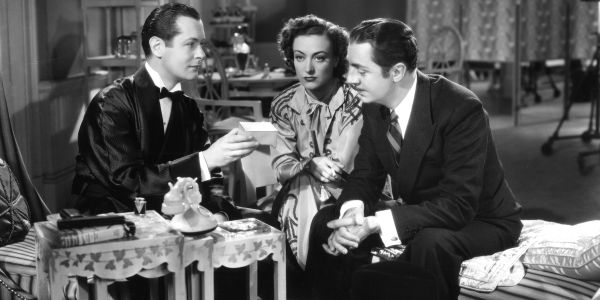
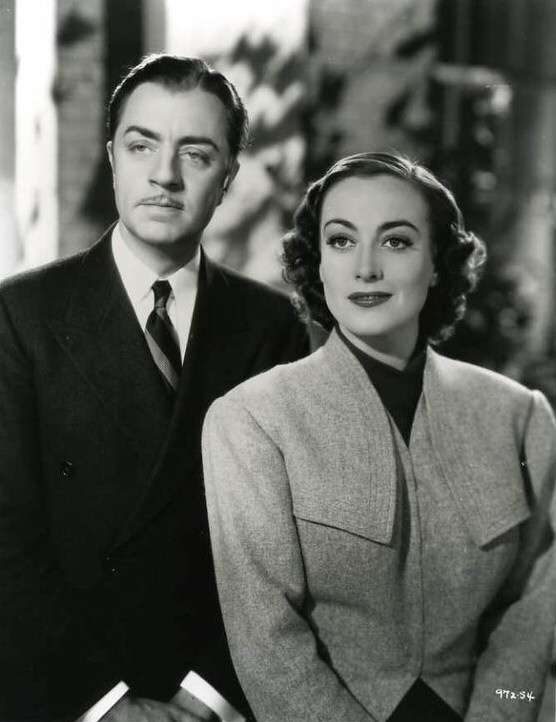
The Last of Mrs. Cheyney (Richard Boleslawksi and Dorothy Arzner, 1937) Remake of the 1928 stage adaptation with Norma Shearer and Basil Rathbone, this one has a little bit more of the star-wattage of M-G-M behind it with Joan Crawford (rarely better) as well as William Powell, Robert Montgomery, Frank Morgan, Nigel Bruce and Jessie Ralph. 

The movie starts stodgily with Montgomery's Lord Arthur Dilling meeting and becoming entranced with widower Mrs. Fay Cheyney (Crawford) on a transatlantic sail. He's intrigued that she takes a fancy to the equally rich, more elderly (and more susceptible) Lord Francis Kelton (Morgan), and keeps an eye on her when they disembark, for though he's smitten, he's curious to see if she might be a gold-digger.

She's not. She's an international jewel-thief in cahoots with Charles (William Powell), the man posing as her butler.  
It's hard to pin-point, but around the time the cast all gets together at the estate of Lady Embley (Ralph) after a charity event, the tone suddenly lightens and everybody, especially Montgomery, get several notches better. Now, at some point, the original assigned director Richard Boleslawski died of a heart attack, to be replaced by Hollywood's only working female director at the time, Dorothy Arzner, and while one is hesitant to say this is entirely due to a change in directors, it is unarguable that the film starts to take off, whereas before it has a strained and stuffy feeling to it. Maybe, it's the presence of Powell—though it's doubtful because Crawford starts to light up, too—maybe because the entire cast is pinging off each other, there's more cross-talk between them and more energy zapping between each and every player. Maybe it's the script because the last half is where the change-up's, turn-around's and surprises in character and situations are clustered, a perfect case of the tail wagging the dog (without a chase, explosion or clinch to be seen). But it makes one want to check out Dorothy Arzner, the lone woman in the field (besides Leni Riefenstahl) to be making films at the time. Not to be sexist or anything, but it does make a difference.