Showing posts with label 1978. Show all posts

Saturday, December 2, 2023

Brass Target

Saturday is, primarily in these parts, "Take Out the Trash" Day.

Brass Target
(
John Hough, 1978) General George Patton was a rather colorful part of the Second World War, but, like many generals of that conflict, he was consigned to the realm of obscurity, despite his considerable efforts to the war effort.
 
That was until 1970 and the release of Patton, which went on to win the Oscar for Best Picture of its year, thanks in no small part to a (pardon the pun) commanding performance by George C. Scott. Patton—and Scott's performance—went beyond merely reviving the story of the man and his accomplishments but also catapulted the general (as well as his foibles and eccentricities) to the echelons of Myth. Those who see newsreel footage of the real Patton are often surprised at his high-pitched voice, his thick Virginia accent, and his rather tentative way of speaking, none of which Scott chose to portray in his characterization. The cult of Patton-worship after the film's release—especially among conservatives—can be construed as a response to Scott's strong portrayal, rather than to the man himself.
 
Another thing that Patton didn't portray was the matter of Patton's death, choosing instead to fade to black as the general walks his dog near to a quixotically-resonant wind-mill, keeping the spirit alive. Patton, who seemed most comfortable in the role of warrior, ironically died soon after the fall of Berlin, eight months into the peace, the result of injuries sustained in an auto accident—his limousine was going too fast across a railroad line and smashed into a truck, and the 60 year old General was the only injury. He'd broken his neck; two crushed vertebrae. He lay in traction for 12 days before succumbing to a blood clot in his heart on December 21st, 1945.
But, the cult of personality, post-Patton, wouldn't let it go at that. For quite a few years—but most notably after the movie's release—there has been idle speculation that Patton's death wasn't be accident, but was planned. No one offers proof, no one can point to a specific reason—they're "just asking questions"—but it's more to the point that some logic circuits just can't handle the fact that Patton who'd served in two world wars would end up dying from the result of something so mundane as a car crash (just as so many couldn't fathom that President Kennedy could be killed by one lone gunman). Imagination is a wonderful, but often faulty, thing. Imagination, though, doesn't make things true.
But, it can make money. The Patton death controversy didn't pop up until the 1974 publication of "The Algonquin Project" (or "The Oshawa Project," internationally) by Frederick W. Nolan, who cooked up a plot to assassinate a Patton-like commander (re-named George R. Campion) in order to keep him from investigating the theft of 250 million in Reichsbank gold being shipped to Frankfurt, a inside-job robbery that claims 59 American lives.
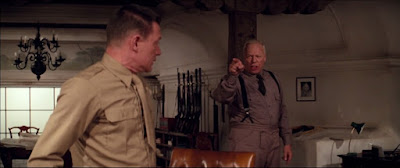
But, when the film-rights were sold and the project made, the commander's name was changed back to its source, George Patton, and the film followed the rest of the fantasy-land speculation, completely ignoring that Patton wasn't killed in the car-crash, but only injured. His surviving and subsequent 12 days of traction are completely ignored.
Instead, we get a sub-par plot of Army Intelligence officers (round up the usual suspects: 
Patrick McGoohanRobert Vaughn, and Edward Herrmann) who pulled off the gold heist—in an elaborate plan that could have gone wrong in many ways, not least of which is that gold is heavy and difficult to transport. Once the theft is discovered, Patton is determined to find out whodunnit—he's livid over the loss of life—and it is arranged that before he can get very far into the investigation that he be killed by a hired assassin, Peter Shelley (Max von Sydow).
It is up to OSS Major Joe De Lucca (John Cassavetes) to determine who was behind the robbery, a task complicated by the plan's similarity to a mission De Lucca himself had masterminded against the Nazis some time earlier. That puts him in the sights of Patton's investigation, but for De Lucca, it merely means that whoever's behind it knows of him, his tactics and has enough security clearance to know what's what in the particularly-secretive-because-it-is-so-new OSS.
There are complications—enough to distract De Lucca from the obvious—and bodies begin piling up, only verifying to him that he's on the right track. And then, there's some romantic entanglements which serve no dramatic purpose other than to put Sophia Loren in the picture.
It's a lousy movie, but I can see why people wanted to do it—money. Cassavettes took less film roles later in his career as he was concentrating on film-making, and this one probably paid for a couple of his. Points to the movie for that. And he also might have also wanted a chance to play with von Sydow (playing another inscrutable assassin—he seemed to be doing that a lot in the paranoid '70's), whose character plays two roles, one in very plain sight as a diplomat and one in the shadows as a very undiplomatic hit-man (the two careers seem to be mutually exclusive in attitude and temperament and either job could impair, if not jeopardize, the other—different color contact lenses notwithstanding).
Great disguise there, Max. 
Superman, at least, puts on a pair of glasses.
But, one shouldn't quibble about details, especially sophisticated ones, as the whole plot is built on the substantial lie of Patton being assassinated. It's a wonder they didn't do it in modern dress, as focused as they are on "accuracy". 
It's taken me a long time to actually sit down and watch this movie, as I knew the Patton history, and knew that the central focus was a canard, so why bother? But, 45 years of blissful ignorance of the inanities of the thing I can chalk up to a "win". I'm just glad I didn't waste any of my money on it. As its failure at the box office helped lead M-G-M to shut down its film-making division—in 1979 M-G-M honcho Kirk Kerkorian announced that they were a hotel company—the studio probably wished the same thing. Ironically, I watched it on Turner Classic Movies (Ted Turner having bought the studio's assets in March, 1986, primarily for its film library), so I guess there's something of a happy ending, after all. 


Tuesday, December 21, 2021

Death on the Nile (1978)

Death on the Nile (John Guillermin, 1978) The success of the 1974 adaptation of Murder on the Orient Express—and author Agatha Christie's favorable view of it—almost guaranteed another all-star production by producers Brabourne and Goodwin and their choice for story was Christie's "Death on the Nile" to be scripted by Anthony Shaffer, who had done re-writes on the film version of Murder..., plus had written The Wicker Man, Sleuth, Alfred Hitchcock's Frenzy, so he knew his way around murder and had a wicked sense of humor.
 
But, plans called for extensive location shooting in Egypt where noon temperatures would soar to 130°F. Albert Finney, who barely tolerated the make-up process that turned him into Christie's Belgian detective Hercule Poirot under studio conditions, balked at having to go through the same thing in the African desert. Producers turned to the versatile double-Oscar winner Peter Ustinov to take over the sleuthing duties, and surrounded him with fading Hollywood glamor and some noteworthy youngsters.
Heiress Linnett Ridgeway (Lois Chiles) has everything she wants in the world and is a loyal and magnanimous companion. When her friend Jacqueline de Bellefort (Mia Farrow) asks Linnett if she could take her fiancé Simon Doyle (Simon McCorkindale) on as an assistant until he can get on his feet, Linnett takes one look at him and is only too happy to oblige. This she does by starting an affair with him—that's quite a benefits package she offers—then the two get married and take off for an Egyptian honeymoon.
But, they're not alone. Wherever they go, no matter how remote, they encounter Simon's jilted
fiancé Jacqueline, who vows never to let them forget and who is determined to ruin their their married life. Two's a honeymoon, but three's a scandal—and possible enemy action, so the two lovers plot to ditch her by pretending to take a train at the Aswan station, but, instead, book a Nile cruise on the paddle steamer, the S.S. Karnak. Coincidentally, also sailing on the cruise is the master detective Hercule Poirot. And if you believe that, you've never read Agatha Christie. 
The honeymoon couple seem to be surrounded by acquaintances on the trip: there's Andrew Pennington (George Kennedy), who is keeping an eye on her because he doesn't want to know he's stealing from her legacy; author Salome Otterbourne (Angela Lansbury) is being sued by Linnett for basing a character on her—she's accompanied by her daughter (Olivia Hussey); Dr. Ludwig Bessner (Jack Warden) is a psychiatrist who had treated some of Linnett's friends in the past and she'd threatened to expose him. 
Then, there's the Communist (Jon Finch), who considers the Doyle couple parasites; the socialite Mrs. van Schuyler (Bette Davis), who merely covets Linnett's jewels (as she's a kleptomaniac)—her nurse Miss Bowers (Maggie Smith) blames Linnett's father for bankrupting her father. Then there's Colonel Race (David Niven), Poirot's old friend and confidante. He's the only one who doesn't have some sort of animosity towards Linnett—and they're all on the same boat.
Then, Jacqueline joins the cruise, carrying a derringer and a marksman's ability with it. As if by clockwork, Jacqueline gets drunk the first night, confronts Simon and shoots him in the leg, and is immediately taken to her cabin and put under heavy sedation. With Jacqueline out of the way, maybe the passengers—and especially the honeymooners—can expect some peace and quiet.
Fat chance of that! The next morning, Linnett is found dead with a bullet-hole in her head, and the letter "J" written in blood within her reach. It's murder alright. And SOMEONE's responsible! But, who? And with so many ties to the dead woman among the passengers, it could be anyone, and the most likely suspect was in a morphine stupor and looked after all night by Nurse Bowers. It's up to Race and Poirot to untangle the connections and sort out the clues to determine who did what. One things for certain—no one's getting off the boat without a splash.
If only the movie were a little splashier. Oh, it has its amusements—the location work, shot by the estimable Jack Cardiff, full-on scenery-chewing by Lansbury and Davis, as well as an amusing turn by Smith. Everybody else hits their marks and don't bump into the masonry. And then there's Mia Farrow...with a performance so over-the-top that you know she's got to be the murderer even though everything points away from her. Hysterical and manic, you just know she's got to be involved somehow. Just because of a person is scheming and jilted doesn't mean the character-actor has to double-down to get the point across. 
 
And ultimately, that's the film's biggest flaw. Because if the actress is so concerned that she appear crazy, it must be pertinent, or else they'd try to appear normal.  It's as if Farrow saw the limelight falling off her and onto Lansbury and Davis and decided to overcompensate. It throws the story and the movie out of whack.
 
It will be interesting, then, to see what happens when a new version of Death on the Nile is released in February of 2022, directed by Kenneth Branagh (again, after Murder on the Orient Express) and starring himself, Gal Gadot, Emma Mackey, Armie Hammer, Jennifer Saunders, Letitia Wright, Annette Bening, and Russell Brand. We shall see.

Saturday, January 30, 2021

The Big Sleep (1978)

Saturday is usually "Take Out the Trash" Day...

The Big Sleep (Michael Winner, 1978) You already know that it's going to be a bit problematic with the very first shot of this adaptation. This later version of Raymond Chandler's first detective novel—cobbled together from elements of his short stories and published in 1939—starts right where the novel starts—with detective Philip Marlowe (played, as in 1975's Farewell, My Lovely, by Robert Mitchum) driving up to the Sternwood Estate for an interview to taking a job. 

The thing is he's driving on the wrong side of the road. That's a clue. When you've been over-stewed in Chandler pot-boilers about L.A.'s most geographically-associated gumshoe that sort of thing stands out like the proverbial tarantula on angel food. He's not in Los Angeles, where they drive on the right (that is "non-left") side of the road, he's in London, held over from The War, it seems, and he's driving a Mercedes. Already you feel that something is very wrong, even before he does his interview. It's not your Grandfather's Philip Marlowe.
The interview with Sternwood (James Stewart) goes well, as far as it goes. The General is being blackmailed—it's not the first time—and his son-in-law Rusty Regan usually handled such things one way or another. But, Rusty has disappeared. There are rumors, but just that. Marlowe has been recommended by Scotland Yard and he accepts the assignment, but not before he's been told about the Sternwood girls, Charlotte (Sarah Miles, Mitchum's co-star in Ryan's Daughter) and Camilla (Candy Clark), who Marlowe has already met ("She tried to sit on my lap...while I was standing up," a line used in the book and both movies. For this version, the names have been changed—from "Vivian" and "Carmen"—to protect the not-so-innocent.
After taking his leave of the General, who has complained of fatigue, he is commanded to the bedroom of Charlotte, who demands to know what Marlowe has been hired for—possibly to find her missing husband? Marlowe says it's the general's business and none of hers, and she leaves unsatisfied and unimpressed.
Marlowe's first stop is to the bookstore of H. R. Geiger, whose name is on the notes. By subterfuge, he concludes that the shop is not a book store, per se, but rather a front for a pornography distributor. He has a bit of disagreement with the shop's receptionist, Agnes (Joan Collins), who develops an instant dislike to Marlowe's pestering.
Marlowe stakes out Geiger's flat and sees lights flashing inside. The last flash, though, is from a gun-shot and Marlowe breaks in to find much amiss: Camilla, drugged and naked in front of a camera, the film missing, drug paraphernalia  strewn about, and Geiger dead on the floor with a gunshot wound in the forehead. He checks the backway to look for the killer, but has missed him. Camilla is certainly in no shape to have done it, she's high out of her mind, the bar of which is set pretty low to begin with. The best thing to do is throw something on Camilla and get her home, pronto. He'll come back to the house later.
That's after he gets some well-deserved shut-eye; the bags under Mitchum's eyes are starting to look like suitcases. But, he gets called by The Yard (in the person of John Mills) to watch a car being dragged from the water. In it is the Sternwood's chauffeur, dead. A little too close to home, even if your home is a mansion, ain't it? Heading back to his office, Marlowe finds older sister Charlotte waiting for him, still wanting to know what the General has hired him for—no dice, lady—and to tell him they're being blackmailed by somebody else, this time with naked pictures of Camilla...from the previous evening's recreations. Marlowe tells her to pay up and she says she can borrow the money from gambling boss Eddie Mars (Oliver Reed in full hissing snake mode). Hmmm. Isn't there a rumor that Rusty ran off with Mars' wife? Bears investigating.
Well, one can get into the weeds very quickly here, and the movie's only 30 minutes in. There is a famous story about the Howard Hawks-Humphrey Bogart-Lauren Bacall version done in the 40's where there was a body but nobody had any idea who killed him. The writers didn't know. Hawks didn't know. Chandler didn't care—"that's your job" he told the movie-makers. By that time, Hawks didn't care, either. There's a line in both movies "so many guns. So few brains." Well, there are so many corpses that keeping track of them all without a toe-tag is an exercise in fatality. The 1978 version wants everything nice and tidy and explained, whether we care or not. Where, the 1946 version kept that information vague and unresolved, Winner doubles down to explain it with voice-over and a flash-back sequence introduced with a picture-spinning rotation (the edge of the frame threatening to slap us awake). He needn't have bothered.
What this version of The Big Sleep does well is to fill the film with so many good British actors that one gets dizzy remembering them all: Miles, Mills, Reed, Harry Andrews, Collins, Edward Fox (he's good!), Colin Blakely, Richard Todd, James Donald, who are clearly enjoying their versions of American 1940's types. It's just that it's set in the 1970's and the transition makes some of the scenes a little bit campy, like the actors are having too good a time "slumming." But, this one doesn't feel like one of those old B-movie shadow-fests. It's film-noir with the lights on, and one fairly squints from that and volunteering too much information. 
There's no style, just a lot of substance. And although it's a slightly more faithful version of the Chandler novel in the tawdry specifics, thanks to deep-sixing the Hays Code, nothing much is gained—other than the feeling that this would have been really racy in the 1940's, but in the era of buying nudie mags at the 7-11, it's merely people going to too much trouble for little return.
One of my favorite lines from the earlier version is in the scene when Vivian comes to Marlowe's office and gives him the envelope with Carmen's nudes. He takes a look at them and cracks "She takes a good picture..." It's funny and sick and rude and if you didn't know what he was talking about, you'd never know, so far does it fly beneath the censor's radar.

And it's clever, something that Winner's "bleed-by-the-numbers version" never really achieves. Should have known when I first saw the Mercedes driving up the left lane. This movie was going the wrong way.

Sunday, May 10, 2020

Don't Make a Scene: Superman: the Movie

The Story: Mother's Day 2020. 

A happy one to those who have one, or are one.

Motherhood is a bittersweet thing. Children leave the nest. It is the nature of children to grow up and go off on their own from the individual that they shared life with (especially in the symbiotic relationship of the first nine months, and thereafter increasingly non-symbiotic). It is the very nature of motherhood to include separation.

All that as the preamble to this scene from Superman: the Movie from 1978, directed by Richard Donner, who somehow managed to  create something terrific out of the chaos of that production. I remember seeing this in theaters (actually a shortened version of this scene, as this is from the "Extended Cut") and tearing up, as the combination of sentiment, Geoffrey Unsworth's beautiful photography, the "epic" camera moves designed by Donner and camera operator Peter McDonald, John William's Copland-esque prairie score (the least bombastic thing about his music for the film), and the "spareness" of the scene, where so little is said and the content of it is almost comic in its understatement—Clark Kent basically "Tom Joads" but without the speechifying about "whenever you see a cop beating up a guy, I'll be there."

It wasn't necessary. It's all in the actors and the camera and the music, done with restraint but not cutting back on the emotion.

Tom Mankiewicz added a part in his version of the screenplay—the last one*—where Clark (because he can) brings in the wheat at super-speed, not leaving it to Ma and Ben Hubbard to do, but it was cut out—probably for budgetary reasons, but also because the moment should not be interrupted by a stunt. Leave a tender moment alone.

It's where you know that Donner is taking the project—for all its comic book origins—seriously, and more as myth than cartoons, imbuing it with so much homespun Americana that nobody dare laugh.

And as the capper (and a bit of fore-shadowing) he ends it with the camera leaving the wheat-field and vaulting to the sky. 

One of the best scenes ever directed by Richard Donner...or just about anybody.

The Set-Up: Rocketed to Earth from the exploding planet Krypton, Kal-el—growing up as Clark Kent (Jeff East, but voiced by Christopher Reeve) is drawn to the ship that carried him (now stashed in the Kent barn), soon after the death of Jonathan Kent (Glenn Ford). Martha Kent (Phyllis Thaxter) starts another Kansas day to discover that her son is missing.

Action.

Note: the pictures don't exactly follow the action. As it plays out, it's a bit more organic.

77 INT. KENT KITCHEN

MARTHA stands over the kitchen stove in the early morning, bacon sizzling in the pan, a pot of hot coffee steaming nearby. 
She turns her head slightly, calls out.
MARTHA Clark? Get up! Are you going to sleep all day? I've got....
MARTHA (to parakeet) Good morning, Smiley...
MARTHA Clark! Breakfast!


MARTHA Are you going to sleep all day?

MARTHA Clark! C'mon! Get up!
She stops, has noticed something out the kitchen window.
CAMERA PANS, pushes in through window: In the distant wheatfield across the road stands the motionless figure of CLARK.

78 EXT. WHEATFIELD - DAY
CLARK stands quietly, immobile, staring north as the late morning sun hits the side of his face. 
The look is trance-like as if some force were pulling at him. There is a rustle in the wheat behind him. 
He does not turn...
CLARK I... have to leave.
MARTHA enters frame, stops, looks at him thoughtfully, full of emotion.
MARTHA I... knew this time would come. We both knew it...from the day we found you. I knew it from the day I found you. .
CLARK turns now, faces her. He speaks flatly, trying to avoid breaking down.
CLARK I'll bring in the crop before I leave. I... talked to Ben Hubbard yesterday. 
CLARK He said that...he'll be happy to help out from now on.
MARTHA He's a good man, Ben is. Your father always said so.
CLARK (emotionally) Mother... 
MARTHA (helpless smile) I know, son. 
MARTHA I know....
79 EXT. WHEATFIELD - DAY
The sun starts to set in the distance. CLARK approaches the vast wheatfield, his .father's scythe in his hand. He hesitates a moment, unobtrusively looks around, then bursts toward the wheat at SUPER SPEED, cutting an instant four-foot wide swath across the field.
80 INT. KITCHEN - DAY - ANGLE ON WHEATFIELD
CAMERA looks through the kitchen window as the wheatfield practically disintegrates in neat rows before us, then PULLS BACK:
MARTHA watches, her eyes filled with tears.
81 EXT. KENT FARM - DAY The wind is blowing. Tall, neat stacks of baled wheat rise up near the barn.
CAMAERA PANS: CLARK stands at the gate to the road in a windbreaker and slacks, has a rucksack at his side. MARTHA holds out a brown paper bag.
81 CONTINUED 
MARTHA I made you... (fighting back tears) ...some sandwiches. 
CLARK smiles silently, closes his hand around the bag. He turns, opens the rucksack to place the bag inside.
82 INSERT SHOT - RUCKSACK
The rucksack interior glows with a green light, tucked inside the red, yellow, and blue blankets is the same one seen earlier, in the barn. CLARK closes it.
83 BACK TO SCENE
They face each other for the final time, all emotion, both at a sudden loss for words.
MARTHA Do you ... know where you're headed?
CLARK North.
MARTHA'S eyes glaze over. 
She manages a brave smile.
MARTHA Remember us, son. 
MARTHA Always remember us.
Unable to restrain themselves any longer, they reach out, collapse into a tight hug.

Superman: The Movie

Words by Mario Puzo, David Newman, Leslie Newman and Robert Benton and Tom Mankiewicz

Pictures by Geoffrey Unsworth and Richard Donner

Superman: The Movie is available on DVD and Blu-Ray from Warner Home Video.


* Here's the scene before the Tom Mankiewicz revisions:
60 INT. KENT HOUSE - DAY The following morning. 
MARTHA KENT. wearing her apron, stands at the foot of the stairs, calling up. 
MARTHA Clark? Clark? 
There is no answer. She starts up the stairs. We note how much she has aged. 
CUT TO: 61 INT. HALLWAY, UPPER LANDING - DAY 
She crosses to the door to Clark's bedroom. 
MARTHA CLARK? 
No answer. She opens the door, peers in. 
HER POV: The room is empty. 
ON MARTHA -- who enters. FOLLOW. 
CUT TO: 62 INT. CLARK'S ROOM - DAY She crosses to the window and looks out. 
CAMERA POSITIONED JUST BEHIND HER, OVER HER SHOULDER, ANGLE DOWN. ZOOM SLOWLY PAST HER To the solitary figure of Clark. He stands alone, out in the field, staring off toward the north. 
CUT TO: 63 INT. KENT KITCHEN - DAY MED. SHOT: MARTHA KENT is sitting at the kitchen table, facing TOWARDS CAMERA, looking at photographs in the family album. Her eyes raise from the photographs; we know she senses he has entered, but she does not turn around. 
CLARK (awkward, odd) Mom... 
MARTHA (eyes front, voice flat) I know. 
There is a palpable tension in the room: both people know what is happening and it is terribly hard for them. Both are trying desperately to keep in non-emotional and flat, for fear of breaking down. 
CLARK I have to leave. 
She still does not turn and face him; trying to keep control of herself. 
MARTHA I knew there'd be this day. I guess I knew it from the minute you came to us. 
He comes around to her side and touches her hair, thereby making her look up at him. her eyes fill with tears. 
CLARK I talked to Ben Hubbard this morning. He'll be more than glad to bring in the crops on shares. 
MARTHA He's a good man, Ben is. Your father always said so. 
A long pause. It is difficult to say anything. 
CLARK (emotionally) Mother... 
MARTHA (she pats his hand) I know son, I know... 
DISSOLVE TO: 64 EXT. KENT FARM - DAY MED. SHOT at the gate to the road. CLARK in windbreaker and slacks, has a rucksack at his side. MRS. KENT holds out a brown bag, the same kind she used to give him his school lunch in. The wind is blowing. 
MARTHA I made you... (fighting back tears) ...some sandwiches. 
(she hands them to him, then takes something from her apron pocket) 
MARTHA And this...this is your father's 
INSERT: Jonathan Kent's old-fashioned pocket watch. She Places it in CLARK'S hand. 
CLOSER TWO SHOT 
MARTHA You remember this? 
CLARK, deeply moved, can only nod. 
MARTHA He always wanted you to have it. 
Silently, CLARK closes his hand around it. Then. stiffly, he turns away, opens the rucksack and puts the watch and the lunch bag inside. 
INSERT: ON THE INTERIOR OF THE RUCKSACK: It glows with green light; inside are all the components and glowing stones and chips and discs seen earlier. He closes the bag. As we SEE this: 
MARTHA (O.S.) Do you know where you're headed? 
CLARK (O.S.) North. It's north 
TWO SHOT: Unable to restrain it anymore, they reach ouch to each other and move into a tight hug. 
MARTHA Keep warm now. 
CLARK I will. They pull back from the embrace. 
CLOSEUP MARTHA 
MARTHA And remember us. Always remember us.