Showing posts with label Jack Warden. Show all posts

Thursday, March 13, 2025

Run Silent, Run Deep

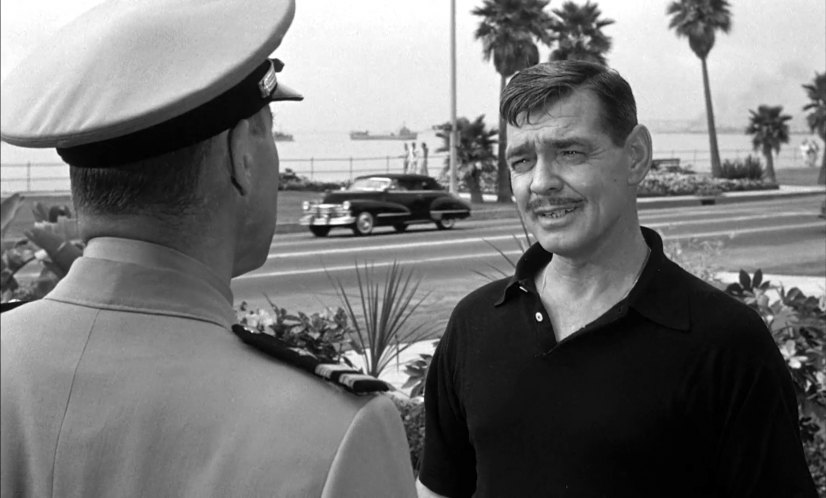
Run Silent, Run Deep (Robert Wise, 1957) One of those general entertainment movies that manages to do so many things exceptionally well that one comes away grateful for the experience. Directed by Robert Wise with a true sense of claustrophobia, the script by John Gay maintains a strict military accuracy while displaying a keen sense of drama, psychology and brevity. A psychological drama, a war film, a story of mystery as well as redemption, the film manages to pull everything off with a propulsive rhythm and fine performances throughout.

Produced by Hecht-Hill-Lancaster, Burt Lancaster the producer takes a back-seat to his star, Clark Gable, the older actor in one of his understated roles that takes into account his age. Gable's the flawed figurehead with shades of Ahab who finagles his way into the command of the S.S. Nerka patrolling the Pacific during World War II, having already lost one sub and and a frustrating convalescence at a desk-job.
Lancaster
's exec Jim Bledsoe is torqued because Gable's Cmdr. "Rich" Richardson has pulled rank to get command—his command—and is
now drilling the men to dive and shoot a torpedo within a record 35 seconds. The already suspicious crew starts to snarl about all this practice with nothing to show for it. Then a lucky strike convinces some of them the new Captain is golden, while the other half think he's out to torpedo their mission. Lancaster turns into a reluctant arbiter.
But, in their first attempt to sink Richardson's unsinkable Japanese war-ship things don't go so well leaving crew-members dead and injured and Lancaster in command.

Robert Wise
is a master of filming people at work with a story-teller's eye for finding the perfect angle (without calling attention to it and himself) and an editor's sense of pace and construction. Wise is also a chameleon of style tamping down his presentation of professionals doing their jobs while also being able to ramp up the spectacle for the unreal worlds of musicals and science fiction. Given his work on this film, you could see why he'd be the perfect choice for the similarly set-bound Star Trek: The Motion Picture.

He also makes goods use of the usual crew of character actors who make up the Nerka's lovable mugs: Jack Warden, Brad Dexter, Don Rickles, Nick Cravat and Joe Maross. The close quarters of a submarine makes the authentic plainness of their faces all the more important and brings them to a prominence near the bright lights of Gable and Lancaster. Both those lights are shaded somewhat, with Lancaster doing subtle, measured work, the kind that would dominate his later career. Gable, even subtler, is the King, here in his twilight, still burning brighter than the vast majority of actors. By this time, Gable was moving slower and had learned the power of economy and his Captain Richardson draws you in.

Finally, the story is a cracker-jack construction. Just when you think you've got it figured out, screenwriter Gay throws in an added complication that ramps up the idea that these are men strategizing in chaos and only repeated dips into the boiling oil of battle can make them seasoned enough to think clearly through the smoke and death.


Run Silent, Run Deep is an intelligent tribute to the fighting services without resorting to jingoism, racism or choired flag-waving. The film-makers' respect for the professionalism under duress of sub-crews runs silent and deep.

Tuesday, December 21, 2021

Death on the Nile (1978)

Death on the Nile (John Guillermin, 1978) The success of the 1974 adaptation of Murder on the Orient Express—and author Agatha Christie's favorable view of it—almost guaranteed another all-star production by producers Brabourne and Goodwin and their choice for story was Christie's "Death on the Nile" to be scripted by Anthony Shaffer, who had done re-writes on the film version of Murder..., plus had written The Wicker Man, Sleuth, Alfred Hitchcock's Frenzy, so he knew his way around murder and had a wicked sense of humor.
 
But, plans called for extensive location shooting in Egypt where noon temperatures would soar to 130°F. Albert Finney, who barely tolerated the make-up process that turned him into Christie's Belgian detective Hercule Poirot under studio conditions, balked at having to go through the same thing in the African desert. Producers turned to the versatile double-Oscar winner Peter Ustinov to take over the sleuthing duties, and surrounded him with fading Hollywood glamor and some noteworthy youngsters.
Heiress Linnett Ridgeway (Lois Chiles) has everything she wants in the world and is a loyal and magnanimous companion. When her friend Jacqueline de Bellefort (Mia Farrow) asks Linnett if she could take her fiancé Simon Doyle (Simon McCorkindale) on as an assistant until he can get on his feet, Linnett takes one look at him and is only too happy to oblige. This she does by starting an affair with him—that's quite a benefits package she offers—then the two get married and take off for an Egyptian honeymoon.
But, they're not alone. Wherever they go, no matter how remote, they encounter Simon's jilted
fiancé Jacqueline, who vows never to let them forget and who is determined to ruin their their married life. Two's a honeymoon, but three's a scandal—and possible enemy action, so the two lovers plot to ditch her by pretending to take a train at the Aswan station, but, instead, book a Nile cruise on the paddle steamer, the S.S. Karnak. Coincidentally, also sailing on the cruise is the master detective Hercule Poirot. And if you believe that, you've never read Agatha Christie. 
The honeymoon couple seem to be surrounded by acquaintances on the trip: there's Andrew Pennington (George Kennedy), who is keeping an eye on her because he doesn't want to know he's stealing from her legacy; author Salome Otterbourne (Angela Lansbury) is being sued by Linnett for basing a character on her—she's accompanied by her daughter (Olivia Hussey); Dr. Ludwig Bessner (Jack Warden) is a psychiatrist who had treated some of Linnett's friends in the past and she'd threatened to expose him. 
Then, there's the Communist (Jon Finch), who considers the Doyle couple parasites; the socialite Mrs. van Schuyler (Bette Davis), who merely covets Linnett's jewels (as she's a kleptomaniac)—her nurse Miss Bowers (Maggie Smith) blames Linnett's father for bankrupting her father. Then there's Colonel Race (David Niven), Poirot's old friend and confidante. He's the only one who doesn't have some sort of animosity towards Linnett—and they're all on the same boat.
Then, Jacqueline joins the cruise, carrying a derringer and a marksman's ability with it. As if by clockwork, Jacqueline gets drunk the first night, confronts Simon and shoots him in the leg, and is immediately taken to her cabin and put under heavy sedation. With Jacqueline out of the way, maybe the passengers—and especially the honeymooners—can expect some peace and quiet.
Fat chance of that! The next morning, Linnett is found dead with a bullet-hole in her head, and the letter "J" written in blood within her reach. It's murder alright. And SOMEONE's responsible! But, who? And with so many ties to the dead woman among the passengers, it could be anyone, and the most likely suspect was in a morphine stupor and looked after all night by Nurse Bowers. It's up to Race and Poirot to untangle the connections and sort out the clues to determine who did what. One things for certain—no one's getting off the boat without a splash.
If only the movie were a little splashier. Oh, it has its amusements—the location work, shot by the estimable Jack Cardiff, full-on scenery-chewing by Lansbury and Davis, as well as an amusing turn by Smith. Everybody else hits their marks and don't bump into the masonry. And then there's Mia Farrow...with a performance so over-the-top that you know she's got to be the murderer even though everything points away from her. Hysterical and manic, you just know she's got to be involved somehow. Just because of a person is scheming and jilted doesn't mean the character-actor has to double-down to get the point across. 
 
And ultimately, that's the film's biggest flaw. Because if the actress is so concerned that she appear crazy, it must be pertinent, or else they'd try to appear normal.  It's as if Farrow saw the limelight falling off her and onto Lansbury and Davis and decided to overcompensate. It throws the story and the movie out of whack.
 
It will be interesting, then, to see what happens when a new version of Death on the Nile is released in February of 2022, directed by Kenneth Branagh (again, after Murder on the Orient Express) and starring himself, Gal Gadot, Emma Mackey, Armie Hammer, Jennifer Saunders, Letitia Wright, Annette Bening, and Russell Brand. We shall see.