Showing posts with label George Kennedy. Show all posts

Saturday, December 2, 2023

Brass Target

Saturday is, primarily in these parts, "Take Out the Trash" Day.

Brass Target
(
John Hough, 1978) General George Patton was a rather colorful part of the Second World War, but, like many generals of that conflict, he was consigned to the realm of obscurity, despite his considerable efforts to the war effort.
 
That was until 1970 and the release of Patton, which went on to win the Oscar for Best Picture of its year, thanks in no small part to a (pardon the pun) commanding performance by George C. Scott. Patton—and Scott's performance—went beyond merely reviving the story of the man and his accomplishments but also catapulted the general (as well as his foibles and eccentricities) to the echelons of Myth. Those who see newsreel footage of the real Patton are often surprised at his high-pitched voice, his thick Virginia accent, and his rather tentative way of speaking, none of which Scott chose to portray in his characterization. The cult of Patton-worship after the film's release—especially among conservatives—can be construed as a response to Scott's strong portrayal, rather than to the man himself.
 
Another thing that Patton didn't portray was the matter of Patton's death, choosing instead to fade to black as the general walks his dog near to a quixotically-resonant wind-mill, keeping the spirit alive. Patton, who seemed most comfortable in the role of warrior, ironically died soon after the fall of Berlin, eight months into the peace, the result of injuries sustained in an auto accident—his limousine was going too fast across a railroad line and smashed into a truck, and the 60 year old General was the only injury. He'd broken his neck; two crushed vertebrae. He lay in traction for 12 days before succumbing to a blood clot in his heart on December 21st, 1945.
But, the cult of personality, post-Patton, wouldn't let it go at that. For quite a few years—but most notably after the movie's release—there has been idle speculation that Patton's death wasn't be accident, but was planned. No one offers proof, no one can point to a specific reason—they're "just asking questions"—but it's more to the point that some logic circuits just can't handle the fact that Patton who'd served in two world wars would end up dying from the result of something so mundane as a car crash (just as so many couldn't fathom that President Kennedy could be killed by one lone gunman). Imagination is a wonderful, but often faulty, thing. Imagination, though, doesn't make things true.
But, it can make money. The Patton death controversy didn't pop up until the 1974 publication of "The Algonquin Project" (or "The Oshawa Project," internationally) by Frederick W. Nolan, who cooked up a plot to assassinate a Patton-like commander (re-named George R. Campion) in order to keep him from investigating the theft of 250 million in Reichsbank gold being shipped to Frankfurt, a inside-job robbery that claims 59 American lives.
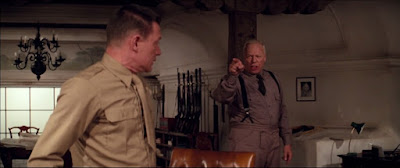
But, when the film-rights were sold and the project made, the commander's name was changed back to its source, George Patton, and the film followed the rest of the fantasy-land speculation, completely ignoring that Patton wasn't killed in the car-crash, but only injured. His surviving and subsequent 12 days of traction are completely ignored.
Instead, we get a sub-par plot of Army Intelligence officers (round up the usual suspects: 
Patrick McGoohanRobert Vaughn, and Edward Herrmann) who pulled off the gold heist—in an elaborate plan that could have gone wrong in many ways, not least of which is that gold is heavy and difficult to transport. Once the theft is discovered, Patton is determined to find out whodunnit—he's livid over the loss of life—and it is arranged that before he can get very far into the investigation that he be killed by a hired assassin, Peter Shelley (Max von Sydow).
It is up to OSS Major Joe De Lucca (John Cassavetes) to determine who was behind the robbery, a task complicated by the plan's similarity to a mission De Lucca himself had masterminded against the Nazis some time earlier. That puts him in the sights of Patton's investigation, but for De Lucca, it merely means that whoever's behind it knows of him, his tactics and has enough security clearance to know what's what in the particularly-secretive-because-it-is-so-new OSS.
There are complications—enough to distract De Lucca from the obvious—and bodies begin piling up, only verifying to him that he's on the right track. And then, there's some romantic entanglements which serve no dramatic purpose other than to put Sophia Loren in the picture.
It's a lousy movie, but I can see why people wanted to do it—money. Cassavettes took less film roles later in his career as he was concentrating on film-making, and this one probably paid for a couple of his. Points to the movie for that. And he also might have also wanted a chance to play with von Sydow (playing another inscrutable assassin—he seemed to be doing that a lot in the paranoid '70's), whose character plays two roles, one in very plain sight as a diplomat and one in the shadows as a very undiplomatic hit-man (the two careers seem to be mutually exclusive in attitude and temperament and either job could impair, if not jeopardize, the other—different color contact lenses notwithstanding).
Great disguise there, Max. 
Superman, at least, puts on a pair of glasses.
But, one shouldn't quibble about details, especially sophisticated ones, as the whole plot is built on the substantial lie of Patton being assassinated. It's a wonder they didn't do it in modern dress, as focused as they are on "accuracy". 
It's taken me a long time to actually sit down and watch this movie, as I knew the Patton history, and knew that the central focus was a canard, so why bother? But, 45 years of blissful ignorance of the inanities of the thing I can chalk up to a "win". I'm just glad I didn't waste any of my money on it. As its failure at the box office helped lead M-G-M to shut down its film-making division—in 1979 M-G-M honcho Kirk Kerkorian announced that they were a hotel company—the studio probably wished the same thing. Ironically, I watched it on Turner Classic Movies (Ted Turner having bought the studio's assets in March, 1986, primarily for its film library), so I guess there's something of a happy ending, after all. 


Tuesday, December 21, 2021

Death on the Nile (1978)

Death on the Nile (John Guillermin, 1978) The success of the 1974 adaptation of Murder on the Orient Express—and author Agatha Christie's favorable view of it—almost guaranteed another all-star production by producers Brabourne and Goodwin and their choice for story was Christie's "Death on the Nile" to be scripted by Anthony Shaffer, who had done re-writes on the film version of Murder..., plus had written The Wicker Man, Sleuth, Alfred Hitchcock's Frenzy, so he knew his way around murder and had a wicked sense of humor.
 
But, plans called for extensive location shooting in Egypt where noon temperatures would soar to 130°F. Albert Finney, who barely tolerated the make-up process that turned him into Christie's Belgian detective Hercule Poirot under studio conditions, balked at having to go through the same thing in the African desert. Producers turned to the versatile double-Oscar winner Peter Ustinov to take over the sleuthing duties, and surrounded him with fading Hollywood glamor and some noteworthy youngsters.
Heiress Linnett Ridgeway (Lois Chiles) has everything she wants in the world and is a loyal and magnanimous companion. When her friend Jacqueline de Bellefort (Mia Farrow) asks Linnett if she could take her fiancé Simon Doyle (Simon McCorkindale) on as an assistant until he can get on his feet, Linnett takes one look at him and is only too happy to oblige. This she does by starting an affair with him—that's quite a benefits package she offers—then the two get married and take off for an Egyptian honeymoon.
But, they're not alone. Wherever they go, no matter how remote, they encounter Simon's jilted
fiancé Jacqueline, who vows never to let them forget and who is determined to ruin their their married life. Two's a honeymoon, but three's a scandal—and possible enemy action, so the two lovers plot to ditch her by pretending to take a train at the Aswan station, but, instead, book a Nile cruise on the paddle steamer, the S.S. Karnak. Coincidentally, also sailing on the cruise is the master detective Hercule Poirot. And if you believe that, you've never read Agatha Christie. 
The honeymoon couple seem to be surrounded by acquaintances on the trip: there's Andrew Pennington (George Kennedy), who is keeping an eye on her because he doesn't want to know he's stealing from her legacy; author Salome Otterbourne (Angela Lansbury) is being sued by Linnett for basing a character on her—she's accompanied by her daughter (Olivia Hussey); Dr. Ludwig Bessner (Jack Warden) is a psychiatrist who had treated some of Linnett's friends in the past and she'd threatened to expose him. 
Then, there's the Communist (Jon Finch), who considers the Doyle couple parasites; the socialite Mrs. van Schuyler (Bette Davis), who merely covets Linnett's jewels (as she's a kleptomaniac)—her nurse Miss Bowers (Maggie Smith) blames Linnett's father for bankrupting her father. Then there's Colonel Race (David Niven), Poirot's old friend and confidante. He's the only one who doesn't have some sort of animosity towards Linnett—and they're all on the same boat.
Then, Jacqueline joins the cruise, carrying a derringer and a marksman's ability with it. As if by clockwork, Jacqueline gets drunk the first night, confronts Simon and shoots him in the leg, and is immediately taken to her cabin and put under heavy sedation. With Jacqueline out of the way, maybe the passengers—and especially the honeymooners—can expect some peace and quiet.
Fat chance of that! The next morning, Linnett is found dead with a bullet-hole in her head, and the letter "J" written in blood within her reach. It's murder alright. And SOMEONE's responsible! But, who? And with so many ties to the dead woman among the passengers, it could be anyone, and the most likely suspect was in a morphine stupor and looked after all night by Nurse Bowers. It's up to Race and Poirot to untangle the connections and sort out the clues to determine who did what. One things for certain—no one's getting off the boat without a splash.
If only the movie were a little splashier. Oh, it has its amusements—the location work, shot by the estimable Jack Cardiff, full-on scenery-chewing by Lansbury and Davis, as well as an amusing turn by Smith. Everybody else hits their marks and don't bump into the masonry. And then there's Mia Farrow...with a performance so over-the-top that you know she's got to be the murderer even though everything points away from her. Hysterical and manic, you just know she's got to be involved somehow. Just because of a person is scheming and jilted doesn't mean the character-actor has to double-down to get the point across. 
 
And ultimately, that's the film's biggest flaw. Because if the actress is so concerned that she appear crazy, it must be pertinent, or else they'd try to appear normal.  It's as if Farrow saw the limelight falling off her and onto Lansbury and Davis and decided to overcompensate. It throws the story and the movie out of whack.
 
It will be interesting, then, to see what happens when a new version of Death on the Nile is released in February of 2022, directed by Kenneth Branagh (again, after Murder on the Orient Express) and starring himself, Gal Gadot, Emma Mackey, Armie Hammer, Jennifer Saunders, Letitia Wright, Annette Bening, and Russell Brand. We shall see.

Saturday, October 17, 2020

Strait-Jacket (1964)

It's October. Guess I'd better start paying attention to horror movies. 

Saturday is "Take Out the Trash" Day. 

Strait-Jacket (William Castle, 1964) It wouldn't be Hallowe'en here at BXC without some review of a film by that wacky prankster of the cinema, William Castle. Castle made b-movies cheap and under-budget and that made him well-regarded by studio's. But, he was more than a writer-director-producer, he was also a superb salesman and promoter. "Superb" as in successful, not so much in sophistication. Castle liked to add an element of "extra" to his films to garner them a bit more attention, ala the "3-D" craze of the 1950's. Castle would come up with some stunt for the theater and then give it an exotic consumer name, like "Percepto" or "Illusion-O" or "Emergo" (the last was just a glowing skeleton that rode a wire into the theater from the screen), some cheap little sap-draw that could increase the audience and the box-office "take," a little surprise that might increase interest and lure viewers away from their television sets. But, it was all done with humor, imagination, and the sensibilities of a huckster. Castle is the favorite director of John Waters and Robert Zemeckis, and in Joe Dante's Matinee from a few years back, John Goodman had a grand time playing a Castle-like director.
Look at the poster; it screeches "WARNING! Strait-Jacket vividly depicts ax murders!" Warning? More like "Come and Watch, Suckers!" And from the beginning, Castle starts with the double ax murder that lands Lucy Harbin (Joan Crawford) in an insane asylum for twenty years punctuated with blasts of electro-shock therapy. Harbin comes home unexpectedly to catch her husband (Lee Majors...Lee Majors?) and his mistress together—and clothed—in bed together. She snaps, and grabs a nearby—handily nearby—ax and decapitates, then dismembers the sleeping lovers, all this in front of her 3 year old daughter Carol. 
EE-yikes. "Mommy Dearest". "No more wires hangers" are nothing compared to an ax murder. 

The consequences of her actions are not execution or life-imprisonment, instead she is committed to an asylum—even given the extremes art direction can take, it's one of the least calming and therapeutic asylums one could imagine. Not to cast aspersions, but Lucy is locked away for a nightmarishly long time.
Twenty years on, grown-up Carol (now Diane Baker) is awaiting her mother's release from the asylum she's been in for the past decade or so. She has been living on a farm with her Uncle Bill and his wife (Leif Erickson and Rochelle Hudson—she was one of the kids in Wild Boys of the Road), who have raised her like her own. But the loss of her mother has shadowed her past and, as she tells her beau, rich-guy Michael Fields (John Anthony Hayes), she is looking forward to seeing her Mother again, but not without a little trepidation. Mom is, after all, a convicted ax-murderer. What can possibly go wrong...living on a farm and all?
Mom comes home and Carol, now a sculptress, is overjoyed, showing her the sculpt she made of her Mom's face from memory and encouraging her to put on the old jingling jewelry she used to wear...that she's kept for her all these years, even getting Mom to go buy a wig to restore her looks to the way she was when Carol was a kid and when...you know..."the ax-murder?" Lucy and Carol have completely different ideas about nostalgia and "living with the past!"
"Cut...cut...CUT-lery!"
Meanwhile, Lucy tries to keep it under control. But it's tough-going. First, she still feels unsure about being out of the (whispers) "you-know-where" and resists the urge to go back. Then, Carol starts all this "remember when" jazz, then there's that weird farm-hand named Krause (Academy Award-winner George Kennedy, in his early "snaggle-tooth" phase), who always sounds like he's making a threat, then there's the voices she starts to hear—that weird nursery rhyme kids are singing about ax-murders. If those kids don't stop, heads will ROLL...no, no, better not say that!
Then, there are the nightmares...(or ARE THEY?). One night, Lucy wakes up, only to find two severed heads on the pillow next to her and an ax within reach. Screaming, she wakes up Uncle Bill...but (of course) when they enter her room, there is no evidence of heads or of ax. Maybe Lucy is just losing her own head. 

She won't be alone. Lucy is so unstrung that she starts drinking and acts rather aggressively towards Carol's beau, which leaves her quite miffed and Lucy unstable. She is visited by her shrink from the asylum who suggests that maybe things are moving too fast and that Lucy should probably come back to the asylum. Lucy runs off and the doc repeats his fears to Carol. They start to search for Lucy, but when the doc starts rummaging around the barn, he is murdered with a swift blow from an ax.
The author of the screenplay is Robert Bloch, the fellow who wrote the novel "Psycho", which Alfred Hitchcock turned into a hit film in 1960. Like that story, there is enough ambiguity in the story-telling that the audience is kept off-kilter, not having anybody to root for, and having their expectations—other than to see something gruesome happening—subverted by some deft narrative sleight-of-hand and up-ending how things appear. Bloch was a prolific writer, creating odd little mind-benders from Hitchcock's TV program (including its gruesome "banned" episode "The Sorcerer's Apprentice"), as well as "Star Trek" and popular spy shows of the 1960's. Strait-jacket was just another of his morbid little audience-teasers.
He had to work for it, though. Joan Blondell was originally to star, but had to bow out due to an accident. Crawford came in and insisted on script-changes, including a new epilogue that undercut the way Castle wanted to end it, and had other demands as well, such as having her psychiatrist played by Pepsi-Cola Vice-President (Joan had married the President). It wasn't as if heads would roll if she didn't get her way, but Castle didn't mind her little interferences. He was getting a performance that would pack the theaters, and if there was some controversy, it just helped the picture.

Just another money-maker for William Castle.
Castle tags his film with a ®-slashing joke.

Tuesday, August 14, 2018

Lonely Are The Brave

Lonely are the Brave (David Miller, 1960) A shot of a sand-blasted scrubby desert landscape—nothing but a clean horizon and no obstacles in sight—begins Lonely are the Brave. The camera heaves from that unbroken horizon to examine the ground and the first indication of interference—a small camp-fire and the toe of a boot belonging to the soul that started it. He's enjoying the last drag of a cigarette before we hear a sound. The man cocks his hat back and squints into the sun. Jets. Military. Three of them, leaving contrails in the sky. A horse snorts. The man looks over at his horse (in the next couple of sentences we'll know its name is "Whiskey") and the man responds, "Time we took off, too."

There's enough time for a last slug of coffee, then he throws the rest on the ground, dousing the fire, and he gets up to saddle his horse. Blanket goes on first. But, as he turns to heft the saddle, the horse reaches over and pulls the blanket off its back. There's a little back and forth of mutual protesting, but eventually the saddle goes on and is cinched. He mounts and the horse rears in protest, but a little useless galloping will burn some of the energy, so man and horse prance around aimlessly for a bit, but they have places to go. Time to take off.
There is some travel time but eventually, they come across a fence. An arbitrary wire thing put on some chart by somebody from the Water and Power Company. But it's in the way. So, he dismounts, takes some clippers out of his saddle-bag and cuts—one, two, three—three violations of an authority he doesn't recognize, nor have use for. And they ride on.
John W.(call him "Jack") Burns (Kirk Douglas) is a cowboy out of time in the 1960's...or just ahead of his time given the era. 

He's a rider on the range. A tumbling tumbleweed. His home is the prairie and his roof is the open sky. He hasn't bought a house, or even bought into the Suburban American Dream. His Dream is older, less expensive, and offers far more freedom. In today's terms, you could call him homeless, but he wouldn't self-identify with that (he'd look at you, amused, with the term "self-identified"—"What's the point of that?") He doesn't want a house—too restrictive. Hell, a fence is too restrictive. 


He rambles...between jobs (he's been herding sheep lately, a bit of a come-down for him), friends, towns. He doesn't use banks. He carries his money. Has no driver's license—he doesn't drive—and no I.D. 
"I don't need a card to tell me who I am. I already know."

But, he has a mission...and a destination. Awhile back, he got 'hold of a newspaper and saw the name of a friend heading for two years in the penitentiary for helping immigrants after they came over the border, giving them food, water, opportunity. He didn't help 'em over, mind you, just helped 'em once they got over. Fences again. Borders.

He and Whiskey cross the freeway into town, past the junkyard with the graveyard on the other side of the path—relics of the past—to pay a call on Jerry Bondi (Gena Rowlands), his pal's wife and it's clear that she and Burns have a past, but how deep a one is never made too clear. But she's another man's wife now and that other man is his friend, so...there's a boundary there, but a mutually agreed upon one. Jerry is frustrated with husband Paul because he's decided to go to the penitentiary than cooperating, choosing prison life over his family. Jack tries to explain that she's an Easterner, not a Westerner, so she puts up with borders as a fact of life, but for him and Jerry that's just not reality, and he implies that she's jealous of "the other woman" whose name is "Do-What-You-Want-And-Hang-'Em-All." She's not amused.
She's glad to see Jack and all, but it's been a long time and why visit now. Jack's a little circumspect, but the implication is he wants to go into town and have a good drunk. Maybe get into some trouble. Maybe get arrested. Maybe see Paul...in prison. "Visiting days are Wednesday," she reminds him. He takes a little bit of his money, gives the rest to her and he skips off into town.

Doesn't take much to get into trouble in a bar there.  First, place he goes there's a belligerent patron (Bill Raisch, a couple years before he played the murderer of Mrs. Richard Kimble on "The Fugitive") who throws a beer stein at him and a fight breaks out. The police come and arrest him, and when he's being booked, he finds out that they'll let him out of the lock-up for 30 days. Not good enough. Jack hauls off and belts a deputy and gets a year in the penitentiary. Good enough.
He eventually gets to Paul (Michael Kane), a writer and activist, and they share old times, but it becomes quite clear to Jack that Paul is going to do his time and not join him in a break-out that Jack has already planned for himself (he's smuggled in hacksaws in his boots—nice search procedures, coppers). Just the thought of being cooped up for a year gives Jack the willies—"my guts get all tied up in knots just thinkin' 'bout it."

But  once they've sawed through one bar of the jail-cell and Jack has shimmied through, Paul tells him why he'll stay: his wife and his son. "I don't want him growing up like we did. I don't want them running away from anything." "Ya grew up on me, didn't ya?" Jack smiles broadly at Paul. "I just changed," he says simply. "That's all." And Jack is gone. He's got 'til sun-up to make it across the mountains and maybe into Mexico. And he stops back at the Bondi's to grab his mare and say good-bye. And leave a gift and a summation of himself and why he can't stay: "'Cause I'm a loner clear down deep to my guts. Know what a loner is? He's a born cripple. He's a cripple because the only person he can live with is himself. It's his life, the way he wants to live. It's all for him. A guy like that, he'd kill a woman like you. Because he couldn't love you, not the way you are loved."

He has one other advantage—the police pursuing him. The local sheriff, Morey Johnson (Walter Matthau) is a good man, but he's a bit ham-strung—his deputy (the immortal William Schallert) is a little slow, and Burns has gone into the mountains, where police cars, stake-outs and search helicopters are at a disadvantage. Even a sadistic deputy (George Kennedy in his first film role) who beat up Burns in prison can't seem to outmaneuver him in the high country, even when Burns is difficulty maneuvering in the terrain with a skittish horse.
The project was the fallow-up project from Spartacus from Douglas' Bryna Productions and the star had fallen in love with the novel "The Brave Cowboy" by ranger and environmental activist Edward Abbey, and went to his Spartacus screenwriter Dalton Trumbo (who had beat the Hollywood black list by receiving an out-in-the-open credit for his Spartacus script) to adapt the novel, taking it out of its 1950's setting and cracking the issue of Paul Bondi's incarceration—substituting his actions in sympathy for Mexican immigrants instead of the novel's draft evasion. Trumbo also did the adaptation one better by planning out Birns trip on a map of the Sandia Mountains. Douglas hired director David Miller, who had a spotty record in Hollywood—directing one Marx Brothers comedy and several thrillers—but an ability to bring films in on budget, something needed with all the location work necessary on this film. 
The film is a classic, and if it has one flaw it might be setting up a parallel, seemingly unimportant story about a truck driver (Carol O'Connor, his film debut) driving "privies" cross-country, which has a tendency to take one abruptly out of Burns' story for one that really doesn't have an pay-off until the climax. It certainly doesn't lend the movie any added suspense to cut away to a truck-driver, when Burns story is compelling, and suspenseful, enough.
It also benefits from one of the breakout scores of composer Jerry Goldsmith, then a contract-writer for Universal pictures, after doing a few B-pictures and some episodic television, including for the series "Thriller" and "The Twilight Zone." Goldsmith was a friend and colleague of composer Alex North, who had composed the music for Spartacus, and it might have been North who passed along Goldsmith's name. What Douglas got was a score of many moods that retained a central theme, but tailored towards introspection and action, with a nice mariachi influence that kept the film rooted to its location (and goal) of the Mexican border. It was the first of Goldsmith's major works, and would be followed quickly by music for John Huston, John Frankenheimer, and Ralph Nelson.

Part of Jerry Goldsmith's classic score for Lonely are the Brave:

Thursday, March 12, 2015

Airport (1970)

Airport (George Seaton, 1970) TV Guide film critic Judith Crist called the original Airport (it became a series for Universal Studios) "the best picture of 1944." Crist was usually more interested in comedy writing than providing any worthwhile analysis, but it's a good line and actually zeroes in on what's great and not-so-great with Ross Hunter's star-studded production about the trials, tribulations and turbulence (and pre-TSA terrors) associated with the modern (for the 1960's) aeronautical transportation hub.  

And it's quite the hub, with spokes constantly threatening to detach and fly hither and yon...without a ticket. It's a Grand Hotel with everybody either in transit or in a holding pattern, and nobody questioning why they're called "terminals" (and perhaps they should). Airport shows just how complicated the airplane industry is on a good day, and then complicates things by focusing on a bad one. Given the modern computer glitches that can ground hundreds of flights at a time, as well as the thousand shocks to the security system recent years have presented, a simple mad-bomber on a single flight may seem routine.

"A cast of thousands" (but few were paid)
Airport is an example of "old school" movie production, brimming with established actors and up-and-coming contract players, fussy with detail and the kind of production design that made everything look like a brushed and scrubbed set. The story feels like it could have come out of the '40's (or '50's), the type of thing Ernest K. Gann used to write, that literally was like Grand Hotel in the skies, accentuating all-walks-of-life characters (homo-gentically white), while displaying the author's knowledge and obvious love for the subject matter—in Gann's case, flying. But, this is Arthur Hailey.
"We've got to make room for the new SST's!"  Mm-hmm. No, you don't.
The fictional Lincoln International Airport (not located in Chicago) is socked in by bad weather, there's a jet stuck in the snow blocking a runway, a local neighborhood where a couple councilmen live (councilmen live in trailer parks—aren't those around airports?) are protesting being under the glide path, there's a serial stowaway (Helen Hayes, who won an Oscar for pixiness), a smuggler (Jessie Royce Landis), a gigolo pilot (Dean Martin) who's gotten a "stew" (Jacqueline Bissett) pregnant, and a mental patient (Van Heflin) who wants to commit suicide by blowing up a plane for the insurance money (Maureen Stapleton being the chief beneficiary). The axis at the center of the hub is Mel Bakersfeld (Burt Lancaster), trying to manage all this mess like he's herding cats, while also doing a balancing act between his wife (Dana Wynter) who wants a divorce and the pretty public relations officer for one of the airlines (Jean Seberg).

Wow! Working at an airport is fun!
"No! If the bomb goes off, this is NOT what the plane is going to look like..."
Well, maybe it isn't, but it sure isn't dull, not when there's a character actor around every corner (Hey! There's Whit Bissell sitting next to Helen Hayes!). It tends to make customer service (which along with office politics seemed to be the specialty of author Arthur Hailey, who also authored "Hotel," "Wheels," and "The Moneychangers"*) a bit more interesting.
"Roger, Roger...Over, Oveur"
Dean Martin, Gary Collins, and Barry Nelson
With Lancaster's Bakersfeld handling the politics, George Kennedy's Gus Patroni (who would show up in other Airport movies) handling the mechanics (and putting in plugs for Boeing planes), Dino playing it cool when he's not grousing, and everybody else fretting, the place can handle the bomb-threat and still keep everything grounded (except for the planes). 
"Ev-rybody bombs somebody some-time"
Screenwriter-director Seaton keeps everything in focus, and manages to give the '60's decor as much presentation as the stars (which is usually a trait of the Fox studio, but this was produced by Universal) and it's amusing to watch all the smoking (even on the planes), the helmet hair on the women, and playing "find the black man?" (a 60's movie variation of "Where's Waldo?") because the movie is filled predominantly with whites. However, there are a few black porters (with lines of dialog, even) and there's actually an African-American doctor on the plane. This was considered "progressive," back in the day. What is interesting is those porters are real porters. So, too, are the security guards and air-traffic controllers, lending a bit of verisimilitude to the proceedings. There's also a nice collection of cliché passengers—the grouser, the wisenheimer adolescent, nuns and vets (but not together), and "the ethnics" (in this case, greek). Only thing missing is the "child going to specialty medical treatment." The men are men and the women are grateful (if they're not cheating on them).
"Hey, look, this is a 60's movie—split-screen"
Airport ushered in the era of the all-star disaster films of the 1970's ("Who will live? Who will die?"), followed by Irwin Allen's ones for Fox, and Universal's series of rumbling "Sensurround" movies (usually starring Charlton Heston). Debris from those films still litter the current movie market-place—I've just seen a trailer for a movie called San Andreas. And whose fault is that?

Airport's, obviously.
The cast and a couple of the crew (although Wynter and Kennedy are cardboard cut-outs)
Of COURSE, they're sitting in First-Class


* Hailey also wrote the book the film Zero Hour was based on, which, in turn, inspired The Zucker Brothers to make Airplane! (which Airport resembles in all sorts of respects).