
That was until 1970 and the release of Patton, which went on to win the Oscar for Best Picture of its year, thanks in no small part to a (pardon the pun) commanding performance by George C. Scott. Patton—and Scott's performance—went beyond merely reviving the story of the man and his accomplishments but also catapulted the general (as well as his foibles and eccentricities) to the echelons of Myth. Those who see newsreel footage of the real Patton are often surprised at his high-pitched voice, his thick Virginia accent, and his rather tentative way of speaking, none of which Scott chose to portray in his characterization. The cult of Patton-worship after the film's release—especially among conservatives—can be construed as a response to Scott's strong portrayal, rather than to the man himself.
Another thing that Patton didn't portray was the matter of Patton's death, choosing instead to fade to black as the general walks his dog near to a quixotically-resonant wind-mill, keeping the spirit alive. Patton, who seemed most comfortable in the role of warrior, ironically died soon after the fall of Berlin, eight months into the peace, the result of injuries sustained in an auto accident—his limousine was going too fast across a railroad line and smashed into a truck, and the 60 year old General was the only injury. He'd broken his neck; two crushed vertebrae. He lay in traction for 12 days before succumbing to a blood clot in his heart on December 21st, 1945. But, the cult of personality, post-Patton, wouldn't let it go at that. For quite a few years—but most notably after the movie's release—there has been idle speculation that Patton's death wasn't be accident, but was planned. No one offers proof, no one can point to a specific reason—they're "just asking questions"—but it's more to the point that some logic circuits just can't handle the fact that Patton who'd served in two world wars would end up dying from the result of something so mundane as a car crash (just as so many couldn't fathom that President Kennedy could be killed by one lone gunman). Imagination is a wonderful, but often faulty, thing. Imagination, though, doesn't make things true.


But, it can make money. The Patton death controversy didn't pop up until the 1974 publication of "The Algonquin Project" (or "The Oshawa Project," internationally) by Frederick W. Nolan, who cooked up a plot to assassinate a Patton-like commander (re-named George R. Campion) in order to keep him from investigating the theft of 250 million in Reichsbank gold being shipped to Frankfurt, a inside-job robbery that claims 59 American lives.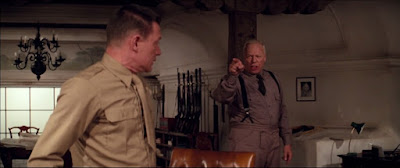

But, when the film-rights were sold and the project made, the commander's name was changed back to its source, George Patton, and the film followed the rest of the fantasy-land speculation, completely ignoring that Patton wasn't killed in the car-crash, but only injured. His surviving and subsequent 12 days of traction are completely ignored. Instead, we get a sub-par plot of Army Intelligence officers (round up the usual suspects: Patrick McGoohan, Robert Vaughn, and Edward Herrmann) who pulled off the gold heist—in an elaborate plan that could have gone wrong in many ways, not least of which is that gold is heavy and difficult to transport. Once the theft is discovered, Patton is determined to find out whodunnit—he's livid over the loss of life—and it is arranged that before he can get very far into the investigation that he be killed by a hired assassin, Peter Shelley (Max von Sydow).


It is up to OSS Major Joe De Lucca (John Cassavetes) to determine who was behind the robbery, a task complicated by the plan's similarity to a mission De Lucca himself had masterminded against the Nazis some time earlier. That puts him in the sights of Patton's investigation, but for De Lucca, it merely means that whoever's behind it knows of him, his tactics and has enough security clearance to know what's what in the particularly-secretive-because-it-is-so-new OSS.

There are complications—enough to distract De Lucca from the obvious—and bodies begin piling up, only verifying to him that he's on the right track. And then, there's some romantic entanglements which serve no dramatic purpose other than to put Sophia Loren in the picture.

It's a lousy movie, but I can see why people wanted to do it—money. Cassavettes took less film roles later in his career as he was concentrating on film-making, and this one probably paid for a couple of his. Points to the movie for that. And he also might have also wanted a chance to play with von Sydow (playing another inscrutable assassin—he seemed to be doing that a lot in the paranoid '70's), whose character plays two roles, one in very plain sight as a diplomat and one in the shadows as a very undiplomatic hit-man (the two careers seem to be mutually exclusive in attitude and temperament and either job could impair, if not jeopardize, the other—different color contact lenses notwithstanding).

Great disguise there, Max.
Superman, at least, puts on a pair of glasses.
But, one shouldn't quibble about details, especially sophisticated ones, as the whole plot is built on the substantial lie of Patton being assassinated. It's a wonder they didn't do it in modern dress, as focused as they are on "accuracy".


