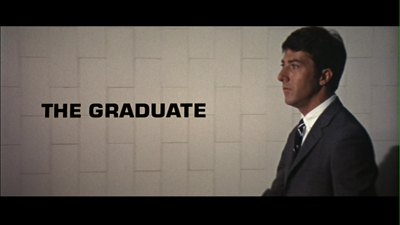
Ever re-visit a film from your youth and realize that it was saying something you hadn't realized at the time? The movie hadn't changed (unless it was directed by George Lucas), but you had. You'd gotten older, maybe wiser, but certainly had learned a few things as you gained time and experiences in the intervening years. The Graduate was one of those films for me. I wrote this a few years ago—but neglected to bring it over from the old blog-site—and things keep changing, but the movie—and it's message—still remains. It just wasn't the vision that was planted in my brain when I first saw it as a self-obsessed romantic youth.
 The Graduate (Mike Nichols, 1967) During the summer of 2009, the small rom/com (500) Days of Summer contained a line that hit home on many fronts. The romantic hero (says the police blotter-like narrator) formed his romantic ideas at an impressionable age due to "a mis-reading of The Graduate."
An easy thing to do.
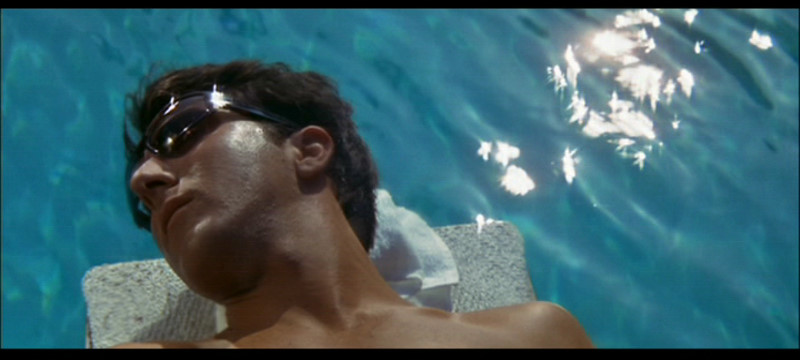
Lots of young romantic kids—I was one of them—grooving on the surface-tension of the movie, missed Mike Nichols' (and scenarists Calder Willingham and Buck Henry's) wise, dispassionate warning of a life led for instant gratification, something that went right over the heads of a clan preparing for "The Summer of Love." When we first find Benjamin Braddock (Dustin Hoffman) he's going nowhere mighty fast: first, stuck in a plane seat, then on an airport's "moving sidewalk"—life going by, him standing still. He'll spend his first summer out of college in much the same way. His first night home, he'll be hiding in his room (to avoid his parents' celebratory welcome home party) "worried about (his) future."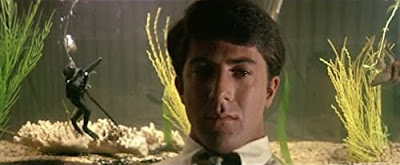 But the world will have none of it. Along with the free advice ("plastics...") and the pinched cheeks that will continue through his adulthood, Ben is coerced into driving the wife of Ben's father's partner home from the party. Once there, "things get a little weird." Dressed in her leopard-print coat,* Mrs. Robinson (Anne Bancroft) reveals herself to be quite the predator, as well as revealing that she's neurotic, alcoholic and...oh, by the way, Mr. Robinson (Murray Hamilton) won't be home for hours. Yes, as a matter of fact, she is trying to seduce him,** and Ben barely makes it home uncompromised by Mrs. and Mr. Robinson, who gets home sooner than expected.
 But Ben is feeling pressure at home. Dad wants him to think about graduate school and is trying to hook him up the Robinson's daughter, Elaine (Katharine Ross). To an extent he does a little bit of both by spending time in post-graduate studies with Mrs. Robinson, who becomes fiercely adamant against Ben dating her daughter. He also finds out that the Robinsons have a marriage of convenience as she became pregnant with Elaine and that was the thing to do.
 It's pretty apparent that after four years of schooling, Benjamin doesn't listen very well. Forced into a date with Elaine, he's determined to screw it up, succeeds all too well, then, having reduced her to tears, decides that he can't be that much of a heel and makes it good to her. A romance begins to take shape, but is quashed when Ben reveals to Elaine that he has had an affair with her mother.
 Against all odds (or reason) Benjamin begins seriously pursuing Elaine, making it his goal, and, despite her initial reservations, culminating in a rescue at the church of her wedding, where they famously escape on a bus, having defied convention, their parents, and get things their way.


It occurred to me (after loving the movie for 30 years) when someone professed to not liking it much because the character of Elaine is so ill-defined and confused. It is not a strong woman's part, despite its screen-time and seems more a fantasy—a screenwriter's convenience, her change of attitude towards Ben being a mystery and ultimately she trades one controlling force—her family—for another—Ben. And Ben is simply a mess—single-minded, shallow, without much motive other than selfish ones. He's very much his parents' son.

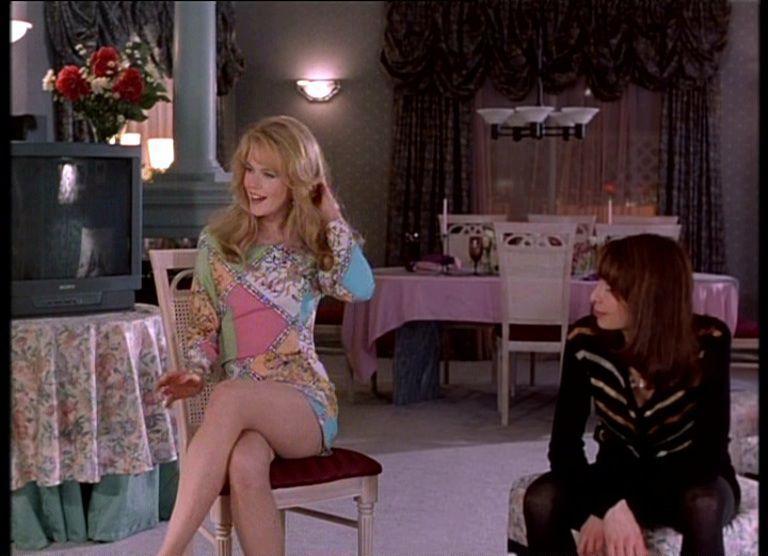
So, when (500) Days of Summer came out, with its shallow male pursuing a female through friendship and assuming forever is part of the bargain, and its female character who enjoys the friendship but doesn't see it "safe" enough to be permanent,*** the connection to The Graduate clicked, all too finally. It is a comedy (in the classical sense), as its protagonists don't even know that by pursuing their course of what they see as rebellion, they've condemned themselves to living the quietly desperate lives of their parents.


What did "The Bard" say? "You say you want a revolution, well, you know/we'd all love to see the plan..."

"Everybody puts Benjy in the corner:" Dustin Hoffman and Anne Bancroft "Graduating"
* This was the 1960's—the term "cougar" would show up forty years later. Bancroft was only six years older than Hoffman at the time.
** We dissected this scene in "Don't Make a Scene: The Graduate."
*** (500) Days of Summer has a telling scene, he takes her to see The Graduate and she ends up sobbing; what he sees as romantic, she sees as frightening, terrifying...and her situation.
.jpg)