Showing posts with label Richard Dreyfuss. Show all posts

Tuesday, June 6, 2023

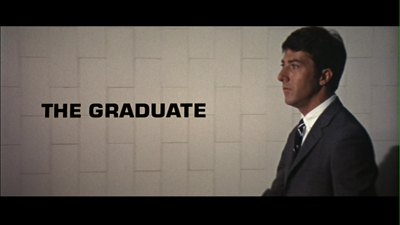
The Graduate (Post-Graduate Studies)

Ever re-visit a film from your youth and realize that it was saying something you hadn't realized at the time? The movie hadn't changed (unless it was directed by George Lucas), but you had. You'd gotten older, maybe wiser, but certainly had learned a few things as you gained time and experiences in the intervening years. The Graduate was one of those films for me. I wrote this a few years ago—but neglected to bring it over from the old blog-site—and things keep changing, but the movie—and it's message—still remains. It just wasn't the vision that was planted in my brain when I first saw it as a self-obsessed romantic youth.


The Graduate (Mike Nichols, 1967) During the summer of 2009, the small rom/com (500) Days of Summer contained a line that hit home on many fronts. The romantic hero (says the police blotter-like narrator) formed his romantic ideas at an impressionable age due to "a mis-reading of The Graduate."

An easy thing to do.

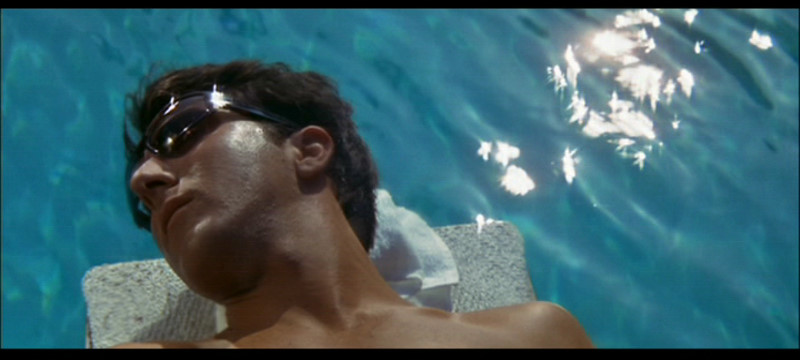
Lots of young romantic kids—I was one of them—grooving on the surface-tension of the movie, missed Mike Nichols' (and scenarists Calder Willingham and Buck Henry's) wise, dispassionate warning of a life led for instant gratification, something that went right over the heads of a clan preparing for "The Summer of Love." When we first find Benjamin Braddock (Dustin Hoffman) he's going nowhere mighty fast: first, stuck in a plane seat, then on an airport's "moving sidewalk"—life going by, him standing still. He'll spend his first summer out of college in much the same way. His first night home, he'll be hiding in his room (to avoid his parents' celebratory welcome home party) "worried about (his) future."
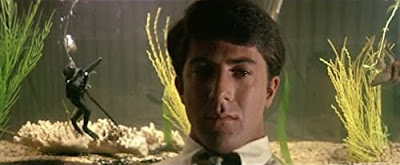
But the world will have none of it. Along with the free advice ("plastics...") and the pinched cheeks that will continue through his adulthood, Ben is coerced into driving the wife of Ben's father's partner home from the party. Once there, "things get a little weird." Dressed in her leopard-print coat,* Mrs. Robinson (Anne Bancroft) reveals herself to be quite the predator, as well as revealing that she's neurotic, alcoholic and...oh, by the way, Mr. Robinson (Murray Hamilton) won't be home for hours. Yes, as a matter of fact, she is trying to seduce him,** and Ben barely makes it home uncompromised by Mrs. and Mr. Robinson, who gets home sooner than expected.
But Ben is feeling pressure at home. Dad wants him to think about graduate school and is trying to hook him up the Robinson's daughter, Elaine (Katharine Ross). To an extent he does a little bit of both by spending time in post-graduate studies with Mrs. Robinson, who becomes fiercely adamant against Ben dating her daughter. He also finds out that the Robinsons have a marriage of convenience as she became pregnant with Elaine and that was the thing to do.
It's pretty apparent that after four years of schooling, Benjamin doesn't listen very well. Forced into a date with Elaine, he's determined to screw it up, succeeds all too well, then, having reduced her to tears, decides that he can't be that much of a heel and makes it good to her. A romance begins to take shape, but is quashed when Ben reveals to Elaine that he has had an affair with her mother.
Against all odds (or reason) Benjamin begins seriously pursuing Elaine, making it his goal, and, despite her initial reservations, culminating in a rescue at the church of her wedding, where they famously escape on a bus, having defied convention, their parents, and get things their way.
Orson Welles has said any story can have a happy ending...depending where you end it. If Nichols had ended with Ben and Elaine flush with revolution bussing away to their future, it would have been a happy ending.
But he doesn't. He stays on his shot of the two rebels as their expressions change from elation to confusion to...what? Ben has been so focused on the prize and Elaine, confused and pressured into marriage, that they don't have a plan...they don't even know where the bus is going. The story will go on, and Nichols doesn't cut away until the last moment—he lets us see their expressions change, her looking at Ben unsure, Ben just looking forward still in an adrenaline daze of what he's done.
And what he's done is risk something the whole movie has been warning against—becoming like his parents. Mrs. Robinson has aspirations and dreams that were exploded when she became pregnant with Elaine and she became dependent on a man for her well-being. Elaine, with no degree, is now dependent on
the adrift Ben and the only thing on his mind is domestic bliss, although how he'll get there, he probably doesn't have a clue. Their impulsive act of rebellion is a trap to becoming their parents. A lot of people missed that message in the 60's, but it's always been there for anybody not blinded by the comedy and the attraction of its stars.
It occurred to me (after loving the movie for 30 years) when someone professed to not liking it much because the character of Elaine is so ill-defined and confused. It is not a strong woman's part, despite its screen-time and seems more a fantasy—a screenwriter's convenience, her change of attitude towards Ben being a mystery and ultimately she trades one controlling force—her family—for another—Ben. And Ben is simply a mess—single-minded, shallow, without much motive other than selfish ones. He's very much his parents' son.
So, when (500) Days of Summer came out, with its shallow male pursuing a female through friendship and assuming forever is part of the bargain, and its female character who enjoys the friendship but doesn't see it "safe" enough to be permanent,*** the connection to The Graduate clicked, all too finally. It is a comedy (in the classical sense), as its protagonists don't even know that by pursuing their course of what they see as rebellion, they've condemned themselves to living the quietly desperate lives of their parents.
On the occasion of its 30th Anniversary, a lot of critics who could do so, re-evaluated The Graduate, and down-graded it accordingly. Given the new "reading between the frames," I'd actually up-graded as being far more subtle and wise than the comedy aspects of the film would suggest. Perhaps it's time to pay a visit to Sam Mendes' Revolutionary Road, as well.
What did "The Bard" say? "You say you want a revolution, well, you know/we'd all love to see the plan..."
"Everybody puts Benjy in the corner:" Dustin Hoffman and Anne Bancroft "Graduating"

* This was the 1960's—the term "cougar" would show up forty years later. Bancroft was only six years older than Hoffman at the time.

** We dissected this scene in "
Don't Make a Scene: The Graduate."

*** (500) Days of Summer has a telling scene, he takes her to see The Graduate and she ends up sobbing; what he sees as romantic, she sees as frightening, terrifying...and her situation.

Friday, May 7, 2021

Anytime Movies #8: American Graffiti

While I catch up on the reviews still in "Draft" phase here, I'll re-run a feature I ran when I first started this blog seven years ago,* when it was suggested I do a "Top Ten" List.

I don't like those: they're rather arbitrary; they pit films against each other, and there's always one or two that should be on the list that aren't because something better shoved it down the trash-bin.

So, I came up with this: "Anytime" Movies.


Anytime Movies are the movies I can watch anytime, anywhere. If I see a second of it, I can identify it. If it shows up on television, my attention is focused on it until the conclusion. Sometimes it’s the direction, sometimes it’s the writing, sometimes it’s the acting, sometimes it’s just the idea behind it, but these are the movies I can watch again and again (and again!) and never tire of them. There are ten (kinda). They're not in any particular order, but the #1 movie IS the #1 movie.

What's George Lucas' best film? For most, it's probably Star Wars (I'm sure there's some poor soul out there who likes Radioland Murders). There's a lot to like about his charmingly scruffy homage to the Buck Rogers serials. But one wonders what direction his career might have gone if he hadn't felt the need to exploit that first "Star Wars" movie as much as he did. It seems the more he explained about his initial concepts the worse the movies got, and the more rich and famous they made him, the more elephantine and fossilized they became.

For me, Lucas has yet to top
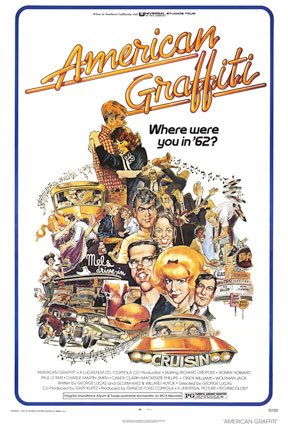
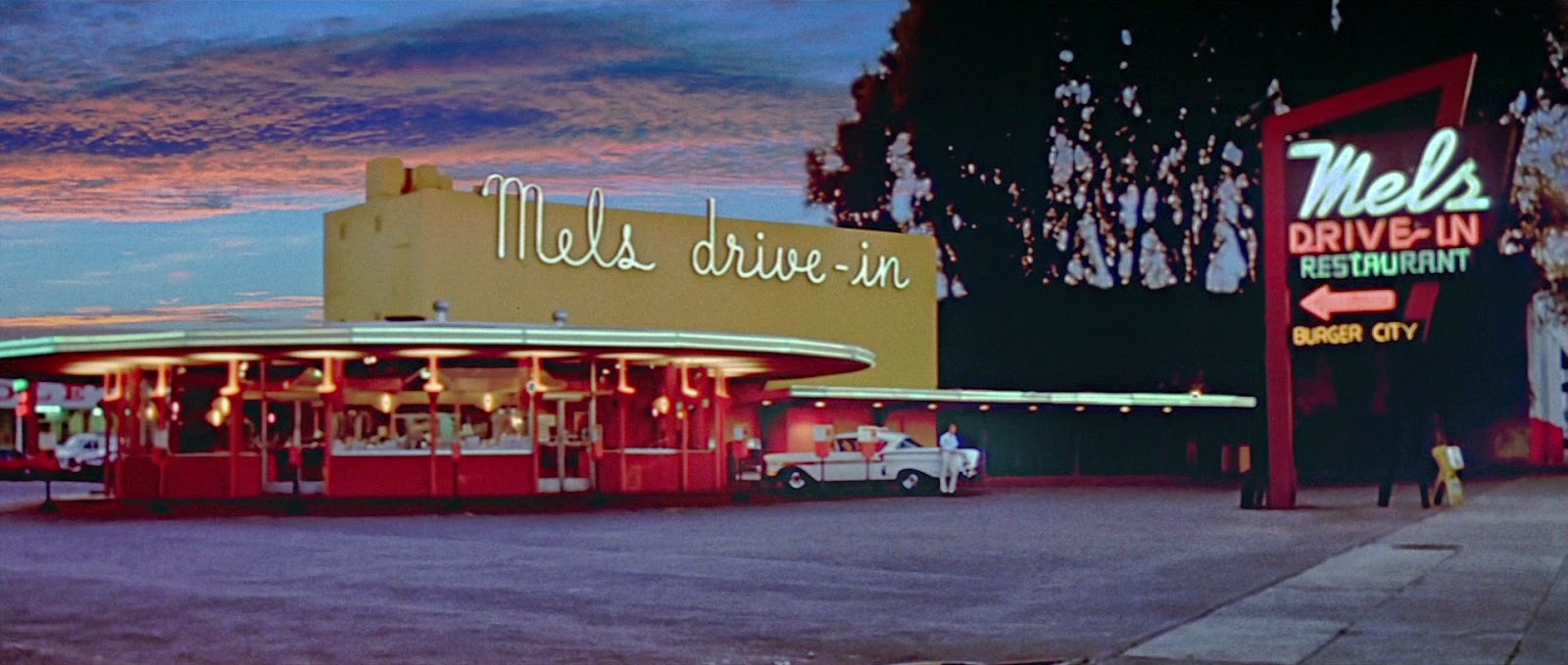
American Graffiti. Made for under a million dollars and filmed mostly at night using a skeleton crew (albeit one headed by Haskell Wexler), it showed just how ingenious Lucas could be when he was strapped for cash. It has the structure and froth of a Shakespeare comedy with the values and budget of an AIP teen flick.  Seemingly aimless, American Graffiti follows four storylines of small town kids on the last night of summer before heading to college. Curt (Richard Dreyfuss) has a scholarship to a big university but is reluctant to go, and spends the night bounced around by local toughs, and diverted by his quixotic pursuit of a phantom blonde in a white Thunderbird. Steve and Laurie (Ron "Ronny" Howard and Cindy Williams) are a couple in transition. Class President and Head Cheerleader, they're the Royal Couple of the Sock-Hop. But Steve can't wait to head out of town to conquer new territory, and Laurie-still in high school-knows she'll lose him when he goes. John (Paul LeMat) is a high school drop-out and legendary hot-rodder endlessly cruising the streets of town, looking for the next race. And Terry (Charles Martin Smithlives a rich fantasy life (that's a kind way of saying he's deluded) where he can imagine himself everything that he's not.
The Village Square
Lives intersect, couples form and break apart, lies are told, misunderstandings abound (to really make it Shakespeare all you'd need is a set of twins), while the majority of kids drive endlessly in circles--not going anywhere, but hoping to, and if not tonight, there's always tomorrow. They're not going anywhere.

In the background are the constant echoes of rock n' roll pouring out of car windows and reverberating down the hallways and back-alleys, broken only by the howls and shrieks of the common thread in their lives,
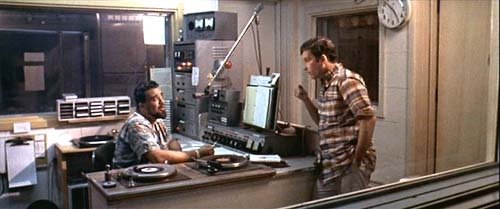
Wolfman Jack. All the kids have their Wolfman myths and he acts as sage, seer, siren and Master of Ceremonies for the evening's adventures. He's also the Fool and "The Man Behind the Curtain." Ultimately the long night's journey leads to his door-step, and, in disguise, dispenses his wisdom to the seeker. 
The Siren
One thing Lucas always knew was how to make a curtain call and American Graffiti is his best. As Curt flies off to college, he is left two signs of passage: the white T-bird reappears one last time to remind him what he's giving up, while locked away in his plane, the sounds of the radio station that have buoyed and sustained all the characters throughout the night fades to static. For the first time in the film there is no music and in the silence that creates, broken only by the drone of the plane we're told the rest of the story. Terry "goes missing" in Vietnam. Steve is an insurance salesman in town. John is killed by a drunk driver. Curt's a writer in Canada. After that punch in the gut, Lucas unsentimentally hammers it home with one of the cheeriest songs in the Beach Boys catalog—"All Summer Long," dismissed earlier in the film as "surfing shit." Lucas turns the future into a sobering fate—the film is set in 1962. The next year would signal the end of the innocence of the 50's and American Graffiti is a sweet farewell to trivial concerns and living in the past.
The Knight-Mentor
Lucas has said that he based the boys on different aspects of himself in high school--the intellectual, the nerd, the sosh' and the JD. Lucas' lesson in this, and all of his work seems to be "Advance or Die." It's the lesson of Graffiti. It is certainly the basis of the story of Anakin Skywalker. So what became of Lucas? Did he follow his own advice? Well, you could say he went to the future with Star Wars, but he set it in the far-away past. Then he built an Empire of his own...in his hometown.

The Trailer for American Graffiti--in the style of Beach Blanket movie

American Grafitti touched me in two ways. I had already been inspired by Lucas' first film, THX-1138 with its inventive sound-scape, to seek out his work and the work of his sound editor Walter Murch. Grafitti was their second collaboration and pretty much sealed my fate for going into sound work. Listening to it now, it's crude and has a lot of holes and bad edits, but the innovations are just as unique 30 years later and just as inspiring. On top of that, the unglamorous portrayal of a radio disc jockey's life (yet romantic in its anonymous/omnipresent effect on a community) made me think "I could do that!" and I started my sound career spinning discs at a radio station. My last job as such was at a station with a glass window that looked out on the town's "loop." Sort of like watching American Graffiti in reverse. That was KEDO-AM in Longview, Washington--long ago bulldozed.

Wolfman Jack explains it all for you, baby

I'd just done a "Don't Make a Scene" segment for American Graffiti* and was looking forward to writing new "insights" on this film, but reading it again, no, I pretty much covered them all. Not that American Graffiti is that simple—it's just that given Lucas' skimpy out-put, there's not a lot of complexity in his ouvre. It is interesting that Lucas goes the Joseph Campbell route in this film before he actually read "The Hero with a Thousand Faces" and used the "seeker's path" for the construction of Star Wars. He was already using it here and doing variations of it for the four Lucas-aspects, each with different fates (a cautionary tale, indeed). He also uses the cross-cutting on different fronts that would be his staple in the "Star Wars" films, but interestingly in his first Star Wars (A New Hope) and this film, there is no cross-cutting at the end, everyone is melded into the final story-line, buttoning everything up nice and neat. 

He wouldn't do that again.
Mort Drucker's original artwork for American Graffiti
from the Estate of Howard Kazanjian
Anytime Movies:
American Graffiti
To Kill a Mockingbird
Goldfinger
Bonus: Edge of Darkness

* And, on Sunday, we'll put up a "Don't Make a Scene" feature from each week's film.

Tuesday, August 18, 2020

W.

Written at the time of the film's release. I took out a long rant about the Bush Administration (when I wrote it Bush was still in office) and I wanted my prejudices out front. Here, the prejudices are for Oliver Stone's issues with film-making (for the most part).

Plus, the venom I spewed at that time, seems almost quaint considering what has come after him since. Bush has been heard to remark about Trump "He makes me look pretty good." Michelle Obama and he are "besties," insisting on sitting together whenever "the formers" must gather. And Clinton and he act like they're joshing brothers, after Clinton and his father became close friends, post-presidencies (Clinton BEAT Bush in in the 1992 presidential election, but it didn't matter...).

One must acknowledge grace in our leaders...when they lead...and show us the way.

"Somethin' 'Bout Bein' in the Barrel"

Oliver Stone is no one's idea of an objective film-maker, if there is such a thing. Once a screenwriter puts pen to paper, they've already started manipulating the movie to their point-of-view, whether it's from the left, right, center or upside-down (Why do you think they're called "directors?"). So, no one should be surprised that Stone has an ax to grind, with W..

Stone is a director of heart, but he frequently by-passes his brain when making his points. So,
Platoon, still his best film, hi-jacks the gritty depiction of grunt jungle-fighting with Stone's own conflicted "Daddy" issues, his "Pvt. Chris Taylor" having to choose between two superiors with different moral ways of engaging the enemy. Lincoln and every fantasist depicting moral choice has put angels and devils on our shoulders. Stone burdens us with His Old Man. That same scenario was transferred to High Finance, with his very next film Wall Street. I haven't seen every film of Stone's, but most of them are concerned, in some capacity, with paternal conflicts. And because he's a better propagandist than scenarist, most Stone films stop dead whenever we get to each Stone "thesis," invariably a Message being presented by a single character who has center-stage and our undivided attention. JFK, a dazzling technical exercise of photography and editing, comes positively unglued in its presentation of conflicting conspiracy scenarios for Pres. Kennedy's assassination (Kennedy being another Stone father figure--"Our murdered King," as he's described in the screenplay (completely by-passing any thought that we might, you know, be living in a democracy with a representative government), until Kevin Costner's prosecutor Jim Garrison places in his summation a theory on military-industrial conspiracy behind the Vietnam War, a Stone obsession.* In W. Dick Cheney—Richard Dreyfuss clearly enjoys being given the opportunity to play him**—stops an Iraq War strategy session to pontificate on securing Middle East interests for oil exploitation for a hundred years. Give the man points for passion, but his movies become such a glut of emotion that the point becomes lost in the gnashing of teeth and the wringing of hands. His bio-pic of Nixon was such a slap-dash affair, it seemed like a badly-cast TV-movie gloss-over, skipping from high-light to low-light in time to shoe-horn the next commercial (A weirdly fictional conversation between Chairman Mao and Nixon was Stone's show-stopper there). By the end, with its End-Credits playing over a Mormon Tabernacle Choir-rendition of "Shenandoah," one almost felt some sympathy for the man. Nixon, not Stone.

W. (his too-early summation of the second Bush Administration) suffers the same problems. It's a gloss of recent events, interspersed with flash-backs to the wastrel days of the young George W. Bush (played throughout by Josh Brolin),*** drunk with entitlement and just about anything else he could find. Particular heed is paid to his relationship with "Pappy" George H.W. Bush (James Cromwell, though he seems nothing like Bush the Elder, displays quiet bluster and submerged weakness), in which the good-for-nothing son is particularly eaten up, not by his own failures, but by his father's view of them.
The best part of the film—oddly for Stone—is Bush's conversion to The Faith. Struggling with his alcoholism, determined to become a Public Figure (as private industry success constantly eludes him), he is converted by Pastor Earl Hudd (Stacy Keach, playing it straight, and doing some of the best work of his long career), introducing Bush to the second "Daddy," the Divine One, slotting this film into the standard Stone scenario. One knew, as soon as Bob Woodward revealed that Bush, prior to the invasion of Iraq, didn't consult his father/former President, but, instead, relied on the advice of a "Higher Father to appeal to," that Stone would obsess on it and exploit it. The film-maker takes the one relationship as far as it will go, creating a fantasy sequence where Bush 41 challenges Bush 43 to fisticuffs, but Stone doesn't have "the stones" to have W. duking it out with his Savior, J.C.

That battle's still to come.
Stone starts "W." with a Sergio Leone close-up of Bush's steely gaze, what impressionist Frank Caliendo says "like he's always got the sun in his eyes." It's another fantasy sequence, where W. acknowledges the cheers of an empty baseball stadium from center-field--what he'll later reveal as "his favorite place on Earth." The movie will end back on those eyes, searching, confused, disoriented--having lost a pop-fly "in the lights." Those distorted lights show up twice more in the movie--in that previously mentioned conversion scene, as well as when a hung-over Bush collapses while jogging. That's it? That's what we get? A half-assed light show? Is Stone saying he's abandoned by God, or that Bush is overwhelmed by his circumstances? The metaphor's too half-baked to communicate as solid concept clearly.
One could look at W.'s story in Shakespearean terms, as a modern day Prince Hal, whoring and wenching in his oats-sewing days to become the Monarch his father couldn't be. The difference is Hal had Falstaff as guide to the back-alleys of Agincourt. George W. Bush is his own King. And his own Fool.
But Oliver Stone is too busy making room for his "Daddy" theories to create a proper condemnation. As with Nixon, you start to actually sympathize with the man. Any illumination into the man or the effect of his Administration is lost in the lights. To Stone, he is just another Yalie "poor little lamb who has lost his way."

Bah. Bah...and Bah.

* Any judge would have gaveled the irrelevancy, but Stone's judge was played by the real-life Garrison.

** Dreyfuss had a lovely phrase about working with Stone on W. when he was on "The View:" "You can still be a fascist...even if you're on the left."

**Josh Brolin does fine work, but the performance feels a bit "one-note," having to nail the too-familiar Bush mannerisms and vocal tendencies.


Tomorrow—merely by coincidence, another "period" film.

Wednesday, July 1, 2020

Red (2010)

Written at the time of the film's release.

"Better Dead Than Red"
or
"Who Wouldn't Want to See Helen Mirren with a Sniper Rifle?"*

Cute.**

That's the word for Red. Not good. Not bad. Just "cute." I mean, what's not to like? A movie top-heavy with talent in front of the lens—in fact, there are so many Emmy/Oscar-winning actors (including Ernest Borgnine and Richard Dreyfuss buried in the credits) that one wonders why there wasn't a better project for them to do than this. Yes, it's entertaining (if you turn the brain off). Sure, it's occasionally funny—it's especially nice to see Bruce Willis back in his lighter mode, reminding one of how damned good he was in his "Moonlighting" days, and John Malkovich taking full advantage of his "crazy coot" part without pretensions of doing anything serious. And it's nice to see a full cast of "mature" actors in a movie based on a comic book series, so that the potential audience demographic is as wide as Morgan Freeman's smile. For a reviewer of my advanced age (55), it is a little disconcerting to see these storied thesp's I've grown up watching (often from their first filmed roles) being sold as "old farts in the pasture,"*** despite how easily they deal with their younger counterparts, like fine actors Karl Urban and Mamet collaborator Rebecca Pidgeon, though it's presented in a somewhat condescending manner.
The main problem I have with the movie is that (timing aside), it's just another in the series of "Dirty Dozen" discarded mercenary movies we've seen so many of this year, and it's an uninspired entry, at that. Oh, sure, it's tricked up with animated post-card location bridges (that get tedious), a coy break-away editing style, and a pyrotechnic fetish that mushrooms every explosion into a lens-searing extravaganza, and the occasional "see-this-I-wonder-how-they-got-this" shot that is, basically, the director trying to draw attention from his actors ("I'm helping!!"). Wish he'd paid a bit more attention to what was going on in the script, rather than in how to present it.
There's a little too much reliance on exposition that telegraphs what will happen in the movie (and it doesn't help that the actors tend to "wink" the importance of those lines at times). And if there's a script problem, the director just figures out a way that he can draw attention away from it, rather than make it better.

Take, for example, an early shot of a line of gun-men—a nice, easily raked-over straight line of gun-men (wouldn't even need to go through a whole clip!)—advancing on a house that Willis' character Frank Moses lives in a quiet suburban neighborhood.  It looks impressive, until you realize how damn dumb it is. These jack-booted thugs (and in a NRA wish-fulfillment, they are government ops) advance on the house, not breaking formation, swiss-cheesing the house back to its foundation in the dead of night. Wow! Cool! One could make a case for "stylized comic action," if it wasn't so stupid-looking at first glance.
But, remember, I said "quiet suburban neighborhood?" You actually, earlier, do see neighbors. So, where is everybody? No one comes outside, the sequence goes on for many minutes, without a dog barking, a siren in the background, someone clappering-on the lights, or an actual NRA member shouting protest. That's just dumb. And it's the first of many "fish-bowl" sequences where things happen in only a world where this movie exists, as it has nothing to do with how "the real world" works—despite playing on the populace's paranoid delusions about "how the real world works." One wishes that one could forgive the contrivances, but you can't, as the movie hinges on them. And as sure as a bullet wound that was excruciating a few minutes ago, will be forgotten in the next few minutes, the director will find a way to wave something shiny at the camera (right before it explodes) to make you forget. I don't mind having my disbelief suspended, so long as someone isn't constantly cutting the cable to sabotage it.
Director Schwentke (The Time Traveler's Wife) is more interested in the kill-shot (with minimal blood-loss) than story-logic. But, lest one think I'm unappreciative, there is a neat shot, however it was done, of Willis stepping outside his skidding car firing his gun as the vehicle cantilevers around him.  Nice.
That's fun and all...even cute...but, I tend to like my spy stories to have a little more substance than cotton-candy to it, a bit more fiber, something at risk, so that when folks do go in harm's way, they do so because it is necessary to do so and the personal risk matters. So that they matter. Or else, what's the point of all the point-and-shoot? I'm not interested in watching a bunch of good actors having fun picking up a paycheck.
Still, want to know the coolest thing about Red? Seeing Helen Mirren firing an automatic weapon without so much as a flinch or an eye-blink, deliberately keeping those flinty eyes wide open, while the burly male extras playing the disposable agents firing back are fluttering their eye-lids right and left. Now, that's a Dame.****


* A quote from "Red" comic series writer Warren Ellis.

** Tommy Lee Jones revealed this (with a sneer) to be his least favorite word on "Inside the Actor's Studio." Yup.

*** The title refers to the group's designation as "Retired: Extremely Dangerous."

**** There was a sequel, that eliminated Urban and added Lee Byung-Hun and Academy Award winners Anthony Hopkins and Catherine Zeta-Jones. Haven't seen it and haven't because life is short.

Thursday, December 5, 2019

Stand By Me

Stand By Me (Rob Reiner, 1986) Stand By Me just might be the best film ever adapted from a Stephen King story, in fine company with Stanley Kubrick's The ShiningBrian DePalma's CarrieFrank Darabont's The Shawshank Redempton and The Green Mile, David Cronenberg's The Dead Zone, and (of course) Children of the Corn V: Fields of Terror.** 

King's collection of novellas "Different Seasons" came at a particularly inspired point in King's early career; each story is a gem, sitting outside of his then-established genre of horror writing, but still full of incident and character that could produce goose-flesh, or laughter. And the writing is sublime. Of the four stories included, only the "tale told in passing"--"The Breathing Method"--has not been filmed. The others--"Apt Pupil" was an indifferent Bryan Singer sophomore effort, and the classic "Rita Hayworth and the Shawshank Redemption" was the sublime Darabont film. But "The Body"--the story of boys of summer--was filmed first, as Stand By Me. It's cast of young actors (River Phoenix, Jerry O'Connell, Wil Wheaton, and Corey Feldman, along with Keifer Sutherland, Casey Siemaszko, and John Cusack--who'd starred in Reiner's The Sure Thing) would become established film players, with Phoenix breaking out early before his death at the age of 23. His death gives the resolution of the story an extra pang it didn't have when it was first released.
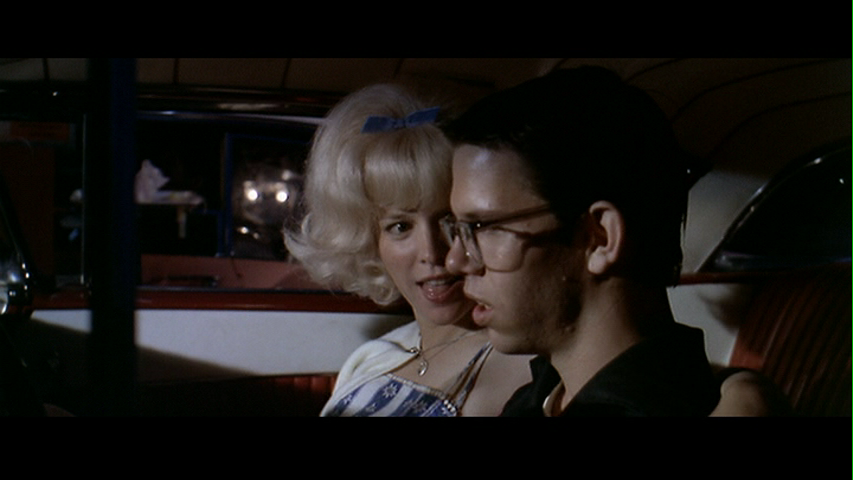
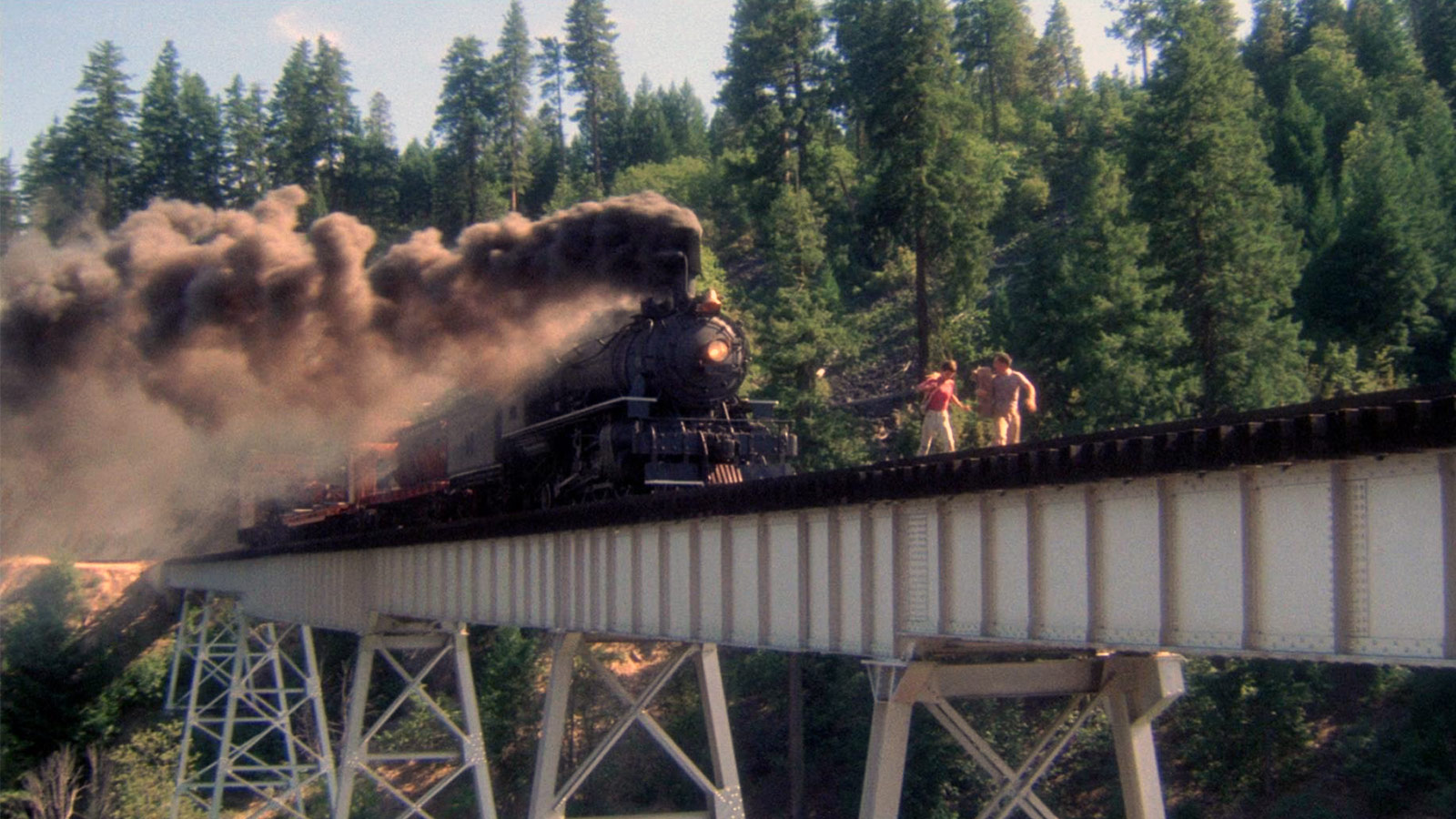
The story is of four 12 year old boys living in King's omnipresent town of Castle Rock (Maine in the story, Oregon in the film), who set out to find the body of Ray Brower--a kid who disappeared, and is gossiped to have been hit by a train--during an idyllic summer, made less so by the kids' circumstances at home, and their harassment by town bullies. Finding no real comfort anywhere, the outsiders set out to find the body in the wilderness for an adventure, and they are tested by Nature and their own natures.
Stand By Me is not so much a "coming-of-age" story as its been pigeon-holed, but a "coming-to-terms"...with one's lot in life, with those who threaten, and with the way life has a way of testing your mettle, and your sense of justice.
Rob Reiner has had a run of bad luck with his recent films clicking with the public. But Stand By Me was right in the middle of a superb run of well-done comedy films before his earnestness became a bit heavy-handed for most Americans' tastes.
There's an axiom in Hollywood that says, "You're only as good as your last film." But there's the "Billy Wilder corollary:" Really, you're only as good as your best film."

Given that, its only a matter of time before Reiner finds his audience again. Or they find him.


** Kidding, kidding... But, let's also include Andy Muscietti's It among them as well as Reiner's other King adaptation Misery.

Wednesday, September 10, 2014

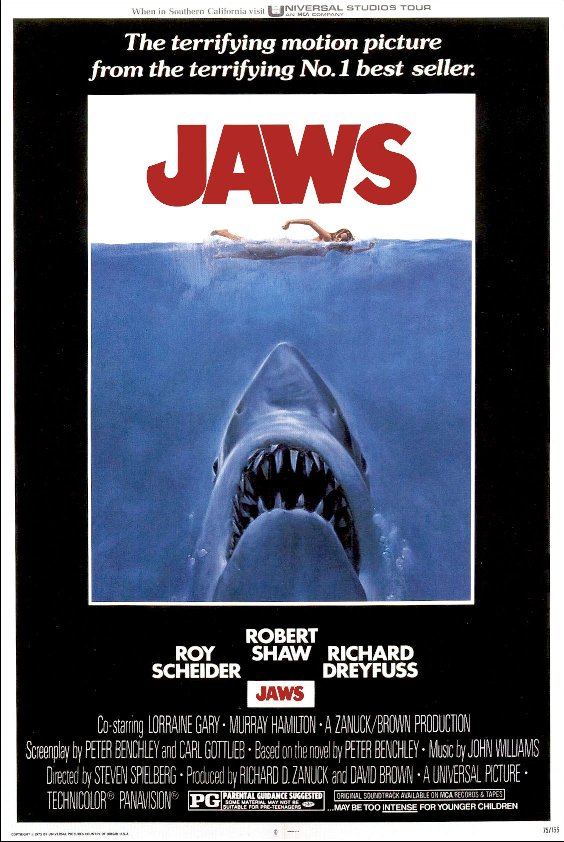
Olde Review: Jaws

I was looking at an old work-book from a UW course I took on Film (Cinema 201-Section AB) way back in 1975. The assignment was to keep a journal of films you saw/film-related things you were doing. And I found this entry for October 5 (with errors intact):
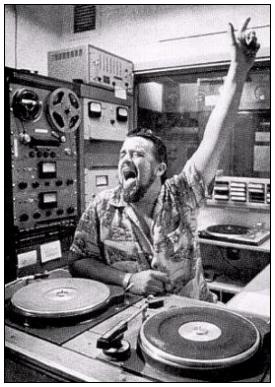
"After putting it off all Summer I went to see the summer's most lucrative film, "Jaws." Despite the fact that it was a matinee showing with what seemed like Western Washington's entire pre-teen population running up and down the aisles, and despite a projectionist whose religion must have prohibited properly framing a film, one was able to glom some sort of satisfaction out of the efforts of Steven Spielberg. I haven't seen much of Spielberg's work on television or theater (I didn't see "Sugarland Express" or many of his "Columbo" episodes) but those I have seen shows him to be a concentrator on montages, and a manipulator of audience reactions through erratic editing.

First of all, I have to say that the movie is a darn sight better than the novel it is based on. Spielberg and his screenwriters Gottlieb and Benchley have taken out the unnecessary sub-plots and gotten down to brass tacks by concentrating on the shark and its influence on the denizens of Amity. 

The first half of the film deals with the suspicions and final confirmation that there is a chomping monster out there in the water. The second half deals with the attempts of Brody, Quint and Hooper to subdue the beast. The fact that the movie is so clearly divided into two sections leaves them open to be compared with each other. As such, I prefer the first half. In this section, Spielberg moves logically from one incident to the next, playing on the suspense of the viewer. Also in this section is Spielberg's best sequence in the picture. As people mill and swim along the beach, Scheider sits on the beach watching for any shark activity in the water. Using passers-by as a blind to soften the jolt and heighten disorientation, Spielberg cuts closer and closer to Scheider as his (and our) tension mounts. Spielberg cuts back and forth between the various people of interest and Scheider, teasing the viewer with a gliding swimming cap (an example of perverse humor running throughout the film, something totally left out of the book, and an improvement) and some underwater shots of splashing limbs (a previous visual signal that the shark was ready to attack), a piece of wood floating in the water that a now-deceased dog had been retrieving. Spielberg builds until when the shark attacks, Brody's horror is shown in a "Rear Window" type of space ripping that brings Brody closer and the surrounding area farther away, separating him from his surroundings. This final scene might have been done faster for my taste, but that Spielberg thought of using it at all, is to be admired. The whole sequence is well-coordinated, tightly edited, and completely effective. As such, it is representative of the first half as a whole: logically scripted, meticulously photographed and planned, tightly edited. Of course, in the first half Spielberg concentrates on proof of the shark's existence. We never fully see it and Spielberg plays on our suspense in anticipating another attack.
With the second part, the suspense leaves. Spielberg, in the scenes in (sic) the Orca, Quint's boat, must rely on grotesque shots of the shark's maw, and sheer savagery, such as Quint being chewed alive. Subtlety leaves the picture. So does the execution that was so effective in the first part. Sequences are slip-shod, the editing, ragged and choppy (this for those action sequences in Part 2 to replace the suspense of Part 1). And Spielberg throws crisis upon crisis ("Let's see, is the boat on fire this time or is it taking on water?") Sure, the second part is tense like the first part, but it is also nerve-wracking. I reacted much more differently to Part 2 than to Part 1. The Orca sequences consisted of horrifying images and situations. I reacted with a horror that I also had from watching the various human torches in "Towering Inferno," a very inferior film, that relied solely on such horrors, for its shocks. Part 1 had much fewer than these, and instead of giving us a jolt from an unexpected violent action draws it out by making it expected and making us wait for it. Hitchcock can draw out such a scene expertly. Spielberg shows signs in Part 1 that he can also. But for now, he also must depend on sudden violence for a shock; a common weakness in films today."

Teacher's Remark: "Best treatment of the film I've yet read anywhere."


Well, as generous as that comment is, I still sound like a little snot, reading this. It's interesting to note this was at the beginning of Spielberg's career...long before he became "Dreamworks SKG"...and was still looked on as a novice film-maker, even by one such as me. And I agree with just about everything I said here. But then, Spielberg shot the film this way because he didn't have a working "mechanical shark" that he could use for the majority of the film's shooting, forcing him to use substitutes...like floating barrels, and to shoot an awful lot of peripheral stuff...and when he did use "Bruce," as the "shark" came to be known, well, it just didn't look very convincing. Hence the look and erratic nature of "Part 2"--the Orca scenes. Recall Orson Welles' line: "The enemy of art is the absence of limitations."