Showing posts with label Roy Scheider. Show all posts

Friday, May 15, 2020

Marathon Man

In these days of communicable diseases and precautionary measures for the greater good, folks on both sides of the aisle and of every color-stripe are being a little flippant with the "N"-word—"Nazi." 

So, just for a refresher course, we are going to sub-set the "Spies" series we're doing with movies where there are Nazi's (you know, "the bad guys"—Indiana Jones fought them in Raiders of the Lost Ark!) 

And we're going to call it "Nazi's...Nazi's everywhere."

Marathon Man (John Schlesinger, 1976) On the celebration of Yom Kippur, two chance encounters in New York City create an interruption in already established conspiracy that will conclude in two two wildly disparate people facing off against each other in a duel to the death: two cranky New Yorkers escalate a road-rage incident into a fiery crash, while on a track around Central Park, two joggers engage in a running battle over who's fastest—the slower of them Thomas "Babe" Levy (Dustin Hoffman) eventually gives up. His brother, an oil company executive, whom he affectionately calls "Doc" tells him he never confronts anything and this is just another example. A student at Columbia, "Babe" is doing his doctoral on tyranny, part of which will deal with the McCarthy era, of which his father, H.V. Levy, became a victim, ultimately committing suicide. "Doc" tells him that it's the past and he should put it behind him.

But, "Babe" still has the gun.
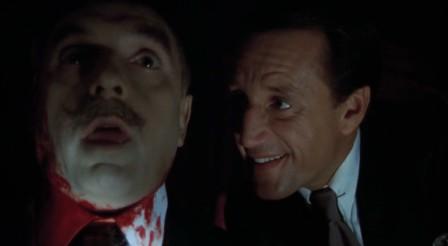
Across the Atlantic, a courier named "Scylla" (Roy Scheider) is beginning to get suspicious about the circle he regularly deals with. When he meets his established contacts, they are surprised to see him when he shows up at his usual haunts in Paris. Maybe because they think he's already been killed. He's nearly blown up by a street-bomb, one of his contacts is garroted at the opera, and the same assassin tries the same thing to him in his Paris apartment, before he gets the drop on him and breaks his attackers' back. Something is up, and he beats it out of Europe to get to the United States.
In South America, meanwhile, events have created movement among individuals who have remained in place for a very long time, lest their activity draw attention. Dr. Christian Szell (Laurence Olivier) under cover of darkness is leaving his Buenos Aries retreat for the first time in years. He has never needed to, but events have put him in danger—he needs information, to secure verifiable funds (that have been interrupted) and to eliminate the forces that have kept him safe all these years. His past is catching up with him. And so he runs. To the United States.
"Babe," meanwhile, couldn't be happier. While doing his research on his paper, he meets Elsa Opel (Marthe Keller), a Swiss student who is beautiful and charmed by him and he's so smitten, he can't believe his luck. Not even when, on an outing in Central Park, they are mugged by two very well-suited men; muggings aren't that rare, but usually by perpetrators less formally dressed. Babe tells Doc about Elsa and the mugging, and Doc wants to meet the girl.
Babe is surprised by a visit from Doc, and the two banter and bicker and make plans for an extended visit, Doc playing the protective older brother, wanting to meet these girl that babe is over the moon for. He has others plans that he doesn't let Babe in on, for Doc is also Scylla...and he's been at his game long enough that he doesn't believe in coincidence. Not with so much happening, of which Babe is innocently unaware.
The introductory dinner initially goes well; Doc picks an up-scale restaurant that leaves babe feeling like a fish out of water—he doesn't even own a tie that is required for so formal a setting. And Doc is clearly taken with Elsa—he flirts, he compliments, puts on airs as when he mysteriously says of the ordered wine "the great Chablis of the world are almost always green eyed. In fact, they're the ones that most resemble diamonds," a remark clearly intended to flatter Elsa and she's caught off-guard.
That's the point. Doc/Scylla is speaking in code. He suspects Elsa has something to do with his business in New York and the mugging makes him sure of it, but he doesn't tell Babe that. What he tells him is that Elsa is likely an exchange student on a foreign visa who wants permanent residency by coercing babe into marriage. Elsa leaves the restaurant in anger and Babe is hurt that Doc would insult her in such a way and have the opinion that Elsa wouldn't be attracted to somebody like himself without a hidden agenda. 

The meal ends on bad terms, but Doc has another meeting to go to and the stakes have just been raised.
Doc has arranged to meet Dr. Szell in a public setting, for those he's an old man, his past belies his frailty—he is the hunted Nazi Doctor Szell of Auschwitz, known as "der weiße Engel" (the White Angel) and for the past few years, his location has been protected by American interests for the information he's provided about war criminals, and for his services he has been provided anonymity and a steady flow of the diamonds obtained from his victims at the camp. One of the victims of the earlier traffic accident was his brother who was the first person in the diamond pipeline, retrieving the stones from a safe deposit box. With his death, Szell has come to this country to retrieve the diamonds, and, having no more need for the pipeline, has been systematically eliminating them.

Doc tells Szell that he is not welcome in the States and threatens to "out" him if he doesn't return to hiding. Suspecting that Elsa and the mugging have something to do with the elimination of the pipeline and his own assassination attempts, he warns Szell to stay away from Babe, as well. But, Szell is in for a penny, in for a pound. The stakes have changed.
Using a spring-loaded blade secreted in his coat-sleeve, he guts Doc like a fish, leaving him bleeding out and makes his escape. But, Doc somehow manages to make it back to Babe's apartment, dying on his floor. If he was attempting to warn Babe, he doesn't have the strength to tell him what has happened, and Babe, shocked and grieving, can only call the police and wait, stunned. 

The police take their time poking through Babe's apartment, asking questions, but he's clueless—there is no reason why his brother would be murdered and also, why he would make it to his apartment, knowing he was mortally wounded. Good question. The police are joined by plainclothesmen led by agent Peter Janeway (William Devane) who ask the same question. Why did Doc come back? Did he say anything to Babe before he died? No, Babe says. He said nothing. But, the question keeps being asked. Are you sure? Yes. He said nothing. Janeway tells Babe that his brother was a government agent and a colleague (and perhaps more?) but, despite the new revelations, Babe can't recall anything.
But, Scylla is dead. His warnings are going to go unheeded, and more people than just Janeway want to know what it was he said when he was dying. For Babe, his life will be put in jeopardy, involving kidnapping and torture—by dentist drill handled by a Nazi doctor in one of the most squirm-inducing sequences in movies (and the immortal line "Is it safe?")—and will be given a first-hand education in how dangerous and cruel the world can be...outside of history books. And he will run. And run for his life.
"Is it safe?"
On the technical side, Marathon Man was the first film to take advantage of the new stabilizing camera rig called "Steadicam." As operated by inventor Garrett Brown, the gimballed gyroscope system kept the camera from bumping in hand-held shots, giving the resulting footage a gliding quality, producing an organic freedom that couldn't be achieved with the conventional tracks and wheels. The running scenes benefited greatly from the new camera rig allowing free-moving close shots without the bump-and-jitter smearing that resulted from even the steadiest operator.
Also, the sound design is very special. Except for some studio scenes and a few others, most of the film's dialog is dubbed, the ambient sounds stripped away to focus on little detailed sounds designed to enhance or draw attention. It's a subtle thing, but every-so-often, one notices that the world is awfully quiet, in which case, be on the alert.
The film isn't nearly as air-tight as William Goldman's novel (Goldman did his own adaptation), leaving some loose threads, and condensing it down to essential scenes, nuggets of intensity, making it primarily a thriller, then veering into horror aspects (and film-strategies) when the action turns violent (which it does sporadically, creating ghastly effects). At the time I first saw it (in theaters), having read the novel, I was a bit disappointed, but the film has grown on me over time, especially in the grittiness of it that belies its slick veneer of polish.
As such, it's more of a sprint...not so much of a marathon.


Wednesday, April 18, 2018

The Russia House

The Russia House (Fred Schepisi, 1990) "Nowadays, you have to think like a hero merely to behave like a decent human being!" Bartholomew "Barley" Scott Blair (Sean Connery), barely getting-by book publisher, deep in his cups at a Russian Book Fair, seals his fate with those words. His words spark an idea in one of his audience-members and a plan of international repercussions is set in place. 

Some time later, he is sought out specifically—by a young Russian woman—not with a potential manuscript to be overseen for publishing, but with documents containing secrets of Soviet nuclear capabilities from a very reputable source. He soon finds himself wanted by both British Intelligence and the Russians, both looking for a hero in a final End Game in the Cold War in John le Carré's indictment of spies who don't even have the sense to come in from the cold.
Scott Blair becomes a hapless go-between for secrets, dispensed by a radical Russian scientist code-named "Dante"* (Klaus Maria Brandauer) who is willing to betray his country for The Good Fight for World Peace. He's enlisted his lover Katya (Michelle Pfeiffer) to contact Blair—the one man "Dante" trusts to smuggle his journals into the West for the purpose of publishing them. But "The Russia House," that wing of the Intelligence Service looking East, gets wind of it first and enlists Barley in an effort to learn as much about Russian nuclear capabilities as they can. Soon, he's wired for sound, followed by surveillance by the Brits (working with U.S. Intelligence) and embarks for a Russia about to collapse in Soviet dis-Union. He's starting to fall himself—for Katya—but, constantly monitored and miked, he'll have to resort to whispering sweet nothings in her ear. It couldn't be more appropriate.
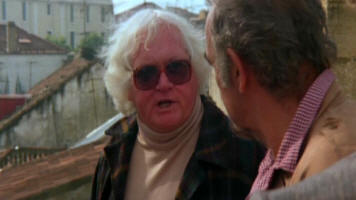
It's a master-stroke to get Connery to play this non-spy in John le Carré's literary world of "anti-Bond's." His long association with 007 is cast aside as he approaches the role bearded, curly-haired and gray, crotchety...and vulnerable, set upon by the author's tweedy grey men smug in their patriotism but lacking in honor. Tom Stoppard's screenplay takes a few bends out of le Carré's labyrinthine plot, but none of the complications in the ethics and politics of strange bedfellows in matters of the State and the heart. The production is top-notch, filmed in Portugal and the Soviet Union, with an eye-popping cast of character actors supporting the Connery, Pfeiffer, Brandauer troika. On the British side are James Fox, Michael Kitchen, Ian McNeice, and...Ken Russell! The Americans are Roy Scheider, J.T. Walsh, and John Mahoney, all salamander-cool and not to be trusted.
But the best part of The Russia House is the sub-text, which is all le Carré's. Distrustful of his brethren in the spy-hood, the author has always been able to forecast a new sin for them to exploit or fall prey to, and David Cornwell (le Carré's nom de réalité) could see the upcoming glasnost and perestroika and see the frosty battles continue un-thawed. Nothing worse or nosier than a spy with nothing to do and not know it. So he looked forward and looked to the past and compared and contrasted.
Remember this, if you must: a bitter cad who sticks his neck out for nobody, a committed idealogue fighting impossible odds, and the woman who is caught in between them. It's Casablanca. But the milieu is wrong. Where the 1945 film is about choosing "the cause" and "the good fight" in a "mixed up, crazy world," in the world of The Russia House, lives are being lost in a quest for worthless secrets...worthless because the other side already has them. The only thing to be gained in the cat-and-mouse games being played are the budgets being authorized for the cat and the mouse. In such a compromised clime, the problems of two little people do amount to much more than a hill of beans, they are a world-entire of pledges to be kept and sanctity to be upheld. They are the only ideals left amidst the corruption. In such a world, the fundamental things no longer apply. And by basing his story on that timeless tale of love and sacrifice, le Carré throws into stark relief the world of today and that world. Of a "mature, grown-up love" held against a world playing games...no matter what the future brings, as time goes by


* In the book, he was, more appropriately, "Goethe"—the man who wrote about making deals with the devil, rather than about his territory.

Tuesday, January 30, 2018

The French Connection

The French Connection (William Friedkin, 1971) Peripatetic police thriller with quite discernible street-grit in the film-emulsion, The French Connection (adapted freely from Robin Cook's "True Crime" book) tells the story of two New York police detectives Eddie "Popeye" Doyle and Buddy Russo (Gene Hackman and Roy Scheider, playing the noms de film of real-life detectives Eddie Egan and "Sonny" Grosso) tracking a high-level cocaine operation hiding in plain sight from overseas. 

The French Connection won the Oscar for best Picture of the Year, which seems like a good choice until you realize it was in contention with A Clockwork Orange and The Last Picture Show (as well as Fiddler on the Roof and Nicholas and Alexandra).*  Then, the choice feels as safe and conservative as can be. Yes, it's gritty. Yes, it's "edgy," but what does it have anything to say besides 1) that sometimes the good guys have to be rough with the bad guys in order to break even on the law-and-order scales, and 2) that outlaws have an easier time of it simply because they're outlaws who are bending the rules?

Not much of anything, really.  But The French Connection did take the police procedural in another direction.** The cops are less formal in their attire and language, and tougher in their asking of questions. Friedkin took a near-documentary approach to the subject matter (with the help of Owen Roizman's inelegant, constantly-searching, subjective cinematography), while conveying the frustration that cops, though maybe not crossing the "T's" and dotting the "i's" on the letter of the law, go through to try to achieve a legitimate, legally-binding "collar". One is left with a morally ambiguous ending in which lines are crossed to merely achieve a semi-positive result, as opposed to being for the greater good.

And (of course) everyone remembers the car chase.


But, the biggest through-line of The French Connection is Friedkin's constant contrasting of the cops and drug-dealers as diametrically opposed in almost every way. Charnier (Fernando Rey)—dubbed "Frog One"—and his traffickers travel and conspire unimpeded, while the detectives skulk and blend in with the savage streets and observe their targets working out in the open. The criminals live the high-life, dining and dressing elegantly, while the cops sit in the cold, eating stale sandwiches and swilling bad coffee on their stake-outs, dealing with bureaucracies and competing enforcement agencies, as the bad guys blithely go about their bad business and routinely handle such impediments punctually with gun-fire.

It is only at the end when a police road-block stops the conspirators in their tracks that the tables are turned, and the lines blur, and the ambiguities become real. And what is essentially a police chase has no discernible finish line.


* It was also the year of Straw Dogs, Dirty Harry, McCabe and Mrs. Miller, Walkabout, Carnal Knowledge, Klute, and Harold and Maude, none of which made the Best Picture category and in some cases, didn't receive any nominations at all.

** Wikipedia has a funny story about Friedkin's behind-the-scenes decision-making.   The director was living with the daughter of legendary director Howard Hawks, who suggested that, since Friedkin's pevious pictures were (in Hawks' view) "lousy," he should put a good chase in the movie "better than anyone's ever done."
The real-life Eddie "Popeye" Egan with the fictional Sonny Russo  (Roy Scheider)

Saturday, May 9, 2015

2010: The Year We Make Contact

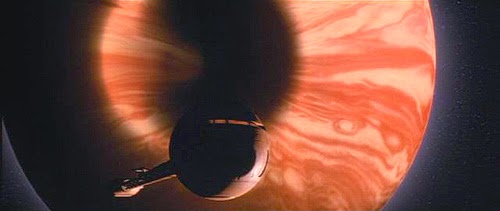
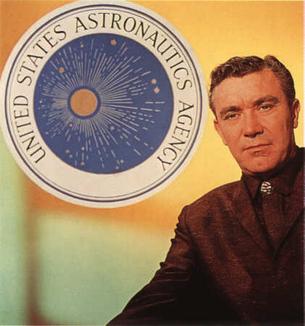
2010: The Year We Make Contact (Peter Hyams, 1984) 2001: A Space Odyssey took scientific precepts and used them as a launching pad for a philosophical adventure about humans and their place in the Universe in a suggestive and non-narrative way. It's "official" follow-up, 2010, however, tells you what it's going to show ya—then it shows ya—then it tells ya what it showed ya, thanks to a narration by Roy Scheider's character that explains everything but what he had for dinner. It's as far afield in style from its cinematic prequel as it could be—so much so that they feel like they've come from two different galaxies, or as one IMDB poster put it, "it's like comparing apples and concrete."

Based on
Arthur C. Clarke's "romp around the Solar System" ("2010: Odyssey Two"), it proposes a fact-finding mission by Dr. Heywood Floyd (Roy Scheider in this one, rather then the original's William Sylvester) to attempt to discover precisely what happened to the Discovery Mission to Jupiter and its crew. By hitching a ride on a Soviet space-craft (commanded by er, Tanya Kirbuk*Helen Mirren) that just happens to be passing by, Floyd and his crew—Discovery engineer Dr. Walter Curnow (John Lithgow) and Dr. R. Chandra (Bob Balaban), the computer scientist who developed the Hal 9000 and its twin in Urbana, Illinois—attempt to find out what went wrong with the mission that ended up with a dead crew and no information on where the signal sent by the un-mooned TMA-1 anomaly led. Where the first film revels in the leaps of evolution foisted on Man by "the Zarathustrians" (as I call them), Hyams' film is stuck with the earth-men and women merely trying to crack "what-done-it." 


Frankly, they should have just re-played the first film.
Kirbuk...uh...Kubrick stayed away from the machinations, unless it was visually arresting or amusing—like the zero-gravity-walking up walls, or the gravity-making squirrel-cage aboard Discovery— but Hyams, like Clarke, is only too happy to show the nuts-and-bolts of dropping into orbit with ablating bags, the stress it has on the crew by shaking the camera, the spark-emitting panels (straight out of Irwin Allen shows), and the requisite astronaut who flies across the control center in zero-g. This is the stuff of sci-fi melodrama in all its cheapness, precisely what Kubrick was trying to avoid in his film.
An interesting thing about the films of Peter Hyams: no matter the genre or concepts that he chose to direct, his films appear essentially flat—that's a weird result from a director who also chose to be the cinematographer on so many of his films (he shot 2010). Even when he chooses to shoot with some depth of field, his films feel like television productions, with a strong central object, and rarely little else of consequence (Kubrick did essentially the same thing, but his shot-compositions tended to be more vertiginous with a purposeful one-point perspecti
While everybody is fussing about the flight-mechanics of the rendezvous' with the Jupiter system and the now-tumbling-in-orbit Discovery, the Zarathustrians choose that moment to pull off a Solar System-affecting gambit, using the missing-in-action Bowman (Keir Dullea returning to his earlier role) as a secret agent appearing everywhere (now?) to pull off something spectacular—one shouldn't call it terra-forming so much as solar-forming—gravity manipulation, while Bowman runs interference, squandering the mystery of that omnipotent-seeming Star-Child (the next leap in human evolution seen at the end of 2001), to serve as a planet-skipping/morphing errand-boy who, it would appear, is discarded as soon as he accomplishes his final mission. 
Clarke's ultimate Big Surprise is a nifty one—educational, too, about the configuration of Jupiter—but by granting the unseen architects in both films motivations that seem like cosmic buttinski's very much cheapens the first film and its scope (much like the sublimation of Bowman's potential), making man's Creation merely all in a monolith's day's work. And the cosmic consequence of 2010 feels like a convenient after-thought, easing tensions of a U.S./Russian nuclear conflict (even though they seem to get along enough to launch a joint space mission together). 
It is eerie to hear the voice of HAL again (Douglas Rain) and to see Keir Dullea, through some artful make-up, look as young (and as old, unnecessarily) as he once was. And working from mere screen-captures, Hyams and his art department did a meticulous job recreating the Discovery sectionsthey can't keep the ships from looking like models in the FX sections, however, which is curious for a more late-model movie. So meticulous is their work that it seems bizarre that the Russian ship would look so different in its interior, than what the Americans had come up with by that time. Again, apples and concrete.
One wonders, ultimately, if it was worth doing: it was a toe-splash for M-G-M to explore the possibilities of one of its core properties, but its utter conventionality only points to the other film's complete unconventionality in terms of belaying cheap dramatic tricks and the standard "science fiction" obsession with mechanics (Kubrick turned all that rendezvousing into a dance). It is the only sense of wonder 2010 allows, where its progenitor was far more about wonder than the why's and wherefore's.

2010 serves as a Reader's Digest version of the original, a blunted, condensed presentation of a larger, more sophisticated work. It has highlights, sure, but there's nothing transcendent about it; it's a blue-print, a schematic of ideas, rather than a fully-formed work of art and expression. It's like a hack-magician, who can only keep an audience's interest by revealing how the tricks are done.

But, as Raymond Chandler noted with inferior movies made from his books, the originals are still there to be appreciated on their own. The creation of 2010 really doesn't diminish the work of 2001—it's still there to be seen and appreciated.
The final message to Earth is in English...and reads like a Hallmark card.

A couple of in-jokey cameo's
Pithy cover of Time: the U.S. President is Arthur C. Clarke/
The Russian Premier is Stanley Kubrick
Arthur Clarke (left) sits on a park-bench outside the White House
(Wait a minute—isn't he the President?)
* Read the last name backwards...

Wednesday, September 10, 2014

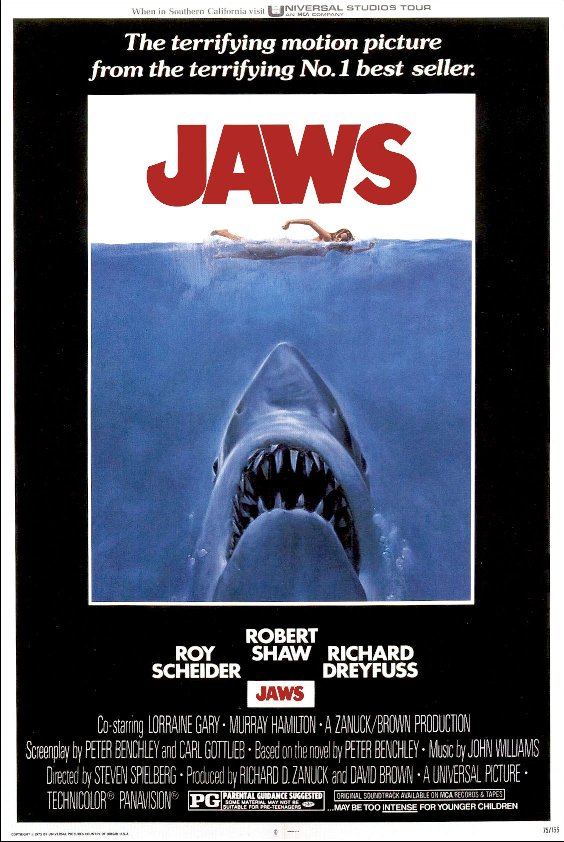
Olde Review: Jaws

I was looking at an old work-book from a UW course I took on Film (Cinema 201-Section AB) way back in 1975. The assignment was to keep a journal of films you saw/film-related things you were doing. And I found this entry for October 5 (with errors intact):

"After putting it off all Summer I went to see the summer's most lucrative film, "Jaws." Despite the fact that it was a matinee showing with what seemed like Western Washington's entire pre-teen population running up and down the aisles, and despite a projectionist whose religion must have prohibited properly framing a film, one was able to glom some sort of satisfaction out of the efforts of Steven Spielberg. I haven't seen much of Spielberg's work on television or theater (I didn't see "Sugarland Express" or many of his "Columbo" episodes) but those I have seen shows him to be a concentrator on montages, and a manipulator of audience reactions through erratic editing.

First of all, I have to say that the movie is a darn sight better than the novel it is based on. Spielberg and his screenwriters Gottlieb and Benchley have taken out the unnecessary sub-plots and gotten down to brass tacks by concentrating on the shark and its influence on the denizens of Amity. 

The first half of the film deals with the suspicions and final confirmation that there is a chomping monster out there in the water. The second half deals with the attempts of Brody, Quint and Hooper to subdue the beast. The fact that the movie is so clearly divided into two sections leaves them open to be compared with each other. As such, I prefer the first half. In this section, Spielberg moves logically from one incident to the next, playing on the suspense of the viewer. Also in this section is Spielberg's best sequence in the picture. As people mill and swim along the beach, Scheider sits on the beach watching for any shark activity in the water. Using passers-by as a blind to soften the jolt and heighten disorientation, Spielberg cuts closer and closer to Scheider as his (and our) tension mounts. Spielberg cuts back and forth between the various people of interest and Scheider, teasing the viewer with a gliding swimming cap (an example of perverse humor running throughout the film, something totally left out of the book, and an improvement) and some underwater shots of splashing limbs (a previous visual signal that the shark was ready to attack), a piece of wood floating in the water that a now-deceased dog had been retrieving. Spielberg builds until when the shark attacks, Brody's horror is shown in a "Rear Window" type of space ripping that brings Brody closer and the surrounding area farther away, separating him from his surroundings. This final scene might have been done faster for my taste, but that Spielberg thought of using it at all, is to be admired. The whole sequence is well-coordinated, tightly edited, and completely effective. As such, it is representative of the first half as a whole: logically scripted, meticulously photographed and planned, tightly edited. Of course, in the first half Spielberg concentrates on proof of the shark's existence. We never fully see it and Spielberg plays on our suspense in anticipating another attack.
With the second part, the suspense leaves. Spielberg, in the scenes in (sic) the Orca, Quint's boat, must rely on grotesque shots of the shark's maw, and sheer savagery, such as Quint being chewed alive. Subtlety leaves the picture. So does the execution that was so effective in the first part. Sequences are slip-shod, the editing, ragged and choppy (this for those action sequences in Part 2 to replace the suspense of Part 1). And Spielberg throws crisis upon crisis ("Let's see, is the boat on fire this time or is it taking on water?") Sure, the second part is tense like the first part, but it is also nerve-wracking. I reacted much more differently to Part 2 than to Part 1. The Orca sequences consisted of horrifying images and situations. I reacted with a horror that I also had from watching the various human torches in "Towering Inferno," a very inferior film, that relied solely on such horrors, for its shocks. Part 1 had much fewer than these, and instead of giving us a jolt from an unexpected violent action draws it out by making it expected and making us wait for it. Hitchcock can draw out such a scene expertly. Spielberg shows signs in Part 1 that he can also. But for now, he also must depend on sudden violence for a shock; a common weakness in films today."

Teacher's Remark: "Best treatment of the film I've yet read anywhere."


Well, as generous as that comment is, I still sound like a little snot, reading this. It's interesting to note this was at the beginning of Spielberg's career...long before he became "Dreamworks SKG"...and was still looked on as a novice film-maker, even by one such as me. And I agree with just about everything I said here. But then, Spielberg shot the film this way because he didn't have a working "mechanical shark" that he could use for the majority of the film's shooting, forcing him to use substitutes...like floating barrels, and to shoot an awful lot of peripheral stuff...and when he did use "Bruce," as the "shark" came to be known, well, it just didn't look very convincing. Hence the look and erratic nature of "Part 2"--the Orca scenes. Recall Orson Welles' line: "The enemy of art is the absence of limitations."