Showing posts with label Peter Hyams. Show all posts

Tuesday, July 23, 2019

Capricorn One

Capricorn One (Peter Hyams, 1978) And then came the backlash.

The Moon landings happened between 1969 and 1972, with six landings—more were planned but were scrapped due to budget cuts and general disinterest in "Man's Greatest Adventure"—and one mission (Apollo 13) that had to be scrapped due to equipment malfunctions. In 1976, a book was self-published by a former technical writer for Rocketdyne (who'd manufactured the Saturn 5 rocket engines) that the Moon landings were faked, based on his theories and his Bachelor of Arts in English.

Peter Hyams was working on the CBS broadcasts of the moon landings, which included—in lieu of real pictures from space—video simulations, animations, and staged views of a life-size Lunar Module on a Moon-simulated stage. He wrote a treatment of a Moon landing hoax in 1972 and after the Watergate scandal, began shopping it around where it was eventually sold to Sir Lew Grade in 1975.
The premise for Capricorn One is that NASA discovers—at the last minute—that the environmental system on-board just plain doesn't work, that despite astronauts supposedly testing the suits and spacecraft before launch, or even having test flights, and despite that keeping the astronauts alive during the mission might be "job 1." So, Head of NASA Dr. James Kelloway (Hal Holbrook) has the three man crew (James Brolin, O.J. Simpson, Sam Waterston) taken out of their capsule before launch and flown to a Nevada base where a planned faux-Mars walk will take place five months hence.*
The studio is a humble affair where all the action—all the action—would take place in a 90° arc around the landing craft—forget that a mission to Mars would be a long time affair requiring months of transit time and and a long staying time, a few months at least, to make the trip worth it, and, you know, "distance". Not to mention that the equipment to be used is the 1969 moon landing vintage—the real lunar lander couldn't support its own weight in anything more than the 1/6th lunar gravity (for some unknown reason—but I'll speculate money—NASA cooperated with this project). 
Anyway, the astronauts, for the good of the country, decide to go along with the subterfuge—and there's also the little matter that if they don't, their wives will be blown up on the trip back to Houston after the launch. Given that threat, you would think these pilot-engineers would be able to connect 1 to 1 and realize that if they're threatening to kill the wives (who wouldn't know about the conspiracy), then it's a small step (rather than a giant leap) to kill three of the  people in the know.
The spend the length of the mission in that desert location—not too different from that Rocketydyne writer's premise that the Moon crews spent their missions in Vegas with hookers and showgirls (they weren't recognized and the women didn't talk or brag about it?). But the crew have no such amenities (and being on Earth, neither can they simulate zero-g conditions—a staple of televised crew activities in space—during their broadcasts**), and once their scheduled broadcasts have concluded, they start to realize their vulnerability (they're not needed anymore) and so they plan to make an escape to try to get back to civilization before the execution can take place.
Once the hoax is accomplished, the crew make their escape, hijacking a jet used to carry the would-be assassins to the desert facility and ditching it when it runs out of fuel—there wasn't enough for a return trip (just how well funded is this conspiracy?)—the astronauts split up to make it more difficult to find ALL of them. They are pursued by your standard conspiracy theory "black helicopters" that are not so smart to separate but pair up in their search. In fact, the black helicopters are rather comically imagined and shot. Looking like bugs, at one point they face each other as if talking in a forced perspective shot*** that belies the fact they'd be chopping each others' blades off if they were really facing each other.
Meanwhile, NASA announces that the astronauts were killed during re-entry. While the nation mourns, one of the cap-techs (named Elliott and played by Robert Walden) tips off an intrepid reporter Robert Caulfield (Elliott Gould) that the television signal for the broadcasts beats the telemetry signals from the space-craft. 
Of course, it would. But what did they do with the spacecraft? Did they shoot it into a course for Mars—in which case it would take 21 minutes to reach Earth and that's a lot of difference—or is it in Earth orbits—in which case tracking stations around the globe would be receiving it at a rate once every 90 minutes (the time it takes to orbit) rather than the regular speed of the Earth turning into the signal (See how this gets less and less likely?).
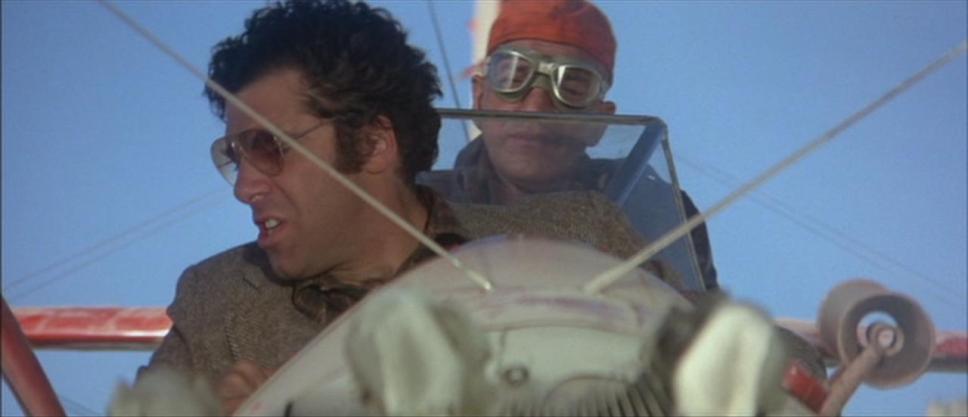
Anyway, Caulfield starts to follow leads and signals and enlists the aid of an eccentric crop-dusting pilot names Albain (Telly Savalas—okay, mock if you want, but Gould and Savalas are the most entertaining thing about this picture) to help find the desert studio and find the astronauts who might've survived—spoiler alert: they have better luck than two "black helicopters").
The unlikely team of Gould and Savalas really are the best thing about the movie. The worst performance is a real surprise—Sam Waterston gives a horribly overly-emotive performance in times of crisis, and I'll put that down to his playing the Command Module pilot because they never get the attention that the other two in the crew get.
The movie is absolute hokum, but it's visuals were tantalizing enough to inspire all sorts of conspiracy theories, to give pictures to the specious theories that were circling like vultures—and shots from the film were used in some garage videos as a basis for likelihood. In this case, those images were more powerful than any logic, as nothing is mentioned in the film about where the actual rocket has gone and no one in the film questions the limited field of view of the faked Mars signals (something you couldn't say about the vistas of the moon missions—even Apollo 11 did a 360° sweep of the landing area with the television camera) or even why the camera couldn't be moved to show the back of the spacecraft (thus showing the stage). Details. For the movie-goer, that's not brought up. Out of sight, out of mind. Plus, if a reporter can figure out a deception is going on—while it's going on—it's not much of a deception. In a post-Watergate world, it was easier to believe a case of malfeasance from the government than it would be to believe that it's easier to actually make the trip than to fake it.
Capricorn One is a mediocre film, but its imagery is compelling enough to charge the imagination...and fool the gullible. In fact, it's just like a conspiracy theory—all surface and no depth and enough holes to fly a Saturn 5 through.

Still, in a 1999 Gallup poll, 6% of Americans believe the Moon landing was faked (Post 9/11, a Pew research poll said that the number had "skyrocketed"...to 7%). 25% of British citizens believe it was a hoax (8 of the 1009 interviewed think Louis Armstrong was the first man to walk on the Moon).

https://news.gallup.com/poll/3712/Landing-Man-Moon-Publics-View.aspx
https://www.scientificamerican.com/article/moon-landing-faked-why-people-believe-conspiracy-theories/
The posters for Capricorn One played up the conspiracy angle.


* At one point Kelloway grouses that Apollo 17 started getting complaints that the coverage was pre-empting re-runs of "I Love Lucy." As I remember it, it started with Apollo 12. If we had the same adventurous spirit at the time of Columbus, we'd be speaking Spanish!

** And this is is rich—during the televised Mars-walk, when they have to simulate Mars' lesser gravity, a director snaps his fingers and says "Slo-Mo" and the picture slows down—and if such a thing WERE possible, they'd still have to find some way to make up the time differential the longer "slo-mo" images would take when things go back to normal speed.

***

Saturday, May 9, 2015

2010: The Year We Make Contact

2010: The Year We Make Contact (Peter Hyams, 1984) 2001: A Space Odyssey took scientific precepts and used them as a launching pad for a philosophical adventure about humans and their place in the Universe in a suggestive and non-narrative way. It's "official" follow-up, 2010, however, tells you what it's going to show ya—then it shows ya—then it tells ya what it showed ya, thanks to a narration by Roy Scheider's character that explains everything but what he had for dinner. It's as far afield in style from its cinematic prequel as it could be—so much so that they feel like they've come from two different galaxies, or as one IMDB poster put it, "it's like comparing apples and concrete."

Based on
Arthur C. Clarke's "romp around the Solar System" ("2010: Odyssey Two"), it proposes a fact-finding mission by Dr. Heywood Floyd (Roy Scheider in this one, rather then the original's William Sylvester) to attempt to discover precisely what happened to the Discovery Mission to Jupiter and its crew. By hitching a ride on a Soviet space-craft (commanded by er, Tanya Kirbuk*Helen Mirren) that just happens to be passing by, Floyd and his crew—Discovery engineer Dr. Walter Curnow (John Lithgow) and Dr. R. Chandra (Bob Balaban), the computer scientist who developed the Hal 9000 and its twin in Urbana, Illinois—attempt to find out what went wrong with the mission that ended up with a dead crew and no information on where the signal sent by the un-mooned TMA-1 anomaly led. Where the first film revels in the leaps of evolution foisted on Man by "the Zarathustrians" (as I call them), Hyams' film is stuck with the earth-men and women merely trying to crack "what-done-it." 


Frankly, they should have just re-played the first film.
Kirbuk...uh...Kubrick stayed away from the machinations, unless it was visually arresting or amusing—like the zero-gravity-walking up walls, or the gravity-making squirrel-cage aboard Discovery— but Hyams, like Clarke, is only too happy to show the nuts-and-bolts of dropping into orbit with ablating bags, the stress it has on the crew by shaking the camera, the spark-emitting panels (straight out of Irwin Allen shows), and the requisite astronaut who flies across the control center in zero-g. This is the stuff of sci-fi melodrama in all its cheapness, precisely what Kubrick was trying to avoid in his film.
An interesting thing about the films of Peter Hyams: no matter the genre or concepts that he chose to direct, his films appear essentially flat—that's a weird result from a director who also chose to be the cinematographer on so many of his films (he shot 2010). Even when he chooses to shoot with some depth of field, his films feel like television productions, with a strong central object, and rarely little else of consequence (Kubrick did essentially the same thing, but his shot-compositions tended to be more vertiginous with a purposeful one-point perspecti
While everybody is fussing about the flight-mechanics of the rendezvous' with the Jupiter system and the now-tumbling-in-orbit Discovery, the Zarathustrians choose that moment to pull off a Solar System-affecting gambit, using the missing-in-action Bowman (Keir Dullea returning to his earlier role) as a secret agent appearing everywhere (now?) to pull off something spectacular—one shouldn't call it terra-forming so much as solar-forming—gravity manipulation, while Bowman runs interference, squandering the mystery of that omnipotent-seeming Star-Child (the next leap in human evolution seen at the end of 2001), to serve as a planet-skipping/morphing errand-boy who, it would appear, is discarded as soon as he accomplishes his final mission. 
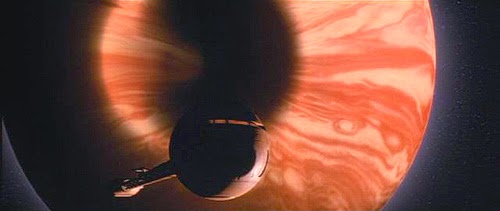
Clarke's ultimate Big Surprise is a nifty one—educational, too, about the configuration of Jupiter—but by granting the unseen architects in both films motivations that seem like cosmic buttinski's very much cheapens the first film and its scope (much like the sublimation of Bowman's potential), making man's Creation merely all in a monolith's day's work. And the cosmic consequence of 2010 feels like a convenient after-thought, easing tensions of a U.S./Russian nuclear conflict (even though they seem to get along enough to launch a joint space mission together). 
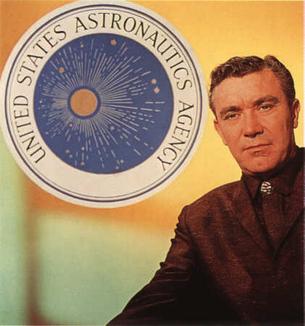
It is eerie to hear the voice of HAL again (Douglas Rain) and to see Keir Dullea, through some artful make-up, look as young (and as old, unnecessarily) as he once was. And working from mere screen-captures, Hyams and his art department did a meticulous job recreating the Discovery sectionsthey can't keep the ships from looking like models in the FX sections, however, which is curious for a more late-model movie. So meticulous is their work that it seems bizarre that the Russian ship would look so different in its interior, than what the Americans had come up with by that time. Again, apples and concrete.
One wonders, ultimately, if it was worth doing: it was a toe-splash for M-G-M to explore the possibilities of one of its core properties, but its utter conventionality only points to the other film's complete unconventionality in terms of belaying cheap dramatic tricks and the standard "science fiction" obsession with mechanics (Kubrick turned all that rendezvousing into a dance). It is the only sense of wonder 2010 allows, where its progenitor was far more about wonder than the why's and wherefore's.

2010 serves as a Reader's Digest version of the original, a blunted, condensed presentation of a larger, more sophisticated work. It has highlights, sure, but there's nothing transcendent about it; it's a blue-print, a schematic of ideas, rather than a fully-formed work of art and expression. It's like a hack-magician, who can only keep an audience's interest by revealing how the tricks are done.

But, as Raymond Chandler noted with inferior movies made from his books, the originals are still there to be appreciated on their own. The creation of 2010 really doesn't diminish the work of 2001—it's still there to be seen and appreciated.
The final message to Earth is in English...and reads like a Hallmark card.

A couple of in-jokey cameo's
Pithy cover of Time: the U.S. President is Arthur C. Clarke/
The Russian Premier is Stanley Kubrick
Arthur Clarke (left) sits on a park-bench outside the White House
(Wait a minute—isn't he the President?)
* Read the last name backwards...