Dracula(John Badham, 1979) A Tony Award winning Broadway revival of the 1924 stage version with stage design by Edward Gorey and a much-heralded performance by Frank Langella in the lead* was the inspiration for this late 70's version of the Bram Stoker story. By the time Universal Studios decided to make another version of the play,**Gorey was out, but director John Badham wanted to make the film in black-and-white to better reflect the Broadway version, but the studio wouldn't have it monochromatic.***
We skip Transylvania and Castle Dracula and the hapless Jonathan Harker visit to start off with a dark and stormy night, which lashes the unfortunate ship Demeter, bearing a cargo of dead men (and, apparently, a wolf) and sends it into the shoreline of Whitby, Yorkshire. The local head of the sanitarium, Dr. Seward (Donald Pleasence) examines the bodies and determines that all aboard the death ship have had their throats slashed. Mina Van Helsing (Jan Francis)—who is visiting her friend, the doctor's daughter Lucy (Kate Nelligan)—finds that a man has washed ashore, miraculously saving him from the fate of the others. He is Count Dracula (Langella), who has purchased a nearby mansion-in-ruins, Carfax Abbey.
Seemingly none the worse for wear, The Count accepts a dinner invitation from Dr. Seward at his residence in the sanitorium. Badham gives him a great entrance where he's announced, strides in and with a perfect flourish takes off his cape and hands it, unseeing, to the butler. Langella's Dracula is handsome, Byronic, and has a way of focusing all his charm through his eyes. Langella also has a condition called nystagmus, which creates involuntary movements of the eye, but here it's an advantage rather than any sort of hindrance; his eyes vibrate in close shots that provide a certain focused attention that seems a bit feral.
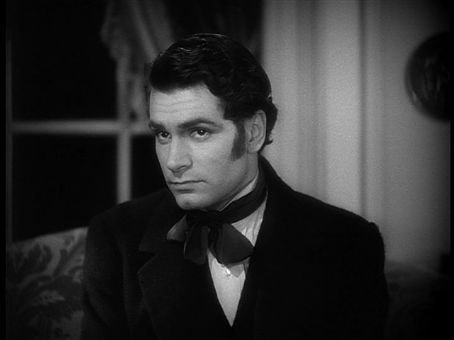
The evening goes quite well, and if the pairings are uneven, with Lucy Seward attended to by her fiancee, the solicitor Jonathan Harker (Trevor Eve), the Count is only too willing to give his undivided attention to Mina (who looks quite pale). Before too long, she will be dead, and her father Professor Abraham Van Helsing (Olivier) will arrive with questions and a fear that his daughter has joined the Undead. Meanwhile, Dracula turns his attention to Lucy.
Where this Dracula has changed over previous incarnations (or reincarnations) is in Dracula's impression as a romantic hunk, as opposed to a creature of the night. Perhaps, it was Hammer's focus on Dracula's effect on the nubile women in those films, or the portrayal of vampire Barnabas Collinsas a doomed romantic figure in the 1960's TV soap "Dark Shadows." As opposed to other versions, there were probably a fair amount of audience members who sided with The Count here, rather than with Seward and Van Helsing. Certainly, the character of Lucy has more than sympathy for him, flashing an enigmatic smile at the film's ambiguous ending.
And, as opposed to Hammer, this Dracula can turn into wolves and bats. In fact, Badham stages a shot where Dracula jumps through a window and emerges as a wolf. And there are several instances of "bat-cams" that parallel a prop-bat as it flies through the air. Binder's laser effects seem a bit irrelevant in the scheme of things, like they were tacked on for effect. But, the most unnerving thing about this Dracula is the way he approaches Mina's room early on, the camera looking up the edifice of Seward's hospital to espy the vampire on the roof, and then he moves down the wall like a cat, emerging upside down in the window and flicking away at the molding with his finger nails. Very creepy.
He also seems less vulnerable to crosses and the other religious paraphenalia and garlics Van Helsing uses against him, and as for only appearing at sun-down, he dismisses it entirely: "It's always daylight somewhere on Earth, professor. After my rest, I only need stay in darkness." Good to know. Universal, the studio that released this version—and other iterations of the 1924 play—as part of their promotional material, put out a poster with handy things to know about vampires in order to "know the facts." I can hear the voice of Agent Scully saying "Well, first, they don't exist..."
All in all, it's not bad. A little hysterical. A little silly. A literal bodice-ripper. But, at least it's a record of Langella's approach to the character from his Broadway run. And there's gratitude for that.
* When Langella left the production, Raul Julia took over. In the touring version, Jeremy Brett and Jean LeClerc played Dracula.
** Universal had a major hit (and franchise) with the Bela Lugosi version in 1931. Before the Langella-Gorey run, the previous Broadway performer had been...Bela Lugosi. While the novel is in the public domain (which is why Francis Coppola could make a film of it) Universal owns the film rights to the play, commissioned by the Stoker estate to combat imitations...like Murnau's Nosferatu .
*** Universal won that round, getting a golden, richly colored film, but when the film was remastered in 1991, for widescreen laserdisc release, Badham had the colors de-saturated. The 2019 "Shout Factory" DVD release has both the theatrical and laserdic versions.
For now, Archie is scraping by, as star/producer of a boardwalk diversion at a seaside holiday camp, in the perfect venue—an old, faded theater, where the air is as stale as his material. His day is only vital in the afternoons and early evenings in the bustling chaos of on-stage and backstage. The rest is the hummest of drums—wife in her cups, son off to war in the Suez, youngest son helping Dad in the dive, and daughter teaches art to a bunch of barely interested teddy-boys and girls. She goes to the seaside, seeking out Father, looking for some form of stability before settling into a perfunctory marriage.
She should have gone somewhere else. Archie is only accessible on-stage, and when off, he's trying to hustle another season, another venue, another donor, another prospective starlet. Life just isn't good enough for him if a limelight isn't on him and the money's starting to run out to pay the electric bill. Much was made of the play as a comment for the fading empiricism of Great Britain, as personified by the propped-up jolly-good Archie, for whom the show must go on, despite not having any juice in it for years, surviving with a heavy layer of rouge and grease-paint to give the long-distance impression of vitality and youth, blithely ignoring the march of time and pasting it over with the false grin of performance, no matter how desperate it may come across.
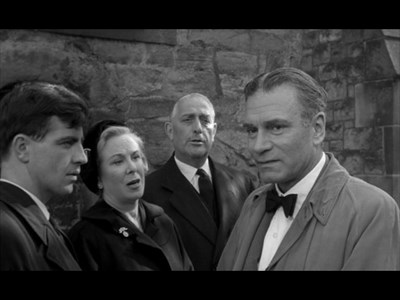
Richardson's film opens the play up, puts instance on Archie's transgressions on-screen instead of just being talked about and blubbered over, and Olivier sticks out like a sore thumb—rightly so—apart from the rest of the cast. Where Livesey is old-school formal and the kids are new-broom casual, Olivier sticks to his guns with a theatrical performance which feels appropriately, desperately false, which benefits the film while also making the character of Archie a complete outsider, a role he no doubt relishes. There's only one star in this "revue," everybody else is a bit player.
For Olivier, it must have fulfilled some need—to slum, maybe, or to reach out to the new material being generated by Osbourne, Richardson and others in the new school of British rebellion. Maybe, after his long string of kings, princes and noblemen, he wanted to explore the has-been's and ignoble men, to cultivate portraits of characters of a more stratified than rarefied stripe. There's also an element that Olivier might have been familiar with—the performer's ennui, bordering on contempt for his audience.
At this stage in his career, Archie is performing for himself—the money's not great, the material stale, and any creative collaboration is non-existent—the most intimate relationship he has is with his make-up mirror and even that is betraying him. Olivier is not above showing bitterness—he was particularly adept at tartly spitting out the ironic put-down in the guise of civility. And he was acknowledging his age (he was a very old Hamlet in his film of it) and the potential for failure, by portraying it, challenging it, mocking it, waving a red cape at it, maybe exorcising it. It was a brave interesting role for Britain's leading thespian.
Olivier as Archie Rice: "The Roar of the Greasepaint"
In these days of communicable diseases and precautionary measures for the greater good, folks on both sides of the aisle and of every color-stripe are being a little flippant with the "N"-word—"Nazi." So, just for a refresher course, we are going to sub-set the "Spies" series we're doing with movies where there are Nazi's (you know, "the bad guys"—Indiana Jones fought them in Raiders of the Lost Ark!) And we're going to call it "Nazi's...Nazi's everywhere."
Marathon Man(John Schlesinger, 1976) On the celebration of Yom Kippur, two chance encounters in New York City create an interruption in already established conspiracy that will conclude in two two wildly disparate people facing off against each other in a duel to the death: two cranky New Yorkers escalate a road-rageincident into a fiery crash, while on a track around Central Park, two joggers engage in a running battle over who's fastest—the slower of them Thomas "Babe" Levy (Dustin Hoffman) eventually gives up. His brother, an oil company executive, whom he affectionately calls "Doc" tells him he never confronts anything and this is just another example. A student at Columbia, "Babe" is doing his doctoral on tyranny, part of which will deal with the McCarthy era, of which his father, H.V. Levy, became a victim, ultimately committing suicide. "Doc" tells him that it's the past and he should put it behind him. But, "Babe" still has the gun.
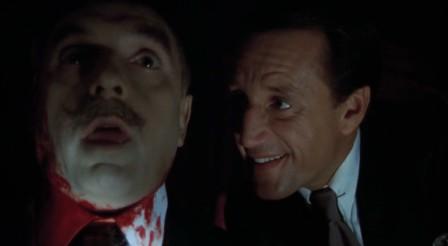
Across the Atlantic, a courier named "Scylla" (Roy Scheider) is beginning to get suspicious about the circle he regularly deals with. When he meets his established contacts, they are surprised to see him when he shows up at his usual haunts in Paris. Maybe because they think he's already been killed. He's nearly blown up by a street-bomb, one of his contacts is garroted at the opera, and the same assassin tries the same thing to him in his Paris apartment, before he gets the drop on him and breaks his attackers' back. Something is up, and he beats it out of Europe to get to the United States.
In South America, meanwhile, events have created movement among individuals who have remained in place for a very long time, lest their activity draw attention. Dr. Christian Szell (Laurence Olivier) under cover of darkness is leaving his Buenos Aries retreat for the first time in years. He has never needed to, but events have put him in danger—he needs information, to secure verifiable funds (that have been interrupted) and to eliminate the forces that have kept him safe all these years. His past is catching up with him. And so he runs. To the United States.
"Babe," meanwhile, couldn't be happier. While doing his research on his paper, he meets Elsa Opel (Marthe Keller), a Swiss student who is beautiful and charmed by him and he's so smitten, he can't believe his luck. Not even when, on an outing in Central Park, they are mugged by two very well-suited men; muggings aren't that rare, but usually by perpetrators less formally dressed. Babe tells Doc about Elsa and the mugging, and Doc wants to meet the girl.
Babe is surprised by a visit from Doc, and the two banter and bicker and make plans for an extended visit, Doc playing the protective older brother, wanting to meet these girl that babe is over the moon for. He has others plans that he doesn't let Babe in on, for Doc is also Scylla...and he's been at his game long enough that he doesn't believe in coincidence. Not with so much happening, of which Babe is innocently unaware.
The introductory dinner initially goes well; Doc picks an up-scale restaurant that leaves babe feeling like a fish out of water—he doesn't even own a tie that is required for so formal a setting. And Doc is clearly taken with Elsa—he flirts, he compliments, puts on airs as when he mysteriously says of the ordered wine "the great Chablis of the world are almost always green eyed. In fact, they're the ones that most resemble diamonds," a remark clearly intended to flatter Elsa and she's caught off-guard.
That's the point. Doc/Scylla is speaking in code. He suspects Elsa has something to do with his business in New York and the mugging makes him sure of it, but he doesn't tell Babe that. What he tells him is that Elsa is likely an exchange student on a foreign visa who wants permanent residency by coercing babe into marriage. Elsa leaves the restaurant in anger and Babe is hurt that Doc would insult her in such a way and have the opinion that Elsa wouldn't be attracted to somebody like himself without a hidden agenda. The meal ends on bad terms, but Doc has another meeting to go to and the stakes have just been raised.
Doc has arranged to meet Dr. Szell in a public setting, for those he's an old man, his past belies his frailty—he is the hunted Nazi Doctor Szell of Auschwitz, known as "der weiße Engel" (the White Angel) and for the past few years, his location has been protected by American interests for the information he's provided about war criminals, and for his services he has been provided anonymity and a steady flow of the diamonds obtained from his victims at the camp. One of the victims of the earlier traffic accident was his brother who was the first person in the diamond pipeline, retrieving the stones from a safe deposit box. With his death, Szell has come to this country to retrieve the diamonds, and, having no more need for the pipeline, has been systematically eliminating them.
Doc tells Szell that he is not welcome in the States and threatens to "out" him if he doesn't return to hiding. Suspecting that Elsa and the mugging have something to do with the elimination of the pipeline and his own assassination attempts, he warns Szell to stay away from Babe, as well. But, Szell is in for a penny, in for a pound. The stakes have changed.
Using a spring-loaded blade secreted in his coat-sleeve, he guts Doc like a fish, leaving him bleeding out and makes his escape. But, Doc somehow manages to make it back to Babe's apartment, dying on his floor. If he was attempting to warn Babe, he doesn't have the strength to tell him what has happened, and Babe, shocked and grieving, can only call the police and wait, stunned. The police take their time poking through Babe's apartment, asking questions, but he's clueless—there is no reason why his brother would be murdered and also, why he would make it to his apartment, knowing he was mortally wounded. Good question. The police are joined by plainclothesmen led by agent Peter Janeway (William Devane) who ask the same question. Why did Doc come back? Did he say anything to Babe before he died? No, Babe says. He said nothing. But, the question keeps being asked. Are you sure? Yes. He said nothing. Janeway tells Babe that his brother was a government agent and a colleague (and perhaps more?) but, despite the new revelations, Babe can't recall anything.
But, Scylla is dead. His warnings are going to go unheeded, and more people than just Janeway want to know what it was he said when he was dying. For Babe, his life will be put in jeopardy, involving kidnapping and torture—by dentist drill handled by a Nazi doctor in one of the most squirm-inducing sequences in movies (and the immortal line "Is it safe?")—and will be given a first-hand education in how dangerous and cruel the world can be...outside of history books. And he will run. And run for his life.
"Is it safe?"
On the technical side, Marathon Man was the first film to take advantage of the new stabilizing camera rig called "Steadicam." As operated by inventor Garrett Brown, the gimballed gyroscope system kept the camera from bumping in hand-held shots, giving the resulting footage a gliding quality, producing an organic freedom that couldn't be achieved with the conventional tracks and wheels. The running scenes benefited greatly from the new camera rig allowing free-moving close shots without the bump-and-jitter smearing that resulted from even the steadiest operator.
Also, the sound design is very special. Except for some studio scenes and a few others, most of the film's dialog is dubbed, the ambient sounds stripped away to focus on little detailed sounds designed to enhance or draw attention. It's a subtle thing, but every-so-often, one notices that the world is awfully quiet, in which case, be on the alert.
The film isn't nearly as air-tight as William Goldman's novel (Goldman did his own adaptation), leaving some loose threads, and condensing it down to essential scenes, nuggets of intensity, making it primarily a thriller, then veering into horror aspects (and film-strategies) when the action turns violent (which it does sporadically, creating ghastly effects). At the time I first saw it (in theaters), having read the novel, I was a bit disappointed, but the film has grown on me over time, especially in the grittiness of it that belies its slick veneer of polish.
As such, it's more of a sprint...not so much of a marathon.
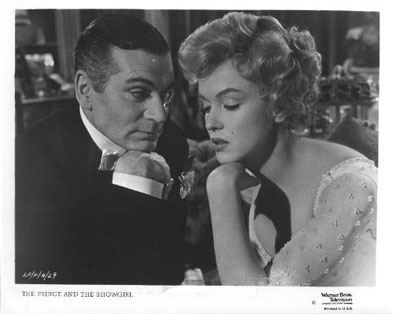
The Prince and the Showgirl(Laurence Olivier, 1957) Olivier and his wife Vivien Leigh made a hit play of Terrence Rattigan's bauble "The Sleeping Prince," and, naturally, Olivier wanted to make a film of it. But, Marilyn Monroe's new production company wanted to make a film of it, too, and so a fait accompli was reached—Monroe's company would produce for Warner Bros. Studio and Olivier would direct and star...not too bad a job, considering that the other offer Olivier had at the time was to play Col. Nicholson in David Lean's The Bridge on the River Kwai. It must have seemed to Olivier an easy choice: sweat over multiple takes with Lean in buggy, balmy Burma, or make love on-screen to Marilyn Monroe at Pinewood Studios. What could possibly go wrong? To Olivier's point of view, Burma might have been the better choice. Monroe came to England—the first time she'd made a movie outside the States—freshly married to playwrite Arthur Miller, and taking classes at the Actors Studio and currently under the tutelage of its head Lee Strasberg (in fact, Strasburg's wife accompanied Monroe to England for filming).
Olivier found working with and directing Monroe frustrating, complaining that she would show up to the set hours late, would have trouble remembering lines, and seemed to not retain directions in her head, never providing the same line reading twice and not hitting her marks.*He also objected to the strong relationship between her acting coach Paula Strasberg, feeling his direction being undermined, and at one point tossing her off the set. In protest, Monroe returned to her dressing room and refused to continue shooting until Strasberg was allowed back. Shooting was stressful on what was supposed to be a light comedy.
It is June 1911 and George V is about to be crowned King of England. For the coronation, the city is flooded with foreign dignitaries including the 16 year old King of Carpathia (Jeremy Spenser), accompanied by his grandmother, the Queen of Carpathia (Dame Sybil Thorndyke), and the Prince Regent Charles (Laurence Olivier), the ostensible leader of the government until the King is of age. The Foreign Office is in high-stiff-upper-lip mode over any incident that might perturb the Prince Regent, as tensions in Europe are high. Thus, Northbrook (Richard Wattis) of the Office is dispatched to the Carpathian Embassy to see to the party's needs.
The first need of the Prince Regent is entertainment, so Northbrook arranges his entourage to a night of musical theater, a little trifle called "The Coconut Girl," featuring an acquaintance of the Prince Regent's in the lead. Backstage, the PR greets the members of the cast, where he is taken by American chorus-girl Elsie Marina (Monroe)—perhaps because she has a wardrobe malfunction when they shake hands. Charles informs Northbrook that he would have much pleasure if Miss Marina could dine with him at the Embassy...at midnight. Northbrook is surprised at the Regent's earlier acquaintance not being asked, but orders are orders.
The invitation is a shock to Elsie—why her? But, with a borrowed dress, and a wary eye, she is brought to the Embassy by Northbrook who sums up the Embassy with "Personally, I find the decoration is a little vulgar." But, Elsie is impressed: "Well, all I can say is give me vulgarity!" She is escorted to the second floor sitting room to await Charles, but she becomes well aware that the Regent is interested in more than just dinner, as the dinner is a private one, only for two. Elsie has other plans, but is more than happy having a fancy dinner. The thing is, she has trouble with the protocol—how to address dignitaries, that one leaves the room walking backwards, facing the dignitary.
Once Charles arrives, he has more concerns about affairs of State than a casual affair—at least for the moment, after making sure she is supplied with drinks, and leaves Elsie to her champagne and food, while he makes telephone calls about the political climate in Europe, while making some disparaging remarks about Americans and their childish democratic notions, which Elsie, her champagne intake increasing, takes as snobbish and insulting. She lets Charles make a clumsy effort at seducing her, but his words are flowery but empty, and more than a little well-practiced. She isn't impressed...nor will she be pressed, vertically or horizontally.
Charles, the Prince Regent: Here am I, having reached the age of 40. And I have never known what it is to love or be loved. It is like the legend of the sleeping princess. Only here, it is the prince who sleeps and awaits the kiss of the beautiful young maiden that will bring him back to life.
Elsie Marina: You mean you want me to kiss you?
Charles, the Prince Regent: You are so literal.
Disconcerting to Charles is that his late night supper still manages to be interrupted...often, and he becomes increasingly annoyed with the pace of the evening, and Elsie's apparent ability to one-up him in his strategies, her impertinence in not succumbing to his admittedly weak efforts at seduction, too practiced and without passion, and her general lack of decorum or fawning respect, something he is used to, but is lacking in what he thought would be a simple sexual conquest. He sums up the evening to Northbrook:
Charles, the Prince Regent: The mind of a backward child, the muscles of a boxer and an approach to life of such stomach-turning sentimentality, that I found myself, Northbrook, I found myself last night uttering phrases which had they been overheard would make me the laughingstock of Europe. To crown it all, she's rendered insensible by an amount of vodka, which in Carpathia, you would add to the morning milk of a 4-year-old child as a mild tonic!
Northbrook: Do I gather, Sir, that the evening was not an entirely happy one?
Charles, the Prince Regent: Northbrook, this British understatement of yours, I begin to find irritating. The evening was an unqualified nightmare.
Northbrook: I'm so sorry, Sir.
Charles, the Prince Regent: I have only one evening in London. One single evening in which to arrange for myself relaxation. And what happens? Out of the whole of this vast, teeming city, teeming with beautiful, intelligent women, you find me what? A little American ninnycompoop.
Northbrook: With respect, Sir, either ninny, by itself, or nincompoop.
Charles, the Prince Regent: Ninnycompoop will serve. She fully deserves a new word.
Confusion ensues. Elsie passes out from the alcohol—never mix with champagne with vodka—and is forced to spend the night at the Embassy, which, although the circumstances are innocent enough, would be scandalous, if found out...especially by the Queen Mother. Then, there is the young King, who, chafing under his father's repressive and autocratic regency, conspires with the Germans to overthrow his father, and is more sympathetic with Elsie for her openness and belief in democratic elections. The two form a bond as she overhears a call the King makes to the German Embassy ("I understand German. I grew up in Milwaukee!") against the Regent, sympathizing with the young King, and hoping she can ease tensions between...everyone.
Monroe exits the room backwards and ad-libs: "Pretty good, huh?"...which stayed in the movie.
On top of that, circumstances allow her to attend the coronation as one of the Dowager Queen's ladies-in-waiting, a ceremony that moves and overwhelms her. Quite a busy couple of days for a seemingly simple show-girl.
It is an unlikely trifle that doesn't amount to much. What is fascinating is the dynamic of the production, which, despite Olivier's complaints of frustration, are rather seamless—except for Monroe calling the Regent "Laurence" at one point. The whole film is carefully plotted and the performances quite proper and professional. All very much as it should be for a rather formal light entertainment, with one element slightly askew.
And that element is Monroe. In such a stuffy environment, and in such a manicured production, she is a breath of fresh air, a release from the tensions and regimentation of the presentation. Where everyone is stiff—none more so than Olivier—she is loose and funny and unbridled, mercurial in her reactions, irreverent in her demeanor, and with a goose-like grace that threatens to trip over its own tail-feathers. And, seriously (and comically) isn't that what the character SHOULD be—an antidote to protocol? While everyone is—sometimes hypocritically—putting on a display of airs with hidden agendas, shouldn't she be the bump in the carpet that they trip over with her honesty and lack of guile?
The answer is a resounding "yes." The actress and her clash of style and method is the perfect element to include in order to point out the folly of the strutting prima-donna's (both before and behind the camera) that their very proper charades are a sham. There is an impertinence in Monroe's performance and manner that speaks truth to power that goes far beyond the movie's surface arguments that her character is in the right, and, thus, garners the audience's sympathy for what the play struggles to preach. Ultimately, the movie fails to convince that there is a love story there, beyond the words expressed, but there is never any doubt the story's soul resides with Monroe's character and the way in which she plays it.
Sometimes, directors just luck out, even if they don't recognize it or have the capacity to admit it. Maybe Olivier would have preferred his wife play the role, as she did on-stage, but one doubts it would have been as good, or beneficial to the film. One can't even imagine the movie being as effective if the next obvious choice to play the role—Grace Kelly (who had starred in another Rattigan confection the previous year)—had played the part, as she was too regimented, too practiced, too perfect to be an effective foil for the pretensions of the rest of the movie.
Olivier would go on to grouse about Monroe's behavior and her performance for the rest of his life (no doubt annoyed that everyone always asks about her), but the truth is she's the best thing about The Prince and the Showgirl as well as aiding the movie and its purpose. Perhaps (as suggested in My Week with Marilyn, which we'll look at tomorrow) he was confounded that she was SO good despite his efforts to manipulate her to something else he had in mind—that he couldn't direct her to be as effective as she is on the screen. She simply was (as many directors were forced to admit), without his direction being a factor. One couldn't direct... or teach...what she presented on camera. It was an undefinable something that couldn't be coaxed or understood. One wonders if she understood that capacity, as well. And feared losing it.