Showing posts with label Joan Plowright. Show all posts

Wednesday, July 27, 2022

The Entertainer (1960)

The Entertainer (Tony Richardson, 1960) One thing about Laurence Olivier, he was an actor for all genres. Yes, he was primarily known as a stage and film Shakespearean, probably the greatest, but he also did light comedies, thrillers, period dramas, horror films, the occasional cheese-fest...everything...including the kitchen sink. Kitchen sink dramas, that is. 

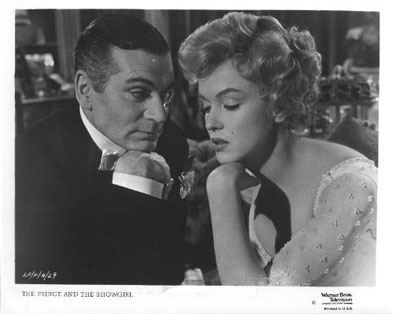
In My Week With Marilyn—the fictionalized telling of the filming of The Prince and the ShowgirlKenneth Branagh's Olivier announces he's done with directing (after his on-set tussles with Monroe and finding out she's incandescent on-screen, anyway, despite his direction) and is going back to the stage to do a John Osbourne piece. That would be "The Entertainer," the play on which this film is based. On stage, it vacillated between life on-stage for Archie Rice (Olivier), and at home, where...well, he's never really OFF-stage, a needy vaudevillian with an alcoholic second wife (Brenda De Banzie), three kids (>Albert Finney, Alan Bates, and Joan Plowright—who would become the last Lady Olivier), and a slightly more talented, but no more wiser live-in Da (Roger Livesey).
For now, Archie is scraping by, as star/producer of a boardwalk diversion at a seaside holiday camp, in the perfect venue—an old, faded theater, where the air is as stale as his material. His day is only vital in the afternoons and early evenings in the bustling chaos of on-stage and backstage. The rest is the hummest of drums—wife in her cups, son off to war in the Suez, youngest son helping Dad in the dive, and daughter teaches art to a bunch of barely interested teddy-boys and girls. She goes to the seaside, seeking out Father, looking for some form of stability before settling into a perfunctory marriage.
She should have gone somewhere else
. Archie is only accessible on-stage, and when off, he's trying to hustle another season, another venue, another donor, another prospective starlet. Life just isn't good enough for him if a limelight isn't on him and the money's starting to run out to pay the electric bill. Much was made of the play as a comment for the fading empiricism of Great Britain, as personified by the propped-up jolly-good Archie, for whom the show must go on, despite not having any juice in it for years, surviving with a heavy layer of rouge and grease-paint to give the long-distance impression of vitality and youth, blithely ignoring the march of time and pasting it over with the false grin of performance, no matter how desperate it may come across.
Richardson's film opens the play up, puts instance on Archie's transgressions on-screen instead of just being talked about and blubbered over, and Olivier sticks out like a sore thumb—rightly so—apart from the rest of the cast. Where Livesey is old-school formal and the kids are new-broom casual, Olivier sticks to his guns with a theatrical performance which feels appropriately, desperately false, which benefits the film while also making the character of Archie a complete outsider, a role he no doubt relishes. There's only one star in this "revue," everybody else is a bit player. 
For Olivier, it must have fulfilled some need—to slum, maybe, or to reach out to the new material being generated by Osbourne, Richardson and others in the new school of British rebellion. Maybe, after his long string of kings, princes and noblemen, he wanted to explore the has-been's and ignoble men, to cultivate portraits of characters of a more stratified than rarefied stripe. There's also an element that Olivier might have been familiar with—the performer's ennui, bordering on contempt for his audience. 
At this stage in his career, Archie is performing for himself—the money's not great, the material stale, and any creative collaboration is non-existent—the most intimate relationship he has is with his make-up mirror and even that is betraying him. Olivier is not above showing bitterness—he was particularly adept at tartly spitting out the ironic put-down in the guise of civility. And he was acknowledging his age (he was a very old Hamlet in his film of it) and the potential for failure, by portraying it, challenging it, mocking it, waving a red cape at it, maybe exorcising it.  It was a brave interesting role for Britain's leading thespian
.

Olivier as Archie Rice: "The Roar of the Greasepaint"

Thursday, June 16, 2022

Tea with the Dames

Tea with the Dames (UK Title: Nothing Like a Dame)
(Roger Michell, 2018) Sometimes it's nice to look behind the curtain. To look past the artifice and see the real, and meet the illusionists who create the illusions. What they think and feel informs the art and can sometimes one can glimpse the individual choices made to produce it, what the priorities are in making it, and it can even change how one subsequently views the art.
 
And, let's face it, it's fun to get "the dish," the gossip, the dirt, which is fun and facetious and is the spoonful of spice that makes the "educational purposes" go down a little easier.
 
The late director Roger Michell had the idea to film a little ritual he'd heard about. Of how four ladies of the theater: Joan Plowright, Eileen Atkins, Maggie Smith and Judi Dench would regularly get together at the West Sussex home of Plowright and her husband Laurence Olivier, when he needed a place close to where he was directing theater. The four saw the place as a bit of an idyll to unwind, talk shop, and as a means to get away with their families. Michell wanted to film the actresses, all named Dame Commander of the Order of the British Empire, talking in a shared space of community.
But, it could hardly be called intimate. Proving that the mere act of observing changes the outcome, the actresses are beset by make-up artists, proper lighting, weather, staging—"have you ever sat like this in your life?"—and a flurry of crew—at one point, Maggie Smith chides a set photographer for taking too many pictures in her field of view and at another, they express shock that it's the first day of one of the crew-members. One is sure that one is watching real conversations—prompted, of course—and the actresses are very forthright, but one gets the sense that they're being honest, they're holding things in reserve for good behavior.
Plowright, nearly completely blind, is imperious, but chummy, Smith is hilariously tart, Dench completely honest, and swearing like a sailor, while Atkins is unafraid to be vulnerable.
—At one point, Plowright mentions that "none of us was ever in the front ranks of great beauties" Atkins recounts hearing an overheard conversation between producer-director in an early stage role: "She's not very pretty, is she?" "No, but she's sexy." "That saved me," she confesses.
—All of them recount stage jitters, with Atkins saying that "On the way to the theater I always think, would you like to be run over now? Or in a massive car accident? And I only just come out on the side of no."
—Michell asks what it was like to work with their husbands and Smith immediately replies "Which one?"
—commenting on their physical frailties, Maggie Smith asks Plowright if she wants to borrow one of her hearing aids (as Plowright's batteries have worn out) and Dench cackles "...and we have three working eyes between us!"
—During her stage run in "Othello" with Olivier, Smith recounts how a slap delivered by him connected and she wryly comments "It was the only time I saw real stars at the National Theater" and how Olivier was always criticizing how she said her vowels, and upon walking in on Olivier applying his Moor make-up "schmudge" said "How now, brown cow?" and noting her vowels, he said "Much better!"
—Dench is forced to recall her questioning director Peter Hall to play Cleopatra: "Are you sure you want a menopausal dwarf to play this?"
Interspersed with the interviews is much archival footage and photographs in their roles throughout their careers, both on stage and in film, as well as the ceremonies where they received their respective British honors, and it's a trip to see them through various stages of their lives doing comedy, drama, even Dench's turn as Sally Bowles in the 1969 staging of "Cabaret." There's some tart chiding of Dench's seeming to now get every part in Hollywood films. The conversation is lively, but, as the documentary nears its end, one can see energies starting to flag, and silences punctuating the conversation. It's a reminder of fragility even for the grandest of dames, even at the highest of teas.
"That's RUDE!" says Dench, outraged.
They're Americans." says Plowright. "That's how they talk!"