Showing posts with label P. Show all posts

Saturday, February 1, 2025

Presence (2024)

Teen Angel, Can You Hear Me?
Teen Angel, Can You See Me?Why Do You Still Give a Damn
Why Do You Glide on Steadi-cam?
or
"Ghosts Are Ass-Holes, Man!" 

I have a friend who (so he says) became a psychic, though not of his own volition. One day, he walked into work and discovered that he could read people's thoughts and know what they were thinking (I should have asked him what number I was thinking of at the moment, but the story was too interesting to hear for some quick-thinking debunking). Anyway, he was a professional psychic for awhile and gave it up, settled down, raised a family. The toughest trick for a psychic is to STOP being a psychic...if you REALLY ARE a psychic.
 
Anyway, I went to a lecture he was giving and was driving him home and we were talking psychic stuff—its arcana and down-sides and my weird forays into TM—when I asked him "What about ghosts?" And he blurted, frustrated, "Aw, ghosts are ASS-HOLES, man!" He'd never met a ghost he'd liked, as they were always hanging around with some left-over agenda from their previous existence that they just...couldn't...let GO of! "One ghost was hanging around her daughter because she never returned a BOOK she borrowed from her! Can you believe that?" I actually could (and if he was really psychic he would have known that). But, he could never understand why ghosts just never let go and move on, especially as the way (I've heard) is perfectly well-illuminated.
 
So...Presence, director Steve Soderbergh's new film with a script by David Koepp that only cost $2 million bucks and (supposedly) has only 33 editorial cuts in it. That is as lean and mean as a movie can get, and I've always liked Soderbergh for his daring and his playing with the movie-form and his many invented ways to get movies made and/or distributed. He's the guy I'd want running DOGE over anybody else. Smart and experimental, but efficient as any director making movies—he even shoots and edits them under pseudonyms. And, in this one, he literally plays a larger part.
We open on a house. More actually, we open IN a house, looking through the window down at some pavement below and then the camera looks up and we see the window, turn around and we're looking at the empty bedroom of a vacant house. The camera glides through rooms, up and down stairs, down to the main floor into the kitchen, around the living room and out the window. Nothing to see here. Fade to black.
When we come back we're looking out the upstairs front window and a woman getting out of a car. "We" run down to the first floor as she enters and it's a real estate agent (Julia Fox) who's going to show the house to a family who soon arrive. They are, as we soon learn, the Payne's: Rebekah (Lucy Liu), Chris (Chris Sullivan) and the kids Tyler (
Eddy Maday) and Chloe (Callina Liang), both teens. Rebekah loves the place, but Chris has questions—are the schools okay? it's by a fire-station and are the sirens going to be annoying—and the kids are... preoccupied. Tyler's a jock and submersed in his phone—it's not even sure if he notices the house ("whatever...") and Chloe wanders around, not saying a word...except...at a couple points she looks directly at the camera, which then swiftly retreats away from her gaze. Nobody else notices or looks our way, only Chloe and only a couple times. In fact, the camera will move very close to people in intense discussions and there is no reaction. It's like we're invisible.
It's like we're a GHOST. Which is exactly what's going on here. There is a spirit in the house (something the real estate agent doesn't mention and probably doesn't know as she's focused on making a sale). Everybody is busy with other issues and so they don't notice, they're not attuned to it. Only Chloe who is sunk deep in depression over the death of a friend—accidental overdose it was ruled—is aware that there's an unseen house-mate, who's useful at putting her books away or causing a fortuitous distraction. One night, on the edge of sleep, she senses something in the closet (the spirit's go-to refuge), gets up, wanders to the center of the room and tentatively asks "Nadia?" It was the name of her passed friend.
There have been plenty of "point-of-view" movies. They were quite prevalent in the day of slasher horror (but only sparingly—but enough that it became a trope—and usually to disguise the perpetrator or increase suspense ala The Silence of the Lambs), and Orson Welles was going to use it for his aborted first RKO film Heart of Darkness, and director Robert Montgomery employed it (partially successfully) in his adaptation of Raymond Chandler's The Lady in the Lake—quite naturally as Chandler wrote his mysteries in the first person. But, it's a gimmick, like those movies employing found media (I'm thinking The Blair Witch Project and Cloverfield) where the point-of-view technique is meant to be claustrophobic and limit what is shown. It's a distraction, as well.
Interesting that there are a couple of extra chairs at the dinner table.
Expecting guests, are we?
But, not here. "Our" role—as we, the audience, don't have a choice in the matter—is not as a stand-in for the narrator or the director's presence (although director Steve Soderbergh DID shoot the whole thing himself, so one could say that he is portraying the ghost). We are the observer (as per usual), like the presence, unseen and unheard—but, even if we don't, it is still quite capable of making an impact.
The film is of our time, and what is going on in the lives of the Paynes is distrust, an uneven power dynamic between the four, and involves teens and bullying and social media, plus an unsolved murder or two, all seen through the eyes of a spirit who knows a few more things than we do and acts accordingly when it feels the urge to. One may have a qualm or two with its selective abilities ("Well, if it can do that, why can't it do this?") and it all may come down to cherry-picking for the sake of dramatic effect and suspense. Given the amount of detail that Koepp and Soderbergh put into the scenario, one suspects that they were just interested in telling an engaging story and didn't want resolutions to be too easy. Poltergeists can't do everything. If they could, they'd be guardian angels...which is another pay-grade.
Are ghosts ass-holes? I don't know. Presence would make the argument against—that they serve some purpose other than flickering lights and poltergeisting to their sacred hearts' content. And "Ass-holes" is a little judgy. Plus, it's never a good idea to look down on things that can look down on you (especially things known for knocking things off ledges). Maybe ghosts are just like those career-people who absolutely refuse to retire and can't imagine themselves relaxing with a harp. That's a little relatable. It certainly would be to Steve Soderbergh who's said at several junctures of his career that he's going to retire and he...just keeps...making...movies.
 
I certainly hope he does...if the spirit is willing.

Wednesday, January 22, 2025

The Philadelphia Story

The Philadelphia Story
(George Cukor, 1940) "The prettiest sight in this fine pretty world is the privileged class enjoying its privileges
."
 
So says Macauley "Mike" Connor (James Stewart), cynical reporter with romantic notions about nobody but himself, as he and photographer "Liz" Imbrie (Ruth Hussey) are given the enviable task of reporting on the biggest marriage event of the season—or should we say "re-marriage season"—the Lord-Kittridge affair, she of the Philadelphia Lords, Tracy Samantha Lord (Katharine Hepburn), to be precise—formerly married to one C.K. Dexter Haven (Cary Grant), an upper class yacht designer—and for her second go-'round, she is marrying George Kittridge (John Howard), a "man of the people" who raised himself from the lower classes to achieve parity (without the legacy or provenance, mind you) of the Main Line of Philadelphia. Newsies Mike and Liz are given permission to "witness" the impending nuptials for a gossip rag (under the subterfuge that they're "distant relatives"), as an arrangement that said tabloid won't be publishing lurid stories about Tracy's father (John Halliday) having an affair with a dancer (of all people). This tit-for-tat has been arranged by a former runner for the mag, that personage being one...C.K. Dexter Haven, the ex (if you'll recall) of the bride-that-was and is to-be. How gauche it all is. How lurid. How delightfully sordid.
The Lord's are trying to manage this hullabaloo without much ballyhoo, thus their agreeing to the limited press coverage. But, they're not going to make it easy for them, no sir. Tracy is determined—with the help of precocious sister Dinah (Virginia Weidler)—to put up a discouraging wall of "airs", acting all hoity-toity...which is just what reporter Connor expects them to be. Tracy sees through their subterfuge just as easily as photographer Liz sees though theirs—just as she also sees through Connor's contempt for them (he protests a bit too much). As a photog' she seems to "read" people better than Connor, which is why she's biding her time with her colleague. She's in love with him, not that he'd ever stop concentrating on himself and his deathless prose to notice.
C.K. is also inserting himself into the affair, much to the delight of the Lords and to the dismay of his ex, Tracy. Their marriage broke up a couple years previously because, as an alcoholic, he did not measure up to her high standards. Tracy is a bit judgey as a rule, and decisively so, which led to tossing Dexter out ("She's generous to a fault" he says, "except for other people's faults") as well as the ostracism of her father from the family (His opinion of her: "You have everything it takes to make a lovely woman except the one essential: an understanding heart. And without that, you might just as well be made of bronze." That one hurts).
Tracy is all too aware of the criticism ("
Oh, we're going to talk about me again, are we? Goody."), but she is absolutely sure of her paragoness—reflecting well on the parents as it may have begun, but it has rigored into an expectation that anyone in her orbit should be beholden to the same courtesy. Her stubbornness is so ram-rod straight that it has appeared to reach her spine, as evidenced by her switch-blade dives into pools or even—in the oft-replayed silent opening sequence—when she's face-palmed back into her own home after kicking out Grant's Dexter Haven. It's amazing that she can be so stiff while performing the herculean task of having one's head up their ass.
She may have grown up, but she's still her parents' child—not that that's their fault. She's just stuck in her dutiful child-role despite long having passed its maturity date. Now, even her parents are annoyed with it (by contrast, youngest daughter Dinah—played by the incomparable
Weidler—seems to have skipped her childhood to become Thelma Ritter) and wish that "the phase she's going through" was over.
But, it's unlikely, even on the eve of the second of her how-many-future-marriages. The first one didn't work out because from her lofty perch, the faults, owing to his drinking, were all on him. This second has a much-better-manufactured future husband so she glides in with confidence, secure that Kittridge is just as stalwart and inflexible as her own reflection of herself—she's found her spine-mate.
Tracy emerges from a drunken night into the light of a new day
—and reacts to it like a vampire.
But, after a night of pre-wedding jitters—no doubt brought on by her being unable to cope with the intricate machinations of "everything is going according to plan" while confronting the failures of others in her past (like Dexter Haven and her prodigal father, who both have the temerity to judge her ("I'm going crazy. I'm standing here solidly on my own two hands and going crazy!")—she ends up drunk and with the appearance of being in a compromising position and in the vulnerable position of seeing herself being judged rather than judging. 
And despite rapt descriptions of her as a "marvelous distant queen" or "the golden girl," this paragon of taste, breeding and virtue who could walk into any room and do so with style can never manage to do it with "grace"
, and when her weak night of drinking has her stumbling through what feels like a "perp walk" under scrutiny, she learns a little of what she's been dishing out...and doesn't like the taste of it. But, you can't have a hangover without some shame in the mix. And despite the bleery eyes, she starts to see things more clearly.
This was Hepburn's project—she'd been labeled "box-office poison" after films like Mary of Scotland and Bringing Up Baby and Holiday bombed (despite the last two eventually gaining reputations of being cinema classics for decades) and helped writer Philip Barry to create it and make it a hit on Broadway. Then, as she owned the rights to it, she personally took it to M-G-M and its head, Louis B. Mayer, to have it made with the director of her choosing (Cukor) and maybe with Spencer Tracy and Clark Gable as the leads. Mayer substituted Grant and Stewart who were more readily available and the deal was made. The movie was her first box-office hit in a couple years. But, there was a little bit of a price to pay for its success.
 
It was the first of Hepburn's movies where she had to have a serious  "comeuppance" moment. Oh, her Jo March in Little Women had to suffer loss and rejection before she achieved any path-way to true happiness, and in her breakout film-role in Stage Door she had to suffer another character-changing tragedy in order to make her "complete" and deserving of success, but here the knives are out for Hepburn's 
"tall poppy" to be "dead-headed" and reduced from imperious competence to crumbling vulnerability.

And that's apparently what audiences liked. Katherine Hepburn seemed to always have to be "taken down a peg" for the customers, even in her many movies with Spencer Tracy (their first pairing, Woman of the Year, had its ending changed and re-shot to end with a humiliating kitchen scene due to the negative remarks on preview cards by female audience members). She wasn't allowed to maintain her dignity, or achieve some sort of parity with her male co-star, but, to insure commercial success, she had to have her characters' weaknesses and failures made manifest and her dependence on male supremacy made apparent despite any evidence that was shown before that she could act independently from her own efforts. Katherine Hepburn, the actress, having already been shown the consequences of bad box-office reputation, conceded the point that emancipation wasn't "a thing" in the make-believe world of the movies and "played the game." Sometimes (like in Woman of the Year) it was grating and and embarrassing. In The Philadelphia Story (which, remember, she helped develop), it's a little easier to digest and becomes the crux of the movie.
It's not a bad lesson to learn, either. Everybody in the movie (unless they've been humbled in some way) is a little "judgey" and before things play out, minds are changed instead of made up and calcified into permanent prejudice. Everybody bends a little bit without the fear of snapping holding them back. Things become malleable, negotiable...why, it almost becomes the euphemism of "polite society". It's why the use of the term "yar" in the film is so apt. "Yar" (in sailboats or yachts) means "easily maneuverable" but it can also be
"agile, quick, nimble"—something C.K. Dexter Haven always aspires to. The mast must be sturdy and strong, sure, but it's the sail that gets you anywhere. You just have to bend with the wind.


Saturday, October 26, 2024

Plan 9 From Outer Space

It's October (Hallowe'en month!) and Saturday is "Take Out the Trash" Day.

And here's somebody's idea of "The Worst Film Ever Made" (not mine, when I have the nerve I'll put that one up), but it's one of those movies that is merely horrifying rather than a horror film. More often than not, I've tried to watch it late at night and just fall asleep.


Plan 9 From Outer Space (originally: Grave Robbers From Outer Space)(Edward D. Wood, Jr. 1957)
 
Greetings, my friend! We are all interested in the future, for that is where you and I are going to spend the rest of our lives. And remember, my friend: Future events such as these will affect you in the future. 
 
You are interested in the unknown, the mysterious, the unexplainable. That is why you are here. And now, for the first time, we are bringing to you the full story of what happened on that fateful day. We are giving you all the evidence, based only on the secret testimony of the miserable souls who survived this terrifying ordeal. The incidents, the places. 
 
My friend, we cannot keep this a secret any longer. Let us punish the guilty; let us reward the innocent. My friend, can your heart stand the shocking facts about grave robbers from outer space?
In their 1980 book "The Golden Turkey Awards," authors Michael and Harry Medved compiled sent-in suggestions from readers of the book "The Fifty Worst Films of All Time" for the considerations of who would be given their "awards" and the ultimate winner was a movie that hadn't even been mentioned in that earlier book. Plan 9 From Outer Space had the dubious distinction of being dubbed "the worst movie ever made" (I should add the disclaimer "that we know of"). It's director, Edward D. Wood, Jr. was voted worst director.
And,
subsequently, it (and its director) became quite well known. I use that phrase because one has to choose between the alternatives "famous" and "infamous" and, frankly, Plan 9 is a little bit of both. Most people know it from Tim Burton's cockamamie film-biography of Ed Wood, where he probably spent more money on recreating Wood's "style" than the original director did himself (He is one of many directors associated with the phrase "He never shot a take he didn't like"). Burton's film is an absurdist comedy, but at its core is the philosophy that one must stay true to their "vision" despite the nay-sayers and...you know..."taste."
Plan 9 has a simple plot, based on the concepts behind The Day the Earth Stood Still, of an alien race visiting Earth to warn of the dangers of scientific advancement without safeguards. Plan 9's aliens have trouble with the whole "take me to your leader" thing and have been unable to communicate with the Earth's governments, so their ninth plan—they're tenacious—is to raise the dead to attack Earth cities to prevent them from discovering "solaronite" (it's pronounced differently by different actors in the thing), which can have the ability to explode sunlight particles, endangering the Universe with an unstoppable chain reaction (well, when you put it that way...).
One can raise all sorts of questions as to why the aliens can't seem to reach the world's governments and why raising the dead is a rather extreme "demonstration" of their abilities, but if one started counting off the absurdities of Plan 9 From Outer Space, one would simply be exhausted by all the inanities, ineptitudes, gaffs, goofs, flubs, fumbles and stumbles that make up the bulk of the film. When you consider that part it of originated with having the last film footage of Bela Lugosi, one has to question if the enterprise was worth starting in the first place.
I have a strange relationship with Plan 9. I've never been able to get through the first hour of it. Just the other day when thinking about the film I couldn't remember how it ended. I'd usually get to the part where the aliens' Commander Eros starts bleating:
"Stronger. You see? You see? Your stupid minds! Stupid! Stupid!" and then gets punched in the face in counter-argument...and then I just give up (or fall asleep). So, I watched only the last half-hour and, lord, it's just the same as the first interminable hour—the level of mediocrity (not stupidity, not just ineptitude) becomes overwhelming and one has to turn away in disgust.
 The "complex" cock-pit set from Plan 9 from Outer Space
I know there are people who watch it for the sheer lame-brainedness of it and find that entertaining. But, I've never found it so, instead finding it sad...and not laugh-out-loud funny...and cruel to watch in a weird way. I have no problems with camp. I have no problems with parody. I have no problems with cheap (cheap actually can produce innovative solutions in story-telling). But, the "bad school-play" feeling it generates just makes me depressed, and I know because of my reaction that I'll probably never watch another Ed Wood movie. I love movies, but his break my heart.
Chiropractor Tom Mason playing Bela Lugosi (deceased) as Ghoul Man ("no one'll notice...")
This October in the blog, we've been looking at a lot of poorly-financed horror movies that still manage to eke out some promise on a budget that wouldn't cover the catering in today's market. It wasn't planned that way, it just happened. But, it shows how talented people can make the most out of limitations by imagination and ingenuity and a certain dramatic flair. Ed Wood evidently had none of those because most of the movies I've reviewed this month had a creative spark just edgy enough that monetary problems could be surmounted or, at least, masked.
Plus, script has an awful lot to do with it. Good construction, the sense of pace and revelation go a long way in making a good script and cleverness makes up a good portion in that consideration. Cleverness goes beyond what Wood thinks is "dialogue"—one line building on the previous line as in "Visits? That would indicate visitors!"—the kind of stuff that would pass muster in grade-school as sophisticated, but is put away as "childish things" once one gets over the fact that you can put words on a blank space. Wood seems to have never got over that fascination. I'm sure he must have gotten rejection letters from somebody in Hollywood that he might have learned from. But, evidently, he was good at conning people out of money to make the bare minimum product displaying his ideas and talent that never received the acclaim it supposedly deserved.
 
I would say it's a classic case of reaching beyond one's grasp, but I don't see much evidence of reaching.
At the risk of getting as pretentious as Edward D. Wood, Jr., it's got me to thinking of how things go right...until they go wrong; how the country is polarized, but more than just in political leanings, but in how we dance around the thin veneer of competence—where you either do the best that can be done or you merely stop, saying "that's good enough" and hope that you don't get caught when things fall apart. We let standards slip just enough to make things easier...until we're no longer accomplishing the job we set out to do and are actually working against it. Things fall between the cracks and we become indifferent to it. If you want to go all-Dr. Strangelove on it, we suffer from a "competence gap" of whether to make a larger profit or do a better job...and we always choose the larger profit.* Then, we scratch our heads and wonder when things start to come crashing down...or we have a market down-turn every ten years.
You'd think we'd learn...but we don't...("You see? Your stupid minds! Stupid! Stupid!"). No wonder I don't get any enjoyment out of Plan 9 from Outer Space: It takes the superior attitude that people are knuckle-dragging monkey-people and proves its point by looking and acting like it was made by knuckle-dragging monkey-people! It makes its point by its very existence! I hate that!

Maybe it's because I'm so steeped in the "work ethic" culture I was propagandized into ("If, at first, you don't succeed, try, try again"...until you get to Plan 9, anyway), or I never bought into the "get-by" mind-set, where "if you can't dazzle them with brilliance, baffle them with bullshit."

But, for my part, Plan 9 From Outer Space, in all senses, leaves me baffled.
"But one thing's sure. Inspector Clay is dead, murdered, and somebody's responsible."
 
Colonel Tom Edwards: This is the most fantastic story I've ever heard.
Jeff Trent: And every word of it's true, too.
Colonel Tom Edwards: That's the fantastic part of it.
 
* Thank you, and with that, I'd like to offer up my services as CEO of Boeing. (Now, about that severance package...)
 

Saturday, October 19, 2024

The Pit and the Pendulum (1961)

The Pit and the Pendulum
(
Roger Corman, 1961) The year 1547. Francis Barnard (John Kerr) arrives at the Medina stronghold on the coast of Spain from England to inquire into his sister Elizabeth's recent demise. Not so recent to Barnard's shock—she has been dead for three months and he's only recently been informed. "Something in the blood" is the vague cause and that makes him even more suspicious. Perhaps if Catherine Medina (Luana Anders) wasn't so circumspect, and Elizabeth's husband Don Nicholas Medina (Vincent Price) wasn't so...peculiarly and demonstrably aggrieved. No matter. Barnard vows not to leave the place until he "knows exactly what has happened here." Despite Medina's overwrought emotions, Barnard cannot be convinced that something suspicious hasn't happened to his sister.

A post-dinner visit by Dr. Leon (Antony Carbone) reveals to Barnard that it wasn't some blood disease, but that Elizabeth "died of fright"—a shock to her heart. Nicholas Medina, you see, is the son of Don Sebastian Medina, "one of the Inquisition's most infamous, degraded..." torturers, it seems. And the Medina castle is just as he left it, with a basement torture chamber reeking of the evil "malignant atmosphere of the castle...the barbaric miasma that permeates these walls." Elizabeth was drawn to it, fascinated by it.
In blue-tinted flashbacks, Nicholas tells of the initial happy weeks of marriage between himself and Elizabeth (Barbara Steele), until her moods began to change and he would find her periodically wandering through the basement torture chamber, until one day she was found inside an "iron maiden", quite dead. But, Nicholas may not be entirely trusted, as he himself suffers from a wracked guilt, having witnessed the death of his uncle and mother at the hands of his father, accusing them of infidelity. Dr. Leon adds that although Nicholas' mother may have been tortured, there was speculation that she was entombed alive by his wicked father. That idea has become an obsession with Nicholas, only now it seems to repeat itself as everyone in the castle starts to hear nocturnal harpsichord playing—as Elizabeth once had—possessing the Don to think his late wife's spirit haunts the castle. And him.
Something, indeed, strange is going on, as everyone has heard the playing with Elizabeth's ruby ring found near the keys and Barnard's presence and truculent insistence to get to the truth only inspires more tragedy. He can't leave well enough alone, going so far as to insist that Elizabeth herself may have been prematurely buried—which seems to be born out when they break through her walled-in sarcophagus and find the moldering skeleton of Elizabeth seemingly trying to scratch through her coffin-lid. This drives Nicholas right over the babbling edge.
Although ostensibly the hero of the story, Barnard is, for the story's purposes, more of a useful idiot. It is only appropriate, then, that he should be the potential victim for the setting and device of the title. With Nicholas' mind snapped by Elizabeth's presence, he seems possessed of his torturer-father's mad spirit and straps his nosy antagonist to a slab in the deepest reaches of the castle and starts the elaborate process of lowering a razor-sharp pendulum ever lower to eviscerate his unwanted guest.
However convoluted the way is to get him down there, the sequence in the pit is a genuine nail-biter, with the heavy blade moving alarmingly fast in its swings looking to nearly slam into the camera as it passes near along with a vicious cross-cut editing employed that seems to build with every oscillation of the stroke until the thing threatens to shred Barnard's shirt as it relentlessly moves on its path to disembowel him. In fact, Barnard is such an unsympathetic character that one wouldn't be surprised if he actually does get sliced in two before the end credits.
The script is far more elaborate than the previous effort, House of Usher, had been with less psychic imaginings and more genuine evil informing its plot, with healthy doses of the previous film's curses and cracked psyches and obsession with premature burial. Yes, the cast is still limited...to six major players this time (up from Usher's four) with Price and "Britain's first lady of horror," 
Barbara Steele, at the start of her film career fresh from Mario Bava's Black Sunday, as the leads (even though Steele has barely six minutes of screen-time, her presence rather haunts the film). Price is allowed to go fully over the top of this one as he fairly jabbers his way into madness thinking himself the reincarnation of his dead father.
But, the movie has less to do with any supernatural evil than it does with the malignancies of evil perpetrated by real flesh-and-blood human beings who just happen to have a mean streak and no compunction to curtail it. In a way, people get the comeuppance they deserve not by spirits but by their own actions There's a genuine plot being perpetrated and those actions only unleash a monster rather than the planned consequences intended. And the final cruelty Matheson has devised is one even Poe might have blanched at—complete and utter uncaring apathy—with a surprise twist in the final shot.
Oh, it's entertaining, alright. And although Price may be going a bit overboard thespianing his way into lip-curling madness, he's fun to watch. But, the skill-level has gained a few notches with much more moody cinematography than the previous Poe film and a third act that's a corker including a line that has seared into my movie-memory forever: "Maximillian, we must break into the torture chamber! Quickly!"
 
You can say that again.

The Pit and the Pendulum was the first AIP Poe film to use 
(and re-use!) these groovy psychedelic graphics

Thursday, September 5, 2024

Project NIM

Written at the time of the film's release.

"More Human Than Human"
or
"If We Could Talk to the Animals (Speaking to a Chimp in Chimpanzee)"
 
"It was the 70's...," says one of the interviewees in Project NIM, as if in explanation.

"It was the species," says I, looking for my tranquilizer gun.

The new film by
Man on Wire
director James Marsh examines a scientific experiment by Columbia researchers to teach sign language to a chimpanzee. The chimp, NIM (son of Carolyn) Chimpsky* is taken from its mother almost at birth, to be raised by humans, and thereafter taught to communicate in a language that humans can understand (This immediately raises a red ethical flag—why not take the Goodall route and learn theirs, but if you're going to get all PETA on me, you might as well just picket the theater rather than watch it).
For just as Man on Wire is a study of hubris and the arrogance of man (which results in a marvelous, magical thing), Project NIM does the same thing, while showing just how lousy human beings are, even with the best (or most curious) of intentions. We meet a lot of talking heads in Project NIM and few can be considered the best examples of our species to teach another anything. In fact, Project NIM is more of a study of human behavior than it is anything to do with monkeys'.
The guy who devises the study is Dr. Herbert Terrace (after Project Washoe which was an earlier, more disciplined study and was more convincing of anecdotal evidence), and one wonders what his motivations are, besides the obvious personal ambitions of getting attention and using it as a means of attracting young interns.** The first person to raise NIM is Stephanie, a self-described "hippie-chick," and it's a mystery that Terrace picked her to be the initial teacher for NIM, as she had no desire to keep notes and records, did not know sign language, and eventually grew impatient with all the insistence on "process," preferring to just interact with NIM as a member of her family. Terrace makes some comment about her being a "warm" "empathetic" person and then drops the bomb that the two had had a previous "relationship," (which will prove to be a common—all-too common—theme throughout the documentary, as the humans seem more concerned with "hooking up" than concentrating on their charge—"it was the 70's, after all" says one laughing). Eventually another trainer is found for NIM, Laura-Ann, and it's readily apparent that there is no love lost between her and Stephanie, as some mutual passive-aggressive sniping occurs between the two. Laura-Ann is much more successful in teaching sign to NIM (Stephanie says on-camera "Words are a fucking nightmare to communication..." which makes one wonder about her qualifications even more) and the chimp's knowledge of ASL increases at a fast clip. Terrace and she also begin "a relationship," just as two other therapists begin working in the study. Also, at this point, Terrace steps out of the day-to-day monitoring, that is, unless a camera shows up for a photo op, or a news-story, and there are some amusing out-takes of Terrace trying to handle NIM, but being quite incapable of it. "Herb Terrace was an absentee landlord" grouses one of the researchers.
It becomes readily apparent in Marsh's timeline and necessary compression of the events that the humans were far more concerned with their own lives, and that, however much affection and wonder is expressed at NIM's progress, he is little more than an amusing lab-rat, albeit one you can talk to about food. And, as with "Frankenstein," pretty soon the subject of the study is considered less valuable, and, ultimately, disposable.
 
It cannot end well and it doesn't, even with the best of intentions, and the heroes of the story, if there can be any, come from the most unlikely of places.
What I find amazing is that Marsh, as he did with Man on Wire, can coax such naked honesty in a documentary that makes the researchers look like such creeps. Philippe Petit, the subject of Man on Wire came across as something of a jerk, but his accomplishment was so amazing one could forgive his idiosyncrasies and foibles. These men and women have no such stunts to hide behind, and although they may act like the end justifies the means, in the end, they simply abandoned a project and left the life they'd altered on its own, not quite chimp, not quite human. That ivory tower looks a little less spotless in the aftermath.   

Makes one wonder if this evolution "thing" is all it's cracked up to be, given the evidence.
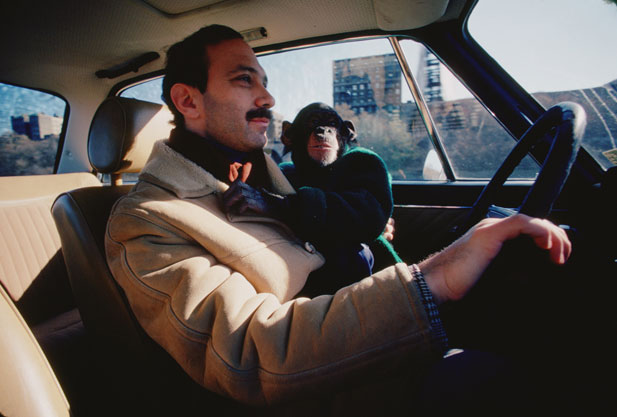
Two of "the good guys"—Bob Ingersoll and Nim Chimpsky

* After Noam Chomsky. "Get it?"

** I seem to be coming down hard on Terrace ("That's DR. Terrace..." he says at one point in the film), but he comes across as smug, arrogant...and a tad clueless in Marsh's film (Don't these folks know how they're going to come off?).  Also, slightly retributive.  After his slap-dash study—heavy on the personal agenda—ends he writes a book about the study saying "Nah...chimps don't use language because they have no syntax"—merely parroting words they've been taught to get what they want, without proper sentence structure, or tense. True. It's the same way I communicate with my dog, Smokey. We pick up on each other's "cues" of behaviors and words we recognize and respond appropriately. For example, if I command my dog to go to the bathroom (he does this by suggestion) and he doesn't "have to go," he'll simply sit.  Which tells me "No, really, it's not necessary. How about a cookie, though?" NIM was doing this with his trainers and with other apes...and taught other apes basic ASL (shades of Planet of...), just as he communicated with ape-cues to other apes. The thing that struck me about NIM (which I remember from some of the docs made when the study was going on), was that he learned to curse.  If he got mad at something, he'd make the sign for "Dirty," which was related to his toilet training. Nobody taught him that "Shit!" was an expression of frustration. He came up with that on his own. Explain that.