Showing posts with label Steve Soderbergh. Show all posts

Thursday, March 20, 2025

Black Bag (2025)

"You Are Cordially Invited to a Night of Fun and Games at George and Kathryn's"
or
"Will There Be a Mess to Clean up?" "Only if We Do it Right"
 
Something is brewing at the NCSC ("Making the UK the safest place to live and work online"), a division of the GCHQ, which is a branch of British Intelligence. Even before the titles come up, George Woodhouse (Michael Fassbender) is called to an off-site meeting with his boss, Philip Meacham (Gustaf Skarsgård—another one! A month of movie releases can't go by without one with a Skarsgård in it) who informs him "we have a traitor in our midst" regarding a very hush-hush program called "Severus" and Meacham wants him to find the "mole" and "ferret" them out. "Give me two weeks" says George. Meacham replies "If Severus is deployed as intended, thousands of people will die."
 
"Okay," says George. "One week."
 
It will be that kind of movie.
 
George, you see, is a highly-regarded agent at intelligence. And so is his wife, Kathryn St. Jean (Cate Blanchett) and he is absolutely devoted to her, as she is to him. But, we've seen enough movies with husband/wife teams in the same professions where vows and oaths clash enough that they can hasten the expiration date of "'til death do you part." And in the spy game, trust is everything, depending on verifiable proof. In the marriage game, trust is usually handled in another department and hemisphere of the brain.
And George has been informed by Meacham that his wife is one of the suspects. Oh, bother. That can tests one's concepts of loyalty, what? But, being a punctilious sort he begins his investigation by inviting the suspects over for dinner, prepared by him, and with the added ingredient being a drug to lower everyone's inhibitions—he has a reputation of being able to catch anyone in a lie—and that gets an amused admonition from his wife ("Darling, you must not dose our guests."), but, as we know, he only has a week.
The dinner guests include the agency's psychiatric analyst Zoe Vaughan (
Naomie Harris), her boyfriend and agent, Col. James Stokes (Regé-Jean Page), his counterpart Freddie Smalls (Tom Burke) and his girlfriend, satellite imagery specialist Clarissa Dubose (Marisa Abela). All work together for the agency for the head of the department Arthur Steiglitz (Pierce Brosnan), but all that really gets revealed at dinner is that Freddie, as is his way, is cheating on Clarissa, which results in her stabbing him in the hand with a steak knife. It is only one of three violent acts in the film, but it gets George no closer to the truth.
And he hasn't begun to investigate his wife, yet. As she was preparing for dinner, she happened to mention that she liked it when he watched her, but, she has no way of knowing how far that will go. He finds out her schedule—she's traveling to Zurich on business—and persuades Clarissa to temporarily way-lay a satellite and discovers that Katheryn is meeting a Soviet operative there. James informs him that she's got access to a Swiss bank account with £7 million in it and that a highly-placed colleague of the fellow she there has gone missing. Perhaps most alarmingly, Meacham—his boss who gave him the assignment of "finding the rat"—has unexpectedly died of a coronary. Things are happening pretty fast.
But, then it's a 
Steven Soderbergh movie. Black Bag is the second 
film he's directed film to be released in three months (the earlier one was Presence, also written by David Koepp), and it is more in the style of Soderbergh's caper movies (the "Ocean's" films, Logan Lucky, or Out of Sight), although slicker and with more of a professional veneer given the spy/thriller setting. It's stylish, witty, but with an underlying smartness that might leave some watchers in the cold. Things get complicated, red herrings abound, and if you're not paying attention, you could get lost. But, the spy vs. spy bubble the movie moves in gives it a certain edge where you're not sure whose side anybody's on at any given moment.
Call it Tinker Tailor Soldier Spy-lite, with a little bit more tech with spy-satellites and AI-enhancers and the like, plus a bit of sleuthing, psychological games, a big "MacGuffin", and even an Agatha Christie "it's-someone-in-this-room" reveal, checking off a lot of film-fan favorites. And the structure of the thing is a nice little touch. It's a clever little game, if not much of a thriller, although Soderbergh keeps it moving at a fast clip, and the badinage witty even if no one smiles. 

Saturday, February 1, 2025

Presence (2024)

Teen Angel, Can You Hear Me?
Teen Angel, Can You See Me?Why Do You Still Give a Damn
Why Do You Glide on Steadi-cam?
or
"Ghosts Are Ass-Holes, Man!" 

I have a friend who (so he says) became a psychic, though not of his own volition. One day, he walked into work and discovered that he could read people's thoughts and know what they were thinking (I should have asked him what number I was thinking of at the moment, but the story was too interesting to hear for some quick-thinking debunking). Anyway, he was a professional psychic for awhile and gave it up, settled down, raised a family. The toughest trick for a psychic is to STOP being a psychic...if you REALLY ARE a psychic.
 
Anyway, I went to a lecture he was giving and was driving him home and we were talking psychic stuff—its arcana and down-sides and my weird forays into TM—when I asked him "What about ghosts?" And he blurted, frustrated, "Aw, ghosts are ASS-HOLES, man!" He'd never met a ghost he'd liked, as they were always hanging around with some left-over agenda from their previous existence that they just...couldn't...let GO of! "One ghost was hanging around her daughter because she never returned a BOOK she borrowed from her! Can you believe that?" I actually could (and if he was really psychic he would have known that). But, he could never understand why ghosts just never let go and move on, especially as the way (I've heard) is perfectly well-illuminated.
 
So...Presence, director Steve Soderbergh's new film with a script by David Koepp that only cost $2 million bucks and (supposedly) has only 33 editorial cuts in it. That is as lean and mean as a movie can get, and I've always liked Soderbergh for his daring and his playing with the movie-form and his many invented ways to get movies made and/or distributed. He's the guy I'd want running DOGE over anybody else. Smart and experimental, but efficient as any director making movies—he even shoots and edits them under pseudonyms. And, in this one, he literally plays a larger part.
We open on a house. More actually, we open IN a house, looking through the window down at some pavement below and then the camera looks up and we see the window, turn around and we're looking at the empty bedroom of a vacant house. The camera glides through rooms, up and down stairs, down to the main floor into the kitchen, around the living room and out the window. Nothing to see here. Fade to black.
When we come back we're looking out the upstairs front window and a woman getting out of a car. "We" run down to the first floor as she enters and it's a real estate agent (Julia Fox) who's going to show the house to a family who soon arrive. They are, as we soon learn, the Payne's: Rebekah (Lucy Liu), Chris (Chris Sullivan) and the kids Tyler (
Eddy Maday) and Chloe (Callina Liang), both teens. Rebekah loves the place, but Chris has questions—are the schools okay? it's by a fire-station and are the sirens going to be annoying—and the kids are... preoccupied. Tyler's a jock and submersed in his phone—it's not even sure if he notices the house ("whatever...") and Chloe wanders around, not saying a word...except...at a couple points she looks directly at the camera, which then swiftly retreats away from her gaze. Nobody else notices or looks our way, only Chloe and only a couple times. In fact, the camera will move very close to people in intense discussions and there is no reaction. It's like we're invisible.
It's like we're a GHOST. Which is exactly what's going on here. There is a spirit in the house (something the real estate agent doesn't mention and probably doesn't know as she's focused on making a sale). Everybody is busy with other issues and so they don't notice, they're not attuned to it. Only Chloe who is sunk deep in depression over the death of a friend—accidental overdose it was ruled—is aware that there's an unseen house-mate, who's useful at putting her books away or causing a fortuitous distraction. One night, on the edge of sleep, she senses something in the closet (the spirit's go-to refuge), gets up, wanders to the center of the room and tentatively asks "Nadia?" It was the name of her passed friend.
There have been plenty of "point-of-view" movies. They were quite prevalent in the day of slasher horror (but only sparingly—but enough that it became a trope—and usually to disguise the perpetrator or increase suspense ala The Silence of the Lambs), and Orson Welles was going to use it for his aborted first RKO film Heart of Darkness, and director Robert Montgomery employed it (partially successfully) in his adaptation of Raymond Chandler's The Lady in the Lake—quite naturally as Chandler wrote his mysteries in the first person. But, it's a gimmick, like those movies employing found media (I'm thinking The Blair Witch Project and Cloverfield) where the point-of-view technique is meant to be claustrophobic and limit what is shown. It's a distraction, as well.
Interesting that there are a couple of extra chairs at the dinner table.
Expecting guests, are we?
But, not here. "Our" role—as we, the audience, don't have a choice in the matter—is not as a stand-in for the narrator or the director's presence (although director Steve Soderbergh DID shoot the whole thing himself, so one could say that he is portraying the ghost). We are the observer (as per usual), like the presence, unseen and unheard—but, even if we don't, it is still quite capable of making an impact.
The film is of our time, and what is going on in the lives of the Paynes is distrust, an uneven power dynamic between the four, and involves teens and bullying and social media, plus an unsolved murder or two, all seen through the eyes of a spirit who knows a few more things than we do and acts accordingly when it feels the urge to. One may have a qualm or two with its selective abilities ("Well, if it can do that, why can't it do this?") and it all may come down to cherry-picking for the sake of dramatic effect and suspense. Given the amount of detail that Koepp and Soderbergh put into the scenario, one suspects that they were just interested in telling an engaging story and didn't want resolutions to be too easy. Poltergeists can't do everything. If they could, they'd be guardian angels...which is another pay-grade.
Are ghosts ass-holes? I don't know. Presence would make the argument against—that they serve some purpose other than flickering lights and poltergeisting to their sacred hearts' content. And "Ass-holes" is a little judgy. Plus, it's never a good idea to look down on things that can look down on you (especially things known for knocking things off ledges). Maybe ghosts are just like those career-people who absolutely refuse to retire and can't imagine themselves relaxing with a harp. That's a little relatable. It certainly would be to Steve Soderbergh who's said at several junctures of his career that he's going to retire and he...just keeps...making...movies.
 
I certainly hope he does...if the spirit is willing.

Tuesday, March 26, 2024

The Good German

Written at the time of the film's release...

The Good German (Steve Soderbergh, 2006)

"Berlin July 1945. Harry Truman, Winston Churchill, and Joseph Stalin are scheduled to meet outside the city, in Potsdam, to draw the post-war map. Only Japan continues to fight..."
 
This was the second of Cate Blanchett's (erk!) "Christmas" movies.* And it's a fascinating little experiment, but not a satisfying movie. 
 
In it, Steve Soderbergh attempted to do a film in the old "Warner Brothers" style. It's in black and white, done on back-lots with incandescent lights, and tube microphones and back-projection. Stylistically, it looks a lot like Michael Curtiz's staging of Casablanca, while in the many instances of conflict it resembles Orson Welles' in-your-face direction. The story, which takes place in a divided post-war Berlin is a bit like the cynical The Third Man crossed with the more romantic Casablanca. But it has the modern sensibility of more natural acting, language, nudity and hyper-cynicism. 
And it's like the two don't go together, there's such a cultural disconnect between the "silver-screen presentation" and the story that ultimately they're working at cross-purposes. It's tough to care about the machinations of the script when you're admiring the technique, and playing "identify that shot." 
Plus, the stars are ill-served by the conceits. Clooney is forced to be a bit more broad, which has never been his strength, and poor Tobey McGuire just can't cope—it doesn't help that he's playing drastically against type. The character actors fare better with more theatrical performances, and Cate Blanchett channels the languid sensibilities of Dietrich and Bergman to get by. 
Still, it's not an incompetent film—it's very accomplished. But the directorial decisions undercut the story, and one wonders why Soderbergh decided to pull off these stunts (which couldn't have been easy and certainly flew in the face of what studios think generate box-office) when a more straight-forward presentation might have served the story better.
** Whatever joys the old techniques generate (one of which is hearing Thomas Newman score a movie in the style of his father, Alfred) aren't worth torpedoing the film.

* The "other" was Notes on a Scandal, which also starred Judi Dench.
 
** Why did he shoot it this way? Probably a bit of nostalgia for the Warner style and the style of Michael Curtiz in particular. Curtiz was known to only use five lenses for filming, and Soderbergh restricted himself to just those types of lenses. Plus, the rigors forced him to shoot only what he needed for the film without re-shooting scenes for "coverage." As he told New York Times writer Dave Kehr for an article dated Nov. 26, 2006: "That kind of staging is a lost art, which is too bad. The reason they no longer work that way is because it means making choices, real choices, and sticking to them ... That's not what people do now. They want all the options they can get in the editing room."

Friday, February 23, 2024

Bubble

Written at the time of the film's release. 

And it's a bit dated. We all know what happened with the pandemic, and it gave an extra push-start to streaming services, with indications that it might have pushed the market to far. Services are consolidating. But director Steve Soderbergh was pushing the red envelope way before anybody, looking for a way to unlock the stranglehold the main studios had with distribution. The situation is still in flux...and theaters are back in business again. We'll see what the market bears.

Bubble (Steven Soderbergh, 2005) Billed as "Another Steven Soderbergh Experience," this low-budget, shot on video, story of a love-triangle at a doll-making factory is more experimental than experiencial.

The business-end of the film is that it was released simultaneously in theaters, on Pay-per-View, and DVD...just to see what would happen. With the theater-life of films to DVD approaching four months and closing, business analysts were interested in what this new paradigm would look like. The costs on
Bubble being reasonable, they had nothing to lose, allowing them the freedom to experiment. Bubble, however, was probably not the best film to do it with, as the entire film is unconventional, with no stars, no pyrotechnics, and the innovations behind the scenes for the most part.
Soderbergh had executive-produced (with
George Clooney, his "Section Eight Productions" partner) a cable series called "K Street", centered around Washington D.C. politics that mixed real actors with politicians, and Soderbergh became fascinated with the split-dynamics in the performances of thespians and politico's—sometimes preferring the latter. Bubble was then designed to accommodate non-professionals before the camera: there was no formal script, taking memorization out of the equation, and the film was designed as a series of "Tableuax," freeing performers and crew from having to "hit their mark" (and it should be noted —
here in 2024—that this was the same approach used by Jonathan Glazer in the recent The Zone of Interest—although Glazer went so far as to hide the cameras and merely "allowed" his actors to interact in their field of view, almost as if they were security cameras).
Filmed locally in the twin-cities of
Belpre, Ohio and Parkersburg, West Virginia with locals culled from an interview process, Soderbergh made great picks for the principles with contrasting personalities and body-types and histories, informing their performances with the DNA of their lives. Line-readings are out of the equation, so the acting is reduced to reactions, flat-toned conversation, and tamped-down emotions.
And their eyes. "It's all in the eyes, really," said
Laurence Olivier, and this trio's "windows to the soul" are doing 80% of the work with fascinating results. Pretty soon, story is reduced to reaction and eyes that sparkle, harden, and hide...and betray inner thoughts, even un-scripted ones. It may not be the most dynamic film in the world, but for taking the mystery out of the film-making, and film-acting process, it makes for a very interesting watch.

Thursday, February 8, 2024

Side Effects

This was written at the time of the film's release...

First, Do No Harm
or
Physician, Heal Thyself

One of my great joys in life is watching happy-pharm' commercials that spend ten of their thirty seconds extolling the virtues of their chemicals ("It stops your brain from telling you you're SAD!"), then the last 20 of them warning about all the dire side effects of said chemicals up to and including death (and maybe beyond).  That's comedy gold right there, masquerading as serious medical advice, wrapped in ad hucksterism.*

Now, prolific director Steve Soderbergh, who started his career twenty four years ago with Sex, Lies, and Videotape is saying he will end his commercial film career** with Side Effects, an odd mixing of genres that has as its basis all those little warnings for the mystery "miracle" pills that are being foisted on the public for the slightest of symptoms and moods, with the tentative approval of the FDA, and a library of law-suits, concerning their consequences on real human beings. In that way, it plays on a public's paranoia and trust of just what kind of human experiments might be being financed by the drug cartels, in much the same way as Hitchcock messed with our minds with our basic fears in his long career.  Soderbergh has never been this direct in his work before, making something akin to a traditional suspense-thriller, instead of a character study with sociological underpinnings (The Informant!,  Contagion, S, L, and V, Traffic) as we're used to from his previous work.
It's a pretty basic story, with some nicely diverting echoes of recent headlines:
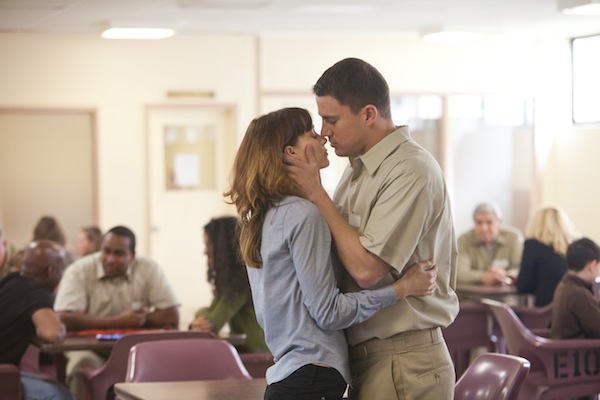
Emily Taylor (Rooney Mara) works for a New York marketing agency and is dealing with a lot of stress in her life. Her husband (Channing Tatumis being released from prison after four years for insider trading.  She's been struggling with these issues for awhile, and being treated for depression over the circumstances. But, once husband comes home, things take a turn for the worst.  

Or actually, don't take a turn—Emily drives her late-model car directly into a garage wall—rather than heading for the "Exit" arrow, she runs INTO the "Exit" arrow.
 
She suffers a concussion and is taken to the hospital, where she comes under the watchful eye of 
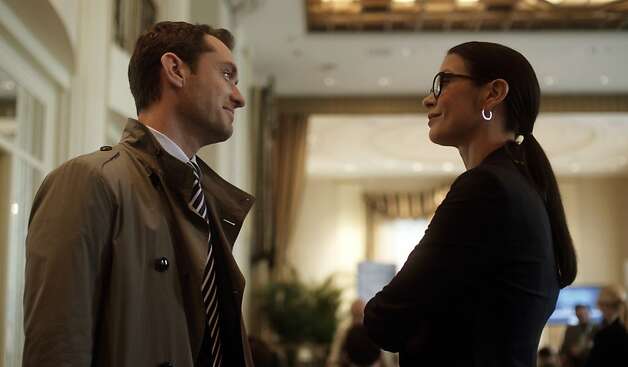
Dr. Jonathan Banks (Jude Law) who knows exactly what's wrong by deducing "usually when someone hits a brick wall, there are skid marks." Emily doesn't want to be a bother, and bargains her way out of the E.R. by promising to visit Dr. Banks for therapy.
At this point, a responsible reviewer should say: "
Warning: complications may occur, consult your physician." Let's just say "things get messy" and merely suggest that a nasty case of medical ethics can turn into...a really nasty case of all kinds of ethics. To say any more would spoil the bumpy ride the film provides, but one doesn't risk too much by sharing a particularly nifty exchange around which the whole film hinges: "Did the person do it? Are they guilty?" "In the present case, those are two very different things." Nice little piece of writing, that.
The screenwriter is Scott Z. Burns (who also wrote
 Contagion and The Informant!) and he's constructed a medical thriller that takes a few hairpin turns and manages to avoid the guardrails of audience expectations and movie cliches. And Soderbergh (who shot and edited the film) has cast it impeccably with folks he's worked with before: Law, who's usually fared better at smaller character parts, here finally shows he can carry off a "leading man" role, dominating the film, while making "normal" interesting; Catherine Zeta-Jones shows (again) how versatile she can be in a small but crucial role as a consulting shrink; Channing Tatum makes the most of his part as the husband caught up in a world that he's just re-entered but can't understand. And Soderbergh rookie Rooney Mara gives a complex performance
that's more than a little unpredictable (not surprising, given her history of moving from a straight performance in The Social Network to anything-but in Fincher's version of The Girl with the Dragon Tattoo) looking like what you'd imagine Sandra Bullock's creepy little sister might look like, Mara convincingly pulls off mood shifts that might require an exorcist rather than a prescription.
Sorry...sorry. I shouldn't have used the word "creepy!"
In many ways, Side Effects is the film many expected last year's Flight to be: instead of a straight-forward look at addictions and their crises, a lot of viewers were expecting there to be some mystery that would neatly tie loose ends and vindicate its protagonist.  But, Side Effects plays with societal responsibility and legalities in a time when the very nature of people's natures is being altered, in the same way that Michael Crichton used to explore science's impacts on us in his books and films, provoking such tough questions and "Are we prepared for this?" "Just because we can do this, should we, and how will we deal with the fall-out?"
In any case, in the theater or after-movie discussions, 
Side Effects will not cause drowsiness.
Jude Law learns his practice isn't perfect in Side Effects

* SNL did a fine parody of this type of advertising with a fictional toy-product, the generically-labelled "Happy Fun Ball:"

**  We'll see how long that lasts, but Soderbergh has long grated against turning out commercial product (the one-two punch last year of Haywire and Magic Mike, notwithstanding) for the sake of commercial product, wanting to experiment with non-box-officey topics and distribution avenues. 

2024 Update: Yeah, he shows no signs of stopping—Presence is coming out this year and after that, a project called Blackbag.

Tuesday, December 20, 2022

Genre/Gender-Bending with Mr. Soderbergh

Written at the time of the films' releases

Haywire (Steve Soderbergh, 2011) Fairly standard actioner about a wet-ops unit for hire, and one particular freelancer who's beginning to suspect harmful links between gigs, directed by Soderbergh (written by past collaborator Lem Dobbs), with some unusual qualities of note. For one, the director stages his fights like they were dance sequences from an M-G-M musical—full-frame/full-figure (but without the Lion Studio's "stage" angle on the axis of the central figures). There are no tight shots, tight editing, it's all composed of mis-en-scene, rather than montage, just an angle/reverse angle one-two parrying between perspectives. It's tough, athletic, and the only real reason to cut away is if something goes wrong—a fluffed punch, or bad timing that creates a lull in the fight or a disconnect with "reality." There's no "lull" between hits because the way the altercations are staged you never see the connections, and there's no simulation of connection, because they're composed mostly of gymnastics, wrestling and fast action—the opposite of The Bourne Identity style of rapid cutting and implication of "hits." Soderbergh does something different with this style, while accomplishing the same intensity of the edit-dependent fisticuffs of the last few years. The most critical part, however, is who's doing the fighting, and that's where Haywire is really different and utterly dependent on its athletic lead.

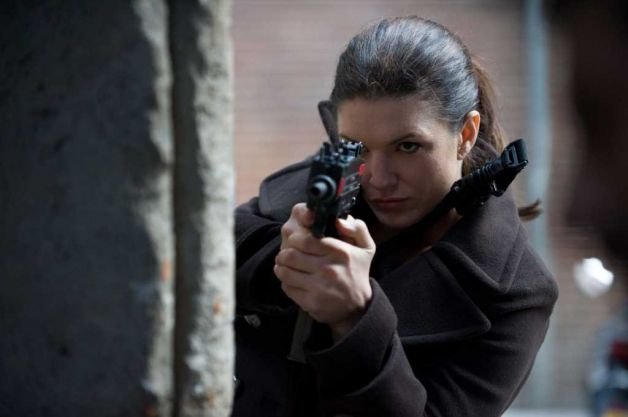
Gina Carano, mixed martial artist—and frequent participant in "American Gladiator"—plays Mallory Kane, and she is disciplined enough to pull off the fight sequences with a savage speed. Any actress can train to look convincing, but Carano has the moves down for her character who is supposed to be a berserker weapon of mass-destruction, so there's rarely a cut-away or an insert shot to betray the use of stunt-doubles. There aren't any. 
So, Soderbergh (who also shot the film) keeps his camera out of the way and keeps everything and everybody in frame as best he can. We've seen women in fights before—fights with men (Tarantino loves to do that)—but it's slightly unnerving to see these, knowing full well that everything was done in-camera, with few editing tricks. The speed makes it a bit more visual—there's no 1/4 second adjustment/orientation lag between cuts—and more upsetting initially, but one does, as the fighting continues for minutes unabated, used to it (except for the question of what kind of make-up she uses to hide the bruising).
Because Carano is largely unknown except for her MMA career—she's fine in her dramatic scenes, just not great (but then, have I ever complained about Jet Li or Jason Statham's acting?)—the cast is a little top-heavy with big-name victims...Ewan McGregor, Michael Douglas, Channing Tatum, Michael Fassbender (the latter doing a fine riff on Bond coolness—of course, he gets his ass kicked in the film's best fight), Bill Paxton and Antonio Banderas. Nobody is required to do anything beyond displaying detached coolness. But the internal logic is there, so at least this one is a better example for the experiment than, say, Salt.
The girl breaks bones and furniture.

Welcome to the Crazy Club!
or
The Moon's Just a Cheap Shot Away

And what's good for the goose...
 
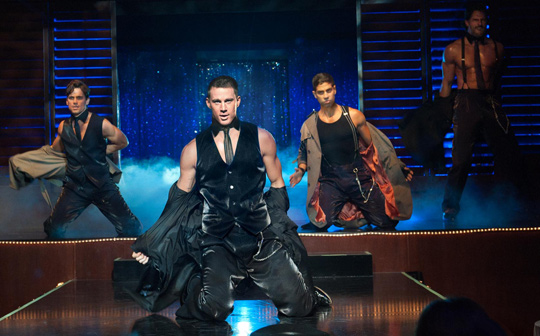
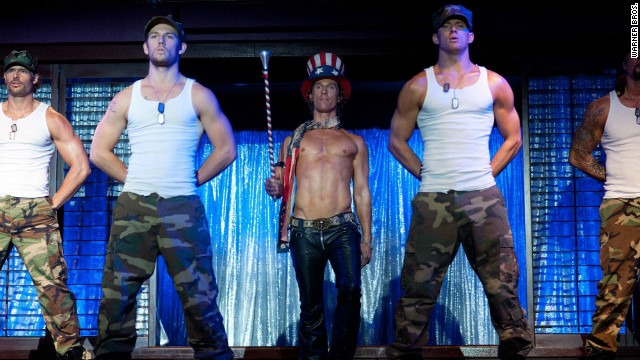
Soderbergh's next film after Haywire (if we don't count his second-unit work for The Hunger Games), also goes against the grain in the traditional genre/gender roles that we come to expect in movies—a dance/backstage drama movie, but with male leads.  Magic Mike is Flashdance with testosterone, the only thing missing is the "if you give up your dreams, you die" line. Here, the basic dream is moving out of Tampa, Florida...to a bigger venue, or a better life. The clutch of male strippers each have their own motivations—mostly money—and for them, the gig is a better alternative than slogging through a 9 to 5 job, wearing a tie. So, at night, they dance, flirt, tease, and as club owner Dallas (Matthew McConaughey) "pry the cash out of their purses."
We're introduced to the skin-trade by Adam (Alex Pettyfer) irresponsible brother of Brooke (Cody Horn), who makes a good enough living for him to sponge off by having a steady job dealing with medical claims. At a construction job that he's ill-equipped for, he runs into Mike Lane (Channing Tatum), who, despite seeing Adam as a loser, takes him under his wing, giving him a job as a "gopher" for the Xquisite dance club, where Mike, he finds to his surprise, is a featured dancer. Well, you know how these backstage stories go: one of the performers can't go on-stage—he's passed out from a growth hormone overdose, and so Adam must make his stripper debut.  Dallas and Mike watch from the wings and simultaneously offer an opinion: "Can't dance worth shit."
 
"But..that..can..be..taught," replies Dallas.
Wish the rest of it could be. It'd save us all a bunch of time. Mike's the hero of the tale, the veteran, "the guy most-together," but Adam is the neophyte and must go through the unfulfilling one-nighters, the drug problems,
the crack-ho relationship, the debts to the hood-pushers, the spiral down to the bottom. Mike just goes home to a brewsky and a night of uncrinkling his Benjamins on the edge of his self-designed furnishings (the establishment of such a business is his dream). He's the cleverest of the bunch—Tatum developed the story based on his own experiences dancing in Tampa, so naturally he's the cleverest—and he's the most romantic of the bunch, mooning over a past-patron (Olivia Munn
*) and very interested in Adam's sister. He probably stays around being The Kid's Obi-Wan just to keep her in the picture, because there's only so many times you can say "You don't want that in your life, bro'" before it gets tiresome.
It does, but it could be a lot worse. It could be "Showboys," and in outline form it resembles it, but it avoids the smarmy camp quality of that film by having a sense of humor about itself** and what it is (and what it doesn't aspire to, which is anything with an overt message) and it stresses the economic times that drop the unskilled (but ripped) into such night-work (day-jobs being rather scarce, especially when you party until 4 am) without having any pretensions about suffering for your art.  And the performances are fine, especially Tatum and McConaughey, who clearly relishes playing an out-and-out bad-boy with no shame. But, all the men throw themselves into the roles of buck-a-throw sex-objects, with a brio and swagger that's fun to watch—as long as nobody takes it for anything more. 
 
It's the old "show-biz is a rough road, kids" movie, but with a "y" chromosome in the script of its DNA, a morality tale with enough immorality to make it worth watching.  And it's a healthy thing for Soderbergh (or anybody) to be turning the tables on these themes with their built-in sexism—even if the tables have some dancing on them.
The boys break rules (but not twenties)

* Interesting role for her.  She plays a woman who plays with Mike like a boy-toy for jollies, but he finds, much to his dismay, that she does not consider him someone to bring home to meet Mom and Dad.  Dude...(if I can use the language of the film) Why do you think you never went over to her place??  As they might say in Showgirls "Denial's not just a river in Egypt, honey..."

** Reviews and synopses are saying it's a comedy-drama, though. No. No, it's not. It's a light drama (with sprinkles of heaviness) and some clever writing here and there. Maybe that hyphenate was there to attract the ladies (as if all the beef-cake and pretty boys wasn't enough).

Sunday, December 4, 2022

Don't Make a Scene: The Laundromat

The Story: Two grifters explain basic economy to you.

And not just money. The absence of money. Who knew that the absence of money was just as important as money? As happens every ten years or so, the American economy goes through some sort of slump, so if you want to save for a rainy day, you'd better have a lot of money or a good meteorologist. Because in order to keep the gears going, you need money. Absent that, you need the promise of money. Which isn't real and promises can be broken.

And so can economic systems. And governments. Ways of life.

All for something that isn't real. Really.

Steve Soderbergh's The Laundromat is one of those rarities—an anthology film—inspired by the revelations of The Panama Papers, documents leaked by a whistleblower showing the invisible strings of promises and absent money all funneled through a business address which was just a mail-box for 214,000 shell companies to avoid taxes and governmental sanctions. I'm sure there's a lot of Russian money going though the eyes of such loop-holes right now.
 
But, the true lesson of economy is value. Nothing is worth anything unless it is valued, be it money, bit-coin, oil paintings, luxury cars, even movies. Without gold backing it up, money is just paper. And coins? Just minerals without the gold hiding behind it.
 
And our tour-guides here, Jürgen Mossack and Ramón Fonseca, they're real people (portrayed by actors, who metaphorically leave destruction in their wake), who quite blithely made a mint...until they got caught. So, what they have to say may be of some value.

Or, perhaps, it isn't worth anything.
 
The Set-up: There is no set-up. This is the start of the movie. In fact, you could say this is the set-up itself. And now, here are your guides, Jürgen Mossack (Gary Oldman) and Ramón Fonseca (Antonio Banderas), both formerly of the firm Mossack Fonseca.
 
Jürgen Mossack
:
First of all, there are some things you should know before we begin. For instance, we are real people, just like you. 
Ramón Fonseca
:
  Secondly, we did not write a word of this. To be perfectly frank, we would have preferred all of this remain a secret.
Jürgen Mossack
:
But we had no choice in the matter. We just woke up one day and everything changed. 
Ramón Fonseca: There were stories about us everywhere: TV, newspapers, and the internet. 
Jürgen Mossack: And now it is our turn to tell a few stories. Think of them as fairy tales that actually happened. 

Ramón Fonseca
:
Don't worry, these stories are not just about us. They're also about you. 
Jürgen Mossack: And how is that possible? 
Ramón Fonseca:  Because all these stories are about money. 
Jürgen Mossack: The idea of money. The necessity of money. The secret life of money. 
Ramón Fonseca:  Before money, there was only the barter system. You tried to trade what you had or you could do for what you needed. You have bananas, but you need a cow. 
Ramón Fonseca
:
  I have a cow, but I hate bananas. So, as you can imagine, there was a limit to this system. Bananas turn brown over time and cows can, you know, wander away. 
Ramón Fonseca
:
  So an agreed-upon medium of exchange was needed. 
Jürgen Mossack
:
What is a medium of exchange? Well, it could be a... a nugget of gold. 
Jürgen Mossack
:
Or some other shiny rocks that are generally found to be scarce. It could be a... 
a slip of paper - with words on it... - Aah! Or pictures of powerful people.
And if you read those words, you will see that they are arranged into a promise of value.
Jürgen's cell phone pings

Ramón Fonseca:
  Slips of paper... 
Ramón Fonseca:  Which you cannot peel and eat, and do not give milk are what we all agreed to call "money." 
Ramón Fonseca:  And these slips gave birth to many other pieces of paper with more writing on them.
Jürgen Mossack: And some of those words, they told the story of credit. 
Ramón Fonseca:
  Oh, stay with us now, this is important. 
Jürgen Mossack
:
Credit is an invention that meant you no longer needed to carry around, uh, millions of bananas on slips of paper.
Ramón Fonseca
:
  So, you now have something invisible, credit, 
Ramón Fonseca
:
  ...standing in for something tangible, a cow. 
Jürgen Mossack
:
Credit said that even if you didn't have all the bananas you need for what you want, you could borrow bananas from the future. 
Ramón Fonseca
:
  So, credit is just the future tense of the language of money.  
Jürgen Mossack
:
Speaking of the future... 
Ramón Fonseca
:
  Uh, things have gotten a little more complicated.
Ramón Fonseca
:
  Actually, a lot more complicated. 
Jürgen Mossack
:
There is more money than ever before. 
Ramón Fonseca
:
  Our money has more names than ever before. 
Jürgen Mossack
:
Commodities, loans, stocks, and bonds. 
Jürgen Mossack
:
Funds and funds of funds. 
Ramón Fonseca
:
  Futures, equity, derivatives, securitized debt, shorts and margin calls. Financial instruments. 
Jürgen Mossack
:
Words. 
Jürgen Mossack
:
Invisible. Abstract. 
Jürgen Mossack
:
Very different from cows.
 
 
Words by Scott Z. Burns
 
Pictures by Steven Soderbergh (as Peter Andrews) and Steven Soderbergh (as Steven Soderbergh)
 
The Laundromat is available for streaming on Netflix.
The real Mossack and Fonseca