In these days of communicable diseases and precautionary measures for the greater good, folks on both sides of the aisle and of every color-stripe are being a little flippant with the "N"-word—"Nazi."
So, just for a refresher course, we are going to sub-set the "Spies" series we're doing with movies where there are Nazi's (you know, "the bad guys"—Indiana Jones fought them in Raiders of the Lost Ark!)
And we're going to call it "Nazi's...Nazi's everywhere."
Marathon Man (John Schlesinger, 1976) On the celebration of Yom Kippur, two chance encounters in New York City create an interruption in already established conspiracy that will conclude in two two wildly disparate people facing off against each other in a duel to the death: two cranky New Yorkers escalate a road-rage incident into a fiery crash, while on a track around Central Park, two joggers engage in a running battle over who's fastest—the slower of them Thomas "Babe" Levy (Dustin Hoffman) eventually gives up. His brother, an oil company executive, whom he affectionately calls "Doc" tells him he never confronts anything and this is just another example. A student at Columbia, "Babe" is doing his doctoral on tyranny, part of which will deal with the McCarthy era, of which his father, H.V. Levy, became a victim, ultimately committing suicide. "Doc" tells him that it's the past and he should put it behind him.
But, "Babe" still has the gun.
Across the Atlantic, a courier named "Scylla" (Roy Scheider) is beginning to get suspicious about the circle he regularly deals with. When he meets his established contacts, they are surprised to see him when he shows up at his usual haunts in Paris. Maybe because they think he's already been killed. He's nearly blown up by a street-bomb, one of his contacts is garroted at the opera, and the same assassin tries the same thing to him in his Paris apartment, before he gets the drop on him and breaks his attackers' back. Something is up, and he beats it out of Europe to get to the United States.

In South America, meanwhile, events have created movement among individuals who have remained in place for a very long time, lest their activity draw attention. Dr. Christian Szell (Laurence Olivier) under cover of darkness is leaving his Buenos Aries retreat for the first time in years. He has never needed to, but events have put him in danger—he needs information, to secure verifiable funds (that have been interrupted) and to eliminate the forces that have kept him safe all these years. His past is catching up with him. And so he runs. To the United States.

"Babe," meanwhile, couldn't be happier. While doing his research on his paper, he meets Elsa Opel (Marthe Keller), a Swiss student who is beautiful and charmed by him and he's so smitten, he can't believe his luck. Not even when, on an outing in Central Park, they are mugged by two very well-suited men; muggings aren't that rare, but usually by perpetrators less formally dressed. Babe tells Doc about Elsa and the mugging, and Doc wants to meet the girl.
Babe is surprised by a visit from Doc, and the two banter and bicker and make plans for an extended visit, Doc playing the protective older brother, wanting to meet these girl that babe is over the moon for. He has others plans that he doesn't let Babe in on, for Doc is also Scylla...and he's been at his game long enough that he doesn't believe in coincidence. Not with so much happening, of which Babe is innocently unaware.
The introductory dinner initially goes well; Doc picks an up-scale restaurant that leaves babe feeling like a fish out of water—he doesn't even own a tie that is required for so formal a setting. And Doc is clearly taken with Elsa—he flirts, he compliments, puts on airs as when he mysteriously says of the ordered wine "the great Chablis of the world are almost always green eyed. In fact, they're the ones that most resemble diamonds," a remark clearly intended to flatter Elsa and she's caught off-guard.

That's the point. Doc/Scylla is speaking in code. He suspects Elsa has something to do with his business in New York and the mugging makes him sure of it, but he doesn't tell Babe that. What he tells him is that Elsa is likely an exchange student on a foreign visa who wants permanent residency by coercing babe into marriage. Elsa leaves the restaurant in anger and Babe is hurt that Doc would insult her in such a way and have the opinion that Elsa wouldn't be attracted to somebody like himself without a hidden agenda.
The meal ends on bad terms, but Doc has another meeting to go to and the stakes have just been raised.
Doc has arranged to meet Dr. Szell in a public setting, for those he's an old man, his past belies his frailty—he is the hunted Nazi Doctor Szell of Auschwitz, known as "der weiße Engel" (the White Angel) and for the past few years, his location has been protected by American interests for the information he's provided about war criminals, and for his services he has been provided anonymity and a steady flow of the diamonds obtained from his victims at the camp. One of the victims of the earlier traffic accident was his brother who was the first person in the diamond pipeline, retrieving the stones from a safe deposit box. With his death, Szell has come to this country to retrieve the diamonds, and, having no more need for the pipeline, has been systematically eliminating them.
Doc tells Szell that he is not welcome in the States and threatens to "out" him if he doesn't return to hiding. Suspecting that Elsa and the mugging have something to do with the elimination of the pipeline and his own assassination attempts, he warns Szell to stay away from Babe, as well. But, Szell is in for a penny, in for a pound. The stakes have changed.
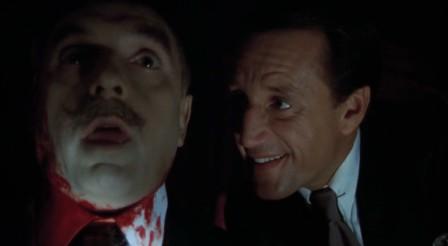
Using a spring-loaded blade secreted in his coat-sleeve, he guts Doc like a fish, leaving him bleeding out and makes his escape. But, Doc somehow manages to make it back to Babe's apartment, dying on his floor. If he was attempting to warn Babe, he doesn't have the strength to tell him what has happened, and Babe, shocked and grieving, can only call the police and wait, stunned.
The police take their time poking through Babe's apartment, asking questions, but he's clueless—there is no reason why his brother would be murdered and also, why he would make it to his apartment, knowing he was mortally wounded. Good question. The police are joined by plainclothesmen led by agent Peter Janeway (William Devane) who ask the same question. Why did Doc come back? Did he say anything to Babe before he died? No, Babe says. He said nothing. But, the question keeps being asked. Are you sure? Yes. He said nothing. Janeway tells Babe that his brother was a government agent and a colleague (and perhaps more?) but, despite the new revelations, Babe can't recall anything.

But, Scylla is dead. His warnings are going to go unheeded, and more people than just Janeway want to know what it was he said when he was dying. For Babe, his life will be put in jeopardy, involving kidnapping and torture—by dentist drill handled by a Nazi doctor in one of the most squirm-inducing sequences in movies (and the immortal line "Is it safe?")—and will be given a first-hand education in how dangerous and cruel the world can be...outside of history books. And he will run. And run for his life.
 |
| "Is it safe?" |
On the technical side, Marathon Man was the first film to take advantage of the new stabilizing camera rig called "Steadicam." As operated by inventor Garrett Brown, the gimballed gyroscope system kept the camera from bumping in hand-held shots, giving the resulting footage a gliding quality, producing an organic freedom that couldn't be achieved with the conventional tracks and wheels. The running scenes benefited greatly from the new camera rig allowing free-moving close shots without the bump-and-jitter smearing that resulted from even the steadiest operator.
Also, the sound design is very special. Except for some studio scenes and a few others, most of the film's dialog is dubbed, the ambient sounds stripped away to focus on little detailed sounds designed to enhance or draw attention. It's a subtle thing, but every-so-often, one notices that the world is awfully quiet, in which case, be on the alert.
The film isn't nearly as air-tight as William Goldman's novel (Goldman did his own adaptation), leaving some loose threads, and condensing it down to essential scenes, nuggets of intensity, making it primarily a thriller, then veering into horror aspects (and film-strategies) when the action turns violent (which it does sporadically, creating ghastly effects). At the time I first saw it (in theaters), having read the novel, I was a bit disappointed, but the film has grown on me over time, especially in the grittiness of it that belies its slick veneer of polish.
As such, it's more of a sprint...not so much of a marathon.