Showing posts with label William Devane. Show all posts

Friday, May 15, 2020

Marathon Man

In these days of communicable diseases and precautionary measures for the greater good, folks on both sides of the aisle and of every color-stripe are being a little flippant with the "N"-word—"Nazi." 

So, just for a refresher course, we are going to sub-set the "Spies" series we're doing with movies where there are Nazi's (you know, "the bad guys"—Indiana Jones fought them in Raiders of the Lost Ark!) 

And we're going to call it "Nazi's...Nazi's everywhere."

Marathon Man (John Schlesinger, 1976) On the celebration of Yom Kippur, two chance encounters in New York City create an interruption in already established conspiracy that will conclude in two two wildly disparate people facing off against each other in a duel to the death: two cranky New Yorkers escalate a road-rage incident into a fiery crash, while on a track around Central Park, two joggers engage in a running battle over who's fastest—the slower of them Thomas "Babe" Levy (Dustin Hoffman) eventually gives up. His brother, an oil company executive, whom he affectionately calls "Doc" tells him he never confronts anything and this is just another example. A student at Columbia, "Babe" is doing his doctoral on tyranny, part of which will deal with the McCarthy era, of which his father, H.V. Levy, became a victim, ultimately committing suicide. "Doc" tells him that it's the past and he should put it behind him.

But, "Babe" still has the gun.
Across the Atlantic, a courier named "Scylla" (Roy Scheider) is beginning to get suspicious about the circle he regularly deals with. When he meets his established contacts, they are surprised to see him when he shows up at his usual haunts in Paris. Maybe because they think he's already been killed. He's nearly blown up by a street-bomb, one of his contacts is garroted at the opera, and the same assassin tries the same thing to him in his Paris apartment, before he gets the drop on him and breaks his attackers' back. Something is up, and he beats it out of Europe to get to the United States.
In South America, meanwhile, events have created movement among individuals who have remained in place for a very long time, lest their activity draw attention. Dr. Christian Szell (Laurence Olivier) under cover of darkness is leaving his Buenos Aries retreat for the first time in years. He has never needed to, but events have put him in danger—he needs information, to secure verifiable funds (that have been interrupted) and to eliminate the forces that have kept him safe all these years. His past is catching up with him. And so he runs. To the United States.
"Babe," meanwhile, couldn't be happier. While doing his research on his paper, he meets Elsa Opel (Marthe Keller), a Swiss student who is beautiful and charmed by him and he's so smitten, he can't believe his luck. Not even when, on an outing in Central Park, they are mugged by two very well-suited men; muggings aren't that rare, but usually by perpetrators less formally dressed. Babe tells Doc about Elsa and the mugging, and Doc wants to meet the girl.
Babe is surprised by a visit from Doc, and the two banter and bicker and make plans for an extended visit, Doc playing the protective older brother, wanting to meet these girl that babe is over the moon for. He has others plans that he doesn't let Babe in on, for Doc is also Scylla...and he's been at his game long enough that he doesn't believe in coincidence. Not with so much happening, of which Babe is innocently unaware.
The introductory dinner initially goes well; Doc picks an up-scale restaurant that leaves babe feeling like a fish out of water—he doesn't even own a tie that is required for so formal a setting. And Doc is clearly taken with Elsa—he flirts, he compliments, puts on airs as when he mysteriously says of the ordered wine "the great Chablis of the world are almost always green eyed. In fact, they're the ones that most resemble diamonds," a remark clearly intended to flatter Elsa and she's caught off-guard.
That's the point. Doc/Scylla is speaking in code. He suspects Elsa has something to do with his business in New York and the mugging makes him sure of it, but he doesn't tell Babe that. What he tells him is that Elsa is likely an exchange student on a foreign visa who wants permanent residency by coercing babe into marriage. Elsa leaves the restaurant in anger and Babe is hurt that Doc would insult her in such a way and have the opinion that Elsa wouldn't be attracted to somebody like himself without a hidden agenda. 

The meal ends on bad terms, but Doc has another meeting to go to and the stakes have just been raised.
Doc has arranged to meet Dr. Szell in a public setting, for those he's an old man, his past belies his frailty—he is the hunted Nazi Doctor Szell of Auschwitz, known as "der weiße Engel" (the White Angel) and for the past few years, his location has been protected by American interests for the information he's provided about war criminals, and for his services he has been provided anonymity and a steady flow of the diamonds obtained from his victims at the camp. One of the victims of the earlier traffic accident was his brother who was the first person in the diamond pipeline, retrieving the stones from a safe deposit box. With his death, Szell has come to this country to retrieve the diamonds, and, having no more need for the pipeline, has been systematically eliminating them.

Doc tells Szell that he is not welcome in the States and threatens to "out" him if he doesn't return to hiding. Suspecting that Elsa and the mugging have something to do with the elimination of the pipeline and his own assassination attempts, he warns Szell to stay away from Babe, as well. But, Szell is in for a penny, in for a pound. The stakes have changed.
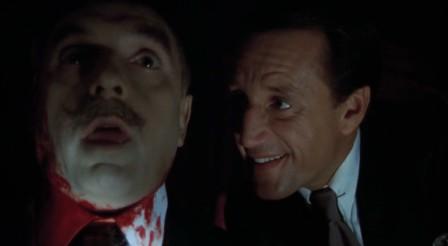
Using a spring-loaded blade secreted in his coat-sleeve, he guts Doc like a fish, leaving him bleeding out and makes his escape. But, Doc somehow manages to make it back to Babe's apartment, dying on his floor. If he was attempting to warn Babe, he doesn't have the strength to tell him what has happened, and Babe, shocked and grieving, can only call the police and wait, stunned. 

The police take their time poking through Babe's apartment, asking questions, but he's clueless—there is no reason why his brother would be murdered and also, why he would make it to his apartment, knowing he was mortally wounded. Good question. The police are joined by plainclothesmen led by agent Peter Janeway (William Devane) who ask the same question. Why did Doc come back? Did he say anything to Babe before he died? No, Babe says. He said nothing. But, the question keeps being asked. Are you sure? Yes. He said nothing. Janeway tells Babe that his brother was a government agent and a colleague (and perhaps more?) but, despite the new revelations, Babe can't recall anything.
But, Scylla is dead. His warnings are going to go unheeded, and more people than just Janeway want to know what it was he said when he was dying. For Babe, his life will be put in jeopardy, involving kidnapping and torture—by dentist drill handled by a Nazi doctor in one of the most squirm-inducing sequences in movies (and the immortal line "Is it safe?")—and will be given a first-hand education in how dangerous and cruel the world can be...outside of history books. And he will run. And run for his life.
"Is it safe?"
On the technical side, Marathon Man was the first film to take advantage of the new stabilizing camera rig called "Steadicam." As operated by inventor Garrett Brown, the gimballed gyroscope system kept the camera from bumping in hand-held shots, giving the resulting footage a gliding quality, producing an organic freedom that couldn't be achieved with the conventional tracks and wheels. The running scenes benefited greatly from the new camera rig allowing free-moving close shots without the bump-and-jitter smearing that resulted from even the steadiest operator.
Also, the sound design is very special. Except for some studio scenes and a few others, most of the film's dialog is dubbed, the ambient sounds stripped away to focus on little detailed sounds designed to enhance or draw attention. It's a subtle thing, but every-so-often, one notices that the world is awfully quiet, in which case, be on the alert.
The film isn't nearly as air-tight as William Goldman's novel (Goldman did his own adaptation), leaving some loose threads, and condensing it down to essential scenes, nuggets of intensity, making it primarily a thriller, then veering into horror aspects (and film-strategies) when the action turns violent (which it does sporadically, creating ghastly effects). At the time I first saw it (in theaters), having read the novel, I was a bit disappointed, but the film has grown on me over time, especially in the grittiness of it that belies its slick veneer of polish.
As such, it's more of a sprint...not so much of a marathon.


Thursday, July 5, 2018

Olde Review: McCabe and Mrs. Miller

This was part of a series of reviews of the ASUW Film series back in the '70's. Except for some punctuation, I haven't changed anything from the way it was presented, giving the kid I was back in the '70's a bit of a break. Any stray thoughts and updates I've included with the inevitable asterisked post-scripts.

McCabe and Mrs. Miller (Robert Altman, 1973) It is very rare when two examples of great artistic achievement can be combined to make something greater than the sum of the parts--where the two complement each other, instead of distracting from each other. But in the first sequence of McCabe and Mrs. Miller, director Robert Altman achieves such a moment. While Altman and master cinematographer Vilmos Zsigmond float their camera onto the form of John McCabe (Warren Beatty) riding through a wintry landscape, Leonard Cohen's "The Stranger Song"* mystically describes the scene and the man. You know when you see this inspired piece of film that Altman has a special kind of vision as regards this project and he pursues this vision throughout with the result that McCabe and Mrs. Miller is Altman's finest film. I'm adamant about this, despite the number of Nashville fanatics who try to convince me otherwise.*
After doing the frenetic M*A*S*H, Altman felt that he was financially secure enough to try artistic projects. McCabe... was his first.** It is a slowly paced, beautifully photographed, acted and edited film about the formation of a western town, a town whose foundations are two rather dubious persons: McCabe, a gambler by trade, and Mrs. Miller (Julie Christie), a madam. It is their vision that gives birth to the town and turns it into a self-sustaining community, a town that will soon displace their once-prevalent position and grow over them, just as surely as the snows accumulate over time. 
But if Altman were to show the growth of the town as that, the growth of a town, what sort of movie would that be?*** So, as it does with more traditional westerns (a term I'm not too comfortable with), the interest of the story falls on the people, in this case, the cornerstones of the community, McCabe and Mrs. Miller. And like most Altman films, there are many characters, many occurrences, but all in the whole of the community--it's a very satisfying film, by a sometimes exciting, sometimes exasperating, but certainly the most innovative of current directors, Robert Altman.

Broadcast on KCMU-FM on Novermber 19th and 20th, 1975.

Altman would continue to be innovative and sometimes exasperating, but never less than assured in the tricks he'd play with the camera and with the perspective he allowed us to see, right up to his final film. And McCabe and Mrs. Miller continues to be (after a recent re-viewing) a wonderfully dreamy frontier film, despite the usurping of some of Altman's strategies in various TV shows since its debut in 1971. Certainly, it feels like a more realistic film about building a community—the town of Presbyterian Church, its most prominent structure, in isolation in the West than most Western films would have you believe. And Vilmos Zsigmond
's innovative cinematography set a high standard that most film-makers can only achieve with CGI and post-gradation.
I find it amusing that this movie didn't find that much of an audience, especially in the West, where the story probably mirrors the origins of every town out in these parts. It certainly does Seattle, where larceny and luck...and women imported from the East Coast...were part and parcel of the city's foundation.

But, as in this review, is it his best film? That would be hard to say. Altman was an iconoclast and rebellious, attempting to subvert film genres and even the organized standards for making films, being more free-wheeling and improvisational, even with a script that was as focused as, say, The Player or Gosford Park.


* And yet I just found a glowing "Olde Review" of Nashville that I'll be putting up in a couple weeks. Nashville certainly has more reach and is a more ambitious project than McCabe... But I did love the dreamy aspect of this revisionist western. Thinking about it the last few minutes I'd be hard pressed to pick "the best" Altman film, or even to a lesser degree, my favorite. How can you compare such disparate films as M*A*S*H, McCabe..., Nashville, Short Cuts, Gosford Park, The Player, and on and on right up to A Prairie Home Companion? Like comparing apples to sweet potatoes.

** I think I might have forgotten the quirky Brewster McCloud in there, and who's to say that M*A*S*H or that film aren't artistic?

*** "Deadwood," frankly...


*


Tuesday, November 11, 2014

Interstellar

The Lo-ove Dimension
or
The Play Fails in the Tesser-act

The must-see movie of the past weekend was Interstellar, Christopher Nolan's new space film with Matthew McConaughey, Anne Hathaway, and a surprising number of good actors, who pop up almost as a surprise. Welcome ones, at that.

For a year or so, Steven Spielberg was attached to direct this, but he let it go, presumably because he could not crack the story and a problematic last act.* Christopher Nolan, the new Spielberg in regards to Hollywood clout, took it over and he and his brother Jonathan re-shaped the screenplay, and unfortunately, this is where the movie fails, and fails rather spectacularly.

For, despite all the research, all the attempts to work with current space-time theory, all the concessions to be...you know, accurate about the science (for instance, no sound—finally—in space—if only one could say the same for Hans Zimmer's interfering, and even dialogue-drowning score), the film is only sporadically interesting, often is eye-rollingly obvious in telegraphing its resolutions, and has a deus ex machina that is so sloppily sentimental** that you have to suspend a little more than belief; you have to practically believe in magic. Or think the whole thing is a time-transplanted conspiracy theory.

It starts off intriguingly. We see a person (Ellen Burstyn in elderly make-up) talk about the Earth's new "Dust Bowl"—with just enough minutiae to place it in the future and mix it in seamlessly with other interviews taken from Ken Burns' The Dust Bowl. Earth is losing its sustainability and bio-diversity, crops are failing into extinction one by one—first wheat, then okrah, with corn being left,*** but for how long no one can say. Budgets and high-tech industries have mostly failed with agriculture and farming replacing them to try and maintain a starving population. That's the history of Cooper (McConaughey), a former NASA test-pilot and engineer who now maintains a vast farm caretaken by automated combines.  But, as has happened before, the top-soil is taking a toll and the country is periodically overtaken with large dust-storms that blanket everything with dirt.
Meanwhile, at home, Cooper is dealing with domestic issues:  a widower, living with Grampa (John Lithgow), Cooper is caring for his son, who, rather than going into a higher earning field is slated for a career that is more necessary in the current day—farming; his daughter is having difficulty with abandonment issues and has a secret friend—a "ghost" who pushes books off the library-shelves. An odd detail like that telegraphs that it will pop up later in the proceedings. It will, so much so that you begin to wonder if you're watching a remake of Signs.
Never mind how they get there, but Cooper stumbles upon a facility which is the last remaining vestiges of NASA, headed by Professor Brand (Michael Caine—Nolan's most regular cast-member) and a team of theoretical physicists and engineers. Their goal is the most lofty one imaginable—Earth's eco-system is so far out of balance that the only way for the human race to survive is to find another Earth and transport the population to that other world. That's Plan A. Plan B is to repopulate the designated planet with a "population bomb" of new humans to that planet in the hopes that they can re-populate without the need of nannies. Both plans are more than a little far-fetched, as is the means to exploring those planets—a wormhole has opened up in the orbit of Saturn, and exploratory teams, twelve in all, have been dispatched to planets visible in the wormhole to send back blips of information about each planet, and Cooper, along with a minimal team of specialists, including Brand's daughter (Anne Hathaway) rocket away to reach those teams, and discover for themselves the viability of human life on those planets.

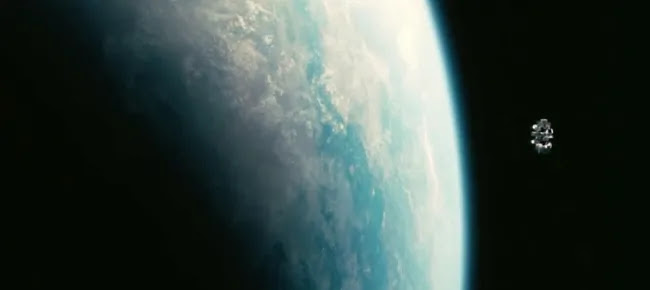
Saturn's wormhole—a snow-globe full of worlds.
That mission will take years—for how long no one can speculate—and it is further complicated by the presence of the black hole that has caused that wormhole in space-time. The closer they get to it, the more the crew will be out of time-sync with Earth. They will age slower than the people of their home-planet. This, frankly, is the best concept in the film (and similar to the different time-rates of the various dream-worlds in Nolan's Inception) and produces the best line in the film about their precious commodities of food and water being added to by time. 

But Cooper going on the mission—no matter how important it is to the species—does not sit well with his family, especially daughter Murph (Mackenzie Foy), who's already lost one parent, and at 10 years old does not want to lose another.  His decision to go anyway, creates a rift between them that time and space only increase, not transcend. But, it will inspire them both on their separate journeys.
Cooper receives messages from home
There are complications—very big complications—that makes one wonder if humans are even worth saving at all. Meanwhile, the uncaring Universe rolls on, completely indifferent to whether you'll be able to make it to your kid's soccer matches...or their weddings...or their funerals. There are wormholes, black holes and more engulfing plot holes. There is an adherence to science theory, but only so far as writers' desperation will allow, and then a lot of fudging goes on in the interest of drama and closure and coincidence...and a banal lack of imagination in its realization of the penultimate act is displayed.  
Ambitious it is, in its limited way, and in places, beautiful. But, for all the dialogue about man (or woman) being an explorer and that, even though humans are born on this planet, they're not destined to die there—ultimately the film falls back to Earth in its focus and its intentions. Opportunities for saying something more, about our place in the Universe and maybe beyond, are lost, for domestic concerns and earthly desires. Interstellar's sights are in the Heavens, but rarely gets off the ground.


* The reason is much less interesting than that.  The property was attached to Paramount, but Spielberg moved his production company Dreamworks from there to Disney.  And, if based on what this article reveals, it's just as well this version wasn't filmed, as the current version is a bit more focused.

** Spoiler Alert: To sum it up, it is "Only Love Can Escape the Sun-Crushing Gravity of a Black Hole."  Really?

*** Rice is never mentioned, which makes one wonder if it's just America that's having these issues and wants to leave the planet.