Showing posts with label Wes Bentley. Show all posts

Saturday, April 4, 2020

Jonah Hex

Saturday is traditionally "Take Out the Trash" Day in these parts, but we're still doing Westerns for awhile, so...

Written at the time of the film's unfortunate release.


"Jonah Bloody Hex...Ah'd Recognize that Half-Cooked Pie-Hole Anywhere."

The title of this post says it all: "Jonah Hex," the movie, is "half-cooked" as in half-baked and a "pie-hole" as in an empty void.

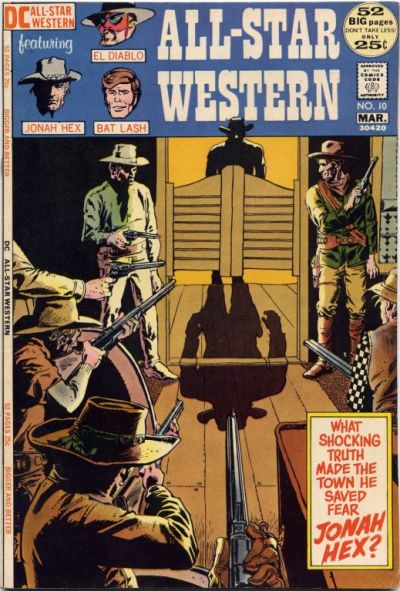
Sad, too. Jonah Hex could have been a lot of savage fun if it were truer to the source—the DC comic book, the last semi-regular western title the publisher produces.

Jonah Hex was a confederate officer, who would not take part in a raid that would only produce civilian casualties, and so, he was the ultimate outlaw, trusted by neither the North or the South, and a bounty hunter, with a particularly nasty streak (not counting the melted-flesh scar adorning his right cheek*).
Hex was in a "funny book," although, he had no "powers and abilities far below those of mortal men," except a deadly accuracy with all things kill-making.  Seems that's not good enough for a four-color movie adaption these days, because the character now has a way to commune in the darker places of the spirit-world, awakening the dead with a touch in order to obtain information.  This hooey is a result of being saved from death by the mumbo-jumbo of the Crow Natives, who salved his wounds (but knew nothing from plastic surgery) and snatched his soul back from the after-life.**  Of course, the wounds were CAUSED by Natives in the comics, but consistency is the hob-goblin of little minds, and the pea-brains who made this one decided to air on the side of political correctness—which "Jonah Hex" never was and never should be.
The best of the "Hex" stories (not counting the ones where he was flung into a post-apocalyptic future, as a "Mad Max"-type) were written by a scribe with with his own twisted streak, Michael Fleischer (although don't call him "crazy" because Harlan Ellison implied it in an interview, and Fleischer sued...and lost).  The last issue he wrote had Hex meeting his end, and then being stuffed and mounted for display and the amusement of anyone who'd fork over two-bits.
He should contact his lawyers, because he might have better luck this time; this one's a PG-13 fiasco that's all-hat and no cattle, that tries to be gritty-tough, but doesn't have the powder to show a kill-shot.  A lot of people get killed, roasted, bludgeoned and chopped, but all discretely off-screen, even while its trying to be as nasty as can be, like a bully that talks tough but runs away from a fight. And anyone who thinks The A-Team was poorly directed (guilty) will be amazed at the cluelessness displayed here by director Jimmy Hayward,*** former animator for Pixar and co-director of the very fine Horton Hears a Who!****
It's all shot in a snatch-and-grab style, awkwardly staged, with no time to linger over period detail, then settles into a Leone-like formality (with picturesquely ugly extras) that's to a spaghetti western what Chef Boy-Ar-Dee's "SpaghettiO's" is to fine Italian cuisine. The Main Title fills in some animated back-story (fine), but then the thing hits the dirt like Hoss' played-out horse, with a tricked up story about a Doomsday Weapon about to be lobbed on Washington by Hex's former commander (who happened to murder his family to boot).  At about the half-way point, it looks like someone had seen Sherlock Holmes***** and tried to emulate the steam-punkish style, but—(never thought I'd say this!)—didn't have a clue how to match the precision of Guy Ritchie.
The movie's look changes dramatically whenever Megan Fox is on-screen, but that's not to the good. Instead of the gritty telephoto look of the rest of the film, she looks like someone spent some precise time lighting her, as she's bathed in golden light with roseate high-lights in her hair—it's the reverse equivalent of smearing vaseline on the lens to hide an actresses' wrinkles—it stands apart from the rest of the film almost to a laughable degree—and for no good reason other than it makes her look damned good. You can't shine gelled baby-spots on her performance, though, which, unencumbered of any modern girly-girl archness (at which she can be quite smart), is delivered in a flat, lazy drawl (sometimes, as she's inconsistent) and suggested to me that she might be this generation's Raquel Welch...or Jill St. John ("Ya look great, honey, just don't speak, okay?  You, too, Keanu").
It's a mess.  The script's bad (by the makers of the "Crank" movies—seems like a "natural" choice to me!), and only matched by the slip-shod film-making—whoever did it, and it could be a bean-counter at Warner for all I know.  The best parts are in the trailer, as the movie's only 85 minutes long (with credits), you're only missing 83 minutes of garbage.
I sat, during the credits, with my own Hex-like sneer on my face, contemplating just how badly this thing was screwed up, when the name of one of the Executive Producers showed up: Akiva Goldsman. Of course! The man who wrote the bad "Batman" scripts, who wrote Lost In Space, I Am Legend, Practical Magic, I, Robot, won an Oscar for A Beautiful Mind ("schizophrenia can be fun, kids!!"), and adapted both The DaVinci Code and Angels and Demons, and whose only talent seems to be the ability to "crack" a script by taking anything edgy or complicated and dumbing it down to the level a kindergartner could understand. If he were a chef, his specialty would be a liquid, runny oatmeal. 
His name has so symbolized terrible work that in my most churlish moments (usually after seeing one of "his" movies) I can only refer to him as "Hackiva." The man should be barred from having control over anything of literary merit, and consigned to merely working on "Chipmunk" sequels. He's been pegged to direct the remake of (appropriately) The Toxic Avenger. One hopes that he's a better director than he is a writer/producer, and may prove to be with the bar set so low. I doubt it. It's tough to avoid the "Hackiva" hex.******


* Among the many flaws of the movie, the prosthetic creating this effect looks a bit plastic—you don't see it on the poster, of course, in another instance of white-washing the movie—but it does have one funny outcome:  Whenever Jonah goes to a bar, he always has to order a double because half of it goes through the open wound in his cheek.

** And, just to pile on the atmospherics, he also seems to be followed around by flocks of crow familiars, which must make it hard to sneak up on people, although he does from time to time. 

*** Okay, to be fair to Hayward—"Horton" IS a great movie and certainly the best of the recent big screen Seuss adaptations—was replaced by Warner execs by Francis Lawrence (Constantine, I Am Legend) during re-shoots, so that may account for the film's inconsistent tone and look. 

**** I first suspected hopelessness when the hilarious Will Arnett showed up...in a completely straight-laced role as a government functionary.  What a waste!

***** Both Jonah and Sherlock are Warner Brothers movies, so, that's a distinct possibility.

****** He did not direct The Toxic Avenger remake, but 2014's Winters Tale, which bombed at the box office. After Hex, he exec-produced Paranormal Activity 2, 3, and 4, wrote the screenplay for The Dark Tower (that's why...), and has latched onto the "Star Trek" franchise, producing and writing "Star Trek: Discovery" and "Star Trek: Picard". 

Wednesday, November 30, 2016

Knight of Cups

Oh, Lucky Man! (Rinse and Repeat)
or
"Likes: Long Walks on the Beach"
"On the positive side, the Knight of Cups is a sensitive soul. He is a poet - a lover of all things romantic and refined. He uses his imagination in wondrous ways and taps the deepest levels of emotion. He knows how to create beauty and share it with others.
On the negative side, this Knight is prone to flights of fancy and illusion. His melodramatic moods are legendary, and his emotions often get the better of him. He's too temperamental and takes offense easily. He can't stand unpleasantness and will always let others deal with it."
We may have reached the end of the inventiveness in Terrence Malick's career and begun the phase of annoying self-indulgence and obtuseness (if we haven't already gone past it). There has always been a danger of that in Malick's work, but he has always worked with a non-traditional approach to narrative drive and story structure that oftentimes has been thrilling. Even after coming out of what seemed a self-imposed eighteen year exile after Days of Heaven, there was still a thread of story in The Thin Red Line and in, especially, The New World. He went far afield of traditional narrative in The Tree of Life, but there was still a through-line of feeling and history, despite star Sean Penn grousing that "this wasn't the movie I read." 
To the Wonder was more problematic—taking the same roundabout "Tree of Life" approach with the film about relationships gone sour despite the spark of the new, the film dragged, felt more than improvisational, and felt slap-dash and pointless, but benefited from some nice performances, even if they were mostly mimed. 
Knight of Cups (which spent very little time in theaters) has more problems than just a sense of randomness. It drifts, following a callow, non-committal screenwriter/script doctor as he roams the country, starting relationships with women, and ending them, sometimes selfishly, and always from that one man's perspective. Unlike To the Wonder, you never see the women's side of things.
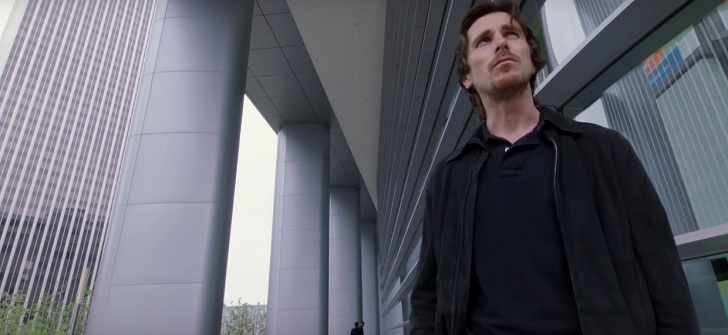
There was no script (Christian Bale, who spends the most amount of time on-screen, supposedly was cribbing character notes from his co-stars' instructions to see if there was something about him in them). One suspects there was no story. At which point, one is left with merely "attitude." That's not enough, especially in a film that has enough reach to employ so many actors and leave them with little or nothing to do than merely be photographed prettily.
But, if one wants a synopsis, here's my best at one: the film begins with a prologue-story, one that was read to our screen-writer when he was a boy by his father (Brian Dennehy). It tells the story of an Egyptian prince who is sent by his father into the city to find a precious pearl. But, once he gets there, he is set upon and given a drink that puts him into a deep sleep and when he wakens, he's forgotten he's a prince, forgotten about the pearl, and lives a life of normalcy, while his father sends out messengers, once his son has gone missing, to find him and bring him home.

The movie's synopsis from its web-page reads like this: "Knight of Cups follows writer Rick (Christian Bale, The Fighter,American Hustle) on an odyssey through the playgrounds of Los Angeles and Las Vegas as he undertakes a search for love and self. Even as he moves through a desire-laden landscape of mansions, resorts, beaches and clubs, Rick grapples over complicated relationships with his brother (Wes Bentley) and father (Brian Dennehy). His quest to break the spell of his disenchantment takes him on a series of adventures with six alluring women: rebellious Della (Imogen Poots); his physician ex-wife, Nancy (Cate Blanchett); a serene model Helen (Freida Pinto); a woman he wronged in the past Elizabeth (Natalie Portman); a spirited, playful stripper Karen (Teresa Palmer); and an innocent Isabel (Isabel Lucas), who helps him see a way forward." 
"Rick moves in a daze through a strange and overwhelming dreamscape -- but can he wake up to the beauty, humanity and rhythms of life around him? The deeper he searches, the more the journey becomes his destination. The 7th film from director Terrence Malick (The Thin Red Line, Tree of Life), Knight of Cups (the title refers to the Tarot card depicting a romantic adventurer guided by his emotions) offers both a vision of modern life and an intensely personal experience of memory, family, and love." 
...and (it might add) a lot of walks on the beach.
Memory and reverie have been the dream-stomping ground for Malick for the last few films, and one can do an awful lot with that, structurally, leading the audience through the memory-maze, which, itself, is a journey. But, there should be markers along the way or you'll get lost in thought, making that journey pointless. The film imposes a structure of chapters into the film (named, except for the last, on cards in the tarot deck), but if one is looking for that to help you find your way, you should ask for a re-shuffle—the cards and their distinct meanings have little to do with the incidents that follow them. Tarot cards are no help when the film resembles a game of "52 pick-up."
Instead, we are given randomness as Rick deals with the death of his brother, his estrangement with his father and brother, his various dealings with studio-folk, parties, happenings, road-trips, and an earthquake. But, mostly women (those being Imogen Poots, Cate Blanchett, Freida Pinto, Isabel Lucas, Theresa Palmer, and Natalie Portman, all drastically under-utliized, which is something of a first for Malick, who are usually the strongest characters in his films). Perhaps we're seeing a cinematic equivalent of depression where Rick is endlessly re-visiting past relationships, looking for a way out of the well. But, it's an endless rumination as he keeps banging his head against a mirror when what he should be looking for is a door-handle. Pin-balling inside your own skull rarely provides the perspective needed to pull oneself out of one's rut; if anything, the circular thoughts such self-examination presents generally cork-screws you even deeper into the abyss.
Hollywood navel-gazing is hardly a new subject for the movies. But, they rarely present a universal truth seeing as how the dream-factory surrounds itself with fantasy and un-reality. Most of us "real" folks have to deal with delusion rather than illusion, and as reality not as art. Yes, we can relate to the phoniness of Hollywood, to the dark-side of the dream-factory, of buying into the fantasy as if it were reality and the way that can mess you up. That orange-grove has been thoroughly tilled to the point where it's been asphalted over and turned into a parking lot. 
But, despite the trope, one shouldn't think of Hollywood's version of tragedy as real tragedy. Sure, one can be depressed in Hollywood, but that's only if one has the idle time to waste. Most of us don't have the luxury to sit back and wonder if they're wasting their lives. We're in the constant struggle not to, and to find worth in something more than the week-end's box-office take. It is hard (and practically impossible) to take Knight of Cups seriously when the person we're supposed to wring our hands about is well-off, handsome, and white, and living a life most people would dream of. "What in the hell does he have to be depressed about?" is the question that kept going on in my mind, competing with Bale's voice-over. On top of that, one shouldn't even consider that Rick is luckier than most—he makes a living as a script-writer—how many would-be writers are out there who've never gotten that chance. Boo-hoo. This is me playing the smallest violin in the world. Are we really meant to sympathize with somebody who has every reason not to be depressed?
Perhaps that's why we're treated to so many images of our poor little screen-writer walking the beach; he's attracted to it because it's so damned shallow.

One sincerely wishes that Malick made this to finance a few more shots of his IMAX project (expected this year), hood-winking the financiers into bank-rolling a few more shots that he needs to fill it out. Other than that, hopefully, this is an anomaly and Malick can return to an actual narrative, rather than these random acts of montage. The world needs more story-tellers like him, when he gets around to telling a story.

Tuesday, August 30, 2016

Pete's Dragon (2016)

"The Bravest Boy I've Ever Met"
or
Ain't Them Dragons Saints?

The latest live-action remake of a past Disney film, Pete's Dragon, does not draw inspiration from the original (made during that period after Walt's death when the studio lost its way and produced "product" rather than innovation), but basically ignores it and starts from scratch, tossing out the songs, the period setting, and hammy performances from stalwart movie veterans to deliver something that hues closer to the main focus of the story, which is "a boy and his dragon."

The result is a far more satisfying film, not so much concerned with eccentrics, than with some core-values, which, although it may not have the slapstick elements of the original or all the schmaltz, still seems much more fitting the bill of "family-friendly" no matter how much mugging Jim Dale and Red Buttons could provide to amuse five year old's.

The film starts with young Pete contentedly sitting in the back seat of a station wagon driving a back-country road, while his mother and father talk about how they're "going on an adventure." They don't know the half of it. To avoid hitting a deer, Dad swerves the car off the road, flipping it and leaving Pete an orphan and alone in some pretty spooky woods that have their fair share of very carnivorous wolves. This is such a "Bambi" moment (and the director stages it with something like that film's strategy) that some kids might be traumatized by it. They won't be traumatized for long, though. No sooner do the wolves start baring their canines, do the trees begin to move and sway like nature's out of joint.
There emerges a very large, furry, winged creature who sniffs out the little kid and, having satisfied itself there is no threat, extends one paw, into which the child climbs. The creature then heaves into the air, flying undetected through the misty sky. Pete calls the creature "Elliott" (after the puppy in the book he carried with him from the wreckage of the car accident) and the two begin their "adventure" together.
Time, like a dragon, flies by. It is six years later, and Pete and Elliott seemingly have the forest (called "Millhaven") to themselves. Pete (now played by the rather stoic little Oakes Fegley) has become quite the little Mowgli, running through the trees, scampering over fallen limbs, fashioning a makeshift tree-house for himself (when he's not hanging out in the dragon's cave) with the snaggle-toothed "Elliott" keeping pace like a protective, obedient pet. Not only can "Elliott" fly, but it also has the ability to camouflage itself, blending in with its surroundings, making it virtually invisible. This becomes handy when eluding detection or for startling any bears that might see Pete as a potential meal...or a threat. No one disturbs them and no one encroaches. They're "Calvin and Hobbes" with no parental controls or supervision. What kid wouldn't love that?
But, that's a fairy tale. The town of Millhaven has stories and songs about the Millhaven dragon and one of its citizens, a retired woodcarver named Meacham (Robert Redford) claims to have actually seen the dragon back in his younger days, which he is only too pleased to regale to young kids who hang on his every word, to the amusement of his ranger daughter Grace (Bryce Dallas Howard) who treats the story like the too-often-told tales on Thanksgiving, with a resigned smile and the faintest of eye-rolls. For Meacham the experience was an example of "magic" made real. For Grace, it's an old man telling stories. As she says she "knows the woods like the back of my hand" and has seen no evidence. She's too busy monitoring the encroaching of man to be noticing 50 foot myths.
Grace may have commitment issues. She's engaged to Jack (Wes Bentley) who, with his brother Gavin (Karl Urban), runs the local saw-mill. While Jack does the books, Gavin does the "harvest," which is going deeper and deeper into protected areas of Millhaven and for which Grace does a certain amount of what is often termed "environmental terrorism" (she grabs the keys from a CAT and tosses them and paints over spray-painted "tagging" marks) to impede his progress (Really? She's going to marry into this family?). She is noticed by Pete and "Elliott" and the boy manages to grab a compass she drops during her walk. 
The boy is curious about the fellow humans, especially when he sees Jack's daughter Natalie (Oona Laurence). It sets up a series of encounters between the disparate parties that will expose "Elliott" to the "outside" world and separate the two and their bond. Plus, once Gavin gets wind of the dragon, he is determined to capture it for his own gain. What was once idyllic will be destroyed, never to be regained, and it will take sacrifice—a lot of it—if any semblance of "right" can be brought back to the world.  
What's great about Pete's Dragon is that it was conceived and directed by David Lowery, the independent film-maker who, a few years earlier, made the very good Ain't Them Bodies Saints, which took the simple story of crime and sacrifice and turned it into an elegaic film where images are most important and where the dialogue is circumspect and actually avoiding spelling things out, lest the hopes and secrets of the characters might be exposed and their lives...and dreams...destroyed. At the time, I wondered what other glories Lowery could be capable of. I never expected it to be a Disney film, Or a damned good one.
Pete's Dragon is not so guarded, whether in story or dialogue, and the characters are much more direct—none of them are doing anything illegal or dangerous, and at the most are just bending some rules to get by. They wear their hearts on their sleeves and their actions follow their desires, whether they're good, bad, selfish, or caring, and even the worst of them is not so shallow that they can't change their heart. It is a film of heart...and soul. And Lowery is enough of a dramatist...and a realist...that he isn't afraid to make things very bad for the characters (after all, he killed the kid's parents in the first five minutes). A good dramatist risks much, even the loyalty and comfort of the audience, in order to engage them, rather than placating. The rewards for such a strategy are great. And Pete's Dragon earns those.
The dragon's amazing, created by New Zealand's WETA with an air towards creating something oddly ungainly while plush, with the playfulness of a puppy but the eyes of an old soul. It is quite the imaginary friend, and one feels as much for the dragon as for the kid, as the two are separated from what is essentially a good thing in order to integrate them into what society considers normal. Just as the loggers are making little encroachments into the woods, reality makes its own in-roads into fantasy and the way Lowery plays it, it feels like a horrible incursion, like something precious is about to be forever lost, never to be regained, and, like the path to Hell, always asphalted over with good intentions.
But, don't tell the kids that. This is one that will keep them from being fidgety or wondering why they had to go someplace to see it, rather than just watch it on TV, and it isn't so insufferable to cause adults to check their I-watches and looking longingly for the "Exit" signs. It's a good, solid surprising "family" film that extols the virtues of family, even while it's questioning that it always has to be the best thing. Like dragons, this movie is something odd and rare and unexpected, especially given the source of Disney, who can do cinematic things that take you aback with how good they can be.

They can even spin gold from the threads of their less-accomplished films, answering the question of "why don't they remake the bad films, rather than merely try to recreate the glories of the good ones (and failing)?" Here, "they" do exactly that and make something wonderful out of it. Something that actually brought well-earned tears to my eyes.
The "original" Pete's Dragon—don't even go there.

Tuesday, November 11, 2014

Interstellar

The Lo-ove Dimension
or
The Play Fails in the Tesser-act

The must-see movie of the past weekend was Interstellar, Christopher Nolan's new space film with Matthew McConaughey, Anne Hathaway, and a surprising number of good actors, who pop up almost as a surprise. Welcome ones, at that.

For a year or so, Steven Spielberg was attached to direct this, but he let it go, presumably because he could not crack the story and a problematic last act.* Christopher Nolan, the new Spielberg in regards to Hollywood clout, took it over and he and his brother Jonathan re-shaped the screenplay, and unfortunately, this is where the movie fails, and fails rather spectacularly.

For, despite all the research, all the attempts to work with current space-time theory, all the concessions to be...you know, accurate about the science (for instance, no sound—finally—in space—if only one could say the same for Hans Zimmer's interfering, and even dialogue-drowning score), the film is only sporadically interesting, often is eye-rollingly obvious in telegraphing its resolutions, and has a deus ex machina that is so sloppily sentimental** that you have to suspend a little more than belief; you have to practically believe in magic. Or think the whole thing is a time-transplanted conspiracy theory.

It starts off intriguingly. We see a person (Ellen Burstyn in elderly make-up) talk about the Earth's new "Dust Bowl"—with just enough minutiae to place it in the future and mix it in seamlessly with other interviews taken from Ken Burns' The Dust Bowl. Earth is losing its sustainability and bio-diversity, crops are failing into extinction one by one—first wheat, then okrah, with corn being left,*** but for how long no one can say. Budgets and high-tech industries have mostly failed with agriculture and farming replacing them to try and maintain a starving population. That's the history of Cooper (McConaughey), a former NASA test-pilot and engineer who now maintains a vast farm caretaken by automated combines.  But, as has happened before, the top-soil is taking a toll and the country is periodically overtaken with large dust-storms that blanket everything with dirt.
Meanwhile, at home, Cooper is dealing with domestic issues:  a widower, living with Grampa (John Lithgow), Cooper is caring for his son, who, rather than going into a higher earning field is slated for a career that is more necessary in the current day—farming; his daughter is having difficulty with abandonment issues and has a secret friend—a "ghost" who pushes books off the library-shelves. An odd detail like that telegraphs that it will pop up later in the proceedings. It will, so much so that you begin to wonder if you're watching a remake of Signs.
Never mind how they get there, but Cooper stumbles upon a facility which is the last remaining vestiges of NASA, headed by Professor Brand (Michael Caine—Nolan's most regular cast-member) and a team of theoretical physicists and engineers. Their goal is the most lofty one imaginable—Earth's eco-system is so far out of balance that the only way for the human race to survive is to find another Earth and transport the population to that other world. That's Plan A. Plan B is to repopulate the designated planet with a "population bomb" of new humans to that planet in the hopes that they can re-populate without the need of nannies. Both plans are more than a little far-fetched, as is the means to exploring those planets—a wormhole has opened up in the orbit of Saturn, and exploratory teams, twelve in all, have been dispatched to planets visible in the wormhole to send back blips of information about each planet, and Cooper, along with a minimal team of specialists, including Brand's daughter (Anne Hathaway) rocket away to reach those teams, and discover for themselves the viability of human life on those planets.

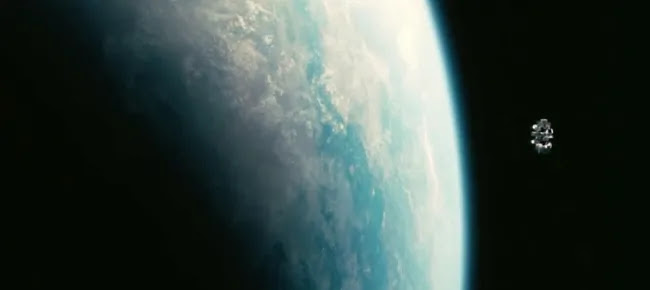
Saturn's wormhole—a snow-globe full of worlds.
That mission will take years—for how long no one can speculate—and it is further complicated by the presence of the black hole that has caused that wormhole in space-time. The closer they get to it, the more the crew will be out of time-sync with Earth. They will age slower than the people of their home-planet. This, frankly, is the best concept in the film (and similar to the different time-rates of the various dream-worlds in Nolan's Inception) and produces the best line in the film about their precious commodities of food and water being added to by time. 

But Cooper going on the mission—no matter how important it is to the species—does not sit well with his family, especially daughter Murph (Mackenzie Foy), who's already lost one parent, and at 10 years old does not want to lose another.  His decision to go anyway, creates a rift between them that time and space only increase, not transcend. But, it will inspire them both on their separate journeys.
Cooper receives messages from home
There are complications—very big complications—that makes one wonder if humans are even worth saving at all. Meanwhile, the uncaring Universe rolls on, completely indifferent to whether you'll be able to make it to your kid's soccer matches...or their weddings...or their funerals. There are wormholes, black holes and more engulfing plot holes. There is an adherence to science theory, but only so far as writers' desperation will allow, and then a lot of fudging goes on in the interest of drama and closure and coincidence...and a banal lack of imagination in its realization of the penultimate act is displayed.  
Ambitious it is, in its limited way, and in places, beautiful. But, for all the dialogue about man (or woman) being an explorer and that, even though humans are born on this planet, they're not destined to die there—ultimately the film falls back to Earth in its focus and its intentions. Opportunities for saying something more, about our place in the Universe and maybe beyond, are lost, for domestic concerns and earthly desires. Interstellar's sights are in the Heavens, but rarely gets off the ground.


* The reason is much less interesting than that.  The property was attached to Paramount, but Spielberg moved his production company Dreamworks from there to Disney.  And, if based on what this article reveals, it's just as well this version wasn't filmed, as the current version is a bit more focused.

** Spoiler Alert: To sum it up, it is "Only Love Can Escape the Sun-Crushing Gravity of a Black Hole."  Really?

*** Rice is never mentioned, which makes one wonder if it's just America that's having these issues and wants to leave the planet.