Showing posts with label Bryce Dallas Howard. Show all posts

Wednesday, February 7, 2024

Argylle

Accent on the "Arrrgh"
or
Henry Cavill's Failed James Bond Audition (Part 3)

Aubrey Argyle (Henry Cavill), an agent for an intelligence division (headed by Richard E. Grant) is on a mission in Greece to find a source of information (doesn't matter what it is...it never matters). In contact with his associates, Wyatt (John Cena) and Keira (Ariana DeBose), he infiltrates a dance club where he asks the seductress LaGrange (Dua Lipa) to dance the "whirleybird," a dance where he basically wears his partner as a muffler. She reveals that the whole set-up is a trap to kill him. She exits, while everyone in the club pulls out an automatic weapon. With such a circular firing squad, Argylle escapes, but is fired upon by a waiting LaGrange. Keira pulls up in a range rover to pursue her, but is shot through the heart. He alerts Wyatt that LaGrange is making her escape, and makes the choice to leave the wounded Keira and hijacks a vehicle to pursue LaGrange himself. As she speeds off down a winding, switch-backing road, Argylle takes the shortest route, over the roof-tops of local buildings, crashing down stair-cases, causing all sorts of damage to the scenery, architecture, and his own vehicle, that, if there was any sort of local press, would create so much havoc that the term "secret mission" would no longer apply. And, it's all for not, as Agent Wyatt, reaches out to the passing LaGrange and merely plucks her off her speeding motorcycle. Okay. So, (one may ask) why the carnage? These guys are talking to each other...why didn't someone just say..."You're strong. Grab her by the designer-label and yank her off her bike?"
Cut to: a book lecture. Author Ellie Conway (
Bryce Dallas Howard) is finishing reading what we'd just seen to her rapt audience. They all applaud her awaiting her to sign her latest book, the fourth in her "Argyle" series about a fictional secret agent with a Dexter Poindexter hair-cut, who's big, strong, impossibly handsome and somehow does undercover work that nobody notices. Nobody brings up that point during her Q-and-A (maybe because screenwriter Jason Fuchs is moderating the talk).
But, after her talk she goes home to her cat, Alfie (director Matthew Vaughn's nepo-kitty, Chip), and her Argylle action figures and tries to write another chapter of her forthcoming book. But, she's stuck, so stuck that even the fantasy-Argylle in her imagination starts to get a little irritated with her. Phone-call to mother (Catherine O'Hara), who advises her that the manuscript to her latest book feels incomplete and she shouldn't end it with a cliff-hanger—why doesn't she come by for a visit and they can resolve it (Sure, that's what I always do when I'm stuck in writerly quick-sand!), and she takes a train—she hates to fly—to go visit.
She and the cat intend to spend an isolated train-trip while she researches, but the train compartment's a bit crowded—anyone wanting to take the seat across from her is rebuffed with a "someone's already sitting there." Except for this one guy (Sam Rockwell), who rather blithely sits across from her, irritates her cat (and her) and wants to make small talk. Elly nose-dives into her book and doesn't engage—he recognizes her and is a big fan of her work (swell!). But around the time she asks him what it is that he does for work—"Espionage" is his answer—she's approached by an autograph-seeker, whose pen sprouts a hypodermic needle and the guy, Aiden Wilde, takes the guy out with a few swift moves.
Aiden is not what he seems (nothing is, as we're to find out). Suddenly, everybody in the train compartment starts to attack Aiden trying to get to Elly. While she sits there, horrified—and imagining that it's her agent Argylle doing the fighting—he flails, kicks, somersaults, and uses everybody's weapons against them. This is some well-organized kidnapping that's been planned out—all those assassins with all those tickets—then, you'd think that they'd all rush at once instead of waiting until their turn at bat. And in the next car, is a bunch of guys with automatic weapons. Big automatic unconcealable weapons. Is Amtrak that lax? And is there no such thing as innocent by-standers in this movie?
Apparently not. Argylle
is one of those spy-fantasy flicks along the lines of Flint, Matt Helm, Austin Powers and Vaughn's own "Kingsman" series, that make the Bond series look like "kitchen-sink" dramas. Things happen very fast so you don't have time to consider the lack of story-logic, gravity, mass, physics and the day-to-day realities of life and the Universe that would stop this movie cold if anybody in the audience raised their hand and said "Excuse me...that makes no sense." In Matthew Vaughn's universe, that audience member would instantly be executed (with colorful smoke!) by every other audience member.
It's eye-candy, not brain-candy. It's a comedy, not an adventure, or a thriller, or a mystery, or an espionage film, or a drama...or much of anything, really. One is never engaged in any means to an end because  It's designed that you sit back, relax, eat your pop-corn, and silence your brain along with your cell-phone (as a matter of fact, it's one of those movies that you could text, make a phone-call, play a game, and not miss a detail—nothing matters and anything might be contradicted fifteen minutes later). The Elly-fantasy sequences are just as realistic as the Elly-"reality" sequences, and if you have a memory retention of more than thirty seconds, you're going to get irritated. Enjoy the popcorn; it's much more substantial.
Great cast, though. John Cena knows how to play comedy merely by timing and not by expression, Bryce Dallas Howard's quite good for what she's been given to work with. Bryan Cranston knows what the material's worth and just chews, chews, chews, and Catherine O'Hara's a bit wasted. Henry Cavill...well...the man's a poser and one wonders how many of these things he's going to do before the internet just throws up their hands and says "James Bond? Anybody but him." The film is also a bit of a bait-and-switch as Cavill and Cena's screen-time amount to about twenty minutes of screen-time. "Such small portions." The film has something to disappoint everybody.
The one thing I clung to throughout the entire movie was Sam Rockwell. From the moment he shows up to the final frame, he's invested in his character and makes it work. Where many in the cast are posturing and playing over-the-top, Rockwell's off-the-cuff insouciance and embracing of the weird feels natural and oddly charismatic. It may be too much to say that Rockwell believes the performance and sells it his manic energy, but he provides a genuineness in something that feels so faked. The one thing you come away sure of after the movie is how damned talented Rockwell is. He's a treasure, worth far more than any plot McGuffin is worth.
Thinking about the movie too much depresses me, but if you want further thoughts—and a lively panel discussion—Argylle is the subject of Episode 721 of the Lambcast (I'm the one grumbling throughout).
 
The best part of the movie (aside from Sam Rockwell) is the trailer.  Here it is. Save yourself the trouble. 

Yeeeeaah...it isn't...and it won't.
"The Bigger the Lie," indeed.

Friday, March 31, 2023

Hereafter

Written at the time of the film's release...

"The Sweet Hereafter"

I had a friend who disappeared for awhile, and when we made contact again after too long, he had an odd explanation: he'd become psychic, able to read people's thoughts, completely unbidden and unasked for, crowding in with his own, and had undergone a battery of tests to see if he was losing his mind. 

He hadn't, as much as gaining insight into other people's minds. For awhile he found ways to exploit his ability, writing a column, diagnosing illnesses (he claimed to be very accurate) and making a living as a working seer. But, he gave it up. It was too painful for him, and his clients were too needy...pathetic, even. Life is complicated enough in one's own mind to be peeping through the windows of others'. I don't know whether I absolutely believe him (I'm as psychic as a block of wood, and he was a writer), but his observations were so ironically down to Earth—"Oh, man!" he told me one time, "Ghosts are ASSHOLES! They're so obsessed with what's going on here—all the little 'unfinished business'! Why don't they just move ON?"—that I just accepted his stories, while keeping any true belief in check. He was my friend. I supported him.
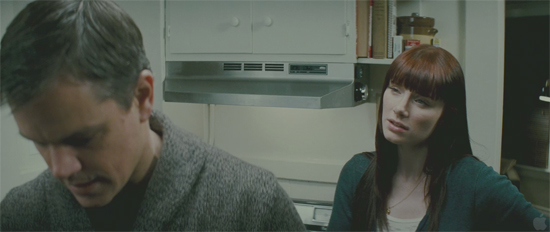
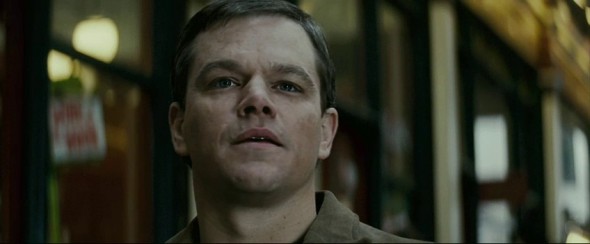
George Lonegan (Matt Damon) wears gloves. Childhood circumstances and medical complications damn near killed him and left him handicapped—all he need do is touch someone, "make a connection," and he is jerked back to an old haunt, the "white corridor" of light that is the foyer of Death. He's been there before, many times, but the touch of an individual's hand takes him to the spirits of the recently deceased of that particular person's past, so that he may pass on their thoughts to those left behind. He wears gloves, so he can avoid these encounters. But he can't avoid the grieving. He used to be a working psychic, ("Look, I don't even DO that anymore." he consistently tells the persistently bereaved*), but he gave it up, despite the imploring of his exploitative brother, Billy (Jay Mohr, toned down and playing a recognizable human being). "You've got a gift!" he is told.  "It's not a gift!  It's a curse!" Now he works, driving forklift at a sugar warehouse in San Francisco, a "normal" occupation that might lead to a "normal" life. That is his wish. Life, not Death.
My psychic friend's story is highly reminiscent of Lonegan's (nice name, that) in Hereafter, Clint Eastwood's film of an original screenplay by The Queen scribe Peter Morgan. Morgan's subjects are fairly factual, so it's surprising to see him venture into the nether-territory of Bruce Joel Rubin (Jacob's Ladder, Ghost).  
But, he places it in the here and now, our world where Death can come specifically from all realms, natural and unnatural. The film begins with a spectacular effects sequence recalling the horrific tsunami in Thailand,** that viscerally places the audience into such a disaster.  But that is only the beginning. It is what comes after—the surviving of such an extreme occurrence, the coming back from it—that is the subject of the film. How, after Death has touched us, can we go back to a normal life...when what awaits us, normally, is our own ending? How can we live while still grieving?
I called them "The Death Tapes." I have no idea who has them now, I passed all the copies I had to friends who were interested (and who isn't?). I did a recording session that was being used for publicity purposes for a fairly terrible Joel Schumacher pot-boiler called Flatliners, about morbid medical students experimenting with near-death experiences—it is typical hyperventilating Hollywood exploitation—all chases and races-against-time, whereas this Morgan-Eastwood film is intriguingly commonplace. The interviewees were all people who had had NDE's;  they'd died, and were pulled back to the land of the living. They were from all walks of life—one woman had been electrocuted in a television studio, another was a Vietnam vet who'd been mortally wounded in a mortar attack. The particulars of how they'd gotten there were all different, but their itineraries were all the same. They'd gone to a corridor of pure white light, where they were met with spirits of their past, and informed, questioned about their circumstances and released back, back to life. They'd all been significantly changed by their experiences, but in different ways, as Death was no longer the  terrifying unknowable it had once been. Been there. Done that. The woman had been yanked back through no choice of her own, through the efforts of EMT's in the studio. The soldier had volunteered to come back, in a way. Asked in that blinding corridor if there was any reason for him to go back, he implored the Voice,  "I want to see my son!" which is significant for the detail—he knew his wife was pregnant, but there was no way to know the sex of the child in those years before ultra-sound (Sure, it was a 50/50 chance, but...still...). An expert (as much as one still breathing can be of such things) talked about children who'd gone through "the process" and other adults, speculating that, perhaps, it could be some spasming electrical processes of self-preservation. But the stories were so similar—the same corridor, the after-life "concierge," the specifically relevant memories of the deceased (and not the living—would a brain going through synaptic anarchy be so choosy?)—combine that with the myths of "pearly gates" and exit-interviews with St. Peter, and it becomes disquietingly consistent. Yes, we have the same meat in our brains, but chemically, we all have our own brand of soup. So, then, would everybody see it the same way? Don't know. And we won't know. Not until we "see the light."
The people left behind—in both senses of the experience—(Richard Kind, Bryce Dallas Howardshe's a brunette, this timeFrankie McLaren, Cécile De France) are changed by the brush with death, but they all have the same goal—a "normal" life, or what passes for normal given the knowledge of extinction. But as that is something that unites us all, players and audience alike, isn't that "normal?"
It all sounds terribly depressing, doesn't it? But it isn't. There are moments of high drama to be sure, but moments of levity, as well. Rather than a dark and morose drama befitting the Hallowe'en season, it ultimately has the feeling more of a star-crossed romance. And Eastwood, who has been known to denature the color palette of his pictures, particularly in Letters from Iwo Jima and Changeling, returns to a more vivid color scheme here, as if to present life in all the glories of luminous sunrises and sunsets. Those looking for a spook-show, like the poor, unsure desperates who crowd the emporiums of the medium/charlatans in the film, should look elsewhere for signs of the occult, or speculation about what it all means.
Eastwood's movie gives us no definitive answers—Hereafter never crosses the threshold into Shakespeare's "undiscovered country," that final frontier we must all travel, the journey of the spirit taking flight unbound by the physical restraints of life, our mortal coil. It remains solidly in the realm of the comfortingly tactile, and concludes with a smile, a touch—simple, normal acts of being, that stave off the nullifying black and the welcoming light.

* The script by Morgan (The Queen, Frost/Nixon, The Damned United, The Last King of Scotland) is extraordinarily precise in its use of words...in English and French (there are subtitles...Eastwood, who directed the all-Japanese Letters from Iwo Jima isn't afraid of them), and quickly you pick up that, more than usual, he uses specific ones, over and over, that tie his characters together...almost like they were a mantra.

** This sequence is exploited in the trailers and advertising for the movie, making it seem like it's a 2012 disaster-like "entertainment."  But, if I can be allowed a SPOILER-like caution, don't be fooled. This sequence...and another jolting one that recalls an arbitrary terrorist attack...are merely means to an end. The story is about recovery of such incidents, and in living a life of hope, despite the common glimpses through the opening of Death's Door.
 
Eastwood's version of the Thailand tsunami is the stuff of nightmares

Thursday, June 16, 2022

Jurassic World: Dominion

It Comes Down to Animating Old Fossils
or
"It's Always Darkest Just Before Eternal Nothingness..."
 
Oh, they have been hyping Jurassic World: Dominion to the point where one doesn't have to see the movie to feel harassed by dinosaurs. There's a glut of advertising tie-ins, a "look-back" television special (which I admit I watched), and I'm sure there's a breakfast cereal ready to hit shelves ("T-Chex!").
 
If there is, I'm sure it will be rather stale.
 
This is the sixth "Jurassic Park" film in the franchise, the third in the "Jurassic World" sub-set, which, when written and published by Michael Crichton, seemed like the flimsiest of his high concept novels. The whole thing started as a 1983 screenplay about a lone geneticist creating a dinosaur with disastrous Frankensteinian results. But, Crichton couldn't crack the reason "why" a geneticist would do such a thing. He decided that the only reason to do it would be for entertainment purposes, so he spliced Americans' fascination with theme parks* with kids' fascination with dinosaurs, and (of course!) the thing was a massive best-seller. 
 
And a hit movie; Universal Pictures only agreed to Steven Spielberg's passion project Schindler's List (which they "knew" would not make money) if he first agreed to make Jurassic Park (which they knew would), and both films garnered the studio tons of money and awards. Spielberg even waived his own rule to not make sequels when he directed The Lost World years later. He is an Executive Producer on all the films.
But, that's all pre-history. What's this one about? Well, it's all about ecological catastrophe. The filmmakers have brought back the character of Lewis Dodgson (now played by
Campbell Scott), head of the rival genetics company BioSyn who has hired geneticist Dr. Wu (BD Wong again), who has engineered a super locust that decimate crops that are not grown with BioSyn seeds, thus cornering the market on food production and threatening a world shortage unless his products are not used. The Jurassic Park island of Isla Nublar was destroyed due to volcanic eruptions, but Lost World's Isla Sorna (or "Site B"), where the engineering work was done is still a preserve for some of the creatures. Dinosaurs are now migrating throughout the Earth, which would seem like a big deal. Raptor whisperer Owen Grady (Chris Pratt) and Claire Dearing (Bryce Dallas Howard) live in the Sierra Nevada Mountains, carrying for Maisie Lockwood (Isabella Sermon), the cloned daughter of an InGen executive. The surviving member of three trained raptors, Blue, is also living in the Sierra Nevadas.
 
Got all that?
BioSyn has been very busy, not just planning a world food crisis, but also trying to track Maisie and Blue's child Beta (wait, I didn't say that Blue reproduced?) to bring back to their Alpian HQ for study. Meanwhile, there seems to be a black market for capturing the animals—something that Dearing is involved in trying to stop. That's when Ellie Sattler (Laura Dern) starts to become interested in those locusts and their ties with BioSyn. She recruits Alan Grant (Sam Neill), who is always glad to see her, for a little tour of the BioSyn plant to see what's going on. And guess who's working for BioSyn now: chaos theorist Ian Malcolm (Jeff Goldblum)!
Meanwhile, back at the ranch, Grady and Dearing discover that Maisie and Beta have been clone-napped by BioSyn and they set off to get them back, using contacts from the CIA. They track them to Malta—where there is evidently a big black-market—and meet up with a pilot Kayla Watts (
DeWanda Wise), who had seen Maisie being transferred to a flight to Italy. So...everybody's going to the same place!
So...everybody's going to the same place and there will be dinosaurs there. You can guess the rest of the movie. Dinosaurs and humans do not mix unless it's in a dinosaurs stomach, so there's going to be a lot of threatened mastication going on. And a lot of running and hiding, and even more distracting dinosaurs with flares. In fact, there are so many of those, they could have just done it in one instance with a single J.J. Abrams movie
But, except for running around and hiding from dinosaurs, that's the rest of movie. The entire set-up has been explained and there's really nothing left to do. The trouble is the movie is set up like a bad Bond movie with a minimum of plot that merely threads action sequences. And, unfortunately, the stunt coordinator and second unit director is Dan Bradley (he's not listed in the movie on IMDB but his name is in the credits), who scurries through action sequences with quick shots that they barely register.
How's the cast? Well, Dern, Howard, and Goldblum do the best work—they also have the best lines—and Wise does some nicely laconic work as an Indiana Jones type. But, Pratt seems slightly disengaged as if he was thinking about the next project he's doing. And Neill is always a welcome presence, but his character has relatively little to do, so he goes in for that Harrison Ford-style mugging that was done in Return of the Jedi, just so he's got something to do.
But, the main attraction for the movie is usually the dinosaurs—and with the characters going by the numbers in this one, they have to be—and even there, this movie isn't all that impressive. Oh, the CGI wizardry has advanced so far from its origins in the original that you can practically see a brontosaurus' uvula for all the detail they put into it now. But, the CGI versions have less credibility than the puppets and animatronics—although a couple of triceratops babies look a little dodgy, too. There is no sense of wonder anymore, or sense of awe, especially as the 'saurs are moving so fast that they have less sense of mass...or threat.
As a result,
Michael Giacchino's score has very few places for John Williams' celebratory, awe-filled theme for Jurassic Park—just a couple of snippets here and there—and that tells you all you need to know about the movie: fast and transitory, not pausing enough to take anything in, or dwell on it. The ideas have all been mined, so it just jumps from danger sequence to danger sequence.
Perhaps it's time to take a break, not make any of these for awhile, and, in the meantime, take some of Michael Crichton's DNA and recreate him, just so we can get some new ideas. 


A sequence that was supposed to open Jurassic Park: Dominion but was cut for time.
Do you think anybody would be interested in a Director's Cut?
 
* Crichton had used the same theme of parks in his directorial debut, Westworld

Wednesday, November 13, 2019

Terminator Salvation

Written at the time of the film's release...as one can tell. I've written about the first two Terminator movies, and the last one Terminator: Genysis, and tomorrow (God willing and I don't get spiked by a T-1000), we'll post about Terminator: Dark Fate

"MOVE ON. (CYB)ORG"

"Everyone deserves a second chance," is the lesson of Terminator Salvation.

They didn't, however, say anything about a fourth.The Terminator, of course, was the first low-budget, high-concept success of James Cameron. It launched Cameron's career, and made a star of Arnold Schwarzenegger. The sequel—Terminator 2: Judgment Day was an amazing recapitulation and expansion of themes, offered amazing stunt-work, cutting edge computer effects and was, if anything, even more entertaining than the first film. At the time, the most expensive film ever made, it still managed to make a healthy profit for its makers.You couldn't kill these Terminator things.

But while Cameron expanded his horizons and Schwarzenegger became a super-star, no more "Terminator" movies were made. Cameron seemed no longer interested (although he and Schwarzenegger teamed up for the clunky spy flick True Lies).

I didn't see Terminator 3: Rise of the Machines (which featured Schwarzenegger's final Termination before launching his political career), but the current one is helmed by the worst director extant—McG—who, like a lot of today's directors would be hard-pressed to direct a movie if his camera couldn't move, and whose "Charlie's Angels" movies were not-very-funny bimbo-fications that barely held together (actually they didn't hold together). Surprisingly, he manages to maintain a fairly straight tone for this fourth "Terminator" film, which focuses on the humans' battles against Skynet with an adult John Connor (Christian Bale).
Terminator Salvation. They should have called it "Terminator Salvage," as most of the good ideas have been used and are recycled into a feature length version of every visualization of those battles (complete with requisite skull-crushing underfoot) seen in the previous films.*
But, look at the cast, like Cameron's original design a mix of A-list and B-movie actors: Bale,** Michael Ironside, Bryce Dallas Howard, Anton Yelchin (the new "Star Trek" Chekhov plays a teen-age Kyle Reese, the character originally played by Michael Biehn), even Jane Alexander and Helena Bonham Carter (in a brief but effectively creepy role). Also Sam Worthington—who started filming James Cameron's Avatar awhile ago (quite awhile ago).
Wish they had something better to do. The plot is a demolition derby of past "Terminator" hits mixed with The Road Warrior and a "Transformers" movie. One expected to see Hasbro in the producing credits, as the only thing new in this are toy-exploitable "Terminator" creations: Terminator motorcycles, mighty-morphin' prison ships with separate pilots (why would robot-ships need pilots?), and underwater T's, I guess you could call them "Termi-gators." Plus, there's an older model that makes a computer-generated "guest" appearance. There's some plot-holes you could transport T-800's through over why some things, like explosions, will bring on Skynet attention, but a major fire-fight (with flares) amongst humans does not. And for all the technical wizardry on display, you can see the cinematic seams showing when cutting away from a post-apocalyptic setting to the green-screened CG expansion.
Things blow up "real good," the usual things are not what they seem, and, as per usual, the whole thing climaxes in a claustrophobic industrial setting.*** It's the same elements as before, just re-assembled in another order...if that. An entirely superfluous "further adventure" is hinted at, but one hopes they don't bother and just scrap this franchise.
James Cameron has moved on—to Titanic and the upcoming Avatar. And Arnold Schwarzenegger has moved on, as well.

Maybe we should, too.


* Well, you could say the original was recycled, as well. A court ordered that a sum be paid and that acknowledgement be made to Harlan Ellison as "Terminator" more than resembled his "Outer Limits" episodes "Soldier" and "Demon with a Glass Hand." I didn't see him mentioned in the credits for this movie. Hopefully, he saw some cash (Come to think of it, I didn't see Cameron's name, either).

"Salvation" does introduce a new angle to its franchise—but it, too, is a well-worn cliche of science fiction and super-hero magazines.

** Bale uses a variation of his deep-Batman voice throughout, which I thought was just an affectation when I realized that Michael Ironside—and practically everybody—is talking in a husky rasp.

*** After 30 minutes, I began thinking "Hey! Where's the requisite beating-up of dirt-bags?"
Patience, patience...it showed up half an hour later.

Tuesday, June 25, 2019

Rocketman (2019)

Elton! John! The! Musical! (Gooooo-tta Shop!)
or
...Burnin' Out of His Fuse Up Here Alone (And I Think It's Gonna Be a Long, Long Time).

A couple years ago, I saw a PBS documentary (co-produced by the BBC, it turns out), "The American Epic Sessions" about a recording project that would serve as a cornerstone on a documentary series about the historical recordings made of roots music during the 1920's. The plan was to reconstruct the original electrical recorder (making recordings on wax records) that was powered by a 100 pound counterweight that would allow for a 3 1/2 minute song before it hit the ground and stopped the recording. Such a device allowed the documenting of music in places off the grid at that time. Songs were played live in one take...because that's what they had. No sweetening, no overdubs. Pure performance.

That's a lot of back-story for the purpose of bringing it up. One of the participants in the project was Elton John (Sir Elton John), who sauntered into where the sessions were being done—Vox Studios in Los Angeles—looked over the reconstructed contraption, until his longtime lyricist Bernie Taupin walked in with a couple sheets of paper, on which he'd written lyrics. The two talked a bit, and Sir Elton sat at the piano and wrote the song ("Two Fingers of Whiskey") right in front over your eyes, the melody coming out almost instinctually. Once he did a run-through of the complete song—that he'd just composed—they did the one "take" and it was done. It was jaw-dropping. I've seen composers compose on the spot before, specifically Paul McCartney, but the result was underwhelming, a throwaway. The Elton John song was GOOD.

I bring this up because in the Elton John bio-pic, Rocketman, you'll see a lot of scenes about his savant-like musical abilities, and even though the film has the cheeky tag-line "Based on a True Fantasy," those abilities are absolutely true.
Rocketman—directed by Dexter Fletcher (the same guy who started the Queen-based Bohemian Rhapsody project, was replaced by Bryan Singer, then finished the film when Singer was fired)—has all the same earmarks as that earlier film: misunderstood youth, nascent talent, professional fame, personal demons, nothing exceeds like success, descent into narcissistic self-destruction, epiphany, personal triumph. It's just that this one is a bit more true. There's no ginned-up drama (although timeline liberties are taken for dramatic effect) and the movie shifts time and reality to include set-pieces that feel like show-stopping production numbers that comment on his life and serve as emotional touchstones throughout the film. John was rarely a navel-gazing singer-songwriter (seeing as his contribution was primarily melodic, Bernie Taupin did the lyrics), yet the choice of songs turn his songbook into an auto-biography of sorts if you switch them around deftly as they do here. It's actually amazing how well his work slots into the story and fleshes out the narrative.
"I know how this goes..." So do we all.
The film starts with Elton bursting dramatically into an AA meeting, wearing an elaborate devil costume.* Everybody else looks like your run-of-the-mill addict, but he stands out...well...like the devil, and one of the conceits of the film is that costume will start going away as he decreases his own inner demons. 
"I know how this goes," he grouses, as he bitterly addresses the proctor and the others in the circle. "I am Elton Hercules John. I'm an alcoholic, drug addict, sex addict, shopaholic..." and sails into flashback—to "The Bitch is Back"—as young nerdy Reginald Dwight, product of a dysfunctional home, finds his inspiration in music, partially inspired by his father's slavish devotion to music, but also to his natural gifts of being a musical savant—Reg' can hear a tune and immediately pick it up on the piano through a combination of eidetic memory and perfect pitch. These abilities lead him to the Royal Academy of Music, and the pursuit of a career as a keyboardist.
The film is not slavish to accuracy—10 year old Reg' plays a local pub and launches into "Saturday Night's Alright for Fighting" (which he didn't put to disc until 1973). But, it's what the filmmakers do with it that's fun; the young Reg' starts to sing, then leaves the keyboard, weaving through the rowdy activities ensuing, then bursts through the pub walls to the street outside as an adult Elton propels himself onto the night-time Pinner, Middlesex streets—including a carnival—jiving through a choreographed dancing crowd, singing and prancing the whole way. It's a great sequence, even if the basis behind it takes liberties. At least, they're playing with the material and not playing with the truth (as was the case with Bohemian Rhapsody).
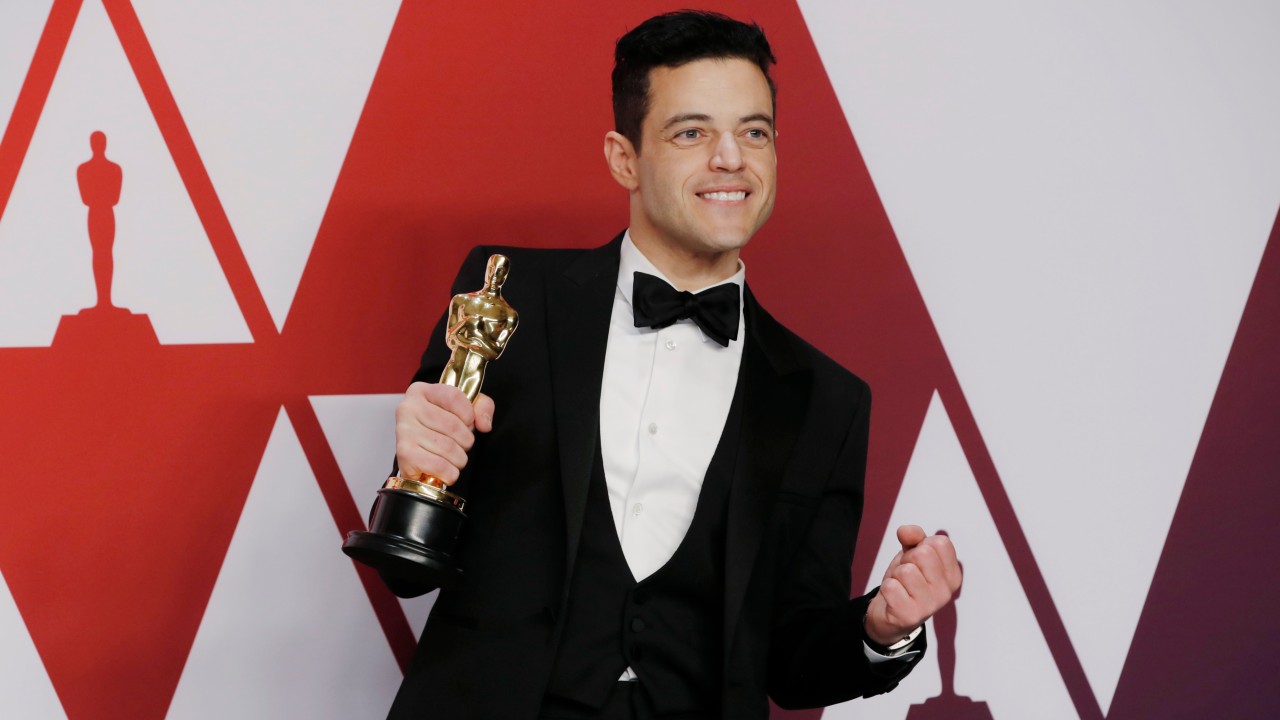
Time to bring up the film's best asset—Taron Egerton as the adult Elton. Egerton, as you may recall, played the character of "Eggsy" in the Kingsmen films and he has a nice, edgy brio in those, even if the films aren't that good—he is. And one must say it's a good thing Rami Malek got his Oscar before Egerton's Elton showed, as the actor is amazing, bringing to the role a verve that reminds one of the young Jimmy Cagney. Malek did a good imitation, but Egerton's is a performance, showing the duality of the man and the entertainer he must become when on-stage. That's a complex tight-rope to walk, much less dance around on it and Egerton throws everything he has at it. And he does his own singing (although he's helped a bit by the music being mixed a little high to drown out the vocals lest we compare too critically). Still, he's a good match, both as Reginald Dwight and the Artist Known as Elton John.
It makes it a bit of a one-man show, although Jamie Bell makes for a good Bernie Taupin,"voice of reason." Richard Madden plays his manager-lover, John Reid** with the intention of being hissable from his first appearance, but it seems you have to have villains in these things, and the "money-men" ill-picked by the stars fill the bill, so he telegraphs the job very well. What is surprising is the actress playing Mother Dwight. Bruce Dallas Howard has played unsympathetic characters before, and she does so with the cold intensity of a surgeon, with no remorse and no signs of wavering. Her depiction of Sheila Eileen Dwight Farebrother is a relentlessly self-absorbed harridan who, once she got safely into her gyroshphere, would lock the door, leaving any expendable dino-researcher to be torn apart by a rampaging T-rex.

Or, am I confusing things here? Anyway, Howard is surprising enough in the role that I spent too much time wondering where I'd seen her before.
It is an enjoyable—albeit predictable—breakdown of life for Elton, burning out his fuse on-stage alone, or—as Rolling Stone's Peter Travers brilliantly put it a " portrait of the artist as a young mess." Just so. The story of the roller-coaster rock-star lifestyle is probably familiar to anyone who's been a fan of anyone caught in the klieg-lights, it follows the same pattern as any addict, just without the abundant opportunity and being set to music. Chopin and Berlioz did opium, but we probably won't see their story any time soon. We'll probably see the same story-line when the David Bowie bio-pic comes out (starring Kodi Smit-McPhee, maybe?)
In a scene while youngish Elton is a keyboardist for a blues band, the lead singer tells him "You gotta kill the person you were born to be to become the person you want to be" (it's in the trailer). Elton doesn't so much kill the young Reg Dwight as disguise him, burying him in elaborate costumes that highlight and distract, in ever more extreme theatricality, from the reality of who he is in favor of the act. He's hiding from himself, and the epiphany of the film is so "on the nose" it risks chortles rather than mystification. But, Egerton sells it in his performance—needy, flashy, schizy—making the movie a go-for-broke triumph, even in its most saccharine moments.

At any meter, it's a rather brave act (even if generating a lot of revenue) to executive produce a movie that grinds axes and doesn't spare the grinder on the kickback, as John has. The fear and self-loathing, reverse narcissism, and petulance are all there on display. The survival of it and openness about it are to be applauded. There's healing there. Bravo, sir. 

* Bob Mackie is credited for the Elton John costumes—the man may win an Oscar for copying his own stuff.

** It's a little bit funny, though.  Reid is also portrayed in Bohemian Rhapsody by Aiden Gillen, and the two re[presentations couldn't be further apart, despite being influenced by the same director. In BR, Reid is portrayed as competent, but sympathetically, being tossed out of a car by Freddie Mercury. In Rocketman, he's portrayed as an oily, manipulative slime-weasel, basically the villain of the piece (much like Allen Leech's Paul Prenter is in BR), the gay manipulator who screws the star both biblically and financially. Does two such instances in the movies count as a vicious stereotype...or just easy shorthand for audiences who don't want things complicated?


Some personal favorite Elton songs-beyond the hits
Aw, hell...one more song...tear it up...

This would seem appropriate-always loved this song. Very noir.
Oh, man. And this...so much this. 
This was a shock for an opening track, and the whole double album holds up to it