Showing posts with label Sam Worthington. Show all posts

Friday, July 5, 2024

Horizon: An American Saga - Chapter 1

Costner's Folly, Chapter 2 ("Nobody Knows Anything")
or
Going For the Fences
 
You've got to hand it to Kevin Costner. He takes chances. He's parlayed his television success on "Yellowstone" to make a movie he's been dreaming of for a couple of decades, in times both fallow and flush, cast it with a steady stream of great character actors who've never passed onto the A-list, split it into two chapters (although hopefully there will be more) and released the first one—in which various story-lines do not intersect—as a 3-hour set-up...the sum of which would spell box-office poison to a movie-going audience that wants its product pre-digested and easily grasped like fast-food.
 
And who can blame him? He's done it before. When he was making it, Dances with Wolves was being derided as "Costner's Folly" for making a Western when they weren't fashionable, for it's extensive location shooting, for the supposed grandiosity of writing, directing, producing and starring in it, for it's planned use of sub-titles, and for its cost overruns. 
 
But, as William Goldman wrote, nobody in Hollywood knows anything. Dances with Wolves became a box-office smash, its elegaic, and unconventionally seditious, story becoming a hit with audiences and garnering the Best Picture Oscar, beating out Goodfellas (which some may argue was a mistake, but, to my mind, really wasn't).
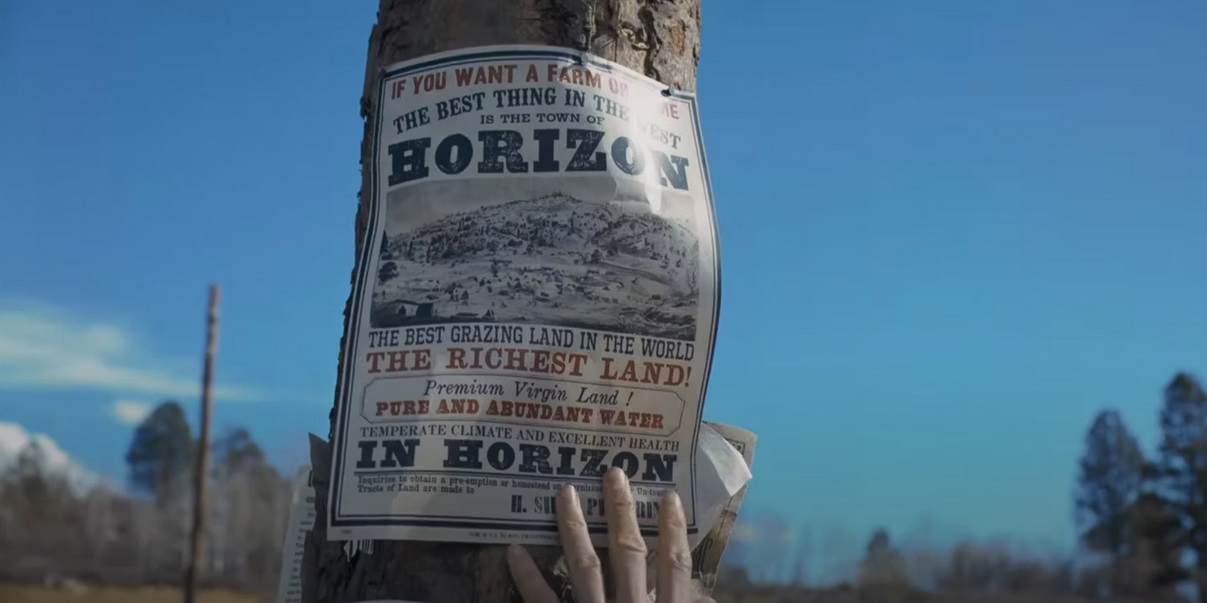
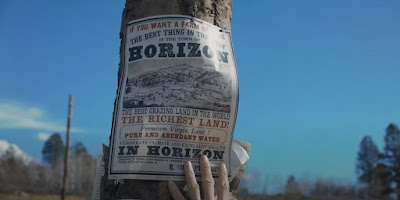
So, here's "Coster's Folly" Chapter Two, the ungainly titled Horizon: An American Saga - Chapter 1
, with a story by Mark Kasdan (who co-wrote Silverado, a favorite of mine), Costner and Jon Baird, photographed by J. Michael Muro, who shot Costner's lovely Open Range.
 
And it's great. Simply great.
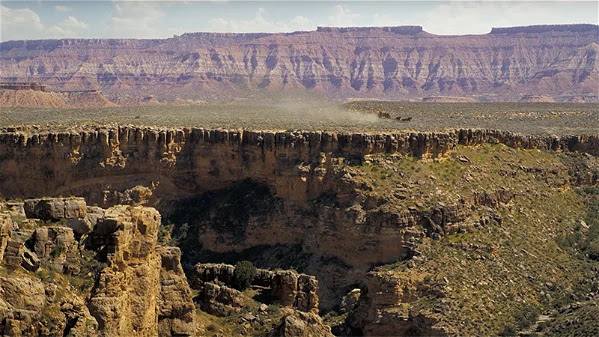
For a 3-hour movie, it sails right by, packed to the sprockets with detail, period and story-wise, never seeming to waste a frame in telling three...four? five?...stories about a plot of land in the San Pedro Valley in the American west that may—or may not —be available for homesteading, and the people who are attracted to the promise of it (whether it is true or not) and the people already living there who take it for what it is. 
 
There are the first white settlers, there to survey and parcel, but as they're alone in the wilderness and, unbeknownst to them, surveying Apache hunting grounds, they soon fall victim to a war party. Their graves are the first semi-permanent structures of Horizon. They won't be the last.
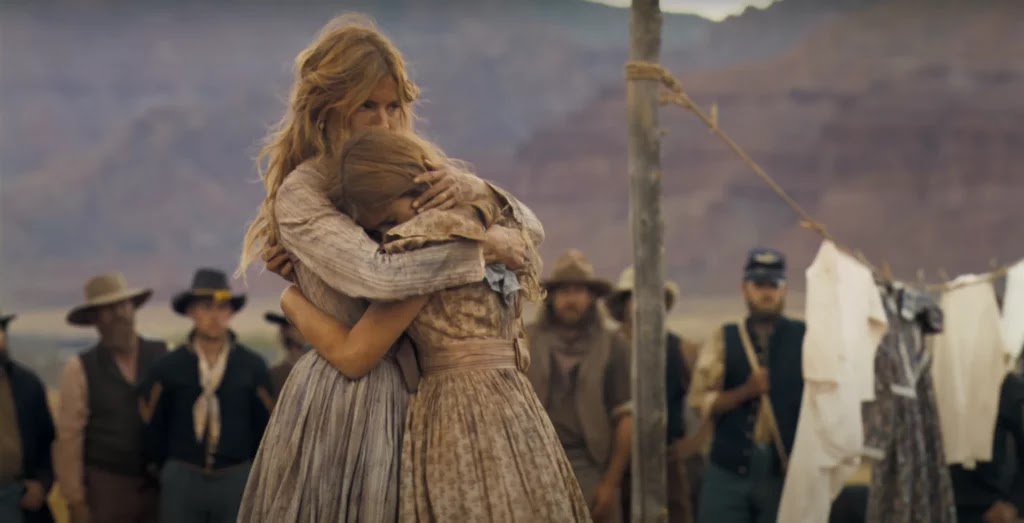
But, the pattern will remain the same. By 1863, there is a well-established colony on the site, across the river from those three original graves. They, too, are attacked by Apache, leaving a limited number of survivors: some, like Frances Kittridge (
Sienna Miller) and her daughter, Elizabeth (Georgia MacPhail) will take shelter at nearby Fort Gallant; others, like the boy who rode to the fort to get help, Russell (Etienne Kellici) form a hunting party to track down the Apache who burned down the encampment.
That attack has caused a dispute between the leader of the war party, Pionsenay (
Owen Crow Shoe) and the leader Tuayeseh (Gregory Cruz), resulting in the younger man splitting from the tribe, taking one of Tuayeseh's sons with him. 
In Montana, James Sykes (
Charles Halford) is shot by Lucy (Jena Malone), who takes her son David and flees for the Wyoming territory. Sykes' sons Junior (Jon Beavers) and Caleb (Jamie Campbell Bower) are sent to find her and the child. They catch up with her where she now goes by the name Ellen, married to hopeful lands-trader Walter Childs and living with a local prostitute Marybelle (Abbey Lee). When the Sykes boys show up, there is a confrontation between the vicious Caleb and saddle-tramp Hayes Ellison (Costner), a potential customer of Marybelle's. She and Hayes and the child escape town to avoid repercussions of the murder.
Also heading for Horizon is a wagon train, moving along the Santa Fe Trail, under the auspices of Matthew Van Weyden (
Luke Wilson), who is having trouble keeping the eclectic group of settlers (including a naive British couple and the family of Frances Kittridge's late husband) of the mind that, although they may be headed for a paradise, they're not there yet, and water and team-spirit are in short supply in a desert.
In the mix are interesting characters, like the leaders of the Army detachment at Ft. Gallant, who are straight out of John Ford's Cavalry films: Lt. Trent Gephart
(Sam Worthington, the most effective performance I've seen of his), who's a pragmatic soldier and would just as soon have settlers somewhere else and the "indigenous" (as he calls them) left to their land to keep the peace, a sentiment acknowledged but considered historically unrealistic by Gallant's leader, Col. Albert Houghton (Danny Huston) and his sergeant major, Thomas Riordan (Michael Rooker, in a slightly less garrulous version of the parts Victor McLaglan played in Ford films). One likes these people and you get the feeling everybody's doing the best they can under the conditions and the inevitability of time.
That's a novel's worth of people and a lot of stories and one suspects everybody's going to converge in Horizon (the town itself will probably end up being the focus of the series), their characters already established and with ensuing complications in the offing—Costner has previews of the next chapter at the end of this one and my appetite for it is whetted.
Despite the obvious nods towards Ford, Horizon: an American Saga, so far, feels more in the vein of the sprawling How the West was Won, but, in character, more like "Lonesome Dove", where individuals weave in and out of the fabric of the narrative, and sometimes—as in life—are never to be seen again in an indifferent Universe, lost in the stream of History. Costner may love his Westerns, but he acknowledges there's less romanticism to it when the survival rate hovers around 50%.
It was in Ford's film The Man Who Shot Liberty Valance, where a reporter states "This is the West, sir. When the legend becomes fact, print the legend." Ford's career peeled back veneers of western legend varnish in his films and in his later work stripped off more layers of his own earlier myth-making. Costner goes even farther, taking into account the grubbier myths of Leone and Peckinpah (and Eastwood) with his hard-scrabble porous towns in need of light and cleaning and extermination. He goes a step further by putting back all the practicalities of the settler experience that Ford cut out—the burying of the dead, the scarcity of water, the bugs and critters, the difficulty of killing a man with ball-shot, the necessity of self-sustainment by farming, the ritual of hard work, more important community matters than tea-dances and ceremonies.
If there's anything more to wish for, for me, it would be that there's more of it (despite others quibbling about length). A couple transition sequences seem to have been excised just to speed things along that might not have added much but may have smoothed a passage of time.
It's still early days, but one gets the sense that Costner will be making a point that the beauty of the West that we admire may not be just a matter of the dirt and stone carved by time and tide but also foundationed by the bones of those who walked before us. 

Tuesday, February 27, 2024

Superman Returns

While doing work on The B/C-L Index—you are using it, aren't you?—I come across reviews that haven't been thrown on here. This one is an oddity. It's the first movie review I wrote after a long time of just letting movies rattle around in my head. It's rough with way Too Much Information about my personal life for me to be comfortable with it, and too much "What I Had for Dinner"-type information that just seems irrelevant to the subject at hand (that being the movie). Still, it was an interesting read (for me, at least). If I haven't improved since then, I've at least learned to stay more on track...which for a blog about movies is important.

You'll Believe a Man Can Float

Driving home from Superman Returns in 4-story IMAX and 3-freepin'-D on Wednesday night, I was listening to KIRO Newsradio. Thousands were evacuating, fearing the cresting of the Delaware River. Andrea Yates was convicted (again) of killing her kids. A public official was lost in the Olympic Forest.

"Man!" I thought. "We could really use Superman."

I knew I needed him. It had been a rough week of moving furniture and hauling myself from The Island to The Redmond. I was swamped at work and I had to take Tuesday off for the transfer of our big stuff from The Place What We're Selling to the current domicile, so my Wednesday started at 4 am (just in time for the sunrise) to get started early on due assignments. After all this, I was looking forward to seeing friends I hadn't seen...in ages, and seeing the new "Superman movie". I was really looking forward to that. I've been pretty discouraged lately, and a new Superman movie...well, that seemed just the ticket. The previews for it were great.
So, how is it?

Good! Not as good as
Superman: The Movie. Better than Superman II (which I've never liked) and it's Shakespeare compared to the moronic Superman III: Wasting Richard Pryor and the incompetent Superman IV: The Quest for Peace ("You'll Believe a Movie Can Stink to Highest Heaven!").
But everyone will be comparing it to the first one. As well they should. Superman Returns should be called "Son of Superman" (*ahem* cough!) as it's so closely tied to the first film. It recycles 
Marlon Brando as Father Jor-El, and recycles whole sections of the first film's Mario Puzo/Robert Benton/David Newman/Tom Mankiewicz script, including my favorite Lex Luthor line: "My father always told me..." "Get out!"
But, Superman: The Movie was really three films: The deadly earnest Krypton section ("This is no fantasy" intoned Brando at the beginning); the equally serious Smallville/Fortress of Solitude section (with 
Glenn Ford's last great performance, and a farewell to Ma Kent scene in a seemingly endless epic wheat field); and finally, the Metropolis movie, with its antic screwball comedy pace (brilliantly achieved, by the way), it's cartoonish villains ("Otis-burg? O-TIS-BURG???!!!") with their absurdly successful attempts at stealing nuclear missiles, and at its soul the "Superman Meets Girl" romantic comedy story-line. I've always felt that lurching shift in tone was a bit out of step with the rest of the film (though you could make a case for showing that stalwart Superman is needed in such a crazy, zany world). Now, I'm not so sure. Because Superman Returns keeps the earnest tone of the first couple sections of the original throughout its considerable length. More cohesive it may be, but it's not more entertaining. In fact, it tends to bog down the proceedings, which consists of "regrets and things unsaid" which would have made Richard Donner's His Girl Friday pacing inappropriate. Which only points out how large the gulf is between that first film and this one.
Donner's Superman was a frothy entertainment, that, in the days of disco, long sideburns, and flaired pants, winked at the concept of heroics. This one is heavier, darker, meaner and less entertaining. There's less joy to it. And it takes its heroes deadly seriously. You think a guy like Spider-man has great power, thus great responsibility? Hell! Try being "Superman!"
Donner's flying scenes in the first (with a lot of credit going to licensed pilot 
Christopher Reeve) showed the joy of flight--the freedom of it--the grace. Who wouldn't want to fly after "Superman?" "SR's" flights are rarely graceful, and powered by stress. This Superman is always in a hurry. He doesn't stop to smell the up-drafts or do a lazy roll through the clouds. He's making a bee-line from one emergency to another. There's another quality to the SR aerial scenes--isolation. Superman is often seen as a small speck in a big, empty sky with life going on far below him. He's not a part of this Earth, and Singer drives the point home again and again. It's no fun being Superman.
I'll bet audiences have a problem with that: if they were Superman, of course, they'd enjoy it. It brings to mind the Superman scene I'd like to see. Howard Chaykin, of "American Flagg!" comics fame said in an interview how he'd like to start off a Superman comic. Lots of panels of ordinary Metropolitans going about their day only to have them interrupted by a blue-red streak going by their window.
BOOM! Another about to sip his coffee. BOOM! A couple more of those until you get to the "splash" page: Superman, over the ocean, wearing a pair of shades, and popping his fingers, listening to "I Believe in You" (from "How to Succeed in Business (Without Really Trying)) on his Walkman. "You have the cool, clear eyes /of a seeker of wisdom and truth."

Yeah. I'd love to see that Superman.

But despite Returns' seriousness, there are joys.
Brandon Routh looks and sounds so much like Christopher Reeve that it doesn't take a big leap (or a single bound) to accept him in the role. He exhibits a bit more life as Clark Kent than the more stalwart Superman, breaking into a goofy grin at the slightest provocation, and restraining the klutz routine (he doesn't constantly punch up his glasses the way Reeves' CK did). I also like the fact that his performance doesn't have the same "I'm sharing a joke with the audience" quality that Reeve brought to the role. Kate Bosworth is damned cute as Lois Lane** (as a blonde, she barely registers on the screen, but here, her hair darkened brown, she seems to have a bit more depth) and has little of the Margot Kidder neuroticism and (here's a plus!) I don't remember hearing her scream once. I do miss Kidder's whiskey baritone cracking on "Clark!," however.
There could be a bit more life to Frank Langella's Perry White and Kevin Spacey's Lex Luthor. Spacey's Luthor is self-contained malice and only sparks to life during a confrontation scene with Lois. Gene Hackman expertly tred the mine-field of jokes in the first film, but it was tough to buy him as a real threat to anybody but his cronies. Spacey's Luthor is a villain who does bad things...and enjoys doing bad things. Unfortunately, here, you mostly see him prepare to do bad things, and so there's no real pay-off for the character until 2/3 of the way through the film.
There is one cracker-jack sequence involving a doomed airliner that shows that it's pretty darned hard task to stop a plane in free-fall. It's note-perfect, right down to showing the skin of the craft buckling from a lurching halt. The movie has a good bead on the concept of heroism, too. There are a lot of heroics in this film (not just from der Ubermensch) where people who could take the easy way out, go against their better judgement and do What Must Be Done, despite the jeopardy it may put them in. It makes a statement that heroism doesn't come from powers and abilities far beyond those of mortal men. It comes from the heart, the conscience and the will.

Good movie/bad movie? Thumbs up/Thumbs down? Hard to say at this point. There are some movies that are merely okay while you suffer through them, but are better in memory (Napoleon Dynamite is one of those films: I can laugh at parts of it in retrospect, but I'd have to be kidnapped and a gun placed to my skull to watch it again***). Superman Returns was just the opposite: enjoyable while sitting through it (though I was aware of just how long it was, I didn't quite get to the point of checking the time), but the farther I get from it, I remember what's wrong with it more than what was right. If I had my "druthers," Superman Returns would be lighter than the Batman Begins, the "X-men" films, Spider-man, certainly lighter than Ang Lee's Hulk. At least it wasn't as frivolous as the Fantastic Four. My opinion of it is evolving, and that brings up another issue.
I've noticed an interesting trend in on-line reviews over the weekend. Initially, they're scathing, criticizing every aspect of the film..and harshly, to a ridiculous , often hysterical level. Second viewings produce a more favorable response, even admiration. I suspect that folks go, expecting to see the first film or worse yet, their idealized memory of the first...or second film. In that regards, this one will fail, but it can't help but fail. You can't fight a cherished favorite, or the memory of a cherished favorite. My advice: Go, expecting Superman IV. I know I'm going to see it again. Through the double exposure of the 3-D glasses, I couldn't tell whether the cribbed...sorry, the "homage"...final shot of Superman flying up, up and away past the audience had its Superman smile benignly at the audience. Like the George Reeves wink at the end of some of the TV shows, and Christopher Reeve's shared smile, it would have been nice to see it in this one. The fact that I didn't disappoints me, and makes me wonder why a decision not to include it, was made. Don't we want Superman on our side? I'll have to see it again. *
My favorite sum-up is by The Stranger's Andrew Wright who grumped: "For a movie featuring a hero who can conceivably give God a wedgie, there's precious little zowie to be found." "Zowie!" as in Adam West clobbering Ceasar Romero "Zowie?"
 
* And, sad to say, there is no smile on the final fly-by of 2006 Superman. He merely scans the audience with his eyes on the way past, ever vigilant. He probably isn't smiling because of the relatively few bodies he sees in the seats. And the ones that were there are already heading for the Exits. Not exactly what a super-hero expects when he sets out to "watch your back." 
 
** Hey, c'mon, younger me: Lois Lane shouldn't be "cute".  Lois Lane would curl her lip if you called her that.
 
*** Yeah, I don't know what my problem was here. I watched it a few years later and fell in love with it and regard it fondly.

A bit of hind-sight from here in 2024: James Gunn is making a new Superman movie with a new "from-scratch" cast and I just read the Internet News says that the "CW" is making a Superman series with Brandon Routh playing the role again—although as it's from the Internet, I'll believe it when I see it on my TV screen. I like Routh. He's gotten looser and more charismatic with age and I bet he could do a fine performance as "Supes" these days (as he did on those recent CW shows).
But, my long-distance memory of Superman Returns tilts it to a "bit of a drag" movie. There WAS no "ZOWIE!" to it. It was dark, dispiriting, mean and vengeful. It lingered on the negative and dismissed the positive.
It should be bright, three-colored and direct. It should take pride in the right and look down on the wrong, not dwell on it. Bad guys shouldn't be taken so seriously; they should be ridiculed...but not by Superman. That would be mean. But, they should be dispatched so that life can go on positively.
And no brooding. Zack Snyder spent so much time having Henry Cavill doubting himself and "his way" that he never got around to showing a good portrait of Superman. And I, for one, am glad he got stopped before he could carry out his "Superman-as-villain" scenario for his planned Justice League series. That would have been just a dreary exercise. As dreary as making Superman a "fair-weather father" as he is in Superman Returns. Not to mention a serial-peeper. The crux of Superman is he's a good guy. Just because he CAN do something, doesn't mean he does. There's a thinking, moral filter there...that the recent incarnations have forgotten about.
Maybe it's because all I see these days (because they're the loudest) are politicians as "anti"-Supermen who don't believe in "Truth" (that's for damn sure!), "Justice" ("Delay, Delay, Delay") and I don't know what the Hell their idea of "The American Way" is (but it probably involves a lead pipe). It would be nice to have that...as an alternative for what America supposedly stands for now.


Thursday, January 19, 2023

Avatar: The Way of Water

It's All About...Family
or 
Fleeing Na'vi Dad
 
I was one of the few inhabitants of this planet that was unimpressed with James Cameron's Avatar—the most popular movie of all time (based on inflated movie receipts, truth be told). I felt it was Cameron at his worst—recycling shop-worn ideas under a veneer of technology and engineering—while also being a fun watch (if you didn't take it too damned seriously).
 
The sequel (first sequel) Avatar: The Way of Water was released at Christmas, and I was in no hurry to see it. I wanted to avoid big crowds, I wasn't "enthused" because I was underwhelmed (while being simultaneously over-stimulated) by the first and expected "more of the same." I also knew that it would be around in theaters for awhile, maybe even held in 3-D (where most movie-chains drop the refinements down to "Standard version" after a week). But, mostly I waited because James Cameron was in no hurry to release it, so why should I be in a hurry to see it. I mean, what's the rush? It wasn't going anywhere.
I did go see it, finally, in XD and 3-D. You might as well go the full yard. And, I found that to be a wise decision, as it brought up many aspects to the film, which I wouldn't even have noticed had I seen it "flat" and "standard." In fact, what is a tad revolutionary in the film and—to me, anyway—makes it worth seeing are the technical aspects of the film, which have achieved a new threshold in presentation of-screen.
 
It's certainly not the story, which can be Cameron's Achilles Heel. Concept, sure. But, what he does with it, not so much. His movies look good on paper, like an architect's sketch, but the blue-prints fleshing it out may reveal some flaws where hard reality conflicts with imagination.
A:TWOW
begins with Jake Sully (
Sam Worthington), now permanently on his surrogate-planet, Pandora, living with his mate Neytiri (Zoe Saldaña, who clearly knows how to eke out a subtle, effective performance from motion capture) and their kids, Notoyam (Jamie Flatters), Lo'ak (Britain Dalton), and Tuk (Trinity Jo-Li Bliss), as well as adopted kids Kiri (Sigourney Weaver), the child of Dr. Grace Augustine's avatar, produced by immaculate conception of something, and "Spider" (Jack Champion), the son of Col. Miles Quaritch (Stephen Lang), both of whom died in the original film.
Well, they're baaa-ack. Dr. Grace as a hologramatic image and spiritual Obi-Wan, and Quaritch as a hologramatic image and his own avatar (something, as I recall, that the original Col. Miles was dead-set against...oh, well...blue-prints). Quaritch's avatar is given one of those too-lame-to-be-inspirational Quaritch pep-talks about how he needs to man-up and take down Jake Sully because...well, he has to. Jake beat him last time fair and square, by having his wife shoot him, but...ya know...there was a conspiracy and rigged voting machines and Quaritch has no life but a huge ego and...blue-prints. There IS no reason for him to revenge himself against Sully, even if one doesn't include the fact the original character is dead and his avatar is only vengeful-by-proxy...and he's told to do it.
As specious as all this seems, it's enough to send Jake and family packing to another part of Pandora as refugees and depend on the kindness of the Metkayina tribe who live on Pandora's eastern seaboard and have a society based mostly on water and the denizens therein.* They must fight discrimination from the Metkayina ("they'll take our jobs!" and, more legitimately, "they'll lead the Earthers right to us!"). Along the way, Jake's kids want to sit at the BIG kid's table, and complicate matters. 
Not that there's much to contemplate. Earthers are bad. Pandorans are good. Earthers-gone-Native are good. Sometimes, parents just don't understand. At some point, Belle from The Little Mermaid should show up and do an "I know, right?"
"Jake! This is where we first met!"
 
But, as simple as it is, it's a three hour movie and Cameron fills the spaces with a lot of his Greatest Hits: two equally matched fighters slugging it out in an industrial setting (pick a Terminator, any Terminator), learning how to manage your breathing underwater (The Abyss) and finally, having to get out from under-deck of a sinking boat (Titanic). Things look different in Metkayina—the folks are greenish around their gills—but it doesn't matter where Cameron goes, there he is. It's very familiar.
Except when it's not. Kudos to the design team to make the Metkayina look like a different culture (I think, by now, movie-goers are hep to accepting and even embracing that concept). But, the real eye-opener is how good the CGI (mostly from New Zealand's WETA) has gotten. Performances are sharper and subtle (as I said, Saldana shines at this), and they even manage to make a Sigourney Weaver character look "right"—I remember there were audible grunts of disappointment at the appearance of her avatar in the last one as the CGI looked "uncanny-valleyish."
Look at the subtlety of expression in Saldana's character.
She is clearly giving Sully the "Dad's being a little heavy-handed" look
 
The CGI characters are so good and so realized that when a real-life human being shares the screen with them, they look flat and slightly less real (the human actors do have the disadvantage of being subject to gravity) than their pixelated counterparts. Maybe it's the effects of 3-D capture, or the differences between reflected lighting and computerized grading, but this is particularly true in the character of Spider, who often gets lost in the wash of images and is bound by the limits of movement bound by the laws of physics. Now, that will be an interesting challenge for Cameron and other film-makers in the future.
There are still issues with close objects "fritzing" as they move across the screen, so maybe objects should be less enfolded in the scenery.** Where the 3-D really, really works are in shots of floating screens and in the underwater shots that dominate the second hour of the film. Cameron went to the trouble of filming his motion-captured actors in a studio water-tank swimming about and there's something about the heavy influence of water and the languid way things move in it that feels particularly realistic with CGI rendering and 3-D projection, far more effectively than with the open-air scenes. It's a particularly effect feat of magical image-making that is incredibly credible and remarkable.
Now, if they could apply the same ingenuity to the scripting as they apply to the technology, that would be something. Maybe like losing the Quaritch character and its lunatic revenge story-line, would allow Cameron to concentrate on something worth the effort, both on his and our parts.
 
* Jake never once thinks that his leaving may not deter Quadritch from laying waste to the Omaticaya, anyway. Because he was so subtle and nuanced in his approach LAST time?

** There is a caveat to this: some of the "Ridley-Scott-fluff" that Cameron inserts into the frame doesn't always "work" but his insects were good enough to provoke the kid in the seat in front of me to reach out to try and grab them. That's a good (if amusing) testament.

Tuesday, March 16, 2021

Clash of the Titans (2010)

Written at the time of the Krakken's release...

"There's a Saga Born Every Minute"
 
or 
"Let's Get Krakken" 

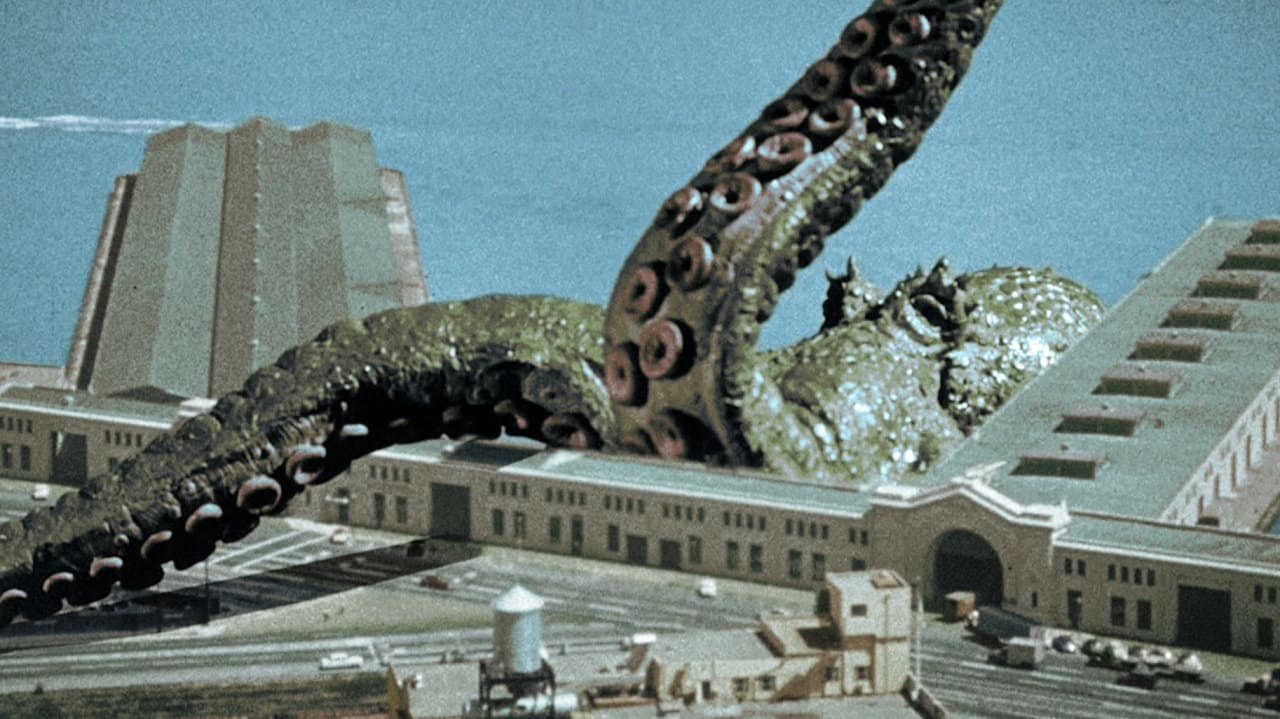
A new version of Clash of the Titans has opened—as if one was needed. The 1981 Clash is notable as being the last film in the storied career of stop-motion animator Ray Harryhausen,* the puppet-magician, who could trace his work-lineage back to Willis O'Brien, the legendary creator of King Kong. Talk about "Titans." Those of us (of a certain age) think very kindly on the series of British films based on Myth, spear-headed by Harryhausen. Some of us might even get a little misty when we think of the battles staged frame-by-frame between the cinematic stalwarts and Harryhausen's skeletons and other slithering, skittering creatures

In the cold light of the critical day, though, one has to admit that, aside from Harryhausen's work (and some legendary Bernard Herrmann film scoring), the movies were a bit stiff dramatically (and not just in the upper-lip department), but they provided adolescent adventure, comely lasses, and were a Colossus' step up from "Hercules" movies. 
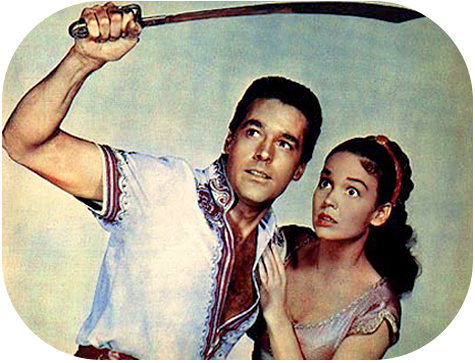
Even the original Clash of the Titans, although boasting a cast that contained a pantheon of British thesps on the order of Lord Laurence Olivier, Maggie Smith, Ursula Andress, and Claire Bloom as Olympian Gods, (and Harry Hamlin, Judi Bowker and Burgess Meredith as mere mortals...or demi-gods), only manages to rise above for the camp-nature of the Brit-Theater vets' performances. Desmond Davis' direction is flat, with many vogueing shots of the hero Perseus brandishing his sword with just the right alignment to eclipse the sun, implying its gift-from-gods status. Not very convincing, nor was Judi Bowker as the damsel-in-distress. 
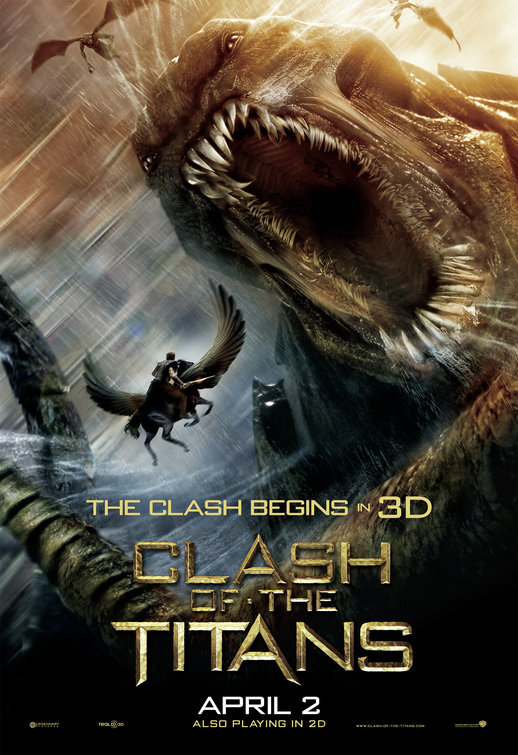
This new version has been in development since the success of
Gladiator, with many re-writers (including an uncredited Lawrence Kasdan) and directors. But it wasn't until French director Louis Leterrier (The TransporterThe Incredible Hulk) took it on that the movie emerged from Development Hades. 
And it's surprisingly good. Oh, it's not anybody's idea of an inspired film, and there are moments where Letterier lets things fall flat (
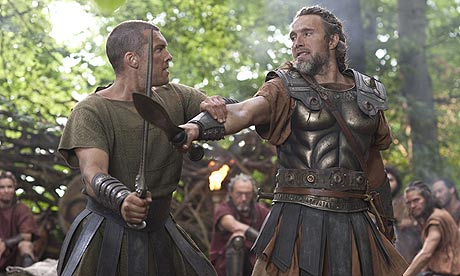
the fight with three mystic crones and even the Big Finale fight with the Krakken are staged too frenetically so that important information gets lost in all the flailing). But there's a nifty fight with giant scorpions and a fight with the Medusa are nicely handled. In fact, they reveal a love of the original (and Harryhausen) that's endearing. That scorpion fight is staged among some strewn ruins that suggest Harryhausen's penchant for staging in proscenium-like settings with rubble for the poor flailing hero to appear to be doing something during filming. And even though it's a pixel-fest, there are winking nods to the 1981 version, and even a replication of the old master's stop-motion semi-stuttering movements. 
Great cast, too, starting with the appearances of
Pete Postlethwaite and Elizabeth McGovern (where's she been?**) as Perseus' foster-parents. Liam Neeson plays Zeus (without any of Olivier's archness) and Ralph Fiennes has fun with his snakey performing of Hades. Sam Worthington plays Persus as a bit like a bland Russell Crowe, and Mads Mikkelsen ("LeChiffre" in Casino Royale) does fine glowering work as an Argosian soldier who only smiles...once. Chief love interest is no longer Andromeda (played by Alexa Davalos, who's a dead-ringer for a brunette Katherine Heigl), but Io (the increasingly ubiquitous Gemma Arterton), cursed by the gods with immortality and, apparently, the tendency to be a buttinski with an all-knowing smile. 
We can analyze this movie until it turns into a block of Quik-crete, but it delivers adventure tickles (one can't really say "thrills"), some nice character bits, and a regard for its original. It's a bit duller in color and flash than the first "Clash," but it does what it does for the most part very well. 
Whether we needed another version is another question.

This Clash of the Titans was intended to be released "flat," but since Avatar (the last movie Sam Worthington "sorta" performed in) received so much tribute, they hastily converted it to 3-D. There are the de rigeur spinning swords, swords poking at our noses, and—this is new—a skipping gold coin. But, as it wasn't designed for 3-D and it's an after-thought, let's call it "2 1/2 D." That, combined with the fact that most IMAX theaters in this country are not IMAX, and you have a lot of people paying extra money to not see what they think they're seeing—a 3-D movie in IMAX format. The tickets are far costlier, and Clash of the Titans was the top of the box-office the last couple of week-ends, so that tells me that there are a lot of people who don't know...and don't care that they're not getting what they think they're getting.

* By the time of of the first TitansILM had begun perfecting the go-motion system—Phil Tippett's way of introducing motion-blur to frame-by-frame filming, best seen in Dragonslayer.
** Filming "Downton Abbey", it turned out, says me in 2021.