Showing posts with label Luke Wilson. Show all posts

Friday, July 5, 2024

Horizon: An American Saga - Chapter 1

Costner's Folly, Chapter 2 ("Nobody Knows Anything")
or
Going For the Fences
 
You've got to hand it to Kevin Costner. He takes chances. He's parlayed his television success on "Yellowstone" to make a movie he's been dreaming of for a couple of decades, in times both fallow and flush, cast it with a steady stream of great character actors who've never passed onto the A-list, split it into two chapters (although hopefully there will be more) and released the first one—in which various story-lines do not intersect—as a 3-hour set-up...the sum of which would spell box-office poison to a movie-going audience that wants its product pre-digested and easily grasped like fast-food.
 
And who can blame him? He's done it before. When he was making it, Dances with Wolves was being derided as "Costner's Folly" for making a Western when they weren't fashionable, for it's extensive location shooting, for the supposed grandiosity of writing, directing, producing and starring in it, for it's planned use of sub-titles, and for its cost overruns. 
 
But, as William Goldman wrote, nobody in Hollywood knows anything. Dances with Wolves became a box-office smash, its elegaic, and unconventionally seditious, story becoming a hit with audiences and garnering the Best Picture Oscar, beating out Goodfellas (which some may argue was a mistake, but, to my mind, really wasn't).
So, here's "Coster's Folly" Chapter Two, the ungainly titled Horizon: An American Saga - Chapter 1
, with a story by Mark Kasdan (who co-wrote Silverado, a favorite of mine), Costner and Jon Baird, photographed by J. Michael Muro, who shot Costner's lovely Open Range.
 
And it's great. Simply great.
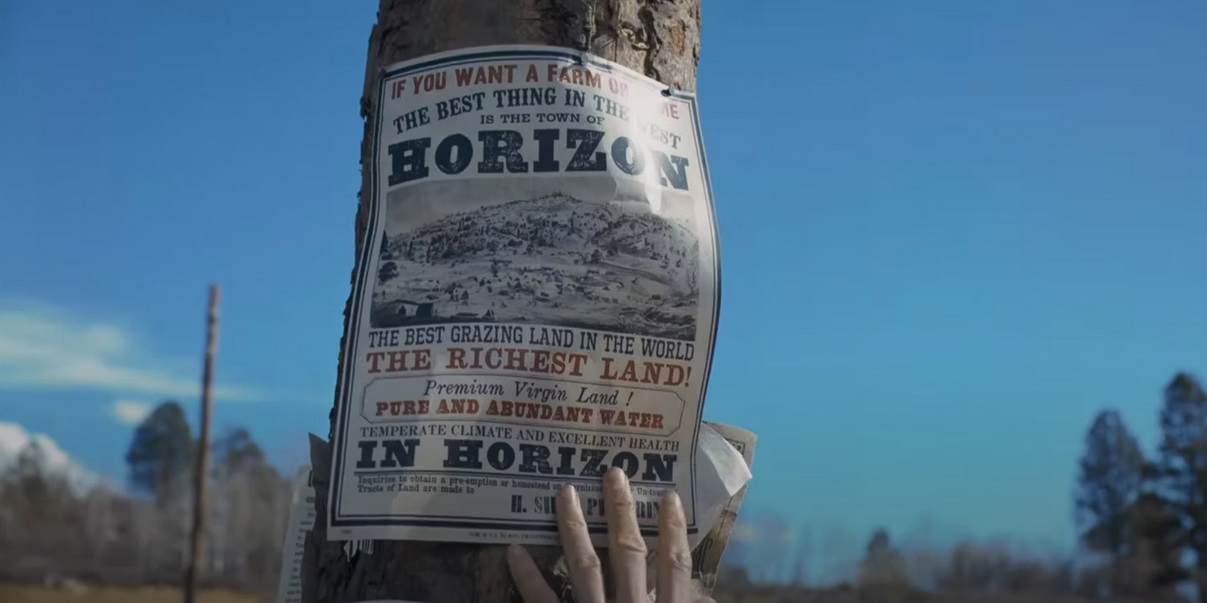
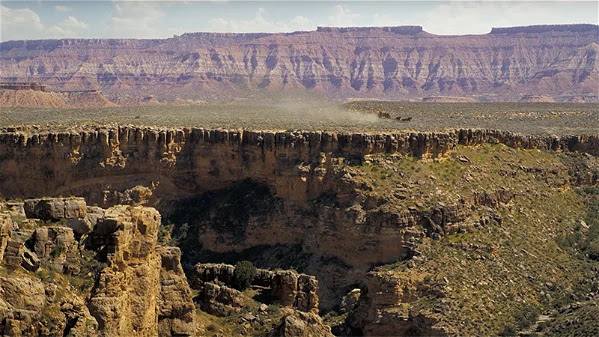
For a 3-hour movie, it sails right by, packed to the sprockets with detail, period and story-wise, never seeming to waste a frame in telling three...four? five?...stories about a plot of land in the San Pedro Valley in the American west that may—or may not —be available for homesteading, and the people who are attracted to the promise of it (whether it is true or not) and the people already living there who take it for what it is. 
 
There are the first white settlers, there to survey and parcel, but as they're alone in the wilderness and, unbeknownst to them, surveying Apache hunting grounds, they soon fall victim to a war party. Their graves are the first semi-permanent structures of Horizon. They won't be the last.
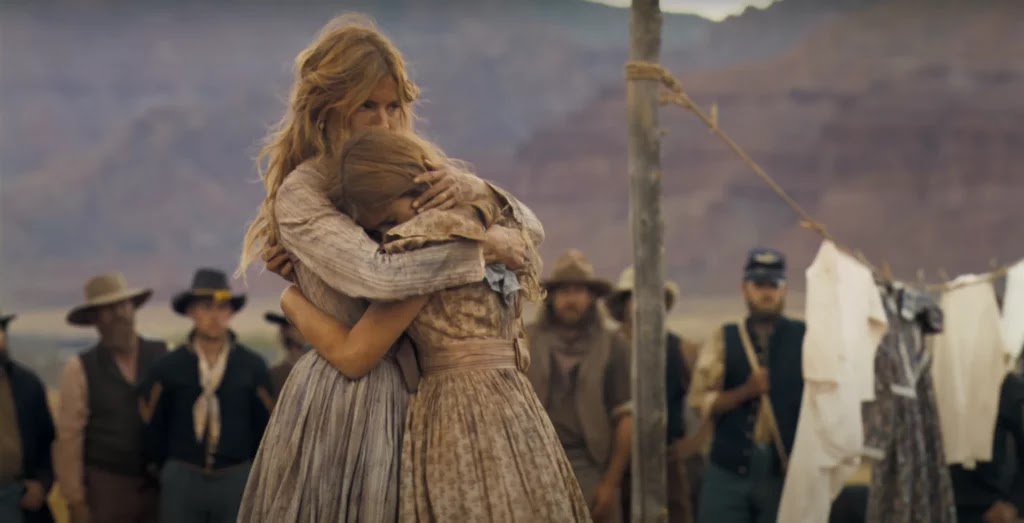
But, the pattern will remain the same. By 1863, there is a well-established colony on the site, across the river from those three original graves. They, too, are attacked by Apache, leaving a limited number of survivors: some, like Frances Kittridge (
Sienna Miller) and her daughter, Elizabeth (Georgia MacPhail) will take shelter at nearby Fort Gallant; others, like the boy who rode to the fort to get help, Russell (Etienne Kellici) form a hunting party to track down the Apache who burned down the encampment.
That attack has caused a dispute between the leader of the war party, Pionsenay (
Owen Crow Shoe) and the leader Tuayeseh (Gregory Cruz), resulting in the younger man splitting from the tribe, taking one of Tuayeseh's sons with him. 
In Montana, James Sykes (
Charles Halford) is shot by Lucy (Jena Malone), who takes her son David and flees for the Wyoming territory. Sykes' sons Junior (Jon Beavers) and Caleb (Jamie Campbell Bower) are sent to find her and the child. They catch up with her where she now goes by the name Ellen, married to hopeful lands-trader Walter Childs and living with a local prostitute Marybelle (Abbey Lee). When the Sykes boys show up, there is a confrontation between the vicious Caleb and saddle-tramp Hayes Ellison (Costner), a potential customer of Marybelle's. She and Hayes and the child escape town to avoid repercussions of the murder.
Also heading for Horizon is a wagon train, moving along the Santa Fe Trail, under the auspices of Matthew Van Weyden (
Luke Wilson), who is having trouble keeping the eclectic group of settlers (including a naive British couple and the family of Frances Kittridge's late husband) of the mind that, although they may be headed for a paradise, they're not there yet, and water and team-spirit are in short supply in a desert.
In the mix are interesting characters, like the leaders of the Army detachment at Ft. Gallant, who are straight out of John Ford's Cavalry films: Lt. Trent Gephart
(Sam Worthington, the most effective performance I've seen of his), who's a pragmatic soldier and would just as soon have settlers somewhere else and the "indigenous" (as he calls them) left to their land to keep the peace, a sentiment acknowledged but considered historically unrealistic by Gallant's leader, Col. Albert Houghton (Danny Huston) and his sergeant major, Thomas Riordan (Michael Rooker, in a slightly less garrulous version of the parts Victor McLaglan played in Ford films). One likes these people and you get the feeling everybody's doing the best they can under the conditions and the inevitability of time.
That's a novel's worth of people and a lot of stories and one suspects everybody's going to converge in Horizon (the town itself will probably end up being the focus of the series), their characters already established and with ensuing complications in the offing—Costner has previews of the next chapter at the end of this one and my appetite for it is whetted.
Despite the obvious nods towards Ford, Horizon: an American Saga, so far, feels more in the vein of the sprawling How the West was Won, but, in character, more like "Lonesome Dove", where individuals weave in and out of the fabric of the narrative, and sometimes—as in life—are never to be seen again in an indifferent Universe, lost in the stream of History. Costner may love his Westerns, but he acknowledges there's less romanticism to it when the survival rate hovers around 50%.
It was in Ford's film The Man Who Shot Liberty Valance, where a reporter states "This is the West, sir. When the legend becomes fact, print the legend." Ford's career peeled back veneers of western legend varnish in his films and in his later work stripped off more layers of his own earlier myth-making. Costner goes even farther, taking into account the grubbier myths of Leone and Peckinpah (and Eastwood) with his hard-scrabble porous towns in need of light and cleaning and extermination. He goes a step further by putting back all the practicalities of the settler experience that Ford cut out—the burying of the dead, the scarcity of water, the bugs and critters, the difficulty of killing a man with ball-shot, the necessity of self-sustainment by farming, the ritual of hard work, more important community matters than tea-dances and ceremonies.
If there's anything more to wish for, for me, it would be that there's more of it (despite others quibbling about length). A couple transition sequences seem to have been excised just to speed things along that might not have added much but may have smoothed a passage of time.
It's still early days, but one gets the sense that Costner will be making a point that the beauty of the West that we admire may not be just a matter of the dirt and stone carved by time and tide but also foundationed by the bones of those who walked before us. 

Tuesday, August 31, 2021

Idiocracy

Idiocracy
(Mike Judge, 2006) The concept here is such an ingenious variation of the Planet of the Apes concept, that one wishes it were a better film.
 
An absolutely average Army recruit (Luke Wilson) is selected to participate in a cryogenics experiment (along with an average intelligence prostitute—played by Maya Rudolph
—as apparently there are no average women in the military?). Then, due to hierarchical mismanagement the program is abandoned and forgotten until the year 2505. During the course of 500 years, the process of natural selection reaches the conclusion of its "survival of the fittest" mode and sails right on past it with dire consequences. Higher IQ couples have been slow to reproduce (if they do at all), and are soon outrun in population by the lower IQ populace, who are always ready to procreate (whatever the hell THAT means) at the drop of a beer can. Or when the bar closes.
When circumstances are such that Wilson's recruit is finally awakened, he finds himself on a planet of morons, self-obsessed and ADD, the world is a corpochracy (clothing is made up of logo patches), dysfunctional, and appallingly apathetic.  He struggles through the legal and penal system (one dimly Kafkaesque, and the other startlingly easy to circumvent) to finally emerge as President of the United States...because he's the smartest guy in the country.
As right on as the satire is here, it doesn't take it to its cynical conclusion, which—if one is cynical enough already—one can see happening before one's very eyes.
 
I would be ecstatically happy if I thought that would really happen—that people would vote for the smartest guy. But I've been through enough election cycles to know that people (whatever their intelligence) are not most likely to vote for the best and the brightest—they would probably resent the more intelligent candidate, voting against them. People don't vote for seeming intelligence or competence, they vote for likability—they want someone "they can have a beer with" or "who talk like I wanna talk." God help us.
On top of that, the inherent cynicism of the concept, brilliant though it is, has no follow-through, and is merely circumvented to reach an end-point. That, and the cheesiness of the production-design (which I could actually buy given a corporate mentality and an apathetic consumer-society) work against the film, which starts out so promisingly, and has flashes of ingenuity throughout. I just wish it might have gone farther, and opted for a less easy way out.
 
Still, every few years it would be good to look at the film just to see what new similarity has become a reality.
 

Tuesday, November 12, 2019

Zombieland: Doubletap

You Might Want To Put Down Your Milk-Duds For This One...
or
"If You Love Someone, You Should Shoot 'Em in the Face So They Don't Become a Flesh-Eating Monster."

"Hey! Welcome to Zombieland: Chapter Two!" Columbus (Jesse Eisenberg) chirps at the beginning of Zombieland: Doubletap, the sequel to the hit Zombieland from way back in 2009. "Thanks for waiting!"

Sure thing, Jess.' Sorry what happened to your career in the meantime.


It's great he came back, so that everyone could appreciate what an eccentric live-wire performer he is, given the right part, and how he can energize a movie just by being in it. But, then, Z:D in an exercise in precise nostalgia. 


Precise because the things that were established in the first go-'round are repeated: Columbus' "Rules" with their accompanying intrusive 3-D graphics, the credit-scattering Main Title montage, the "Bill Murray" cameo—wait until the very last frame on this one—the splintering of the group and the third act brightly lit night-time zombie-splatter orgy are all in place, just like you remember. That's some comfort food among the grisly fare.
But, also the Zombieland teams are back, the ones both in front of* and behind the camera. That Emma Stone (again playing "Wichita") turned down a big movie to return to the franchise says a lot about her affection for the filmmakers and the actors involved, as her star has risen considerably since that time, even winning an Oscar for La La Land. That says something.
My own reaction to the first Zombieland was an admiration for its fresh take on the well-chewed zombie concept. It helped that the characters in the film are a bizarre family of out-casts who probably wouldn't have anything to do with each other if the world hadn't gone to dead people who want a piece of your mind. 
Things haven't changed that much since the zombie apocalypse, other than that Darwin's theory seems to keep working on walking corpses. Either that or the winnowing of zombies makes typing the remaining ones that much easier. What is most troubling is that there are some strata that are tougher to kill, making them tougher to knock down than, say, Star Wars storm-troopers. There aren't many, but it would seem that late-model zombies need more than a simple double-tap to take them down. It doesn't make logical sense, but it does have a tendency to stretch out some of the splatter-fests to be more marathons than short sprints. It's all well and good to increase the challenges to the main characters, but it kind of goes off the proverbial cliff in the third act when the numbers start to increase. 
For the four main characters, the issue centers around the wishes of  Columbus to impart some stability on their rag-tag band of zomb-busters. He wants to establish a home, as the four—Tallahassee (Harrelson), Columbus, Wichita (Stone) and Little Rock (Abigail Breslin)—have already established a loose-knit family and their identities (they're still following the "no names" rule) are based on their home-towns. So, where's home when society has completely broken down? Well, in the United States, they set up shop at The White House (or "Casablanca" as Tallahassee calls it).That's good for awhile, and everybody gives it a shot. But, we're talking about four alpha-wolves trying to live together in peace and harmony: Tallahassee tries to be a father-figure, Wichita and Columbus try to be a couple—even if she's leery of settling down—and Little Rock is just tired of being around old people and wants to find friends (non-dead kind) her own age.
So, as in the first film, the group splinters—it's not like any of the members can't take care of themselves—sisters Wichita and Little Rock, feeling trapped and wanting freedom, take off, leaving "the boys" to their own devices, if both hurt by their desertion. Tallahassee also starts to feel a bit of wanderlust, wanting to go to Graceland, and Columbus, bitter over Wichita's leaving, runs into another survivor, Madison (a hilarious Zoey Deutsch), who is just as pink and girly-girl as can be. And...well, any port in the zombie-storm. She moves into the White House with Columbus and his "father" (as she calls Tallahassee, to his annoyance), and so, it's a little embarrassing when Wichita comes back to arm up, as Little Rock has run off with a namaste Berkeley pacifist (Avan Jogia)—this enrages Tallahassee ("It's not that I hate pacifists, I just wanna beat the shit outta them!").
So, the dynamic changes a lot. Wichita loathes Madison and despises Columbus for his quick rebound dalliance with somebody else...so..."Madison" after his previous matrimonial-bound devotion ("Wow...just...wow") and the four set off to find Little Rock as there is no way that she can defend herself with a pacifist in tow. With a little difficulty finding the proper vehicle to do their road-trip, they start to track down Little Rock by following the lead where she wants to go—that being Graceland, former domicile of Elvis "The King" Presley
When they get there, they are disappointed—Graceland is in ruins. But, nearby, they find the stolen Tallahassee-mobile, the Beast, parked outside an Elvis-themed shrine called the Hounddog Hotel. Little Rock had been there. But, exploring the place, they find that though they were there, they've left. But, they're not alone. Fearing they're about to be overrun by zombies, they find themselves assaulted by the Hotel's caretaker, Nevada (Rosario Dawson) to whom Tallahassee is instantly attracted. 
It's reciprocated, but then, maybe Nevada is reminded of somebody else—like her current squeeze, a western ruffian named Albuquerque (Luke Wilson), who...kinda...reminds you of Tallahassee and, actually, reminds everybody of Tallahassee, except for (of course) Tallahassee, who takes an instant dislike to the man. And—to make the conceit even more precious, Albs (please don't make me spell it again!) has a nervous, nerdish compadre named Flagstaff (Thomas Middleditch), who Columbus thinks is a really-together guy...with his commandments instead of rules and his unlikely skills at zombie-dispatching. As if knowing they've gone a little too far with the doppelganger bit, the two get eliminated fairly quickly. 
There's nowhere the two could go, anyway, it's a silly conceit and the jokes wear out their welcome pretty quickly...plus it eliminates a rival for Nevada's affections and she's pretty necessary to the plot, as everybody moves on to find Little Rock, who has been persuaded by "Berkeley" to find a mythical place called "Babylon," an oasis in the zombie-desert, where there is nothing but peace and harmony and hacky-sack, and no weapons—you just know that that is where the last confrontations in the movie are going to take place, like the big amusement park set-piece in the first one: it raises the stakes for the heroes and gives them a handicap, as well. But, it provides little suspense and hardly any danger. You know that everybody's going to come out of it alright, no matter how much danger is pretended.
Yes, it's fun, more in the smaller moments than in the large ones: you have a lot of really good actors who are enjoying playing their characters, even if they all could be playing better roles, and their idiosyncratic performances are always a pleasure to watch. They manage to evoke pleasure out of recycled materials and make fresh conceits that are beyond their sell-by date. If another Zombieland is made, one knows where it will go—splintering the group again and reforming them with a third act action set-piece. And, no doubt, they'll be just as good even though the vehicle itself will have become as charmless as an animated corpse.

* Zombieland: Doubletap's trailer makes comedic hay of the fact that Harrelson, Eisenberg and Breslin are all Oscar nominees and that Stone is an Oscar winner, juxtaposed with shots of them firing all sorts of weaponry. Hey, Helen Mirren rocks a machine-gun.

Tuesday, October 7, 2014

The Skeleton Twins

The Return of the Gruesome Twosome
or
Better Late Than Never

Bellingham native Craig Johnson's second feature (after the filmed-in-Seattle True Adolescents) is The Skeleton Twins, a story of dysfunctional siblings trying to function and benefiting from some great performances by SNL alums Bill Hader and Kristen Wiig (who haven't appeared in a film together since Adventureland away back in 2009).

Milo Dean (Hader) is a struggling actor in LA, gay, and in mourning due to post-parting depression. He writes a terse note "To Whom It May Concern: See You Later" turns up his favorite music...loud...then sinks into a bathtub and slits his wrists.


Cut to sister Maggie contemplating a handful of sleeping pills, when the phone rings. It's the hospital, telling her that Milo has attempted suicide. She looks at the pills. "Uh, he's okay" says the voice over the phone, confused by her long pause. "Good" comes the tentative reply.

Already there are parallels between brother and sister with the conflict apparent between them. She's trying to commit suicide but gets interrupted because he did it first. She flies out to California to see him; they haven't in ten years. "You changed your hair" is the first thing he says to her.

None of this is played for laughs, but comedy comes out of Hader and Wiig even through drama, and their shared past as performers fills in for the lifetime of shared memories of family members. There is an unquantifiable sixth sense in their reactions to each other and how they play off each other that goes far beyond the written page to timing, reaction, and suppressed thought that seems to seep out of their pores. It sometimes takes one, two, even three beats before one realizes that they're just messing with each other or being serious. Hader has the more flamboyant part, Wiig, the repressed one, but they exchange personas constantly throughout the movie in varying degrees of hope and despair.
Wiig plays a dental assistant who, after huffing nitrous, 
tries on an aparatus—her ad-lib cracks Hader up
When Maggie takes the wounded Milo home with her to recuperate, it's a bit of an invited invasion. They haven't seen in each other in a decade. She's gotten married to a fairly cheery guy (Luke Wilson, always good to see) and they're trying to have kids. The idea terrifies Maggie, and she's sneaking birth control pills to avoid it. She's also taking scuba diving lessons and carrying on a guilty affair with her hunkish Australian instructor (Boyd Holbrook). Milo takes the opportunity to meet up with a former teacher (Ty Burrell) with whom he had an affair as a student, and that does not go well, as he's now married with an eleven year old child—er, his wife and he have an eleven year old child (that would be better phrasing). You can't go home again.

But, sometimes it pays a visit. Their self-absorbed Mom (Joanna Gleason) comes by (she's in town for a new age retreat) and old animosities flair up, the chakras, evidently, being extraordinarily fiery. The kids were always closer to their father, who, himself, committed suicide, and, no doubt, imprinted his bi-polar giddy sense of life amidst the morbid drudgery of day-to-day living on them. If the film has a weakness, it's in the Mom's portrayal—she's all new age ideologue without a smidgen of complexity or roundness of character, and stands out like a cracked healing crystal from the rest of the dramatis personæ (in fact, she might have escaped from a Coen Brothers movie. Hmmm). It doesn't do the movie, or any satiric jab it might make about this sort of thing, any good.

No, you want to talk about good? That would be Hader and Wiig doing a hilarious lip-sync of Starship's feel-good "Nothing's Gonna Stop Us Now" that just keeps getting better and better until the sequence ends. It's one of those magical moments that tends to obliterate the memory of any weaknesses the film may have, and propel it along on the good will of that one bit. It can't last, however, and the ending is a bit of a let-down from what has come before. Still, The Skeleton Twins is smart, funny, multi-layered and not content to merely "get by" (as is often the case)—and if it was, one gets the impression that Hader and Wiig wouldn't allow it.