Showing posts with label Emma Stone. Show all posts

Friday, January 5, 2024

Poor Things

Candy'd
or
"I Have Found This World To Be Full of Sugar and Violence"
 
Yorgos Lanthimos' film of Poor Things immediately grabs you by the "hairy business" and never lets go. Even the titles starting the movie refuse to be conventional, emerging like stitching around a baby blanket. Then, the film starts proper with a low-res black-and-white sequence shot with a distorting wide-angle lens of Bella Baxter (Emma Stone) waddling around the ornate interior of the work-home of Dr. Godwin Baxter (Willem Dafoe), eccentric scientist and anatomist, whom Bella calls "God."

And so he is, scarred and etched by much surgery-presumably self-inflicted-he teaches anatomy at a London University, where he regularly dissects corpses for the education of his students and puts them back together for his. "What's the purpose of putting the organs back in?" asks one of his audience. "My amusement!" He bellows, and one dare not question him.
Evidently. His estate is populated by hybrid creatures constructed and tended by him: pug-ducks and pig-chickens (with their heads swapped out), all experiments to test the limits of what can be done. Speaking of predecessors, he says they "pushed the boundaries of what was known. And paid the price."
But, Bella is the most important one, an opportunity that arose by accident, and Dr. Baxter made the most of it...uh, her. Now, he tracks Bella's development, her growing vocabulary, her skill-sets, all in an environment meant to keep her safe, despite her abundant curiosity. Bella wants to learn, most particularly about the world outside the Baxter flat, and that, as he notes, is a problem: "So many things in the world can kill you, Bella."
Still, she seeks to learn. Baxter recruits one of his more sensitive students, Max McCandles (
Ramy Youssef) to do the research work that his busy schedule can't accommodate, and, given Bella's combined increasing abilities and interests, someone has to keep an eye on her so she doesn't get in trouble. Dr. Godwin allows a brief foray into the park, but even that doesn't go smoothly, and it's only through the use of chloroform that he and Max are able to get her home.
But, things start to go south when Bella becomes sexually aware, and Godwin suggests that Max marry her as there is obvious affection between the two of them. A marriage contract is proposed and Godwin brings in lawyer Duncan Wedderburn (
Mark Ruffalo) to draw it up. But, Wedderburn is unscrupulous and a cad and his interest in who would inspire such a contract makes him seek out Bella and propose that, instead of marrying Max, that she go off with him on a "grand adventure" traveling the world. To Bella, this seems the best of all possible ideas and she insists that she travel with Wedderburn and will marry Max when she returns. Dr. Godwin objects and tries to warn her, but, ultimately lets her go, realizing that Bella is "a being of free will" and can make up her own mind.
Of course, Wedderburn's intentions are the worst, indulging Bella in what she describes as "furious jumping" and acting a man of the world when all he really wants is control over her. Plus, being sheltered for all her time at Baxter's flat, Bella is unused to the "polite society" that Wedderburn loathes, and still has instinctual issues ("I must go punch that baby!") to the point where he commands her that she is to say only three things at dinner conversation: "Delightful" "How marvelous" and "How do they get the pastry so crisp." She starts to assert herself, slapping Duncan and making her own friends, while he drinks and gambles and begins a downward spiral of self-pity.
It's a coming-of-age story of the innocent learning about the world and the hardships and disillusionments that are learned along the way as her travels teach her in ways being cloistered in the doctor's care could not. Experience is the best teacher, whether you're "Candide" or "Candy" and Bella's travels, the people she meets, the hardships she endures, the sacrifices she makes are all in the benefit of her becoming a complete human being by the time she makes her way back to London.
You might think you've heard this one before, but you've certainly never seen anything like Poor Things. As anyone who's seen his The Favourite can attest, Lanthimos does things differently, using different film formats, lenses, distortions, and with no regard to realism or verisimilitude. His extreme world-building is not unlike Wes Anderson's or Tim Burton's, or Terry Gilliam's, but with a free-wheeling scatter-shot explosion of any expectations or any sort in a delirious mash-up of Dali and Magritte surrealism that ignore the laws of physics and architectural rigor while staying true to the possibilities of psychology and motivation. Think of the films of Tarsem Singh and tilt them another 90° and you'll be closer to Lanthimos' wheel-house.
Even while you're mind is reeling and your eyes are agog at what he presents, one can't help but be amazed at the performances he gets. As creepy as the visage of Willem Dafoe is in this film, his performance as a mad scientist is still heart-felt and, as bizarre as it is, just a little wise. Mark Ruffalo hasn't been this funny...ever. 
But, the miracle of this movie is Emma Stone. One doesn't want to reveal too much of the movie...or the "why" of it...but her Bella Baxter starts out as a fully-formed child and progresses to a cerebral philosophical mind while taking every idiosyncrasy and playing it with a crack comic timing that makes you shake your head in wonder at the inventiveness and sheer "go-for-broke" ingenuity of it. For all the special effect wizardry going on in the thing, she is the glue that holds the thing together for a solid 2½ hours. And her transformation from wobbling infant to sophisticated lady is a triumph. It's all pretty astounding.
And the movie will make an excellent double bill with Barbie.


Tuesday, January 2, 2024

The Amazing Spider-Man

Written at the time of the film's release.

Don't worry. New stuff tomorrow....


Spider-man v. 2.0
or
"With Great Power Comes Sequels, Re-Boots, Etc....(A Spider-man's Work is Never Done)"

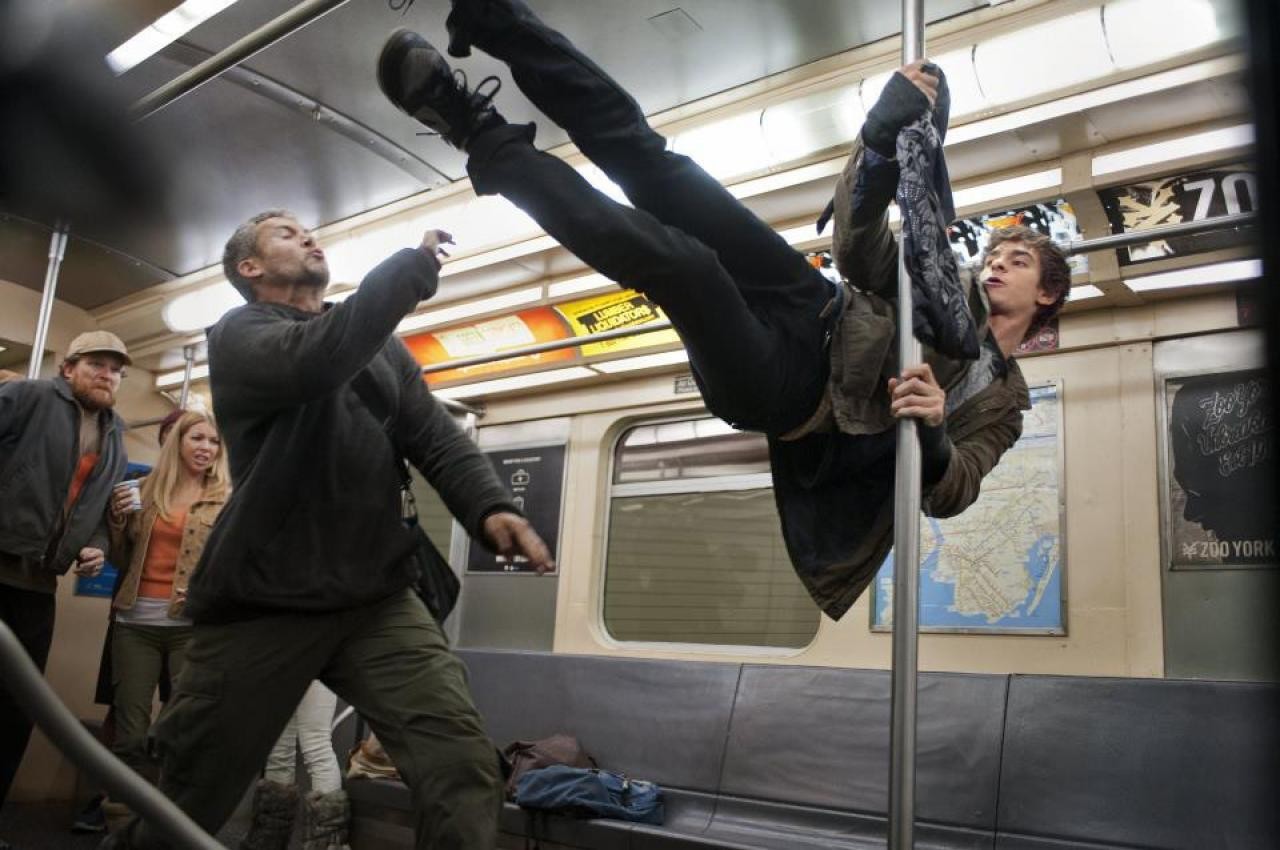
It may be a web-strand too soon to be doing a re-boot of the "Spider-man" franchise, but The Amazing Spider-man does do one thing that justifies its existence—it's better than the Tobey McGuire/Sam Raimi first film in the original trilogy, and right off the ledge manages to have the fun, energy, pop-soapishness, and inventiveness of the second film in that series, the one with Dr. Octopus. We have to go through the origin story again (but that's okay, we seem to have to with every "Superman" film, and evidently will with the next one).

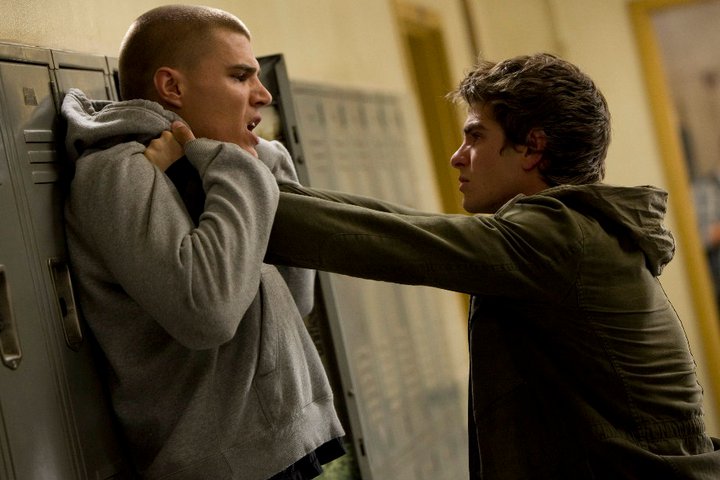
The story is basically the same—Peter Parker (Andrew Garfield) is a smart high school geek with a photog' hobby, and his first encounter with an industrial science lab manages to put the bite on him, arachnidally-speaking, then strange things start happening as he does whatever a spider can, conflicts, conflicts, conflicts (of the physical and angst variety), "with great power comes great responsibility," yadda yadda yadda. But there's a lot of "Spidey"-history to draw on, and the writers (James Vanderbilt, Alvin Sargent—who added a lot to Spiderman 2—and Steve Kloves—who mentored Harry Potter) have tinkered and brought a lot of missing pieces to the table. 
This time the love interest is Gwen Stacy (Emma Stone, who appears to be the oldest person in school, but that may be part of the appeal of the character, certainly to Parker), daughter of an NYPD captain (Denis Leary, who plays it straight, tough, and with impeccable comic timing), and bowing to the fan-boyish, his web-powers are not so organiche's got the little web-shooters now, although interestingly, he doesn't develop the web-goo. Oscorp is still around, although we never see its CEO (or do we?), so's the Daily Bugle—but Parker doesn't have a job there yet, so there's no J. Jonah Jameson (how could replace or improve on J.K. Simmons' interpretation?). The villain is another industrial bio-scientist, Curt Connors (played as if was Peter O'Toole by Rhys Ifans and he's terrific), who—not giving anything away here—eventually turns into the Lizard.

What's different is motivation and sub-text. Echoing the Potter series, attention and emphasis is paid to what happened to Peter's parents (Campbell Scott and Embeth Davidtz) that put him in the care of Uncle Ben and Aunt May (Martin Sheen and Sally Field, both extraordinarily good) and indications are that is the story which will run throughout this movie-arc (as well, I suspect, as the consequences of keeping secrets (as I said, there's a lot of history to drawn on).
 

What's also different and good is how everybody's perfected the formula, including director Marc Webb (who made the, to me, extraordinarily fine
(500) Days of Summer): Garfield's Parker is more in line with the comic character, mood-swinging as well as web-slinging, and his Parker is awkward, stammering, frequently inarticulate and perceived outwardly as something of a jerk, a simp, or worthless* (hey, wow, they got the character of a misunderstood teenager down), and the fights, which in the past have been rushed and often unfollowable, now flow and, frequently—thanks to CGI—in one continuous shot that swoops, loops and parallels Spider-man's flight patterns.
The pace is still there, but thanks to stunt arranger and second-unit director Vic Armstrong (a few of the Bonds and Indiana Jones), it's not all a blur. Also, under Raimi, some of these fights were brutal and sadistic, and, don't get me wrong, these are no less savage, and take more of a toll on the participants.
** But the desperation is there, and the "wrong-ness" of the abuse of power, which kept my moral compass (or is it "Spidey"-sense?) from peaking out in the red zone.  

So, yes, it's the same story, but more sure-footed (by having its hero less so), and also intriguing for what it might hold in the future. The first trilogy seemed to be a little wobbly as it went along, searching for story. This one already feels like it knows where its going, and will find the best and most opportune path to get there.
***

* And—a nice touch—he's thin and ungainly, not buffed-out, like the typical "strong-man" super-hero, which is the way he was when Steve Ditko first drew him.  Nice.

** This does bring up something that will be difficult to sustain: Parker is frequently shown battered, bruised, and slashed from these fights, which makes his encounters post-fight with Aunt May a little illogical.  And at some point, when will she clamp down on him, or child-protective services step in? 

*** A couple more things: there's no interpretation of the "Spider-man" theme from the 60's cartoon ("Hey there, there goes the Spider-man!") but James Horner's score is his most inventive in a long time—if a little needlessly bombastic in rare instances; there is a "coda" of sorts, but early in the credits (so you won't be missing anything if you don't stay for the full credit roll); and the Stan Lee cameo actually made me smile and feel affectionate towards the man.  Now, that's amazing.

Saturday, September 2, 2023

Gangster Squad

Saturday is traditionally "Take Out the Trash" Day.
 
Written at the time of the film's release...
 
Manifest Density
or
The War for the Soul of Los Angeles (such as it is)
 
Ruben Fleischer's third film (after the very good Zombieland and the excremental 30 Minutes or Less) is Gangster Squad, a Hollywoodized version of the efforts by the LAPD to take down the efforts of Mickey Cohen, the lieutenant of Bugsy Siegel's Jewish mafia, who took over Siegel's interests when the mob kingpin was murdered in 1947.

If one is looking for a history lesson, one should look elsewhere. This is a glamorized, fictionalized version of the events set in some art-deco post-war version of Los Angeles that doesn't seem to have existed anywhere except the Warner Brothers gangster films and Brian de Palma's The Untouchables, to which this film owes a great debt. The gangsters all wear dark clothes with long coats (the better to identify them) and are all greasy and ugly, while the police are all good-looking guys in nice suits who bend the rules a bit (with the possible exception of Chief Parker, played with a gruff somnambulance by Nick Nolte, who headed up the similar "Hat Squad" in Lee Tamahori's Mulholland Falls).*

It all feels very false, from how the gangsters rarely hit anything despite the thousands of rounds shot from tommy-guns, and the Gangster Squad "hit" ratio usually fares better. The Squad (hand-picked by the leader's wife, played by Mireille Anos, for being rough-necks and not promotion-headed top-of-their-classers) consists of boss John O'Mara (who did exist, but did not run the unit) as played by Josh Brolin, Jerry Wooters (played by Ryan Gosling), Max Kennard (Robert Patrick)—a sharpshooter, Conway Keeler (Giovanni Ribisi) a surveillance/electronics expert, as well as two PC members for the 21st century audience—Anthony Mackie (so good in The Adjustment Bureau) and Michael Peña. Their target is Mickey Cohen (Sean Penn in a make-up that makes him look like he walked out of Warren Beatty's Dick Tracy), who's reputation is movie-inflated to make him seem like he's an empire-building Al Capone, rather than the cheap hood with star connections he ultimately was.
Fleischer is more interested in flash than being true to the source. His fights are surprisingly well-staged, one shot per flying fist, but not Bourne-edited so one can easily follow it—an early fight in an elevator borrows heavily from a similar scene in a James Bond movie but actually goes places the 007 film merely used for suspense. Once in awhile, he'll go for a Matrix-y slo-sloo-slooo-mo effect (rather than a fleeting Peckinpah image) just to make a point of something, like cartridges flying out of a machine gun, or a Christmas ornament exploding due to gunfire, but it's just slowing things down as opposed to telling a story. Brolin's fine, nuanced even, but Gosling's McQueen-ish hipster act is wearing a little thin, and the chemistry exhibited between he and Emma Stone from Crazy, Stupid Love is completely missing here. Mackie, Peña, and Patrick are far more engaging probably because they don't fit the established mold.
It's entertaining, to a certain extent, but one gets the feeling, after patterns have been set that bring to mind other films, that one is being sold a bill of goods, and we are.
The real-life Cohen was convicted of tax evasion (not murder) in 1950, serving four years. Upon his release, he established several businesses (the ones portrayed in the film) and was again convicted of tax evasion in 1961 and released (again) in 1972. Cohen died in his sleep in 1976.
The real Mickey Cohen, photographed in 1950
The real "Gangster Squad"

* Amusingly, his driver is Officer Darryl Gates (played by Josh Pence) who would be Chief from 1978 to 1992.

Tuesday, November 12, 2019

Zombieland: Doubletap

You Might Want To Put Down Your Milk-Duds For This One...
or
"If You Love Someone, You Should Shoot 'Em in the Face So They Don't Become a Flesh-Eating Monster."

"Hey! Welcome to Zombieland: Chapter Two!" Columbus (Jesse Eisenberg) chirps at the beginning of Zombieland: Doubletap, the sequel to the hit Zombieland from way back in 2009. "Thanks for waiting!"

Sure thing, Jess.' Sorry what happened to your career in the meantime.


It's great he came back, so that everyone could appreciate what an eccentric live-wire performer he is, given the right part, and how he can energize a movie just by being in it. But, then, Z:D in an exercise in precise nostalgia. 


Precise because the things that were established in the first go-'round are repeated: Columbus' "Rules" with their accompanying intrusive 3-D graphics, the credit-scattering Main Title montage, the "Bill Murray" cameo—wait until the very last frame on this one—the splintering of the group and the third act brightly lit night-time zombie-splatter orgy are all in place, just like you remember. That's some comfort food among the grisly fare.
But, also the Zombieland teams are back, the ones both in front of* and behind the camera. That Emma Stone (again playing "Wichita") turned down a big movie to return to the franchise says a lot about her affection for the filmmakers and the actors involved, as her star has risen considerably since that time, even winning an Oscar for La La Land. That says something.
My own reaction to the first Zombieland was an admiration for its fresh take on the well-chewed zombie concept. It helped that the characters in the film are a bizarre family of out-casts who probably wouldn't have anything to do with each other if the world hadn't gone to dead people who want a piece of your mind. 
Things haven't changed that much since the zombie apocalypse, other than that Darwin's theory seems to keep working on walking corpses. Either that or the winnowing of zombies makes typing the remaining ones that much easier. What is most troubling is that there are some strata that are tougher to kill, making them tougher to knock down than, say, Star Wars storm-troopers. There aren't many, but it would seem that late-model zombies need more than a simple double-tap to take them down. It doesn't make logical sense, but it does have a tendency to stretch out some of the splatter-fests to be more marathons than short sprints. It's all well and good to increase the challenges to the main characters, but it kind of goes off the proverbial cliff in the third act when the numbers start to increase. 
For the four main characters, the issue centers around the wishes of  Columbus to impart some stability on their rag-tag band of zomb-busters. He wants to establish a home, as the four—Tallahassee (Harrelson), Columbus, Wichita (Stone) and Little Rock (Abigail Breslin)—have already established a loose-knit family and their identities (they're still following the "no names" rule) are based on their home-towns. So, where's home when society has completely broken down? Well, in the United States, they set up shop at The White House (or "Casablanca" as Tallahassee calls it).That's good for awhile, and everybody gives it a shot. But, we're talking about four alpha-wolves trying to live together in peace and harmony: Tallahassee tries to be a father-figure, Wichita and Columbus try to be a couple—even if she's leery of settling down—and Little Rock is just tired of being around old people and wants to find friends (non-dead kind) her own age.
So, as in the first film, the group splinters—it's not like any of the members can't take care of themselves—sisters Wichita and Little Rock, feeling trapped and wanting freedom, take off, leaving "the boys" to their own devices, if both hurt by their desertion. Tallahassee also starts to feel a bit of wanderlust, wanting to go to Graceland, and Columbus, bitter over Wichita's leaving, runs into another survivor, Madison (a hilarious Zoey Deutsch), who is just as pink and girly-girl as can be. And...well, any port in the zombie-storm. She moves into the White House with Columbus and his "father" (as she calls Tallahassee, to his annoyance), and so, it's a little embarrassing when Wichita comes back to arm up, as Little Rock has run off with a namaste Berkeley pacifist (Avan Jogia)—this enrages Tallahassee ("It's not that I hate pacifists, I just wanna beat the shit outta them!").
So, the dynamic changes a lot. Wichita loathes Madison and despises Columbus for his quick rebound dalliance with somebody else...so..."Madison" after his previous matrimonial-bound devotion ("Wow...just...wow") and the four set off to find Little Rock as there is no way that she can defend herself with a pacifist in tow. With a little difficulty finding the proper vehicle to do their road-trip, they start to track down Little Rock by following the lead where she wants to go—that being Graceland, former domicile of Elvis "The King" Presley
When they get there, they are disappointed—Graceland is in ruins. But, nearby, they find the stolen Tallahassee-mobile, the Beast, parked outside an Elvis-themed shrine called the Hounddog Hotel. Little Rock had been there. But, exploring the place, they find that though they were there, they've left. But, they're not alone. Fearing they're about to be overrun by zombies, they find themselves assaulted by the Hotel's caretaker, Nevada (Rosario Dawson) to whom Tallahassee is instantly attracted. 
It's reciprocated, but then, maybe Nevada is reminded of somebody else—like her current squeeze, a western ruffian named Albuquerque (Luke Wilson), who...kinda...reminds you of Tallahassee and, actually, reminds everybody of Tallahassee, except for (of course) Tallahassee, who takes an instant dislike to the man. And—to make the conceit even more precious, Albs (please don't make me spell it again!) has a nervous, nerdish compadre named Flagstaff (Thomas Middleditch), who Columbus thinks is a really-together guy...with his commandments instead of rules and his unlikely skills at zombie-dispatching. As if knowing they've gone a little too far with the doppelganger bit, the two get eliminated fairly quickly. 
There's nowhere the two could go, anyway, it's a silly conceit and the jokes wear out their welcome pretty quickly...plus it eliminates a rival for Nevada's affections and she's pretty necessary to the plot, as everybody moves on to find Little Rock, who has been persuaded by "Berkeley" to find a mythical place called "Babylon," an oasis in the zombie-desert, where there is nothing but peace and harmony and hacky-sack, and no weapons—you just know that that is where the last confrontations in the movie are going to take place, like the big amusement park set-piece in the first one: it raises the stakes for the heroes and gives them a handicap, as well. But, it provides little suspense and hardly any danger. You know that everybody's going to come out of it alright, no matter how much danger is pretended.
Yes, it's fun, more in the smaller moments than in the large ones: you have a lot of really good actors who are enjoying playing their characters, even if they all could be playing better roles, and their idiosyncratic performances are always a pleasure to watch. They manage to evoke pleasure out of recycled materials and make fresh conceits that are beyond their sell-by date. If another Zombieland is made, one knows where it will go—splintering the group again and reforming them with a third act action set-piece. And, no doubt, they'll be just as good even though the vehicle itself will have become as charmless as an animated corpse.

* Zombieland: Doubletap's trailer makes comedic hay of the fact that Harrelson, Eisenberg and Breslin are all Oscar nominees and that Stone is an Oscar winner, juxtaposed with shots of them firing all sorts of weaponry. Hey, Helen Mirren rocks a machine-gun.

Thursday, November 7, 2019

Zombieland

There are a lot of new movies I've seen and reviews are coming up, slowly but surely. Patience.

Written at the time of the film's release...

"Woulda...Coulda...Shoulda."

The University of Florida, being on a pan-handle with nowhere to run, was recently thoughtful enough to include in their on-line instructions dealing with hurricanes and pandemics, a section on what to do in case the area was attacked by zombies, or as they put it, "life-impaired individuals."

The section was quickly expunged.

Some folks have no sense of humor.

It's a good thing
Zombieland does. Ruben Fleischer's zombie comedy has traded knife-sharp horror timing for sledge-hammer comedy timing, and the results are giddy, gory ghastly fun. At some point, the gangly slavering zombies just become targets and rarely are posed as threats and become merely a means to many grisly perforated punch-lines. The result of a fast-food outbreak of mad cow disease ("then mad human, then mad zombie" relates the film's geeky narrator "Columbus"), the flesh consuming zombies pass on the disease to their victims, and so on, ad nauseum.* 

Our narrator is on a one-man trek from his college room in Austin, Texas to try to find his parents in Columbus, Ohio, dodging zombies who are fast, but not very bright (at one point, he evades them by just running around a deserted parking lot in a circle, while they slavishly chase him like...zombies). Walking the highways with his carry-all on wheels he meets up with another fellow human, a rough-neck, well-armed and driving a Cadillac Escalante, and they pool their resources, conditionally. 
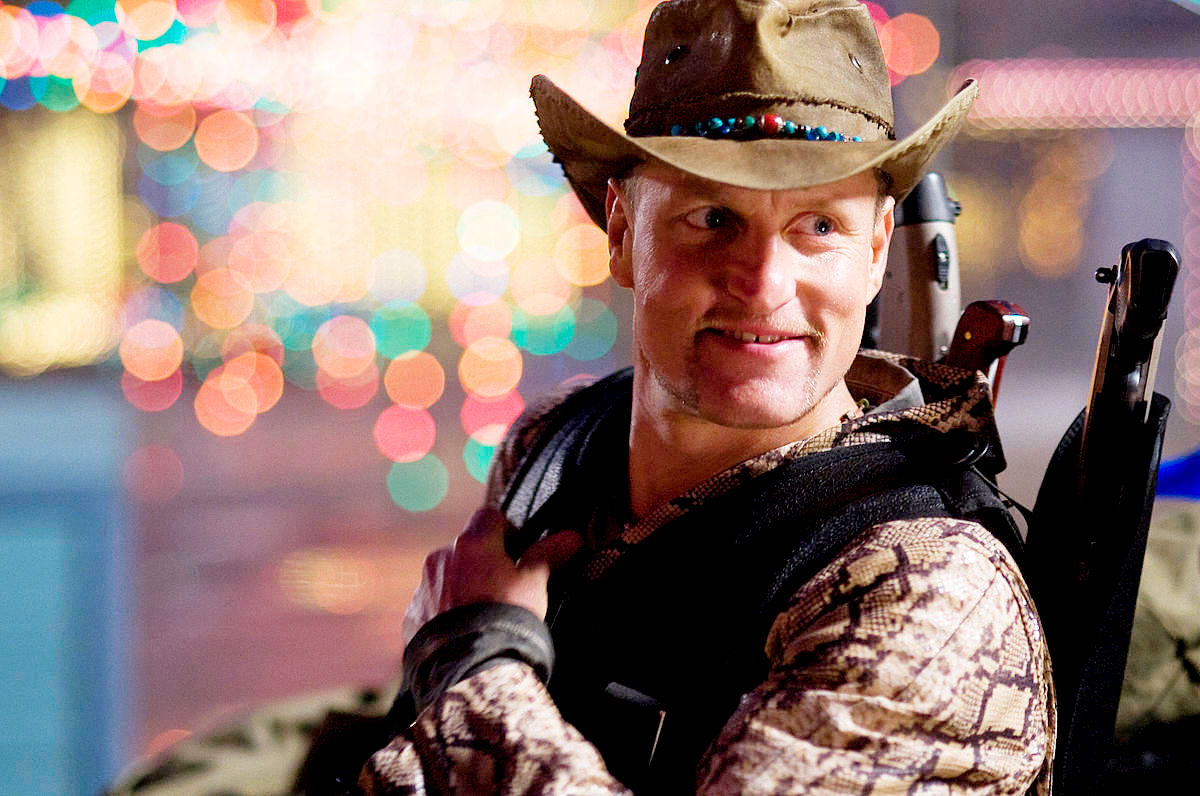
"No names" is the rule, so they call each other by their home-towns: "Columbus" (Jesse Eisenberg—combine Michael Cera with Hugh Grant's stammering timing and that's him) and "Tallahassee" (Woody Harrelson, who's extremely funny), and the film becomes an "armed-to-the-teeth" road-movie searching for the mythical "safe zone" that always seems to provide a goal for these movies.**
All the characters are smart (or dumb) enough and funny enough that everyone has their fair share of laughs. Ultimately, that's the final goal, along with a slice of relationship-therapy, as the movie can't come to any real resolution of the zombie problem (which would be...running out of bullets...or zombies). The best one can do is compromise on the "I wouldn't if you were the last (whatever) on Earth" as that's become an attainable goal.
It's a funnier movie than Shaun of the Dead, which gnawed on the same material, but Zombieland trades in its laughs for a Hollywood slickness that feels as if its going down well-worn storyline grooves of character resolution. The movie is given a seventh inning stretch by a gracious cameo by Bill Murray (no, really...he must owe Sony Pictures a movie) and wonderful graphic work, which solves the University of Florida problem by providing the "Columbus'" rules for dealing with zombies by pop-up graphics that regularly illustrate an example. As a public service, I provide them here:
Rule #1: Cardio ("the fatties" went first)
Rule #2: Double-Tap (don't trust the first shot)
Rule #3: Beware of bathrooms
Rule #4: Seat-belts (wear them)
(Here, things get a little sketchy)
Rule #7: Travel light
Rule #17: Don't be a hero
Rule #18: Limber Up
Rule #22: When in doubt, know your way out
Rule #31: Check the back-seat
Rule #32: Enjoy the little things

* And one would think "ad internecionem." Since these zombies are flesh-eating, that would mean that a lot of the zombies are missing limbs and would make lousy zombies, and eventually, well, supply and demand being what it is...wouldn't they basically eat themselves to extinction? In the words of "Tallahassee:" "Pretty soon life's little Twinkie gauge is gonna go empty." But I digress...


** The movie has such a fun time dealing with zombie and movie cliche's that it even addresses the issue:
Columbus: You know there's a place untouched by all this crap?
Tallahassee: Out east, yeah?
Columbus: Yeah.
Tallahassee: Out west, we hear it's out east, out east they hear it's out west. It's all bullshit. It's like you're a penguin at the North Pole hears the South Pole is real nice this time of year.
Columbus: There are no penguins in the North Pole.
Tallahassee: (pause) You wanna feel how hard I can punch?

Saturday, June 22, 2019

The Help (2011)

Written at the time of the film's release...

"The Other Side of the Bridge Club (Insuring Domestic Tranquility)"
or
"You Ought Not to Joke About the Colored Situation"

You go into The Help with a certain amount of trepidation.  Will it be so politically correct as to have no bite? Will it be a "TWGSTD" movie, where the true story of the oppresssed is supplanted by "the drama" of a privileged person's conscience to help? Will it be a Neapolitan "Chick-Flick," all sugary ice cream of different flavors and colors? We've seen plenty of those, and one would hope that we've evolved out of our tribalism enough that film-makers—even commercial film-makers—hedge their story by surrounding the center with white-washing vanilla.**

Stanley Kramer, after all, has been dead for ten years.
With The Help, it's a hesitant answer of "Yes" and "No." "Yes," the story has elements of "White Guilt" saves the day, but only in the short term, and said Guilty Party, Eugenia "Skeeter" Phelan (known as "Long-Haul" to her high school friends for actually attending and graduating college and pursuing a journalism "job," rather than settling for domestic tranquility) may have a sense of accomplishment, but it costs her. And the issue of "You think you're gonna help us?" is very pointedly brought up by the character of Minny Jackson (played by her real-life inspiration, Octavia Spencer, in an excellent performance).  Say it, sister.. Nice touch of dignity, that. 
Young Miss "Skeeter" (Emma Stone), is ambitious, as are all the white women in the segregated community of Jackson, Mississippi; her ambitions don't center around who throws the nicest bridge club setting (or has it thrown for them), or making a name for herself preserving the traditions of The South. She wants to be a journalist, which, given the times, relegates her to ghosting a "best-bleach-for-the-sheets" column for the local newspaper. 
But, gnawing at her no. 2 pencil is what happened to the woman who raised her as a child. No, not mother Charlotte (Allison Janney, who tends to periodically rise above her material), but the house-servant, Constantine Jefferson (the always wonderful Cicely Tyson—I've missed her), who accepted and applauded her graceless duckling ways in a city of debu-taunting swans, and who disappeared while she was away at college, never to return. The vacancy of Constantine and her story inspires her to talk to the "help" about their stories, and how they maintain during their domestic servitude. Fearing a backlash from amongst the womens' society, she initially only gets to talk to a reluctant Aibileen Clark (Viola Davis, whose movie this is**), who tells her of her early days and of her family's molasses-like progress from house-"slaves" to house-"servants."
It involves the telling of tales on the pastel and flower-printed white woman she works for, a friend of "Skeeter's" (Anna Camp) and of the Red Queen of the Bridge set, Miss Hilly Holbrook (Bryce Dallas Howard, a subtle, ethereal actress, allowed to go "broadly comic," which, as when Meryl Streep does it, is not pretty).*** 
Set about the time of the Medgar Evers murder, where any sort of racial consciousness-raising was cracked down upon by Jackson police and strict curfews enforced, The Help has a tendency to overlook the more serious event in the timeline of its narrative, veering more towards comedy in Tate Taylor's adaptation (Taylor is a lifelong friend of novelist Kathryn Stockett's and acquired the rights to her novel before publication), but there is enough genuine tension in scenes of servants trying to get home by curfew, that the plight of the women in the serving class, and the genuine danger they faced in up-braiding their employers, and the structure imposed on them, simmers under the surface.  
Even in the face of somewhat trivially humiliating comeuppance, any sense of triumphant table-turning seems negligible against the long road to some sense of justice, however piddling (though entertainingly apt to provide a shit-eating grin) those small victories might be. 

As such, The Help, like those small victories, is a measured success.

(And I appreciated the handy list of uses for Crisco).

* "The White Guy Saves The Day," ala "Robinson Crusoe," Dances with Wolves, Glory, Guess Who's Coming to Dinner, Mississippi Burning, The Last Samurai, Avatar, heck, even "Transformers"...

** The closest it comes to teetering over the edge is in a sub-plot of an ostracized Southern belle from the other side of the tracks (played by Jessica Chastain), who embodies a white version of Southern social stigma, and, in a reverse of the normal Hollywood strategy of "white moves first," is shown "the ropes" by one of "the help," an act that becomes mutually beneficial.

*** Octavia Spencer is a real "find" here and a shoo-in to get a Best Supporting Actress nomination come Oscar season, but I hope that Academy voters will also give a Best Actress nod to Davis, whose tremulous fire in her role would make it her second nomination in three years—her first being Doubt, in which her one-speech scene managed to outshine Meryl Streep, Amy Adams and Philip Seymour Hoffman.

**** As if this embarrassment of acting riches wasn't enough, Miss Hilly's mother is played by Sissy Spacek, who continues to play ordinary roles in a most extraordinary way.


*+