Showing posts with label Ryan Gosling. Show all posts

Friday, May 24, 2024

The Fall Guy (2024)

"That Happily-Ever-After Stuff? Unsubscribed!"
or
"What's the Message of My Films?" "Nihilism is a Valid World-view?"
 
Watching Ryan Gosling and Emily Blunt's prickly banter when they were presenting at the Oscars this past year made one actually think that their upcoming movie The Fall Guy might be somewhat entertaining. Bear in mind that I'm one of those crusty souls with no heart and no sense of humor (and no taste, apparently) who is not a fan of director David Leitch. Or of producer David Leitch. I stopped watching the "John Wick" series after the first one, which I did not enjoy and I suffered through it wondering if it was, in fact, meant to be a comedy. I mean...c'mon...the stunts were only believable if you weren't considering what would logically be the collateral damage outside the frame. And Wick goes off because someone kills his dog. Really? That would be funny...if it wasn't so damned dumb. I mean, they made fun of it in Deadpool. You know, the good Deadpool...the first one...the one David Leitch didn't direct. I figure you have to have a screw loose to really get off on these films. That they're successful and have spawned their own series of films only further makes me hang my head and despair about the future of the medium.
In this, a loosely-based spin-off of "The Fall Guy" TV show from the 1980's, Gosling plays Colt Seavers (played on TV by 
Lee Majors*). At the beginning of the film, he's a successful stunt-man, doubling for star Tom Ryder (Aaron Taylor-Johnson), a big box-office draw, and he is having a heating-up relationship with camera op Jody Moreno (Blunt) until he's called to repeat a stunt—a wire-drop inside a high-rise edifice—that goes wrong and he's put in the hospital with a busted back. He emerges 18 months later parking cars at an L.A. Mexican restaurant and swearing off his stunt-man career. 
 
Besides, his phone isn't ringing, the one sure sign that nobody wants you in L.A..
Until, one day, the producer of those Tom Ryder movies, Gail Meyer, (Hannah Waddingham) calls to implore him that his services are once again needed—apparently Ryder has disappeared, whereabouts unknown (something Colt could care less about), but the signing bonus is the movie is being directed by first-time director Jody Moreno—former camera op, former flame. Colt gets on a plane to Australia where the film is shooting.
Told by Meyer that old flame Jody requested him specifically, Colt is sucker-punched when he finds out a) Jody didn't ask for him and b) she's surprised to see at all and c) she's pissed at how they broke up by not breaking up—Colt didn't return phone calls, didn't reach out, didn't do any of those things that men don't like to do, especially when they're fragile, physically and mentally. She proves her affection for him by having him repeatedly set on fire** and trip-wired to be slammed into a rock. Over and over again. Colt's way of responding to all of this is with his laconic "thumbs up" after surviving each take. Jody hates that. But, she still makes him do all that stunt work with a broken back. ("Get...on...a...plane, Colt!")
Um...you can see the crew in the sunglasses..."Props!"
So, immediately I began to question why Colt doesn't just leave as he was obviously there under false pretenses, and, if not the first thing, the second thing I would do after finding that out would be to verify if I was getting paid. Because, obviously, somebody in the front office is lying to him and if they're lying to him about that, there are probably all sorts of things they can't be trusted on. But, by this time, I had given up on the movie being any good and just hoping that it would eke out some entertainment.
It is, on occasion, because Gosling and Blunt are pro's and they can squeeze out entertainment no matter how necrotic the script is.
But, that's not how movies work these days. Entertaining as that may be, what the movie audience apparently wants, and the movie is determined to give them, is wall-to-wall practical action sequences. Things go boom, guys do gymnastic falls and fights, big puffs of smoke and dirt go up in the air for no real apparent reason, sparks fly. A lot. There are spectacular falls where Gosling pops up into the frame as if he did the stunt. Standard Operating Procedure. The movie is a professed love-letter to stunting people and, sure, I'm all for that. I'd rather see practical effects than CGI animation any day. Employ the hell out of 'stunt-people. But, pay them a living wage and make sure they have insurance, first. I mean, stunting is NOT a lost art. The only difference is it's being done in front of green-screens now.
It just doesn't look all that impressive when it's shown being filmed. Leitch doesn't exactly pull off the stunt that the story-stunts are more dangerous than the in-the-movie stunts (and they're still trying to make us believe the guy who cracked his spine a year and a half ago can do these things).
Two things did strike my mind while I was watching the thing scroll in one cortex and out the other: Movies save SO...MUCH...MONEY making a movie about making movies! You don't have to have sets, just people milling around with cameras and eating craft services, and walkie-talkies and cell-phones. You don't have to hide anything, or make believe it's real, and you can even shoot the dressing-trailers. It's so cost-effective as to be ridiculous.
The Fall Guy doesn't have a plot, so much as a thin thread to string between stunt sequences, like some of the really bad Roger Moore James Bond movies or the Mission: Impossible series...or like the Wick films. That seems so ass-backwards a way of making movies—well, of making movies that mean anything, anyway. For someone who sees movies as an art form, and its own unique form of communication, it's really a drag to see a movie like this.
 
The best you can say is: "Well, people were employed..."
Humor example: Blunt and Gosling are talking back and forth about story-approach, 
when she suddenly asks "What about split-screen?"
And before you can say "Oh, they're not..." (which I did),
they go split-screen. 
Laugh? (I didn't)

 
I never watched the TV version of "The Fall Guy"; this is as far as I ever got....
 
* Does Lee have a cameo? Yes, along with Heather Thomas in the post-credit scene (if you haven't walked out by then!)

**  Because she's an "old flame" "carrying a torch"? ...am I looking for sub-text that isn't there? Yeah, pretty sure I am!


Wednesday, February 14, 2024

Blue Valentine

"For Better or For Worse (and this is me at my worse)"
or
"...With a Hasty Word You Can't Recall."

When Derek Cianfrance's Blue Valentine comes out on DVD in the Spring, I wouldn't be surprised if a few June weddings got cancelled. Not because it's such a depressing movie about marriage (it is!), but because it is so annoyingly accurate in depicting its scenes from a broken marriage. Not broken, really, and not sinking...but definitely floundering—one of Woody Allen's "dead sharks."

It depicts 24 hours in a marriage, complete with flash-backs of the puppyish love of the participants (Ryan Gosling and Michelle Williams, both brave performances and both equally deserving of Oscar recognition—like love and marriage, you couldn't have one without the other*) and devoted actions that led to it. Because that is what is so painful about watching Blue Valentine—you see both the sour and sweet of the marriage without the glacial wearing down of feelings into numb reaction that occurred in between. The contrast between the two periods is stark, and the film jumps between them with the speed of a single edit.
He's a house painter with Peter Pan syndrome, she's a nurse who can't cure itThey have a child who adores them both, and doesn't notice the tension in the words between the two adults. They're not bad people and married with the best of intentions. But, at some point, the growing between them stopped, and the euphemism for marriage—"settling down"—has a chilling ring of complacency to it.
Love is hard work, and marriage is even harder (that is, if you do it right—says Mr. Divorcee).
One cannot take the initial spark that prompted it and forget it, like a pilot light (a metaphor that Blue Valentine exploits at its ending). It must be tended and cared for and nurtured and not taken for granted. And that is one thing the romantic comedies of today's cinema rarely get right—they stop right at the beginning, making them a bit of a cheat and giving them all the validity of a Hallmark card. You look at a film like Blue Valentine, so brave in its depiction of the tough love a relationship or marriage requires, and the final shot of a typical rom-com like James L. Brooks' How Do You Know—the held framing of a now abandoned bus stop indicating that the couple are now together—looks a little hollow, like a null set (as opposed to Brooks' Spanglish, which is a bit more mature in its depiction of dedication in the face of desirable and easier choices. 

One of the aspects of the film, which has hung with me for days and haunts me, is its use of delayed pay-offs. Most films these days hammer image and soundtrack together in an obvious manner to reinforce a point in case the audience doesn't get it. A bit insulting, actually. Cianfrance and his writers and actors have far more faith and build a skein of rock-solid "call-backs" that, given the perspective of the whole film—The Big Picture—creates a rich tapestry of a film. Blue Valentine, in its appropriately fractured structure, leaves things hanging, that in retrospect—a major theme of the film—connect to other incidents that shore up the situation: the song "
Smoke Gets in Your Eyes" snaps to the end-shot; Cindy's casual mentioning of a chance encounter in a liquor store that inexplicably sets Dean off is revealed to be an insensitive and cruel topic; and—my favorite—an odd protracted shot of Dean looking directly at the camera in a hospice corridor.

So, yes, it might discourage a couple of
Darwin Award-winning marriages, but Blue Valentine is a raw, rewarding, intelligent film about maybe-not-so-intelligent choices, however right they may feel. It might be the pomegranate in the box of chocolates, but during this Valentine month, full of hearts and flowers and fluff on the cinema screens, it's a brave thing to say that the course of true love never runs smooth, but the path to Hell...even the one down a church-aisle...is paved with good intentions.

* Gosling was shut out of the Oscar race, which is a shame. His performance is so seeringly on the money, taking full advantage of Gosling's callow strengths as an actor, that it makes his myopic man-child of a young husband painful to watch, while not making him entirely unsympathetic. Tough trick to pull off, but Gosling makes it look easy. Sometimes, Ryan Gosling is not so good. Here, he's brilliant.

2024 Update: He took things to a toxic, pathetic extreme in Barbie, of course. And now he's in the Oscar race!

Saturday, September 2, 2023

Gangster Squad

Saturday is traditionally "Take Out the Trash" Day.
 
Written at the time of the film's release...
 
Manifest Density
or
The War for the Soul of Los Angeles (such as it is)
 
Ruben Fleischer's third film (after the very good Zombieland and the excremental 30 Minutes or Less) is Gangster Squad, a Hollywoodized version of the efforts by the LAPD to take down the efforts of Mickey Cohen, the lieutenant of Bugsy Siegel's Jewish mafia, who took over Siegel's interests when the mob kingpin was murdered in 1947.

If one is looking for a history lesson, one should look elsewhere. This is a glamorized, fictionalized version of the events set in some art-deco post-war version of Los Angeles that doesn't seem to have existed anywhere except the Warner Brothers gangster films and Brian de Palma's The Untouchables, to which this film owes a great debt. The gangsters all wear dark clothes with long coats (the better to identify them) and are all greasy and ugly, while the police are all good-looking guys in nice suits who bend the rules a bit (with the possible exception of Chief Parker, played with a gruff somnambulance by Nick Nolte, who headed up the similar "Hat Squad" in Lee Tamahori's Mulholland Falls).*

It all feels very false, from how the gangsters rarely hit anything despite the thousands of rounds shot from tommy-guns, and the Gangster Squad "hit" ratio usually fares better. The Squad (hand-picked by the leader's wife, played by Mireille Anos, for being rough-necks and not promotion-headed top-of-their-classers) consists of boss John O'Mara (who did exist, but did not run the unit) as played by Josh Brolin, Jerry Wooters (played by Ryan Gosling), Max Kennard (Robert Patrick)—a sharpshooter, Conway Keeler (Giovanni Ribisi) a surveillance/electronics expert, as well as two PC members for the 21st century audience—Anthony Mackie (so good in The Adjustment Bureau) and Michael Peña. Their target is Mickey Cohen (Sean Penn in a make-up that makes him look like he walked out of Warren Beatty's Dick Tracy), who's reputation is movie-inflated to make him seem like he's an empire-building Al Capone, rather than the cheap hood with star connections he ultimately was.
Fleischer is more interested in flash than being true to the source. His fights are surprisingly well-staged, one shot per flying fist, but not Bourne-edited so one can easily follow it—an early fight in an elevator borrows heavily from a similar scene in a James Bond movie but actually goes places the 007 film merely used for suspense. Once in awhile, he'll go for a Matrix-y slo-sloo-slooo-mo effect (rather than a fleeting Peckinpah image) just to make a point of something, like cartridges flying out of a machine gun, or a Christmas ornament exploding due to gunfire, but it's just slowing things down as opposed to telling a story. Brolin's fine, nuanced even, but Gosling's McQueen-ish hipster act is wearing a little thin, and the chemistry exhibited between he and Emma Stone from Crazy, Stupid Love is completely missing here. Mackie, Peña, and Patrick are far more engaging probably because they don't fit the established mold.
It's entertaining, to a certain extent, but one gets the feeling, after patterns have been set that bring to mind other films, that one is being sold a bill of goods, and we are.
The real-life Cohen was convicted of tax evasion (not murder) in 1950, serving four years. Upon his release, he established several businesses (the ones portrayed in the film) and was again convicted of tax evasion in 1961 and released (again) in 1972. Cohen died in his sleep in 1976.
The real Mickey Cohen, photographed in 1950
The real "Gangster Squad"

* Amusingly, his driver is Officer Darryl Gates (played by Josh Pence) who would be Chief from 1978 to 1992.

Wednesday, August 9, 2023

Fracture

I must confess I remember little about this film, other than Ryan Gosling wasn't very good in it ("well...he got better!"). This review—trying very hard to be spoiler-free isn't much help in remembering. It was written at the time of the film's release...
 
Fracture (Gregory Hoblit, 2007) Gregory Hoblit has had a long career shepherding quality television work as a co-executive producer/writer/director on such shows as "Hill Street Blues," and "L.A. Law." He can be counted on to lend an air of verisimilitude to his legal films (though when he strays off-court into such films as Hart's War, he brings no real style to the proceedings--even though there was an extended trial scene in the Bruce Willis/Colin Farrell P.O.W. film)
 
But he does have an unerring eye for talent as his Primal Fear was a fine showcase for Laura Linney, Andre Braugher, and especially Edward Norton, all eclipsing star Richard Gere.
 
The cast for Fracture is just as impressive with great character actors like Fiona Shaw, David Strathairn, and Bob Gunton lending strong supporting roles. But the film is a bit too "legal procedural" for its own good. Let's see what legal cliches can we trot out:
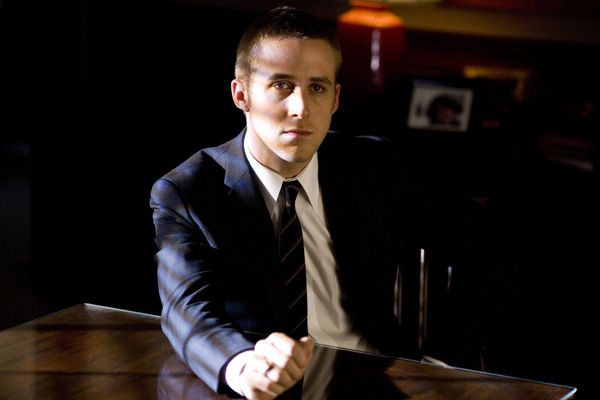
- the cocky upstart lawyer (Ryan Gosling) just begging for a come-uppence:
- the cocky genius (Anthony Hopkins) using the legal system for his own ends:
- the distracting affair with a legal superior (Rosamund Pike) that throws said "upstart" off his game:
- the mentor (Straithairn) who warns "upstart" every step of the way, while secretly pulling for the kid because he has such "pluck:"
- the legal maneuvering that twists a seemingly open-and-shut court case into a series of technicalities that derail any sense of justice:
- the tony upscale-silvery locations that serve as contrast (and siren call) to the "upstart's" stuffy offices of wood-panels and metal desks:
- the red herring revealed only at the end which casts a different light on the whole proceedings:

Will the clichés please rise while the judge enters the chambers?
Ultimately what it comes down to is an acting duel between
old war-horse Hopkins, and "new turk" Gosling, and there it's no contest. Hopkins can do more just leaning back in his chair and stretching his neck suggesting megalomania than any actor doing movies. Hopkins has bags of tricks he hasn't gotten to yet. Gosling, then, tries to match him by going the opposite route--doing too much so that his legal eagle looks jittery and scattered; Gosling's busy performance reminds one of the bizarre early work of Nicolas Cage--too much over-thinking the part, and trying too hard to get noticed, that one is distracted by the tic's in the foreground to notice any subtleties that might be working. By the ending of the film, Gosling settles down, but it comes off as too little (finally) coming too late.

Thursday, August 3, 2023

Suspensions of Disbelief —"Like, yeah-Huh!"

On my earlier film blog, I would sometimes pair up movies I'd seen recently if they had some slight connection. This is one of those. 

Juno became a smash hit, despite my reservations and Diablo Cody—and Jason Reitman—went on to do some stellar work. Both are working on things. Ellen Page is now Elliott Page, and is now identifying as a male. One thing that hasn't changed is his amazing talent. I don't change things when I move these posts from the old blog to the new blog, unless I find mistakes, so I've kept Elliott's name as it was at the time of the writing, which was at the time of the film's release. 

Director Craig Gillespie, who made Lars and the Real Girl, made I, Tonya, Cruella, and the min-series "Pam and Tommy", as well as directing Diablo Cody's mini-series "The United States of Tara."
 
--Sacred Vessels in the Land of Addictionary.org

Juno is a film so dominated by its script (by Diablo Cody*) and its actors (they're all television veterans with countless man-hours before the camera) that all director Jason Reitman has to do is get out of the way-though in the transitions he routinely cuts on the 1's of the pervasively twee-rock soundtrack to maintain the air of perkiness. The kids that dominate this film about lower-middle-class families making the most of a bad situation—well, bad in the timing—are so pervasively cute and clever in their articulation and word-play that one wonders if they hail from some part of the country where the main sport is Scrabble, and instead of MySpace they all hover around "Addictionary.org." 
Ultimately one has to ascribe to it the same rule that one applies to Bette Davis movies where everyone always has the perfect come-back: "They have better writers than we do."
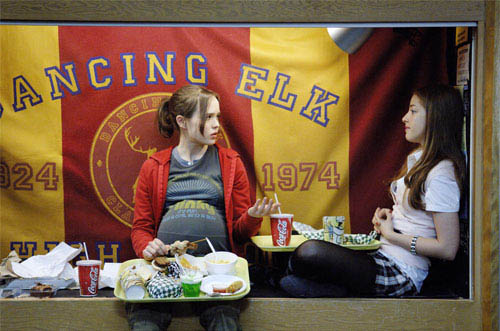
But the same troubles. Juno MacGuff (Ellen Page) starts the movie pregnant and pissed. And pissing. She's buying the home-pregnancy tests out of the box one at a time from the convenience store and using their facilities to test it. "You better pay for that pee-stick when you're done with it," says the clerk (played by "The Office's Rainn Wilson). "Don't think it's yours just because you marked it with your urine!" She gets the unholy pink "x" and starts to puzzle out how to proceed: telling parents, telling sperm-donor, what to do with said spawn, yadda yadda yadda.
Juno skips along dealing with all these crises and quite a few more, and never slides into bathos, preaching or "after-school special" earnestness. The characters are all people for whom regrets are a waste-of-time, and are too busy doing their best to do too much navel-gazing. Well, almost all. One walks away charmed, and admiring the cleverness and the near-occasion of bravery the movie displays. And there are no bad performances. Anywhere. No actor lets this material touch the ground, whether its the stunningly decent work by vet-thesps like Alison Janney and J.K. Simmons, but also wise work by Michael Cera, Jason Bateman, and, yes, Jennifer Garner. But the big bouquet goes to Ellen Page who carries the movie on her slim shoulders and always finds a way to make the dialog sound like she's just saying it off the cuff. That's a tough trick to pull for an entire movie--an entire comic movie--this entire comic movie. Frankly, it would've been easier giving birth.
------------------------------------------------------------------ 
It Takes a Sex Toy to Raise a Village
 
 
 Everybody likes Lars (Ryan Gosling). Lars is 27, lives in the carriage-house of the family home. Keeps to himself. He goes to work, eats, attends church, chops wood.

And that's about it.

Lars is socially retarded to an alarming degree, so much so that he feels it hurts to be touched. His family worries about him. They feel guilty. They don't know what to do.

But Lars does. He's surrounded by people with relationships, so he decides to get one. But that touching thing...that's a problem.

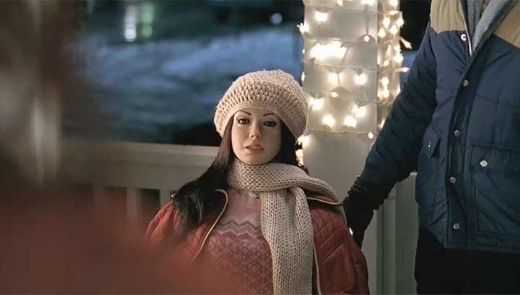
Then one day, Bianca shows up, a mail-order girlfriend. Lars tells his brother and sister-in-law that he has a girl-friend and he'll bring her over for dinner. They're elated. Then they find they didn't need the extra setting. Bianca's a sex-doll. Fairly realistic looking, but she doesn't move. At all. Lars has to carry her, until he gets her a wheelchair. He cuts her food for her. Eats it, too.
In a case of intervention, all four go to the doctor (Patricia Clarkson, being warm but acting cold), who takes one look at Bianca and worries out loud that she needs weekly treatments for her alarmingly low blood pressure, and uses the opportunity to find out exactly what is going on with Lars. She advises that they should play along--"Bianca's in town for a reason," she says. "But, people will laugh at him!" says his harried brother, played by a note-perfect Paul Schneider. "You, too," says the doc.
Lars and the Real Girl
could be perverse, and if Lars actually had relations with Bianca, people wouldn't be enjoying this movie nearly so much. Nor would it be as enjoyable if the entire town didn't, for the sake of Lars, go along with the story and accept Bianca. And that acceptance happens almost immediately. Sister-in-law Karin informs her coffee klatsch friends that Bianca is anatomically correct, and one of them says, "Soooo...she's just one of the girls, then..." The pastor of the church goes along with it. Everybody does. Ev-e-ry-bo-dy. Which set off some reality alarms for me. There aren't any disaffected youth, or jerks or morons in this town? Hell, if any of the kids from Juno lived there, Lars would be getting the "stink-eye," at least. And in a land where every inflatable Christmas lawn ornament is at risk, Bianca has it REALLY easy.
Still, it's an enjoyable film, full of heart in the right place, and offers lots of enjoyable surprises in screenplay, performance (it's hard to believe this is the same
Ryan Gosling from Fracture) and overall tone. One wishes there was a second there where one could believe in it.
---------------------------------------------------------------------------------

* Diablo Cody has such a fresh, smart way with dialog that one hasn't been as excited by a screen author's work since Zach Helm, who wrote Stranger Than Fiction. Since Helm went on to create the lead balloon Mr. Magorium's Wonder Emporium, one doesn't want to be too effusive in one's praise, lest one set oneself up for disappointment.

Wednesday, July 26, 2023

Barbie

Barbie
's Arch Support ("It's $well!")

 or
"Math is HARD! Let's Study Art as Social Commentary 101, Instead!"
 
When Greta Gerwig guested on NPR's "Wait, Wait, Don't Tell Me!" she was asked this by the host, Peter Sagal: "Do you know—one of the things that happens, it seems, is that young, talented independent directors who make a successful movie on a low budget are immediately handed enormous Hollywood blockbusters. Have you picked yours?"
 
"Oh!" she gasped."A Hollywood blockbuster? No, I have not picked my blockbuster yet. But, when I do...get ready..."
 
And here it is, Barbie, written (with Noah Baumbach) and directed by Gerwig, that seems to want to carry a lot of agendas on its plastic-ly arched foot. After all, the Barbara Millicent Roberts or "Barbie doll" has been around since 1959, "the first aspirational doll for girls" (says Barbie historian MG Lord, author of "Forever Barbie: The Unauthorized Biography of a Real Doll") "with—I search for euphemisms—the body of a German sex-worker."  Dolls were, to that point, mostly restricted to baby dolls—as the film wittily describes in its Kubrickian "Dawn of Barbie" prologue—relegating and regulating (grooming, shall we say?) the doll-owners to the role of motherhood which was what passed for ambition in a patriarchal society. But, Barbie changed all that, we are led to believe, because if Barbie could be anything (which she did after some entry level positions as a stewardess and such), women—monolithically—could also be anything. And have rad hair and clothes.
This is not much to base a movie on. And Barbie is, after all, merchandise. My prejudice—and I confess I went in prejudiced—was this: Barbie is as important to the art of cinema as the Transformers series is. As the recent Super Mario Brothers Movie is. As important as the Lego movies are. Bottom-line, it's the bottom-line: Selling product, and Barbie the movie will push kids pushing parents into the toy-aisles at far greater numbers then before its premiere.
Okay, it may do the latter, of course, but on the first point: Gerwig completely surprised me and up-ends the merchandising aspects. I knew she would not leave it at face value. I knew that there would be a satiric thrust to it ("Barbie now with 'satiric thrust' action!"), but, it could go in so many ways, one was hard-pressed to know what aspect of the Barbie-phenomenon it would choose to skewer (with the permission of the Mattel ™ and © owners, of course!).
I just didn't think it would satiric to the point of seditious, which I must confess warmed my guiltily paternalistic, capitalist-suspicious heart.
Narrator 
Helen Mirren explains things to us as she relates the relationship between the Real World and the Barbie Merchi-verse. In a sequence that compares to the morning rituals of Pee-Wee's Big Adventure, Barbie (Margot Robbie) wakes up perfectly in her Dream-House, takes a shower (there's no water, of course, as Dream-Houses didn't), mimes brushing her teeth, has a plasticized breakfast, dresses, and floats down to her car as if being carried by an invisible hand, to greet the day and the many varying Barbies, Skippers and Midge (the discontinued pregnant one), before spending the day at The Beach, where she plays with her friends, under the ever-watchful, ever-worshipful gaze of Ken (Ryan Gosling, in a lighter mood than of late), who, as they say, covets. He has no idea why as he's a toy and has no chromosomes or hormones.
After another in a perpetual string of "girls' nights", Barbie starts noticing that things aren't so perfect: she wakes up with morning breath, the water that still doesn't come out of the shower is cold, the plastic breakfast is burned, and when she steps off her balcony to get to her car, she lands with a splat. No broken parts or joints, but when she gets to the beach, things get really "off the shelf"--taking off her high heels, instead of remaining walking on tippy-toes, her HEELS touch the ground...she has FLAT FEET! 
What is happening? Barbie is supposedly perfect—she is, self-admittedly, "the original stereotypical Barbie"—and suddenly things are going wrong—"I feel sad, and mushy, and complicated"—and she even has thoughts about death. The other Barbies (and Kens) are totally grossed-out (totally!) and advise Barbie to go visit "Weird Barbie" (
Kate McKinnon)—she's the one that was played with a little too hard and a little too long—because she's seen things...and she might know what is happening to our doll.
She does, of course, speculating that somehow a portal has opened up between Barbieland and the Real World*, and it has (no doubt) been caused by the Real World person playing with this Barbie, after all, "it takes two to rip a portal." Truer words were never said.
 
She sends Barbie on a mission to the Real World to find the little girl playing with her and existence as she knows it, and fix the rift, while also being showered with thanks by all those women who owe their wonderful lives to Barbie.
Oh, dear, this will not go well. And, she is figuratively and literally in for a world of hurt. To make matters worse, Ken has stowed-away in Barbie's C4 Barbie Corvette for the trip, although he doesn't know why, just that he has to, despite the fact that she is capable and talented and pretty enough to handle the assignment on her own. "You'll just slow me down!" she yells at Ken, without even bothering to mention that he might cause her to "settle" and derail a budding career in just about anything you can imagine for domestic bliss. Barbie's, after all, live in their own little world of accomplishment—and the movie makes the point that they don't even know where the Kens live.
But, it's a different story in The Real World, where men rule everything, can be anything they want—and women can be anything they want...at 60% the pay, and the thermostats in offices are always set for men's comfort, not women's. There's no day-care, and no parental leave, and, heck, women don't even have control of their own bodies in the eyes of the legal system, and heck, it's like they're just dolls whose job it is to please no matter the mood, and have no agency...and wait a minute, Barbie really IS in the real world! 
Okay. Enough of the scenario, you might know where this is going. It's a polemic on the aspirational aspects of Barbie's play-world and the ways it differs from the reality into which those playing children will grow up. It's a satire with one eye on the world of imagination and potential and what happens when play-time is over and responsibility and irresponsibility go hand-in-fist, and life is a lot less fun. Just as hedonistic and materialistic, sure, but a lot less fun.

Credit Gerwig and Baumbach for threading the needle to make this laugh-out-loud funny and entertaining, while also making it smart, and almost too smart. There's a lot of talk of existential crises, depression-era Barbies, and prescient flashbacks ("Remember 'Proust Barbie?' Didn't sell well!") that are going to sail right over kids' heads (and some adults'), but hits a lot of sophisticated points. It tells you the Barbie movie is more aspirational in its own goals than your standard kids' movie that gets by with Saturday morning "don't be mean" social lessons. Here, it skewers stereotypical patriarchy and male egotism--which will make some adults and Ron DeSantis squirm--but, the kids will like the bright colors and the fashions and the sparkling gayness of it all (which will also make DeSantis squirm) while the parents worry about questions they'll be asked later ("I'll tell ya when yer older!").

Hey, parents, be glad there's no mention of "Barbie-heads"!
In the same way that "Rocky and Bullwinkle" skewered the Cold War 1960's while mixing in the most childish of jokes,  Barbie treads (on tippy-toes!) the highly-charged issues of gender inequities and sexual politics in our "Old Man" Society, and doing it cheekily, with the knowledge that by aiming high, the kids will eventually catch up while giving the oldsters something to chew on during the ride home. Anyone wondering what audience the filmmakers were aiming for can be answered with the simple "Everyone...eventually."
And in so doing, it gives one more aspiration for little girls to fantasize about becoming: block-busting director.

Billie Eilish and Finneas do the final credits song and once again nail it.
Somehow...after the movie, that wink seems a lot more conspiratorial....
* I would point out that there is a natural barrier between Barbie-land and The Real World called the "checkout counter"...with uniformed guards!...but that would only complicate things in an already complicated scenario,