Showing posts with label Craig Gillespie. Show all posts

Thursday, August 3, 2023

Suspensions of Disbelief —"Like, yeah-Huh!"

On my earlier film blog, I would sometimes pair up movies I'd seen recently if they had some slight connection. This is one of those. 

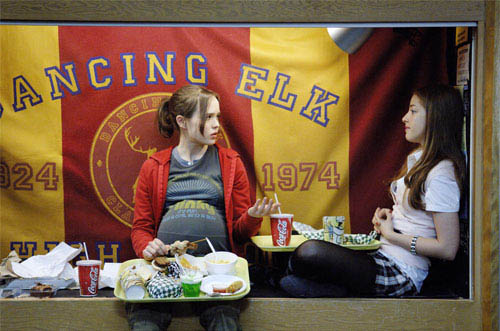
Juno became a smash hit, despite my reservations and Diablo Cody—and Jason Reitman—went on to do some stellar work. Both are working on things. Ellen Page is now Elliott Page, and is now identifying as a male. One thing that hasn't changed is his amazing talent. I don't change things when I move these posts from the old blog to the new blog, unless I find mistakes, so I've kept Elliott's name as it was at the time of the writing, which was at the time of the film's release. 

Director Craig Gillespie, who made Lars and the Real Girl, made I, Tonya, Cruella, and the min-series "Pam and Tommy", as well as directing Diablo Cody's mini-series "The United States of Tara."
 
--Sacred Vessels in the Land of Addictionary.org

Juno is a film so dominated by its script (by Diablo Cody*) and its actors (they're all television veterans with countless man-hours before the camera) that all director Jason Reitman has to do is get out of the way-though in the transitions he routinely cuts on the 1's of the pervasively twee-rock soundtrack to maintain the air of perkiness. The kids that dominate this film about lower-middle-class families making the most of a bad situation—well, bad in the timing—are so pervasively cute and clever in their articulation and word-play that one wonders if they hail from some part of the country where the main sport is Scrabble, and instead of MySpace they all hover around "Addictionary.org." 
Ultimately one has to ascribe to it the same rule that one applies to Bette Davis movies where everyone always has the perfect come-back: "They have better writers than we do."
But the same troubles. Juno MacGuff (Ellen Page) starts the movie pregnant and pissed. And pissing. She's buying the home-pregnancy tests out of the box one at a time from the convenience store and using their facilities to test it. "You better pay for that pee-stick when you're done with it," says the clerk (played by "The Office's Rainn Wilson). "Don't think it's yours just because you marked it with your urine!" She gets the unholy pink "x" and starts to puzzle out how to proceed: telling parents, telling sperm-donor, what to do with said spawn, yadda yadda yadda.
Juno skips along dealing with all these crises and quite a few more, and never slides into bathos, preaching or "after-school special" earnestness. The characters are all people for whom regrets are a waste-of-time, and are too busy doing their best to do too much navel-gazing. Well, almost all. One walks away charmed, and admiring the cleverness and the near-occasion of bravery the movie displays. And there are no bad performances. Anywhere. No actor lets this material touch the ground, whether its the stunningly decent work by vet-thesps like Alison Janney and J.K. Simmons, but also wise work by Michael Cera, Jason Bateman, and, yes, Jennifer Garner. But the big bouquet goes to Ellen Page who carries the movie on her slim shoulders and always finds a way to make the dialog sound like she's just saying it off the cuff. That's a tough trick to pull for an entire movie--an entire comic movie--this entire comic movie. Frankly, it would've been easier giving birth.
------------------------------------------------------------------ 
It Takes a Sex Toy to Raise a Village
 
 
 Everybody likes Lars (Ryan Gosling). Lars is 27, lives in the carriage-house of the family home. Keeps to himself. He goes to work, eats, attends church, chops wood.

And that's about it.

Lars is socially retarded to an alarming degree, so much so that he feels it hurts to be touched. His family worries about him. They feel guilty. They don't know what to do.

But Lars does. He's surrounded by people with relationships, so he decides to get one. But that touching thing...that's a problem.

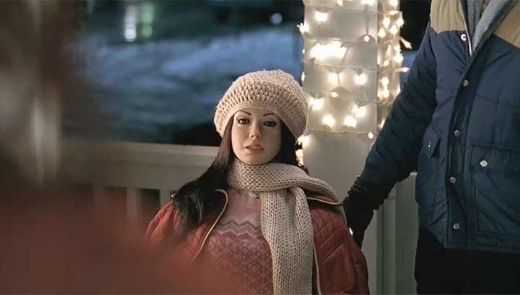
Then one day, Bianca shows up, a mail-order girlfriend. Lars tells his brother and sister-in-law that he has a girl-friend and he'll bring her over for dinner. They're elated. Then they find they didn't need the extra setting. Bianca's a sex-doll. Fairly realistic looking, but she doesn't move. At all. Lars has to carry her, until he gets her a wheelchair. He cuts her food for her. Eats it, too.
In a case of intervention, all four go to the doctor (Patricia Clarkson, being warm but acting cold), who takes one look at Bianca and worries out loud that she needs weekly treatments for her alarmingly low blood pressure, and uses the opportunity to find out exactly what is going on with Lars. She advises that they should play along--"Bianca's in town for a reason," she says. "But, people will laugh at him!" says his harried brother, played by a note-perfect Paul Schneider. "You, too," says the doc.
Lars and the Real Girl
could be perverse, and if Lars actually had relations with Bianca, people wouldn't be enjoying this movie nearly so much. Nor would it be as enjoyable if the entire town didn't, for the sake of Lars, go along with the story and accept Bianca. And that acceptance happens almost immediately. Sister-in-law Karin informs her coffee klatsch friends that Bianca is anatomically correct, and one of them says, "Soooo...she's just one of the girls, then..." The pastor of the church goes along with it. Everybody does. Ev-e-ry-bo-dy. Which set off some reality alarms for me. There aren't any disaffected youth, or jerks or morons in this town? Hell, if any of the kids from Juno lived there, Lars would be getting the "stink-eye," at least. And in a land where every inflatable Christmas lawn ornament is at risk, Bianca has it REALLY easy.
Still, it's an enjoyable film, full of heart in the right place, and offers lots of enjoyable surprises in screenplay, performance (it's hard to believe this is the same
Ryan Gosling from Fracture) and overall tone. One wishes there was a second there where one could believe in it.
---------------------------------------------------------------------------------

* Diablo Cody has such a fresh, smart way with dialog that one hasn't been as excited by a screen author's work since Zach Helm, who wrote Stranger Than Fiction. Since Helm went on to create the lead balloon Mr. Magorium's Wonder Emporium, one doesn't want to be too effusive in one's praise, lest one set oneself up for disappointment.

Friday, January 26, 2018

I, Tonya

The Bull in the China Shop
or
Tonya Harding Accepts Your Damn Apology

"I hear they're making a sequel to I ,Tonya called I, Nancy: it's about a nice lady who gets her knee bashed in by some trailer-park assassin and then 25 years later has to see a great award-winning movie about how she's NOT the victim..."
John Mullaney

I, Tonya (like The Post) was on the 2016 Annual "Black List" of interesting un-produced film scripts. But, it's the description—also used in the film's introduction—that grabs you: "Based on the irony free, wildly contradictory, totally true interviews with Tonya Harding and Jeff Gillooly." 

And thereby hangs the tale. The way the movie sets itself up is as a series of filmed interviews—with Harding (Margot Robbie), Gillooly (Sebastian Stan), Harding's mother Levon Golden (Allison Janney), Harding's "bodyguard" and Gillooly friend Shawn Eckhardt (Paul Walter Hauser), and an anonymous producer from "Hard Copy" the tabloid news syndicated show ("that everybody else has become," the guy snarks) that gives "the bigger picture" on the story—soon settles into a wide-screen narrative of Harding's ascent as an athletic tom-boy in the pristine princess world of figure skating. It quickly establishes that Tonya, growing up (played by Maizie Smith at 3 1/2 and the amazing McKenna Grace at 8) in Portland, Oregon, is a "daddy's girl" who wants nothing more than to ice-skate and do the things she sees the girls on TV do. Her mother strong-arms a skating coach (Julianne Nicholson) to take on the kid—but she has to take on the mother (now divorced again), too, who will not back down from any instinct to correct.
That relationship is abusive, too. But, Tonya ends up, at 9, winning skating competitions over older and more practiced skaters. This is explained by Tonya's tenaciousness (and the occasional bribe by Mom to a heckler—who, in the "totally true interviews," admitted that?). By age 16, Tonya is dating Gillooly (whom she meets—with Eckhardt at his side—at the rink), then after a particularly sticky argument with her mother, she's moving in with him, but after a certain period of adjustment, that relationship turns abusive, too...abusive enough that they get married.  
In the mean time, Tonya wins competition after competition. She is just so doggedly determined that she easily blows everybody off the ice. But, when it comes to national competitions, she can be as good as she can get, but the scores will not reflect it...because Tonya is an athlete rather than a performer, a fighter not a dancer, and compromise does not come easily to her. She plays the game, but harbors a deep suspicion that she will lose to any pixie with no muscles and a cute costume. This might be paranoid if it weren't absolutely true.
But, she still has the talent that pushes her beyond complacency and she begins to push through the prejudices with more and more ambitious programs, culminating in her doing a triple axle in competition (only six women in the world have done it and it's such a tough move that no one even attempted it for the movie—it's accomplished by special effects and some judicial editing). Once Harding is on the map, the pressures of fame and her antic private life combine to lead to what everybody in the movie calls "The Incident."
"The Incident" ("the part you really want to know") is well known on a surface level, but the devil of these things is always in the details and that's where the repetition of half-truths and a tsunami of comedy wash-back has conspired to make it seem as if Tonya took a bat and beat up Nancy Kerrigan herself, instead of the confederacy of dunces that pulled off the attack (clumsily but effectively). All of a sudden, that isolating field of ice started to get very crowded with the weight of coverage, overshadowing any competition being conducted, and turning it into a carnival atmosphere—how could it be anything else with an unprovoked attack making news. Instead of increasing security at these events, it became a circus that the media controlled.
At this point, it's more blood-sport than sport, as anything "sporting" becomes suffused with tabloid trash. It's an industry now, even football games are given a "fairy story" for the viewing public to consume along with their beer and nacho's but it has as much to do with the game as it does with popularity contests at High School. But, the industry will tell you, it "pegs the ol' meter." Blame ABC Sports Producer Roone Arledge's "Up Close and Personal" approach to sports coverage, so that now we can't have a singing contest on TV without the little "personal" film filled with the longings and desires and epiphanies of every single contestant on the show, whether it's pertinent or not. You gotta build the fairy tale...and in competitive figure-skating that applies to every tinker-bell gliding across the frosted ice arena and the starry-eyed judges who don't see it as a competition, but an art...a show, complete with music, costumes, and choreography—thank God, sprinters don't have to be concerned with such nonsense; their only judge is the clock not the prejudiced eye of the beholder. Or the audience.
As entertaining as I, Tonya—in its "irony-free" cloaking—may be, it is not unjudgmental. In fact, it seems to wallow in a cruelty to the subjects that reminded me of the nasty tinge with which Midnight Cowboy presented its characters (and bear in mind, these are human beings who are, for the most part, still alive). The movie likes to point fingers and accuse us, the audience, of continuing the cycle of abuse that Tonya Harding grew up in, and stepped in, her entire life. But, the movie is complicit, too, escalating the carnage and being clever in its choice of music to underscore scenes for the sake of "entertainment" and, yes, irony. It is its own "hit-piece" with the cooperation of of the very people it is undermining. There is something very sick and twisted going on there.
But, it didn't actually make me mad until the end-narration where the movie Tonya Harding sums it all up:

I was the second most known person behind Bill Clinton in the world. That meant something. People still wanted to see me. So I became a lady boxer. I mean, why not? Violence was always what I knew anyway.
America, you know. They want someone to love but they want someone to hate. And they want it easy.

But what’s easy? The haters always say, Tonya just tell the truth. But there’s no such thing as truth. It’s bullshit.

Everyone has their own truth. And life just does whatever the fuck it wants.

No. People who don't face facts say that "everyone has their own truth." Because, there is truth; anything else is just perception. And that's not truth, it's opinion. Now, opinion is always easier than truth because truth is complicated with details and timing and motivation, and so it's not something covered in 5 minute segments in a 24/7 news cycle. Truth comes with perspective and objectivity. And it doesn't come easy, so it's often overlooked by the Wisdom of the Tribe, which is easier and comfortable and often 180 degrees wrong in the details. And, whatever, everybody's too busy to really care about the truth...and, whenever a contradiction to their opinion of truth comes along, they'll just forget it. Or deny it. Or discount it. And stick with their own truth.

Which isn't truth. It's opinion. 
So I, Tonya—my opinion (or "my truth" by the twisted parameters of the movie). It's well-done. It's entertaining. I didn't like it, but I am willing to concede that it is the perfect movie for what America stands for right now.

God help us.


Pure Tonya Harding, without controversy, without irony...just talent