Showing posts with label Paul Schneider. Show all posts

Friday, March 29, 2024

Bright Star

Every so often you get bored with writing reviews—and I don't have a supervisor or editor (that should be obvious by a scan of the material) and I do this as a hobby and a form of preserving some space in my brain. But, one gets tired of writing Thesis/Description/Particulars/Summation on a perpetual basis. One gets in a rut, which isn't good for me (the writer) and you (the reader, one hopes). So sometimes, one experiments.

This was one of those times.

Looking back on it, I find it amusing, not exactly helpful as far as details, and the writing almost as tortured as the doomed romance portrayed.

Eh. "You win some, you lose some"...just like love.

Composed at the time of the film's release...
 

"Perish the Thought"*

There are many artists I would put inside the director's pantheon,
But of all those chaps, among my faves is
Jane (the Aussie) Campion.

Her heroes (mostly female) both imbue and fight the schisms
that go along (as well they might) with social ostracism,

maintaining self, their specialness, not merely as statistic
that goes against the status quo
of things paternalistic.

Campion works in
mythic films, the types you can get lost in,
But this one takes some pages from
that other Jane (Ms. Austen).

For though her films have, in the past, explored romantic themes,
I'd call them cautionary, "
love's not always what it seems."
But
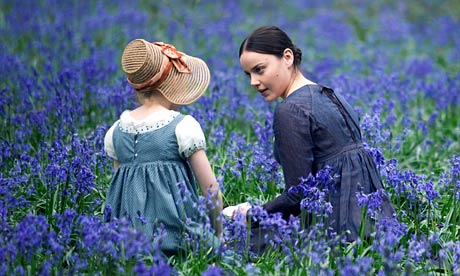
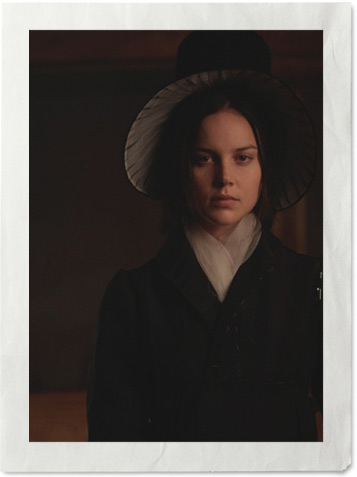
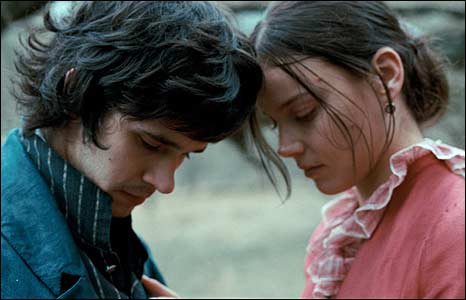
this tale of Miss Fanny Brawne and lovin' bard, John Keats
shows a more impassioned love, although keeping it discreet.

It's not like modern movies where the sex is done to death
The most explicit this one gets is int'mate shuddering breaths.
The costumes are exquisite
, the period details, right
Abbie Cornish and Ben Whishaw make you feel their love's delight.

It truly is amazing the director took this chance
to realize, to dramatize unmodernized romance
I wouldn't be surprised to find this one in Oscar's thicket.

That's why I grant
Bright Star a most deserv'd "Full Price Ticket."**

* Shall I review Bright Star in verse?
(I don't know. I could do worse)

** My old blog—from where this thing comes—had a rating system (which I now don't do because I hate them and hate the parsing—3 stars or 4 stars? Hmmm), which based movies on the amount of money you should spend on it, which went (from highest to lowest):


Full Price Ticket
Matinee
Rental ("Rental? What's THAT?!")
Cable-Watcher
A Waste of Time 


When I started B/C-L, I abandoned the rating system entirely, as I've reconsidered the monetization of worth, but, at the time, I thought it was a good idea, as it was inspired by the quote from Alfred Hitchcock: "A good film is when the price of the dinner, the theatre admission and the babysitter were worth it."

Thursday, August 3, 2023

Suspensions of Disbelief —"Like, yeah-Huh!"

On my earlier film blog, I would sometimes pair up movies I'd seen recently if they had some slight connection. This is one of those. 

Juno became a smash hit, despite my reservations and Diablo Cody—and Jason Reitman—went on to do some stellar work. Both are working on things. Ellen Page is now Elliott Page, and is now identifying as a male. One thing that hasn't changed is his amazing talent. I don't change things when I move these posts from the old blog to the new blog, unless I find mistakes, so I've kept Elliott's name as it was at the time of the writing, which was at the time of the film's release. 

Director Craig Gillespie, who made Lars and the Real Girl, made I, Tonya, Cruella, and the min-series "Pam and Tommy", as well as directing Diablo Cody's mini-series "The United States of Tara."
 
--Sacred Vessels in the Land of Addictionary.org

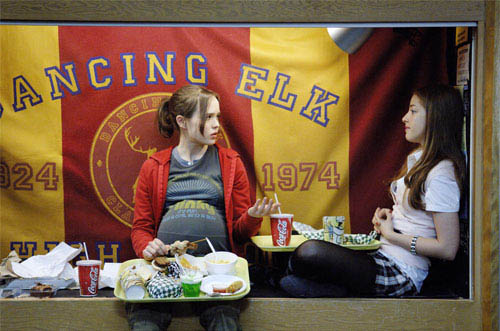
Juno is a film so dominated by its script (by Diablo Cody*) and its actors (they're all television veterans with countless man-hours before the camera) that all director Jason Reitman has to do is get out of the way-though in the transitions he routinely cuts on the 1's of the pervasively twee-rock soundtrack to maintain the air of perkiness. The kids that dominate this film about lower-middle-class families making the most of a bad situation—well, bad in the timing—are so pervasively cute and clever in their articulation and word-play that one wonders if they hail from some part of the country where the main sport is Scrabble, and instead of MySpace they all hover around "Addictionary.org." 
Ultimately one has to ascribe to it the same rule that one applies to Bette Davis movies where everyone always has the perfect come-back: "They have better writers than we do."
But the same troubles. Juno MacGuff (Ellen Page) starts the movie pregnant and pissed. And pissing. She's buying the home-pregnancy tests out of the box one at a time from the convenience store and using their facilities to test it. "You better pay for that pee-stick when you're done with it," says the clerk (played by "The Office's Rainn Wilson). "Don't think it's yours just because you marked it with your urine!" She gets the unholy pink "x" and starts to puzzle out how to proceed: telling parents, telling sperm-donor, what to do with said spawn, yadda yadda yadda.
Juno skips along dealing with all these crises and quite a few more, and never slides into bathos, preaching or "after-school special" earnestness. The characters are all people for whom regrets are a waste-of-time, and are too busy doing their best to do too much navel-gazing. Well, almost all. One walks away charmed, and admiring the cleverness and the near-occasion of bravery the movie displays. And there are no bad performances. Anywhere. No actor lets this material touch the ground, whether its the stunningly decent work by vet-thesps like Alison Janney and J.K. Simmons, but also wise work by Michael Cera, Jason Bateman, and, yes, Jennifer Garner. But the big bouquet goes to Ellen Page who carries the movie on her slim shoulders and always finds a way to make the dialog sound like she's just saying it off the cuff. That's a tough trick to pull for an entire movie--an entire comic movie--this entire comic movie. Frankly, it would've been easier giving birth.
------------------------------------------------------------------ 
It Takes a Sex Toy to Raise a Village
 
 
 Everybody likes Lars (Ryan Gosling). Lars is 27, lives in the carriage-house of the family home. Keeps to himself. He goes to work, eats, attends church, chops wood.

And that's about it.

Lars is socially retarded to an alarming degree, so much so that he feels it hurts to be touched. His family worries about him. They feel guilty. They don't know what to do.

But Lars does. He's surrounded by people with relationships, so he decides to get one. But that touching thing...that's a problem.

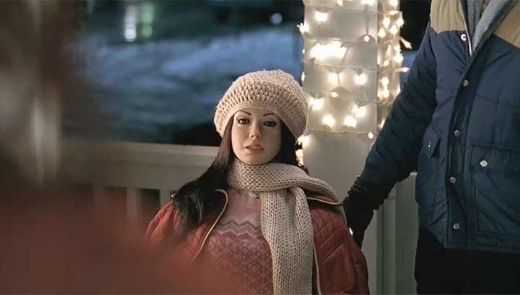
Then one day, Bianca shows up, a mail-order girlfriend. Lars tells his brother and sister-in-law that he has a girl-friend and he'll bring her over for dinner. They're elated. Then they find they didn't need the extra setting. Bianca's a sex-doll. Fairly realistic looking, but she doesn't move. At all. Lars has to carry her, until he gets her a wheelchair. He cuts her food for her. Eats it, too.
In a case of intervention, all four go to the doctor (Patricia Clarkson, being warm but acting cold), who takes one look at Bianca and worries out loud that she needs weekly treatments for her alarmingly low blood pressure, and uses the opportunity to find out exactly what is going on with Lars. She advises that they should play along--"Bianca's in town for a reason," she says. "But, people will laugh at him!" says his harried brother, played by a note-perfect Paul Schneider. "You, too," says the doc.
Lars and the Real Girl
could be perverse, and if Lars actually had relations with Bianca, people wouldn't be enjoying this movie nearly so much. Nor would it be as enjoyable if the entire town didn't, for the sake of Lars, go along with the story and accept Bianca. And that acceptance happens almost immediately. Sister-in-law Karin informs her coffee klatsch friends that Bianca is anatomically correct, and one of them says, "Soooo...she's just one of the girls, then..." The pastor of the church goes along with it. Everybody does. Ev-e-ry-bo-dy. Which set off some reality alarms for me. There aren't any disaffected youth, or jerks or morons in this town? Hell, if any of the kids from Juno lived there, Lars would be getting the "stink-eye," at least. And in a land where every inflatable Christmas lawn ornament is at risk, Bianca has it REALLY easy.
Still, it's an enjoyable film, full of heart in the right place, and offers lots of enjoyable surprises in screenplay, performance (it's hard to believe this is the same
Ryan Gosling from Fracture) and overall tone. One wishes there was a second there where one could believe in it.
---------------------------------------------------------------------------------

* Diablo Cody has such a fresh, smart way with dialog that one hasn't been as excited by a screen author's work since Zach Helm, who wrote Stranger Than Fiction. Since Helm went on to create the lead balloon Mr. Magorium's Wonder Emporium, one doesn't want to be too effusive in one's praise, lest one set oneself up for disappointment.

Wednesday, March 14, 2018

Water for Elephants

Written at the time of the film's release...

"To Talent and Illusion..."
or
"Jacob Jankowski, The Only"

Really, there's nothing too special about Water for Elephants, other than it's a well-told tale that doesn't treat its audience like they're idiots, showing you things that happen, rather than showing you and having some helpful person with a grasp of the obvious tell you what you're seeing. This is nice. And before the film goes South in its last third, it's a cut above your standard romance story. Told in flashback (the framing sequence features Hal Holbrook  and Paul Schneider and I could've used a lot more of them), it's mostly a period piece set in 1931 during the days of Prohibition of a young veterinary student, Jacob Jankowski (Robert Pattinson), who must drop out due to circumstances of Fate.  Without inheritance and no foreseeable future, he hitches a ride on a passing train and barely escapes being tossed off it.
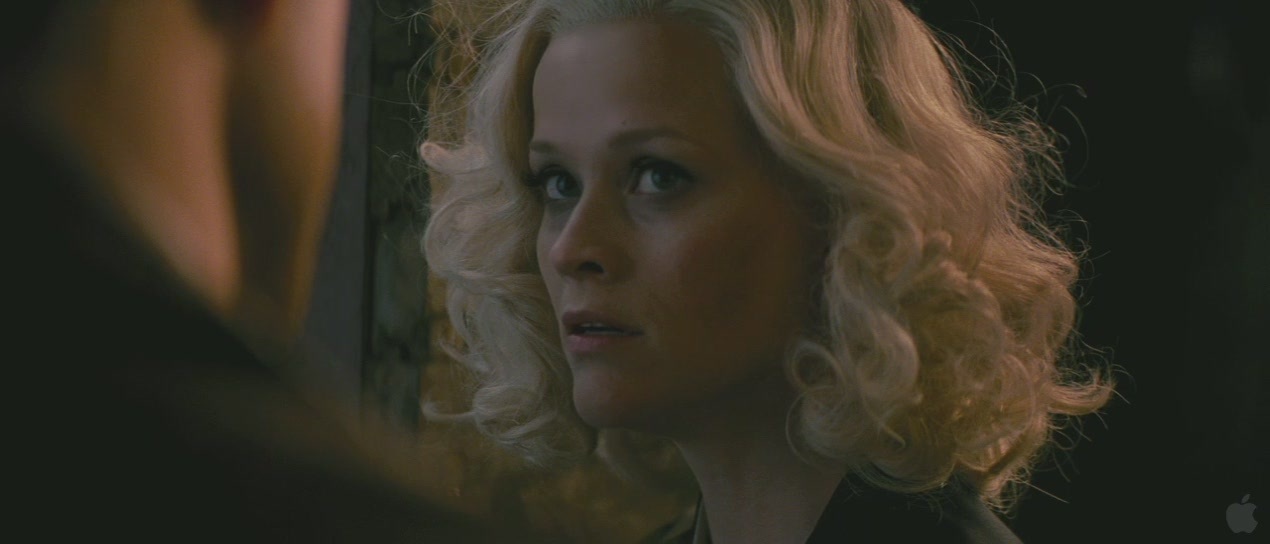
In the morning, in a lovely shot that moves out of the freight car he's been sleeping in, he discovers he's hitched his way into the circusthe Berzini Brothers circus, specifically, a down-on-its-luck travelling menagerie of animals and people just one rung up from them trying to eke out an existence during the dark days of the Depression. He finds temporary work mucking out the cages but it isn't too long before his veterinary skills make him indispensable to the inscrutable owner August (Christoph Waltz, finally finding a project worthy of his talents) and his main attraction, a stunt equestrienne named Marlene (Reese Witherspoon, all platinum blonded and permed, almost resembling Madeline Kahn).
It doesn't take a genius to know where this is going, but director Francis Lawrence (I Am Legendthe best parts of his movies seem to involve animals) manages to make it interesting before the romantic sub-plot kicks in. Until then, Water for Elephants is quite interesting in its portrayal of carny life amidst the human mis-fits. Things become very interesting when August, picking among the scraps of a dead circus—one of the many that are going broke during the hard economic times—finds his new star attraction, onto whose hide he pins all of the circus' economic hopes—a bull pachyderm named Rosie. Dismissed by its previous owner as being none-too-bright, it is Jankowski's job to take care of and train the elephant to become the star of the show, aided and abetted by Marlene. Where August is content to just beat the animal into compliance, Jankowski develops a bond with the beast, throwing him at odds with the ring-master and closer to the woman.
I remember working at a radio station in a small town when a circus set up stakes in the same parking lot of the local Montgomery Wards' the station perched on. Walking out the studios' back door led you straight to the holding area for the elephants and I would spend my lunch hours, watching them rock back and forth, their only restraint being a coil of rope around their foot and the memory of the chain that used to be there. I could never tell whether that huge elephant was content, bored or crazy, but I knew that it was huge, that it could have taken me out, and maybe the station and maybe the Monkey Ward's, given the time, inclination and a substantial telephone pole. But for now, it was content to watch me watching it, and swaying, forever swaying—something to do before the food arrived. Was it the elephant version of rocking in the corner, or was it dancing?
I thought about that elephant a lot during Water for Elephants and what was in its mind as I sat watching it while it watched me.  I wondered where it is now and if it remembered the kid that sat contemplating it on those hot Summer days.  Probably not.  But, I remembered it, as well as a couple of the actors appearing in this movie that I'd worked with and admired (Good work on their parts, and I noted how they'd made something more of their small parts that didn't require the breadth of their talents—nice stuff, Scott and John).  Everybody's good in it and I was amused that more attention seemed to be paid lighting Pattinson than Witherspoonthat might please his fan-base.
But, as I said...nothing too special, although there is solid work throughout, and not too unlike a circus—a pleasant diversion that manages to take you away from the real destruction going on in the real world.

Wednesday, August 17, 2016

The Assassination of Jesse James by the Coward Robert Ford

Written at the time of the film's release with a 2016 post-script

The Assassination of Jesse James by the Coward Robert Ford  (Andrew Dominik, 2007)

Poor Jesse had a wife to mourn for his life,
Three children, they were brave;
But the dirty little coward
that shot Mr. Howard*
Has laid Jesse James in his grave

That's from the old song "The Ballad of Jesse James" which I remember from my youth, forever enshrining James and the "dirty little coward" Robert Ford in my memory. It was written by one Billy Gashade (who took pains to include himself in the lyrics, naturally) soon after the outlaw's death. As with so much in the Jesse James business, it is reflective of the myth of Jesse James rather than the reality. 

For instance (as the Ford character points out in the movie) Jesse only had two kids. 
The fact behind the myth was that Jesse James was a vicious little punk—racist, paranoid, just as capable of killing friends as enemies, and women and children in the bargain. And while it's true he did rob from the rich—his target was banks and trains (or Union veterans)—the legend that he gave to the poor only extended to himself and members of his gang. 
Besides, you rob from the rich because that's where the money is.

No one who sees Jesse James as a folk-hero, or seeks to profit from that image, mentions the mutilations he would perform on his victims. It kinda gets in the way of the "fun." Yet, folks in Missouri still talk of the history of Jesse James (I once stayed in a hotel that advertised he slept there), and there's even a feud going on about whether Jesse really did die, and there are folks who want to dig him up to check DNA evidence to claim family affiliation. The myth rolls on. The lies that were sold in the pulp-magazines during his life are still at work, and as the line from The Man Who Shot Liberty Valance goes: "This is the West, sir. If the Legend becomes Fact, print the Legend." Even if it is a god-damned lie and the guy was a scum-bag.
It is the yin and yang of truth and fiction that suffuses The Assassination of Jesse James by the Coward Robert Ford, but then it did in reality, too. The conceit of the film (and the book by Ron Hansen on which it is based) is that Robert Ford was a product of a pulp-western inspired hero-worship, that Jesse had his eye on the stories, too, and their mutual attraction and loathing of the truth behind it was the music to the dance of death they engaged in. Robert Ford was a nobody, and, in the film's words "Jesse James stood as tall as a tree." And that set up a love-hate relationship with the unstable hoodlum. "I can't figger it out," says Brad Pitt's Jesse to Casey Affleck's Bob Ford. "Do you wanna be like me, or do you wanne be me?" 
In the film, Ford doesn't know himself and the answer changes depending on his fortunes...and his fears. But as the cliche goes there's only room for one of them, and if there's no doubt that the strong will prevail, there is some question which one that would be. Maybe it will merely be a case of who is the least weak. Ironically, both will go on to greater fame and infamy.
Andrew Dominick's film meanders between an informative narration** spoken over landscapes beneath time-lapsed speeding clouds, as if Nature is careening to a foregone conclusion, while the figures take their own sweet time getting there. Dominick has a formalism going with those fleeting clouds and shots that are framed by a time-distancing diffusion. But it's very inconsistent, and rendered meaningless--no doubt due to post-production cutting by Producer Ridley Scott and star Pitt to punch up the pace. 
If it's not all Dominick wanted it to be, at least there remains some terrific performances all-around. Pitt is at his enigmatic best here, an unreadable half-smile on his face in all occasions. Sam Rockwell as Ford's older brother and fellow gang member gives another off-kilter performance that is spot-on. Along the way there are terrific cameos by Sam Shepard, Michael Parks and Ted Levine (and one distracting one by James Carville), but the stand-out is Casey Affleck. Affleck is every insecure, withdrawn kid who talks big, with a defensive smile on his face, and eyes that roll protectively up into his head when challenged. He's a train-wreck waiting to happen. And Jesse James specialized at trains.
If you're of a patient frame of mind, and have a taste for an unromantic West with heavy-handed irony then The Assassination of Jesse James is for you. But if not, it's a rental.
Narration: He was growing into middle age, and was living then in a bungalow on Woodland Avenue. He installed himself in a rocking chair and smoked a cigar down in the evenings as his wife wiped her pink hands on an apron and reported happily on their two children. His children knew his legs, the sting of his mustache against their cheeks. They didn't know how their father made his living, or why they so often moved. They didn't even know their father's name. He was listed in the city directory as Thomas Howard. And he went everywhere unrecognized and lunched with Kansas City shopkeepers and merchants, calling himself a cattleman or a commodities investor, someone rich and leisured who had the common touch. He had two incompletely healed bullet holes in his chest and another in his thigh. He was missing the nub of his left middle finger and was cautious, lest that mutilation be seen. He also had a condition that was referred to as "granulated eyelids" and it caused him to blink more than usual as if he found creation slightly more than he could accept. Rooms seemed hotter when he was in them. Rains fell straighter. Clocks slowed. Sounds were amplified. He considered himself a Southern loyalist and guerrilla in a Civil War that never ended. He regretted neither his robberies, nor the seventeen murders that he laid claim to. He had seen another summer under in Kansas City, Missouri and on September 5th in the year 1881, he was thirty-four-years-old.


The view from 2016: 

I was writing less and faster when I did this and there are some things that are remiss. In hindsight, I should mention it's an early film, not only of Sam Rockwell, but a pre-fame Jeremy Renner, the wonderful Paul Schneider, and Garret Dillahunt, as well as brief cameos by Nick Cave and Zooey Deschanel.
But, I think the biggest sin here is there isn't even a mention of Roger Deakins, who did the cinematography. One thing that DOES stand out about The Assassination of Jesse James, besides its rather astringent presentation—narration over tableau/scene/narration over tableau—is the beautiful imagery Deakins pulls out of his camera, to the point where it's almost trying to create myth in its own manner, by the sheer beauty and care of the images, some even diffused at the edges to give it a "magic camera" feel. 
Deakins, the go-to cameraman for the Coen Brothers, Sam Mendes, and so many others, knows that the images will become as communicative as the narration in those tableaux and he has a great ally in Dominick (who is also a cinematographer, working with Terrence Malick on The New World) in achieving amazing images throughout the film, but none more so than when the world is still and actors are not having to hit marks.
Narratively, the film is still a bit of a mess, but a second look recently struck me how beautiful the thing looks. It truly one of the best examples of Deakins' work in a storied career.

* "Thomas Howard" was the alias Jesse James was using at the time of his death.

** The narration has its own problems. One is not too sure of its reliability. For instance, in describing Jesse it states that he had "granulated eye-lids" which caused him to blink excessively, though part of Brad Pitt's performance is a protracted concentration, where he stares but does not blink. Then, the narration goes all flowery on the subject "...caused him to blink as if the world was too big to take in for too long." The film has its own problems with truth and myth.