Showing posts with label Michael Cera. Show all posts

Thursday, August 3, 2023

Suspensions of Disbelief —"Like, yeah-Huh!"

On my earlier film blog, I would sometimes pair up movies I'd seen recently if they had some slight connection. This is one of those. 

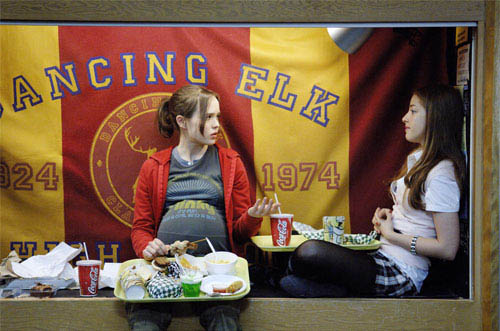
Juno became a smash hit, despite my reservations and Diablo Cody—and Jason Reitman—went on to do some stellar work. Both are working on things. Ellen Page is now Elliott Page, and is now identifying as a male. One thing that hasn't changed is his amazing talent. I don't change things when I move these posts from the old blog to the new blog, unless I find mistakes, so I've kept Elliott's name as it was at the time of the writing, which was at the time of the film's release. 

Director Craig Gillespie, who made Lars and the Real Girl, made I, Tonya, Cruella, and the min-series "Pam and Tommy", as well as directing Diablo Cody's mini-series "The United States of Tara."
 
--Sacred Vessels in the Land of Addictionary.org

Juno is a film so dominated by its script (by Diablo Cody*) and its actors (they're all television veterans with countless man-hours before the camera) that all director Jason Reitman has to do is get out of the way-though in the transitions he routinely cuts on the 1's of the pervasively twee-rock soundtrack to maintain the air of perkiness. The kids that dominate this film about lower-middle-class families making the most of a bad situation—well, bad in the timing—are so pervasively cute and clever in their articulation and word-play that one wonders if they hail from some part of the country where the main sport is Scrabble, and instead of MySpace they all hover around "Addictionary.org." 
Ultimately one has to ascribe to it the same rule that one applies to Bette Davis movies where everyone always has the perfect come-back: "They have better writers than we do."
But the same troubles. Juno MacGuff (Ellen Page) starts the movie pregnant and pissed. And pissing. She's buying the home-pregnancy tests out of the box one at a time from the convenience store and using their facilities to test it. "You better pay for that pee-stick when you're done with it," says the clerk (played by "The Office's Rainn Wilson). "Don't think it's yours just because you marked it with your urine!" She gets the unholy pink "x" and starts to puzzle out how to proceed: telling parents, telling sperm-donor, what to do with said spawn, yadda yadda yadda.
Juno skips along dealing with all these crises and quite a few more, and never slides into bathos, preaching or "after-school special" earnestness. The characters are all people for whom regrets are a waste-of-time, and are too busy doing their best to do too much navel-gazing. Well, almost all. One walks away charmed, and admiring the cleverness and the near-occasion of bravery the movie displays. And there are no bad performances. Anywhere. No actor lets this material touch the ground, whether its the stunningly decent work by vet-thesps like Alison Janney and J.K. Simmons, but also wise work by Michael Cera, Jason Bateman, and, yes, Jennifer Garner. But the big bouquet goes to Ellen Page who carries the movie on her slim shoulders and always finds a way to make the dialog sound like she's just saying it off the cuff. That's a tough trick to pull for an entire movie--an entire comic movie--this entire comic movie. Frankly, it would've been easier giving birth.
------------------------------------------------------------------ 
It Takes a Sex Toy to Raise a Village
 
 
 Everybody likes Lars (Ryan Gosling). Lars is 27, lives in the carriage-house of the family home. Keeps to himself. He goes to work, eats, attends church, chops wood.

And that's about it.

Lars is socially retarded to an alarming degree, so much so that he feels it hurts to be touched. His family worries about him. They feel guilty. They don't know what to do.

But Lars does. He's surrounded by people with relationships, so he decides to get one. But that touching thing...that's a problem.

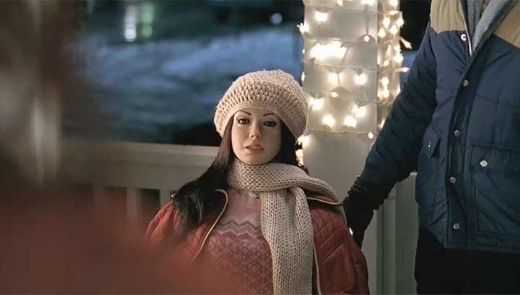
Then one day, Bianca shows up, a mail-order girlfriend. Lars tells his brother and sister-in-law that he has a girl-friend and he'll bring her over for dinner. They're elated. Then they find they didn't need the extra setting. Bianca's a sex-doll. Fairly realistic looking, but she doesn't move. At all. Lars has to carry her, until he gets her a wheelchair. He cuts her food for her. Eats it, too.
In a case of intervention, all four go to the doctor (Patricia Clarkson, being warm but acting cold), who takes one look at Bianca and worries out loud that she needs weekly treatments for her alarmingly low blood pressure, and uses the opportunity to find out exactly what is going on with Lars. She advises that they should play along--"Bianca's in town for a reason," she says. "But, people will laugh at him!" says his harried brother, played by a note-perfect Paul Schneider. "You, too," says the doc.
Lars and the Real Girl
could be perverse, and if Lars actually had relations with Bianca, people wouldn't be enjoying this movie nearly so much. Nor would it be as enjoyable if the entire town didn't, for the sake of Lars, go along with the story and accept Bianca. And that acceptance happens almost immediately. Sister-in-law Karin informs her coffee klatsch friends that Bianca is anatomically correct, and one of them says, "Soooo...she's just one of the girls, then..." The pastor of the church goes along with it. Everybody does. Ev-e-ry-bo-dy. Which set off some reality alarms for me. There aren't any disaffected youth, or jerks or morons in this town? Hell, if any of the kids from Juno lived there, Lars would be getting the "stink-eye," at least. And in a land where every inflatable Christmas lawn ornament is at risk, Bianca has it REALLY easy.
Still, it's an enjoyable film, full of heart in the right place, and offers lots of enjoyable surprises in screenplay, performance (it's hard to believe this is the same
Ryan Gosling from Fracture) and overall tone. One wishes there was a second there where one could believe in it.
---------------------------------------------------------------------------------

* Diablo Cody has such a fresh, smart way with dialog that one hasn't been as excited by a screen author's work since Zach Helm, who wrote Stranger Than Fiction. Since Helm went on to create the lead balloon Mr. Magorium's Wonder Emporium, one doesn't want to be too effusive in one's praise, lest one set oneself up for disappointment.

Wednesday, July 26, 2023

Barbie

Barbie
's Arch Support ("It's $well!")

 or
"Math is HARD! Let's Study Art as Social Commentary 101, Instead!"
 
When Greta Gerwig guested on NPR's "Wait, Wait, Don't Tell Me!" she was asked this by the host, Peter Sagal: "Do you know—one of the things that happens, it seems, is that young, talented independent directors who make a successful movie on a low budget are immediately handed enormous Hollywood blockbusters. Have you picked yours?"
 
"Oh!" she gasped."A Hollywood blockbuster? No, I have not picked my blockbuster yet. But, when I do...get ready..."
 
And here it is, Barbie, written (with Noah Baumbach) and directed by Gerwig, that seems to want to carry a lot of agendas on its plastic-ly arched foot. After all, the Barbara Millicent Roberts or "Barbie doll" has been around since 1959, "the first aspirational doll for girls" (says Barbie historian MG Lord, author of "Forever Barbie: The Unauthorized Biography of a Real Doll") "with—I search for euphemisms—the body of a German sex-worker."  Dolls were, to that point, mostly restricted to baby dolls—as the film wittily describes in its Kubrickian "Dawn of Barbie" prologue—relegating and regulating (grooming, shall we say?) the doll-owners to the role of motherhood which was what passed for ambition in a patriarchal society. But, Barbie changed all that, we are led to believe, because if Barbie could be anything (which she did after some entry level positions as a stewardess and such), women—monolithically—could also be anything. And have rad hair and clothes.
This is not much to base a movie on. And Barbie is, after all, merchandise. My prejudice—and I confess I went in prejudiced—was this: Barbie is as important to the art of cinema as the Transformers series is. As the recent Super Mario Brothers Movie is. As important as the Lego movies are. Bottom-line, it's the bottom-line: Selling product, and Barbie the movie will push kids pushing parents into the toy-aisles at far greater numbers then before its premiere.
Okay, it may do the latter, of course, but on the first point: Gerwig completely surprised me and up-ends the merchandising aspects. I knew she would not leave it at face value. I knew that there would be a satiric thrust to it ("Barbie now with 'satiric thrust' action!"), but, it could go in so many ways, one was hard-pressed to know what aspect of the Barbie-phenomenon it would choose to skewer (with the permission of the Mattel ™ and © owners, of course!).
I just didn't think it would satiric to the point of seditious, which I must confess warmed my guiltily paternalistic, capitalist-suspicious heart.
Narrator 
Helen Mirren explains things to us as she relates the relationship between the Real World and the Barbie Merchi-verse. In a sequence that compares to the morning rituals of Pee-Wee's Big Adventure, Barbie (Margot Robbie) wakes up perfectly in her Dream-House, takes a shower (there's no water, of course, as Dream-Houses didn't), mimes brushing her teeth, has a plasticized breakfast, dresses, and floats down to her car as if being carried by an invisible hand, to greet the day and the many varying Barbies, Skippers and Midge (the discontinued pregnant one), before spending the day at The Beach, where she plays with her friends, under the ever-watchful, ever-worshipful gaze of Ken (Ryan Gosling, in a lighter mood than of late), who, as they say, covets. He has no idea why as he's a toy and has no chromosomes or hormones.
After another in a perpetual string of "girls' nights", Barbie starts noticing that things aren't so perfect: she wakes up with morning breath, the water that still doesn't come out of the shower is cold, the plastic breakfast is burned, and when she steps off her balcony to get to her car, she lands with a splat. No broken parts or joints, but when she gets to the beach, things get really "off the shelf"--taking off her high heels, instead of remaining walking on tippy-toes, her HEELS touch the ground...she has FLAT FEET! 
What is happening? Barbie is supposedly perfect—she is, self-admittedly, "the original stereotypical Barbie"—and suddenly things are going wrong—"I feel sad, and mushy, and complicated"—and she even has thoughts about death. The other Barbies (and Kens) are totally grossed-out (totally!) and advise Barbie to go visit "Weird Barbie" (
Kate McKinnon)—she's the one that was played with a little too hard and a little too long—because she's seen things...and she might know what is happening to our doll.
She does, of course, speculating that somehow a portal has opened up between Barbieland and the Real World*, and it has (no doubt) been caused by the Real World person playing with this Barbie, after all, "it takes two to rip a portal." Truer words were never said.
 
She sends Barbie on a mission to the Real World to find the little girl playing with her and existence as she knows it, and fix the rift, while also being showered with thanks by all those women who owe their wonderful lives to Barbie.
Oh, dear, this will not go well. And, she is figuratively and literally in for a world of hurt. To make matters worse, Ken has stowed-away in Barbie's C4 Barbie Corvette for the trip, although he doesn't know why, just that he has to, despite the fact that she is capable and talented and pretty enough to handle the assignment on her own. "You'll just slow me down!" she yells at Ken, without even bothering to mention that he might cause her to "settle" and derail a budding career in just about anything you can imagine for domestic bliss. Barbie's, after all, live in their own little world of accomplishment—and the movie makes the point that they don't even know where the Kens live.
But, it's a different story in The Real World, where men rule everything, can be anything they want—and women can be anything they want...at 60% the pay, and the thermostats in offices are always set for men's comfort, not women's. There's no day-care, and no parental leave, and, heck, women don't even have control of their own bodies in the eyes of the legal system, and heck, it's like they're just dolls whose job it is to please no matter the mood, and have no agency...and wait a minute, Barbie really IS in the real world! 
Okay. Enough of the scenario, you might know where this is going. It's a polemic on the aspirational aspects of Barbie's play-world and the ways it differs from the reality into which those playing children will grow up. It's a satire with one eye on the world of imagination and potential and what happens when play-time is over and responsibility and irresponsibility go hand-in-fist, and life is a lot less fun. Just as hedonistic and materialistic, sure, but a lot less fun.

Credit Gerwig and Baumbach for threading the needle to make this laugh-out-loud funny and entertaining, while also making it smart, and almost too smart. There's a lot of talk of existential crises, depression-era Barbies, and prescient flashbacks ("Remember 'Proust Barbie?' Didn't sell well!") that are going to sail right over kids' heads (and some adults'), but hits a lot of sophisticated points. It tells you the Barbie movie is more aspirational in its own goals than your standard kids' movie that gets by with Saturday morning "don't be mean" social lessons. Here, it skewers stereotypical patriarchy and male egotism--which will make some adults and Ron DeSantis squirm--but, the kids will like the bright colors and the fashions and the sparkling gayness of it all (which will also make DeSantis squirm) while the parents worry about questions they'll be asked later ("I'll tell ya when yer older!").

Hey, parents, be glad there's no mention of "Barbie-heads"!
In the same way that "Rocky and Bullwinkle" skewered the Cold War 1960's while mixing in the most childish of jokes,  Barbie treads (on tippy-toes!) the highly-charged issues of gender inequities and sexual politics in our "Old Man" Society, and doing it cheekily, with the knowledge that by aiming high, the kids will eventually catch up while giving the oldsters something to chew on during the ride home. Anyone wondering what audience the filmmakers were aiming for can be answered with the simple "Everyone...eventually."
And in so doing, it gives one more aspiration for little girls to fantasize about becoming: block-busting director.

Billie Eilish and Finneas do the final credits song and once again nail it.
Somehow...after the movie, that wink seems a lot more conspiratorial....
* I would point out that there is a natural barrier between Barbie-land and The Real World called the "checkout counter"...with uniformed guards!...but that would only complicate things in an already complicated scenario,

Thursday, December 28, 2017

Molly's Game

Upping Aaron's Ante
or
"Do You Know Who Circe is?"

Aaron Sorkin is one of the better writers in Hollywood and he's had a good number of directors shepherding his screenplays—Rob Reiner, Thomas Schlamme (on "Sports Night" "The West Wing" and "Studio 60 on the Sunset Strip"), Mike Nichols, David Fincher, Bennett Miller, and Danny Boyle, an impressive roster—But, with his latest screenplay, Molly's Game, he has decided to take the helm himself.

The results are impressive—very—especially for someone making their first movie behind the camera. He's had some excellent teachers along the way, but their trademarks do not show up in the camera work of Molly's Game, nor does any effort to "show off" behind the camera. Sorkin, quite rightly, is in service to the story, letting it and his actors shine, while he does the necessary prop work and keeps the pace, filling in gaps, and allowing moments to breathe and sink in. At times, his directors have clashed with the material, but Sorkin knows every beat, rhythm and nuance, and, as opposed to say, David Mamet's direction of his own work, it is a perfect match of source and interpretation.

We are introduced to Molly (Jessica Chastain in another remarkable performance that she carries with an outward calm that looks like it could shatter at any moment) with a preamble: "A survey of three hundred individuals asked "what's the worst thing that can happen in sports?" She foes over a list of things—losing in the seventh game, being swept in four, as well as "losing to Argentina"...in anything—but she lands on "Coming in fourth in the Olympics." She then talks about her own experience in fourth place to make the Olympic ski team...if she can just "nail" this one freestyle run, which turns into a disaster that does severe damage to her spine, which had already had surgery done for early onset scoliosis. But, despite the injury, she walked off the ski run, defeated, and probably never to ski again. "Whoever said the worst thing that can happen is fourth in the Olympics? SERIOUSLY. Fuck You!"
Cut to years later. She is on a promotional tour for her book "Molly's Game" which details her years hosting high stakes poker games in Los Angeles and New York when she receives an early morning phone call. It's from the FBI, who are right outside her door and about to arrest her. She gives up without a fight and takes a look at the indictment for running an illegal gambling organization—"United States of America v. Molly Bloom." "I'd lay odds on the favorite." she mutters.
Molly hides the headlines so her potential lawyer's daughter won't see it.
That first sequence is a stunner. A carefully intricate assemblage of anticipatory shots before Molly's big run that ends with a disastrous accident where the million to one odds of what went into the making of it are laid out so that both the chances and the impact of it are made clear to the audience. It's a combination of Molly's special circumstances and just bad luck that contribute to it. It is an editor's nightmare, but a storyteller's dream and both jobs come off smoothly and successfully. A lot of what Sorkin brings to the mix is how to tell us a story and anticipating the "needs-to-know" and placing them where they make the most impact. The viewer becomes part of the storytelling process. It is a strategy—and a talent—that will be utilized in great abundance throughout the entire picture.
Molly is having trouble landing a lawyer—it's a little tough when you've written a book admitting to the crime that you're being charged with. But, Charlie Jaffey (Idris Elba—finally, finally, in a part that shows how good the man is) of the law firm of Gage Whitney (Hey! That's Sam Seaborn's law firm!) has an interest in the case. He's been reading Molly's book and finds it more interesting for what she doesn't say than what she does. He's non-committal; he's not sure he wants to be her lawyer—she's said too much in public, she's too high-profile, and there's the more-than-likely suspicion that the prosecution is just using her to crack some bad sorts in Russian organized crime and other high-rollers in international crime sects. No way. No how.

Bloom's first court appearance—Jaffey has arranged bodyguards for her protection,
and hasn't decided to take the case, but, to advise her, he keeps switching with the bodyguards.
That's Graham Greene—"Kicking Bird" from Dances with Wolves—as the judge.

Now...this is "based on a true story" (the title card that makes me the most suspicious these days) and in the End Credits says it's based on Bloom's book, but the main story-line takes place AFTER the book has been written and published. Sorkin is furrowing new ground here, but also reading between lines  of that book and doing his due diligence—he goes way back into Molly's background with little nuggets—like that her father, a psychology professor (played by Kevin Costner—never better) would video-tape his kids in an ongoing questionnaire while they were growing up (Geez, MOST parents just use a ruler and a pencil-mark on the wall) that he uses to great advantage—it may not seem important at the time you first see it, but out of sight/out of mind...and when you come back to it, it's devastating.
It's the book scenes that most people will be preoccupied with and those are outlined as past discussions to fill in Charlie and give a taste of what that high-stakes life style was like. It doesn't matter what anyone is wearing and who's who (Michael Cera plays"Player X" a celebrity named in the book as Tobey Maguire, who basically is in it to destroy people) as Molly enters this world as a personal assistant for a propped-up financier (Jeremy Strong) who runs a weekly game at "The Cobra Club" (The Viper Room) for a select few. She treats the poker game as she does any job and gradually learns enough that she finds a way to better it, stealing away the financier's players in a hostile takeover engineered by "X". 
But, poker is not a game of luck. It's a game of skill. And as Molly's fortunes rise and fall and balloon on the East Coast, she starts to compromise, succumbing to her own gambler's greed and a bit of hubris, even inheriting a bit of Player X's "take-no-prisoners" gambiting. All the while in "Real-Time" land, the stakes of her case are becoming more and more dire.
Doesn't seem like much, does it? But Sorkin makes it fascinating and he has thoroughbreds pulling off the artifice while he keeps all his dishes spinning on sticks, never keeping the audience out of the game by—sparingly—going into quick poker tutorials whenever something gets a bit technical, or runs a danger of seeming inconsequential. You always learn something from a Sorkin script (for instance, that scientists have concluded the center of the galaxy smells like rum and raspberries...the movie says "strawberries," but, hey, Hollywood....). But for all the ruthlessness and cold-heartedness displayed in the thick of a green felt battleground, the film has a soft spot. In fact, I dare you to get through Costner's "three years of therapy" scene with Chastain ("See what you can do when you're not charging by the hour?") without at least throat-lumpage occurring. 
No, it doesn't seem like much. However, if the film was released at any other time, poised at any other cusp of our social fabric evolving, Molly's Game would still resonate—maybe not as much as Spielberg's upcoming The Post does in terms of the role of the press and big "T" Truth—with the issue of the base dynamics of power—between men and women, between bosses and subordinates, between government entities and those of us caught between the gears of them—of the high-stakes games of bluff and threats that make up the dark matter of our everyday Universe. And the Evil that can be done in the atmosphere of it. Molly's Game hits it. And hits it hard.
Now, it may be too early to say that Molly's Game is the movie of the year—there's a lot of good things that haven't even opened in my area yet—but, so far, it's one of my favorites if not THE favorite, and I'd lay serious odds on it.

Friday, August 14, 2015

Scott Pilgrim vs. the World

"Getting a Life"

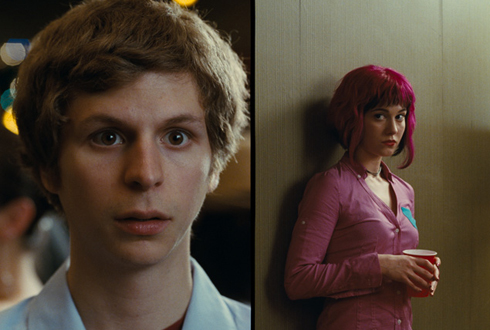
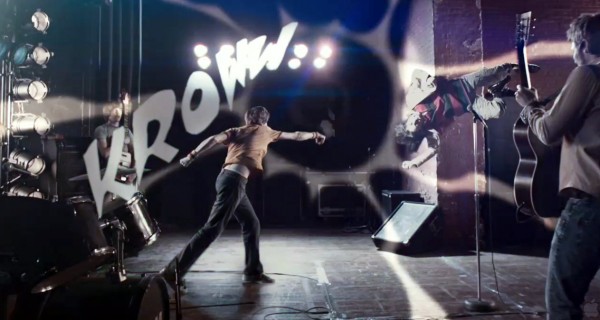
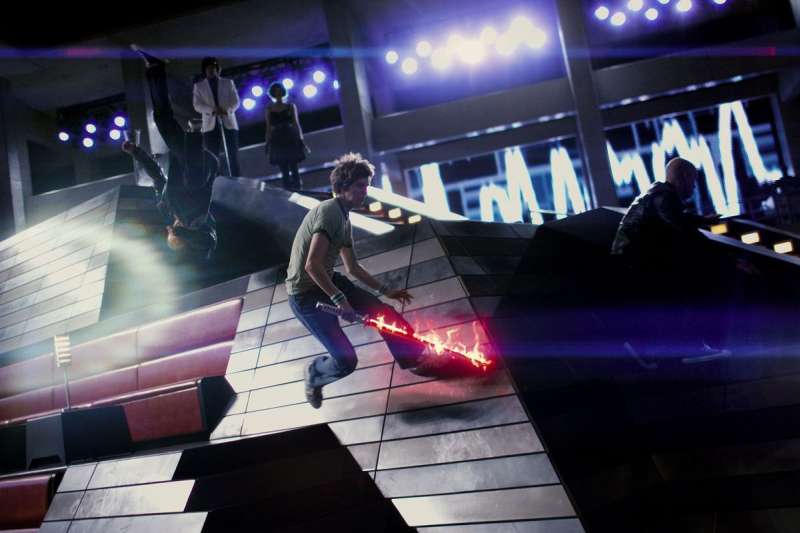
Finally. A comedy that's ambitious, funny, and definitely not "coasting." If anything, Scott Pilgrim vs. The World might be working too hard for its laughs by violating every rule in the book: episodic, fast, edited in a deliberately outre style with images crashing into each other, stepping on and crushing dialogue, seamlessly merging, not unlike "The Archers," reality and fantasy. Indeed, you're never sure if what you're seeing is reality, or merely the Red Bull fueled fantasies of its lead character, Scott Pilgrim (Michael Cera, appearing "scruffy," thin and even more chinless than usual) young adult, but in name only. And the movie manages to sustain the breathless pace its entire length, without losing its inventiveness or attitude.

That's something of a surprise as director Edgar Wright's previous films, like Shaun of the Dead, and Hot Fuzz, outwore their welcomes at the 2/3 mark but kept on going. Scott Pilgrim vs. The World starts out of the gate fast and only lets up at its resolution (appropriately), in a melange of styles and techniques, while also shifting the narrative into over-drive with cartoony and comics graphics touches that invade and overlay photo-reality. Fight Club and Stranger Than Fiction did the same with a formalist style, but "Pilgrim" suffuses it with an energetic slacker zeal, as if these things were appearing off the top of its protagonist's head (which, in the narrative, it probably is). A movie hasn't been this anarchistically fun to watch tearing apart movie-sensibilities since...oh...Fight ClubMoulin Rouge!, or, hell, Citizen Kane.* Film-making rules are bent almost in two, but never break the narrative flow. This is good stuff.**
I've stayed away from reading any reviews (which is my M.O.), but a scan of headlines leads one to think that the film has turned off its "Gamer" audience.
I can see where the argument would come: it's really not about gaming (not in the electronic sense) and whimsically lampoons the culture using its tropes and excesses against it. On a deeper level, however, it manages to take the insular mind-set and short-term rewards and gratification of gaming and place it in context into the real world. And finds it wanting in the course of a life. At the same time, it manages to make the sensibilities of gaming concepts—the nexus-choices of "Continue?," "Adding a life," and "Game Over," and draw parallels to painful life-lessons—real ones—that legitimize the story-line, gaming structure and the very reason for making the movie. Very, very smart.
Now, this is a lot of "deep thought" for a teen-relationship (kinda) movie, and I run the risk of gilding the lily, and worse, building high anticipation which might kill the appreciation for what is there in the theater.*** But, more light-bulbs went off for me in this one, about how to use the craft to tell a story, and, in context, of achieving something more than the instant gratification that permeates our society (and the damage it can create) than anything I've seen in awhile.
It also managed to save, for me, what has been a rather disappointing movie Summer. It's also the kind of high-concept circus act that the director can only pull off once—another movie in this style would lay him open to suggestions that he's a "one-trick pony." But, if he can bring this kind of sensibility to this project, imagine where that mind could go in the future. It makes one anticipate, and excited for, what can happen in the future.  As for now, Wright's taken things to a whole new level.


* Okay, lest this be taken out of context ("He's comparing
'Scott Pilgrim vs. the World' to 'Citizen Kane?'!) and I'm accused of Kael-esque hyperbole, I found the same sense of film-making brio in this one that I've found in the others.  I always find this exciting, whoever does it, even if the results are ultimately to a less than satisfying experience.  I'm all for pushing the envelope, but the results have to be more than a good-looking envelope.  There's got to be a good message inside it, too.


 ** And, there's another layer—the sound design.  This one may be my winner for "Best Use of Sound" for the year, tossing in music and effects in a giddy montage that's constantly inventive and supportive.  I've tried to do this sort of stuff in my work—specifically for the old "Bill Nye the Science Guy" show—but, I could only aspire to the level that "Scott Pilgrim" does. Bravo. (Clapclapclap)
*** Notice, please, that I haven't done a plot synopsis, quoted good lines (which there are, a-plenty) or said anything about the movie other than a basic wash-and-rinse of the film-going experience.  There are too many surprises, and too fine a resolution, to go about spoiling one's viewing.  I want to keep your preconceptions of this movie (which I hope you'll do) as spoiler-free as possible.  Go in expecting nothing, and this will be a better film—for you—for it.