"Math is HARD! Let's Study Art as Social Commentary 101, Instead!"
When Greta Gerwig guested on NPR's "Wait, Wait, Don't Tell Me!" she was asked this by the host, Peter Sagal: "Do you know—one of the things that happens, it seems, is that young, talented independent directors who make a successful movie on a low budget are immediately handed enormous Hollywood blockbusters. Have you picked yours?"
"Oh!" she gasped."A Hollywood blockbuster? No, I have not picked my blockbuster yet. But, when I do...get ready..."
This is not much to base a movie on. And Barbie is, after all, merchandise. My prejudice—and I confess I went in prejudiced—was this: Barbie is as important to the art of cinema as the Transformers series is. As the recent Super Mario Brothers Movie is. As important as the Lego movies are. Bottom-line, it's the bottom-line: Selling product, and Barbie the movie will push kids pushing parents into the toy-aisles at far greater numbers then before its premiere.
I just didn't think it would satiric to the point of seditious, which I must confess warmed my guiltily paternalistic, capitalist-suspicious heart.
Narrator Helen Mirren explains things to us as she relates the relationship between the Real World and the Barbie Merchi-verse. In a sequence that compares to the morning rituals of Pee-Wee's Big Adventure, Barbie (Margot Robbie) wakes up perfectly in her Dream-House, takes a shower (there's no water, of course, as Dream-Houses didn't), mimes brushing her teeth, has a plasticized breakfast, dresses, and floats down to her car as if being carried by an invisible hand, to greet the day and the many varying Barbies, Skippers and Midge (the discontinued pregnant one), before spending the day at The Beach, where she plays with her friends, under the ever-watchful, ever-worshipful gaze of Ken (Ryan Gosling, in a lighter mood than of late), who, as they say, covets. He has no idea why as he's a toy and has no chromosomes or hormones.
After another in a perpetual string of "girls' nights", Barbie starts noticing that things aren't so perfect: she wakes up with morning breath, the water that still doesn't come out of the shower is cold, the plastic breakfast is burned, and when she steps off her balcony to get to her car, she lands with a splat. No broken parts or joints, but when she gets to the beach, things get really "off the shelf"--taking off her high heels, instead of remaining walking on tippy-toes, her HEELS touch the ground...she has FLAT FEET!
What is happening? Barbie is supposedly perfect—she is, self-admittedly, "the original stereotypical Barbie"—and suddenly things are going wrong—"I feel sad, and mushy, and complicated"—and she even has thoughts about death. The other Barbies (and Kens) are totally grossed-out (totally!) and advise Barbie to go visit "Weird Barbie" (Kate McKinnon)—she's the one that was played with a little too hard and a little too long—because she's seen things...and she might know what is happening to our doll.
She does, of course, speculating that somehow a portal has opened up between Barbieland and the Real World*, and it has (no doubt) been caused by the Real World person playing with this Barbie, after all, "it takes two to rip a portal." Truer words were never said.
She sends Barbie on a mission to the Real World to find the little girl playing with her and existence as she knows it, and fix the rift, while also being showered with thanks by all those women who owe their wonderful lives to Barbie.
Oh, dear, this will not go well. And, she is figuratively and literally in for a world of hurt. To make matters worse, Ken has stowed-away in Barbie's C4 Barbie Corvette for the trip, although he doesn't know why, just that he has to, despite the fact that she is capable and talented and pretty enough to handle the assignment on her own. "You'll just slow me down!" she yells at Ken, without even bothering to mention that he might cause her to "settle" and derail a budding career in just about anything you can imagine for domestic bliss. Barbie's, after all, live in their own little world of accomplishment—and the movie makes the point that they don't even know where the Kens live.
But, it's a different story in The Real World, where men rule everything, can be anything they want—and women can be anything they want...at 60% the pay, and the thermostats in offices are always set for men's comfort, not women's. There's no day-care, and no parental leave, and, heck, women don't even have control of their own bodies in the eyes of the legal system, and heck, it's like they're just dolls whose job it is to please no matter the mood, and have no agency...and wait a minute, Barbie really IS in the real world!
Okay. Enough of the scenario, you might know where this is going. It's a polemic on the aspirational aspects of Barbie's play-world and the ways it differs from the reality into which those playing children will grow up. It's a satire with one eye on the world of imagination and potential and what happens when play-time is over and responsibility and irresponsibility go hand-in-fist, and life is a lot less fun. Just as hedonistic and materialistic, sure, but a lot less fun.
Credit Gerwig and Baumbach for threading the needle to make this laugh-out-loud funny and entertaining, while also making it smart, and almost too smart. There's a lot of talk of existential crises, depression-era Barbies, and prescient flashbacks ("Remember 'Proust Barbie?' Didn't sell well!") that are going to sail right over kids' heads (and some adults'), but hits a lot of sophisticated points. It tells you the Barbie movie is more aspirational in its own goals than your standard kids' movie that gets by with Saturday morning "don't be mean" social lessons. Here, it skewers stereotypical patriarchy and male egotism--which will make some adults and Ron DeSantis squirm--but, the kids will like the bright colors and the fashions and the sparkling gayness of it all (which will also make DeSantis squirm) while the parents worry about questions they'll be asked later ("I'll tell ya when yer older!").
Hey, parents, be glad there's no mention of "Barbie-heads"!
In the same way that "Rocky and Bullwinkle" skewered the Cold War 1960's while mixing in the most childish of jokes, Barbie treads (on tippy-toes!) the highly-charged issues of gender inequities and sexual politics in our "Old Man" Society, and doing it cheekily, with the knowledge that by aiming high, the kids will eventually catch up while giving the oldsters something to chew on during the ride home. Anyone wondering what audience the filmmakers were aiming for can be answered with the simple "Everyone...eventually."
And in so doing, it gives one more aspiration for little girls to fantasize about becoming: block-busting director.
Billie Eilish and Finneas do the final credits song and once again nail it.
Somehow...after the movie, that wink seems a lot more conspiratorial....
* I would point out that there is a natural barrier between Barbie-land and The Real World called the "checkout counter"...with uniformed guards!...but that would only complicate things in an already complicated scenario,
“Asteroid City does not exist. It is an imaginary drama created expressly for the purposes of this broadcast. The characters are fictional, the text hypothetical, the events an apocryphal fabrication."
Well, of course they are! It's a Wes Anderson movie!
Early on, with Anderson's movies—back before they got really stylistic with consistent lateral camera moves and a severe one-point perspective, and looked like they could have happened in the "real world"—there was a depth to the subject matter that was undeniable. That has remained to this day, even while the visual look of the films have become more juvenile and seem to be contained in toy-like play-sets that defy good construction practices or even three-dimensionality. Characters became types moving around in play-houses that seem to be defiantly artificial...like shooting in a western town that were deliberately shown to be propped up stage settings and mere facades. Most directors try to expand their horizons along with their budgets and to take pains to make things more realistic and less like pre-planned photographed dramatizations. Not Wes Anderson.
Hitchcock said of Spielberg that he was "the first one of us who doesn't see theproscenium arch" noting that Spielberg grew up with film, rather than the stage. But, Anderson is going a different direction. He WANTS you to see the proscenium arch, and will go out of his way...with a child-like glee...to make sure it's noticed and appreciated to be artificial. His new film,Asteroid Cityis one more step in that direction as it's story looks like it takes place in one of Maurice Noble's desert landscapes in the Road-runner cartoons.*
But, that's one aspect of Anderson's film (he usually has at least two he's presenting in his movies). Usually, he's as stringent in his story through-line as he is with a tracking shot (hisThe French Dispatch, with its a handful of stories, being an exception). This one, he's made a layered story, through several simulated media—television, stage, and film—each one has its place in the film and each one is subject to being violated, one by the other.
Now, Asteroid City tells the story of what happens when a bunch of "super-genius" kids arrive with their families at the titular city—famed for its vicinity to the "Arid Springs Meteorite" impact crater—for the "Junior Stargazer/Space Cadet" convention put on by "The Larkings Foundation" and the U.S. Military under its United States Military-Science Research and Experimentation Division. They're to be given awards for their inventions—it should be noted that those inventions (jet-packs, destructo-rays, projecting on the Moon) were not viable in the setting of 1955, but would be just the sorts of things kids would want to invent. Each family have their issues and quirks, and they become unwitting witnesses to a major event in the history of mankind.
So, that's the plot. But, it's not the whole movie. We begin—in black-and-white and a square Academy ratio—with a television program (of the arts-programming "Omnibus" variety) where the host (Bryan Cranston) intones that they are presenting a special production of a play by famed playwright Conrad Earp (Edward Norton) called "Asteroid City" and after a brief episode where Earp meets actor Jones Hall (Jason Schwartzman), we begin with a wide-screen version of the play in the colors of a faded post-card you'd find in a rack at a tourist trap.
Augie Steenbeck (played by Jones Hall played by Jason Schwartzman)—photographer—arrives (barely) at 'Roid City with his three daughters Andromeda, Pandora, and Casseiopeia as well as his son Woodrow (Jake Ryan), who is participating in the awards contest. Augie was a war photographer, still has shrapnel in his head, and takes his station wagon in to be serviced (by mechanic Matt Dillon)—it having given up the ghost miles down the road. It's decided that they will stay in town for the convention, rather than stay with Augie's father-in-law, Stanley Zak (Tom Hanks).
Stanley is concerned about this, but he's more distressed that Augie hasn't told the kids that Augie's wife/his daughter died two weeks ago, and don't you think it's about time to do that? So Augie stoically tells the kids—"Are we orphans now?" "No, I'm still alive."—which affects them all deeply, despite Woodrow being steeped in all things science and the three daughters, embracing mysticism seeing themselves as witches (well, two witches and one vampire). To allow the kids to grieve, Augie lets the kids bury their mother's ashes (contained in a Tupperware container) temporarily in the car-park until their grandfather can arrive to take them to his home for a more proper burial.
Also there for the awards ceremony is actress Midge Campbell (played by Mercedes Ford, played by Scarlett Johansson), who is studying her lines for a new play and develops a curious relationship with Augie—seeing as their neighbors and all. Like the majority of the actor/characters, they are demonstratively undemonstrative, and—if I may use the word again—"stoic." These are, after all, adults in the 1950's, having lived through a ghastly world war, only to see it emerge with advances in technology and weaponry that dwarf, and could ultimately consume them. The many small inconveniences of living in a desert tourist trap not to far away from a nuclear test-site, leave them unfazed.
It is only when a cosmic event happens that is ultimately beyond their understanding that things change. Asteroid City, due to that happenstance is shut down and quarantined, leaving the temporary residents stranded. But, true to their nature—or perhaps the nature that Conrad Earp has given them—they react more to the minor annoyances that the quarantine imposes, rather than the perspective shock that its cause should have created.
Seems a bit like real life, doesn't it?
Anderson and consigliere Roman Coppola were writing this in 2020, so the COVID quarantine may not have been the genesis for the project, but filming during COVID restrictions certainly did, necessitating the recasting of Bill Murray when he came down with the plague. Still, when the outrage in real life is over the inconvenience of wearing masks rather than the loss of more than a million souls (you can't make this stuff up!), one can infer that it was on the creative minds.
Six feet apart?
But, there is one attitude shift present from the happenstance; Anderson abandons his persistent horizon-bisecting in the frame for something else—overhead shots looking down on the players. Oh, everything still has that one-point perspective, but from above with no horizon in sight, putting (in camera-terms) the people on screen at a disadvantage, making them smaller, vulnerable, putting them in their place—at least from the perspective of an observing extra-terrestrial. It's a bit jarring, but completely apt. It's the only evidence of a new perspective in the movie.
So, I found it fascinating, but then, I always look forward to Anderson's films. They may not come to an all-encompassing conclusion, but instead take on the mantle of a childish inquiry without answers. They make me feel a little younger, where playfulness was everyday, and not in those moments in between crises. They embrace innocence, but leave plenty of room for cynicism and mild bemusement, rather than a-musement. And the cultural touchstones he invokes are pretty sophisticated, even if he's not being sophisticated about them. I'm all in for that.
I hope he never grows up and loses it.
And Asteroid City is the perfect come-back for all those scary A-I generated parodies of "visionary director" Wes Anderson that are flooding YouTube now ad nauseum. Whatever the "brave new world" of AI generates, Anderson will always top it. I find that reassuring.
* Anderson even throws in an occasional stop-motion road-runner just so we get the point.
"Wow"
Some more shots from Asteroid City, just because they amuse me...
I admire writer-director Damian Chazelle's work, so it pains me to say that Saturday is traditionally "Take Out the Trash" Day.
Angels and Ghosts of Toxic Nostalgia
or
Make Hollywood a Cesspool Again
Yeah, well, nostalgia isn't what it used to be.
Damien Chazelle'sBabylon tries to be many things in its break-neck, inarticulate way: a love-sonnet to "Cinema", an hysterical screed about ambition (the uphill) and the Fickle Finger of Fate—and Fashion (the downside), an impotent rage about the inevitability of Change, and an excremental wallow in excess "just because we can."
It's also a bit of a litmus test on how you feel about Hollywood: starry-eyed dreamy or worm-at-the-bottom-of-a-tequila-bottle cynical. You can love the taste of sausage, but you don't want to see how it's made.
Movies about movie-making rarely make a lot of coin at the box-office, but the industry does love to bestow them with Oscars. Babylon has failed at the former, and, because it's not properly rose-Technicolored besotted with The Art, it won't win any bling, either.
It's 1926, and Kinoscope studio head Don Wallach (Jeff Garlin) is throwing a wild party—security is loose, morals are looser, and everybody is either tight or flaccid—at his palatial Bel Air estate high atop a graded mountain with nothing around it but steppe and orange groves. The house looks like it fell out of the sky to the most desolate place on Earth. Thus, it's quite a task to transport anything to the place. We meet Manuel Torres (Diego Calva)—"Manny" to just about everybody who can give him a job—who has convinced one of Wallach's assistants (Flea) that he can deliver an elephant to the party. An elephant. This proves problematic and particularly perilous as the pachyderm's poundage prevents purchase. The solution? Roughage. The subsequent eruption of elephant diarrhea—which Chazelle stages like a famous silent film clip (thanks, Damien! This won't influence my review at all!)—blows enough ballast to allow everyone to get all the way up the hill.
That serves as a warning shot for the next 30 minutes as Chazelle presents his version of the "Godfather wedding", where he introduces all of the principal characters attending this orgiastic party of excess. But, where Coppola stages his sequence with snapshots of telling detail, Chazelle glides his camera in, up and around the frontal and backal nudity bumping and grinding to obfuscate the- something-to-offend-everyone anything goes-ery of his bacchanal.
We meet: Manny (of course), Mexican immigrant, who is the ultimate volunteer ("I'll do it!") to get ahead; the gossip columnist Elinor St. John (Jean Smart), who's seen a lot ("I knew Proust, you know..."), but only divulges the choice bits when it's to her highest advantage; star Jack Conrad (Brad Pitt), a reigning light at M-G-M, slumming it at the party which he attends on his wife (Olivia Wilde) just announcing that she's divorcing him as the capper to their latest spat, Lady Faye Zhu (Li Jun Li), the most capable one of the bunch—she does a rich Dietrich routine to a song that's hard to believe was of the period—but is a minor player at Kinoscope because 1) she is bi-sexual (which she can hide) and 2) she is Asian (which she can't).
There's bandleader Sidney Palmer (Jovan Adepo), who is professional amidst all the madness, but still keeps the energy of the party lively through his work. Late to the party (and not invited) is Nellie LaRoy (Margot Robbie), a New Jersey native who just knows she's going to make it in Hollywood ("Ya either a stah or ya ain't! And I'm a stah!"), and whom Manny instantly crushes on.
After a cocaine-binge with Manny, Nellie's go-for-broke dancing at the party attracts the attention of Kinoscope brass, who are in need of an actress on-set the next day—it seems the one they hired has just died upstairs after a drug-fueled micturating display for star Orville Pickwick. By the morning, Nellie's on her way to the Kinoscope set out in the desert, and a drunken Conrad has been driven home by Manny, whom the star immediately makes his assistant ("He can do anything!").
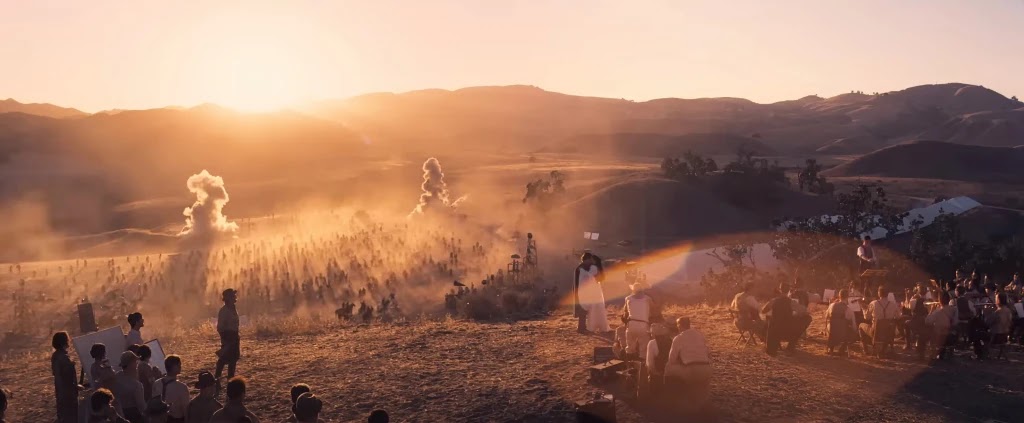
Conrad tells Mannie the movie set is "the most wonderful place in the world," but when Nellie gets there it's anything but. The "studio" is a large field, fenced off to keep the "Hire me" crowd at bay, and there are 10 sets running simultaneously (there's no sound to interfere with silent movies), orchestras playing to provide "mood music" and a sense of chaos going on everywhere. Nellie is shuffled off to make-up, brought back, made up again and then thrown into the shoot, where she acts and dances with abandon, overshadowing the film's star (Samara Weaving). Meanwhile, a hung-over Jack takes Manny to the space where they're making his costume epic with 10 cameras filming a battle scene where the knights are played by skid-row bums off the street. One of them gets killed by running into his own spear.
It's anarchy, but, despite that, sometimes magic happens. When Nellie is asked to cry for a scene, the director (Olivia Hamilton) is amazed that she can produce them on cue. "You think you can cry a little less?" "How many drops and which eye?" Nellie asks, and, as promised, delivers that many drops from that eye. "How do you DO that?" her director asks. "I just think of home." Nellie says matter-of-factly.
You see where this is going: Chazelle the director is in love with "the timeless" image and Chazelle the writer is showing the work, patience, pain, suffering, and craziness employed to achieve it. Even if it kills you. Throughout the time-frame of the movie—1926 through (significantly) 1952—the stars will have their ups and downs, the first become last, the insignificant achieve power, and they all can lose it with a bad headline or a stupid choice...in a land and profession rife with the possibilities of both. Lives and relationships are fragile and are erased and forgotten in the quest for the indelible image made by artifice.
The advent of talking pictures will be a life and game-changer for the industry. Technicians will be under more pressure, and the performers will have to be all-around actors, not emoters, not just-pretty-faces...and if their voices destroy the illusion the audience has of them, it's a career crusher. We've seen the story before. What Price Hollywood? (or its progeny, the variousversions of A Star is Born) The Artist. Truffaut's Day for Night. Bogdanovich's Nickolodeon. Directors get nostalgic for the simpler times of film-making and return to it once they have success. It's as if they have to re-torch the pilot light to remember why they loved making movies in the first place. As the bandleader Sidney Powell says of making movies "I think they got the cameras pointed in the wrong, direction. That's what I think." Directors can't resist the urge of turning the camera.
Made in 1952. About the struggles of performers to adjust to "The Talkies." It is no coincidence that Chazelle references it twice in Babylon, and does so directly when Manny goes to see the movie and breaks down in tears. It's a story he lived. But, instead of death and ruin, it's in Technicolor with music and songs and laughs, even in the face of humiliation and tragedy. No one thinks of Clara Bow or John Gilbert or Anna May Wong or "Fatty" Arbuckle while they watch Singin' in the Rain. The film-makers are too good at their jobs. They're having too good a time. If you laugh, the world laughs with you...
Chazelle shopped Babylon around town after Whiplash caused a stir and he was advised it was too big a project too soon. Someone suggested a musical and so he made La La Land, instead—the modern era's version of Singin' in the Rain with music and dancing and aspirations and baked-in nostalgia. But, it's the antithesis of Babylon, just as one could say that, with Babylon, Chazelle made the "anti-Singin' in the Rain," telling the same story, but without the Technicolor-tinted filters, the practiced and fluid choreography, the charm or the illusion. Oh, it's got production value and good performances and period detail and moves like a bat outta hell. It just doesn't leave you with any feelings other than wanting to take a shower.
Babylon
tells the story of what happens when you lose success, but, in an unintentionally
meta-way, it also tells the story of what can happen if you have too
much. You make a bad movie that you think is wonderful and important.
In the pre-showing "vamp", Margot Robbie says she's grateful that Babylon can be seen "as it should be...with an enthused audience." Well, keep wishing, sister.