I admire writer-director Damian Chazelle's work, so it pains me to say that Saturday is traditionally "Take Out the Trash" Day.
Angels and Ghosts of Toxic Nostalgia or
Make Hollywood a Cesspool Again
Yeah, well, nostalgia isn't what it used to be.
Damien Chazelle's Babylon tries to be many things in its break-neck, inarticulate way: a love-sonnet to "Cinema", an hysterical screed about ambition (the uphill) and the Fickle Finger of Fate—and Fashion (the downside), an impotent rage about the inevitability of Change, and an excremental wallow in excess "just because we can."
It's also a bit of a litmus test on how you feel about Hollywood: starry-eyed dreamy or worm-at-the-bottom-of-a-tequila-bottle cynical. You can love the taste of sausage, but you don't want to see how it's made.
Movies about movie-making rarely make a lot of coin at the box-office, but the industry does love to bestow them with Oscars. Babylon has failed at the former, and, because it's not properly rose-Technicolored besotted with The Art, it won't win any bling, either.
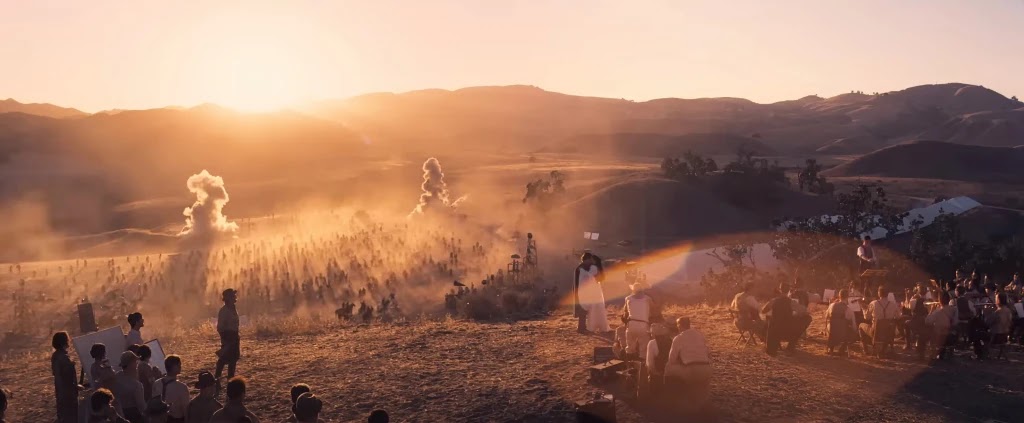
It's 1926, and Kinoscope studio head Don Wallach (Jeff Garlin) is throwing a wild party—security is loose, morals are looser, and everybody is either tight or flaccid—at his palatial Bel Air estate high atop a graded mountain with nothing around it but steppe and orange groves. The house looks like it fell out of the sky to the most desolate place on Earth. Thus, it's quite a task to transport anything to the place. We meet Manuel Torres (Diego Calva)—"Manny" to just about everybody who can give him a job—who has convinced one of Wallach's assistants (Flea) that he can deliver an elephant to the party. An elephant. This proves problematic and particularly perilous as the pachyderm's poundage prevents purchase. The solution? Roughage. The subsequent eruption of elephant diarrhea—which Chazelle stages like a famous silent film clip (thanks, Damien! This won't influence my review at all!)—blows enough ballast to allow everyone to get all the way up the hill. That serves as a warning shot for the next 30 minutes as Chazelle presents his version of the "Godfather wedding", where he introduces all of the principal characters attending this orgiastic party of excess. But, where Coppola stages his sequence with snapshots of telling detail, Chazelle glides his camera in, up and around the frontal and backal nudity bumping and grinding to obfuscate the- something-to-offend-everyone anything goes-ery of his bacchanal. We meet: Manny (of course), Mexican immigrant, who is the ultimate volunteer ("I'll do it!") to get ahead; the gossip columnist Elinor St. John (Jean Smart), who's seen a lot ("I knew Proust, you know..."), but only divulges the choice bits when it's to her highest advantage; star Jack Conrad (Brad Pitt), a reigning light at M-G-M, slumming it at the party which he attends on his wife (Olivia Wilde) just announcing that she's divorcing him as the capper to their latest spat, Lady Faye Zhu (Li Jun Li), the most capable one of the bunch—she does a rich Dietrich routine to a song that's hard to believe was of the period—but is a minor player at Kinoscope because 1) she is bi-sexual (which she can hide) and 2) she is Asian (which she can't). There's bandleader Sidney Palmer (Jovan Adepo), who is professional amidst all the madness, but still keeps the energy of the party lively through his work. Late to the party (and not invited) is Nellie LaRoy (Margot Robbie), a New Jersey native who just knows she's going to make it in Hollywood ("Ya either a stah or ya ain't! And I'm a stah!"), and whom Manny instantly crushes on. After a cocaine-binge with Manny, Nellie's go-for-broke dancing at the party attracts the attention of Kinoscope brass, who are in need of an actress on-set the next day—it seems the one they hired has just died upstairs after a drug-fueled micturating display for star Orville Pickwick. By the morning, Nellie's on her way to the Kinoscope set out in the desert, and a drunken Conrad has been driven home by Manny, whom the star immediately makes his assistant ("He can do anything!").
It's anarchy, but, despite that, sometimes magic happens. When Nellie is asked to cry for a scene, the director (Olivia Hamilton) is amazed that she can produce them on cue. "You think you can cry a little less?" "How many drops and which eye?" Nellie asks, and, as promised, delivers that many drops from that eye. "How do you DO that?" her director asks. "I just think of home." Nellie says matter-of-factly.You see where this is going: Chazelle the director is in love with "the timeless" image and Chazelle the writer is showing the work, patience, pain, suffering, and craziness employed to achieve it. Even if it kills you. Throughout the time-frame of the movie—1926 through (significantly) 1952—the stars will have their ups and downs, the first become last, the insignificant achieve power, and they all can lose it with a bad headline or a stupid choice...in a land and profession rife with the possibilities of both. Lives and relationships are fragile and are erased and forgotten in the quest for the indelible image made by artifice.
The advent of talking pictures will be a life and game-changer for the industry. Technicians will be under more pressure, and the performers will have to be all-around actors, not emoters, not just-pretty-faces...and if their voices destroy the illusion the audience has of them, it's a career crusher. We've seen the story before. What Price Hollywood? (or its progeny, the various versions of A Star is Born) The Artist. Truffaut's Day for Night. Bogdanovich's Nickolodeon. Directors get nostalgic for the simpler times of film-making and return to it once they have success. It's as if they have to re-torch the pilot light to remember why they loved making movies in the first place. As the bandleader Sidney Powell says of making movies "I think they got the cameras pointed in the wrong, direction. That's what I think." Directors can't resist the urge of turning the camera.
And there's one more most appropriate example:
Singin' in the Rain.Made in 1952. About the struggles of performers to adjust to "The Talkies." It is no coincidence that Chazelle references it twice in Babylon, and does so directly when Manny goes to see the movie and breaks down in tears. It's a story he lived. But, instead of death and ruin, it's in Technicolor with music and songs and laughs, even in the face of humiliation and tragedy. No one thinks of Clara Bow or John Gilbert or Anna May Wong or "Fatty" Arbuckle while they watch Singin' in the Rain. The film-makers are too good at their jobs. They're having too good a time. If you laugh, the world laughs with you...
Babylon
tells the story of what happens when you lose success, but, in an unintentionally
meta-way, it also tells the story of what can happen if you have too
much. You make a bad movie that you think is wonderful and important.
In the pre-showing "vamp", Margot Robbie says she's grateful that Babylon can be seen "as it should be...with an enthused audience." Well, keep wishing, sister.