Showing posts with label Damien Chazelle. Show all posts

Saturday, January 21, 2023

Babylon (2022)

I admire writer-director Damian Chazelle's work, so it pains me to say that Saturday is traditionally "Take Out the Trash" Day.
 
Angels and Ghosts of Toxic Nostalgia
or
Make Hollywood a Cesspool Again 
 
Yeah, well, nostalgia isn't what it used to be. 
 
Damien Chazelle's Babylon tries to be many things in its break-neck, inarticulate way: a love-sonnet to "Cinema", an hysterical screed about ambition (the uphill) and the Fickle Finger of Fate—and Fashion (the downside), an impotent rage about the inevitability of Change, and an excremental wallow in excess "just because we can."
 
It's also a bit of a litmus test on how you feel about Hollywood: starry-eyed dreamy or worm-at-the-bottom-of-a-tequila-bottle cynical. You can love the taste of sausage, but you don't want to see how it's made. 
 
Movies about movie-making rarely make a lot of coin at the box-office, but the industry does love to bestow them with Oscars. Babylon has failed at the former, and, because it's not properly rose-Technicolored besotted with The Art, it won't win any bling, either.
It's 1926, and Kinoscope studio head Don Wallach (Jeff Garlin) is throwing a wild party—security is loose, morals are looser, and everybody is either tight or flaccid—at his palatial Bel Air estate high atop a graded mountain with nothing around it but steppe and orange groves. The house looks like it fell out of the sky to the most desolate place on Earth. Thus, it's quite a task to transport anything to the place. We meet Manuel Torres (Diego Calva)—"Manny" to just about everybody who can give him a job—who has convinced one of Wallach's assistants (Flea) that he can deliver an elephant to the party. An elephant. This proves problematic and particularly perilous as the pachyderm's poundage prevents purchase. The solution? Roughage. The subsequent eruption of elephant diarrhea—which Chazelle stages like a famous silent film clip (thanks, Damien! This won't influence my review at all!)—blows enough ballast to allow everyone to get all the way up the hill.
That serves as a warning shot for the next 30 minutes as Chazelle presents his version of the "Godfather wedding", where he introduces all of the principal characters attending this orgiastic party of excess. But, where Coppola stages his sequence with snapshots of telling detail, Chazelle glides his camera in, up and around the frontal and backal nudity bumping and grinding to obfuscate the- something-to-offend-everyone anything goes-ery of his bacchanal.
We meet: Manny (of course), Mexican immigrant, who is the ultimate volunteer ("I'll do it!") to get ahead; the gossip columnist Elinor St. John (Jean Smart), who's seen a lot ("I knew Proust, you know..."), but only divulges the choice bits when it's to her highest advantage; star Jack Conrad (Brad Pitt), a reigning light at M-G-M, slumming it at the party which he attends on his wife (Olivia Wilde) just announcing that she's divorcing him as the capper to their latest spat, Lady Faye Zhu (Li Jun Li), the most capable one of the bunch—she does a rich Dietrich routine to a song that's hard to believe was of the period—but is a minor player at Kinoscope because 1) she is bi-sexual (which she can hide) and 2) she is Asian (which she can't). 
There's bandleader Sidney Palmer (Jovan Adepo), who is professional amidst all the madness, but still keeps the energy of the party lively through his work. Late to the party (and not invited) is Nellie LaRoy (Margot Robbie), a New Jersey native who just knows she's going to make it in Hollywood ("Ya either a stah or ya ain't! And I'm a stah!"), and whom Manny instantly crushes on.
After a cocaine-binge with Manny, Nellie's go-for-broke dancing at the party attracts the attention of Kinoscope brass, who are in need of an actress on-set the next day—it seems the one they hired has just died upstairs after a drug-fueled micturating display for star Orville Pickwick. By the morning, Nellie's on her way to the Kinoscope set out in the desert, and a drunken Conrad has been driven home by Manny, whom the star immediately makes his assistant ("He can do anything!").
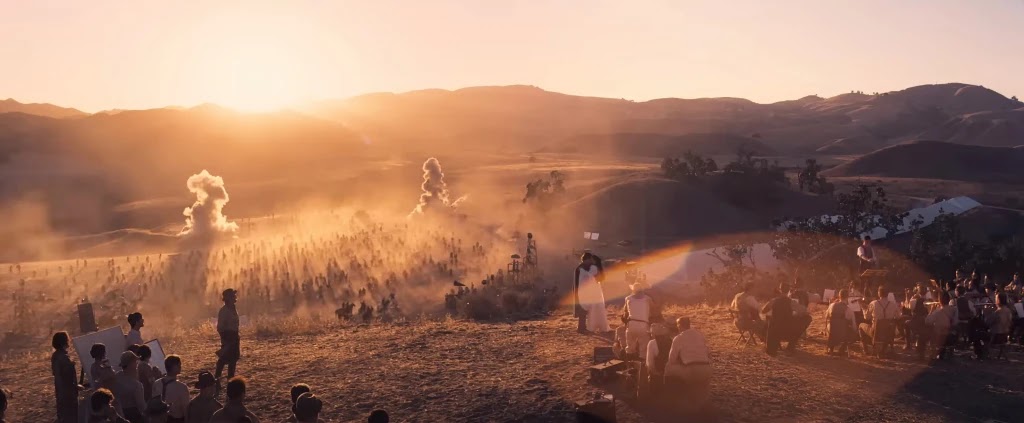
Conrad tells Mannie the movie set is "the most wonderful place in the world," but when Nellie gets there it's anything but. The "studio" is a large field, fenced off to keep the "Hire me" crowd at bay, and there are 10 sets running simultaneously (there's no sound to interfere with silent movies), orchestras playing to provide "mood music" and a sense of chaos going on everywhere. Nellie is shuffled off to make-up, brought back, made up again and then thrown into the shoot, where she acts and dances with abandon, overshadowing the film's star (
Samara Weaving). Meanwhile, a hung-over Jack takes Manny to the space where they're making his costume epic with 10 cameras filming a battle scene where the knights are played by skid-row bums off the street. One of them gets killed by running into his own spear.
It's anarchy, but, despite that, sometimes magic happens. When Nellie is asked to cry for a scene, the director (
Olivia Hamilton) is amazed that she can produce them on cue. "You think you can cry a little less?" "How many drops and which eye?" Nellie asks, and, as promised, delivers that many drops from that eye. "How do you DO that?" her director asks. "I just think of home." Nellie says matter-of-factly.
You see where this is going: Chazelle the director is in love with "the timeless" image and Chazelle the writer is showing the work, patience, pain, suffering, and craziness employed to achieve it. Even if it kills you. Throughout the time-frame of the movie—1926 through (significantly) 1952—the stars will have their ups and downs, the first become last, the insignificant achieve power, and they all can lose it with a bad headline or a stupid choice...in a land and profession rife with the possibilities of both. Lives and relationships are fragile and are erased and forgotten in the quest for the indelible image made by artifice. 
The advent of talking pictures will be a life and game-changer for the industry. Technicians will be under more pressure, and the performers will have to be all-around actors, not emoters, not just-pretty-faces...and if their voices destroy the illusion the audience has of them, it's a career crusher. We've seen the story before. What Price Hollywood? (or its progeny, the various versions of A Star is Born) The Artist. Truffaut's Day for Night. Bogdanovich's Nickolodeon. Directors get nostalgic for the simpler times of film-making and return to it once they have success. It's as if they have to re-torch the pilot light to remember why they loved making movies in the first place. As the bandleader Sidney Powell says of making movies "I think they got the cameras pointed in the wrong, direction. That's what I think." Directors can't resist the urge of turning the camera.

And there's one more most appropriate example:
 
Singin' in the Rain.
Made in 1952. About the struggles of performers to adjust to "The Talkies." It is no coincidence that Chazelle references it twice in Babylon, and does so directly when Manny goes to see the movie and breaks down in tears. It's a story he lived. But, instead of death and ruin, it's in Technicolor with music and songs and laughs, even in the face of humiliation and tragedy. No one thinks of Clara Bow or John Gilbert or Anna May Wong or "Fatty" Arbuckle while they watch Singin' in the Rain. The film-makers are too good at their jobs. They're having too good a time. If you laugh, the world laughs with you...
Chazelle shopped Babylon around town after Whiplash caused a stir and he was advised it was too big a project too soon. Someone suggested a musical and so he made La La Land, instead—the modern era's version of Singin' in the Rain with music and dancing and aspirations and baked-in nostalgia. But, it's the antithesis of Babylon, just as one could say that, with Babylon, Chazelle made the "anti-Singin' in the Rain," telling the same story, but without the Technicolor-tinted filters, the practiced and fluid choreography, the charm or the illusion. Oh, it's got production value and good performances and period detail and moves like a bat outta hell. It just doesn't leave you with any feelings other than wanting to take a shower.
Babylon tells the story of what happens when you lose success, but, in an unintentionally meta-way, it also tells the story of what can happen if you have too much. You make a bad movie that you think is wonderful and important.
In the pre-showing "vamp", Margot Robbie says she's grateful that Babylon can be seen "as it should be...with an enthused audience." Well, keep wishing, sister.


Tuesday, October 16, 2018

First Man

“I guess the question I'm asked the most often is: "When you were sitting in that capsule listening to the count-down, how did you feel?" Well, the answer to that one is easy. I felt exactly how you would feel if you were getting ready to launch and knew you were sitting on top of two million parts -- all built by the lowest bidder on a government contract.”
Astronaut John Glenn

The Man in the Glass Booth
or
The Moon is a Harsh Mistress

I read James R. Hanson's biography of astronaut Neil Armstrong, "First Man" some months ago—I'd always been fascinated by the American Space Program of the 1960's when I was a kid—and I found the book a tedious slog. Despite my interest, it tested my ability to be fascinated by Armstrong's career, going into such extreme depth as listing Armstrong's scores during military flight training in the 1960's and the grind of astronaut training...as well as the author's fervently pushed sub-text that Armstrong was a mythical figure on a par with Adam. Plus, Armstrong was such a tight-lipped, interior soul that one got the impression that, despite the scrutiny and coverage of his career before and after the first moon landing, the man was pretty much a cipher, so unknowable that the author depended on other people's impressions to such a large extent that one never really got the sense that you knew the man, and certainly never warmed to him. The flaws were the most interesting things about him: he was an ace test-pilot but a horrible driver, seemingly never able to concentrate on the road, he had a stoicism that kept him apart from those he loved—his grueling schedule usually ensured that, anyway—and he was an innate problem-solver, which did him well at his job of controlling machines, but, on a human level, stymied him, particularly in the challenge of death—of Navy comrades, his only daughter Karen,*** and fellow astronauts (particularly Ed White, his next-door neighbor) killed in the process of the head-long rush to achieve the Moon landing within a ten year time-span.
With Armstrong's death in 2012, it was probably inevitable that they would make a film of Armstrong's life.* First Man encapsulates (pun intended) the intense period of Armstrong's life between the tail-end of his time testing X-15 rocket-planes to the moon landing of Apollo 11, a period of 8 years.** It begins with a disorienting shot looking out through grimy windows from the cockpit of an X-15. The camera buffets wildly. The noise is deafening, from the wind-shear, the clacking instruments, the creaking strains on the metal exterior, the rattling of anything not bolted down in the little compartment, the squawking chatter of the radio. Everything except the rattling of the pilot's teeth.

That X-15 is strapped to the underside of a B-52 and it will be dropped like a bomb, and, once it's fallen far enough to safely do so without blowing up its host-plane, the pilot will light up its rocket engines and take the X to its limits (which turned out to be a height of 67 miles and a maximum speed of 4,520 miles per hour). That plummeting drop might be the calmest part of the ride, because once the engines kick in, the X-15 is a shaking, vibrating brick that gets red hot in the friction of the atmosphere. Now the film is in 3-D (I didn't see it in that format or in IMAX), but, if it was also presented in Sensurround it would be intolerable. Damned effective in communicating what it's like in that circumstance, but probably beyond what a casual viewer munching popcorn could handle. It's a neat primer on what First Man does differently in the depiction of space travel that separates it from previous films on the subject in regards to the actual experience of the pioneers doing it.
For First Man, like its subject, is not exactly romantic when it comes to the Conquest of Space, but is, instead, realistic and practical. While most films look at the tiny vessels contrasted with the vastness of the space they're pushing through, First Man keeps you in the cockpit, from the vantage point of the sailors strapped in for dear life, who are warily watching the attitude indicators of their control panels as opposed to dreamily gazing at the stars out the window. Zero G is not something to be luxuriated in, it's a problem to be worked around, so that a stray foot doesn't hit the wrong toggle-switch and the floating clutter doesn't get in the way of the job.
Armstrong might have been the perfect candidate for the job. He loved flying and he loved the problem-solving of the task, trying to get it "just so" in the engineering from the time he had his siblings throwing out balsa wood airplanes from his window, so he could mark with popsicle sticks stuck in the yard the differences his adjustment would make in their aerodynamics. When the film starts in medias res of that X-15 flight, Armstrong goes too high and too fast, so that he ends up "skipping off the atmosphere" and has to find a radical way to use his attitude jets to give him enough drag to get the X-15 back to the ground. He makes it, but glances are passed between the ground crew: Armstrong's flights have been shaky lately; something's going on.
I see the moon, the moon sees me
shining through the leaves of the old oak tree
Oh, let the light that shines on me
shine on the one I love.
What's going on is shown in the next scene as a large menacing piece of chrome lowers to the head of a little girl; it is the Armstrong's daughter, Karen, and the worrying parents, Neil (Ryan Gosling) and Janet (Claire Foy), watch, their arms around each other, stricken—the child is being treated for a brain tumor, and, as we'll see, Armstrong keeps notebooks on her treatment, just as he does after his X-15 flights, but it's not going well. And over a shot of Armstrong watching over his sleeping daughter, as his fingers consider the strands of her hair, we hear a deliberate creaking of rope...
...it is the sound of her coffin being lowered into the ground, as Armstrong watches hollow-eyed. There will be flash-backs to the shot of her hair in his hands, the tactile sensation of his daughter later in the movie, but Armstrong, rarely—if ever—mentioned his daughter's death—at 2 1/2 years old—in the many interviews that he actually would allow. One can speculate, as Hanson, "writing to silence"**** in the biography, did, that his daughter's death informed the course of Armstrong's actions for the rest of his life and probably played a hand in his becoming a "deist," after having been raised by the devoutest of mothers. But, Armstrong's life was a full one and, no matter how artfully done in the book or movie, it probably can't be thinned down to making his daughter Karen the "Rosebud" of the movie, the Rosetta Stone that has all the answers.
After these scenes, the film then turns episodic—as so many bio-pics do—between highlights and low-lights in Armstrong's astronaut career: his applying for NASA and acceptance (during his interview when he's being questioned, one of the NASA hierarchy starts "I'm sorry about your daughter." and Armstrong's reply is "I'm sorry, is there a question?"), some training footage (which will become pertinent later), the deaths of fellow astronauts Elliot See and Charlie Bassett, and Armstrong's pick as commander of Gemini 8, which would prove an essential stepping-stone to the Apollo moon landing; It's mission is to rendezvous and dock with a previously launched Agena target, which Armstrong pulls off smoothly until he's out of communication with Mission Control, at which point the two locked vehicles begin to spin wildly out of control, and Armstrong makes the decision to separate from the target vehicle thinking that it has malfunctioned.
Once that happens, the capsule begins to spin faster—it wasn't a fault with the Agena, it is with their own capsule, and as it begins to spin faster and faster, approaching speeds that will cause the astronauts to black out, Armstrong shuts down his main thruster systems on the ship, suspecting them as the problem, and uses the forward thrusters for re-entry to bring the vehicle out of its death-tumble, effectively ending the mission as required by NASA protocols. The mission is seen as both a success and a failure—yes, its objective was achieved, but it is aborted early, days before its scheduled conclusion, lest the already used thrusters become essential for an eventual return to Earth .
Once Armstrong is cleared of any failure on his part—he is, in fact, lauded for saving his own life and that of his crew-mate, Dave Scott, he is then used as a NASA ambassador among politicians, and it is on one of those junkets he hears of the Apollo 1 fire, which costs the lives of veteran astronauts Gus Grissom, his neighbor Ed White and Roger Chaffee.***** He also narrowly escapes his own fiery death by his last minute ejection from a lunar landing trainer that malfunctions and loses control.
The rest of the film follows his subsequent training and command for Apollo 11, which, planned to be the first lunar landing if all the objectives are met, is the most prized assignment among the astronauts, but bares heavy responsibility and scrutiny, something that only makes Armstrong withdraw further into his work and away from his family.
The work is isolating, and, given all the unknowns about the lunar surface and whether diseases might be brought back to Earth from contact with the soil, the crew is kept in hermetically sealed chambers for press conferences and maintain a restricted access. As if the suits and pressurized conditions aren't enough, it seems like layers upon layers are being put between Armstrong and his family. At one point, just before leaving for the isolation before the launch, Armstrong's wife Janet demands that he sits down with his sons and explains to them the danger of his mission...and that he might not come back, something Armstrong wants to avoid talking about given the company line of "highest confidence in the Mission." It goes awkwardly and with not the best of resolutions. No one is exactly comforted.
The tensest part of the film is, of course, the Moon Landing itself, as Armstrong has to pilot where no pilot has gone before to a landing field that is nothing but pot-holes that could break one of the lander's spindly legs, all the time that alarms are going off warning that the computer can't process all of the information being funneled to it, the lander is low of fuel and running on fumes, and its auto-pilot decides that it's going to land in a large crater strewn with crippling boulders. Armstrong has to yank control from the targeted systems, try and overshoot the crater's lip, draining the fuel even more before touching down on another world. It was tense when it was happening live on television 49 years ago, and it's just as tense when Chazelle has his choice of angles and a galloping soundtrack from his composer Jason Hurwitz.
Damien Chazelle has now made three movies (he's now 33)—Whiplash, First Man, and La La Land (which was made during the long and complicated pre-production of First Man) and those three movies could not be more different in style, genre, and energy, but each one is a confident and accomplished film about obsession and sacrifice in pursuit of a cherished goal. The other films were wild, fast-moving things that frequently soared, where First Man—which is all about soaring—has its most sublime moments in stillness and incredible silence. One can quibble with Gosling's performance as Armstrong being too morose, generally—one can't find any fault in Claire Foy's performance...at all—as Armstrong may have been restrained but hardly the "Debbie Downer" one might assume from this movie. But, as a portrait of a sacrificing hero, First Man quite triumphantly communicates the measure of a measured man.


* Clint Eastwood and Warner Bros. bought the rights to "First Man" in 2003, but the film never moved forward until acquired by Steven Spielberg for his Dreamworks Studio.

** Although Armstrong's boyhood fascination with model airplanes is hinted at by the sound of toy engines over the Universal/Dreamworks logos before the first image of the film—in the cockpit of an X-15—appears.

**** "Writing to silence" is a lovely little phrase that you can't "google" to any accuracy, but refers to the writerly act of speculation when there isn't anyone alive to provide the inspiration...or rebuttal...to what you commit to the page.

***** Okay, let's talk about the "flag" controversy. It's a non-issue, like complaining about no hedge monsters in The Shining. There are flags and stars and stripes all over First Man. But, for some reason...for some people...this discerning mature portrait of an American hero succeeds or fails on whether there's a scene of planting the American flag on the Moon (we DO see it, by the way, the flag, I mean). Okay, maybe these "critics" have their priorities (or something) "out of whack," but the filmmakers solved a potential problem that would REALLY get folks up in arms. One of the things that Armstrong revealed in the biography was that when he and Aldrin launched from the Moon's surface, the blast of the engine basically flattened the flag and knocked it to the ground. It wasn't stuck in very well as the astronauts had a hell of a time trying to hammer it deep enough into the clay-like lunar surface to make it anything other than precarious. Maybe nobody should mention it. Maybe those folks should find a way to get there and fix it. Maybe they should take a trip to the Moon.

The second group of selected astronauts responding to a direction to "stare off in the distance."
Armstrong is in the upper-left looking up with his mouth agape.
*****
The ill-fated "Apollo 1" crew—White, Grissom and Chaffee—take a dim view of a model of their Apollo space capsule. At another time, Grissom hung a lemon on the capsule under construction.

 ***

The Armstrong's before NASA: Neil, son Eric, daughter Karen, Janet

Thursday, February 2, 2017

La La Land (2016)

Walk and Talk (and Dance and Sing)
or
"It's a Classic Rope-a-Dope" (Nostalgia EVERYBODY Likes!)

I'm not sure when the smile first hit my face during La La Land. Maybe it was the vintage Summit Entertainment logo that leads it off (but probably not—lengthy studio logo's have been a pet peeve of mine, lately). Maybe it was the cherry "Filmed in Cinemascope" card that followed. That was a funny touch and not in the snarky Quentin Tarantino crowing way.

But, I know it was during the opening production number, "Another Day in the Sun," filmed on an L.A. overpass in a simulated traffic jam that more than a few times made me gasp at the intricacy and energy of the thing, filmed in a fluid camera movement that dipped and dived and scurried and followed not just the movement but the verve of the sequence in an elegant, not too-showy way. Yeah, it moves, but at the behest of the action on-screen and the pace of the music that pops and shimmies, runs together and doesn't let up, not for a moment, not for a breath. It's one of those moments where you just try to take it all in, rather than wonder how the hell they did it. That it comes out of a mundane situation, stuck in traffic on a highway slab, individuals cocooned in their vehicles, bubbled in their own little sonic environments and private performances, until it bursts, becomes communal and celebratory and as one, makes the sequence a lovely, rich evocation of the private dreams of Los Angeles emerging into the light.

That smile didn't leave my face until the MPAA PG-13 rating ("For coarse language") card came up at the very end.

Sophomore films are always tough for new directors. They either hone their craft or flame out, their reach exceeding their grasp, indulgence acting like gravity. Damien Chazelle started his feature career with Whiplash, which garnered much attention (and a deserved acting Oscar for J.K.Simmons). Looking at that one, you could see the attention to the performances—especially from Teller and Simmons—but, you could also see how Chazelle zeroed in on the music (the movie revolved around a college jazz band) and the way Chazelle designed those music sequences showed a devotion to enhancing the music visually, putting emphasis on rhythm and transition with his shot composition and their movement in each shot. At the time, I remarked that Chazelle would make a very good music video director, with his concentration on the life of the song, not the participants. 
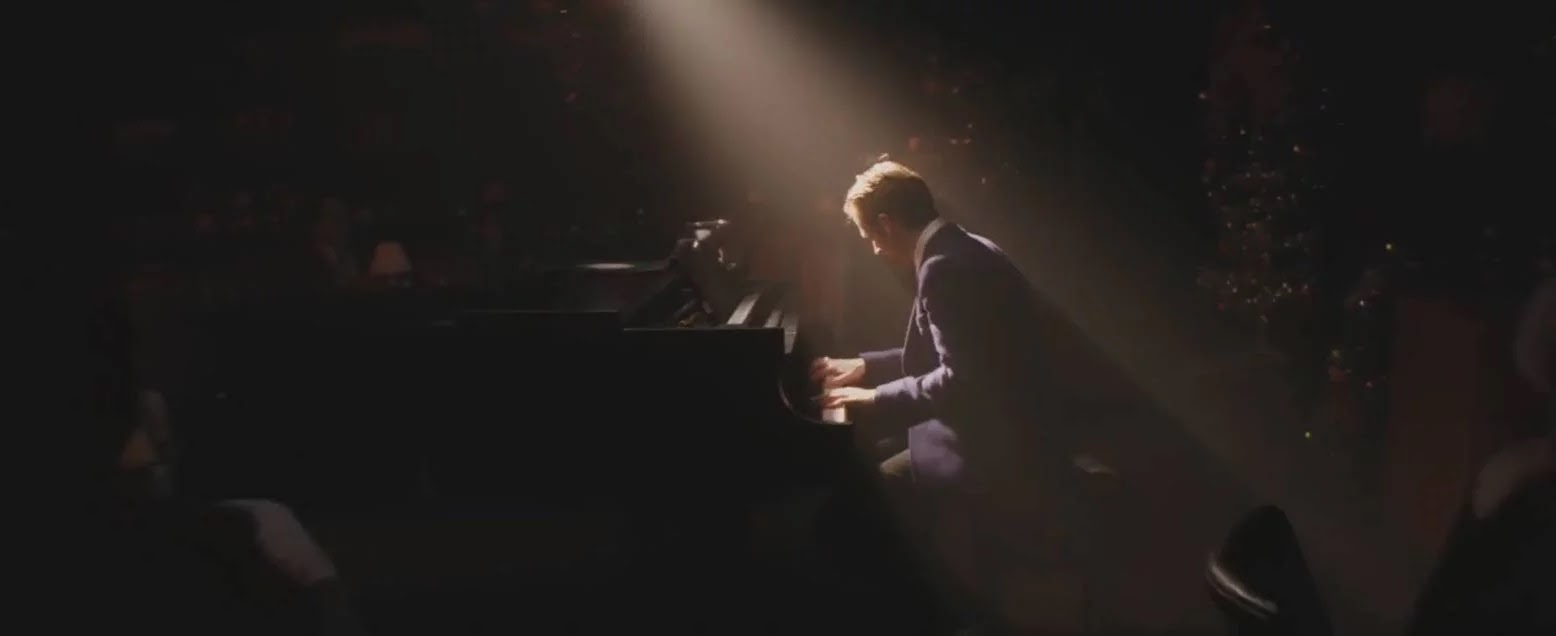
A very good music video director, but La La Land (and Whiplash) reveals him to be so much more. After that rousing opening, Chazelle segues seamlessly to the story at hand, where Sebastian (Ryan Gosling) and Mia (Emma Stone) are stuck in the same traffic jam, him right behind her, in an upside down version of "meeting cute:" they're both stuck in the traffic and she's a bit slower in her reactions than he is, and he peels off and past her, flipping her "the  bird" which she responds to in kind. He's a jazz musician-composer, with a taste for classic jazz—you can tell because he's busy in his car rewinding and listening to old cassettes, and one of his few prized furnishings is a cast-away stool Hoagy Carmichael threw away ("Really?" says his sister "What if Miles Davis pissed on it?"). Mia's an actress, but she's working as a barista at a coffee shop on the Warner Brothers lot as her "day-job." She encounters Sebastian again after a Hollywood party proves disastrous, when he's playing a Christmas gig at a bar where his obstinance over the play-set gets him fired. These two keep meeting at the wrong place at the wrong time. But, L.A. is a place where you keep running into people.
Another encounter—another industry party—throws them into each other's orbits again and this also does not go well, albeit with a little more depth than a throw-away "dick" move, and they actually have a conversation where they reveal that (really) their compatibility would only depend on their being the last people on Earth. But, it is a musical and it is a fantasy version of L.A., so they end up spending far more time together than they might wish. 
 
I feel a song coming on...

So, let's look at that. First off, the song is all dialog, operetta-style, or the way Astaire and Rogers did "A Fine Romance" in their movie Swing Time (with the sarcastic tone of that song), more akin to the dialog-songs of The Umbrellas of Cherbourg where every-day language just happened to have a rhythm and a background score. The singing is not full-throated emoting-to-the-wings artifice, but conversational and thin and...untrained. The dancing is a bit sloppy, but endearing despite that and seems to fit character and mood, even emulating body-language and the emotion it reveals. This is not Gene Kelly's athletic bounding enthusiasm version of "Gotta Dance!" It is far more casual and ambling (much like the music)—my impression was that Gosling could have done all his dancing with his hands in his pockets. Ultimately, you know that the two, while seemingly at odds, will get together because they are in sync in an unconscious and conscious way, which is the very core and underlying artistic message of dance, isn't it?
There is obvious chemistry between Stone and Gosling—this is, after all, their third movie together and that pairing yields good results in the films Crazy, Stupid Love and, less so, in Gangster Squad. Their enthusiastic un-professionalism in their songs in La La Land endears you to them. They are unrealistic people struggling with realism, dreamers unsatisfied with their waking lives and finding some comfort in each other, and continue striving for the dream. The dream's the thing in La La Land and down-to-Earth "things" like love, relationships and family just aren't good enough. Why settle for a simple life in a town that can manufacture fantasy? A city that only sleeps with dreams of its own making?
And the movie frames that dream by being extraordinarily cinematic in the telling of the story of their lives...by doing what movies do at their most basic level—by focusing our attention. It is choreographed and art-directed to a high-gloss perfection with a color palette right out of Vertigo (the shimmering soft greens and roseate reds of emotion), the slo-mo anticipation of hope that seems to manifest as snow in the air (in L.A.?), the light design that, right on cue, dims and highlights the intended object of importance, along with "old-time" silent-movie iris transitions anticipate where the director wants us to concentrate when he starts a scene. We are force-fed where the movie takes us and what the film-makers want us to see and feel. Movies are a carefully-plotted dance. 

And the director always leads.

1) The green glow of desire from La La Land (above) and Vertigo (below)
2) When hope flourishes, snow flurries...
3) When Mia goes to the old Rialto Theater to meet Sebastian for a showing of Rebel Without a Cause...
for some reason, she enters from the front!

(and they're showing the film's preview before the film)

4) A meeting at the Hayden Planetarium (also from Rebel...) turns into a
zero-g dance among the stars.
The movie lopes along on the base-line of its music (composed by Justin Hurwitz, who also worked on Whiplash), which varies from East Coast versions of salsa, Broadway, and one, "City of Stars," feels like it could have been written by Ennio Morricone, late of the Sergio Leone spaghetti westerns. It is energized by the dance sequences, which while not as precise as Kelly or Astaire and Rogers, still have a joy and verve to them, whatever style people fall into...and it does feel like they're falling into them.
I am no fan of musicals. Not that I have a problem with the form, but in the way they are presented, most of the time. Musicals have an imposed artificiality to them—but then, so do stage-plays and movies. They're at their best when the illusion is convincing and the music interludes are organic and not imposed because, well, the production needs a song right about here and the foot-tapping will wake people up. But, this movie's story plants everyone in L.A. with the idea that it's a fantasy-factory, despite the evidence of hard work and tough luck. Out of that springs a love story, but there are rivals for affection—that being a sustainable career that answers the needs of their inner creativity and passion. With such drive, it makes relationships vulnerable and, frankly, unsustainable (ever wonder why there's so much divorce in show business, aside from the constant rejection, gypsy-like existence, and moth-like attention to bright objects?). I like that. It sets things apart from the convolutions of the "happily-ever-after-at-all-costs" sappiness of the golden-age musicals that were so sugary they set my teeth on edge. No, this has the mature sensibilities of the "Umbrellas of Cherbourg" European school, with a distinctly American swing. And I like that La La Land doesn't end with "they-lived-happily-ever-after," but with living with the satisfaction of the experience, and with memory the catalyst to inspire.

I can live with that, happily ever after.
After its initial splash, and after its many winnings of Golden Globe Awards from the Hollywood Foreign Press, La La Land has received a bit of a back-lash—it's a trifle, a bon-bon, a light-weight film in a year of so many more "important" movies. Maybe. I don't find it trifling, though. After a dispiriting year of reality as well as a dispiriting movie-year, La La Land managed to cheer me without being too saccharine about it (I'm always suspicious of that in movies). There's a profound sense of regret to it that is...well, profound. And it's stuck with me after seeing a slew of "important" movies that left me depressed and disappointed.
La La Land does not depress or disappoint. It thrills. It amazes. It reminds one of why one goes to the movies and the rich legacy of movies in general from which it has culled for its inspiration. And that's not a waste, whatever the outcome. It is time well spent.


Yeah, it's fun. But, there's so much hard work to make it look so free-wheelin' easy.