Showing posts with label Jason Reitman. Show all posts

Thursday, October 24, 2024

Saturday Night

"I Didn't Tape the Dress Rehearsal"

 or
"Who Are You in the Metaphor?"
 
I like director Jason Reitman's work, whether he's swinging for the fences (Thank You for Smoking, Up in the Air) or playing it safe (Ghostbusters: Afterlife, Juno, Young Adult). I'm sure with every single one of his projects he did not believe he was "playing it safe." All of his films, I'm sure, had challenges that I'd never be privy to, that affected his decisions to make the film, or how he made them. 
 
Maybe it's because these projects all hover around the same theme, "Lies we tell ourselves," which seems to show up in all of his work, where we're never sure if anybody's telling the truth because it's our instinct to believe the lie. That's quite a sophisticated thesis and sometimes the movie doesn't warrant the effort and sometimes it does, but it's a very American trait, and given his willingness to go back to it again and again, I don't think Reitman could ever make a movie not set in the United States. We seem to have that weakness, whether it be hope or hubris or merely sleeping through the sedative of "The American Dream".
It's hard to say where Lorne Michaels (played, again brilliantly, by
Gabriel LaBelle of The Fabelmans) falls in those options. I'd wager on "hubris" these days, but back in the days when "Saturday Night" (the first title of what would become "Saturday Night Live"*), who knows what it might have been. Lorne Michaels was Canadian, for one thing, but he'd had a lot of success in the States as a writer and when NBC was in one of their little tiffs with "Tonight Show" host Johnny Carson, they decided they wanted to prove to their late night star that they didn't need him and that they didn't have to fill an empty Saturday late-night slot with another re-run of one of his past shows. NBC Late-night "suit" Dick Ebersol (played by Cooper Hoffman) was charged with filling the time.
The idea was a "live" sketch comedy show with prominent musical acts who didn't show up on the likes of "The Dean Martin Show" and more in spirit with "The Smothers Brothers Comedy Hour" (which had been canceled after many problems with the network over material deemed too controversial), but without regular hosts—initially the idea was to have rotating hosts of Lily Tomlin (Michaels had produced one of her specials), Richard Pryor and George Carlin, but Pryor made NBC nervous—and, with that spirit, aimed for a younger audience demographic and a hipper crowd than NBC was used to garnering. Michaels wanted to make a show that parodied television for an age-group that grew up watching television (and now, ironically, is making a version that for kids who grew up watching "Saturday Night Live"!)
Having read the oral history "Live from New York: The Complete Uncensored History of Saturday Night Live as Told by Its Stars, Writers, and Guests" (by James Andrew Miller and Tom Shales), and I know a lot of the stories culled for Reitman's Saturday Night, some of which happened, some of which only happened later during the chaotic first season, and some of which didn't happen at all—the bit with Milton Berle (J.K. Simmons) dressing down Chevy Chase (Cory Michael Smith) didn't happen (although Berle did show off the size of his penis to SNL writer Alan Zweibel...at Zweibel's curious request). Yes, a lot of it is true (and Reitman goes into the whole Johnny Carson dilemma with the moment it's decided to go "live" with the show or roll the Carson tape being the dramatic high-point), but some of it is left out...like character actor George Coe's short tenure as a "Not Ready for Prime-Time Player" and an awful lot of short shrift is given the writers. But if you put all of it in, it would have been epic-length—not unlike Michaels' 3 hour dress rehearsal that has to be cut down to an hour and a half.
Even with the deletions, Reitman has to move his movie fast and it hurdles along in long tracking shots until it finds a conversation of interest or an arresting image—frequently involving a llama—then swings his camera between each side of the discussion before veering off with a passer-by who'll act as tour-guide to the next section, as sub-plots whirl in the background. It's not done in one continuous shot—something this complex would make Alfonso Cuaron's head, or
Alejandro González Iñárritu's continuity director, explode—but one gets the simulation of continuous unbroken action for a good part of the film and it ramps up the tension, if the myriad disasters falling around Michaels' head—be they flaming scripts or newly-installed studio lights or a Belushi-hurled ash-tray—weren't enough. 
Of course, it's tough to give this stuff any verisimilitude without threatening to turn it into caricature—Labelle assiduously avoids the Michaels-based "Dr. Evil" voice, for example**—but one wonders if the audience cares, since they know Chevy Chase from endlessly repeating "National Lampoon" movies or his "older" roles and probably don't know any of the writers at all. Some of the passing references to other "Saturday Night" bits might go over their heads. And one, rather sheepishly, admits that the movie will probably play with "the older crowd" beyond the show's originally intended demographic so that it becomes an episode of nostalgia. Yikes.
I remember "Saturday Night", initially, because it aired in rotation with NBC "Weekend", a brilliantly written news program with Lloyd Dobyns and Linda Ellerbee, that was a favorite of mine and I was always fairly irked when it wasn't on and "Saturday Night" was. It grew on me, however, when Paul Simon and then Richard Pryor hosted (in one of the best overall episodes of the show's first season). And although I think the past couple of seasons have been pretty strong, one can't help but be chagrined that the show is 50 years old and that it's audience is about the same as our folks' when they were watching "Dean Martin."
It would have been the ultimate irony if Reitman had ended the film with an acknowledgment of that fact. One would doubt it would get the approval of Michaels and his production company Broadway Video who had little to do with this movie other than to say "well, we won't say you can't can't do it" (and the "disclaimer" about "work of fiction" and "persons, living or dead" is a briar-patch of timorous legalese). Even self-described "revolutionaries" get old and stale after awhile...just as sure as "Generalissimo Francisco Franco is still dead".
The very first sketch on "Saturday Night":
Head-writer Michael O'Donahugh, John Belushi and Chevy Chase
* The reason they didn't use the the "SNL" title initially was because competing network ABC already had a variety show called "Saturday Night Live"...hosted by...Howard Cosell?
 
** And kudos must go to Nicholas Braun, who plays both Andy Kaufman AND Jim Henson.
 
Competing posters of Saturday Night
which, more, in spirit, tells of the difficulties they had.

Thursday, August 3, 2023

Suspensions of Disbelief —"Like, yeah-Huh!"

On my earlier film blog, I would sometimes pair up movies I'd seen recently if they had some slight connection. This is one of those. 

Juno became a smash hit, despite my reservations and Diablo Cody—and Jason Reitman—went on to do some stellar work. Both are working on things. Ellen Page is now Elliott Page, and is now identifying as a male. One thing that hasn't changed is his amazing talent. I don't change things when I move these posts from the old blog to the new blog, unless I find mistakes, so I've kept Elliott's name as it was at the time of the writing, which was at the time of the film's release. 

Director Craig Gillespie, who made Lars and the Real Girl, made I, Tonya, Cruella, and the min-series "Pam and Tommy", as well as directing Diablo Cody's mini-series "The United States of Tara."
 
--Sacred Vessels in the Land of Addictionary.org

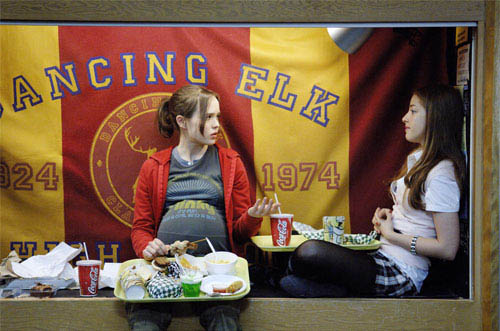
Juno is a film so dominated by its script (by Diablo Cody*) and its actors (they're all television veterans with countless man-hours before the camera) that all director Jason Reitman has to do is get out of the way-though in the transitions he routinely cuts on the 1's of the pervasively twee-rock soundtrack to maintain the air of perkiness. The kids that dominate this film about lower-middle-class families making the most of a bad situation—well, bad in the timing—are so pervasively cute and clever in their articulation and word-play that one wonders if they hail from some part of the country where the main sport is Scrabble, and instead of MySpace they all hover around "Addictionary.org." 
Ultimately one has to ascribe to it the same rule that one applies to Bette Davis movies where everyone always has the perfect come-back: "They have better writers than we do."
But the same troubles. Juno MacGuff (Ellen Page) starts the movie pregnant and pissed. And pissing. She's buying the home-pregnancy tests out of the box one at a time from the convenience store and using their facilities to test it. "You better pay for that pee-stick when you're done with it," says the clerk (played by "The Office's Rainn Wilson). "Don't think it's yours just because you marked it with your urine!" She gets the unholy pink "x" and starts to puzzle out how to proceed: telling parents, telling sperm-donor, what to do with said spawn, yadda yadda yadda.
Juno skips along dealing with all these crises and quite a few more, and never slides into bathos, preaching or "after-school special" earnestness. The characters are all people for whom regrets are a waste-of-time, and are too busy doing their best to do too much navel-gazing. Well, almost all. One walks away charmed, and admiring the cleverness and the near-occasion of bravery the movie displays. And there are no bad performances. Anywhere. No actor lets this material touch the ground, whether its the stunningly decent work by vet-thesps like Alison Janney and J.K. Simmons, but also wise work by Michael Cera, Jason Bateman, and, yes, Jennifer Garner. But the big bouquet goes to Ellen Page who carries the movie on her slim shoulders and always finds a way to make the dialog sound like she's just saying it off the cuff. That's a tough trick to pull for an entire movie--an entire comic movie--this entire comic movie. Frankly, it would've been easier giving birth.
------------------------------------------------------------------ 
It Takes a Sex Toy to Raise a Village
 
 
 Everybody likes Lars (Ryan Gosling). Lars is 27, lives in the carriage-house of the family home. Keeps to himself. He goes to work, eats, attends church, chops wood.

And that's about it.

Lars is socially retarded to an alarming degree, so much so that he feels it hurts to be touched. His family worries about him. They feel guilty. They don't know what to do.

But Lars does. He's surrounded by people with relationships, so he decides to get one. But that touching thing...that's a problem.

Then one day, Bianca shows up, a mail-order girlfriend. Lars tells his brother and sister-in-law that he has a girl-friend and he'll bring her over for dinner. They're elated. Then they find they didn't need the extra setting. Bianca's a sex-doll. Fairly realistic looking, but she doesn't move. At all. Lars has to carry her, until he gets her a wheelchair. He cuts her food for her. Eats it, too.
In a case of intervention, all four go to the doctor (Patricia Clarkson, being warm but acting cold), who takes one look at Bianca and worries out loud that she needs weekly treatments for her alarmingly low blood pressure, and uses the opportunity to find out exactly what is going on with Lars. She advises that they should play along--"Bianca's in town for a reason," she says. "But, people will laugh at him!" says his harried brother, played by a note-perfect Paul Schneider. "You, too," says the doc.
Lars and the Real Girl
could be perverse, and if Lars actually had relations with Bianca, people wouldn't be enjoying this movie nearly so much. Nor would it be as enjoyable if the entire town didn't, for the sake of Lars, go along with the story and accept Bianca. And that acceptance happens almost immediately. Sister-in-law Karin informs her coffee klatsch friends that Bianca is anatomically correct, and one of them says, "Soooo...she's just one of the girls, then..." The pastor of the church goes along with it. Everybody does. Ev-e-ry-bo-dy. Which set off some reality alarms for me. There aren't any disaffected youth, or jerks or morons in this town? Hell, if any of the kids from Juno lived there, Lars would be getting the "stink-eye," at least. And in a land where every inflatable Christmas lawn ornament is at risk, Bianca has it REALLY easy.
Still, it's an enjoyable film, full of heart in the right place, and offers lots of enjoyable surprises in screenplay, performance (it's hard to believe this is the same
Ryan Gosling from Fracture) and overall tone. One wishes there was a second there where one could believe in it.
---------------------------------------------------------------------------------

* Diablo Cody has such a fresh, smart way with dialog that one hasn't been as excited by a screen author's work since Zach Helm, who wrote Stranger Than Fiction. Since Helm went on to create the lead balloon Mr. Magorium's Wonder Emporium, one doesn't want to be too effusive in one's praise, lest one set oneself up for disappointment.

Saturday, December 11, 2021

Ghostbusters: Afterlife

Ghostbuster Babies Wake The Dead
or
Who You Gonna Call? Ghost-WRITERS!

One walks into a movie with such hope. 
 
Take Ghostbusters: Afterlife (please). The director and co-writer is Jason Reitman, son of the original's director (the real-life sequel if you will). But, Jason has made some terrific movies in his own right—Thank You for Smoking, Juno, Up in the Air, Young Adult, Tully—that eclipsed the quality of his father's work and heralded an original and mature director whose film-making instincts would, at least, be interesting and, more often than not, thought-provoking and challenging.
 
What one does not expect is a work of desperation, of a studio in need of a tent-pole of a franchise, even one that has suffered in the past (except for the first one) from its own haphazardness and money grubbing, and of a director in need of a hit who doesn't want to wade in the world of mass-market spandex and not fall too far from the money-tree. I'm sure the Sony execs were crowing that they had the best of both worlds—a younger director with a track record who was close enough to the material (and its initial legacy) that he wouldn't try to re-invent their hit (as had been tried...with disastrous box-office results).
 
Is there life in Ghosbusters? Or after-life? Stay tuned.

Callie Spengler (Carrie Coon), divorced mother of two—that would be Trevor (Finn Wolfhard) and Phoebe (Mckenna Grace)—has just been evicted from her place and she and the kids pack up everything and move for the Summer to—Summerville, Oklahoma—as her only assets are the tumble-down dirt farm, where her father, Dr. Egon Spengler—former Ghostbuster—moved and ultimately died (under mysterious circumstances). Callie has nothing but vitriol for her father—science skipping a generation—for abandoning her and her family for something having to do with his work. The house itself is a disaster, with books stacked high ("symmetrical book-stacking..." Humans DO do that, evidently), and a secret laboratory in the basement (accessible by fire-pole), and an abandoned Ecto-1 in the back-broken barn.
While Trevor tries to make friends working at the local burger drive-in, Phoebe, the science-nerd takes Summer science classes from Mr. Grooberson (Paul Rudd), who plugs a horror movie into the VHS (funding...) while he investigates the strange seismological activity happening in Oklahoma. Fracking? "Fracking annoying!" responds Callie. The humor here is mostly visual, although verbal attempts are constant, usually consisting of some sort of cynical comment that hurts.*
Eventually, everyone becomes aware that Granddad was a Ghostbuster, and shows up at the house by inhabiting inanimate objects and moving them around—chess pieces, lights, desk-drawers. Trevor gets Ecto-1 going again, despite its age and rust and oxidating gas supply. And Phoebe wins this year's "Mary Sue" award for figuring out how Egon's "unlicensed nuclear accelerator" proton pack works without any sort of guidance. "Why worry?"
Why, indeed? She catches her first ghost on her first pursuit and traps it. It results in some substantial property damage around town and she, Trevor, and their buddy "Podcast" (because...he...does a...ah, forget it) wind up in jail, with their equipment confiscated and Mom being really pissed at them for interrupting her date with Mr. Grooberson.
Eventually, it's determined that Summerville is the epicenter for another emergence of Gozer the Gozarian (who'll appear as Olivia Wilde in an uncredited cameo) as Ivo Shandor (J. K. Simmons), the designer of the building that was ground zero for "The Great Manhattan Crossrip of '84") built the town just for that purpose. Mom Callie and Mr. Grooberson become the gate-keeper and key-master for the return.
Basically, the movie is "Goonies Meets Ghosbusters" while using the same strategy as The Force Awakens by bringing back most of the elements of the original (including SPOILER ALERT: the remaining Ghostbusters) in another locale and pulling a Carrie Fisher by having the late Harold Ramis appear as the spirit of Egon, complete with Obi-Wan Kenobi blue-shimmer. The devil-dogs appear, and so do possessed Stay-Puft marshmallow men. Everybody but Rick Moranis. But, it's the same story filled to busting with call-backs, heavily encrusted with nostalgia.
The kids are alright, though. Wolfhard is a good presence, and Mckenna Grace is a highlight as young Phoebe, using the same straight-faced strategy as "Young Sheldon"'s Iain Armitage, that somehow enhances the amusement factor as when told that as key-master and gate-keeper, her Mom and Mr. Grooberson have probably "done it": "
No, I just don't show my emotions like everyone else, on the inside I'm vomiting." It's not the line; it's the delivery—the singer, not the song.
One goes into these things with such hope. But, movies in a franchise need to grow not just regurgitate and please the fan-base or the investors. It's funny. They could really do some interesting things with the concept of an after-life** besides resurrecting "force-ghosts." But, "Ghostbusters" has always been a bit shallow in its intentions and this version does not intend to dig any deeper. But, then, it's not so much a movie, as it's a wake. For Ramis. And for the franchise.
 
* Phoebe wishes her Mother good night with : "Have a good night! Don't be yourself." Paul Rudd has a good line: "History is safe. Geometry is safe. Science is a safety-pin through the nipple of academia!"
 
** I had a friend who professed to be a psychic, and the most believable thing about it was he was so casual talking about it. A casual mention of ghosts and he blurted "Ah, ghosts are ASS-holes, man..."

Wednesday, November 28, 2018

The Front Runner

Everybody Knows
or
Hart the Herald Scriveners Zing

Every review of a movie is an opinion-piece, by its very nature. 

This one, however, is of, for, and by...opinion and is, as such, suffused with it. Like politicians, one shouldn't put too much trust in it. Proceed with caution. 

One wonders what would be the reason to make and release The Front Runner at this time other than as an exercise in nostalgia. Jason Reitman (second film released in a year—the first was Tully) has made a film based on the 1987 scandal that ruined the campaign of Senator Gary Hart, while he was running for president. Said scandal involved the Senator being linked with a woman not his wife, a practice that had been overlooked in the past, but, at that time, was not only not overlooked but blared in the nation's headlines. 

One could almost call the scandal quaint in this day and age, when the current President pays off porn-stars, admits it, then denies it, then probably brags about it when the microphones are off (are they?) then denies that he said it even when the tapes show up (Really, now, does this seem sane to you?). But, it isn't quaint. It's the age-old story of abuse of power and betrayal of trust. In this day and age, it has a hash-tag followed by "MeToo."
But, that year, many factors were in play. The Watergate scandal of the early 70's had put the public on alert to the duplicity of it's leaders, while the press, most of whom took no lead in the uncovering of the Watergate break-in and resulting White House cover-up were on high alert to any wrong-doing—that is, any wrong-doing that didn't hurt their access or financial stability. It had long been a standard practice among reporters to look away at the suspected infidelities of Presidents—certainly with FDR, Kennedy and Johnson. It was an "understanding" that such things were to be kept out of the press. After all, "the press" were equally capable of transgressing, such as Washington Post reporter and Watergate investigator Carl Bernstein's cheating on his wife Nora Ephron. What was good for the goose was not necessarily good for the gander who was trying to dig up dirt on the goose. 
Gary Hart was another matter. He was a senator who'd made a run for Democratic nominee for President in 1984 and lost to Walter Mondale. In 1987, after Mondale lost to Ronald Reagan, he was considered "the front-runner" for the nomination in the next year's presidential race, and it was assumed he'd get the nomination. Then, the events on board the private yacht "Monkey Business" happened. 
Now, what happened is a bit vague—and not a little, a lot. To this day, nobody can say for certain what happened. Hart was invited aboard the yacht, ostensibly to work on an economics speech, by a lobbyist loyal to the Democratic Party. Afterwards, Hart (played in the film by Hugh Jackman without an awful lot of the Kennedy-esque charisma that Hart radiated) went back to the nation's capitol. Reporters from the Miami Herald were tipped off that "a friend"* of the caller was having an affair with Hart (even the identity of "the tipper" and what that particular person knew when they knew it has some holes in the details) and was travelling from Miami to Washington for a tryst, and plans were made by reporters to follow the woman "who looks like a model" on the flight. There are rumors that Hart is a "womanizer" and the tip seems like a good bet, to the point where, when they lose track of her, they immediately go to Hart's D.C. townhouse, so they can stake the place out, take some pictures.
That is until Hart notices the car outside his house, and leads them unwittingly to a back-alley confrontation behind his town-house. To the reporters, they've got him dead to rights, despite not noticing that someone could—could—leave the place unnoticed from the street. Hart's attitude is that they have no right to cover it, or question him about it. These aren't things he has to answer. 
It is an attitude he will stay with throughout the three weeks it takes for him to decide to call off the campaign, and it is something that the reporters and his own campaign staff (including J.K. Simmons and Molly Ephraim) have a hard time grasping, as the attitude he adapts seems irrelevant to the crisis—it's happening and it needs to be addressed with something better than the candidate's standard "I don't have to answer that!"

Everybody knows that you love me baby
Everybody knows that you really do
Everybody knows that you've been faithful
Ah, give or take a night or two
Everybody knows you've been discreet
But there were so many people you just had to meet
Without your clothes
And everybody knows
See what I did there? I merged from fact to movie plot, without skipping a beat. That's because Reitman and his team essentially tell the story as it has been laid out in the public record, without any speculation, without any editorializing—other than to put words in people's mouths in those instances when notes weren't being taken, and in scenes—especially between movie-Hart and wife Lee (played superbly by Vera Farmiga)—where issues brought up by audience questions can be handled by "writing to silence" (as nobody seems to want to protest the veracity). But, Hart's actions appeared to be those of a guilty man and that is what Reitman—and we—have to go by.
It is entirely plausible. Because the issue is about power and its abuse—just as it can happen in politics and in statecraft—so it happens when somebody entitled thinks they can take advantage and get away with it. The issue crosses all party-lines and is more evident now than it was "way back when" this story came out. It's a matter of class structure and the assuming of privilege "because they can." And it doesn't seem to matter how sanctimonious the perpetrators are, they see it as a right and an opportunity. Maybe even a divine right. That much can be known, because we see it every day. Even at the highest levels, there are low human beings.
Recently—too recently to have been made a part of this movie—there have been allegations that the circumstances were a "set-up" by a very prominent Republican operative with a history of such things. How much that can be believed can be argued about (and the reporters who covered the story have been extraordinarily quick to defend "their" records saying it wasn't possible because they weren't privy to it. What one cannot argue with is if it was a set-up, it was a good one, and worked very well to achieve the ends that were sought. You don't have to read too many spy-stories to know how effective honey-traps can be. But, it's just another aspect to a story about the inevitability of a weakness of character.
I found the whole thing a dissatisfying enterprise. The Front Runner provides facts, but no answers. It doesn't delve into all the facts, just the encapsulated time-line of what went down in those three weeks, regurgitating publicly available records supported by those with their own axes to grind and their own records to defend. One wonders, however, if it is the truth, the whole truth, and nothing but the truth.

Or merely what everybody knows.


And everybody knows that the Plague is coming
Everybody knows that it's moving fast
Everybody knows that the naked man and woman
Are just a shining artifact of the past
Everybody knows the scene is dead
But there's gonna be a meter on your bed
That will disclose
What everybody knows


* The movie ends with a line that says the Hart's are still together. Well, that's nice to know. They should have included what happened to "the other woman" Donna Rice, as well. She went back to her Christian roots, where she does advocacy work...and is an ardent Trump supporter. Donna, Donna, Donna. "Fool me once, shame on you; Fool me twice..."

Wednesday, August 8, 2018

Up in the Air

The Economy and how it grinds up people has been on my mind of late. Here are some movies I've written about in that subject matter. 

Written at the time of the film's release.

"Passing Over"

Down in the lower right hand corner of this review (and every review on BXC) there's a space for meta-data to help readers find similar personnel, year of release, director, major stars—basically general stuff.

But I also like to put the genre of where the film would fit, say, at the video store—nothing too specific.
Jason Reitman's new film Up in the Air is the first one to have me stumped. I lean towards "drama," but it's too clever and funny to meet that description. It's not a "comedy" as it deals with pain and contemporary issues that most comedies (most modern comedies, at least) steer clear of—although it's tempting to say that it's a "Judd Apatow comedy" for adults, taking on his basic "growing up" arc, but with a more mature, melancholy overtone. Yet it made me laugh out loud fairly regularly. And it made me think of what a sorry mess we're in.

Ryan Bingham (George Clooney) is a corporate hit-man for hire. His company (run by a tight-smiled cut-throat Jason Bateman) provides a termination service for struggling companies. Bingham flies to the home-offices and fires the people the weasley exec's are too cowardly to break the news to face-to-face. And business is booming.

"This is the biggest financial melt-down in our nation's history" crows Bateman's CEO. "This is our moment." And to make the most of it, he's hired a new 23 year old tyro named Natalie Keener
(
Anna Kendrick, who gets perpetually lost in the lunch-room in the "Twilight" movies*), who hopes to streamline the down-sizing process by doing it over the internet, rather than in person.
This throws the well-managed world of Bingham into a tizzy. No more frequent flier miles which he collects like office-absconded paper-clips. No more stipends and luxury cars for hire, and platinum service lounges. He'll be flying coach rather than first-class. Worse than that, he'll be stuck in a cubicle going nowhere, considerably worse than coach.
Not only will he have to get his own drinks, he may have to get a life. Bingham is in a groove, as personal and as transitory as the swipe of a card-reader. He is constantly between Point A and Point B and prides himself on finding the most efficient route. His life is reduced to a minimum of baggage—carry-on's with wheels that don't squeak, a packing ritual as choreographed as a Fosse number down to the split-second, and little contact with family. He knows the airport routine cold. And as a sideline, he gives lectures on travelling efficiently in the air and in life. "Our attachments weigh us down," he intones to his conference rooms of drones. "The slower we move, the faster we die. Make no mistake, moving is living. We are not monogamous swans. We are sharks."
Clooney's in full smug mode—a variation of his divorce attorney Miles Massey from Intolerable Cruelty played straight—he practically marches to the beat of "Come Fly With Me" and his smile is as practiced and measured as his patter...with everyone, business associates and family. His character has a part to play and when the show's over, it's "me" time, like the "James Bond" fantasy of living the high life while doing dirty jobs. Everything is first-class and preferred customer, his one goal being a targeted accumulation of miles over a life-time—his own personal best. He has an apartment, but he's never in it and it has the same empty utilitarian ambiance of a Ramada Suite. He's the personification of "fly-by-night" in slip-off shoes.

So are his relationships, such as they are. At the same time that he is forced to show Natalie "the ropes" of the "down-sizing" business, he's established a "ships that pass in the night" fling with fellow traveller Alex Goran (Vera Farmiga, finally getting a role that has more heft than "girlfriend"). Natalie, who probably has a Power-Point presentation for how her life is going to go ("I should be driving an Explorer by 23"), is horrified at the casualness of it all. She's just out of the starting blocks and doesn't know the pit-falls of the track ahead, with all the confidence and brashness of someone who doesn't know what she doesn't know, and how theory reacts when it collides with reality. It's a crash-course in transitioning, on the job and in real life, and the two veterans try to bring the kid down easy—at least to get her to remember to lock her wheels.
There'll I'll leave it, for to tell too much will ruin it. But I admire any movie that acknowledges the mature adult, that attempts to show that a life is segmented, complicated and compromised, where dreams could come true, but mostly don't, where decency is its own reward and the idea of "soul-mates" is a lot of hooey. A lot of hooey to sell soap.

And movies.

Jason Reitman grew up in movies—his father is Ivan Reitman—and with his first three films (the others being Thank You for Smoking and Juno) he has shown himself all too willing to throw sabo's into the gears of the Hollywood Dream Factory,** making contemporary movies of stylish form about tough choices and compromised principles in today's America, while still keeping them highly entertaining and unpretentious. One hopes he can sustain that promise and not flirt with issues of the elite, as so many of his peers have in the past, and buy into the fairy tale myth of mainstream Hollywood.

One hopes he can keep his feet on the ground.

* Kendrick is great, no doubt about it, but one hears a whine of feed-back in the false amplification of her performance. It is nuanced and studied, alright, and just a tinge robotic. The joy in the performance is watching the gears seize, the plugs mis-fire, and the LED's in her eyes dim. It's like watching a puppet turn into a real live girl. But she doesn't blow the other stars away, or "steal the movie." There's just a whiff of Dream Factory hype in this talk. As long as it stays in the publicity and stays off the screen, I'm all for it.

** If you do want an unequivocal happy ending and an example of dreams coming true, stay to the end of the movie. Reitman is a very generous man. And the song manages to perfectly distill the movie.